

Обновитесь для доступа ко всему словарю
Получите неограниченный доступ ко всем словам с подпиской Pro
Обновить до ProПеревод
Прошедшее
Причастие прошедшего времени
Третье лицо единственного числа
Герундий
Значение
Пример предложения
Перевод примера предложения
Синонимы
Антонимы
Коллокации
Мнемоника

Swipe left or right, or use the buttons. Tap image to zoom.
Обновитесь для доступа ко всем предложениям
Получите неограниченный доступ ко всем предложениям с подпиской Pro
Обновить до ProПеревод примера предложения
Слово
Lesson 247Lesson 247 - Переключатель маски
|
Эмодзи
|
Слово | Images | Перевод | Прошедшее | Причастие прошедшего времени | Третье лицо единственного числа | Герундий | Значение | Пример предложения | Перевод примера предложения | Пример выражения | Значение примера выражения | Перевод примера выражения | Синонимы | Антонимы | Коллокации | Мнемоника |
|---|---|---|---|---|---|---|---|---|---|---|---|---|---|---|---|---|---|
|
#7380
🔁
|
/rɪˈkɜːr/
verb
••••••
|
- •••••• | - •••••• |
recurred
••••••
|
recurred
••••••
|
recurs
••••••
|
recurring
••••••
|
to happen again, especially repeatedly or at regular intervals
••••••
|
The headache tends to recur every few weeks. |
- •••••• |
history repeats itself |
events tend to recur in a similar way over time
••••••
|
- •••••• |
repeat, return, reappear, happen again, reemerge
••••••
|
cease, stop, end
••••••
|
recur frequently, symptoms recur, problem recurs, pain recurs
••••••
|
No •••••• |
|
#7381
🗑️
|
/rɪˈdʌndənt/
adjective
(ridántant)
••••••
|
|
избыточный
izbytochnyy
••••••
|
- •••••• | - •••••• | - •••••• | - •••••• |
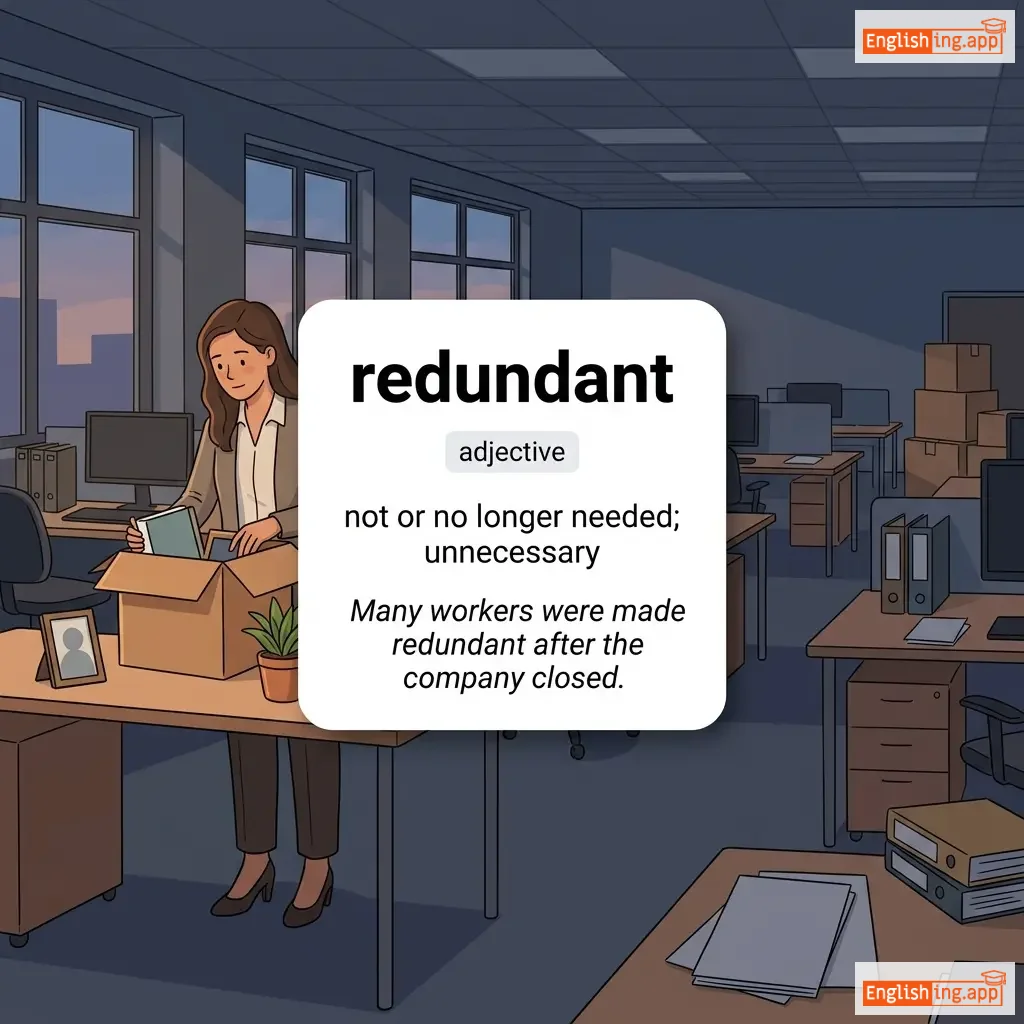
not or no longer needed; unnecessary
••••••
|
Many workers were made redundant after the company closed. |
Многие работники стали избыточными после закрытия компании.
Mnogie rabotniki stali izbytochnymi posle zakrytiya kompanii.
••••••
|
made redundant |
dismissed from a job because the role is no longer necessary
••••••
|
быть уволенным
byt' uvolennym
••••••
|
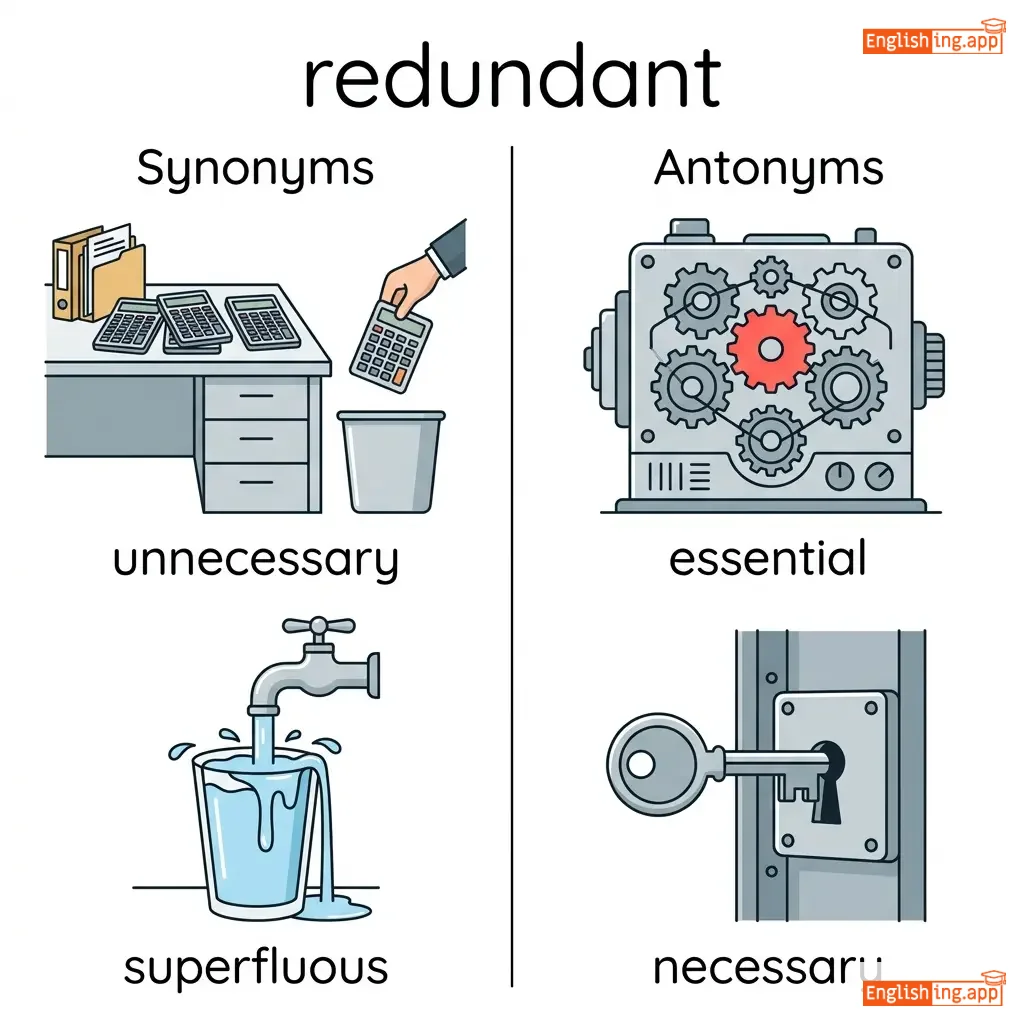
unnecessary, superfluous, excessive, surplus
••••••
|
essential, necessary, needed
••••••
|
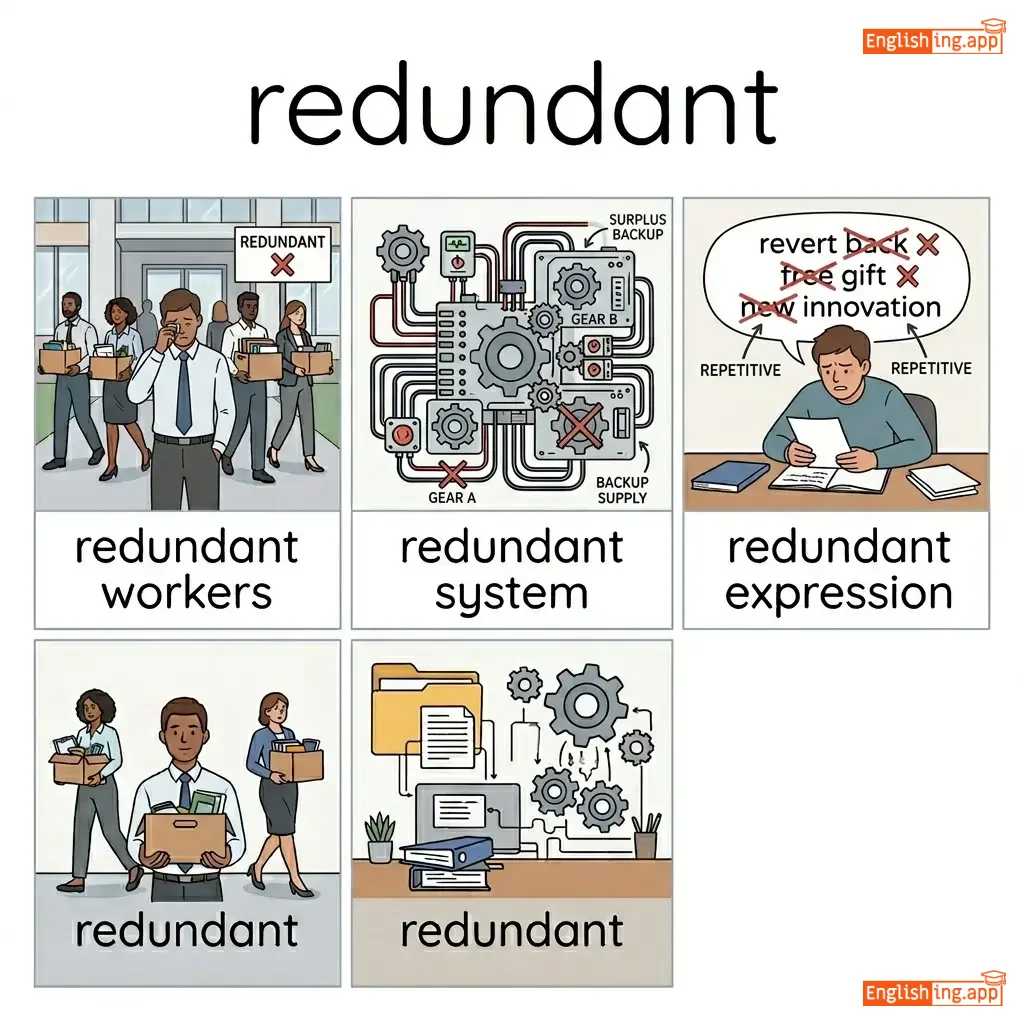
redundant workers, redundant system, redundant expression
••••••
|
Redundant = переделанный = избыточный
••••••
|
|
#7382
♻️
|
/rɪˈdʌndəns/
noun
(риданданс)
••••••
|
- •••••• |
избыточность
izbytochnost
••••••
|
- •••••• | - •••••• | - •••••• | - •••••• |
the state of being unnecessary or more than needed
••••••
|
The report contained too much redu ndance and repetition. |
В отчете было слишком много избыточности и повторений.
V otchete bylo slishkom mnogo izbytochnosti i povtoreniy.
••••••
|
- •••••• | - •••••• | - •••••• |
excess, superfluity, surplus, repetition
••••••
|
necessity, essential, need
••••••
|
unnecessary redundance, redu ndance in writing, speech redundance
••••••
|
Избыточность = когда слишком много повторений.
••••••
|
|
#7383
📉
|
/rɪˈdjuːsəbl̩/
adjective
••••••
|
- •••••• | - •••••• | - •••••• | - •••••• | - •••••• | - •••••• |
capable of being simplified, lessened, or made smaller
••••••
|
The problem is complex but reducible to a few basic principles. |
- •••••• | - •••••• | - •••••• | - •••••• |
simplifiable, manageable, compressible, resolvable
••••••
|
irreducible, unsolvable, unmanageable
••••••
|
reducible problem, reducible fraction, reducible equation
••••••
|
No •••••• |
|
#7384
➖
|
/rɪˈdjuːs/
verb
(редуцировать)
••••••
|
|
уменьшать
umenshat
••••••
|
reduced
редуцировал
••••••
|
reduced
редуцировал
••••••
|
reduces
редуцирует
••••••
|
reducing
редуцируя
••••••
|
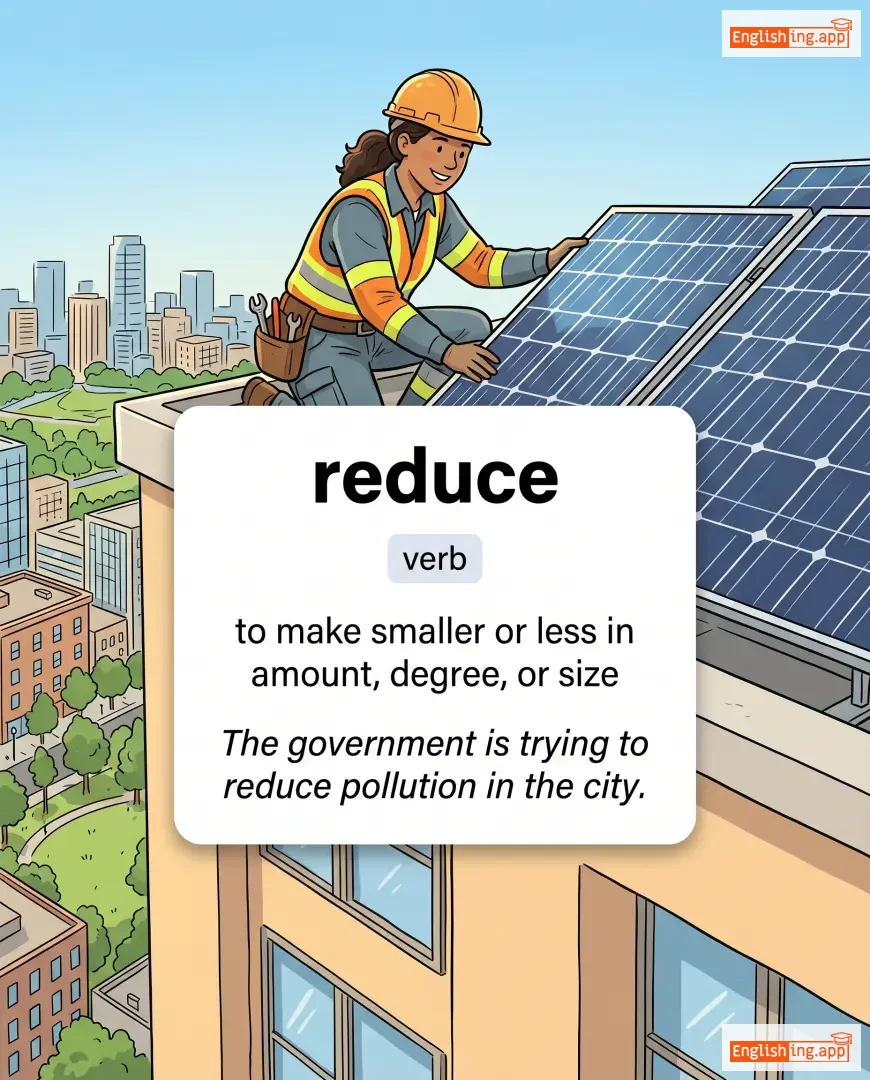
to make smaller or less in amount, degree, or size
••••••
|
The government is trying to reduce pollution in the city.
Правительство пытается уменьшить загрязнение в городе.
••••••
|
Правительство пытается уменьшить загрязнение в городе.
Pravitel'stvo pytayetsya umenshit' zagryazneniye v gorode.
••••••
|
reduce to tears
редуцировать до слез
••••••
|
to make someone cry
••••••
|
сделать кого-то плачущим
sdelat' kogo-to plachushchim
••••••
|
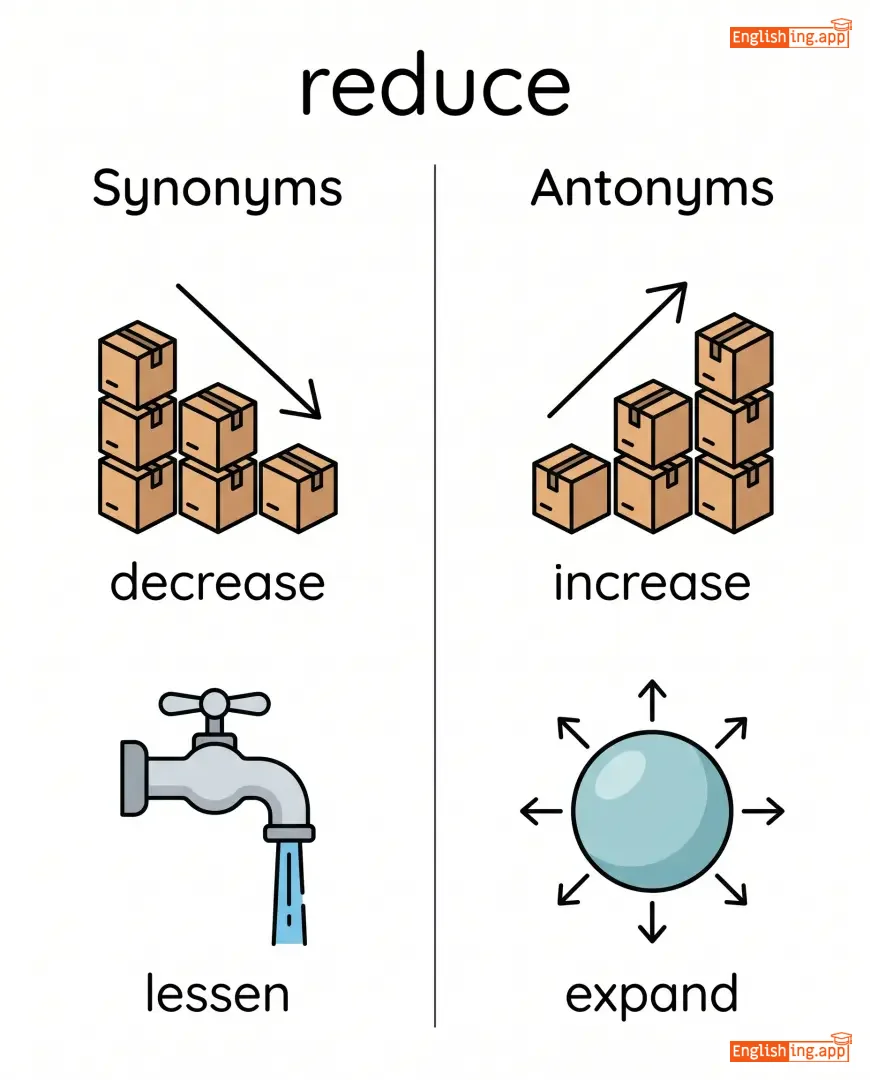
decrease, lessen, diminish, cut, lower
••••••
|
increase, expand, enlarge
••••••
|
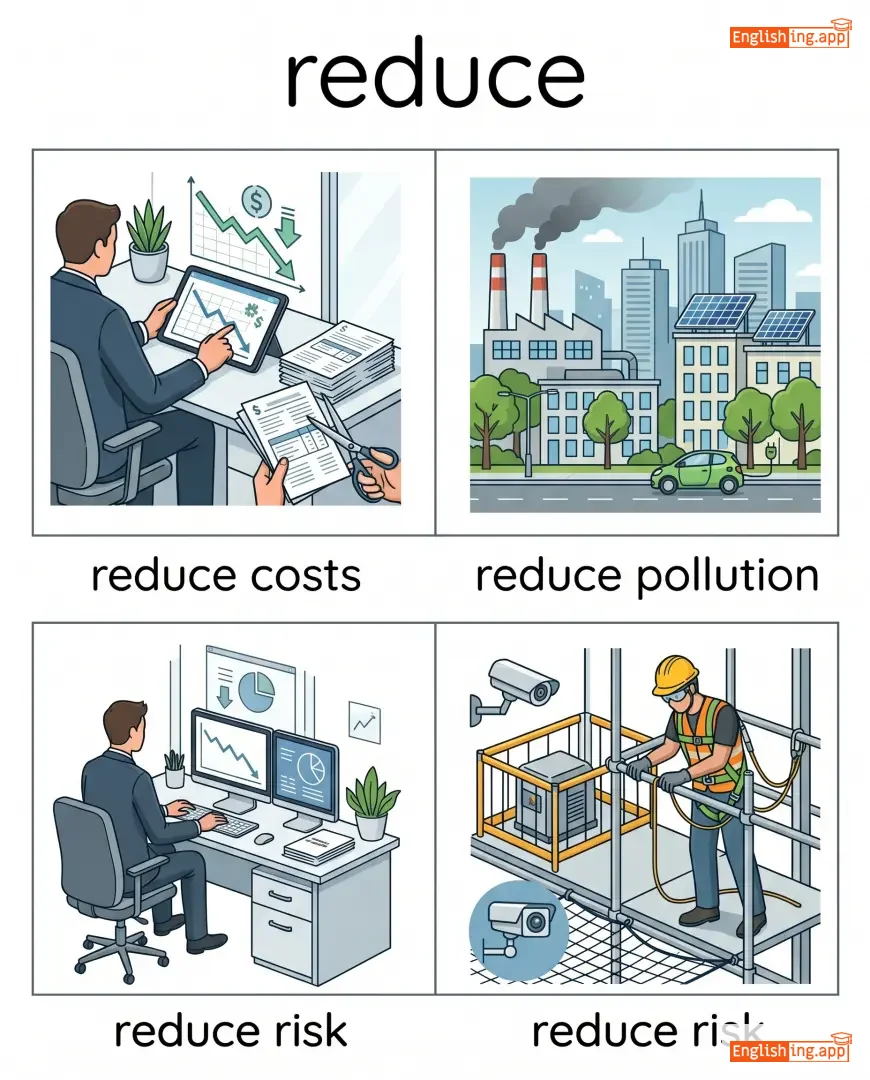
reduce costs, reduce pollution, reduce risk, reduce stress
••••••
|
Reduce означает уменьшить—'Редуцировать стресс помогает чувствовать себя лучше.'
••••••
|
|
#7385
⚖️
|
/rɪˈdrɛs/
verb
(редрес)
••••••
|
- •••••• |
исправлять
ispravljat'
••••••
|
redressed
редрест
••••••
|
redressed
редрест
••••••
|
redresses
редрессес
••••••
|
redressing
редресинг
••••••
|
to set right, remedy, or compensate for a wrong or grievance
••••••
|
The company promised to redress the complaints of its customers.
Компания пообещала устранить жалобы своих клиентов.
••••••
|
Компания пообещала устранить жалобы своих клиентов.
Kompaniya poobeshchala ustranit' zhaloby svoikh klientov.
••••••
|
seek redress
искать возмещение
••••••
|
to pursue compensation or remedy for a wrong or grievance
••••••
|
искать возмещение
iskat' vozmeschenie
••••••
|
remedy, rectify, amend, compensate, correct
••••••
|
worsen, aggravate, ignore
••••••
|
seek redress, redress grievances, redress injustice, redress balance
••••••
|
Red dress (редрес) нужен, чтобы исправить (исправлять) ошибку.
••••••
|
|
#7386
📈
|
/rɪˈdaʊnd/
verb
(редаунд)
••••••
|
- •••••• |
способствовать
sposobstvovat'
••••••
|
redounded
редаундед
••••••
|
redounded
редаундед
••••••
|
redounds
редаундс
••••••
|
redounding
редаундинг
••••••
|
to contribute greatly to a result or consequence, usually beneficial
••••••
|
His hard work will redound to the success of the company.
Его усердная работа принесет успех компании.
••••••
|
Его усердная работа принесет успех компании.
Yego usyerdnaya rabota prinesyot uspekhi kompaniyi.
••••••
|
redound to someone's credit
принести чью-то честь
••••••
|
to bring honor or advantage to someone
••••••
|
принести чью-то честь
prinesti ch'yu-to chest'
••••••
|
contribute, add, lead, result
••••••
|
detract, diminish
••••••
|
redound to success, redound to credit, redound to benefit
••••••
|
Redound означает большой вклад, как 'красное добавление'.
••••••
|
|
#7387
🛡️
|
/rɪˈdaʊ.tə.bəl/
adjective
(ридaутебл)
••••••
|
- •••••• |
ужасный/внушающий уважение
uzhasnyj/vnushayushchij uvazhenie
••••••
|
- •••••• | - •••••• | - •••••• | - •••••• |
formidable, especially as an opponent; inspiring fear or respect
••••••
|
She was a redoubtable leader who commanded respect from all. |
Она была ужасным лидером, который пользовался уважением всех.
Ona byla uzhasnym liderom, kotoryj pol'zovalsya uvaženiem vsekh.
••••••
|
- •••••• | - •••••• | - •••••• |
formidable, intimidating, powerful, commanding
••••••
|
weak, unimpressive
••••••
|
redoubtable opponent, redoubtable leader, redoubtable warrior
••••••
|
Redoubtable - это кто-то, кто вызывает уважение и страх, как 'extra doubt'.
••••••
|
|
#7388
🌹
|
/ˈrɛd.ələnt/
adjective
••••••
|
- •••••• | - •••••• | - •••••• | - •••••• | - •••••• | - •••••• |
having a strong pleasant smell; strongly reminiscent or suggestive of something
••••••
|
The kitchen was redolent of spices and fresh herbs. |
- •••••• | - •••••• | - •••••• | - •••••• |
fragrant, aromatic, evocative, perfumed
••••••
|
odorless, scentless
••••••
|
redolent of roses, redolent of memories, redolent with spices
••••••
|
No •••••• |
|
#7389
🌸
|
/ˈrɛd.ə.ləns/
noun
(редоленс)
••••••
|
- •••••• |
аромат
aromat
••••••
|
- •••••• | - •••••• | - •••••• | - •••••• |
a pleasant smell or the quality of suggesting something strongly
••••••
|
The redolence of jasmine filled the evening air. |
Аромат жасмина наполнил вечерний воздух.
Aromat zhasmina napolnil vecherniy vozdukh.
••••••
|
- •••••• | - •••••• | - •••••• |
fragrance, aroma, perfume, scent
••••••
|
odor, stench
••••••
|
redolence of flowers, redolence of history, redolence of spices
••••••
|
Redolence это как аромат цветов.
••••••
|
|
#7390
⚖️
|
/ˌriː.dɪ.strɪˈbjuː.ʃən/
noun
(ˌrɛdɪstrɪbjuˈʃən)
••••••
|
|
перераспределение
pereraspredelenie
••••••
|
- •••••• | - •••••• | - •••••• | - •••••• |
the act of sharing something out differently from before, often wealth or resources
••••••
|
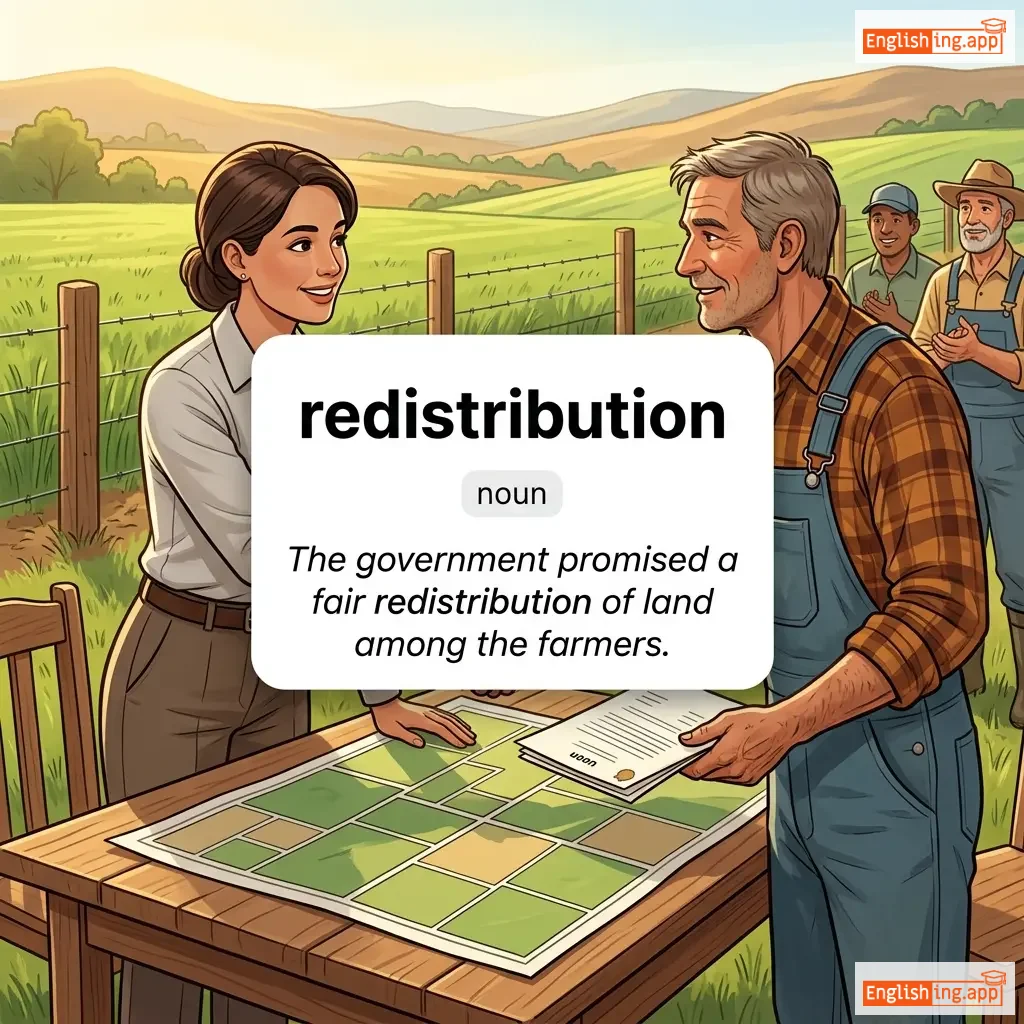
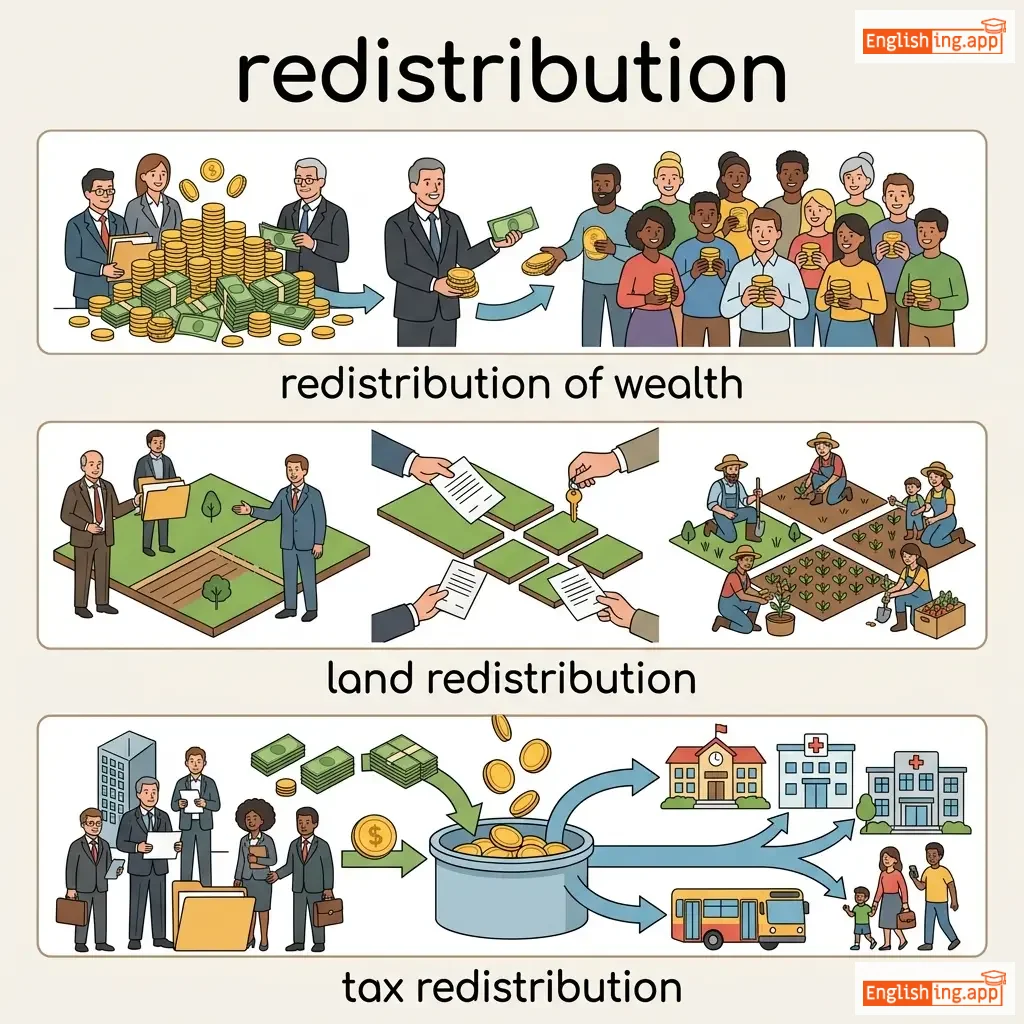
The government promised a fair redistribution of land among the farmers. |
Правительство пообещало справедливое перераспределение земли между фермерами.
Pravitel'stvo poobeshchalo spravedlivoe pereraspredelenie zemli mezhdu fermerami.
••••••
|
- •••••• | - •••••• | - •••••• |
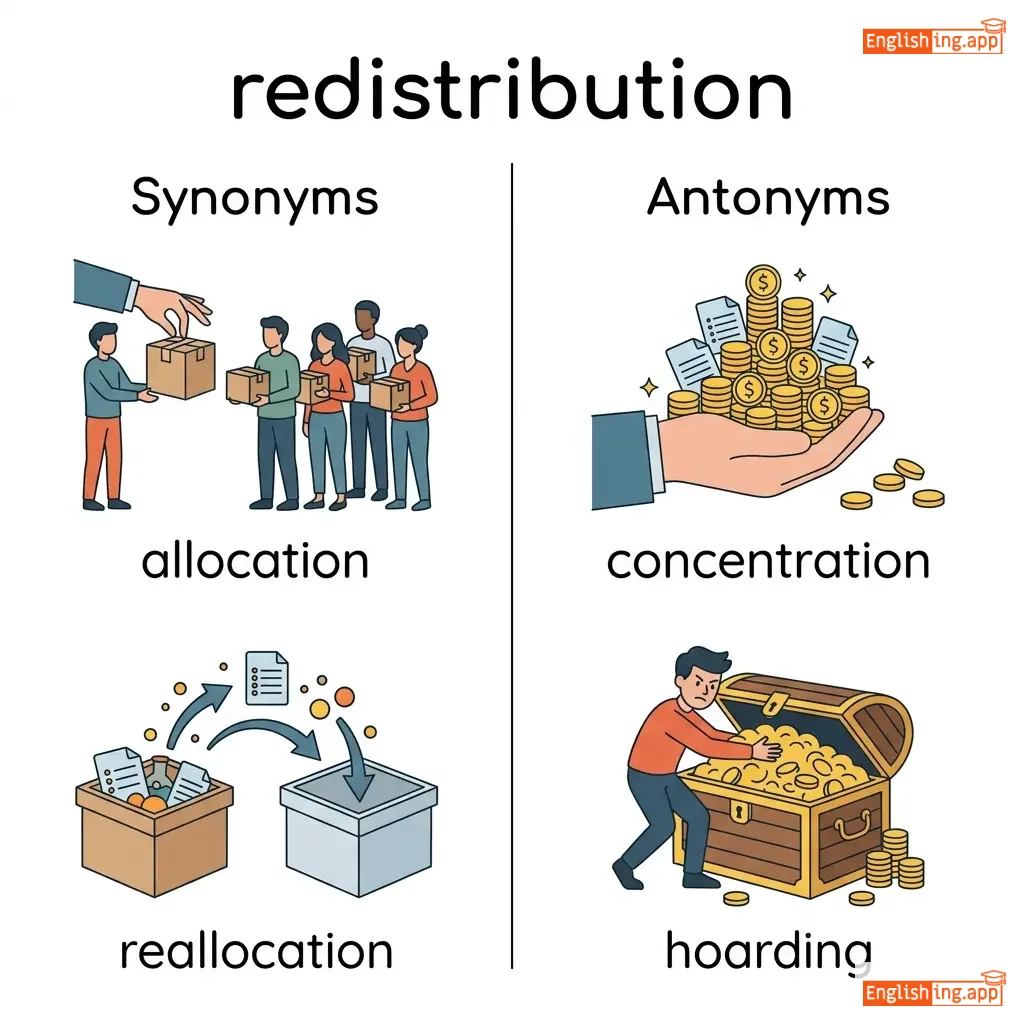
allocation, reallocation, division, sharing, apportionment
••••••
|
concentration, hoarding
••••••
|
redistribution of wealth, land redistribution, tax redistribution, income redistribution
••••••
|
Re-distribution означает перераспределение, по-русски перераспределение.
••••••
|
|
#7391
🙏
|
/rɪˈdɛmpʃən/
noun
(рɪˈдэмпʃн)
••••••
|
|
искупление
iskuplenie
••••••
|
- •••••• | - •••••• | - •••••• | - •••••• |
the act of being saved from sin, error, or evil; also the act of regaining possession or making something better
••••••
|
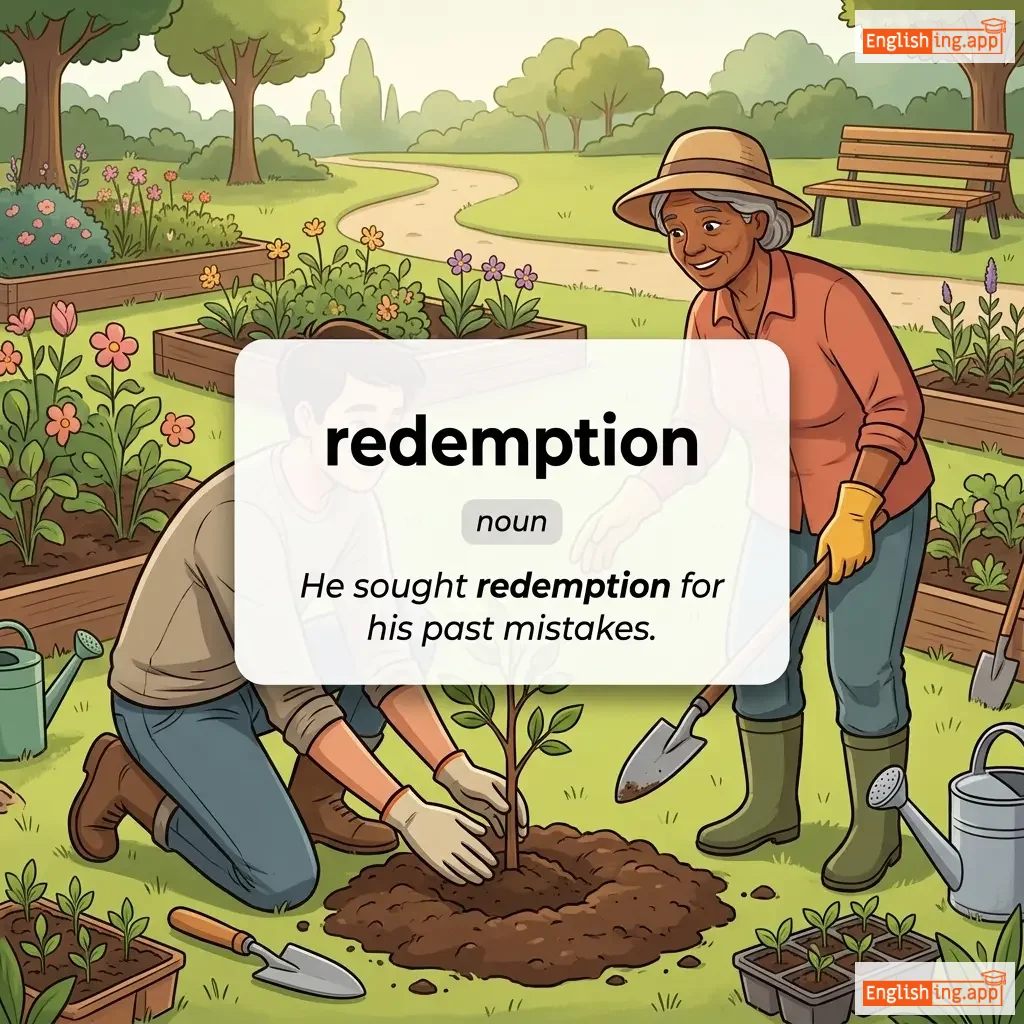
He sought redemption for his past mistakes. |
Он искал искупление за свои прошлые ошибки.
On iskal iskuplenie za svoi proshlye oshibki.
••••••
|
beyond redemption |
too bad to be improved or saved
••••••
|
за пределами искупления
za predelami iskupleniya
••••••
|
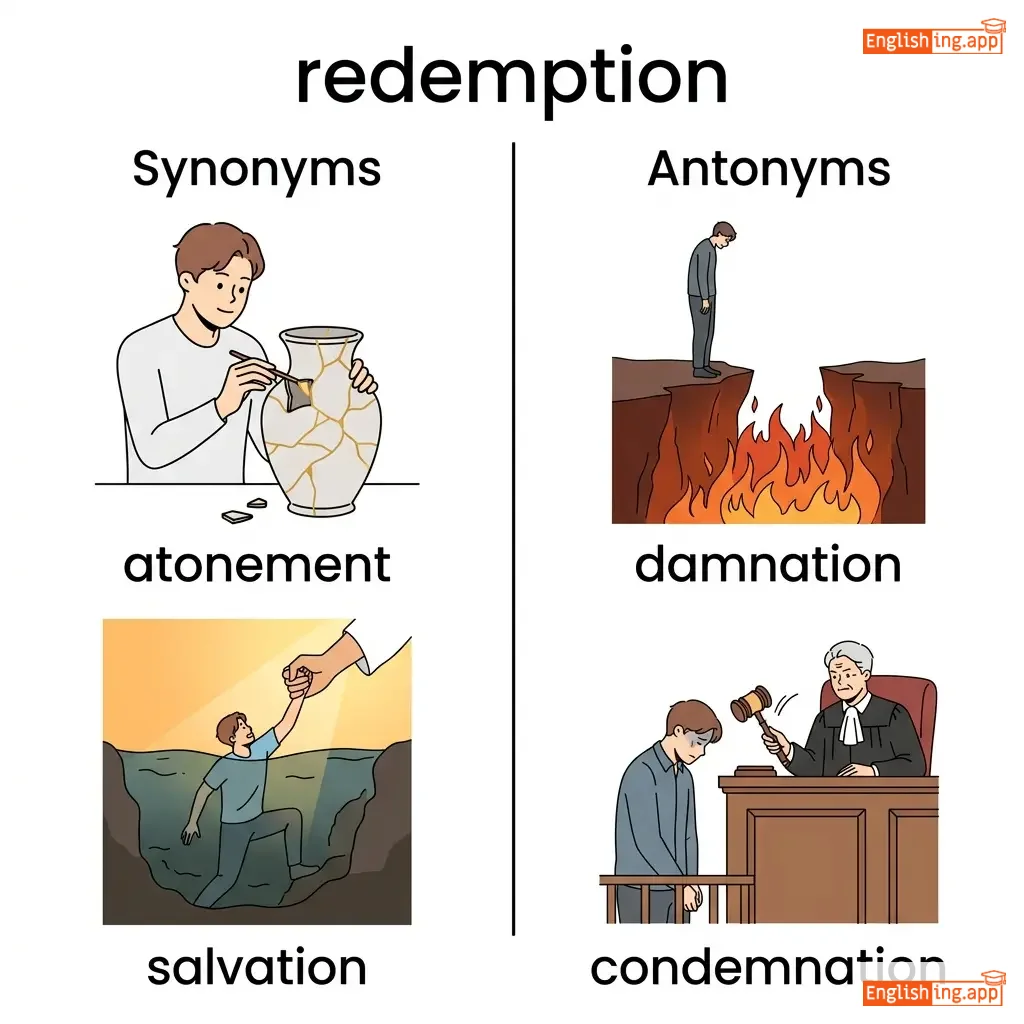
atonement, salvation, recovery, deliverance
••••••
|
damnation, condemnation
••••••
|
seek redemption, path to redemption, beyond redemption, redemption value
••••••
|
ИСКУПЛЕНИЕ – это как второй шанс исправить ошибки.
••••••
|
|
#7392
✊
|
/ˈrɛkjʊzənt/
noun
(rikyuzant)
••••••
|
- •••••• |
непокорный
nepokornyj
••••••
|
- •••••• | - •••••• | - •••••• | - •••••• |
a person who refuses to submit to authority or comply with rules
••••••
|
The recusant opposed the new law.
Рекюзант выступил против нового закона.
••••••
|
Непокорный выступил против нового закона.
Nepokornyj vystupil protiv novogo zakona.
••••••
|
- •••••• | - •••••• | - •••••• |
dissenter, rebel, nonconformist, protester
••••••
|
follower, conformist
••••••
|
Catholic recusant, political recusant, recusant group
••••••
|
Recusant = отказывать + власть = тот, кто не подчиняется
••••••
|
|
#7393
🔄
|
/rɪˈkʌrənt/
adjective
(рикуррент)
••••••
|
- •••••• |
повторяющийся
povtoryayushchijsya
••••••
|
- •••••• | - •••••• | - •••••• | - •••••• |
happening again and again, repeatedly
••••••
|
She suffers from recurrent nightmares.
Она страдает от повторяющихся кошмаров.
••••••
|
Она страдает от повторяющихся кошмаров.
Ona stradayet ot povtoryayushchikhsya koshmarov.
••••••
|
- •••••• | - •••••• | - •••••• |
repeated, frequent, periodic, returning
••••••
|
rare, occasional
••••••
|
recurrent problem, recurrent issue, recurrent theme, recurrent dream
••••••
|
ReCURRENT – это то, что происходит снова и снова, как кошмары
••••••
|
|
#7394
🩹
|
/rɪˈkjʊə/
verb
(рекьюр)
••••••
|
- •••••• |
лечить снова
lechit' snova
••••••
|
recured
рекьюрд
••••••
|
recured
рекьюрд
••••••
|
recures
рекьюрс
••••••
|
recuring
рекьюринг
••••••
|
to cure again; to remedy a second time
••••••
|
The doctor had to recure the wound after it reopened.
Доктору нужно было снова вылечить рану, когда она снова открылась.
••••••
|
Доктору нужно было снова вылечить рану, когда она снова открылась.
Doktoru nuzhno bylo snova vylechit' ranu, kogda ona snova otkrylas'.
••••••
|
- •••••• | - •••••• | - •••••• |
heal again, remedy, fix, treat again
••••••
|
harm, injure
••••••
|
recure wound, recure problem, recure damage
••••••
|
Recure = лечить снова (восстановить)
••••••
|
|
#7395
📖
|
/rɪˈkaʊnt/
verb
(rikàunt)
••••••
|
- •••••• |
рассказывать
rasskazyvat'
••••••
|
recounted
rikàunted
••••••
|
recounted
rikàunted
••••••
|
recounts
rikàunts
••••••
|
recounting
rikàunting
••••••
|
to narrate or tell the details of an event or experience
••••••
|
She recounted her adventures during the summer trip.
Она рассказала о своих приключениях во время летнего путешествия.
••••••
|
Она рассказала о своих приключениях во время летнего путешествия.
Ona rasskazala o svoikh priklyuchenyakh vo vremya letnego puteshestviya.
••••••
|
- •••••• | - •••••• | - •••••• |
narrate, describe, relate, tell, detail
••••••
|
conceal, suppress
••••••
|
recount a story, recount events, recount experiences, recount details
••••••
|
Рассказывать — это то же самое, что пересказать старую историю, как если бы ты снова пересчитывал.
••••••
|
|
#7396
🛌
|
/rɪˈkuːpəreɪt/
verb
(рекуперейт)
••••••
|
- •••••• |
восстановиться
vostanovitsya
••••••
|
recuperated
рекуперейтед
••••••
|
recuperated
рекуперейтед
••••••
|
recuperates
рекуперейтс
••••••
|
recuperating
рекуперейтинг
••••••
|
to recover from illness or regain strength
••••••
|
She went to the countryside to recuperate after surgery.
Она поехала в деревню, чтобы восстановиться после операции.
••••••
|
Она поехала в деревню, чтобы восстановиться после операции.
Ona poehala v derevnyu, chtoby vosstanovitsya posle operatsii.
••••••
|
recuperate from illness
восстановиться после болезни
••••••
|
to get well after being sick
••••••
|
восстановиться после болезни
vostanovitsya posle bolezni
••••••
|
recover, heal, restore, regain
••••••
|
deteriorate, decline, weaken
••••••
|
recuperate from, recuperate after, time to recuperate
••••••
|
Recover + Operate → восстановиться означает восстановиться после болезни
••••••
|
|
#7397
🛋️
|
/rɪˈkʌmbənt/
adjective
(rikʌmbənt)
••••••
|
- •••••• |
лежащий
lezhashchiy
••••••
|
- •••••• | - •••••• | - •••••• | - •••••• |
lying down or in a resting position
••••••
|
He was found recumbent on the sofa after a long day.
Он был найден лежащим на диване после долгого дня.
••••••
|
Он был найден лежащим на диване после долгого дня.
On byl nayden lezhashchim na divane posle dolgogo dnya.
••••••
|
- •••••• | - •••••• | - •••••• |
lying, reclining, resting, supine
••••••
|
standing, upright, erect
••••••
|
recumbent position, recumbent bicycle, lie recumbent
••••••
|
Re + Cumbent = Отдых (лежащий)
••••••
|
|
#7398
⚖️
|
/ˈrɛktɪtjuːd/
noun
(ректитюд)
••••••
|
|
добродетель
dobrodetel
••••••
|
- •••••• | - •••••• | - •••••• | - •••••• |
morally correct behavior or thinking
••••••
|
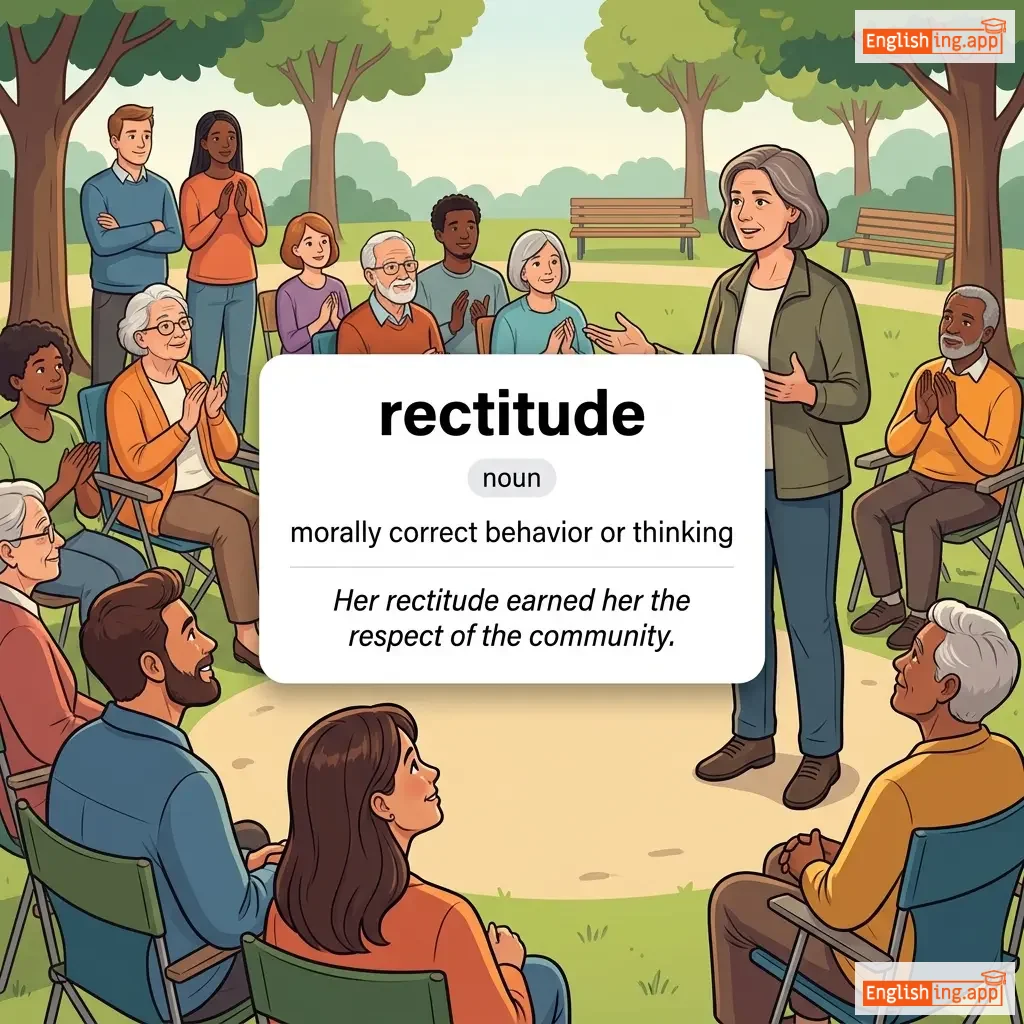
Her rectitude earned her the respect of the community. |
Её добродетель принесла ей уважение в сообществе.
Yeyo dobrodetel' prinesla yey uvaženie v soobshchestve.
••••••
|
- •••••• | - •••••• | - •••••• |
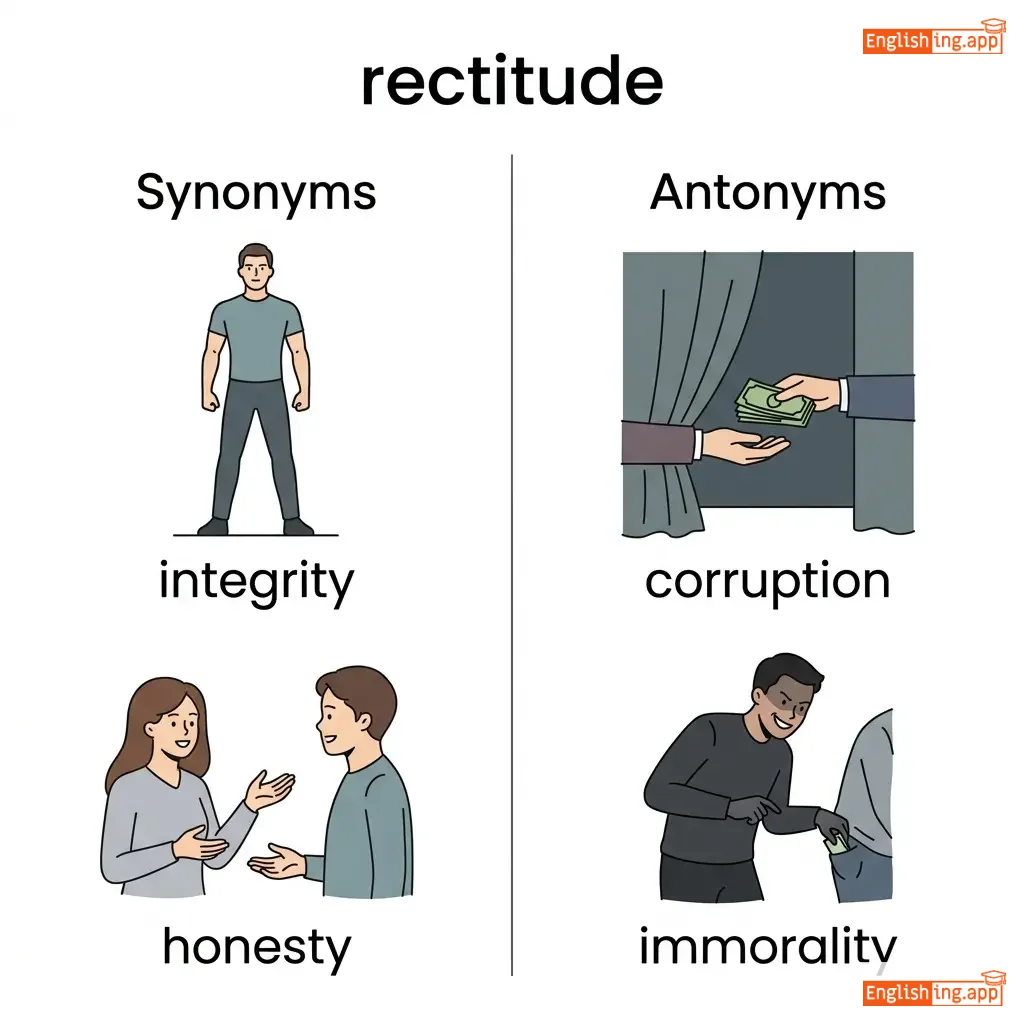
integrity, honesty, righteousness, virtue
••••••
|
corruption, immorality, dishonesty
••••••
|
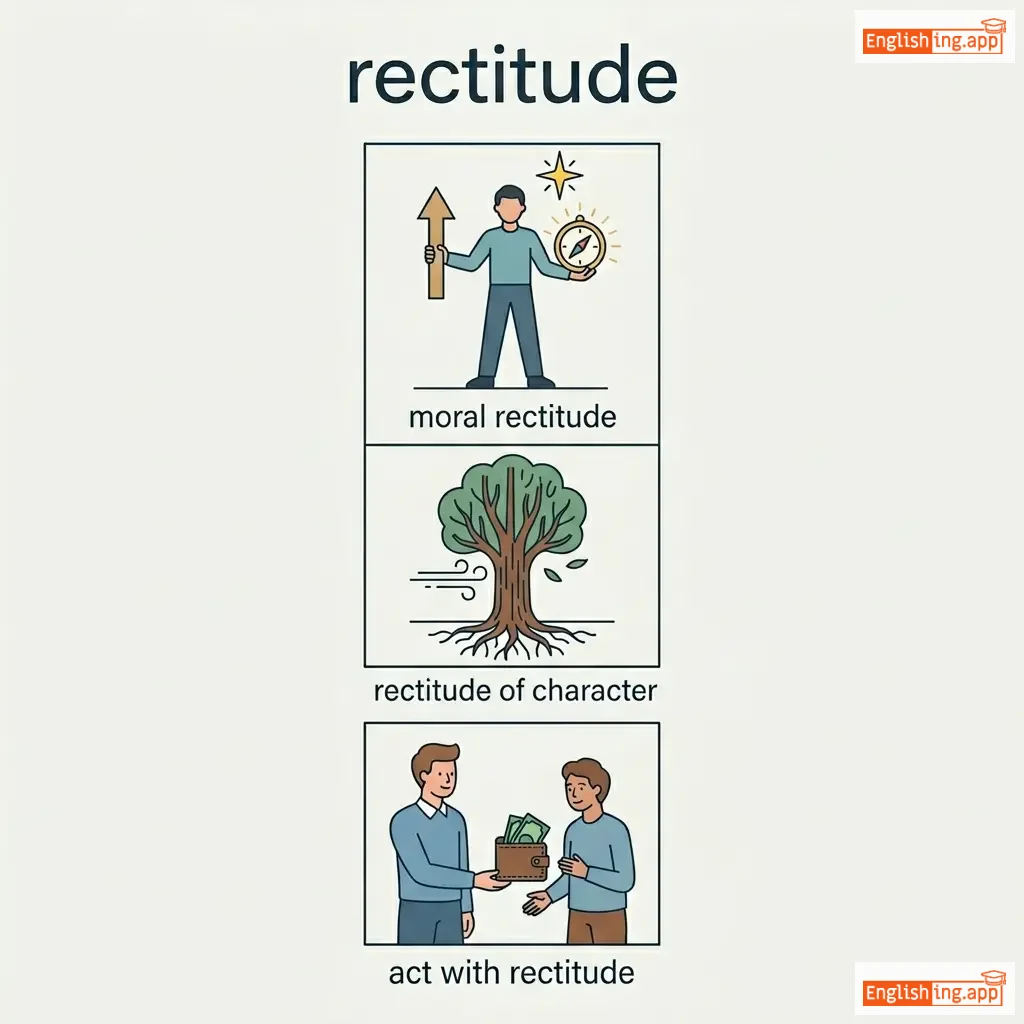
moral rectitude, rectitude of character, act with rectitude
••••••
|
Rect → Pravo; добродетель означает правильное поведение
••••••
|
|
#7399
🛠️
|
/ˈrɛktɪfaɪ/
verb
(ректиифай)
••••••
|
|
исправить
ispravit'
••••••
|
rectified
ректифайд
••••••
|
rectified
ректифайд
••••••
|
rectifies
ректифайз
••••••
|
rectifying
ректифаинг
••••••
|
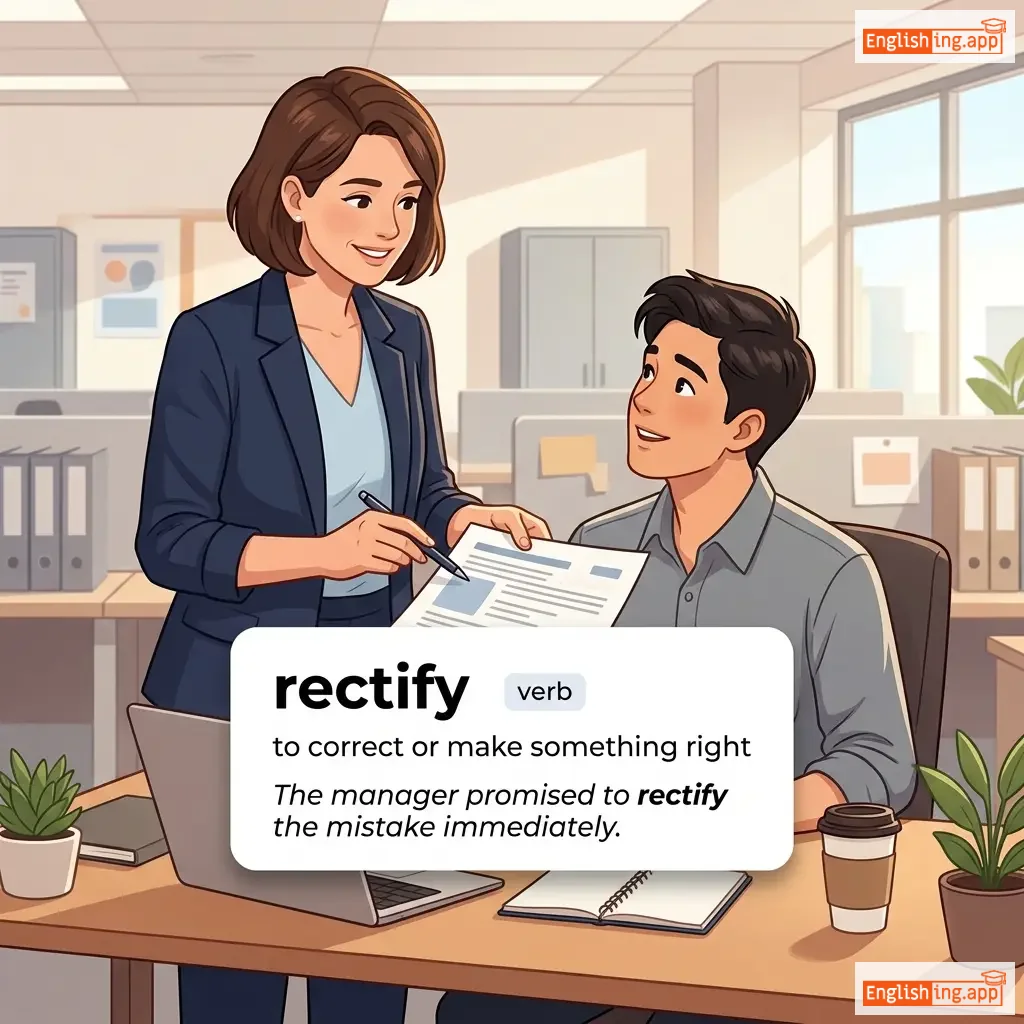
to correct or make something right
••••••
|
The manager promised to rectify the mistake immediately.
Менеджер пообещал немедленно исправить ошибку.
••••••
|
Менеджер пообещал немедленно исправить ошибку.
Menedzher poobeshchal nemedlenno ispravit' oshibku.
••••••
|
rectify an error
исправить ошибку
••••••
|
to correct a mistake
••••••
|
исправить ошибку
ispravit' oshibku
••••••
|
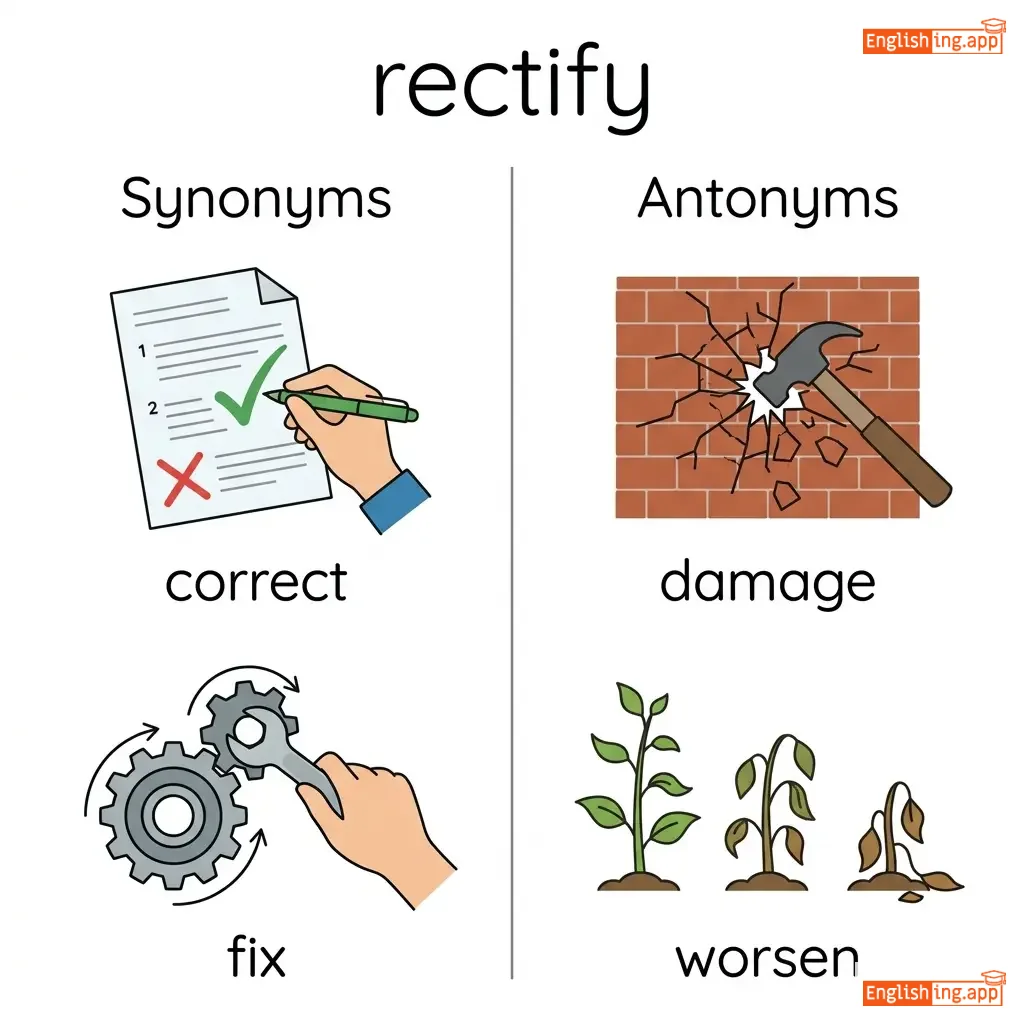
correct, fix, amend, resolve, adjust
••••••
|
damage, worsen, spoil
••••••
|
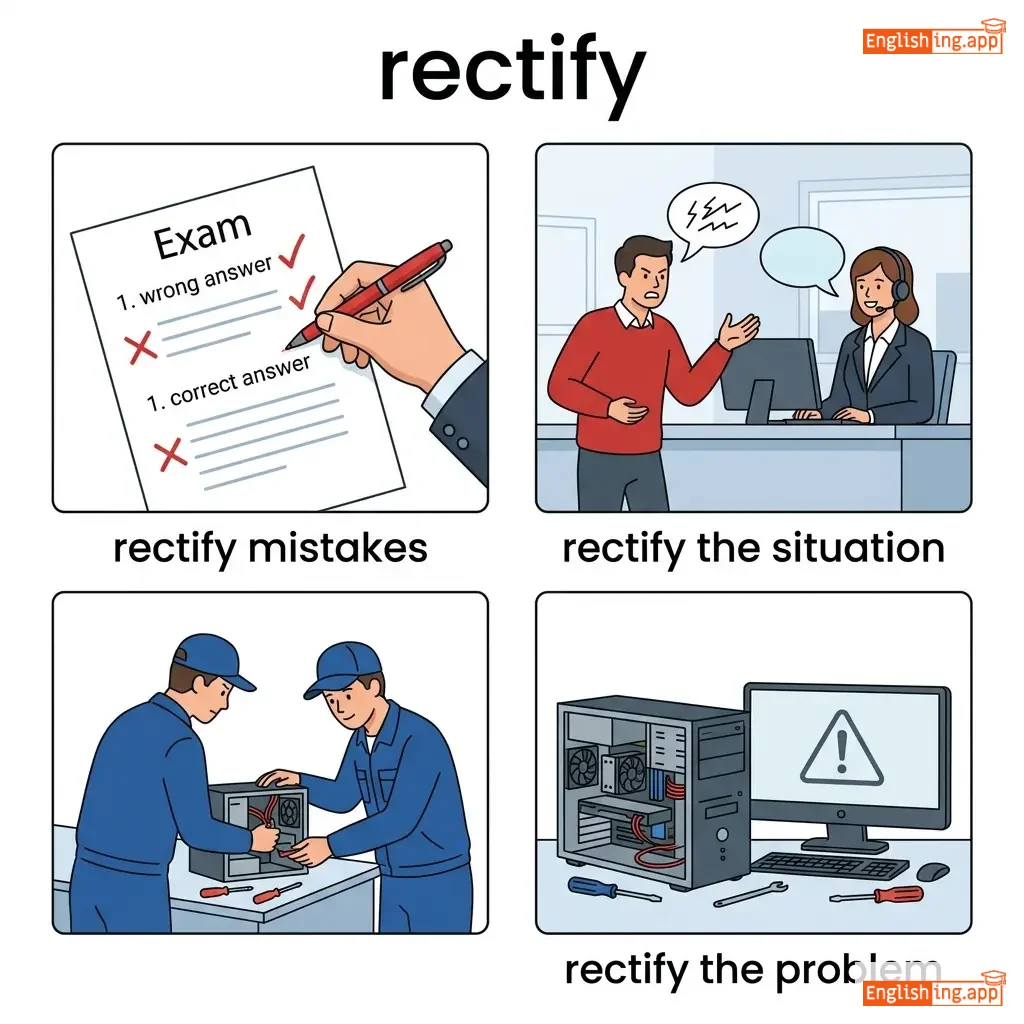
rectify mistakes, rectify the situation, rectify the problem
••••••
|
Rectify = Right + Ify → исправить значит делать что-то правильным
••••••
|
|
#7400
🧑💼
|
/rɪˈkruːt/
verb
(rikrut)
••••••
|
- •••••• |
рекрутировать
rekrutirovat
••••••
|
recruited
rikruted
••••••
|
recruited
rikruted
••••••
|
recruits
rikruts
••••••
|
recruiting
rikruting
••••••
|
to enlist or hire people for a job, service, or membership
••••••
|
The company is trying to recruit more software engineers.
Компания пытается нанять больше инженеров-программистов.
••••••
|
Компания пытается нанять больше инженеров-программистов.
Kompaniya pytayetsya nanyat' bol'she inzhenerov-programmistov.
••••••
|
recruit talent
нанимать таланты
••••••
|
to attract and hire skilled people
••••••
|
нанимать таланты
nanimat' talanty
••••••
|
enlist, hire, enroll, draft, engage
••••••
|
dismiss, fire, reject
••••••
|
recruit staff, recruit volunteers, recruit new members, recruit soldiers
••••••
|
Рекрутировать – это как искать таланты и привлекать их в свою команду.
••••••
|
|
#7401
🌋
|
/ˌriːkruːˈdɛsənt/
adjective
(рекрудесент)
••••••
|
- •••••• |
рецидивирующий
retsidiviruyushchiy
••••••
|
- •••••• | - •••••• | - •••••• | - •••••• |
reviving or breaking out again after a period of abatement
••••••
|
Recrudescent tensions threatened the fragile ceasefire. |
Рецидивирующие напряжения угрожали хрупкому перемирию.
Retsidiviruyushchiesya napryazheniya ugrozhali khrupkomu peremiriyu.
••••••
|
- •••••• | - •••••• | - •••••• |
resurgent, returning, renewed, relapsing
••••••
|
waning, subsiding
••••••
|
recrudescent fever, recrudescent violence, recrudescent nationalism, recrudescent outbreaks
••••••
|
recrude-‘scent’ представь старый запах, который снова появляется – рецидивирующий = снова проявляющийся после перерыва.
••••••
|
|
#7402
🔄
|
/ˌriːkruːˈdɛsəns/
noun
(rikruːˈdɛsəns)
••••••
|
- •••••• |
рекрудесценция
rekrudesentsiya
••••••
|
- •••••• | - •••••• | - •••••• | - •••••• |
a new outbreak or revival of something that had subsided, especially an undesirable condition
••••••
|
Health officials warned of a recrudescence of measles in several districts.
Сотрудники здравоохранения предупредили о повторном всплеске кори в нескольких районах.
••••••
|
Сотрудники здравоохранения предупредили о повторном всплеске кори в нескольких районах.
Sotrudniki zdravookhraneniya predupredili o povtornom vspleske kori v neskol'kikh rayonakh.
••••••
|
- •••••• | - •••••• | - •••••• |
resurgence, relapse, renewal, reappearance
••••••
|
remission, abatement
••••••
|
recrudescence of disease, recrudescence of violence, sudden recrudescence, seasonal recrudescence
••••••
|
Re + crew (группа) снова появляется—рекрудесценция означает возрождение проблем.
••••••
|
|
#7403
🔥
|
/ˌriːkruːˈdɛs/
verb
(рекрудес)
••••••
|
- •••••• |
вспыхнуть снова
vspykhnut' snova
••••••
|
recrudesced
рекрудесед
••••••
|
recrudesced
рекрудесед
••••••
|
recrudesces
рекрудесес
••••••
|
recrudescing
рекрудесинг
••••••
|
to break out or appear again after a period of dormancy or decline
••••••
|
After months of calm, violence recrudesced in the region.
После месяцев спокойствия насилие снова проявилось в регионе.
••••••
|
После месяцев спокойствия насилие снова проявилось в регионе.
Posle mesyatsev spokoystviya nasiliye snova proyavilos' v regione.
••••••
|
- •••••• | - •••••• | - •••••• |
resurge, reappear, relapse, flare up, reemerge
••••••
|
subside, abate
••••••
|
symptoms recrudesce, conflict recrudesces, disease recrudesces, tensions recrudesce
••••••
|
re + crude (старое повреждение) снова оживает — вспыхнуть снова.
••••••
|
|
#7404
⚔️
|
/rɪˌkrɪmɪˈneɪʃən/
noun
(rikriminatsiya)
••••••
|
- •••••• |
взаимные обвинения
vzaimnye obvinenija
••••••
|
- •••••• | - •••••• | - •••••• | - •••••• |
an accusation made in response to an accusation; mutual blaming
••••••
|
The debate quickly descended into mutual recriminations. |
Дебаты быстро перешли в взаимные обвинения.
Debaty bystro pereshli v vzaimnye obvinenija.
••••••
|
- •••••• | - •••••• | - •••••• |
countercharge, accusation, blame, finger-pointing
••••••
|
forgiveness, exoneration, reconciliation
••••••
|
mutual recriminations, bitter recriminations, cycle of recrimination, exchange of recriminations
••••••
|
Re-CRIMination звучит как преступление— ответ на обвинение (re) = взаимные обвинения.
••••••
|
|
#7405
🔁
|
/ˌriːkriˈeɪt/
verb
(рикриейт)
••••••
|
- •••••• |
воссоздавать
vossazdavat
••••••
|
recreated
рикриэйтед
••••••
|
recreated
рикриэйтед
••••••
|
recreates
рикриэйтс
••••••
|
recreating
рикриэйтинг
••••••
|
to create or produce something again, especially a new version of something lost or destroyed
••••••
|
The team recreated the lost dataset from backups.
Команда восстановила потерянный набор данных из резервных копий.
••••••
|
Команда восстановила потерянный набор данных из резервных копий.
Komanda vosstanovila poteryannyy nabor dannykh iz rezervnykh kopiy.
••••••
|
- •••••• | - •••••• | - •••••• |
rebuild, reconstruct, remake, reproduce, reconstitute
••••••
|
destroy, ruin, demolish
••••••
|
recreate the scene, recreate the experience, recreate from memory, recreate the look, recreate a model
••••••
|
Recreate означает восстановить — думай о: 're' как о начале заново; поэтому воссоздавать = создавать заново.
••••••
|
|
#7406
😨
|
/ˈrɛkriənt/
adjective
(rekriant)
••••••
|
- •••••• |
трус, предатель
trus, predatel'
••••••
|
- •••••• | - •••••• | - •••••• | - •••••• |
cowardly or unfaithful to duty
••••••
|
The recreant soldier abandoned his post in fear.
Рекриант солдат покинул свой пост из страха.
••••••
|
Трус солдат покинул свой пост из страха.
Trus soldat pokinul svoy post iz strakha.
••••••
|
- •••••• | - •••••• | - •••••• |
cowardly, faithless, traitorous, disloyal
••••••
|
brave, loyal, faithful
••••••
|
recreant knight, recreant behavior, recreant act, recreant soldier
••••••
|
Recreant означает трус или предатель, человек, который покидает свой долг из страха.
••••••
|
|
#7407
🛌
|
/rɪˈkʌvərɪŋ/
verb
(восстановление)
••••••
|
- •••••• |
восстановление
vosstanovlenie
••••••
|
- •••••• | - •••••• | - •••••• |
recovering
восстановление
••••••
|
the process of getting better after illness, loss, or difficulty
••••••
|
She is still recovering from the flu.
Она всё ещё восстанавливается после гриппа.
••••••
|
Она всё ещё восстанавливается после гриппа.
Ona vsyo eshchyo vosstanavlivaetsya posle grippa.
••••••
|
- •••••• | - •••••• | - •••••• |
healing, improving, mending, regaining
••••••
|
relapsing, worsening
••••••
|
recovering patient, recovering addict, recovering economy, still recovering
••••••
|
Восстановление - это как вернуться к норме после болезни.
••••••
|
|
#7408
💪
|
/rɪˈkʌvər/
verb
(rikóvər)
••••••
|
|
восстановить, поправиться
vosstanovit', popravit'sya
••••••
|
recovered
rikóvərd
••••••
|
recovered
rikóvərd
••••••
|
recovers
rikóvərs
••••••
|
recovering
rikóvəring
••••••
|
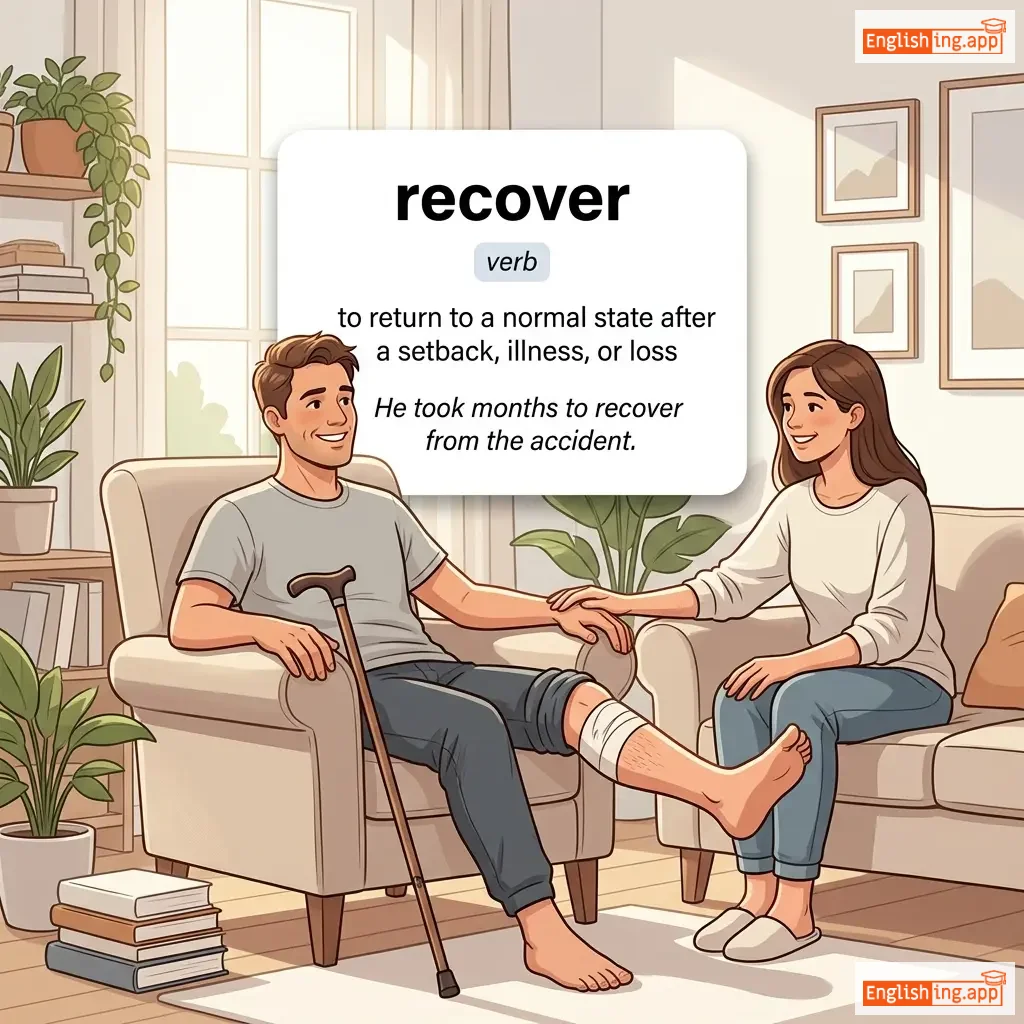
to return to a normal state after a setback, illness, or loss
••••••
|
He took months to recover from the accident.
хи тюк мэнс ту рикóвэр фром ди эксидэнт.
••••••
|
Ему потребовались месяцы, чтобы оправиться после аварии.
Emu potrebovalis' mesyatsy, chtoby opravit'sya posle avarii.
••••••
|
recover one's strength
рикóвэр уан'с стрэнгс
••••••
|
to regain energy or health
••••••
|
восстановить силы
vosstanovit' sily
••••••
|
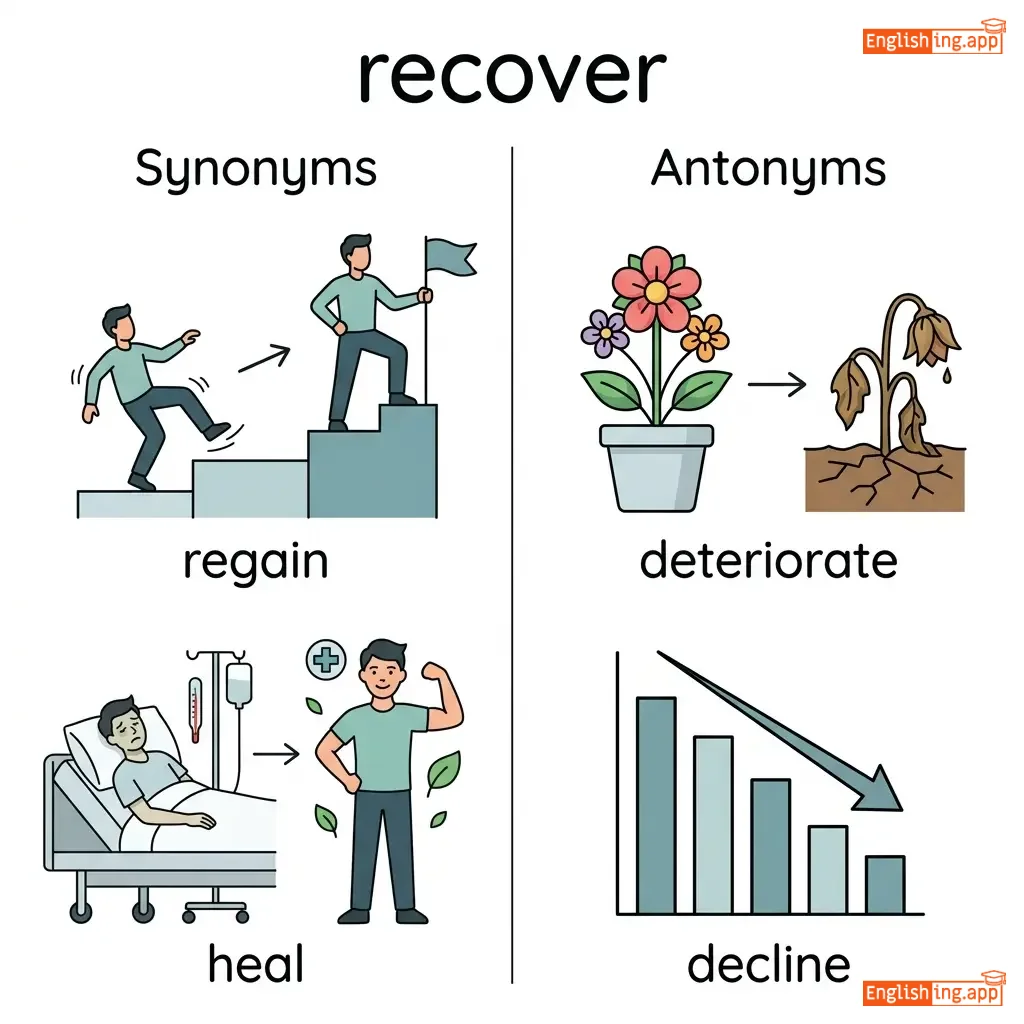
regain, heal, restore, bounce back
••••••
|
deteriorate, decline, worsen
••••••
|
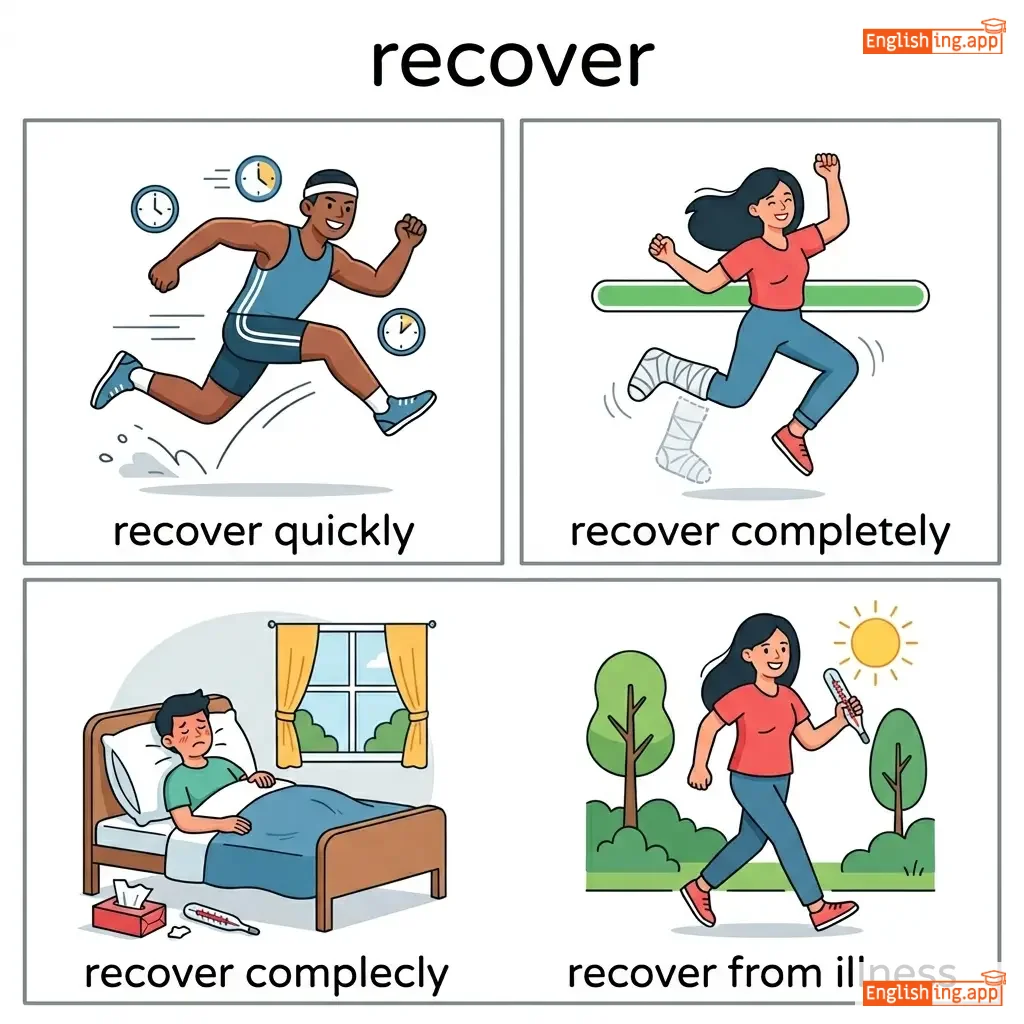
recover quickly, recover completely, recover from illness, recover lost
••••••
|
Recover означает вернуться, чтобы снова встать, выйти из болезни
••••••
|
|
#7409
🛡️
|
/ˈriːkɔːrs/
noun
(rikors)
••••••
|
- •••••• |
обращение, помощь
obrashchenie, pomoshch
••••••
|
- •••••• | - •••••• | - •••••• | - •••••• |
a source of help or protection in a difficult situation
••••••
|
The students had no recourse but to appeal to the principal. |
У студентов не было другого выхода, кроме как обратиться к директору.
U studentov ne bylo drugogo vykhoda, krome kak obratit'sya k direktor.
••••••
|
- •••••• | - •••••• | - •••••• |
resort, aid, help, remedy
••••••
|
helplessness, abandonment
••••••
|
legal recourse, without recourse, recourse to law, last recourse
••••••
|
No •••••• |
Vocabulary Quiz
Test your vocabulary by matching words with their translations or meanings.
Login to take the quiz
Comments (0)
Share your thoughts and join the discussion.
Join the discussion by logging in
Login to CommentNo comments yet
Be the first to share your thoughts!