語彙集

英単語辞書 | 単語の意味、定義、例文

conjunction
/ðæn/
より (yori)

used to introduce the second element in a comparison

"She is taller than her brother."

"彼女は彼女の兄よりも背が高い。" (Kanojo wa kanojo no ani yori mo se ga takai.)
noun
/ˈtɛkstʃər/
質感 (shitsukan)

the way something feels when you touch it; the quality of a surface or substance

"The fabric has a soft and smooth texture."

"その布は柔らかく滑らかな質感です。" (Sono nuno wa yawarakaku namerakana shitsukan desu.)
noun
/ˈtek.staɪl/
織物 (orimono)

a type of cloth or woven fabric made by knitting or weaving fibers

"Bangladesh is famous for its high-quality textile industry."

"バングラデシュはその高品質なテキスタイル産業で有名です。" (Banguradesh wa sono kōhinshitsu na tekisutairu sangyō de yūmei desu.)
noun
/ˈtɛkstbʊk/
教科書 (kyōkasho)

a book used for studying a subject in school or college

"She bought a new biology textbook for her class."

"彼女はクラスのために新しい生物学の教科書を買いました。" (Kanojo wa kurasu no tame ni atarashī seibutsugaku no kyōkasho o kaimashita.)
noun
/tɛkst/
テキスト (tekisuto)

a written or printed work or passage, especially a book or document

"The teacher asked us to read the text on page 50."

"先生は私たちにページ50のテキストを読むように言いました。" (Sensei wa watashitachi ni pēji 50 no tekisuto o yomu yō ni iimashita.)
verb
/ˈtɛðər/
繋ぐ (tsunagu)

To tie an animal with a rope or chain so it cannot move far.

"The farmer tethered the goat to a post."

"農夫はヤギを柱に繋ぎました。" (Nōfu wa yagi o hashira ni tsunagimashita.)
adjective
/ˈtɛsti/
イライラした (iraira shita)

Easily irritated or annoyed.

"He became testy when asked the same question repeatedly."

"同じ質問を繰り返し聞かれると、彼はイライラしてきた。" (Onaji shitsumon o kurikaeshi kikareru to, kare wa iraira shite kita.)
noun
/ˈtɛstɪŋ/
テスト (tesuto)

the process of assessing or evaluating something, often by trying it out

"The testing of the new software is still ongoing."

"新しいソフトウェアのテストはまだ進行中です。" (Atarashī sofutōwēa no tesuto wa mada shinkōchū desu.)
noun
/ˈtɛstəˌmoʊni/
証言 (shōgen)

A formal statement given in a court of law or evidence supporting a fact.

"Her testimony in court helped convict the criminal."

"彼女の証言は裁判で犯人を有罪にするのに役立ちました。" (Kanojo no shōgen wa saiban de han'nin o yūzai ni suru no ni yakudachimashita.)
testimonials definition card — visual illustration of the meaning
noun
/ˌtɛstɪˈməʊnɪəlz/
推薦状, 証言 (suishenjou, shougen)

Written or spoken statements of praise or recommendation from clients or customers.

"Positive testimonials can enhance a company's reputation."

"ポジティブなテスティモニアルは企業の評判を高めることができます。" (Pojitibu na tesutimoniaru wa kigyou no hyouban wo takameru koto ga dekimasu.)
noun
/ˌtɛstɪˈmoʊniəl/
推薦状 (suishenjō)

A formal statement testifying to someone's character, qualifications, or the quality of a product or service.

"The company shared a glowing testimonial from a satisfied customer."

"その会社は満足した顧客からの輝かしい推薦状を共有しました。" (Sono kaisha wa manzoku shita kokyaku kara no kagayakashī suishenjō o kyōyū shimashita.)
verb
/ˈtɛstəfaɪ/
証言する (shougen suru)

to make a statement or declaration under oath or to give evidence

"She was called to testify in court about the accident."

"彼女は事故について証言するために裁判所に呼ばれました。" (Kanojo wa jiko ni tsuite shougen suru tame ni saibansho ni yoba remashita.)
noun
/ˈtɛsteɪtər/
遺言者 (yigonsha)

a person who has made a will

"The lawyer read the will of the deceased testator."

"弁護士は故人の遺言を読みました。" (Bengoshi wa kojin no yigon o yomimashita.)
noun
/ˈtɛstəmənt/
遺言 / 証拠 (igon / shouko)

a person's will; or strong evidence of something

"His success is a testament to his hard work and dedication."
"彼の成功は彼の努力と献身の証です。" (kare no seikou wa kare no doryoku to kenshin no shouko desu.)
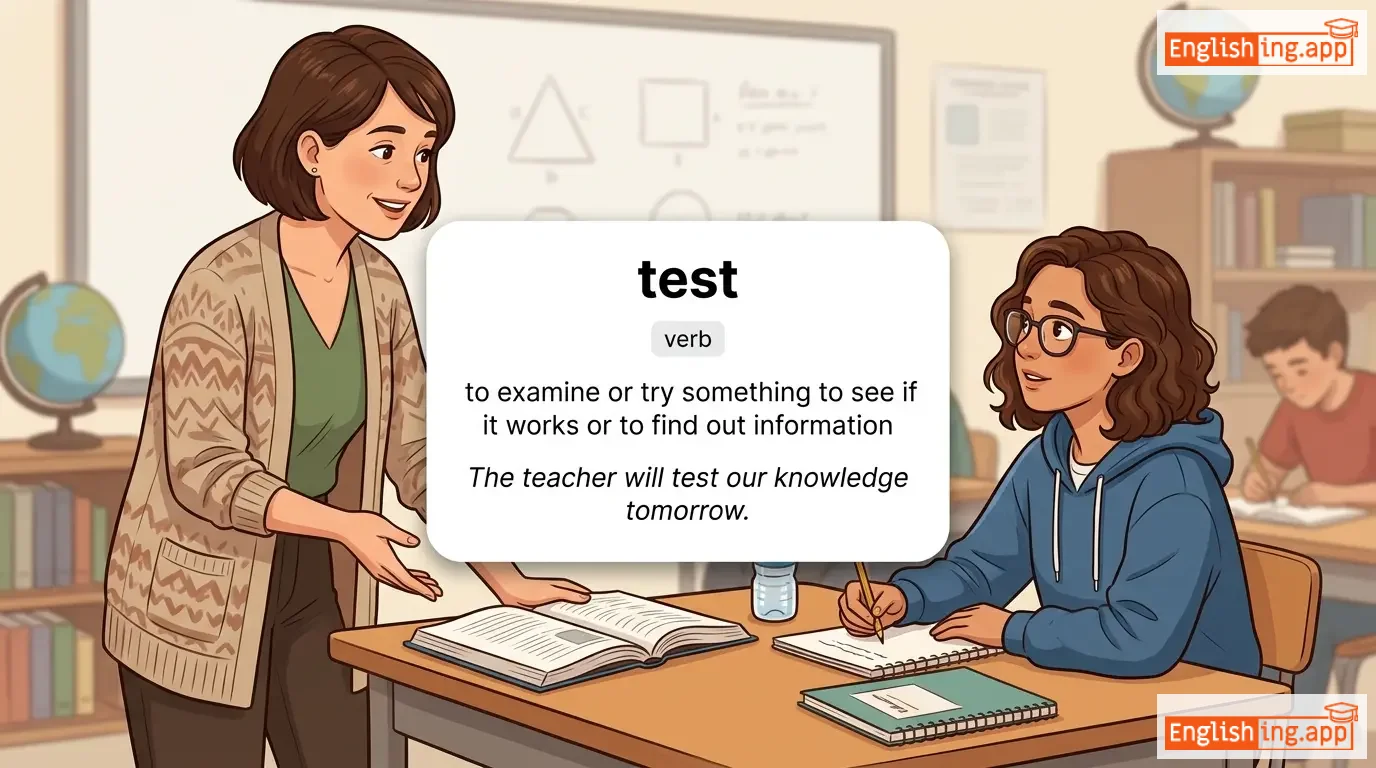
test definition card — visual illustration of the meaning
noun
/tɛst/
テスト (tesuto)

a procedure intended to establish the quality, performance, or reliability of something

"The test results will determine whether the treatment is effective."

"テストの結果は、治療が効果的かどうかを決定します。" (Tesuto no kekka wa, chiryō ga kōka-teki ka dō ka o kettei shimasu.)
adjective
/ˈtɛsəleɪtɪd/
タイル模様 (tairu moyou)

arranged in a pattern of repeated shapes fitting together without gaps

"The tessellated floor was made of colorful tiles arranged in perfect symmetry."

"テセレイテッドな床はカラフルなタイルで作られ、完璧な対称性で配置されていました。" (Tesserated na yuka wa karafuru na tairu de tsukurare, kanpeki na taishō-sei de haichi sarete imashita.)
3️⃣

tertiary

adjective
/ˈtɜːrʃieri/

third in order, rank, or level

"He is pursuing his tertiary education at the university."

adjective
/tɜːrs/
簡潔 (kanketsu)

brief and to the point; sparing in the use of words

"His reply was terse and ended the conversation quickly."

"彼の返答は簡潔で、すぐに会話を終わらせた。" (kare no hentou wa kanketsu de, sugu ni kaiwa o owaraseta.)
noun
/ˈtɛrərɪst/
テロリスト (terorisuto)

a person who uses violence or threats to intimidate or coerce, especially for political purposes

"The terrorist was arrested by the police after the attack."

"テロリストは攻撃後、警察に逮捕されました。" (Terorisuto wa kōgeki go, keisatsu ni taiho saremashita.)
noun
/ˈtɛrərɪzəm/
テロリズム (terorizumu)

the use of violence or threats to intimidate or coerce, especially for political purposes

"Terrorism is a serious threat to global peace and security."

"テロリズムは、世界の平和と安全に対する深刻な脅威です。" (Terorizumu wa, sekai no heiwa to anzen ni taisuru shinkoku na kyōi desu.)
noun
/ˈtɛrər/
恐怖 (kyōfu)

Extreme fear or dread.

"The villagers fled in terror during the attack."
"村人たちは攻撃の際に恐怖におののいて逃げた。" (Mura hitotachi wa kōgeki no sai ni kyōfu ni ononoi te nigeta.)
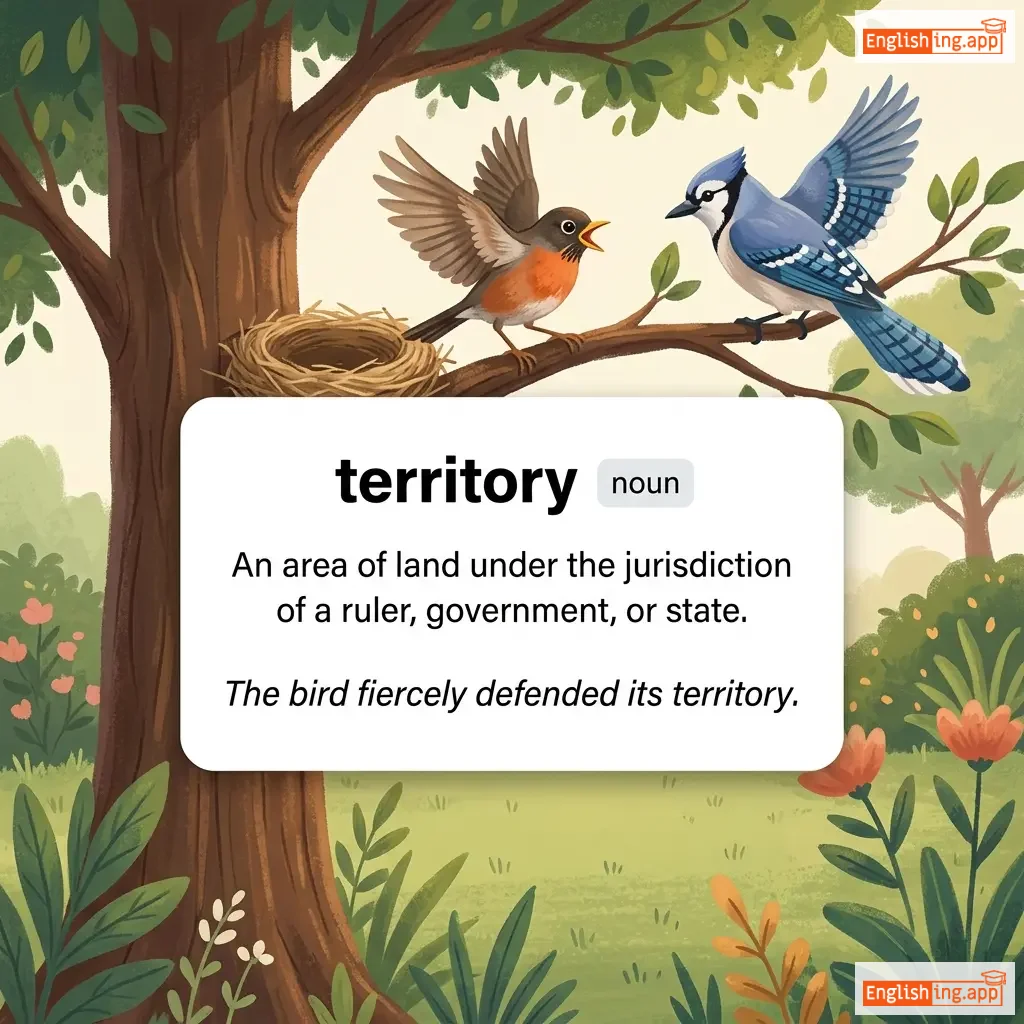
territory definition card — visual illustration of the meaning
noun
/ˈtɛrɪˌtɔːri/
領土 (ryoudo)

An area of land under the jurisdiction of a ruler, government, or state.

"The bird fiercely defended its territory."

"その鳥は自分の領土を激しく守った。" (Sono tori wa jibun no ryoudo o hageshiku mamotta.)
adjective
/ˌtɛrɪˈtɔːriəl/
領土の (ryōdo no)

Relating to the ownership or control of land or territory.

"The two countries had a territorial dispute over the island."

"二国はその島に関する領土問題を抱えていました。" (Nikoku wa sono shima ni kansuru ryōdo mondai o kakaete imashita.)
verb
/ˈtɛrəˌfaɪ/
怖がらせる (kogaraseru)

To cause someone to feel extreme fear.

"The loud thunder terrified the children."

"大きな雷が子供たちを怖がらせた。" (Ōkina kaminari ga kodomotachi o kowagaraseta.)
adjective
/təˈrɪfɪk/
素晴らしい (subarashii)

extremely good or excellent; very great or intense

"The concert last night was absolutely terrific."

"昨夜のコンサートは絶対に素晴らしかった。" (Sakuya no konsāto wa zettai ni subarashikatta.)
adverb
/ˈtɛrəbli/
ひどく (hidoku)

to a very great or extreme degree; very badly or unpleasantly

"He felt terribly sad after hearing the news."
"彼はそのニュースを聞いた後、ひどく悲しく感じました。" (Kare wa sono nyūsu o kiita ato, hidoku kanashiku kanjimashita.)
adjective
/ˈtɛrɪbəl/

extremely bad or unpleasant

"The food at that restaurant was terrible."

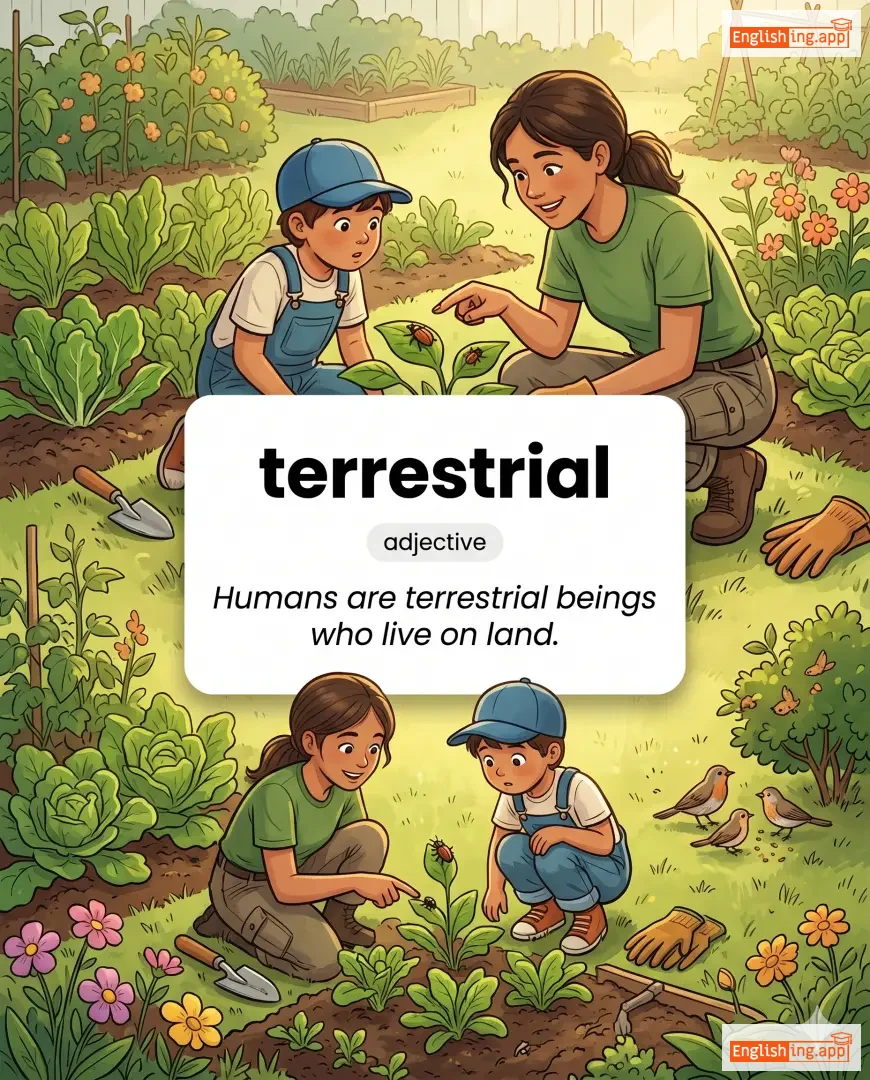
terrestrial definition card — visual illustration of the meaning
adjective
/təˈrɛstriəl/
陸生 (rikusei)

Relating to the Earth or land as opposed to the sea or air; living or growing on land.

"Humans are terrestrial beings who live on land."

"人間は陸上で生きる陸生の生物です。" (Ningen wa rikujō de ikiru rikusei no seibutsu desu.)
noun
/ˈterəpɪn/
小さな淡水カメ (chiisana tansui kame)

a small freshwater turtle, especially one found in North America

"The terrapin slowly crawled into the pond."

"テラピンはゆっくりと池に這い込んだ。" (Terapin wa yukkuri to ike ni haikonda.)
noun
/təˈreɪn/
地形 (chikei)

a stretch of land, especially with regard to its physical features

"The soldiers had to cross rough terrain during the mission."

"兵士たちは任務中に険しい地形を越えなければならなかった。" (Heishi-tachi wa ninmu-chuu ni kewashii chikei o koenakereba naranakatta.)
noun
/tɜːmz/
条件 (jouken)

plural of term; conditions or rules in a contract or agreement

"The terms of the agreement are clearly outlined in the contract."

"契約条件は契約書に明確に記載されています。" (Keiyaku jouken wa keiyakusho ni meikaku ni kisai sareteimasu.)
noun
/ˈtɜːrmɪnəs/
終点 (shūten)

the final point or end of something, especially the final station on a railway line

"The train finally arrived at the terminus after a long journey."

"長い旅の後、電車はついに終点に到着しました。" (Nagai tabi no ato, densha wa tsuini shūten ni tōchaku shimashita.)
noun
/ˌtɜːrməˈnɑːlədʒi/
用語 (yōgo)

the set of technical or special words used in a particular subject

"Medical terminology can be difficult for new students to understand."

"医学用語は新しい学生にとって理解が難しいことがあります。" (Igaku yōgo wa atarashī gakusei ni totte rikai ga muzukashī koto ga arimasu.)
noun
/ˌtɜːrmɪˈneɪʃən/
終了 (shuuryou)

the act of ending something or the state of being ended

"The termination of the contract caused financial loss."

"契約の終了は財務的損失を引き起こしました。" (Keiyaku no shuuryou wa zaimutekisonshitsu wo hikiokoshimashita.)
verb
/ˈtɜːrmɪˌneɪt/
終了する (shūryō suru)

to bring something to an end or to stop something from continuing

"The company decided to terminate his contract."

"会社は彼の契約を終了することを決定した。" (Kaisha wa kare no keiyaku o shūryō suru koto o kettei shita.)
noun/adjective
/ˈtɜːrmɪnəl/
ターミナル、終点、末期の病 (taaminaru, shūten, maki no yamai)

As a noun: A place where transport routes begin or end. As an adjective: Relating to the end or final stage of something, often an illness.

"He waited for the bus at the central terminal."

"彼は中央ターミナルでバスを待っていた。" (kare wa chūō taaminaru de basu o matte ita.)
noun
/ˈtɜːrməɡənt/
気難しく支配的な女性 (kimuzukashiku shihai-tekina josei)

A harsh-tempered or overbearing woman.

"The character was portrayed as a loud and domineering termagant."

"キャラクターは騒々しく支配的なターマガントとして描かれました。" (Kyarakutā wa sōzōshiku shihai-tekina tāmaganto to shite egakaremashita.)
noun
/tɜːm/
用語 (yōgo)

a word or phrase used to describe a thing or to express a concept

"The term 'machine learning' is commonly used in technology."

"「機械学習」という用語は、技術分野で広く使われています。" ('Kikai gakushū' to iu yōgo wa, gijutsu bun'ya de hiroku tsukawareteimasu.)
noun
/ˌtɜːdʒɪvərˈseɪʃən/
回避, 二重性 (kaibi, nijūsei)

Evasion of straightforward action or speech; changing sides or being inconsistent.

"The politician’s tergiversation frustrated his supporters."

"その政治家のタージヴァーセイションは彼の支持者を失望させた。" (Sono seijika no tājivāseishon wa kare no shijisha o shitsubō saseta.)
noun
/ˌtɜːsənˈtɛnəri/
三百周年記念 (sanbyaku shuunen kinen)

The 300th anniversary of an event.

"The city celebrated its tercentenary with a grand festival."

"その都市は盛大な祭りで三百年祭を祝いました。" (Sono toshi wa seidaina matsuri de sanbyaku nen sai o iwaimashita.)
adjective
/ˈtɛpɪd/
ぬるい, 無関心 (nurui, mukanshin)

Lukewarm; showing little enthusiasm or force.

"His speech received only a tepid response from the audience."

"彼のスピーチは観客からただのぬるい反応しか受けなかった。" (Kare no supīchi wa kankyaku kara tada no nurui hannō shika ukenakatta.)
noun
/ˈtɛnjər/
任期 (ninki)

The period of time during which someone holds a position, office, or land.

"His tenure as president lasted for five years."
"彼の大統領としての任期は5年間続きました。" (Kare no daitōryō toshite no ninki wa 5-nenkan tsuzukimashita.)
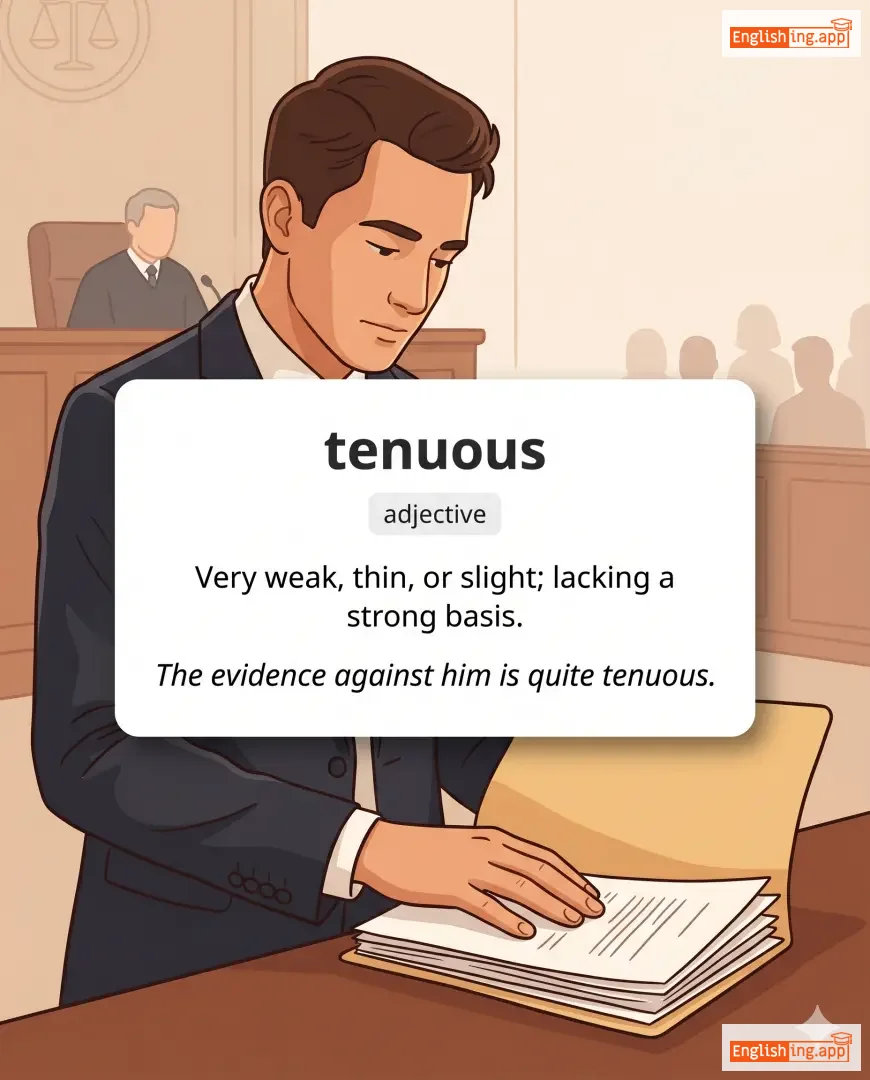
tenuous definition card — visual illustration of the meaning
adjective
/ˈtɛn.ju.əs/
弱い / 薄い (yowai / usui)

Very weak, thin, or slight; lacking a strong basis.

"The evidence against him is quite tenuous."

"彼に対する証拠はかなり弱いです。" (Kare ni taisuru shōko wa kanari yowai desu.)
adjective
/ˈtɛn.tə.tɪv/
仮の (kari no)

Not certain or fixed; done without confidence.

"She gave a tentative smile before agreeing."

"彼女は同意する前に仮の笑顔を見せた。" (Kanojo wa dōi suru mae ni kari no egao o miseta.)
noun
/tɛnt/
テント (tento)

a portable shelter made of fabric, supported by poles and ropes

"We set up a tent for the camping trip."

"キャンプのためにテントを設置しました。" (Kyanpu no tame ni tento o setchi shimashita.)
noun
/ˈtɛn.ʃən/
緊張 (kinchou)

A state of being stretched tight; mental or emotional strain.

"There was a lot of tension in the room before the exam results were announced."
"試験結果が発表される前、部屋には多くのテンションがありました。" (Shiken kekka ga happyou sareru mae, heya ni wa ooku no tenshon ga arimashita.)
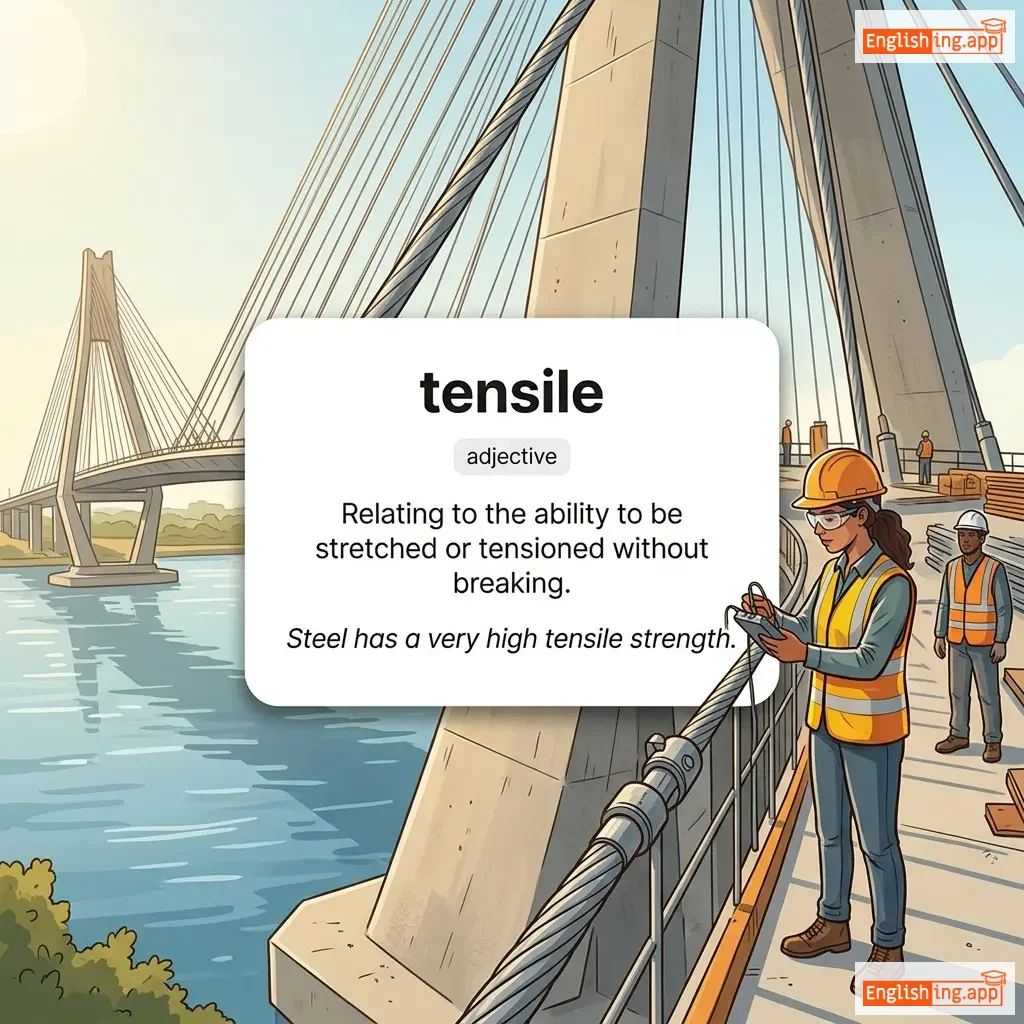
tensile definition card — visual illustration of the meaning
adjective
/ˈtɛn.saɪl/
伸張性 (shinchou-sei)

Relating to the ability to be stretched or tensioned without breaking.

"Steel has a very high tensile strength."

"鋼鉄は非常に高い伸張性を持っています。" (kōtetsu wa hijō ni takai shinchō-sei o motteimasu.)
noun, adjective, verb
/tɛns/
緊張 / 時制 (kinchou / jisei)

a grammatical category showing time reference; stretched tight or anxious

"She felt tense before the interview."

"彼女はインタビューの前に緊張していた。" (Kanojo wa intabyu no mae ni kinchou shite ita.)
noun
/ˈtɛnər/
テノール / 一般的なトーン (tenooru / ippantekina toon)

the general meaning, drift, or character of something; a male singing voice between baritone and alto

"The overall tenor of his speech was hopeful and reassuring."

"彼のスピーチの全体的なトーンは希望に満ち、安心感を与えるものでした。" (Kare no supīchi no zentaiteki na tōn wa kibō ni michi, anshinkan o ataeru mono deshita.)
noun
/tiː/
お茶 (ocha)

a hot drink made by infusing the dried, crushed leaves of the tea plant in boiling water

"I drink tea every morning to start my day."

"私は毎朝、1日を始めるためにお茶を飲みます。" (Watashi wa mai asa, ichinichi o hajimeru tame ni ocha o nomimasu.)