词汇表

英语词汇词典 | 单词含义、定义和示例

conjunction
/ðæn/
(bǐ)

used to introduce the second element in a comparison

"She is taller than her brother."

"她比她的哥哥高。" (Tā bǐ tā de gēgē gāo.)
noun
/ˈtɛkstʃər/
质地 (zhì dì)

the way something feels when you touch it; the quality of a surface or substance

"The fabric has a soft and smooth texture."

"这块布的质地柔软光滑。" (Zhè kuài bù de zhì dì róuruǎn guānghuá.)
noun
/ˈtek.staɪl/
纺织品 (fǎngzhīpǐn)

a type of cloth or woven fabric made by knitting or weaving fibers

"Bangladesh is famous for its high-quality textile industry."

"孟加拉国以其高质量的纺织业而闻名。" (Mèngjiālāguó yǐ qí gāo zhìliàng de fǎngzhīyè ér wénmíng.)
noun
/ˈtɛkstbʊk/
教科书 (jiaokeshu)

a book used for studying a subject in school or college

"She bought a new biology textbook for her class."

"她为她的班级买了一本新的生物学教科书。" (Tā wèi tā de bānjí mǎile yī běn xīn de shēngwùxué jiàokēshū.)
noun
/tɛkst/
文本 (wenben)

a written or printed work or passage, especially a book or document

"The teacher asked us to read the text on page 50."

"老师让我们阅读第50页上的文本。" (Laoshi rang women yuedu di 50 ye shang de wenben.)
verb
/ˈtɛðər/
绑住 (bang zhu)

To tie an animal with a rope or chain so it cannot move far.

"The farmer tethered the goat to a post."

"农民把山羊绑在柱子上。" (Nóngmín bǎ shānyáng bǎng zài zhùzi shàng.)
adjective
/ˈtɛsti/
暴躁 (bàozào)

Easily irritated or annoyed.

"He became testy when asked the same question repeatedly."

"当他一再被问到相同的问题时,他变得易怒。" (Dāng tā yīzài bèi wèn dào xiāngtóng de wèntí shí, tā biàn dé yìnù.)
noun
/ˈtɛstɪŋ/
测试 (ceshi)

the process of assessing or evaluating something, often by trying it out

"The testing of the new software is still ongoing."

"新软件的测试仍在进行。" (Xin ruanjian de ceshi reng zai jinxing.)
noun
/ˈtɛstəˌmoʊni/
证词 (zhèngcí)

A formal statement given in a court of law or evidence supporting a fact.

"Her testimony in court helped convict the criminal."

"她在法庭上的证词帮助定罪了罪犯。" (Tā zài fǎtíng shàng de zhèngcí bāngzhù dìngzuì le zuìfàn.)
testimonials definition card — visual illustration of the meaning
noun
/ˌtɛstɪˈməʊnɪəlz/
见证, 推荐信 (jianzheng, tuijianshin)

Written or spoken statements of praise or recommendation from clients or customers.

"Positive testimonials can enhance a company's reputation."

"积极的见证可以提升公司的声誉。" (Jījí de jiànzhèng kěyǐ tíshēng gōngsī de shēngyù.)
noun
/ˌtɛstɪˈmoʊniəl/
推荐信 (tuījiànxìn)

A formal statement testifying to someone's character, qualifications, or the quality of a product or service.

"The company shared a glowing testimonial from a satisfied customer."

"公司分享了来自满意客户的热情推荐信。" (Gōngsī fēnxiǎngle láizì mǎnyì kèhù de rèqíng tuījiànxìn.)
verb
/ˈtɛstəfaɪ/
作证 (zuò zhèng)

to make a statement or declaration under oath or to give evidence

"She was called to testify in court about the accident."

"她被叫到法庭作证,关于那起事故。" (Tā bèi jiào dào fǎtíng zuò zhèng, guānyú nà qǐ shìgù.)
noun
/ˈtɛsteɪtər/
立遗嘱人 (lì yízhǔ rén)

a person who has made a will

"The lawyer read the will of the deceased testator."

"律师朗读了已故立遗嘱人的遗嘱。" (Lǜshī lǎngdúle yǐgù lì yízhǔ rén de yízhǔ.)
noun
/ˈtɛstəmənt/
遗嘱 / 证明 (yízhǔ / zhèngmíng)

a person's will; or strong evidence of something

"His success is a testament to his hard work and dedication."
"他的成功是他辛勤工作和奉献精神的证明。" (tā de chénggōng shì tā xīnqín gōngzuò hé fèngxiàn jīngshén de zhèngmíng.)
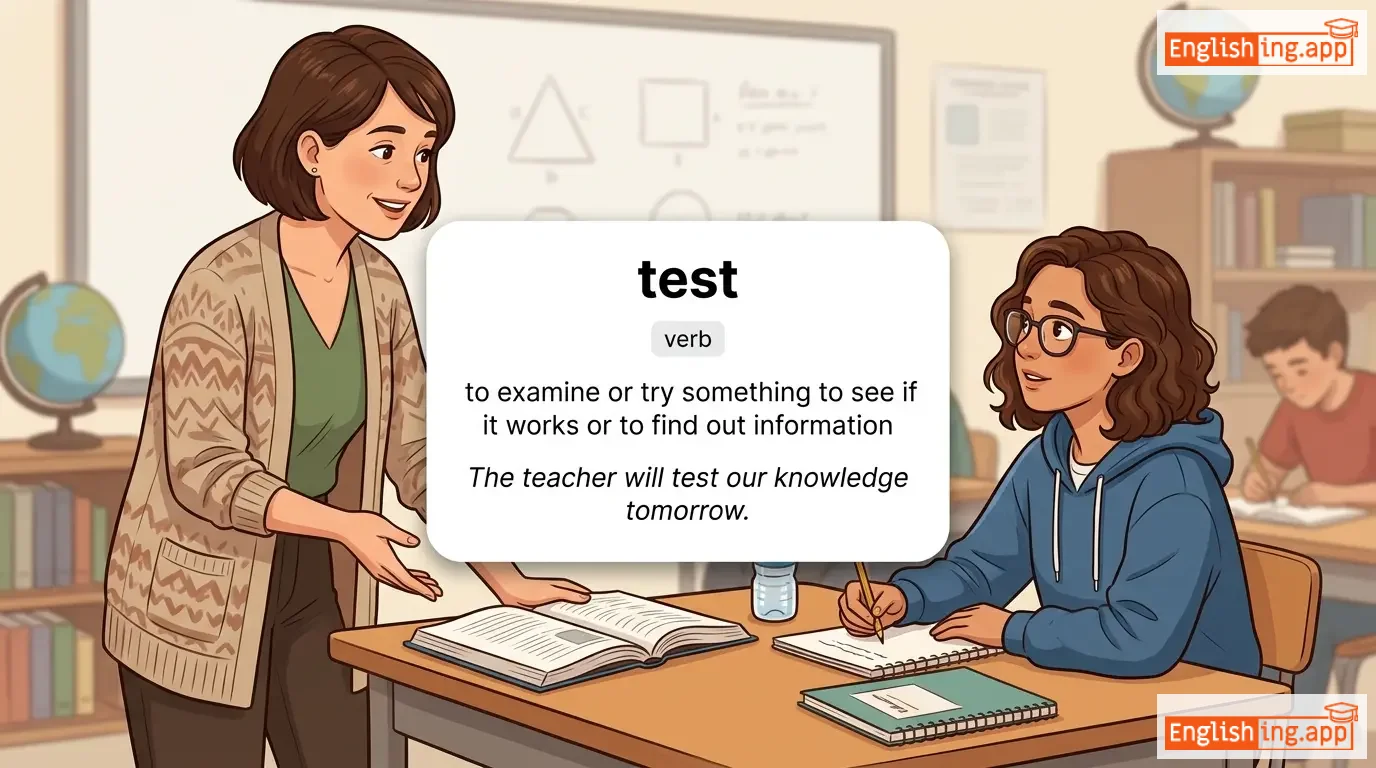
test definition card — visual illustration of the meaning
noun
/tɛst/
测试 (ceshi)

a procedure intended to establish the quality, performance, or reliability of something

"The test results will determine whether the treatment is effective."

"测试结果将决定治疗是否有效。" (Cèshì jiéguǒ jiāng juédìng zhìliáo shìfǒu yǒuxiào.)
adjective
/ˈtɛsəleɪtɪd/
马赛克 (mǎsàikè)

arranged in a pattern of repeated shapes fitting together without gaps

"The tessellated floor was made of colorful tiles arranged in perfect symmetry."

"马赛克地板由色彩斑斓的瓷砖组成,完美对称地排列。" (mǎsàikè dìbǎn yóu sècǎi bānlán de cí zhuān zǔchéng, wánměi duìchèn de páiliè.)
3️⃣

tertiary

adjective
/ˈtɜːrʃieri/

third in order, rank, or level

"He is pursuing his tertiary education at the university."

adjective
/tɜːrs/
简洁 (jianjie)

brief and to the point; sparing in the use of words

"His reply was terse and ended the conversation quickly."

"他的回答简洁,迅速结束了对话。" (tade huida jianjie, xunxu jieshu le duihua.)
noun
/ˈtɛrərɪst/
恐怖分子 (kongbufenzi)

a person who uses violence or threats to intimidate or coerce, especially for political purposes

"The terrorist was arrested by the police after the attack."

"恐怖分子在袭击后被警察逮捕。" (Kongbufenzi zai xiji hou bei jingcha daibu.)
noun
/ˈtɛrərɪzəm/
恐怖主义 (kǒngbù zhǔyì)

the use of violence or threats to intimidate or coerce, especially for political purposes

"Terrorism is a serious threat to global peace and security."

"恐怖主义是对全球和平与安全的严重威胁。" (Kǒngbù zhǔyì shì duì quánqiú hépíng yǔ ānquán de yánzhòng wēixié.)
noun
/ˈtɛrər/
恐怖 (kongbu)

Extreme fear or dread.

"The villagers fled in terror during the attack."
"村民们在袭击时逃入恐惧之中。" (Cūnmínmen zài xíjī shí táo rù kǒngjù zhī zhōng.)
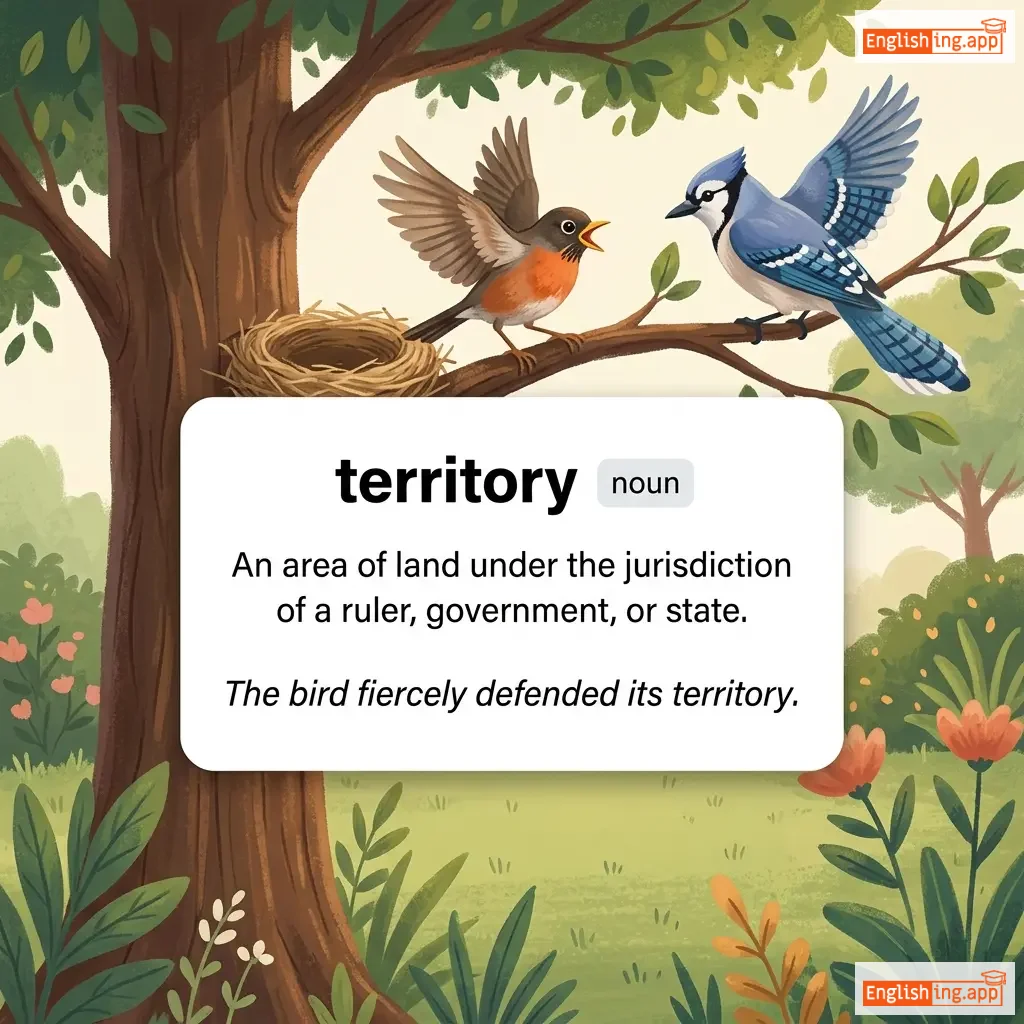
territory definition card — visual illustration of the meaning
noun
/ˈtɛrɪˌtɔːri/
领土 (lingtu)

An area of land under the jurisdiction of a ruler, government, or state.

"The bird fiercely defended its territory."

"鸟类猛烈地保卫着它的领土。" (Niaolai menglie de baowei zhe ta de lingtu.)
adjective
/ˌtɛrɪˈtɔːriəl/
领土的 (lingtu de)

Relating to the ownership or control of land or territory.

"The two countries had a territorial dispute over the island."

"这两个国家在这个岛屿上有领土争议。" (Zhè liǎng gè guójiā zài zhège dǎoyǔ shàng yǒu lǐngtǔ zhēngyì.)
verb
/ˈtɛrəˌfaɪ/
使惊吓 (shǐ jīng xià)

To cause someone to feel extreme fear.

"The loud thunder terrified the children."

"响亮的雷声把孩子们吓坏了。" (Xiǎngliàng de léishēng bǎ háizimen xià huài le.)
adjective
/təˈrɪfɪk/
了不起 (liaobuqi)

extremely good or excellent; very great or intense

"The concert last night was absolutely terrific."

"昨晚的音乐会真是太棒了。" (Zuó wǎn de yīnyuè huì zhēn shì tài bàngle.)
adverb
/ˈtɛrəbli/
可怕地 (kěpà de)

to a very great or extreme degree; very badly or unpleasantly

"He felt terribly sad after hearing the news."
"听到消息后,他感到可怕地悲伤。" (Tīng dào xiāoxī hòu, tā gǎndào kěpà de bēishāng.)
adjective
/ˈtɛrɪbəl/

extremely bad or unpleasant

"The food at that restaurant was terrible."

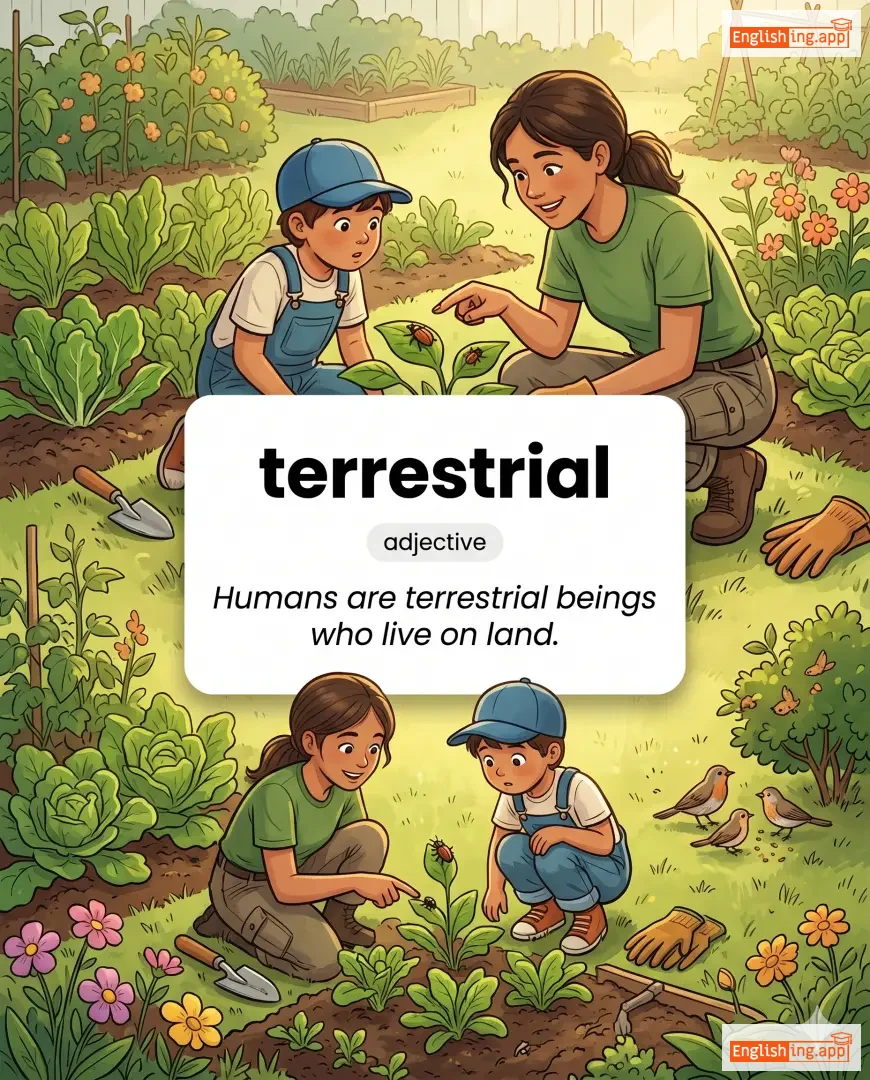
terrestrial definition card — visual illustration of the meaning
adjective
/təˈrɛstriəl/
陆生 (lù shēng)

Relating to the Earth or land as opposed to the sea or air; living or growing on land.

"Humans are terrestrial beings who live on land."

"人类是生活在陆地上的陆生生物。" (Rénlèi shì shēnghuó zài lùdì shàng de lùshēng shēngwù.)
noun
/ˈterəpɪn/
一种小型淡水龟 (yī zhǒng xiǎo xíng dàn shuǐ guī)

a small freshwater turtle, especially one found in North America

"The terrapin slowly crawled into the pond."

"特拉品慢慢爬进了池塘。" (Tèlā pǐn màn man pá jìn le chítáng.)
noun
/təˈreɪn/
地形 (dixing)

a stretch of land, especially with regard to its physical features

"The soldiers had to cross rough terrain during the mission."

"士兵们必须在任务期间穿越艰难的地形。" (Shibing men bixu zai renwu qi jian chuanyue jiannan de dixing.)
noun
/tɜːmz/
条款 (tiaokuan)

plural of term; conditions or rules in a contract or agreement

"The terms of the agreement are clearly outlined in the contract."

"协议条款在合同中明确列出。" (Xieyi tiaokuan zai hetong zhong mingque liechu.)
noun
/ˈtɜːrmɪnəs/
终点站 (zhong dian zhan)

the final point or end of something, especially the final station on a railway line

"The train finally arrived at the terminus after a long journey."

"火车经过长时间的旅行后,终于到达了终点站。" (Huoche jingguo chang shijian de lvxing hou, zhongyu daoda le zhongdian zhan.)
noun
/ˌtɜːrməˈnɑːlədʒi/
术语 (shùyǔ)

the set of technical or special words used in a particular subject

"Medical terminology can be difficult for new students to understand."

"医学术语可能对新学生来说很难理解。" (Yīxué shùyǔ kěnéng duì xīn xuéshēng lái shuō hěn nán lǐjiě.)
noun
/ˌtɜːrmɪˈneɪʃən/
终止 (zhongzhi)

the act of ending something or the state of being ended

"The termination of the contract caused financial loss."

"合同的终止导致了财务损失。" (Hetong de zhongzhi daozhi le caiwu sunshi.)
verb
/ˈtɜːrmɪˌneɪt/
终止 (zhongzhi)

to bring something to an end or to stop something from continuing

"The company decided to terminate his contract."

"公司决定终止他的合同。" (Gōngsī juédìng zhōngzhǐ tā de hétong.)
noun/adjective
/ˈtɜːrmɪnəl/
终点站,最终,绝症 (zhōngdiǎn zhàn, zuìzhōng, juézhèng)

As a noun: A place where transport routes begin or end. As an adjective: Relating to the end or final stage of something, often an illness.

"He waited for the bus at the central terminal."

"他在中央终点站等公交车。" (tā zài zhōngyāng zhōngdiǎn zhàn děng gōngjiāo chē.)
noun
/ˈtɜːrməɡənt/
专横且脾气暴躁的女性 (zhuānhèng qiě píqì bàozào de nǚxìng)

A harsh-tempered or overbearing woman.

"The character was portrayed as a loud and domineering termagant."

"这个角色被描绘成一个大声且专横的特尔玛甘特女性。" (Zhège juésè bèi miáohuì chéng yīgè dàshēng qiě zhuānhèng de tè'ěrmágāntè nǚxìng.)
noun
/tɜːm/
术语 (shùyǔ)

a word or phrase used to describe a thing or to express a concept

"The term 'machine learning' is commonly used in technology."

"‘机器学习’这一术语在技术领域中广泛使用。" (‘Jīqì xuéxí’ zhè yī shùyǔ zài jìshù lǐngyù zhōng guǎngfàn shǐyòng.)
noun
/ˌtɜːdʒɪvərˈseɪʃən/
回避, 背离 (huí bì, bèi lí)

Evasion of straightforward action or speech; changing sides or being inconsistent.

"The politician’s tergiversation frustrated his supporters."

"政治家的回避行为让他的支持者感到沮丧。" (Zhèngzhìjiā de huíbì xíngwéi ràng tā de zhīchí zhě gǎndào jǔsàng.)
noun
/ˌtɜːsənˈtɛnəri/
三百周年纪念 (san bai zhou nian ji nian)

The 300th anniversary of an event.

"The city celebrated its tercentenary with a grand festival."

"这座城市以盛大的节日庆祝了它的三百年纪念日。" (Zhe zuo chengshi yi shengda de jieri qingzhu le ta de san bai nian jinian ri.)
adjective
/ˈtɛpɪd/
温热, 不热衷 (wēn rè, bù rèzhōng)

Lukewarm; showing little enthusiasm or force.

"His speech received only a tepid response from the audience."

"他的演讲只收到听众的温热反应。" (Tā de yǎnjiǎng zhǐ shōu dào tīngzhòng de wēn rè fǎnyìng.)
noun
/ˈtɛnjər/
任期 (renqi)

The period of time during which someone holds a position, office, or land.

"His tenure as president lasted for five years."

"他作为总统的任期持续了五年。" (Tā zuòwéi zǒngtǒng de rènqī chíxù le wǔ nián.)
tenuous definition card — visual illustration of the meaning
adjective
/ˈtɛn.ju.əs/
薄弱 / 稀薄 (bó ruò / xī bó)

Very weak, thin, or slight; lacking a strong basis.

"The evidence against him is quite tenuous."

"对他不利的证据相当薄弱。" (Duì tā bù lì de zhèngjù xiāngdāng bó ruò.)
adjective
/ˈtɛn.tə.tɪv/
试探性的 (shì tàn xìng de)

Not certain or fixed; done without confidence.

"She gave a tentative smile before agreeing."

"她在同意之前露出了试探性的微笑。" (Tā zài tóngyì zhīqián lùchūle shì tàn xìng de wēixiào.)
noun
/tɛnt/
帐篷 (zhàngpéng)

a portable shelter made of fabric, supported by poles and ropes

"We set up a tent for the camping trip."

"我们为露营旅行搭建了一个帐篷。" (Wǒmen wèi lùyíng lǚxíng dājiànle yīgè zhàngpéng.)
noun
/ˈtɛn.ʃən/
紧张 (jin zhang)

A state of being stretched tight; mental or emotional strain.

"There was a lot of tension in the room before the exam results were announced."
"考试结果公布前,房间里充满了紧张气氛。" (Kaoshi jieguo gongbu qian, fangjian li chongman le jinzhang qifen.)
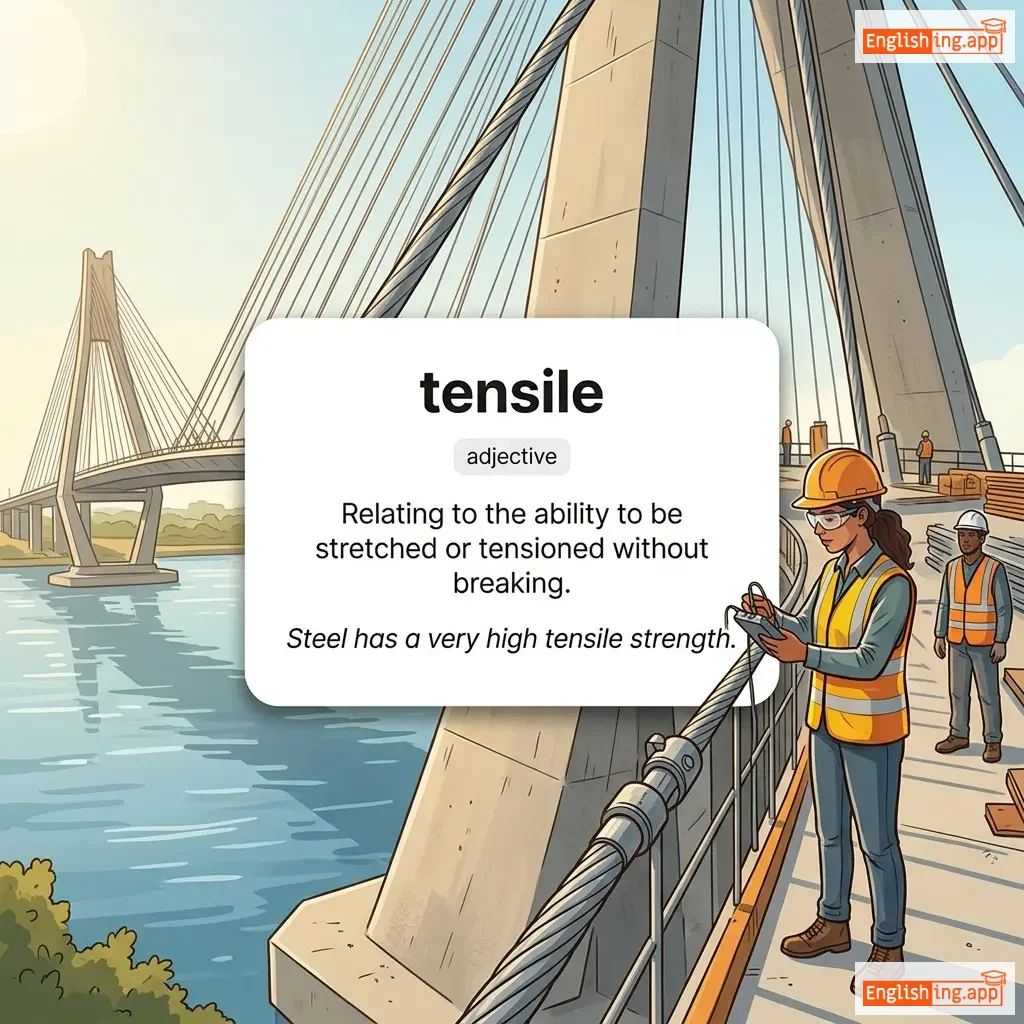
tensile definition card — visual illustration of the meaning
adjective
/ˈtɛn.saɪl/
可伸展的 (kě shēnzhǎn de)

Relating to the ability to be stretched or tensioned without breaking.

"Steel has a very high tensile strength."

"钢铁具有非常高的可伸展强度。" (gāngtiě jùyǒu fēicháng gāo de kě shēnzhǎn qiángdù.)
noun, adjective, verb
/tɛns/
紧张 / 语法时态 (jin zhang / yu fa shi tai)

a grammatical category showing time reference; stretched tight or anxious

"She felt tense before the interview."

"她在面试前感到紧张。" (Ta zai mianshi qian gandao jinzhang.)
noun
/ˈtɛnər/
男高音 / 一般基调 (nán gāo yīn / yī bān jī diào)

the general meaning, drift, or character of something; a male singing voice between baritone and alto

"The overall tenor of his speech was hopeful and reassuring."

"他演讲的总体基调是充满希望和安慰的。" (Tā yǎnjiǎng de zǒngtǐ jīdiào shì chōngmǎn xīwàng hé ānwèi de.)
noun
/tiː/
(cha)

a hot drink made by infusing the dried, crushed leaves of the tea plant in boiling water

"I drink tea every morning to start my day."

"我每天早晨喝茶开始新的一天。" (Wǒ měitiān zǎochén hē chá kāishǐ xīn de yītiān.)