词汇表

英语词汇词典 | 单词含义、定义和示例

noun
/ˈtʌnəl/
隧道 (suìdào)

an underground passage or shaft

"They dug a tunnel under the river."

"他们在河底挖了一个隧道。" (Tāmen zài hédǐ wāle yīgè suìdào.)
noun
/ˈtɜːrbən/
头巾 (tóujīn)

a head covering made by wrapping a long piece of cloth around the head

"The Sikh man wore a colorful turban."
"那位锡克教徒戴着一顶彩色的头巾。" (nà wèi xī kè jiào tú dài zhe yī dǐng cǎisè de tóujīn.)
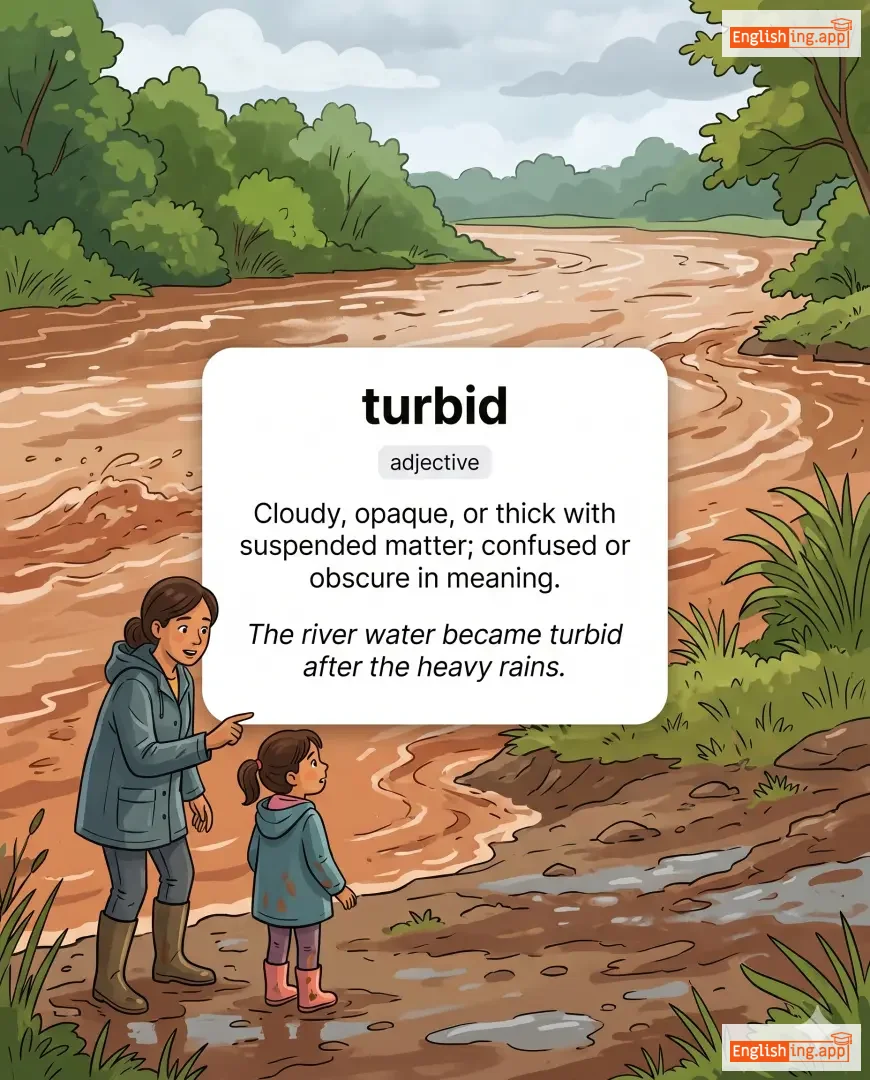
turbid definition card — visual illustration of the meaning
adjective
/ˈtɜːrbɪd/
浑浊 (hunzhuo)

Cloudy, opaque, or thick with suspended matter; confused or obscure in meaning.

"The river water became turbid after the heavy rains."

"大雨过后,河水变得浑浊。" (Dayu guo hou, he shui biande hunzhuo.)
noun
/ˈtɜːrbjələns/

Violent or unsteady movement of air, water, or some other fluid; disorder or conflict.

"The plane experienced severe turbulence during the flight."

adjective
/ˈtɜːrbjələnt/
动荡 (dongdang)

Characterized by conflict, disorder, or confusion; not stable or calm.

"The country went through a turbulent period of political change."

"这个国家经历了一个动荡的政治变革时期。" (Zhe ge guo jia jing li le yi ge dong dang de zheng zhi bian ge shi qi.)
noun
/tʊˈriːn/
炖锅 (dun guo)

A large deep dish with a cover, used for serving soups or stews.

"She brought the hot soup to the table in a silver tureen."
"她把热汤端到桌子上,放在一个银色的炖锅里。" (Ta ba re tang duan dao zhuozi shang, fang zai yige yinse de dun guo li.)
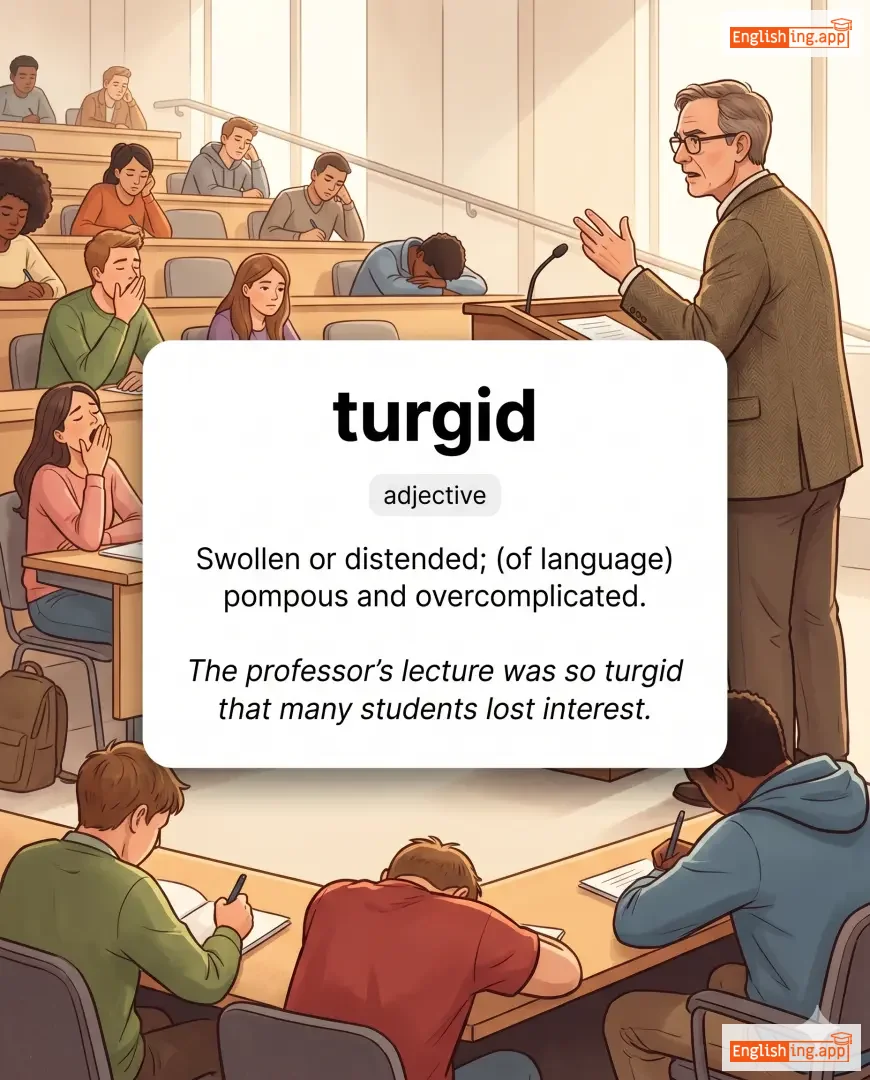
turgid definition card — visual illustration of the meaning
adjective
/ˈtɜːrdʒɪd/
肿胀的, 浮夸的 (zhongzhang de, fu kua de)

Swollen or distended; (of language) pompous and overcomplicated.

"The professor’s lecture was so turgid that many students lost interest."

"教授的讲座太浮夸了,许多学生失去了兴趣。" (Jiaoshou de jiangzuo tai fu kua le, xu duo xuesheng shiqu le xingqu.)
noun
/ˈtɜːrki/
火鸡 (一种大鸟) (huǒ jī)

a large bird native to North America, often eaten at special occasions like Thanksgiving; also the meat of this bird.

"We roasted a turkey for Thanksgiving dinner."

"我们为感恩节晚餐烤了一只火鸡。" (Wǒmen wèi gǎn'ēn jié wǎncān kǎo le yī zhī huǒ jī.)
noun
/ˈtɜr.mər.ɪk/
姜黄 (jiang huang)

A bright yellow spice powder made from the root of a tropical plant, used in cooking and medicine

"Add turmeric to the curry for color and flavor."

"在咖喱中加入姜黄,以增加色彩和味道。" (Zai gāli zhōng jiārù jiāng huáng, yǐ zēngjiā sècǎi hé wèidào)
noun
/ˈtɜːr.mər.ɪk ˈpaʊ.dər/
姜黄粉 (jiang huang fen)

ground turmeric root used as a spice and for its medicinal properties

"Add a pinch of turmeric powder to the curry for color and flavor."
"在咖喱中加入一撮姜黄粉,增加色泽和味道。" (Zai gāli zhōng jiārù yī cuò jiāng huáng fěn, zēngjiā sèzé hé wèidào.)
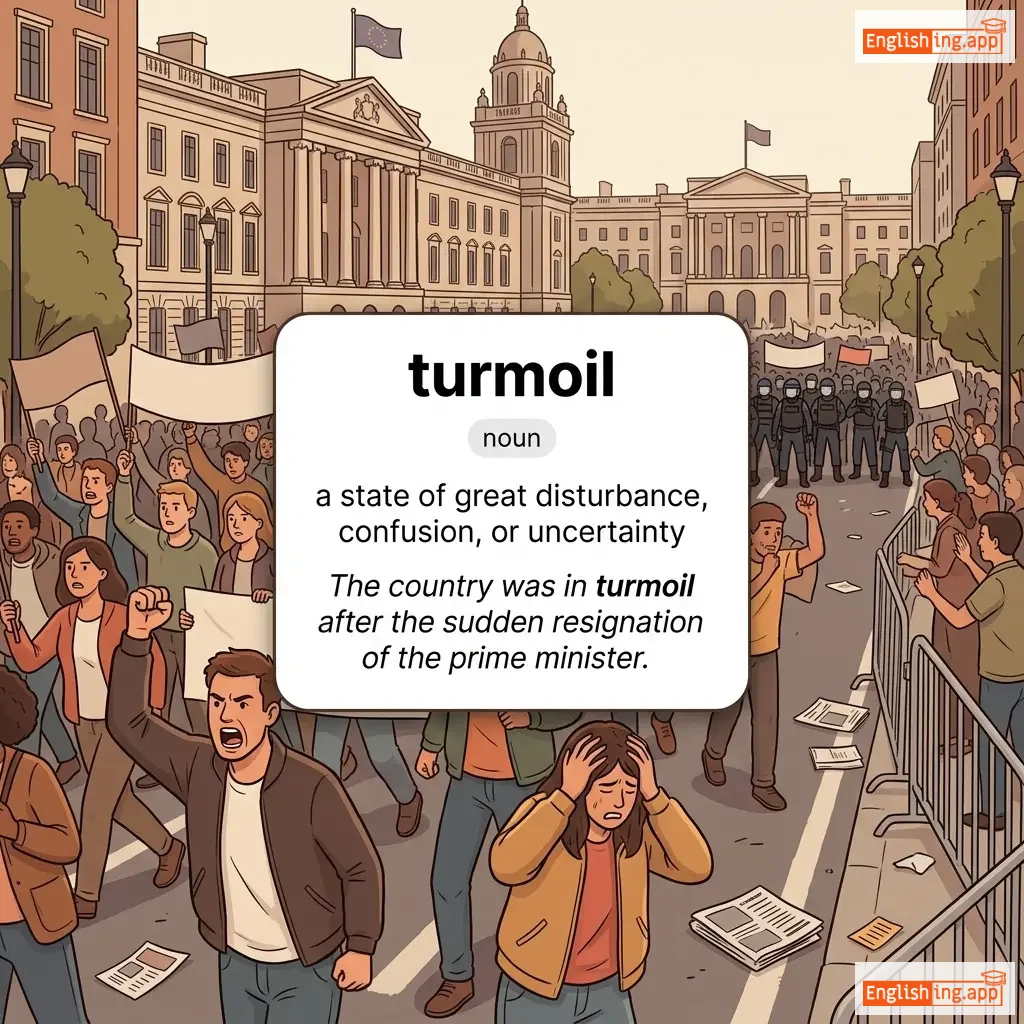
turmoil definition card — visual illustration of the meaning
noun
/ˈtɜːrmɔɪl/
混乱 (hunluan)

a state of great disturbance, confusion, or uncertainty

"The country was in turmoil after the sudden resignation of the prime minister."

"在总理突然辞职后,国家陷入了混乱。" (Zai zongli tuuran cizhi hou, guojia xianru le hunluan.)
Turn definition card — visual illustration of the meaning
verb
/tɜːrn/
转动 (zhuandong)

to change direction or position

"Turn right at the next intersection."

"在下一个路口右转。" (Zai xia yige lukou you zhuan.)
noun
/ˈtɜːrnkoʊt/
叛徒 (pantú)

a person who switches allegiance, often betraying a cause or group

"He was branded a turncoat after joining the rival political party."

"在加入对立的政党后,他被贴上了叛徒的标签。" (Zài jiārù duìlì de zhèngdǎng hòu, tā bèi tiē shàngle pàntú de biāoqiān.)
noun
/ˈtɜːr.nɪŋ/
转弯; 侧路 (zhuǎn wān; cè lù)

a place where a road branches off from another; a side road

"Take the first turning on the left."

"在第一个转弯处左转。" (zài dì yī gè zhuǎn wān chù zuǒ zhuǎn.)
noun
/ˈtɜːr.nɪp/
萝卜 (luóbo)

a round root vegetable with white or purple skin and white flesh

"We grew turnips in our vegetable garden."

"我们在菜园里种了萝卜。" (Women zai caiyuan li zhongle luobo.)
adjective
/ˈtɜːrnkiː/
交钥匙 (jiao yaoshi)

ready for immediate use; a complete product or solution

"The company provides turnkey solutions for small businesses."

"公司为小企业提供交钥匙解决方案。" (Gongsi wei xiao qiye tigong jiao yaoshi jiejue fang'an.)
noun
/ˈtɜːr.naʊt/
出席人数 (chuxi renshu)

the number of people who attend or participate in an event or activity

"The turnout at the rally was impressive, with thousands showing up."

"集会的出席人数令人印象深刻,成千上万的人到场。" (Jihui de chuxi renshu lingren yinxiang shenke, chengqian shangwan de ren dao chang.)
noun
/ˈtɜːnˌəʊvə/
营业额 (yíngyèé)

the amount of business conducted during a particular period, or the rate at which employees leave a company

"The company reported a high turnover in its sales department."

"公司报告了其销售部门的高营业额。" (Gōngsī bàogào le qí xiāoshòu bùmén de gāo yíngyèé.)
noun
/ˈtɜːrpɪtuːd/
堕落 (duòluò)

depraved or wicked behavior or character

"The judge condemned the criminal’s act of moral turpitude."

"法官谴责了罪犯的道德堕落行为。" (Fǎguān qiǎnzéle zuìfàn de dàodé duòluò xíngwéi.)
noun
/ˈtɜːrkwɔɪz/
绿松石 (lü sōng shí)

a greenish-blue color or gemstone

"She wore a necklace with a beautiful turquoise stone."

"她戴着一条美丽的绿松石项链。" (Tā dàizhe yītiáo měilì de lǜsōngshí xiàngliàn.)
noun
/ˈtʌrɪt/
一个较大塔楼或建筑物顶部的小塔 (yīgè jià dà tǎlóu huò jiànzhúwù dǐngbù de xiǎo tǎ)

A small tower on top of a larger tower or building, often used in castles or fortifications.

"The castle was guarded by soldiers stationed in the turret."

"城堡由驻守在塔楼中的士兵守卫。" (Chéngbǎo yóu zhùshǒu zài tǎlóu zhōng de shìbīng shǒuwèi.)
noun
/ˈtɜːrtl/
乌龟 (wugui)

A slow-moving reptile with a hard shell that lives in water or on land

"The turtle slowly crossed the sandy beach."

"乌龟慢慢地穿过沙滩。" (Wugui manman de chuanguo shatan)
noun
/ˈtjuːtɪlɪdʒ/
教导 (jiaodao)

The act of guarding, protecting, or guiding; instruction or teaching.

"She studied painting under the tutelage of a famous artist."

"她在一位著名艺术家的指导下学习绘画。" (Tā zài yī wèi zhùmíng yìshùjiā de zhǐdǎo xià xuéxí huìhuà.)
adjective
/ˈtjuːtɪlɑːr/
保护的 (bǎohù de)

Serving as a guardian or protector.

"The tutelar spirit of the forest was believed to protect travelers."
"森林的守护灵被认为是保护旅行者的存在。" (Senlin de shouhuling bei renwei shi baohu luxingzhe de cunzai.)
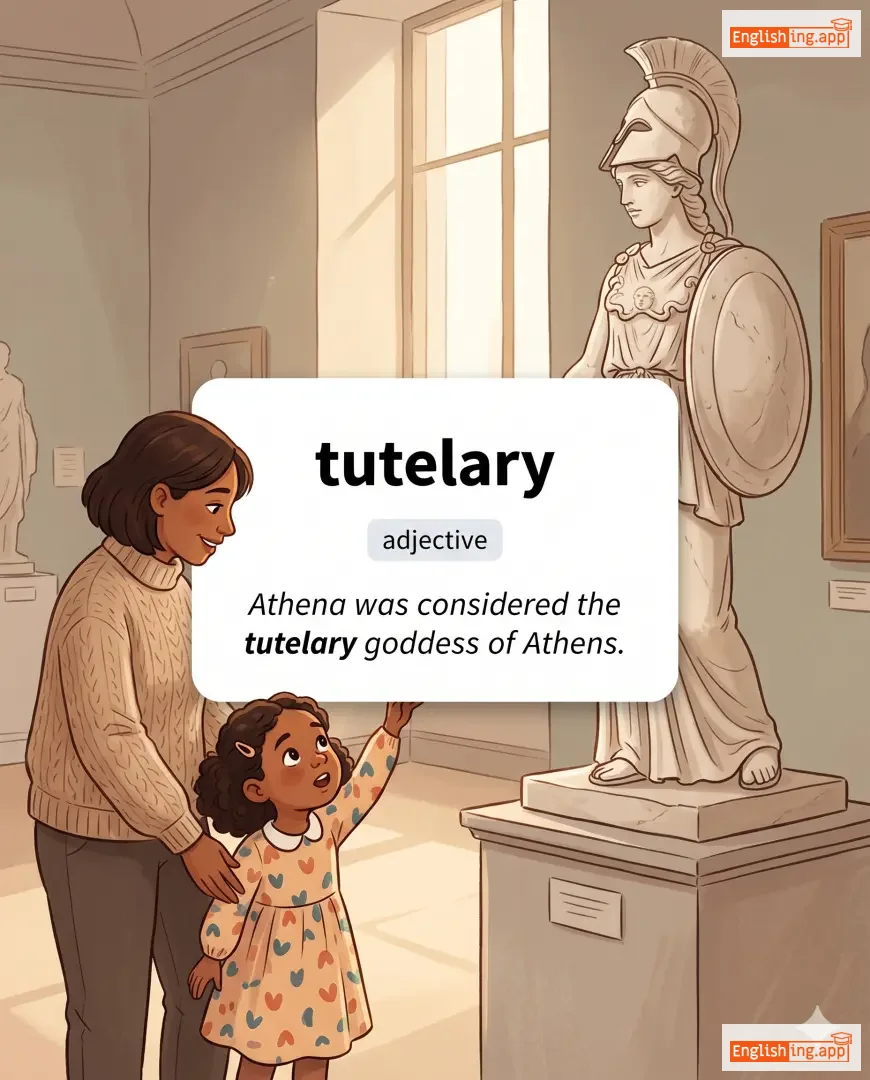
tutelary definition card — visual illustration of the meaning
adjective
/ˈtjuːtɪləri/
守护神 (shouhushen)

Relating to or serving as a guardian or protector, often used for deities or spirits.

"Athena was considered the tutelary goddess of Athens."

"雅典娜被认为是雅典的守护女神。" (Yadianna bei renwei shi Yadian de shouhu nvshen.)
noun
/ˈtjuːtərʃɪp/
辅导 (fǔdǎo)

The office or position of a tutor; guidance or instruction given by a tutor.

"He thrived under the tutorship of his mentor."

"他在导师的辅导下取得了成功。" (Tā zài dǎoshī de fǔdǎo xià qǔdé le chénggōng.)
noun
/ˈtiːˈviː/
电视 (diànshì)

a device used to receive television broadcasts

"I watch my favorite shows on TV every evening."

"我每天晚上都在电视上看我最喜欢的节目。" (Wǒ měitiān wǎnshàng dōu zài diànshì shàng kàn wǒ zuì xǐhuān de jiémù.)
tweak definition card — visual illustration of the meaning
verb
/twiːk/
微调 (wēi tiáo)

to make small adjustments; to fine-tune something

"We need to tweak the design slightly."

"我们需要稍微调整设计。" (Wǒmen xūyào shāowéi tiáo zhěng shèjì)
noun
/twiːt/
鸣叫 (mingjiao)

a short high-pitched sound made by a small bird; a post on Twitter

"I heard the sweet tweet of a sparrow this morning."

"我今天早上听到了一只麻雀的甜美推特声。" (Wo jintian zaoshang tingdao le yizhi maque de tianmei tuite sheng.)
adjective
/twɛlv/
十二 (shi er)

the number equivalent to 12

"There are twelve months in a year."

"一年有十二个月。" (Yi nian you shi er ge yue.)
adjective
/ˈtwɛntiəθ/
第二十 (dièrshí)

coming after the nineteenth in order; being one of twenty equal parts.

"She was born on the twentieth of April."

"她出生在四月二十日。" (Tā chūshēng zài sìyuè èrshí rì.)
2️⃣0️⃣

twenty (èrshí)

adjective
/ˈtwɛnti/
二十 (èrshí)

the number equivalent to 20

"He is twenty years old."

"他二十岁。" (Tā èrshí suì.)
adverb
/twaɪs/
两次 (liǎng cì)

two times

"I have seen that movie twice."

"我看过那部电影两次。" (Wǒ kànguò nà bù diànyǐng liǎng cì.)
noun
/twɪɡ/
小树枝 (xiao shu zhi)

a small thin branch of a tree or bush

"She broke a twig off the tree to use as a stick."

"她从树上折下一根小树枝用作棍子。" (Ta cong shu shang zhe xia yi gen xiao shuzhi yong zuo gunzi.)
noun
/ˈtwaɪ.laɪt/
暮光 (muguang)

the soft glowing light from the sky when the sun is below the horizon; a period of decline

"We walked along the beach at twilight."

"我们在暮光下沿着海滩散步。" (Women zai muguang xia yanzhe haitan sanbu.)
👯‍♂️

twin (双胞胎)

noun
/twɪn/
双胞胎 (shuāngbāotāi)

either of two children born at the same time to the same mother

"They have twin girls."

"他们有一对双胞胎女孩。" (Tāmen yǒu yī duì shuāngbāotāi nǚhái.)
noun
/twɪndʒ/
剧烈的痛苦 (julie de tongku)

a sudden, sharp pain or an emotional pang

"He felt a twinge of guilt after lying to his friend."

"他在对朋友撒谎后感到一阵罪恶感的剧烈痛苦。" (Tā zài duì péngyǒu sāhuǎng hòu gǎndào yī zhèn zuì'è gǎn de jùliè tòngkǔ.)
verb
/twɪst/
扭曲, 旋转 (niǔqū, xuánzhuǎn)

to bend or turn something into a coil or spiral shape; to distort.

"He twisted the rope tightly around the pole."

"他把绳子紧紧地缠绕在杆子上。" (Tā bǎ shéngzi jǐn jǐn de chánrào zài gǎnzi shàng.)
adjective
/ˌʌltrəˈmɒnteɪn/
教皇支持者 (jiaohuang zhichi zhe)

beyond the mountains, especially referring to support for the Pope over local church authority

"The debate highlighted the ultramontane position in church politics."

"辩论突出了教会政治中超山的立场。" (Bianlun tuchu le jiaohui zhengzhi zhong chaoshan de lichang.)
noun
/ʌnəˈbɪləti/
无能 (wuneng)

the state of being unable to do something; incapacity

"His unability to solve the problem caused delays in the project."

"他解决问题的无能导致了项目的延误。" (Ta jiejue wenti de wuneng daozhule xiangmu de yanwu)
noun
/ʌmˈbrɛlə/
(san)

A device used for protection against rain or sun, typically consisting of a collapsible canopy mounted on a central rod.

"She opened her umbrella as it started to rain."

"下雨时她打开了她的伞。" (Xia yu shi ta dakai le ta de san.)
noun
/ˈʌmbrɪdʒ/
冒犯,愤怒 (maofan, fennu)

A feeling of resentment or offense.

"She took umbrage at his rude remark."

"她对他的粗鲁言论感到愤怒。" (Tā duì tā de cūlǔ yánlùn gǎndào fènnù.)
noun
/ˈʌm.brə/
完全的阴影,太阳黑子的黑暗中心 (wánquán de yīnyǐng, tàiyáng hēizǐ de hēi'àn zhōngxīn)

the fully shaded inner region of a shadow cast by an opaque object; the dark center of a sunspot

"During the eclipse, we stood in the moon's umbra."

"在日食期间,我们站在月亮的本影中。" (zài rìshí qījiān, wǒmen zhàn zài yuèliàng de běn yǐng zhōng)
adjective
/ˌʌltrəˈmʌndeɪn/
超凡 (chaofan)

Relating to things beyond the physical world; supernatural or transcendental.

"Philosophers often discuss ultramundane realities beyond human perception."

"哲学家们常常讨论超越人类感知的超凡现实。" (Zhexueshi men changchang taolun chaoyue renlei ganzhi de chaofan xianshi.)
adjective
/ˈʌltɪmət/
终极 (zhongji)

being the best, final, or most extreme

"Success is the ultimate goal of hard work."

"成功是辛勤工作中的终极目标。" (Chenggong shi xinqin gongzuo zhong de zhongji mubiao.)
🤕

ulcer

noun
/ˈʌlsər/

a sore on the skin or a mucous membrane that does not heal easily

"The doctor prescribed medicine to treat the stomach ulcer."

adjective
/ʌlˈtɪəriər/
隐藏的动机 (yǐn cáng de dòng jī)

hidden or secret, often with a selfish motive

"He invited her with an ulterior motive."

"他带着隐藏的动机邀请了她。" (Tā dàizhe yǐn cáng de dòng jī yāo qǐng le tā.)
🙅‍♀️

Unable (ʌˈneɪbl)

adjective
/ʌˈneɪbl/
无法 (wúfǎ)

not able to do something

"She was unable to attend the meeting."

"她无法参加会议。" (Tā wúfǎ cānjiā huìyì.)
adverb
/ˈʌltəmətli/
最终 (zuì zhōng)

in the end, after everything else

"Ultimately, we decided to go ahead with the project."

"最终,我们决定继续推进该项目。" (Zuì zhōng, wǒmen juédìng jìxù tuījin gāi xiàngmù.)
noun
/ˌʌltɪˈmeɪtəm/
最后通牒 (zuìhòu tōngdié)

a final demand or statement of terms

"The workers gave the company an ultimatum to raise their wages."

"工人们向公司提出了一个要求,要求提高工资。" (Gōngrénmen xiàng gōngsī tíchūle yīgè yāoqiú, yāoqiú tígāo gōngzī.)