词汇表

英语词汇词典 | 单词含义、定义和示例

⬇️

nadir

noun
/ˈneɪdɪər/

The lowest point of a situation or condition.

"The company reached its nadir during the financial crisis."

noun, verb
/neɪl/
钉子 (dīngzi)

a small metal spike driven into wood or other material, or to fasten or fix something with nails

"He nailed the wooden board to the wall."

"他把木板钉在墙上。" (tā bǎ mùbǎn dī zài qiáng shàng.)
adjective
/naɪˈiːv/
天真 (tian zhen)

Lacking experience, wisdom, or judgment; too trusting.

"She was naïve to believe every advertisement she saw."

"她天真地相信她看到的每一个广告。" (Ta tian zhen de xiang xin ta kan dao de mei yi ge guang gao.)
noun
/naɪˈiːvteɪ/

The quality of being naive; lack of experience, wisdom, or judgment.

"His naivete made him an easy target for manipulation."

noun
/naɪˈiːvɪti/
天真 (tianzhen)

The quality of being innocent, simple, and lacking experience or sophistication.

"Her naivety made her trust people too easily."

"她的天真使她太容易相信别人。" (Ta de tianzhen shi ta tai rongyi xiangxin bieren.)
adjective
/ˈneɪkɪd/
赤裸 (chiluo)

not covered by clothing or without protection

"The child was running naked in the yard."

"孩子在院子里赤裸地跑来跑去。" (Haizi zai yuanzi li chiluo de pao lai pao qu.)
name definition card — visual illustration of the meaning
noun
/neɪm/
名字 (mingzi)

a word by which a person or thing is known or called

"His name is John."

"他的名字是约翰。" (Tā de míngzì shì Yuēhàn.)
adjective
/ˈneɪmləs/
无名 (wu ming)

Without a name or not known by name.

"A nameless fear crept over him in the dark room."

"一个无名的恐惧在黑暗的房间里袭击了他。" (Yi ge wu ming de kong ju zai hei'an de fang jian li xi ji le ta.)
adverb
/ˈneɪmli/
也就是说 (ye shi shuo)

that is to say; to be specific

"The festival will be held in three cities, namely Dhaka, Chittagong, and Sylhet."
"节日将在三个城市举行,也就是说,达卡、吉大港和西莱特。" (Jieri jiang zai san ge chengshi juxing, ye shi shuo, Daka, Jidagang he Xilaite.)
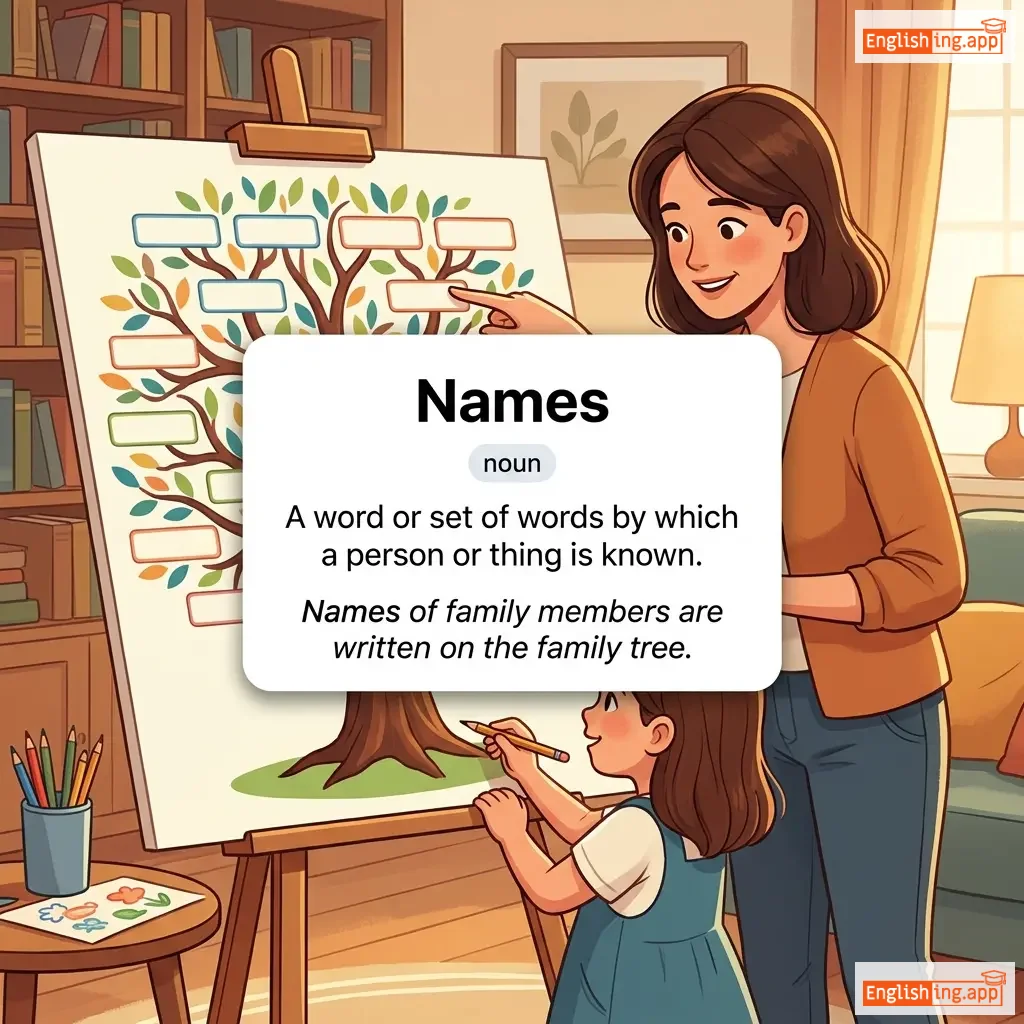
Names definition card — visual illustration of the meaning
noun
neɪmz
名字 (mingzi)

A word or set of words by which a person or thing is known.

"Names of family members are written on the family tree."

"家庭成员的名字写在家谱上。" (Jiātíng chéngyuán de míngzì xiě zài jiāpǔ shàng.)
nanotechnology definition card — visual illustration of the meaning
noun
ˌnæn.oʊ.tekˈnɒl.ə.dʒi
纳米技术 (nà mǐ jì shù)

The branch of technology that deals with dimensions and tolerances of less than 100 nanometers.

"Nanotechnology is advancing medical treatments."

"纳米技术正在推动医疗治疗的发展。" (Nà mǐ jì shù zhèng zài tuī dòng yī liáo zhì liáo de fā zhǎn.)
noun
/ˈnæp.kɪn/
餐巾 (canjin)

a piece of cloth or paper used for wiping the mouth and hands while eating

"She placed the napkin on her lap before starting dinner."

"她在开始吃晚餐前,把餐巾放在了自己的膝盖上。" (Tā zài kāishǐ chī wǎncān qián, bǎ cānjīn fàng zài le zìjǐ de xīgài shàng.)
noun
/ˈnæfθə/
石油醚 (shíyóu mǐ)

A flammable oil containing hydrocarbons, obtained from petroleum or coal tar, used as fuel or solvent.

"The factory stored barrels of naphtha for industrial use."

"工厂储存了工业用途的纳夫塔桶。" (gōngchǎng chǔcúnle gōngyè yòngtú de nàfūtǎ tǒng.)
noun
/ˈnæpkɪn/
餐巾 (canjin)

a piece of cloth or paper used to wipe the mouth and hands while eating

"She placed a napkin on her lap before eating."

"她在吃饭前把餐巾放在膝盖上。" (Ta zai chifan qian ba canjin fang zai xigai shang.)
narcissism definition card — visual illustration of the meaning
noun
/ˈnɑːrsɪsɪzəm/
自恋 (zì liàn)

Excessive interest in or admiration of oneself.

"His constant selfies were a sign of his narcissism."

"他不断自拍是他自恋的表现。" (tā bù duàn zì pāi shì tā zì liàn de biǎo xiàn.)
noun
/ˈnɑːrsɪsɪst/
自恋者 (zìliàn zhě)

A person who has an excessive interest in or admiration of themselves.

"Everyone avoided him because he was a narcissist."

"每个人都避开他,因为他是一个自恋者。" (měi gè rén dōu bì kāi tā, yīnwèi tā shì yīgè zìliàn zhě.)
noun
/nɑːrˈsɪsəs/
水仙花 (shuǐxiān huā)

A type of flowering plant with yellow or white blooms, often associated with self-love from Greek mythology.

"A narcissus bloomed in the garden during spring."

"春天时,一朵水仙花在花园里盛开。" (Chūntiān shí, yī duǒ shuǐxiān huā zài huāyuán lǐ shèngkāi.)
noun
/nɑːrˈkɒtɪk/
麻醉品 (mázuìpǐn)

A drug that dulls the senses and relieves pain, often causing sleep and sometimes addiction.

"The police seized a large amount of narcotic substances."

"警察查获了一大批麻醉品。" (Jǐngchá cháhuòle yī dà pī mázuìpǐn.)
verb
/ˈnæreɪt/
叙述 (xushù)

To tell a story or describe events, often in detail.

"She will narrate the events of her journey to the audience."

"她将向观众叙述她旅途中的事件。" (Ta jiang xiang guanzhong xushu ta lütu zhong de shijian.)
noun
/næˈreɪʃən/
叙述 (xushu)

The act of telling a story or describing events in detail.

"The movie’s narration was done by a famous actor."

"电影的叙述由一位著名演员完成。" (Dianying de xushu you yi wei zhuming yanyuan wancheng.)
noun
/ˈnærətɪv/

A spoken or written account of connected events; a story.

"The novel’s narrative explores themes of identity and freedom."

narrative style definition card — visual illustration of the meaning
noun
ˈnærətɪv staɪl
叙事风格 (xushi fengge)

The way in which a story is told, including the point of view and the voice of the narrator.

"Dickens' narrative style is engaging and emotional."

"狄更斯的叙事风格引人入胜且富有情感。" (Dí gèngsī de xùshì fēnggé yǐn rén rù shèng qiě fùyǒu qínggǎn.)
noun
/ˈnæreɪtər/
叙述者 (xùshù zhě)

A person who tells the story in a book, play, or film.

"The narrator guided the audience through the complex plot."

"叙述者引导观众穿越复杂的情节。" (Xùshù zhě yǐndǎo guānzhòng chuānyuè fùzá de qíngjié.)
adjective
/ˈnær.oʊ/
狭窄 (xiazhai)

limited in width or extent; not wide

"The narrow street made it difficult for cars to pass."

"狭窄的街道使得汽车很难通过。" (Xiazhai de jiedao shide qiche hendan tongguo.)
adjective
/ˌnæroʊˈmaɪndɪd/

Having a limited outlook or unwillingness to accept different opinions or ideas.

"She was too narrow-minded to consider other perspectives."

adverb
/ˈnæroʊli/
勉强地; 刚好 (miǎnqiǎng de; gānghǎo)

by a small margin; barely; in a limited way

"She narrowly escaped the accident."

"她差点逃脱了事故。" (Tā chàdiǎn táotuōle shìgù.)
adjective
/ˈneɪzl/
鼻音的 (bīyīn de)

Relating to the nose; a sound produced through the nose.

"He spoke with a nasal voice due to his cold."

"他因感冒说话带有鼻音。" (Tā yīn gǎnmào shuōhuà dàiyǒu bíyīn.)
nascent definition card — visual illustration of the meaning
adjective
/ˈneɪsnt/
萌芽 (méngyá)

Just coming into existence and beginning to develop.

"The nascent technology has great potential."

"萌芽中的技术具有巨大的潜力。" (Méngyá zhōng de jìshù jùyǒu jùdà de qiánlì.)
adjective
/ˈnæsti/
令人不快的 (lìng rén bù kuài de)

very unpleasant, unkind, or offensive

"He made a nasty comment about her dress."

"他对她的裙子发表了令人不快的评论。" (Tā duì tā de qúnzi fābiǎo le lìng rén bù kuài de pínglùn.)
adjective
/ˈneɪtl/
与出生有关的 (yu chusheng youguan de)

Relating to birth or the place of birth.

"She returned to her natal village after many years."

"她在许多年后返回了她的出生村庄。" (Ta zai xu duo nian hou fanhui le ta de chusheng cunzhuang.)
noun
/næˈteɪʃən/
游泳 (you yong)

The act or sport of swimming.

"She took lessons in natation to improve her swimming skills."

"她参加了游泳课程,以提高她的游泳技巧。" (Ta canjia le youyong kecheng, yi tigao ta de youyong jiqiao.)
noun
/ˈneɪʃən/
国家 (guójiā)

a large group of people united by common descent, history, culture, or language

"The nation celebrated its independence day with pride."

"国家以自豪的心情庆祝独立日。" (Guójiā yǐ zìháo de xīnqíng qìngzhù dúlì rì.)
adjective
/ˈnæʃənəl/
国家的 (guójiā de)

relating to a nation, especially its culture, language, or government

"The national anthem was played at the ceremony."

"国歌在仪式上播放。" (Guógē zài yíshì shàng bōfàng.)
noun
/ˈnæʃənəl ˈænθəm/
国歌 (guoge)

an official patriotic song of a country, performed at national events and ceremonies

"The national anthem was played before the international match."

"国际比赛前演奏了国歌。" (Guoji bisai qian yanzou le guoge)
noun
/ˌnæʃəˈnæləti/
国籍 (guójí)

The status of belonging to a particular nation, either by birth or naturalization.

"Her nationality is Canadian, though she was born in France."

"她的国籍是加拿大的,尽管她出生在法国。" (Tā de guójí shì jiānádà de, jǐnguǎn tā chūshēng zài fǎguó.)
nationalization definition card — visual illustration of the meaning
noun
/ˌnæʃ.ən.ə.laɪˈzeɪ.ʃən/
国家化 (guojiahua)

The transfer of private property or business to government ownership.

"The nationalization of banks increased state control over finance."

"银行的国家化增加了国家对金融的控制。" (Yinhang de guojiahua zengjia le guo jia dui jinrong de kongzhi.)
adverb
/ˈnæʃənəli/
在全国范围内 (zai quanguo fanwei nei)

at the level of a whole nation; in a way that involves or affects an entire country

"The policy was implemented nationally to ensure equal benefits for all citizens."

"该政策在全国范围内实施,以确保所有公民享有平等的福利。" (gai zhengce zai quanguo fanwei nei shishi yi qubao suoyou gongmin xiangyou pingdeng de fuli)
adjective, adverb
/ˈneɪʃənˌwaɪd/
全国范围 (quanguo fanwei)

existing or happening throughout an entire nation

"The campaign received nationwide support."

"这项运动得到了全国范围的支持。" (Zhe xiang yundong dedaole quanguo fanwei de zhichi.)
adjective
/ˈneɪtɪv/
本地的 (běndì de)

Belonging to a person by birth; originating in a particular place.

"He is a native speaker of Bengali."

"他是孟加拉语的母语者。" (Tā shì mèngjiālā yǔ de mǔyǔ zhě.)
adjective
/ˈnæti/
时尚 (shíshàng)

Neat, stylish, and fashionable in appearance.

"He looked very natty in his new suit."

"他在新西装里看起来非常时尚。" (Tā zài xīn xīzhuāng lǐ kàn qǐlái fēicháng shíshàng.)
adjective
/ˈnætʃərəl/
自然的 (zìrán de)

existing in or derived from nature; not made or caused by humankind

"She prefers to use natural ingredients in her cooking."

"她更喜欢在烹饪中使用天然的食材。" (Tā gèng xǐhuān zài pēngrèn zhōng shǐyòng tiānrán de shícái.)
noun
/ˈnætʃərəl dɪˈzæstər/
自然灾害 (ziran zaihai)

a catastrophic event caused by natural processes of the Earth that results in significant damage, destruction, or loss of life

"The coastal town was devastated by a natural disaster."
"这座沿海城镇被一场自然灾害摧毁了。" (zhe zuo yanhai chengzhen bei yi chang ziran zaihai cuhui le)
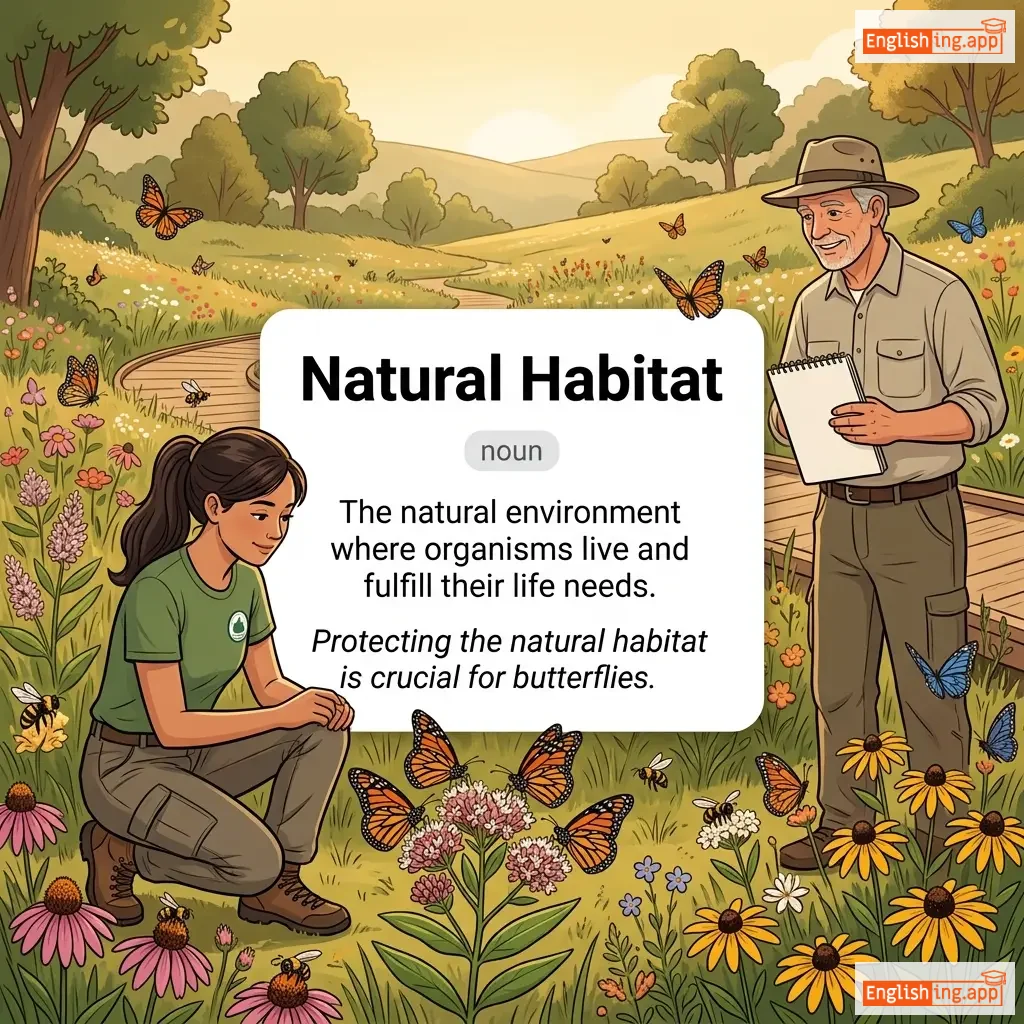
Natural Habitat definition card — visual illustration of the meaning
noun
ˈnætʃərəl ˈhæbɪtæt
自然栖息地 (zìrán qīxī dì)

The natural environment where organisms live and fulfill their life needs.

"Protecting the natural habitat is crucial for butterflies."

"保护自然栖息地对蝴蝶至关重要。" (Bǎohù zìrán qīxī dì duì húdié zhìguān zhòngyào.)
adverb
/ˈnætʃrəli/
自然地 (zìrán de)

In a way that is normal, expected, or without effort.

"He spoke so naturally that everyone felt comfortable."
"他讲得如此自然,以至于每个人都感到舒服。" (Tā jiǎng dé rúcǐ zìrán, yǐzhì yú měi gèrén dōu gǎndào shūfú.)
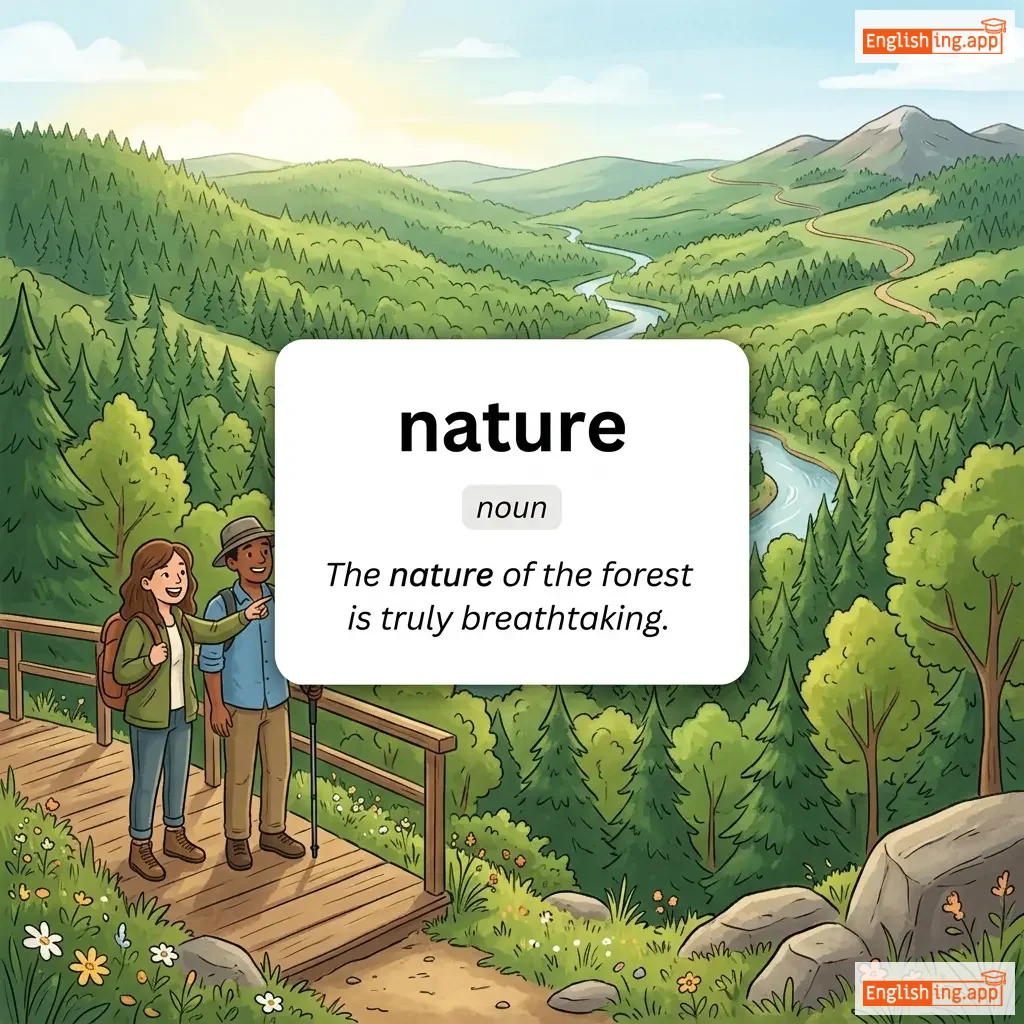
nature definition card — visual illustration of the meaning
noun
/ˈneɪtʃər/
自然 (ziran)

the physical world and everything in it, including plants, animals, and the landscape

"The nature of the forest is truly breathtaking."

"森林的自然景观确实令人叹为观止。" (Sēnlín de zìrán jǐngguān quèshí lìng rén tàn wéi guānzhǐ.)
Nature Enthusiasts definition card — visual illustration of the meaning
noun
ˈneɪʧər ɪnˈθjuːziæsts
自然爱好者 (zìrán àihào zhě)

People who have a passionate interest in and love for the natural world and outdoor activities.

"Nature enthusiasts often visit Sajek Valley for its scenic beauty."

"自然爱好者常常前往萨杰克山谷,欣赏其美丽的景色。" (Zìrán àihào zhě chángcháng qiánwǎng Sàjiékè shāngǔ, xīnshǎng qí měilì de jǐngsè.)
adjective
/ˈnɔːti/
顽皮 (wánpí)

Disobedient or mischievous, often in a playful or mildly bad way.

"The naughty child drew on the walls with crayons."

"顽皮的孩子用蜡笔在墙上画画。" (Wánpí de háizi yòng làbǐ zài qiáng shàng huàhuà.)
noun
/ˈnɔːziə/
恶心 (èxīn)

A feeling of sickness with an inclination to vomit.

"The strong smell of paint gave her a sudden nausea."

"油漆的刺鼻气味让她突然感到恶心。" (Yóuqī de cìbí qìwèi ràng tā túrán gǎndào èxīn.)
verb
/ˈnɔːzieɪt/
引起恶心 (yǐnqǐ èxīn)

To make someone feel sick, with an inclination to vomit.

"The spoiled food nauseated him quickly."

"坏掉的食物很快让他感到恶心。" (Huài diào de shíwù hěn kuài ràng tā gǎndào èxīn.)
adjective
/ˈnɔːʃəs/
感觉恶心 (gǎn jué ě xīn)

feeling like you are about to vomit; causing a feeling of sickness

"The smell of rotten food made her feel nauseous."

"腐烂食物的气味让她感到恶心。" (fǔ làn shí wù de qì wèi ràng tā gǎn dào ě xīn.)