词汇表

英语词汇词典 | 单词含义、定义和示例

noun
/ˌtɜːrməˈnɑːlədʒi/
术语 (shùyǔ)

the set of technical or special words used in a particular subject

"Medical terminology can be difficult for new students to understand."

"医学术语可能对新学生来说很难理解。" (Yīxué shùyǔ kěnéng duì xīn xuéshēng lái shuō hěn nán lǐjiě.)
noun
/ˈtɜːrmɪnəs/
终点站 (zhong dian zhan)

the final point or end of something, especially the final station on a railway line

"The train finally arrived at the terminus after a long journey."

"火车经过长时间的旅行后,终于到达了终点站。" (Huoche jingguo chang shijian de lvxing hou, zhongyu daoda le zhongdian zhan.)
noun
/tɜːmz/
条款 (tiaokuan)

plural of term; conditions or rules in a contract or agreement

"The terms of the agreement are clearly outlined in the contract."

"协议条款在合同中明确列出。" (Xieyi tiaokuan zai hetong zhong mingque liechu.)
noun
/təˈreɪn/
地形 (dixing)

a stretch of land, especially with regard to its physical features

"The soldiers had to cross rough terrain during the mission."

"士兵们必须在任务期间穿越艰难的地形。" (Shibing men bixu zai renwu qi jian chuanyue jiannan de dixing.)
noun
/ˈterəpɪn/
一种小型淡水龟 (yī zhǒng xiǎo xíng dàn shuǐ guī)

a small freshwater turtle, especially one found in North America

"The terrapin slowly crawled into the pond."
"特拉品慢慢爬进了池塘。" (Tèlā pǐn màn man pá jìn le chítáng.)
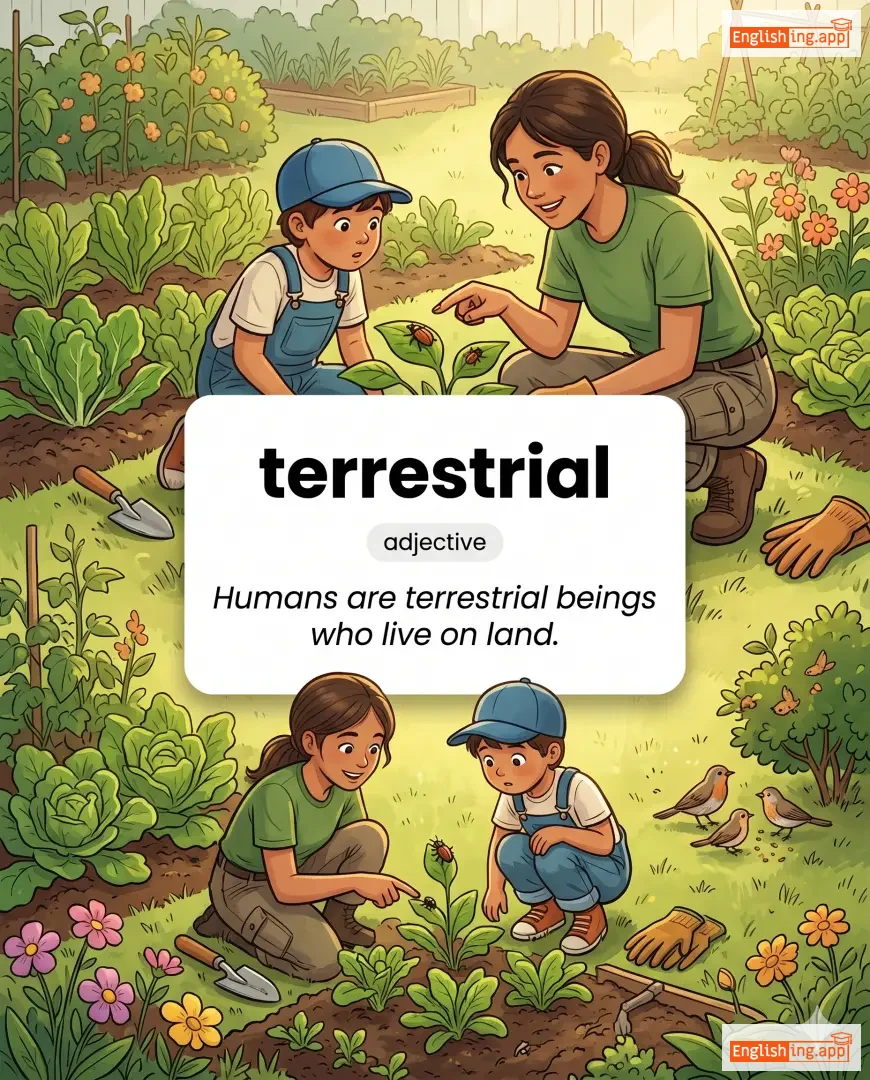
terrestrial definition card — visual illustration of the meaning
adjective
/təˈrɛstriəl/
陆生 (lù shēng)

Relating to the Earth or land as opposed to the sea or air; living or growing on land.

"Humans are terrestrial beings who live on land."

"人类是生活在陆地上的陆生生物。" (Rénlèi shì shēnghuó zài lùdì shàng de lùshēng shēngwù.)
adjective
/ˈtɛrɪbəl/

extremely bad or unpleasant

"The food at that restaurant was terrible."

adverb
/ˈtɛrəbli/
可怕地 (kěpà de)

to a very great or extreme degree; very badly or unpleasantly

"He felt terribly sad after hearing the news."

"听到消息后,他感到可怕地悲伤。" (Tīng dào xiāoxī hòu, tā gǎndào kěpà de bēishāng.)
adjective
/təˈrɪfɪk/
了不起 (liaobuqi)

extremely good or excellent; very great or intense

"The concert last night was absolutely terrific."

"昨晚的音乐会真是太棒了。" (Zuó wǎn de yīnyuè huì zhēn shì tài bàngle.)
verb
/ˈtɛrəˌfaɪ/
使惊吓 (shǐ jīng xià)

To cause someone to feel extreme fear.

"The loud thunder terrified the children."

"响亮的雷声把孩子们吓坏了。" (Xiǎngliàng de léishēng bǎ háizimen xià huài le.)
adjective
/ˌtɛrɪˈtɔːriəl/
领土的 (lingtu de)

Relating to the ownership or control of land or territory.

"The two countries had a territorial dispute over the island."
"这两个国家在这个岛屿上有领土争议。" (Zhè liǎng gè guójiā zài zhège dǎoyǔ shàng yǒu lǐngtǔ zhēngyì.)
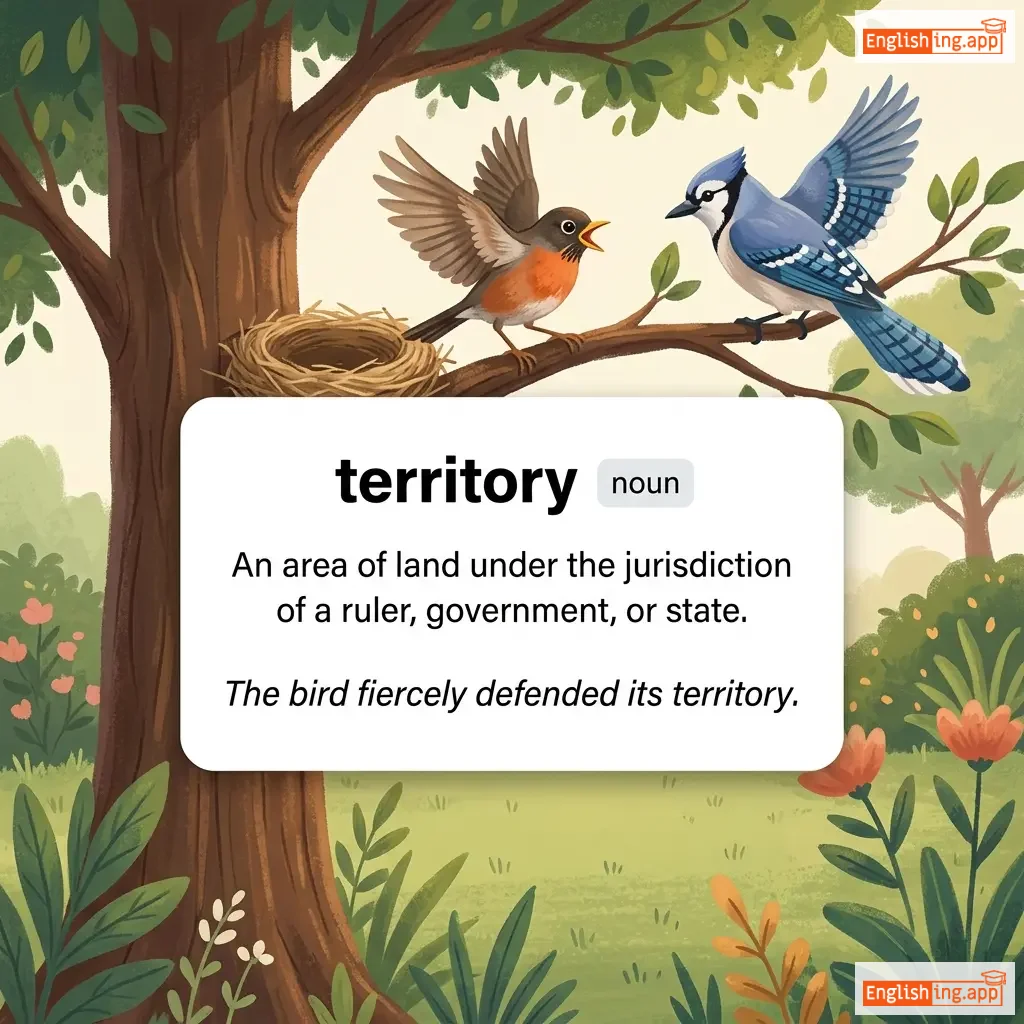
territory definition card — visual illustration of the meaning
noun
/ˈtɛrɪˌtɔːri/
领土 (lingtu)

An area of land under the jurisdiction of a ruler, government, or state.

"The bird fiercely defended its territory."

"鸟类猛烈地保卫着它的领土。" (Niaolai menglie de baowei zhe ta de lingtu.)
noun
/ˈtɛrər/
恐怖 (kongbu)

Extreme fear or dread.

"The villagers fled in terror during the attack."

"村民们在袭击时逃入恐惧之中。" (Cūnmínmen zài xíjī shí táo rù kǒngjù zhī zhōng.)
noun
/ˈtɛrərɪzəm/
恐怖主义 (kǒngbù zhǔyì)

the use of violence or threats to intimidate or coerce, especially for political purposes

"Terrorism is a serious threat to global peace and security."

"恐怖主义是对全球和平与安全的严重威胁。" (Kǒngbù zhǔyì shì duì quánqiú hépíng yǔ ānquán de yánzhòng wēixié.)
noun
/ˈtɛrərɪst/
恐怖分子 (kongbufenzi)

a person who uses violence or threats to intimidate or coerce, especially for political purposes

"The terrorist was arrested by the police after the attack."

"恐怖分子在袭击后被警察逮捕。" (Kongbufenzi zai xiji hou bei jingcha daibu.)
adjective
/tɜːrs/
简洁 (jianjie)

brief and to the point; sparing in the use of words

"His reply was terse and ended the conversation quickly."

"他的回答简洁,迅速结束了对话。" (tade huida jianjie, xunxu jieshu le duihua.)
3️⃣

tertiary

adjective
/ˈtɜːrʃieri/

third in order, rank, or level

"He is pursuing his tertiary education at the university."

adjective
/ˈtɛsəleɪtɪd/
马赛克 (mǎsàikè)

arranged in a pattern of repeated shapes fitting together without gaps

"The tessellated floor was made of colorful tiles arranged in perfect symmetry."

"马赛克地板由色彩斑斓的瓷砖组成,完美对称地排列。" (mǎsàikè dìbǎn yóu sècǎi bānlán de cí zhuān zǔchéng, wánměi duìchèn de páiliè.)
test definition card — visual illustration of the meaning
noun
/tɛst/
测试 (ceshi)

a procedure intended to establish the quality, performance, or reliability of something

"The test results will determine whether the treatment is effective."

"测试结果将决定治疗是否有效。" (Cèshì jiéguǒ jiāng juédìng zhìliáo shìfǒu yǒuxiào.)
noun
/ˈtɛstəmənt/
遗嘱 / 证明 (yízhǔ / zhèngmíng)

a person's will; or strong evidence of something

"His success is a testament to his hard work and dedication."

"他的成功是他辛勤工作和奉献精神的证明。" (tā de chénggōng shì tā xīnqín gōngzuò hé fèngxiàn jīngshén de zhèngmíng.)
noun
/ˈtɛsteɪtər/
立遗嘱人 (lì yízhǔ rén)

a person who has made a will

"The lawyer read the will of the deceased testator."

"律师朗读了已故立遗嘱人的遗嘱。" (Lǜshī lǎngdúle yǐgù lì yízhǔ rén de yízhǔ.)
verb
/ˈtɛstəfaɪ/
作证 (zuò zhèng)

to make a statement or declaration under oath or to give evidence

"She was called to testify in court about the accident."

"她被叫到法庭作证,关于那起事故。" (Tā bèi jiào dào fǎtíng zuò zhèng, guānyú nà qǐ shìgù.)
noun
/ˌtɛstɪˈmoʊniəl/
推荐信 (tuījiànxìn)

A formal statement testifying to someone's character, qualifications, or the quality of a product or service.

"The company shared a glowing testimonial from a satisfied customer."

"公司分享了来自满意客户的热情推荐信。" (Gōngsī fēnxiǎngle láizì mǎnyì kèhù de rèqíng tuījiànxìn.)
testimonials definition card — visual illustration of the meaning
noun
/ˌtɛstɪˈməʊnɪəlz/
见证, 推荐信 (jianzheng, tuijianshin)

Written or spoken statements of praise or recommendation from clients or customers.

"Positive testimonials can enhance a company's reputation."

"积极的见证可以提升公司的声誉。" (Jījí de jiànzhèng kěyǐ tíshēng gōngsī de shēngyù.)
noun
/ˈtɛstəˌmoʊni/
证词 (zhèngcí)

A formal statement given in a court of law or evidence supporting a fact.

"Her testimony in court helped convict the criminal."

"她在法庭上的证词帮助定罪了罪犯。" (Tā zài fǎtíng shàng de zhèngcí bāngzhù dìngzuì le zuìfàn.)
noun
/ˈtɛstɪŋ/
测试 (ceshi)

the process of assessing or evaluating something, often by trying it out

"The testing of the new software is still ongoing."

"新软件的测试仍在进行。" (Xin ruanjian de ceshi reng zai jinxing.)
adjective
/ˈtɛsti/
暴躁 (bàozào)

Easily irritated or annoyed.

"He became testy when asked the same question repeatedly."

"当他一再被问到相同的问题时,他变得易怒。" (Dāng tā yīzài bèi wèn dào xiāngtóng de wèntí shí, tā biàn dé yìnù.)
verb
/ˈtɛðər/
绑住 (bang zhu)

To tie an animal with a rope or chain so it cannot move far.

"The farmer tethered the goat to a post."

"农民把山羊绑在柱子上。" (Nóngmín bǎ shānyáng bǎng zài zhùzi shàng.)
noun
/tɛkst/
文本 (wenben)

a written or printed work or passage, especially a book or document

"The teacher asked us to read the text on page 50."

"老师让我们阅读第50页上的文本。" (Laoshi rang women yuedu di 50 ye shang de wenben.)
noun
/ˈtɛkstbʊk/
教科书 (jiaokeshu)

a book used for studying a subject in school or college

"She bought a new biology textbook for her class."

"她为她的班级买了一本新的生物学教科书。" (Tā wèi tā de bānjí mǎile yī běn xīn de shēngwùxué jiàokēshū.)
noun
/ˈtek.staɪl/
纺织品 (fǎngzhīpǐn)

a type of cloth or woven fabric made by knitting or weaving fibers

"Bangladesh is famous for its high-quality textile industry."

"孟加拉国以其高质量的纺织业而闻名。" (Mèngjiālāguó yǐ qí gāo zhìliàng de fǎngzhīyè ér wénmíng.)
noun
/ˈtɛkstʃər/
质地 (zhì dì)

the way something feels when you touch it; the quality of a surface or substance

"The fabric has a soft and smooth texture."

"这块布的质地柔软光滑。" (Zhè kuài bù de zhì dì róuruǎn guānghuá.)
conjunction
/ðæn/
(bǐ)

used to introduce the second element in a comparison

"She is taller than her brother."

"她比她的哥哥高。" (Tā bǐ tā de gēgē gāo.)
Thank definition card — visual illustration of the meaning
verb
/θæŋk/
感谢 (gǎnxiè)

to express gratitude to someone

"I want to thank you for your help."

"我想感谢你提供的帮助。" (Wǒ xiǎng gǎnxiè nǐ tígōng de bāngzhù.)
adjective
/ˈθæŋk.fəl/
感激的 (gǎn jī de)

pleased and relieved; expressing gratitude; appreciative

"I am thankful for all your help and support."

"我感谢你所有的帮助和支持。" (Wǒ gǎnxiè nǐ suǒyǒu de bāngzhù hé zhīchí.)
adverb
/ˈθæŋkfəli/
幸好 (xing4 hao3)

used to express relief or gratitude

"Thankfully, she arrived just in time for the meeting."

"幸好,她准时到达了会议。" (Xing4 hao3, ta2 zhun3 shi2 dao4 da2 le hui4 yi.)
noun
/θæŋks/
谢谢 (xièxiè)

an expression of gratitude

"Thanks for helping me with the project."

"谢谢你帮我做这个项目。" (Xièxiè nǐ bāng wǒ zuò zhège xiàngmù.)
noun
/ˈθæŋksˌɡɪvɪŋ/
感恩节 (gan'en jie)

an annual holiday in the US for giving thanks, celebrated with a meal

"We spent Thanksgiving dinner with our family."

"我们与家人一起度过了感恩节晚餐。" (Women yu jia ren yiqi duguo le Gan'en jie wanshan.)
pronoun
/ðæt/
这个 (zhège)

used to identify a specific person or thing observed or heard

"That is my book on the table."

"这是我桌子上的书。" (Zhè shì wǒ zhuōzi shàng de shū.)
noun
/ˈθɔːməˌtɜrdʒɪst/
奇术师 (qí shù shī)

A worker of miracles or magician.

"The thaumaturgist amazed the audience with his tricks."

"这位奇术师用他的把戏让观众惊叹不已。" (Zhè wèi qí shù shī yòng tā de bǎ xì ràng guānzhòng jīng tàn bù yǐ.)
verb
/θɔː/
融化 (rónghuà)

to melt or cause to melt after being frozen

"The ice began to thaw in the sun."

"冰开始在阳光下融化。" (Bīng kāishǐ zài yángguāng xià rónghuà.)
adverb
/ˌðeərˈwɪð/
与此一起; (yǔ cǐ yīqǐ)

together with that; in addition to that

"He handed me the contract and the pen therewith."

"他把合同和笔与此一起交给了我。" (Tā bǎ hé tóng hé bǐ yǔ cǐ yīqǐ jiāo gěi le wǒ.)
noun
/ˈθiːsɪs/
论文 (lunwen)

A long piece of writing on a particular subject, usually for a degree at a university.

"She spent two years writing her doctoral thesis."

"她花了两年时间写她的博士论文。" (Tā huāle liǎng nián shíjiān xiě tā de bóshì lùnwén.)
pronoun
/ðiːz/
这些 (zhe xie)

used to refer to things or people that are near or present

"These are my friends."

"这些是我的朋友。" (Zhe xie shi wo de pengyou.)
adjective
/θɜrd/
第三 (di san)

constituting number three in a sequence

"She finished in third place."
"她得了第三名。" (Ta de le di san ming.)
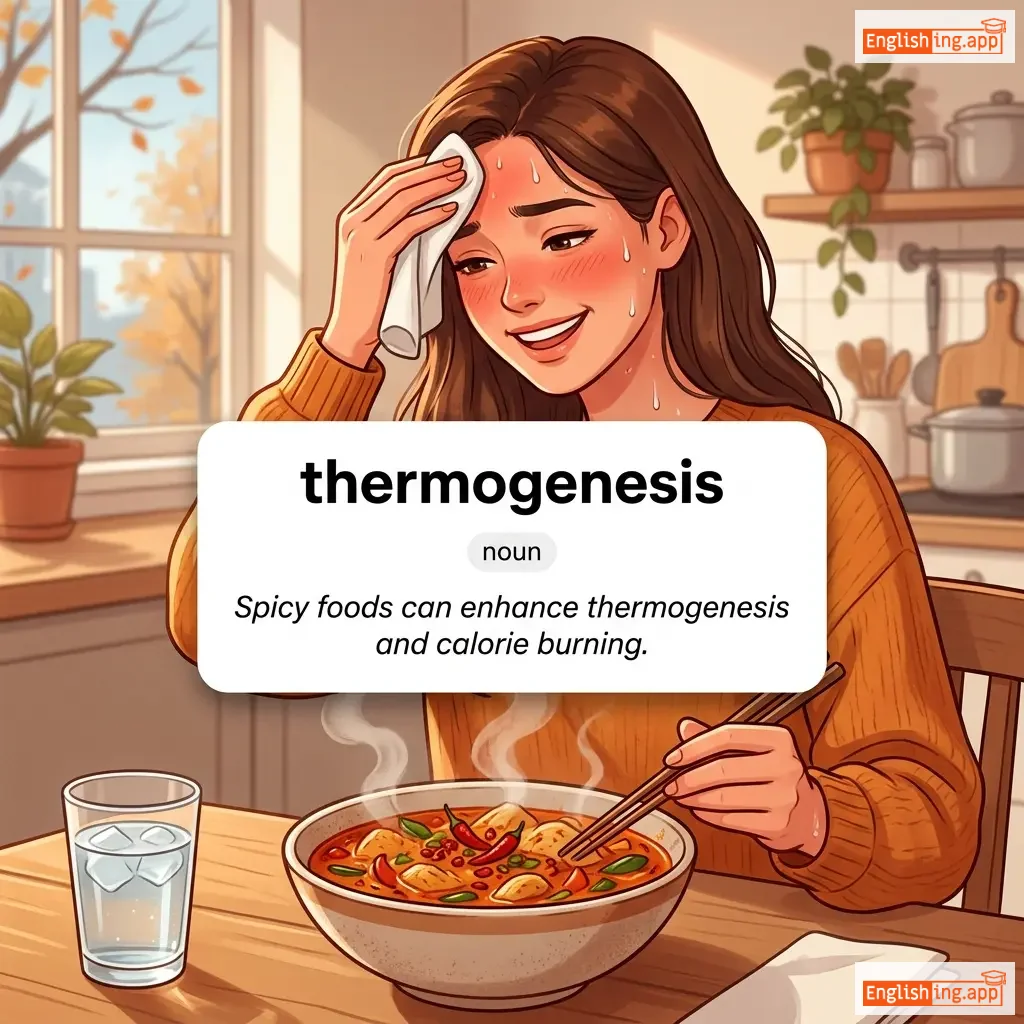
thermogenesis definition card — visual illustration of the meaning
noun
/ˌθɜː.məʊˈdʒen.ɪ.sɪs/
热量生产过程 (relian shengchan guocheng)

The process of heat production in living organisms, often associated with burning calories and energy expenditure.

"Spicy foods can enhance thermogenesis and calorie burning."
"辛辣食物可以增强热生热和卡路里燃烧。" (Xinla shiwu keyi zengqiang reshengre he kaluli ranshao.)
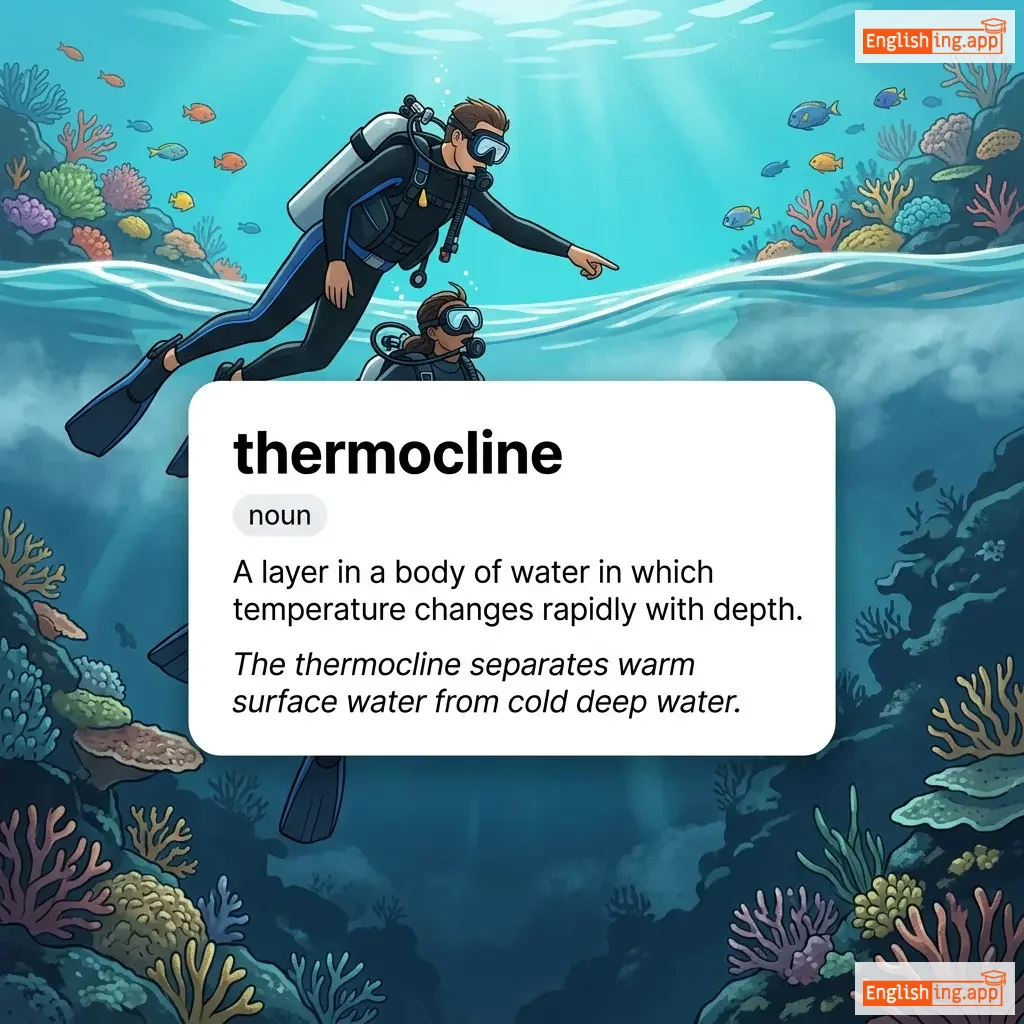
thermocline definition card — visual illustration of the meaning
noun
/ˈθɝː.moʊ.klaɪn/
热跃层 (rè yuè céng)

A layer in a body of water in which temperature changes rapidly with depth.

"The thermocline separates warm surface water from cold deep water."
"热跃层将温暖的表层水与寒冷的深层水分开。" (Rè yuè céng jiāng wēnnuǎn de biǎocéng shuǐ yǔ hánlěng de shēncéng shuǐ fēn kāi.)
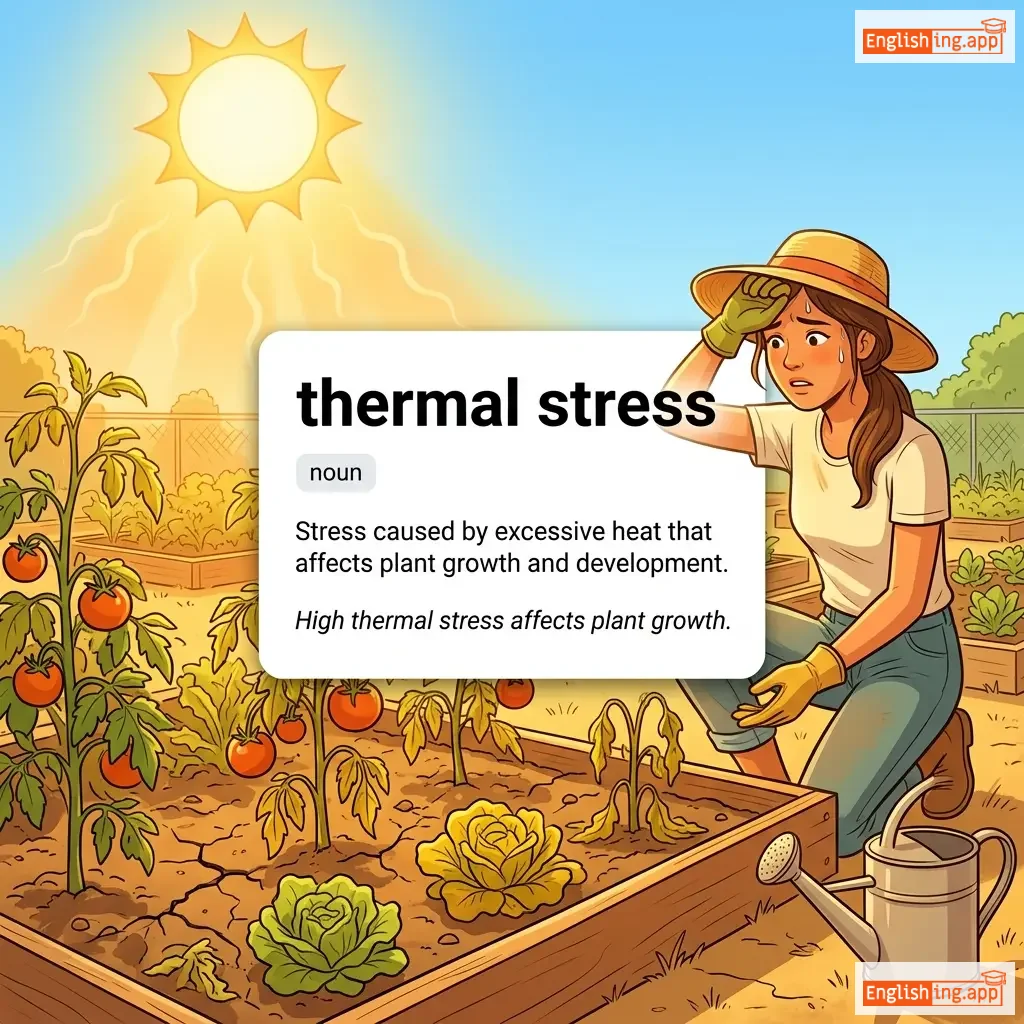
thermal stress definition card — visual illustration of the meaning
noun
ˈθɜː.məl stres
热应力 (rè yìnglì)

Stress caused by excessive heat that affects plant growth and development.

"High thermal stress affects plant growth."

"高温应力影响植物的生长。" (Gāowēn yìnglì yǐngxiǎng zhíwù de shēngzhǎng.)
adjective
/ˈθɜːrməl/
热的 (re de)

Related to heat or temperature.

"She wore a thermal jacket to stay warm in winter."

"她穿着一件热的夹克,在冬天保持温暖。" (Ta chuanzhe yijian re de jiake, zai dongtian baochi wennuan.)
conjunction
/ðɛəˈfɔː/

for that reason; because of that

"She was tired; therefore, she went to bed early."