Vocabulaires

Découvrez, apprenez et maîtrisez le vocabulaire anglais

noun
/ˌtɜːrməˈnɑːlədʒi/
terminologie (terminologie)

the set of technical or special words used in a particular subject

"Medical terminology can be difficult for new students to understand."

"La terminologie médicale peut être difficile à comprendre pour les nouveaux étudiants." (La terminologie medicale peut etre difficile a comprendre pour les nouveaux etudiants.)
noun
/ˈtɜːrmɪnəs/
point final (pwan fianal)

the final point or end of something, especially the final station on a railway line

"The train finally arrived at the terminus after a long journey."

"Le train est finalement arrivé au terminus après un long voyage." (Le tran é finaleman arrivé o terminus après un long voyaj.)
noun
/tɜːmz/
termes (termes)

plural of term; conditions or rules in a contract or agreement

"The terms of the agreement are clearly outlined in the contract."

"Les termes de l'accord sont clairement définis dans le contrat." (Les termes de l'accord sont clairement definis dans le contrat.)
noun
/təˈreɪn/
terrain (terrain)

a stretch of land, especially with regard to its physical features

"The soldiers had to cross rough terrain during the mission."

"Les soldats ont dû traverser un terrain difficile pendant la mission." (Les soldats ont du traverser un terrain difficile pendant la mission.)
noun
/ˈterəpɪn/
une petite tortue d'eau douce (une petite tortue d'eau douce)

a small freshwater turtle, especially one found in North America

"The terrapin slowly crawled into the pond."

"Le terrapin se glissa lentement dans l'étang." (Le terrapin se glissa lentement dans l'étang.)
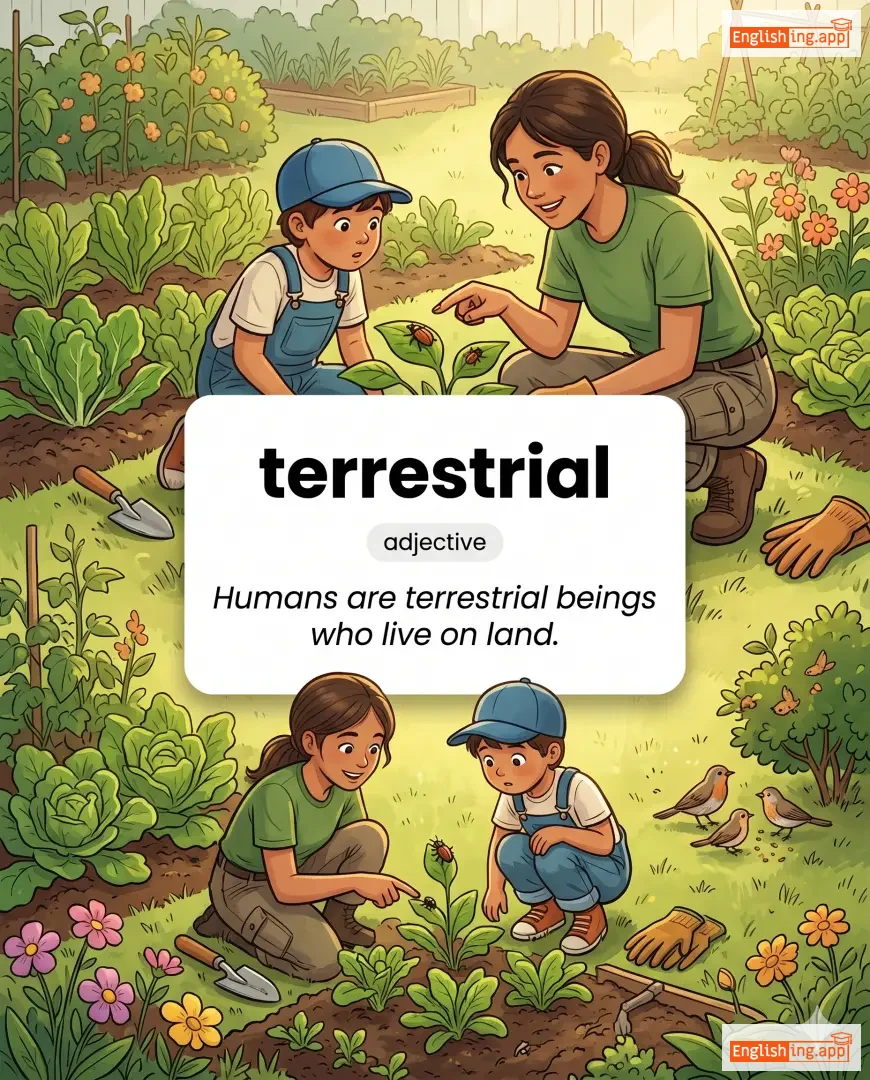
terrestrial definition card — visual illustration of the meaning
adjective
/təˈrɛstriəl/
terrestre (terrestre)

Relating to the Earth or land as opposed to the sea or air; living or growing on land.

"Humans are terrestrial beings who live on land."

"Les humains sont des êtres terrestres qui vivent sur la terre." (Les humains sont des êtres terrestres qui vivent sur la terre.)
adjective
/ˈtɛrɪbəl/
terrible (terble)

extremely bad or unpleasant

"The food at that restaurant was terrible."

"La nourriture de ce restaurant était terrible." (La nourriture de ce restaurant etait terrible.)
adverb
/ˈtɛrəbli/
terriblement (terriblement)

to a very great or extreme degree; very badly or unpleasantly

"He felt terribly sad after hearing the news."

"Il se sentait terriblement triste après avoir entendu la nouvelle." (Il se sentait terriblement triste après avoir entendu la nouvelle.)
adjective
/təˈrɪfɪk/
fantastique (fantastik)

extremely good or excellent; very great or intense

"The concert last night was absolutely terrific."

"Le concert d'hier soir était absolument fantastique." (Le concert d'hier soir etait absolument fantastique.)
verb
/ˈtɛrəˌfaɪ/
terrifier (terifier)

To cause someone to feel extreme fear.

"The loud thunder terrified the children."

"Le fort tonnerre a terrifié les enfants." (Le fort tonnerre a terrifie les enfants.)
adjective
/ˌtɛrɪˈtɔːriəl/
territorial (territorial)

Relating to the ownership or control of land or territory.

"The two countries had a territorial dispute over the island."

"Les deux pays avaient un différend territorial concernant l'île." (Les deux pays avaient un different territorial concernant l'ile.)
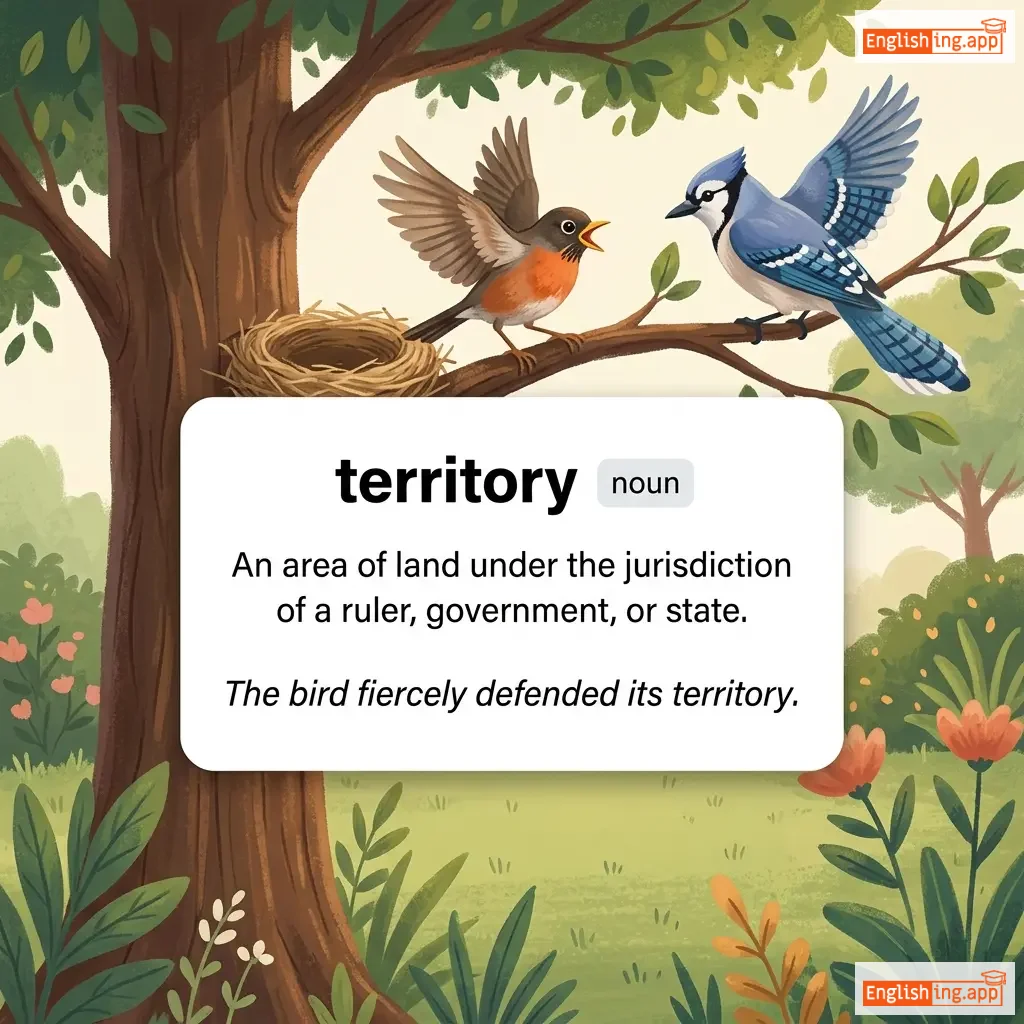
territory definition card — visual illustration of the meaning
noun
/ˈtɛrɪˌtɔːri/
territoire (territoire)

An area of land under the jurisdiction of a ruler, government, or state.

"The bird fiercely defended its territory."

"L'oiseau a défendu son territoire avec férocité." (L'oiseau a defendu son territoire avec ferocite.)
noun
/ˈtɛrər/
terreur (terreur)

Extreme fear or dread.

"The villagers fled in terror during the attack."

"Les villageois ont fui dans la terreur lors de l'attaque." (Les villageois ont fui dans la terreur lors de l'attaque.)
noun
/ˈtɛrərɪzəm/
terrorisme (terrorisme)

the use of violence or threats to intimidate or coerce, especially for political purposes

"Terrorism is a serious threat to global peace and security."

"Le terrorisme est une menace sérieuse pour la paix et la sécurité mondiales." (Le terrorisme est une menace sérieuse pour la paix et la sécurité mondiales.)
noun
/ˈtɛrərɪst/
terroriste (terroriste)

a person who uses violence or threats to intimidate or coerce, especially for political purposes

"The terrorist was arrested by the police after the attack."

"Le terroriste a été arrêté par la police après l'attaque." (Le terroriste a été arrêté par la police après l'attaque.)
adjective
/tɜːrs/
bref (bref)

brief and to the point; sparing in the use of words

"His reply was terse and ended the conversation quickly."

"Sa réponse était brève et a rapidement mis fin à la conversation." (sa reponse etait breve et a rapidement mis fin a la conversation.)
adjective
/ˈtɜːrʃieri/
tertiaire (tertiaire)

third in order, rank, or level

"He is pursuing his tertiary education at the university."

"Il poursuit ses études tertiaires à l'université." (Il poursuit ses etudes tertiaires a l universite)
adjective
/ˈtɛsəleɪtɪd/
carrelé (carrele)

arranged in a pattern of repeated shapes fitting together without gaps

"The tessellated floor was made of colorful tiles arranged in perfect symmetry."

"Le sol carrelé était composé de carreaux colorés disposés en parfaite symétrie." (Le sol carrele etait compose de carreaux colores disposes en parfaite symetrie.)
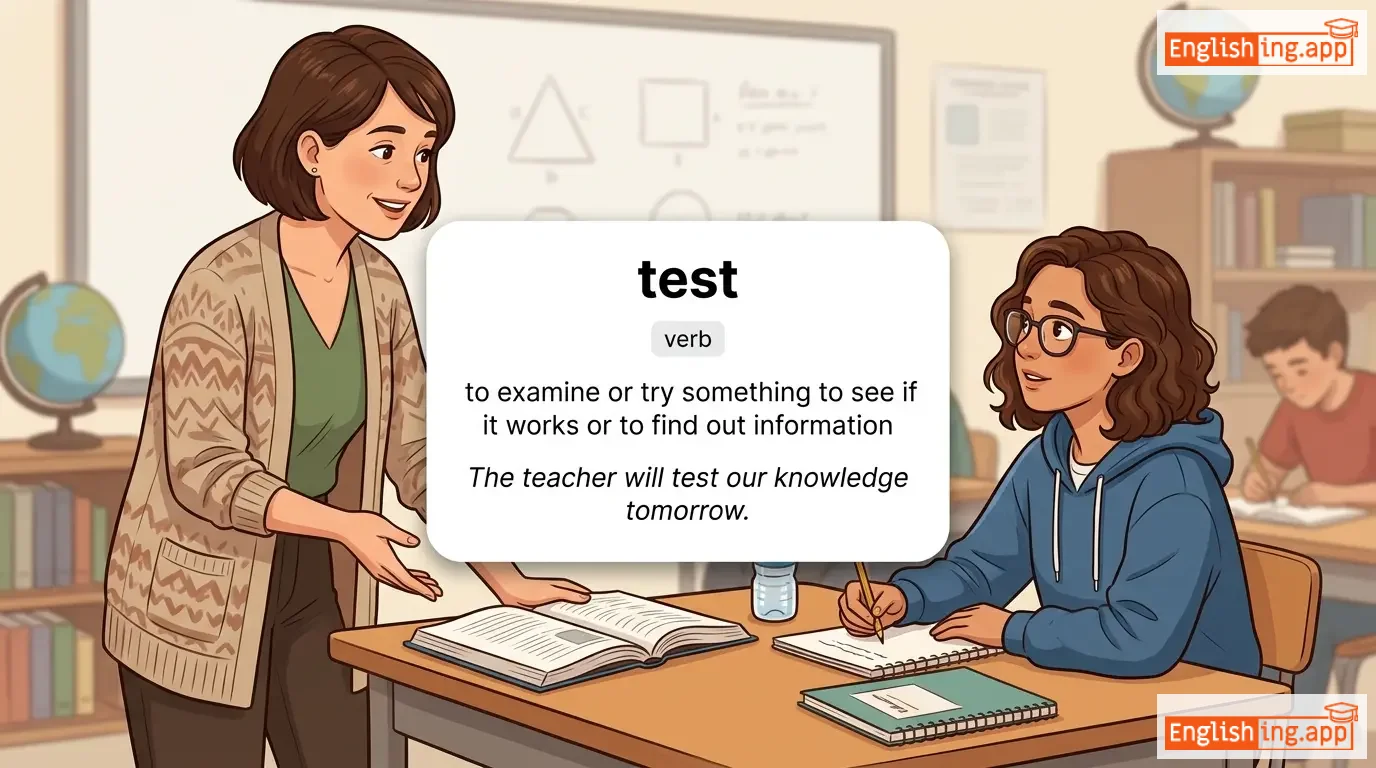
test definition card — visual illustration of the meaning
noun
/tɛst/
test (test)

a procedure intended to establish the quality, performance, or reliability of something

"The test results will determine whether the treatment is effective."

"Les résultats du test détermineront si le traitement est efficace." (Les résultats du test détermineront si le traitement est efficace.)
noun
/ˈtɛstəmənt/
testament / preuve (testament / preuve)

a person's will; or strong evidence of something

"His success is a testament to his hard work and dedication."

"Son succès est un testament de son travail acharné et de son dévouement." (Son succès est un testament de son travail acharné et de son dévouement.)
noun
/ˈtɛsteɪtər/
testateur (testateur)

a person who has made a will

"The lawyer read the will of the deceased testator."

"L'avocat a lu le testament du testateur décédé." (L'avocat a lu le testament du testateur décédé.)
verb
/ˈtɛstəfaɪ/
témoigner (temoigner)

to make a statement or declaration under oath or to give evidence

"She was called to testify in court about the accident."

"Elle a été appelée à témoigner au tribunal sur l'accident." (Elle a été appelée à témoigner au tribunal sur l'accident.)
noun
/ˌtɛstɪˈmoʊniəl/
témoignage (temoignage)

A formal statement testifying to someone's character, qualifications, or the quality of a product or service.

"The company shared a glowing testimonial from a satisfied customer."

"L'entreprise a partagé un témoignage élogieux d'un client satisfait." (L'entreprise a partage un temoignage elogieux d'un client satisfait.)
testimonials definition card — visual illustration of the meaning
noun
/ˌtɛstɪˈməʊnɪəlz/
témoignages, lettres de recommandation (temoignages, lettres de recommandation)

Written or spoken statements of praise or recommendation from clients or customers.

"Positive testimonials can enhance a company's reputation."

"Des témoignages positifs peuvent améliorer la réputation d'une entreprise." (Des temoignages positifs peuvent ameliorer la reputation d'une entreprise.)
noun
/ˈtɛstəˌmoʊni/
témoignage (temoignage)

A formal statement given in a court of law or evidence supporting a fact.

"Her testimony in court helped convict the criminal."

"Son témoignage devant le tribunal a aidé à condamner le criminel." (Son temoignage devant le tribunal a aide a condamner le criminel.)
noun
/ˈtɛstɪŋ/
test (test)

the process of assessing or evaluating something, often by trying it out

"The testing of the new software is still ongoing."

"Le test du nouveau logiciel est toujours en cours." (Le test du nouveau logiciel est toujours en cours.)
adjective
/ˈtɛsti/
irritable (irritable)

Easily irritated or annoyed.

"He became testy when asked the same question repeatedly."

"Il est devenu irritable lorsqu'on lui a posé la même question à plusieurs reprises." (Il est devenu irritable lorsqu'on lui a posé la même question à plusieurs reprises.)
verb
/ˈtɛðər/
attacher (attacher)

To tie an animal with a rope or chain so it cannot move far.

"The farmer tethered the goat to a post."

"Le fermier a attaché la chèvre à un poteau." (Le fermier a attaché la chèvre à un poteau.)
noun
/tɛkst/
texte (texte)

a written or printed work or passage, especially a book or document

"The teacher asked us to read the text on page 50."

"L'enseignant nous a demandé de lire le texte à la page 50." (L'enseignant nous a demandé de lire le texte à la page 50.)
noun
/ˈtɛkstbʊk/
livre scolaire (livre scolaire)

a book used for studying a subject in school or college

"She bought a new biology textbook for her class."

"Elle a acheté un nouveau livre de biologie pour sa classe." (Elle a acheté un nouveau livre de biologie pour sa classe.)
noun
/ˈtek.staɪl/
tissu (tissu)

a type of cloth or woven fabric made by knitting or weaving fibers

"Bangladesh is famous for its high-quality textile industry."

"Le Bangladesh est célèbre pour son industrie textile de haute qualité." (Le Bangladesh est célèbre pour son industrie textile de haute qualité.)
noun
/ˈtɛkstʃər/
texture (texture)

the way something feels when you touch it; the quality of a surface or substance

"The fabric has a soft and smooth texture."

"Le tissu a une texture douce et lisse." (Le tissu a une texture douce et lisse.)
conjunction
/ðæn/
que (que)

used to introduce the second element in a comparison

"She is taller than her brother."

"Elle est plus grande que son frère." (Elle est plus grande que son frère.)
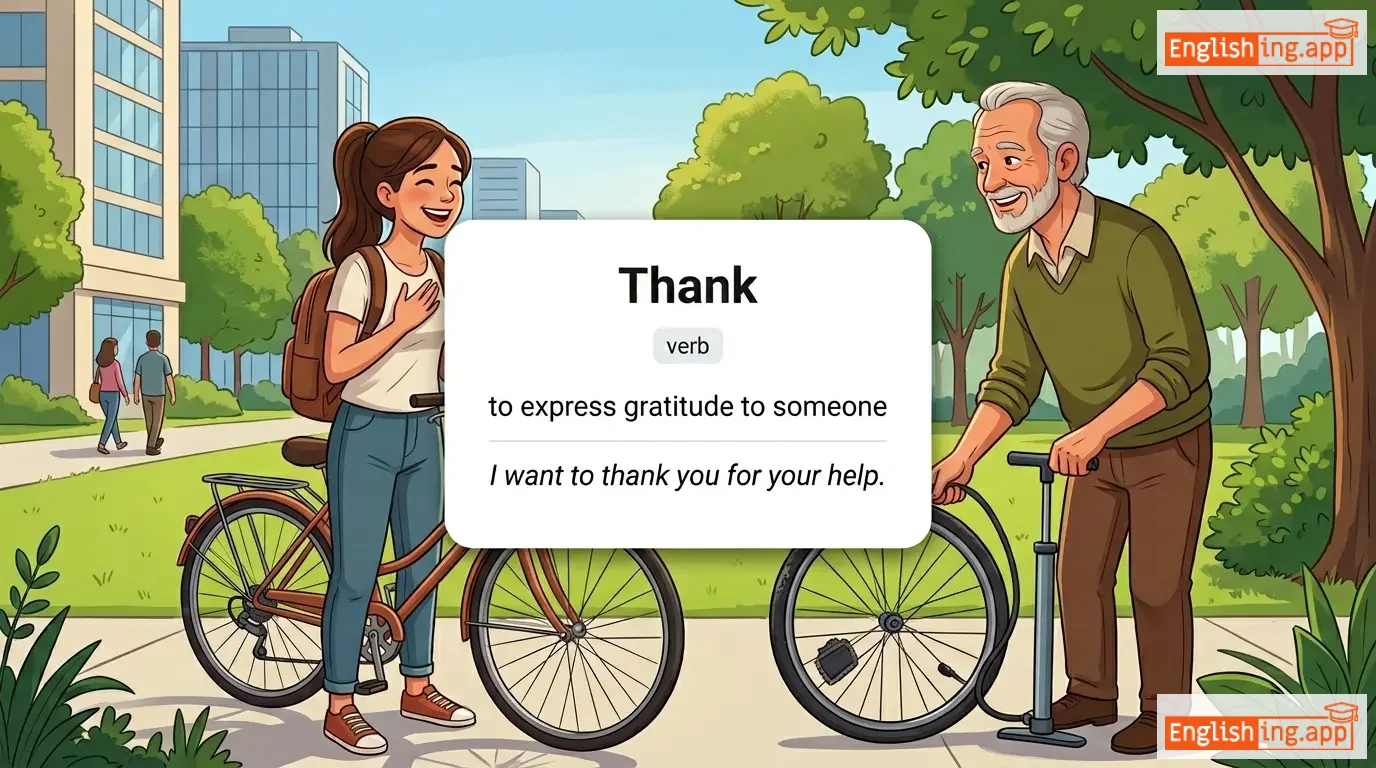
Thank definition card — visual illustration of the meaning
verb
/θæŋk/
remercier (remercier)

to express gratitude to someone

"I want to thank you for your help."

"Je veux vous remercier pour votre aide." (Je veux vous remercier pour votre aide.)
adjective
/ˈθæŋk.fəl/
reconnaissant; reconnaissante (reconnaissant; reconnaissante)

pleased and relieved; expressing gratitude; appreciative

"I am thankful for all your help and support."

"Je suis reconnaissant pour toute ton aide et ton soutien." (Je suis reconnaissant pour toute ton aide et ton soutien.)
adverb
/ˈθæŋkfəli/
heureusement (heureusement)

used to express relief or gratitude

"Thankfully, she arrived just in time for the meeting."

"Heureusement, elle est arrivée juste à temps pour la réunion." (Heureusement, elle est arrivée juste à temps pour la réunion.)
noun
/θæŋks/
merci (merci)

an expression of gratitude

"Thanks for helping me with the project."

"Merci de m'avoir aidé avec le projet." (Merci de m'avoir aidé avec le projet.)
noun
/ˈθæŋksˌɡɪvɪŋ/
Action de Grâce (Action de Grace)

an annual holiday in the US for giving thanks, celebrated with a meal

"We spent Thanksgiving dinner with our family."

"Nous avons passé le dîner de Thanksgiving avec notre famille." (Nous avons passe le diner de Thanksgiving avec notre famille.)
pronoun
/ðæt/
ce (se)

used to identify a specific person or thing observed or heard

"That is my book on the table."

"C'est mon livre sur la table." (C'est mon livre sur la table.)
noun
/ˈθɔːməˌtɜrdʒɪst/
thaumaturge (thaumaturge)

A worker of miracles or magician.

"The thaumaturgist amazed the audience with his tricks."

"Le thaumaturge a émerveillé le public avec ses tours." (Le thaumaturge a émerveillé le public avec ses tours.)
verb
/θɔː/
fondre (fondre)

to melt or cause to melt after being frozen

"The ice began to thaw in the sun."

"La glace a commencé à fondre au soleil." (La glace a commencé à fondre au soleil.)
adverb
/ˌðeərˈwɪð/
avec cela; (avec cela)

together with that; in addition to that

"He handed me the contract and the pen therewith."

"Il m'a remis le contrat et le stylo avec cela." (Il m'a remis le contrat et le stylo avec cela.)
noun
/ˈθiːsɪs/
thèse (these)

A long piece of writing on a particular subject, usually for a degree at a university.

"She spent two years writing her doctoral thesis."

"Elle a passé deux ans à rédiger sa thèse de doctorat." (Elle a passé deux ans à rédiger sa thèse de doctorat.)
pronoun
/ðiːz/
ces (ses)

used to refer to things or people that are near or present

"These are my friends."

"Ce sont mes amis." (Ce sont mes amis.)
adjective
/θɜrd/
troisième (troisiem)

constituting number three in a sequence

"She finished in third place."

"Elle a terminé à la troisième place." (Elle a termine a la troisieme place.)
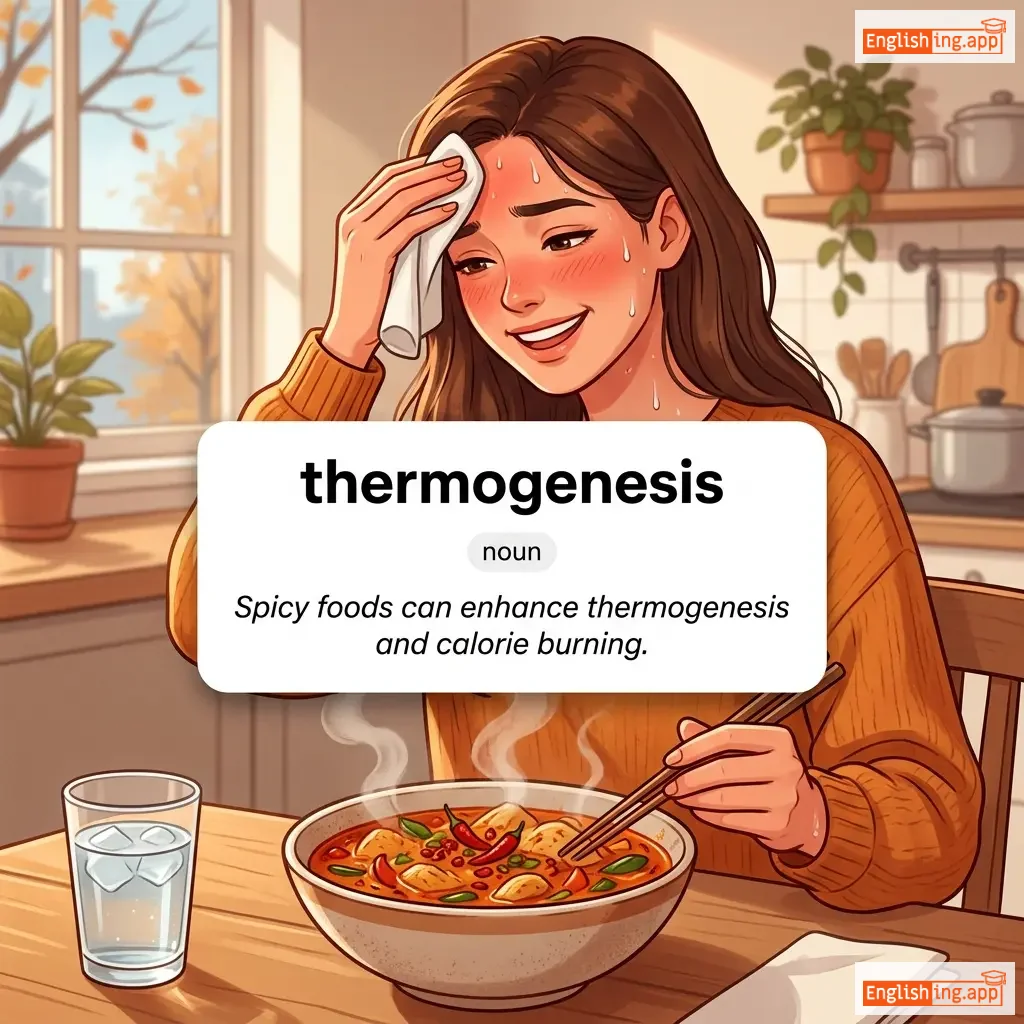
thermogenesis definition card — visual illustration of the meaning
noun
/ˌθɜː.məʊˈdʒen.ɪ.sɪs/
processus de production de chaleur (processus de production de chaleur)

The process of heat production in living organisms, often associated with burning calories and energy expenditure.

"Spicy foods can enhance thermogenesis and calorie burning."

"Les aliments épicés peuvent améliorer la thermogenèse et la combustion des calories." (Les aliments epices peuvent ameliorer la thermogenese et la combustion des calories.)
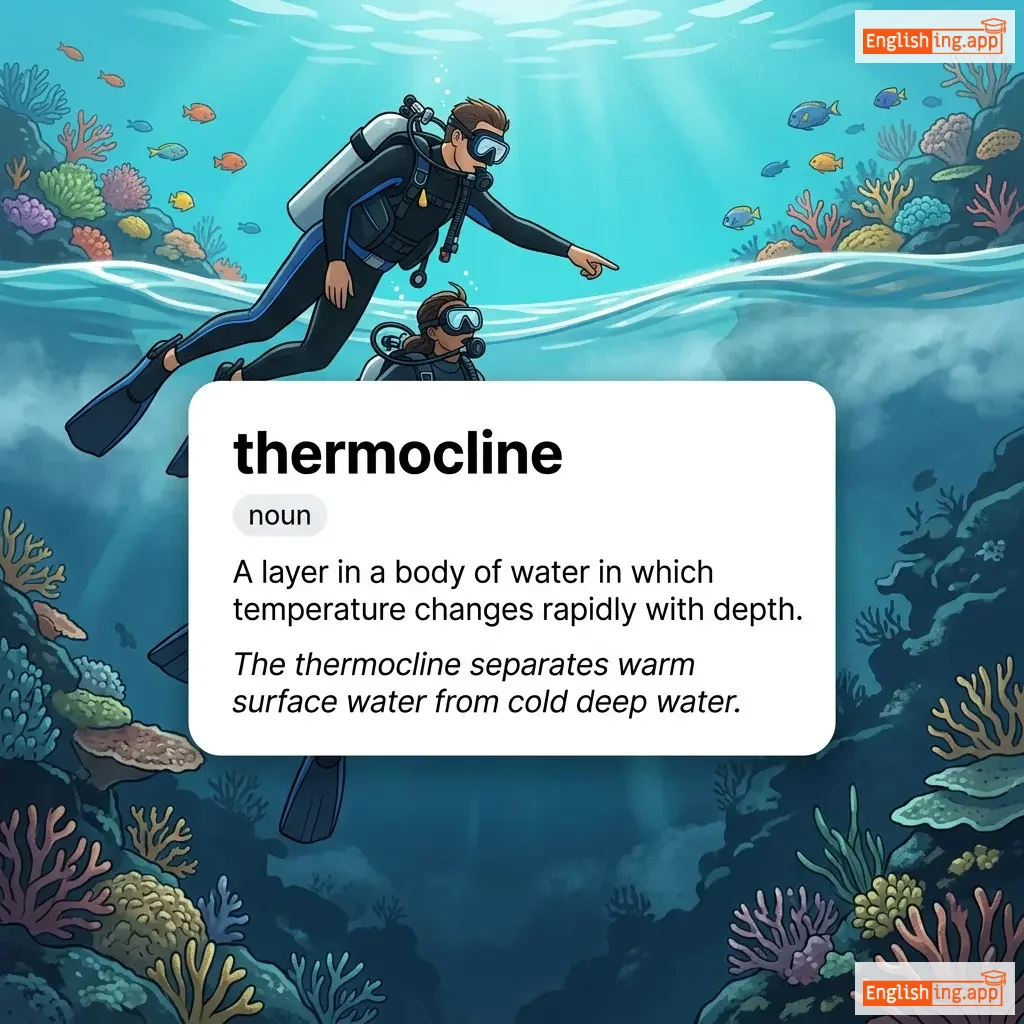
thermocline definition card — visual illustration of the meaning
noun
/ˈθɝː.moʊ.klaɪn/
thermocline (thermocline)

A layer in a body of water in which temperature changes rapidly with depth.

"The thermocline separates warm surface water from cold deep water."

"La thermocline sépare l'eau chaude de la surface de l'eau froide en profondeur." (La thermocline sépare l'eau chaude de la surface de l'eau froide en profondeur.)
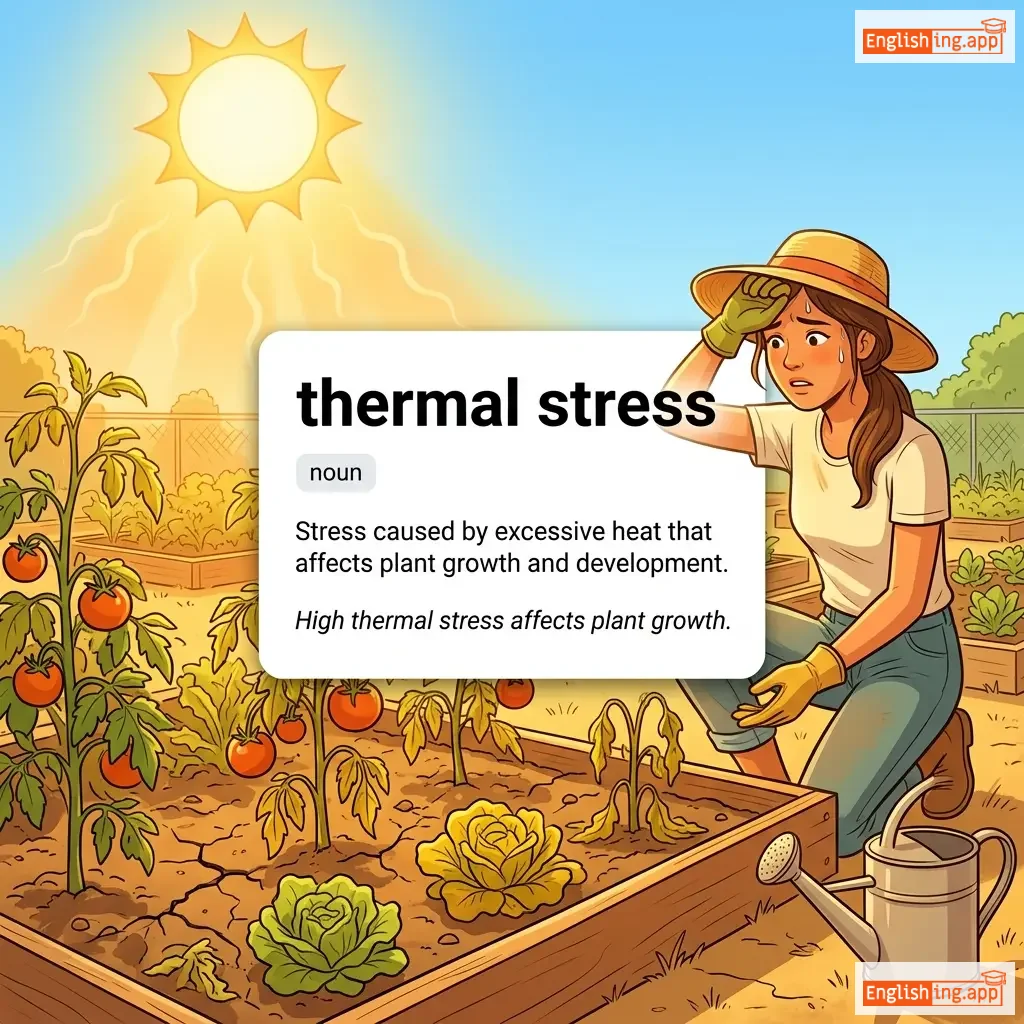
thermal stress definition card — visual illustration of the meaning
noun
ˈθɜː.məl stres
stress thermique (stress thermique)

Stress caused by excessive heat that affects plant growth and development.

"High thermal stress affects plant growth."

"Le stress thermique affecte la croissance des plantes." (Le stress thermique affecte la croissance des plantes.)
adjective
/ˈθɜːrməl/
thermique (thermique)

Related to heat or temperature.

"She wore a thermal jacket to stay warm in winter."

"Elle portait une veste thermique pour rester au chaud en hiver." (Elle portait une veste thermique pour rester au chaud en hiver.)
conjunction
/ðɛəˈfɔː/
donc (therefore)

for that reason; because of that

"She was tired; therefore, she went to bed early."

"Elle était fatiguée; donc, elle est allée se coucher tôt." (Elle etait fatiguee; donc, elle est allee se coucher tot.)