Vocabulaires

Découvrez, apprenez et maîtrisez le vocabulaire anglais

adjective
/ʌnˈkɒmən/
inhabituel (inhabituel)

rare, unusual, or remarkable

"It is uncommon to see snow in this region."

"Il est rare de voir de la neige dans cette région." (Il est rare de voir de la neige dans cette région.)
adjective
/ʌnˈkʌmfətəbl/
inconfortable (inconfortable)

causing or feeling physical or emotional discomfort

"He felt uncomfortable during the long meeting."

"Il s'est senti inconfortable pendant la longue réunion." (Il s'est senti inconfortable pendant la longue réunion.)
noun
/ʌnˈkloʊðɪŋ/
déshabillage (déshabillage)

the act or process of removing clothing

"The child quickly ran inside for unclothing after playing in the mud."

"L'enfant est rapidement allé à l'intérieur pour le déshabillage après avoir joué dans la boue." (L'enfant est rapidement alle a l'interieur pour le deshabillage apres avoir joue dans la boue)
verb
/ʌnˈkloʊð/
déshabiller; enlever les vêtements (deshabiller; enlever les vetements)

to remove clothing from someone or something

"The nurse helped unclothe the patient for the examination."

"L'infirmière a aidé à déshabiller le patient pour l'examen." (L'infirmiere a aide a deshabiller le patient pour l'examen)
adjective
/ʌnˈklɪər/
peu clair (peu clair)

not easy to understand; vague or ambiguous

"The instructions were unclear, so I asked for clarification."

"Les instructions étaient peu claires, alors j'ai demandé des clarifications." (Les instructions etaient peu claires, alors j'ai demande des clarifications)
👨‍🦳

uncle (onkel)

noun
/ˈʌŋkəl/
oncle (oncle)

the brother of one's father or mother

"My uncle is visiting us next week."

"Mon oncle nous rendra visite la semaine prochaine." (Mon oncle nous rendra visite la semaine prochaine.)
adjective
/ʌnˈkleɪmd/
non réclamé; non demandé; abandonné ou sans propriétaire (non reclame; non demande; abandonne ou sans proprietaire)

not claimed by anyone; not demanded or requested; abandoned or ownerless

"The unclaimed luggage was stored in the airport's lost property department."

"Les bagages non réclamés ont été stockés dans le département des objets trouvés de l'aéroport." (Les bagages non reclamés ont été stockés dans le département des objets trouvés de l'aéroport.)
adjective
/ʌnˈsɪvəlaɪzd/
non civilisé; sauvage; (non civilisé; sauvage;)

not developed in terms of civilization; lacking social organization and culture; barbarous

"The explorers encountered an uncivilized tribe deep in the Amazon rainforest."

"Les explorateurs ont rencontré une tribu non civilisée au cœur de la forêt amazonienne." (Les explorateurs ont rencontre une tribu non civilisee au coeur de la foret amazonienne.)
adjective
/ʌnˈsɪvəl/
incivil; impoli; (ansivil; impoli)

not polite or courteous; rude and discourteous in behavior

"His uncivil remarks during the meeting offended everyone present."

"Ses remarques inciviles lors de la réunion ont offensé tout le monde présent." (Ses remarques inciviles lors de la réunion ont offensé tout le monde présent.)
adjective
/ʌnˈtʃeɪst/
immoral; impur; (immoral; impur;)

not celibate; having engaged in sexual relations; lacking moral purity

"The conservative society considered her behavior unchaste and improper."

"La société conservatrice a jugé son comportement immoral et inapproprié." (La société conservatrice a jugé son comportement immoral et inapproprié.)
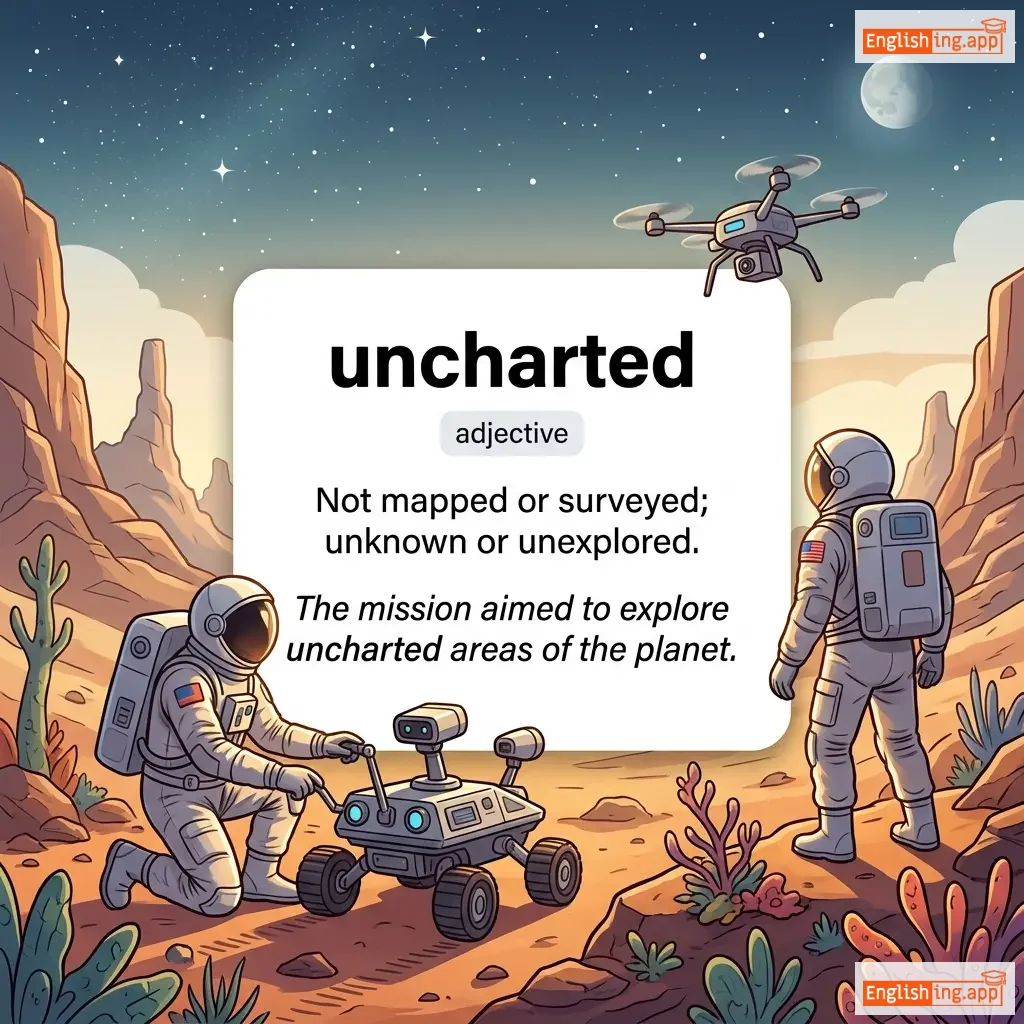
uncharted definition card — visual illustration of the meaning
adjective
ʌnˈtʃɑːtɪd
inexploré (inexplore)

Not mapped or surveyed; unknown or unexplored.

"The mission aimed to explore uncharted areas of the planet."

"La mission visait à explorer des zones inexplorées de la planète." (La mission visait à explorer des zones inexplorées de la planète.)
adjective
/ʌnˈtʃeɪndʒɪŋ/
inchangé (inchangé)

remaining the same over time; not changing

"Her love for her family was unchanging throughout the years."

"Son amour pour sa famille est resté inchangé au fil des ans." (Son amour pour sa famille est reste inchange au fil des ans.)
adjective
/ʌnˈtʃeɪndʒəbəl/
inchangable; fixe; (inchangable; fixe;)

not able to be changed or altered; fixed and permanent

"The laws of physics are unchangeable principles that govern the universe."

"Les lois de la physique sont des principes inchangables qui gouvernent l'univers." (Les lois de la physique sont des principes inchangables qui gouvernent l'univers.)
adjective
/ʌnˈtʃælɪndʒd/
incontesté; accepté sans opposition; sans rival (incontesté; accepté sans opposition; sans rival)

not disputed or questioned; accepted without opposition; having no rival

"He remained the unchallenged champion for five years."

"Il est resté le champion incontesté pendant cinq ans." (Il est reste le champion inconteste pendant cinq ans.)
noun
/ʌnˈsɜːtənti/
incertitude (incertitude)

the state of being unsure or not knowing what will happen

"Economic uncertainty affects business investments."

"L'incertitude économique affecte les investissements commerciaux." (L'incertitude économique affecte les investissements commerciaux.)
adverb
/ʌnˈsɜːrtənli/
avec incertitude (avec incertitude)

in a way that shows doubt or lack of certainty

"She glanced uncertainly at the complicated instructions."

"Elle a regardé les instructions compliquées avec incertitude." (Elle a regarde les instructions compliquees avec incertitude.)
adjective
/ʌnˈsɜːtən/
incertain (incertain)

not sure or confident about something; not clearly known or decided

"She felt uncertain about her future after graduation."

"Elle se sentait incertaine quant à son avenir après l'obtention de son diplôme." (Elle se sentait incertaine quant à son avenir après l'obtention de son diplôme.)
adjective
/ˌʌnsɛrəˈmoʊniəs/
sans cérémonie/rude (sans ceremonie/rude)

Done without formality or courtesy; abrupt or rude.

"He made an unceremonious exit from the party."

"Il a fait une sortie sans cérémonie de la fête." (Il a fait une sortie sans cérémonie de la fête.)
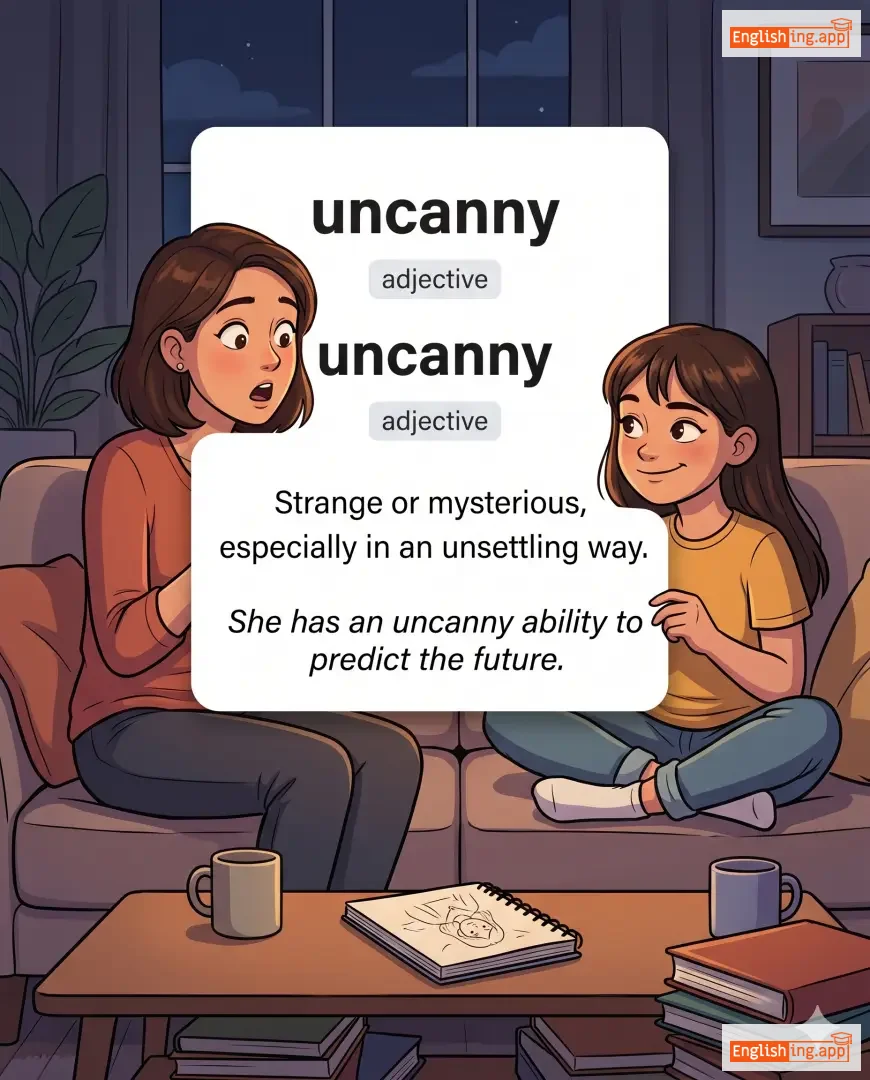
uncanny definition card — visual illustration of the meaning
adjective
/ʌnˈkæni/
étrange (etrange)

Strange or mysterious, especially in an unsettling way.

"She has an uncanny ability to predict the future."

"Elle a une étrange capacité à prédire l'avenir." (Elle a une etrange capacite a predire l'avenir.)
adjective
/ʌnˈbraɪdld/
déraisonné (deraisonne)

Uncontrolled and unrestrained.

"The protesters showed unbridled enthusiasm for change."

"Les manifestants ont montré un enthousiasme débridé pour le changement." (Les manifestants ont montré un enthousiasme débridé pour le changement.)
adjective
/ʌnˈbreɪkəbəl/
qui ne peut être brisé ou endommagé ; très fort et durable (ki nu pe otʁe bʁise ozɔndomaʒe ; tʁe fɔʁ e dyʁabl)

not able to be broken or damaged; very strong and durable

"Their friendship formed an unbreakable bond."

"Leur amitié a formé un lien incassable." (leur amitié a formé un lien incassable.)
adjective
/ʌnˈblʌʃɪŋ/
effronté; sans vergogne (effronte; sans vergogne)

showing no shame or embarrassment; boldly shameless

"He told the unblushing lie without any hesitation."

"Il a dit le mensonge effronté sans hésitation." (Il a dit le mensonge effronte sans hesiter.)
adjective
/ʌnˈbaɪəst/
impartiale (impartiale)

Not showing prejudice; impartial and fair.

"The report gave an unbiased view of the situation."

"Le rapport a donné un point de vue impartial de la situation." (Le rapport a donné un point de vue impartial de la situation.)
adjective
/ˌʌnbɪˈliːvɪŋ/
incrédule (incredule)

Not willing or able to believe; skeptical or doubtful

"She gave him an unbelieving look when he claimed to have met a celebrity."

"Elle lui a lancé un regard incrédule lorsqu'il a affirmé avoir rencontré une célébrité." (Elle lui a lance un regard incredule lorsqu'il a affirme avoir rencontre une celebrité.)
adjective
/ˌʌnbɪˈliːvəbəl/
incroyable (incroyable)

impossible to believe; extremely surprising or remarkable

"The magician's performance was absolutely unbelievable."

"La performance du magicien était absolument incroyable." (La performance du magicien etait absolument incroyable.)
noun
/ˌʌnbɪˈliːf/
incrédulité (incredulite)

A lack of belief, especially in religious faith.

"His heart was full of doubt and unbelief."

"Son cœur était rempli de doute et d'incrédulité." (Son coeur etait rempli de doute et d'incredulite.)
adjective
/ˌʌnbɪˈkʌmɪŋ/
inapproprié (inapproprie)

Not proper or appropriate for a person; unsuitable.

"His rude behavior was unbecoming of a leader."

"Son comportement grossier était inapproprié pour un leader." (Son comportement grossier était inapproprié pour un leader.)
adjective
/ʌnˈbiːtən/
invaincu; non défait (invaincu; non défait)

not defeated; having never lost; undefeated

"The team remains unbeaten this season."

"L'équipe reste invaincue cette saison." (L'équipe reste invaincue cette saison.)
adjective
/ʌnˈbeərəbl/
insupportable (insupportable)

Too difficult or unpleasant to endure.

"The heat was unbearable in the afternoon."

"La chaleur était insupportable l'après-midi." (La chaleur etait insupportable l'apres-midi.)
adjective
/ʌnˈbæləns/
déséquilibré; instable (déséquilibré; instable)

not balanced; lacking stability or equilibrium; mentally unstable

"The unbalanced table kept wobbling."

"La table déséquilibrée continua à osciller." (La table déséquilibrée continua à osciller.)
🤷‍♂️

Unaware (anawer)

adjective
/ˌʌnəˈweər/
inconscient; ignorant; sans savoir (inconscient; ignorant; san savoir)

not knowing or realizing; having no knowledge of something

"She was completely unaware of the danger."

"Elle était complètement inconsciente du danger." (Elle était complètement inconsciente du danger.)
adjective
/ˌʌnəˈvɔɪdəbl/
inévitable (inevitable)

Impossible to avoid or prevent.

"Delays were unavoidable due to heavy rain."

"Les retards étaient inévitables en raison de la forte pluie." (Les retards étaient inévitables en raison de la forte pluie.)
adjective
/ˌʌnəˈveɪləbəl/
indisponible (indisponible)

Not able to be obtained, reached, or used; not present or accessible.

"The manager was unavailable to take calls during the meeting."

"Le directeur n'était pas disponible pour répondre aux appels pendant la réunion." (Le directeur n'etait pas disponible pour repondre aux appels pendant la reunion.)
noun
/ˌʌnəˌveɪləˈbɪləti/
indisponibilité (indisponibilite)

The state of being not available or not accessible.

"The unavailability of the manager caused a delay in the project."

"L'indisponibilité du gestionnaire a causé un retard dans le projet." (L'indisponibilite du gestionnaire a cause un retard dans le projet)
adjective
/ˌʌnəˈteɪnəbl/
inaccessible (inaccessible)

impossible to achieve, reach, or accomplish

"For many, becoming a professional athlete remains an unattainable dream."

"Pour beaucoup, devenir un athlète professionnel reste un rêve inaccessible." (Pour beaucoup, devenir un athlète professionnel reste un rêve inaccessible.)
adjective
/ˌʌnəˈʃʊəd/
incertain (incertain)

Lacking confidence or certainty.

"She gave an unassured answer during the interview."

"Elle a donné une réponse incertaine lors de l'entretien." (Elle a donné une réponse incertaine lors de l'entretien.)
adjective
/ˌʌnəˈsjuːmɪŋ/
modeste (modeste)

Not pretentious or arrogant; modest.

"Despite his success, he remained unassuming and humble."

"Malgré son succès, il est resté modeste et humble." (Malgré son succès, il est resté modeste et humble.)
adjective
/ˌʌnəˈsweɪdʒd/
inquiet (inquiet)

Not made less intense or relieved; unrelieved.

"His grief remained unassuaged despite the passage of time."

"Sa douleur est restée inquiète malgré le passage du temps." (Sa douleur est restée inquiète malgré le passage du temps.)
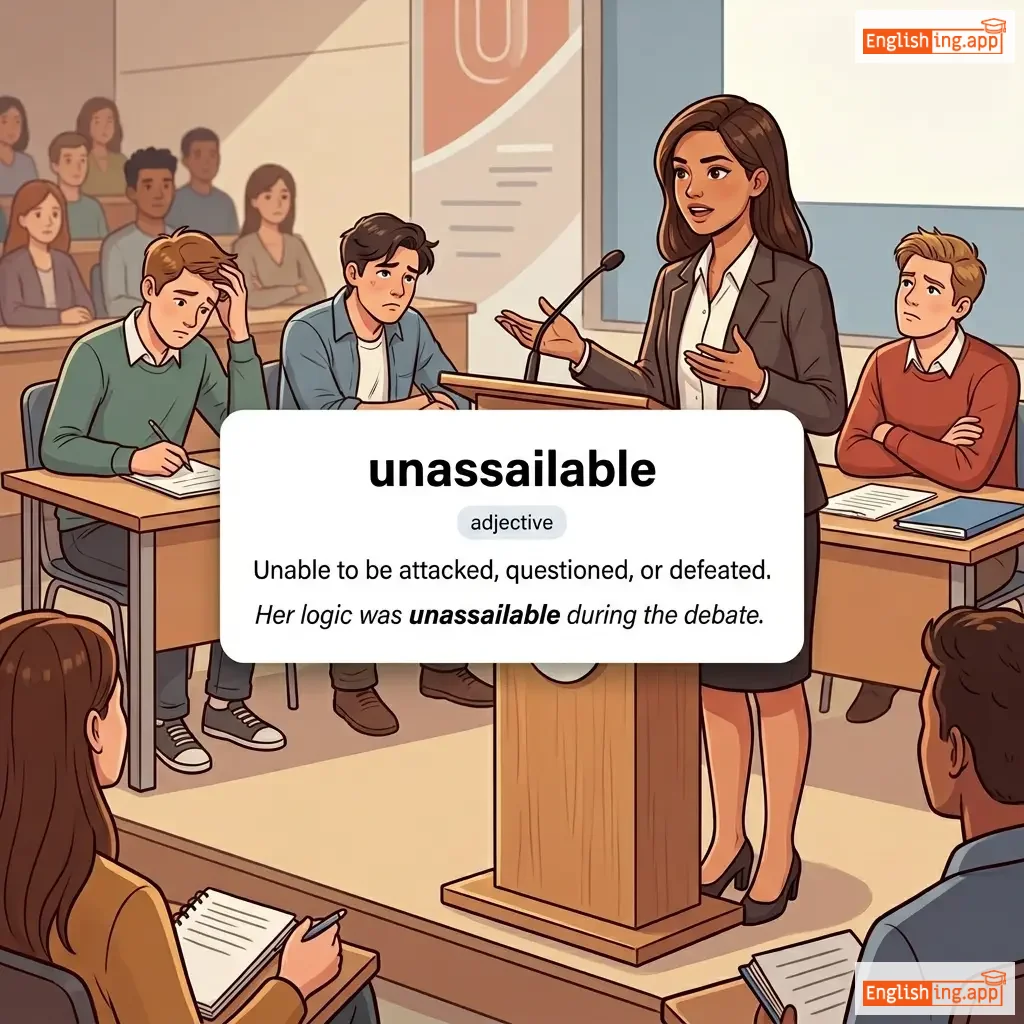
unassailable definition card — visual illustration of the meaning
adjective
/ˌʌnəˈseɪləbl/
inattaquable (inattaquable)

Unable to be attacked, questioned, or defeated.

"Her logic was unassailable during the debate."

"Sa logique était inattaquable pendant le débat." (Sa logique était inattaquable pendant le débat.)
adjective
/ʌnˈɑːrmd/
désarmé (desarme)

Not equipped with or carrying weapons

"The police found the suspect unarmed during the search."

"La police a trouvé le suspect désarmé pendant la fouille." (La police a trouve le suspect desarme pendant la fouille.)
verb
/ʌnˈɑːrm/
désarmer (desarmer)

to remove weapons from someone or to deprive of means of attack or defense

"The soldiers were ordered to unarm the prisoners."

"Les soldats ont reçu l'ordre de désarmer les prisonniers." (Les soldats ont recu l'ordre de desarmer les prisonniers)
noun
/ˈtʌrɪt/
petite tour sur le sommet d'une tour ou d'un bâtiment plus grand (petite tour sur le sommet d'une tour ou d'un batiment plus grand)

A small tower on top of a larger tower or building, often used in castles or fortifications.

"The castle was guarded by soldiers stationed in the turret."

"Le château était gardé par des soldats postés dans la tourelle." (Le chateau etait garde par des soldats postes dans la tourelle.)
noun
/ˈtjuːtərʃɪp/
tutorat (tutorat)

The office or position of a tutor; guidance or instruction given by a tutor.

"He thrived under the tutorship of his mentor."

"Il a prospéré sous le tutorat de son mentor." (Il a prospéré sous le tutorat de son mentor.)
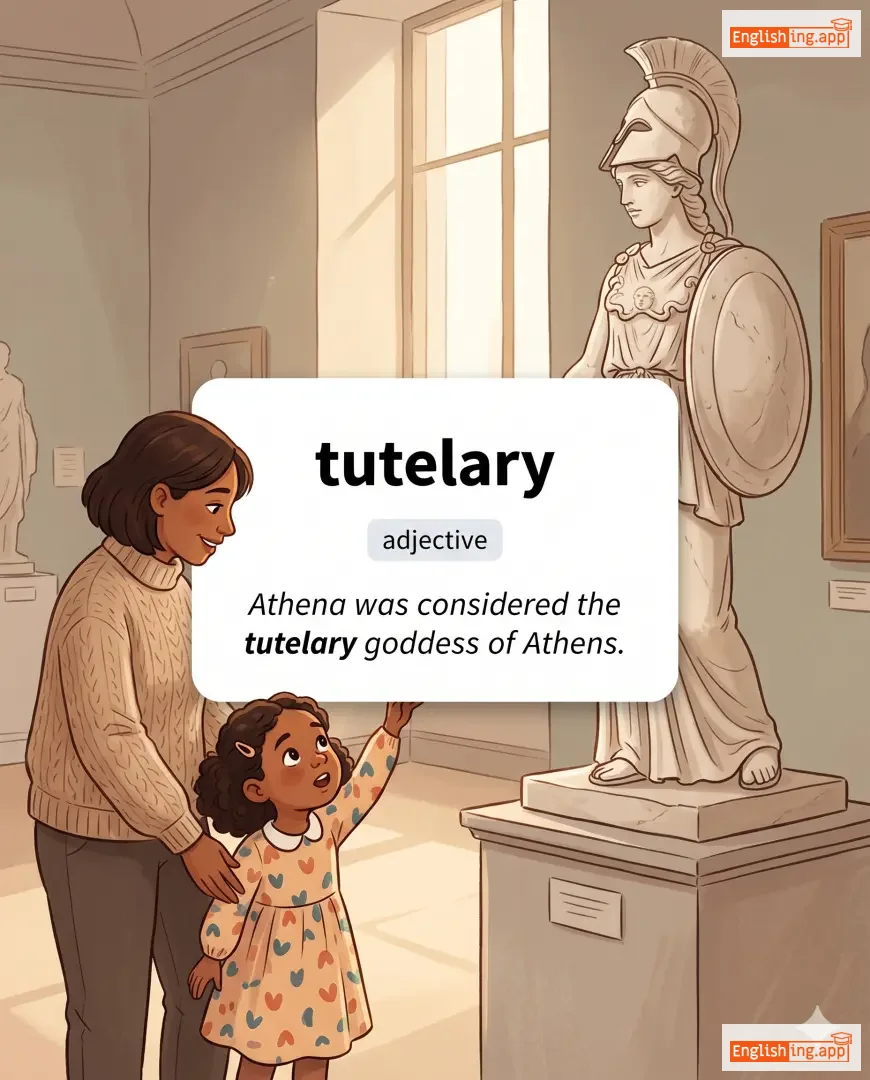
tutelary definition card — visual illustration of the meaning
adjective
/ˈtjuːtɪləri/
tutélaire (tutelaire)

Relating to or serving as a guardian or protector, often used for deities or spirits.

"Athena was considered the tutelary goddess of Athens."

"Athéna était considérée comme la déesse tutélaire d'Athènes." (Athéna était considérée comme la déesse tutélaire d'Athènes.)
adjective
/ˈtjuːtɪlɑːr/
tutélaire (tutelaire)

Serving as a guardian or protector.

"The tutelar spirit of the forest was believed to protect travelers."

"On croyait que l'esprit tutélaire de la forêt protégeait les voyageurs." (On croyait que l'esprit tutélaire de la forêt protégeait les voyageurs.)
noun
/ˈtjuːtɪlɪdʒ/
tutelle (tutelle)

The act of guarding, protecting, or guiding; instruction or teaching.

"She studied painting under the tutelage of a famous artist."

"Elle a étudié la peinture sous la tutelle d'un artiste célèbre." (Elle a étudié la peinture sous la tutelle d'un artiste célèbre.)
noun
/ˈtɜːrtl/
tortue (tortue)

A slow-moving reptile with a hard shell that lives in water or on land

"The turtle slowly crossed the sandy beach."

"La tortue a traversé lentement la plage de sable." (La tortue a traverse lentement la plage de sable)
noun
/ˈtɜːnˌəʊvə/
chiffre d'affaires (chiffre d'affaire)

the amount of business conducted during a particular period, or the rate at which employees leave a company

"The company reported a high turnover in its sales department."

"L'entreprise a rapporté un chiffre d'affaires élevé dans son département des ventes." (L'entreprise a rapporte un chiffre d'affaire eleve dans son departement des ventes.)
adjective
/ˈtɜːrnkiː/
clé en main (cle en main)

ready for immediate use; a complete product or solution

"The company provides turnkey solutions for small businesses."

"L'entreprise fournit des solutions clés en main pour les petites entreprises." (L'entreprise fournit des solutions clés en main pour les petites entreprises.)
noun
/ˈtɜːr.naʊt/
participation (participation)

the number of people who attend or participate in an event or activity

"The turnout at the rally was impressive, with thousands showing up."

"La participation à la manifestation était impressionnante, avec des milliers de personnes présentes." (La participation a la manifestation etait impressionnante, avec des milliers de personnes presentes.)