Vocabulaires

Découvrez, apprenez et maîtrisez le vocabulaire anglais

verb
/ˈwɒd.əl/
marcher en titubant (marcher en titubant)

to walk with short steps and a clumsy swaying motion, like a duck

"The duck waddled across the yard."

"Le canard a marché en titubant à travers la cour." (Le canard a marché en titubant à travers la cour.)
verb
/weɪd/
marcher dans l'eau (marcher dans l'eau)

to walk through water or another substance that impedes movement

"The children waded in the shallow river."

"Les enfants marchaient dans le fleuve peu profond." (Les enfants marchaient dans le fleuve peu profond.)
noun/verb
/ˈwɒf.əl/
gaufre (aliment), parler de manière vague (gaufre (aliment), parler de manière vague)

as noun: a crisp cake with a pattern of deep squares; as verb: to speak or write vaguely without making a clear decision

"He kept waffling instead of making a decision."

"Il n'arrêtait pas de tergiverser au lieu de prendre une décision." (Il n'arrêtait pas de tergiverser au lieu de prendre une décision.)
verb
/wɑːft/
flotter dans l'air (flotter dans l'air)

to move gently through the air, carried by a breeze

"The smell of fresh bread wafted through the kitchen."

"L'odeur du pain frais flottait dans la cuisine." (L'odeur du pain frais flottait dans la cuisine.)
verb
/wæɡ/
agiter (agiter)

to move or cause to move rapidly from side to side

"The dog wagged its tail happily."

"Le chien a agité sa queue joyeusement." (Le chien a agité sa queue joyeusement.)
noun/verb
/weɪdʒ/
salaire (weidzh)

payment for work or services, usually on a daily or weekly basis; also to engage in or carry on (a war, campaign, or struggle)

"The workers demanded a fair wage for their labor."

"Les travailleurs ont demandé un salaire juste pour leur travail." (Les travailleurs ont demande un salaire juste pour leur travail)
adjective
/ˈwæɡ.ɪʃ/
espiègle ou taquin (espiègle ou taquin)

playfully humorous or mischievous

"His waggish remarks made everyone laugh."

"Ses remarques espiègles ont fait rire tout le monde." (Ses remarques espiègles ont fait rire tout le monde.)
noun
/ˈwæɡən/
chariot (chariot)

a vehicle with four wheels used for carrying loads, often pulled by horses or a motor vehicle used for transporting goods or people

"The farmer loaded hay onto the wagon."

"Le fermier a chargé du foin dans le chariot." (Le fermier a charge du foin dans le chariot.)
noun
/weɪf/
enfant abandonné (enfant abandonné)

a homeless, neglected, or abandoned person, often a child

"The young waif wandered the streets in search of food."

"Le jeune enfant abandonné errant dans les rues à la recherche de nourriture." (Le jeune enfant abandonné errant dans les rues à la recherche de nourriture.)
noun
/weɪl/
gémissement; plainte (wail)

a prolonged cry of pain, grief, or anger; to cry loudly

"The child's wail could be heard throughout the house."

"Le cri de l'enfant pouvait être entendu dans toute la maison." (Le cri de l'enfant pouvait être entendu dans toute la maison.)
🧍‍♂️

Waist (wéist)

noun
/weɪst/
taille (taille)

the part of the human body between the ribs and the hips

"He tied a belt around his waist."

"Il a noué une ceinture autour de sa taille." (Il a noué une ceinture autour de sa taille.)
noun
/weɪst tʃeɪn/
chaîne de taille (chaine de taille)

a decorative chain worn around the waist as jewelry or ornamentation

"The traditional waist chain complemented her ethnic outfit perfectly."

"La chaîne traditionnelle de taille complétait parfaitement sa tenue ethnique." (La chaîne traditionnelle de taille complétait parfaitement sa tenue ethnique.)
noun
/ˈweɪs(t).koʊt/
gilet (zhee-lay)

a sleeveless garment worn over a shirt and under a jacket

"He wore a black waistcoat with his suit."

"Il portait un gilet noir avec son costume." (Il portait un gilet noir avec son costume.)
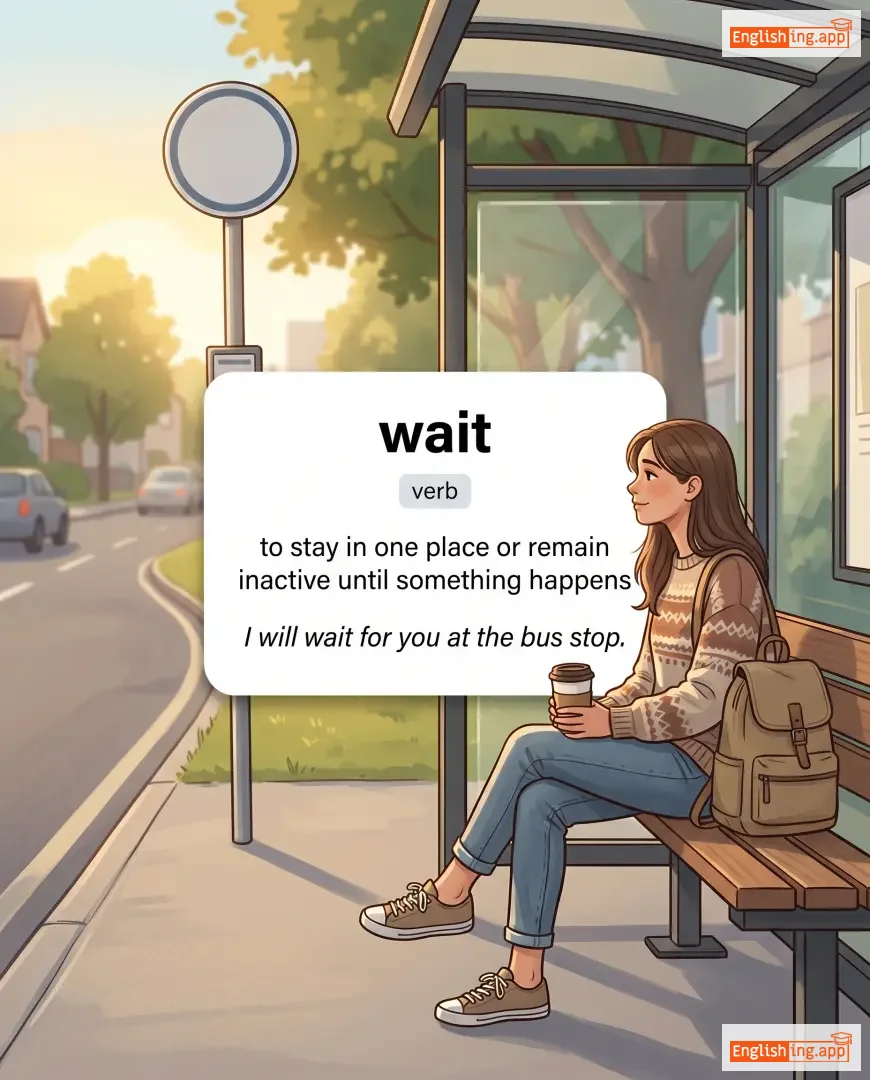
wait definition card — visual illustration of the meaning
verb
/weɪt/
attendre (attendre)

to stay in one place or remain inactive until something happens

"I will wait for you at the bus stop."

"Je vais t'attendre à l'arrêt de bus." (Je vais t'attendre à l'arrêt de bus.)
noun
/ˈweɪtər/
serveur (serveur)

a person whose job is to serve food and drinks to customers in a restaurant or café

"The waiter brought the menu and took our order politely."

"Le serveur a apporté le menu et pris la commande." (le serveur a apporte le menu et pris la commande)
noun
/ˈweɪtrəs/
serveuse (serveuse)

a woman who serves food and drinks to customers in a restaurant or café

"The waitress took our order with a friendly smile."

"La serveuse a pris notre commande avec le sourire." (La serveuse a pris notre commande avec le sourire)
verb
/weɪv/
bonheur (bonheur)

to refrain from insisting on or enforcing something, especially a right or claim

"She decided to waive her right to a lawyer."

"Elle n'a pas pu cacher son bonheur lorsqu'elle a reçu le prix." (Elle n'a pas pu cacher son bonheur lorsqu'elle a reçu le prix.)
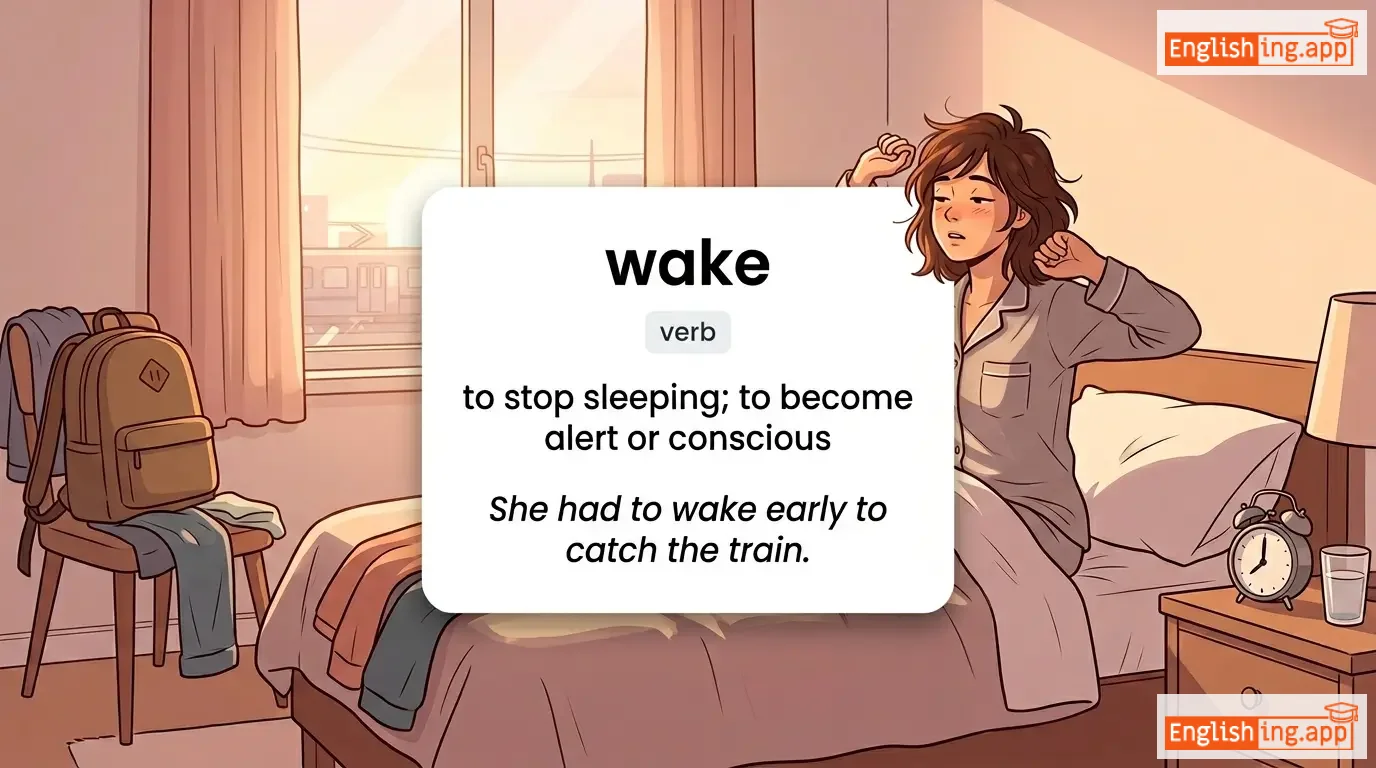
wake definition card — visual illustration of the meaning
verb
/weɪk/
bonheur (bonheur)

to stop sleeping; to become alert or conscious

"She had to wake early to catch the train."

"Elle n'a pas pu cacher son bonheur lorsqu'elle a reçu le prix." (Elle n'a pas pu cacher son bonheur lorsqu'elle a recu le prix.)
adjective
/ˈweɪ.kɪŋ/
éveillé; conscient (eveillé; conscient)

awake and conscious; relating to the time when one is awake

"She spent her waking hours studying for the exam."

"Elle a passé ses heures éveillées à étudier pour l'examen." (Elle a passe ses heures eveillees a etudier pour l'examen.)
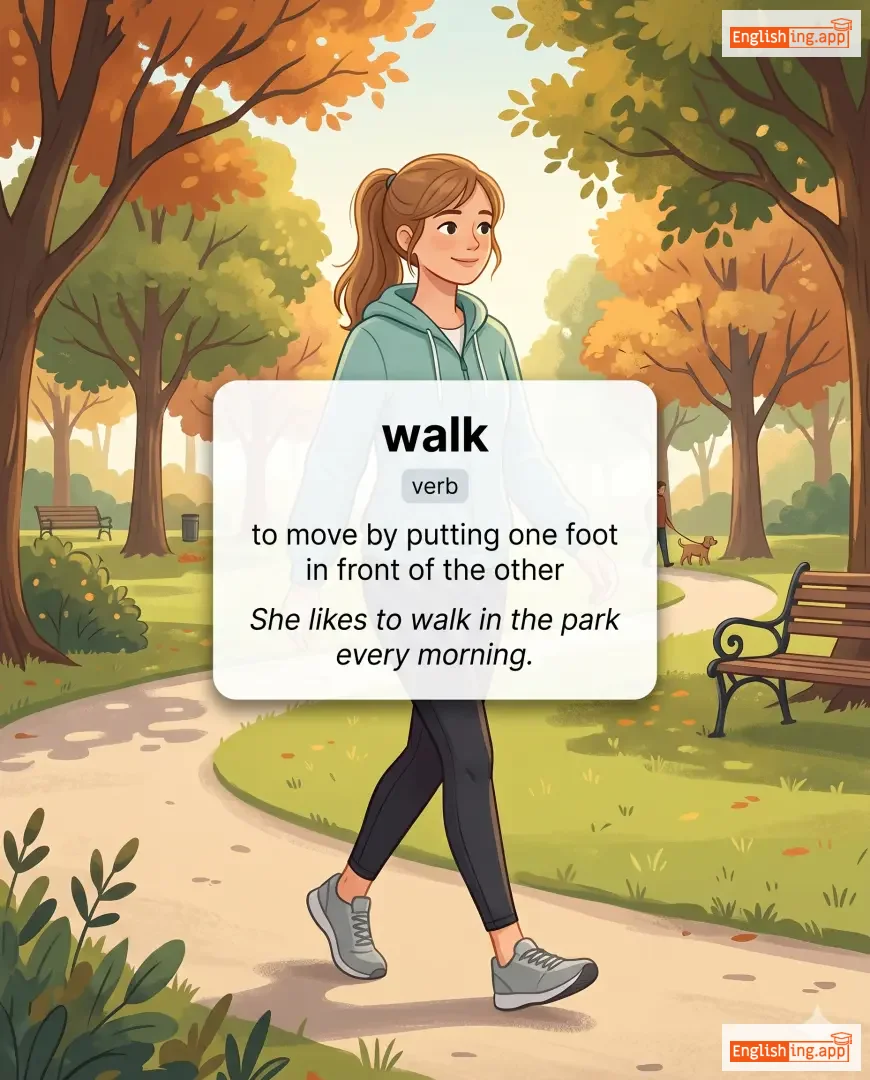
walk definition card — visual illustration of the meaning
verb
/wɔːk/
marcher (marcher)

to move by putting one foot in front of the other

"She likes to walk in the park every morning."

"Elle aime marcher dans le parc tous les matins." (Elle aime marcher dans le parc tous les matins.)
🚶‍♂️

walking (woking)

noun
/ˈwɔːkɪŋ/
marcher (marcher)

the activity of moving on foot at a moderate pace

"Walking every morning is good for your health."

"Marcher tous les matins est bon pour votre santé." (Marcher tous les matins est bon pour votre santé.)
noun
/ˈwɔːkɪŋ fɪʃ/
poisson marcheur (poisson marcheur)

a fish that can move on land using its fins and breathe air for extended periods

"The walking-fish can travel across dry land to find new water sources."

"Le poisson marcheur peut voyager à travers la terre sèche pour trouver de nouvelles sources d'eau." (Le poisson marcheur peut voyager à travers la terre sèche pour trouver de nouvelles sources d'eau.)
noun
/wɔːl/
mur (mur)

a vertical structure that encloses or divides an area

"The wall in our living room is painted blue."

"Le mur dans notre salon est peint en bleu." (Le mur dans notre salon est peint en bleu.)
noun
/ˈwɒlɪt/
portefeuille (portefeuille)

a small folding case for carrying money, credit cards, and identification

"He pulled out his wallet to pay for the coffee."

"Il a sorti son portefeuille pour payer le café." (Il a sorti son portefeuille pour payer le cafe.)
verb
/ˈwɒloʊ/
se vautrer, s'enfoncer (se vautrer, s'enfoncer)

to roll about or indulge oneself in something excessively

"The buffalo likes to wallow in the mud on hot days."

"Le buffle aime se vautrer dans la boue lors des journées chaudes." (Le buffle aime se vautrer dans la boue lors des journées chaudes.)
noun
/ˈwɔːl.nʌt/
noix (nwa)

an edible nut with a hard shell and a wrinkled appearance

"I love to eat walnuts with honey for breakfast."

"J'adore manger des noix avec du miel au petit déjeuner." (J'adore manger des noix avec du miel au petit déjeuner.)
noun
/ˈwɑːmpəm/
colliers en coquillage (colliers en coquillage)

beads made by Native Americans from shells, used as money or decoration

"The tribe traded furs for wampum."

"La tribu a échangé des fourrures contre des colliers en coquillage." (La tribu a échangé des fourrures contre des colliers en coquillage.)
adjective
/wɒn/
pâle (pale)

looking pale or sickly; lacking color or vitality

"After the long illness, his face looked wan and tired."

"Après la longue maladie, son visage semblait pâle et fatigué." (Apres la longue maladie, son visage semblait pale et fatigue.)
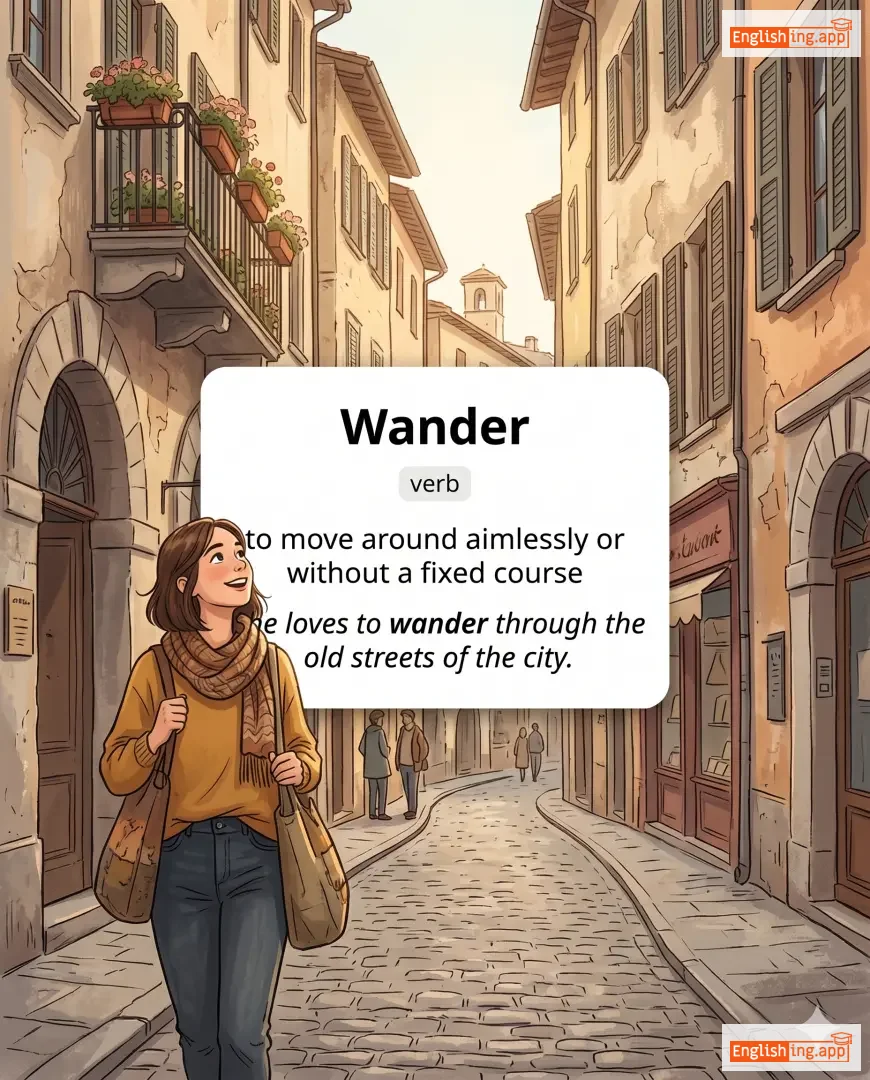
Wander definition card — visual illustration of the meaning
verb
/ˈwɒndər/
errier (errier)

to move around aimlessly or without a fixed course

"She loves to wander through the old streets of the city."

"Elle aime se promener dans les anciennes rues de la ville." (Elle aime se promener dans les anciennes rues de la ville.)
noun
/ˈwɒndərər/
vagabond; personne qui voyage sans but précis (wanderer)

a person who travels aimlessly; someone who roams from place to place

"The wanderer explored different countries without a fixed destination."

"Le vagabond a exploré différents pays sans destination fixe." (Le vagabond a exploré différents pays sans destination fixe.)
noun
/ˈwɒndərlʌst/
passion pour voyager (passion pour voyager)

A strong desire to travel and explore the world.

"Her wanderlust took her to every corner of the globe."

"Sa passion pour voyager l'a menée dans tous les coins du monde." (Sa passion pour voyager l'a menée dans tous les coins du monde.)
verb
/weɪn/
décroître (decroitre)

To decrease gradually in power, intensity, or size.

"The moon wanes after the full moon night."

"La lune décroît après la nuit de pleine lune." (La lune décroît après la nuit de pleine lune.)
verb
/ˈwaŋɡl/
obtenir quelque chose par astuce (obtenir quelque chose par astuce)

To achieve something by clever or sometimes dishonest persuasion or trickery.

"He wangled a free ticket to the concert."

"Il a obtenu un billet gratuit pour le concert par astuce." (Il a obtenu un billet gratuit pour le concert par astuce.)
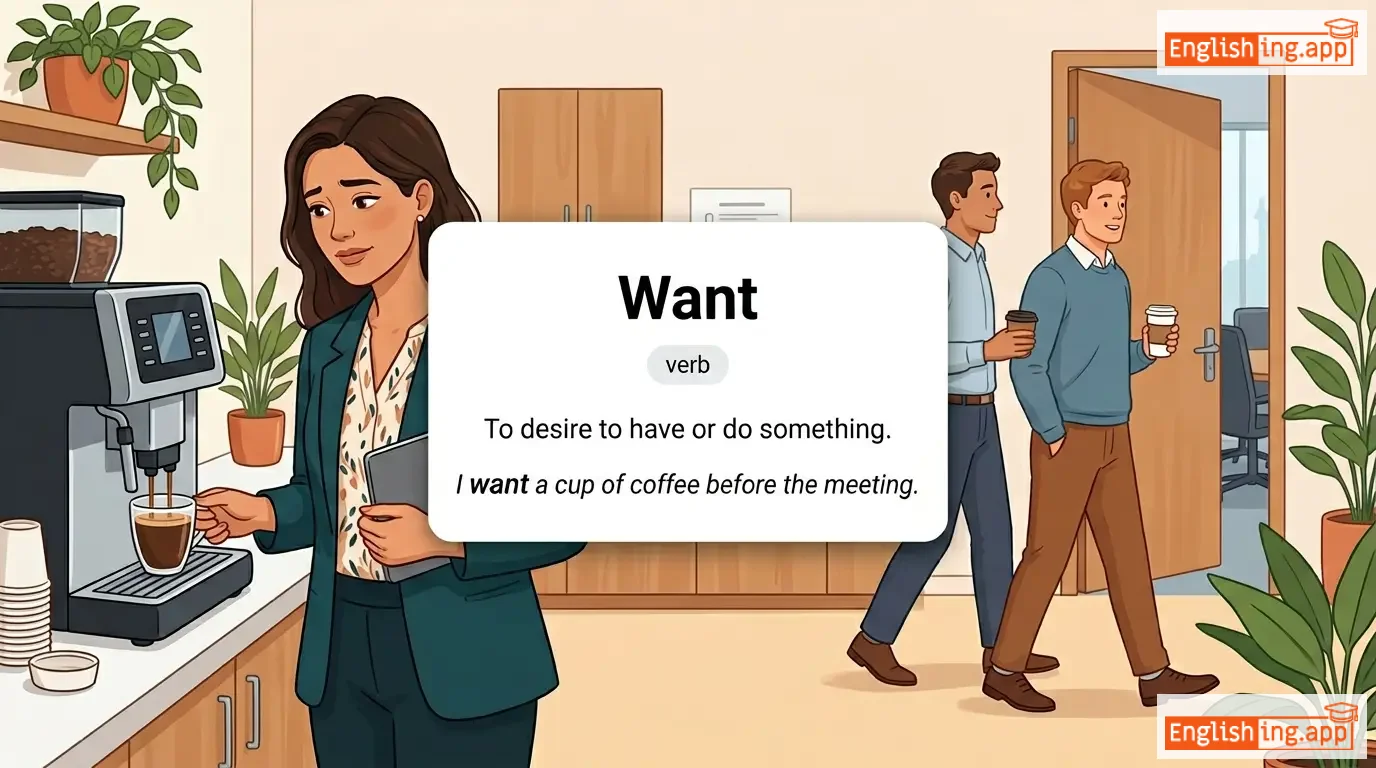
Want definition card — visual illustration of the meaning
verb
/wɒnt/
vouloir (vouloir)

To desire to have or do something.

"I want a cup of coffee before the meeting."

"Je veux une tasse de café avant la réunion." (Je veux une tasse de café avant la réunion.)
adjective
/ˈwɒntɪŋ/
insuffisant (insuffisant)

Lacking or deficient in quality or quantity.

"His explanation was wanting in clarity."

"Son explication manquait de clarté." (son explication manquait de clarté.)
adjective
/ˈwɒntən/
cruauté inutile (cruaute inutile)

Deliberate and unprovoked; reckless or cruel.

"The soldiers were accused of wanton destruction."

"Les soldats ont été accusés de destruction inutile." (Les soldats ont été accusés de destruction inutile.)
noun
/ˈwɒntənnəs/
méchanceté gratuite (mechancete gratuite)

The quality of being reckless, cruel, or deliberately malicious.

"His wantonness shocked everyone at the gathering."

"Sa méchanceté gratuite a choqué tout le monde à la réunion." (Sa mechancete gratuite a choque tout le monde a la reunion.)
noun
/wɔːr/
guerre (guerre)

a state of conflict between different countries or groups

"The war caused great suffering to the people."

"La guerre a causé une grande souffrance aux gens." (La guerre a causé une grande souffrance aux gens.)
verb
/ˈwɔːbəl/
chanter ou siffler avec une voix tremblante ou des trilles (chanter ou siffler avec une voix tremblante ou des trilles)

To sing or whistle with a quavering voice or with trills.

"The bird warbled a sweet tune in the morning."

"L'oiseau a chanté une douce mélodie le matin." (L'oiseau a chante une douce melodie le matin.)
noun
/wɔːrd/
salle (salle)

A separate room in a hospital for patients; also a division of a city or a person under guardianship.

"She was admitted to the children's ward."

"Elle a été admise dans la salle des enfants." (Elle a ete admise dans la salle des enfants.)
noun
/ˈwɔːdrəʊb/
armoire (armoire)

A large cupboard where clothes are stored; also the collection of clothes someone owns.

"Her wardrobe is full of colorful dresses."

"Son armoire est pleine de robes colorées." (Son armoire est pleine de robes colorées.)
noun
/ˈweə(r)haʊs/
entrepôt (entrepot)

a large building where goods are stored before being sold or distributed

"The company stores all its products in a big warehouse."

"L'entreprise stocke tous ses produits dans un grand entrepôt." (L'entreprise stocke tous ses produits dans un grand entrepôt.)
noun
/ˈwɔːfeə/
guerre (guerre)

engagement in or the activities involved in war

"The country prepared for the possibility of total warfare."

"Le pays s'est préparé à la possibilité d'une guerre totale." (Le pays s'est prepare a la possibilite d'une guerre totale.)
adjective
/ˈwɔːrˌlaɪk/
martial (martial)

Having an aggressive or militant nature; inclined to fight or engage in war.

"The tribe was known for its warlike traditions."

"La tribu était connue pour ses traditions martiales." (La tribu était connue pour ses traditions martiales.)
adjective
/wɔːrm/
chaleur (chaleur)

having a moderate degree of heat

"The warm sunlight made the room feel cozy."

"La lumière chaude a rendu la pièce confortable." (La lumière chaude a rendu la pièce confortable.)
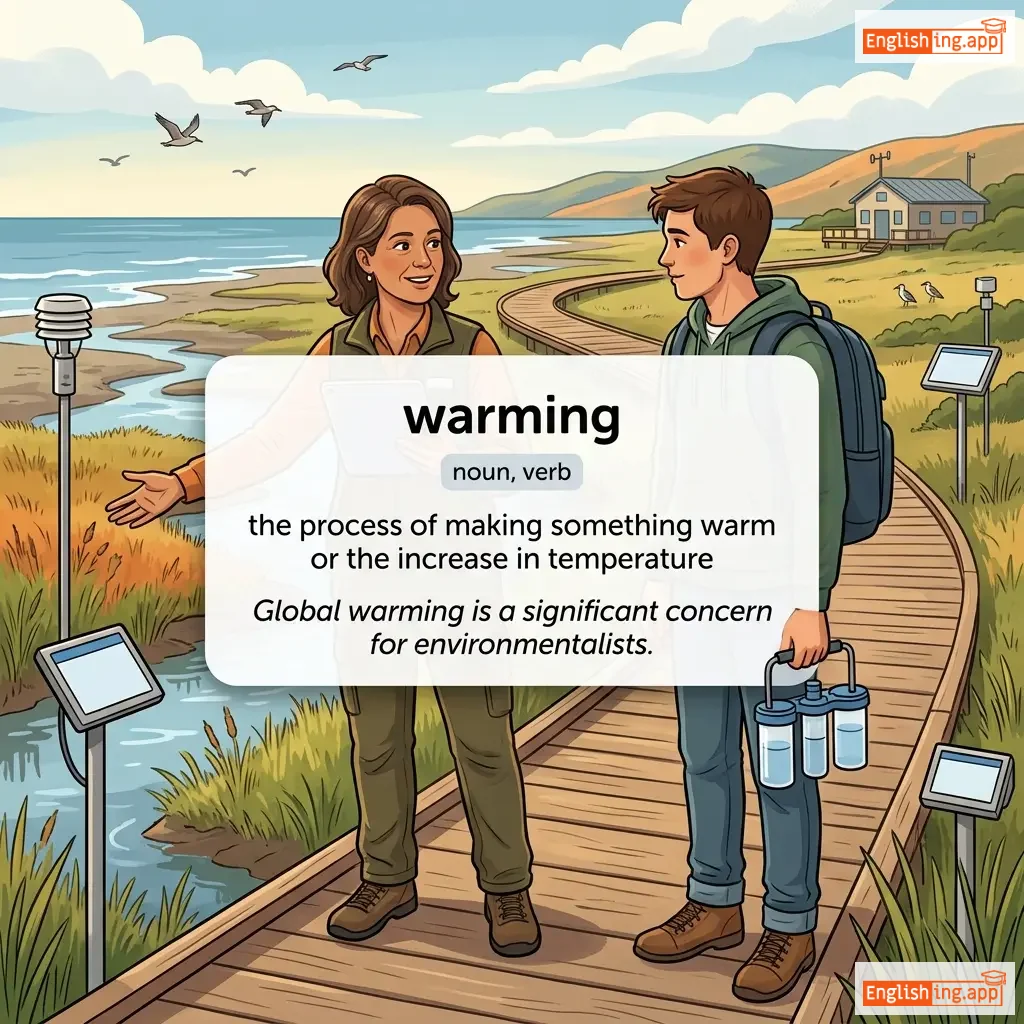
warming definition card — visual illustration of the meaning
noun, verb
/ˈwɔːmɪŋ/
augmentation de la température (augmentation de la temperature)

the process of making something warm or the increase in temperature

"Global warming is a significant concern for environmentalists."

"Le réchauffement climatique est une préoccupation importante pour les écologistes." (Le réchauffement climatique est une préoccupation importante pour les écologistes.)
adverb
/ˈwɔːm.li/
chaleureusement; affectueusement (chaleureusement; affectueusement)

in a warm manner; with warmth; cordially; affectionately

"She welcomed the guests warmly at the door."

"Elle a accueilli les invités chaleureusement à la porte." (Elle a accueilli les invités chaleureusement à la porte.)
noun
/ˈwɔːrˌmʌŋɡər/
belliciste (belliciste)

A person who advocates or promotes war or conflict.

"The leader was criticized as a warmonger by his opponents."

"Le leader a été critiqué comme un belliciste par ses opposants." (Le leader a été critiqué comme un belliciste par ses opposants.)
noun
/wɔːmθ/
chaleur (chaleur)

the quality or state of being warm in temperature or feeling

"She felt the warmth of the sun on her face."

"Elle ressentait la chaleur du soleil sur son visage." (Elle ressentait la chaleur du soleil sur son visage.)
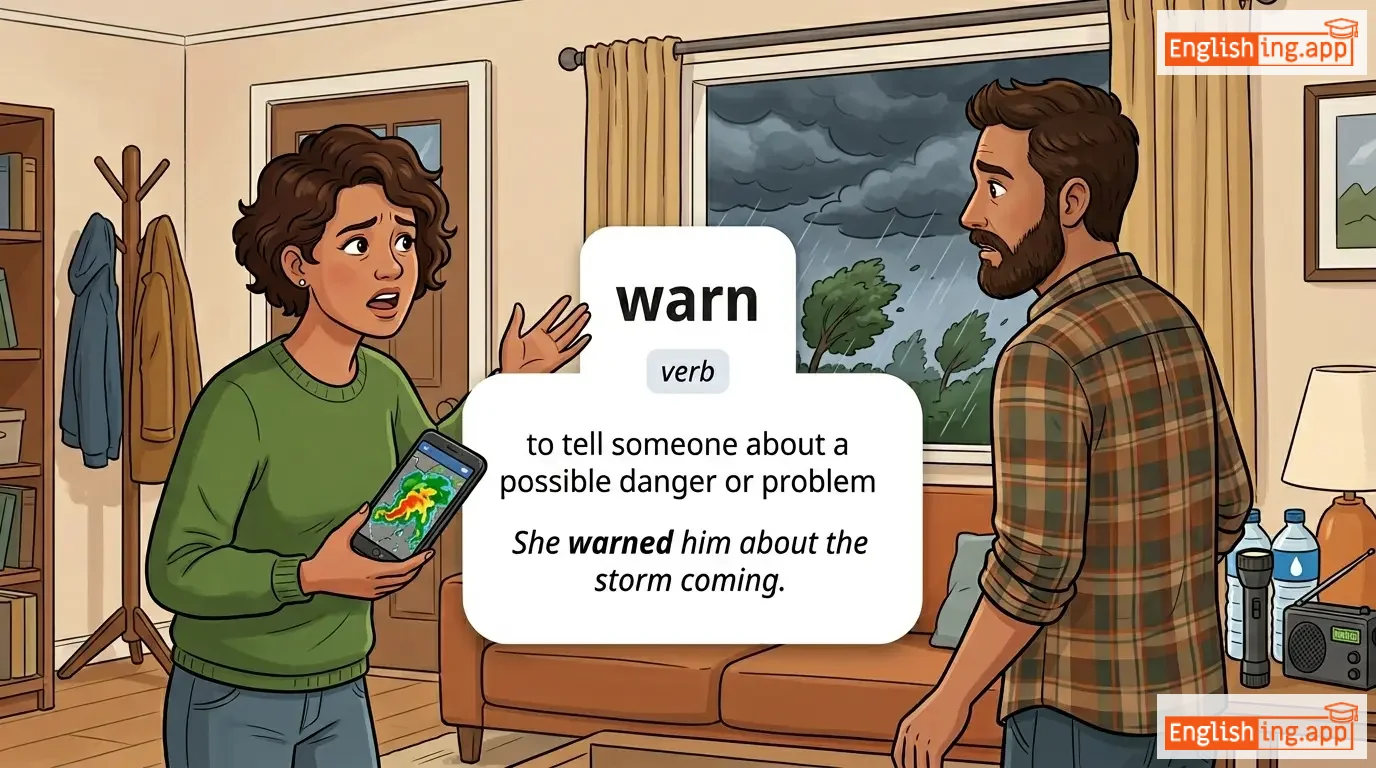
warn definition card — visual illustration of the meaning
verb
/wɔːrn/
avertir (avertir)

to tell someone about a possible danger or problem

"She warned him about the storm coming."

"Elle lui a averti de la tempête qui arrivait." (Elle lui a averti de la tempête qui arrivait.)