Vocabulaires

Découvrez, apprenez et maîtrisez le vocabulaire anglais

adverb
/əˈbæk/
surpris (surpris)

by surprise; unexpectedly

"I was taken aback by his sudden announcement."

"J'ai été surpris par son annonce soudaine." (J'ai été surpris par son annonce soudaine.)
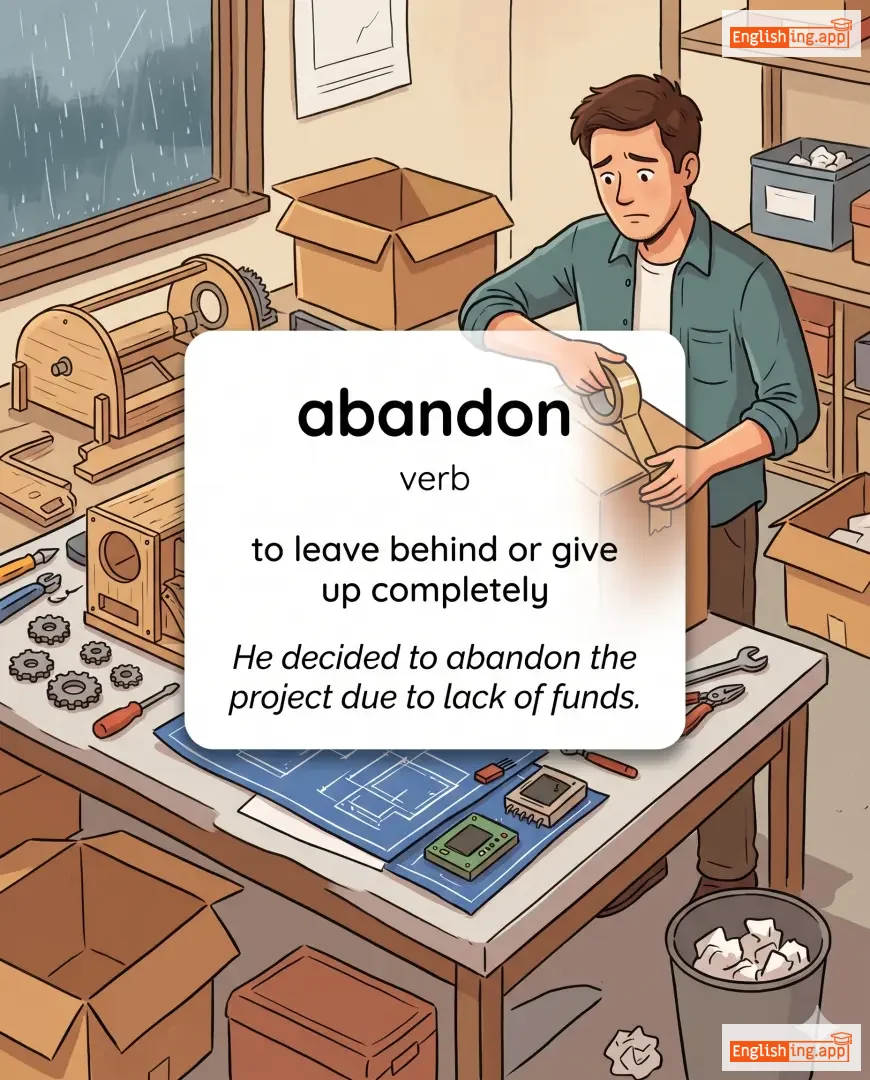
abandon definition card — visual illustration of the meaning
verb
/əˈbændən/
abandonner (abandonner)

to leave behind or give up completely

"He decided to abandon the project due to lack of funds."

"Il a décidé d'abandonner le projet en raison du manque de fonds." (Il a décidé d'abandonner le projet en raison du manque de fonds.)
noun
/əˈbændənmənt/
abandon (abandon)

the act of leaving someone or something behind completely; the state of being deserted

"The child suffered deep emotional pain because of abandonment."

"L’enfant a souffert d’une profonde douleur émotionnelle à cause de l’abandon." (Lenfant a souffert dune profonde douleur emotionnelle a cause de labandon)
verb
/əˈbeɪs/
abaisser (abaisser)

to belittle or degrade someone

"He refused to abase himself before the king."

"Il a refusé de s'abaisser devant le roi." (Il a refusé de s'abaisser devant le roi.)
verb
/əˈbæʃ/
déconcerter (deconcerter)

to make someone feel embarrassed or ashamed

"Her sudden question seemed to abash him."

"Sa question soudaine semblait le déstabiliser." (Sa question soudaine semblait le destabiliser.)
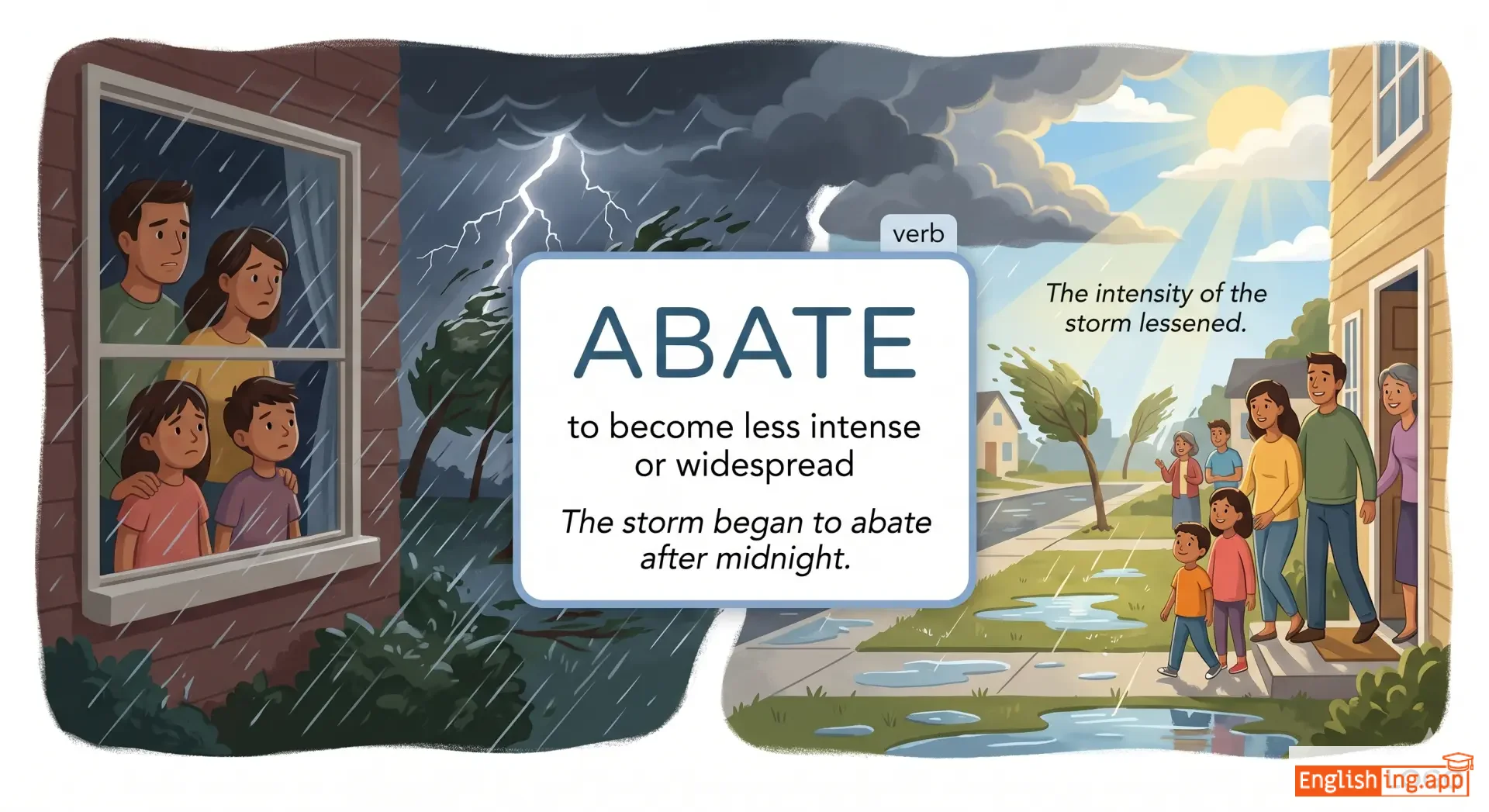
abate definition card — visual illustration of the meaning
verb
/əˈbeɪt/
diminuer (diminuer)

to become less intense or widespread

"The storm began to abate after midnight."

"La tempête a commencé à diminuer après minuit." (La tempête a commencé à diminuer après minuit.)
noun
/ˈæbɪs/
abbesse (femme responsable d'un couvent) (abbesse (femme responsable d'un couvent))

the woman in charge of a convent of nuns

"The abbess welcomed the visitors to the convent."

"L'abbesse a accueilli les visiteurs au couvent." (L'abbesse a accueilli les visiteurs au couvent.)
noun
/ˈæbi/
abbaye (abbaye)

A large church building or monastery where monks or nuns live, work, and worship.

"The old abbey on the hill attracts many tourists each year."

"La vieille abbaye sur la colline attire de nombreux touristes chaque année." (La vieille abbaye sur la colline attire de nombreux touristes chaque année.)
noun
/ˈæbət/
abbé (abbe)

The head of a monastery for monks.

"The abbot welcomed the visitors to the monastery."

"L'abbé a accueilli les visiteurs au monastère." (L'abbé a accueilli les visiteurs au monastère.)
verb
/əˈbriːvieɪt/
abréger (abréger)

To shorten a word, phrase, or text by leaving out letters or parts.

"We often abbreviate 'Doctor' to 'Dr'."

"Nous abrégons souvent 'Docteur' en 'Dr'." (Nous abrégons souvent 'Docteur' en 'Dr'.)
noun
/əˌbriːviˈeɪʃən/
abréviation (abréviation)

a shortened form of a word or phrase

"NASA is an abbreviation for National Aeronautics and Space Administration."

"NASA est une abréviation de National Aeronautics and Space Administration." (NASA est une abréviation de National Aeronautics and Space Administration.)
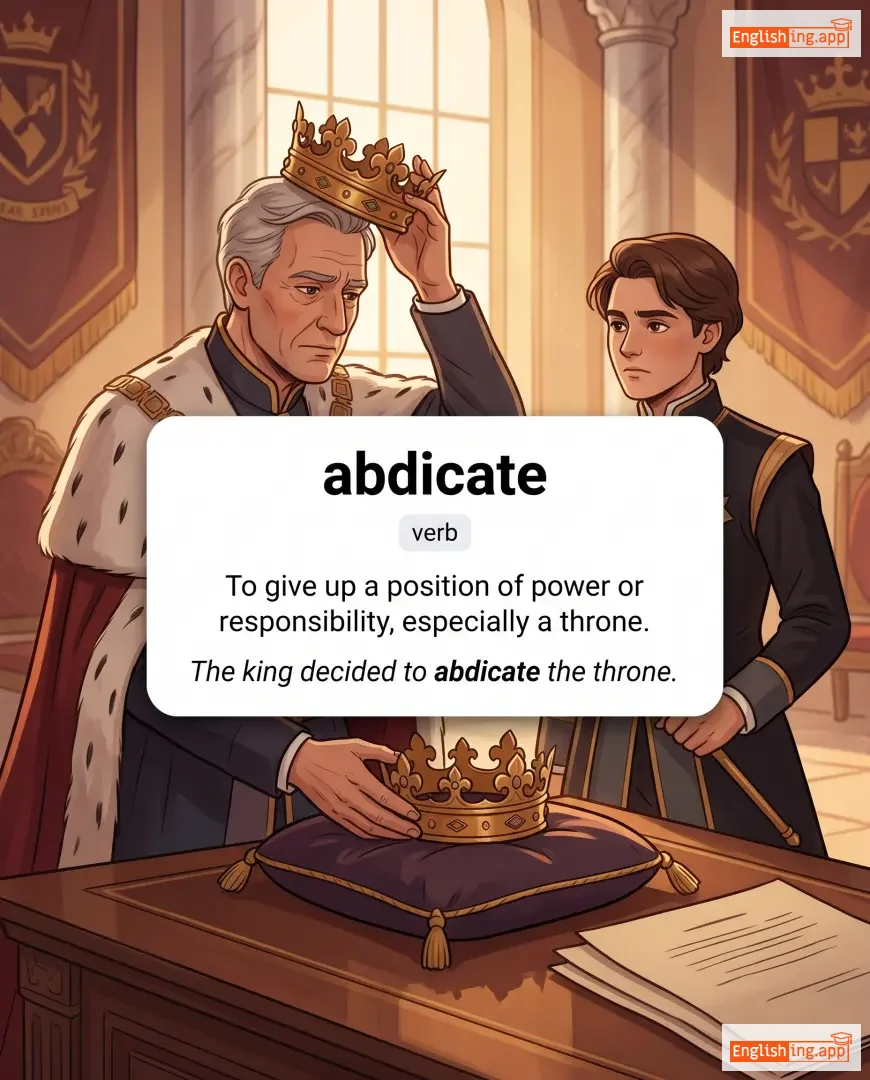
abdicate definition card — visual illustration of the meaning
verb
/ˈæbdɪkeɪt/
abdiquer (abdiquer)

To give up a position of power or responsibility, especially a throne.

"The king decided to abdicate the throne."

"Le roi a décidé d'abdiquer du trône." (Le roi a décidé d'abdiquer du trône.)
noun
/ˈæbdəmən/
abdomen (abdomen)

The part of the body below the chest and above the hips that contains the stomach and other organs.

"He complained of pain in his abdomen."

"Il s'est plaint de douleur dans son abdomen." (Il s'est plaint de douleur dans son abdomen.)
adjective
/æbˈdɑː.mə.nəl/
abdominal (abdominal)

relating to the abdomen (the part of the body between the chest and pelvis)

"He complained of severe abdominal pain."

"Il se plaignait de douleurs abdominales sévères." (Il se plaignait de douleurs abdominales sévères.)
verb
/əbˈdʌkt/
enlever (enlever)

to take someone away illegally by force or deception

"The criminal tried to abduct the child in broad daylight."

"Le criminel a essayé d’enlever l’enfant en plein jour." (Le criminel a essaye denlever lenfant en plein jour)
noun
/æbˈdʌk.ʃən/
enlèvement (enlevement)

the act of taking someone away illegally by force; kidnapping

"The police are investigating the abduction of the child."

"La police enquête sur l'enlèvement de l'enfant." (La police enquête sur l'enlèvement de l'enfant.)
noun
/əbˈdʌktər/
ravisseur (ravisseur)

a person who kidnaps or forcibly takes someone away

"The police arrested the abductor after a nationwide search."

"La police a arrêté le ravisseur après une longue recherche." (La police a arrete le ravisseur apres une longue recherche)
adverb
/əˈbɛd/
au lit (au lit)

in bed

"She stayed abed all day due to illness."

"Elle est restée au lit toute la journée à cause de la maladie." (Elle est restée au lit toute la journée à cause de la maladie.)
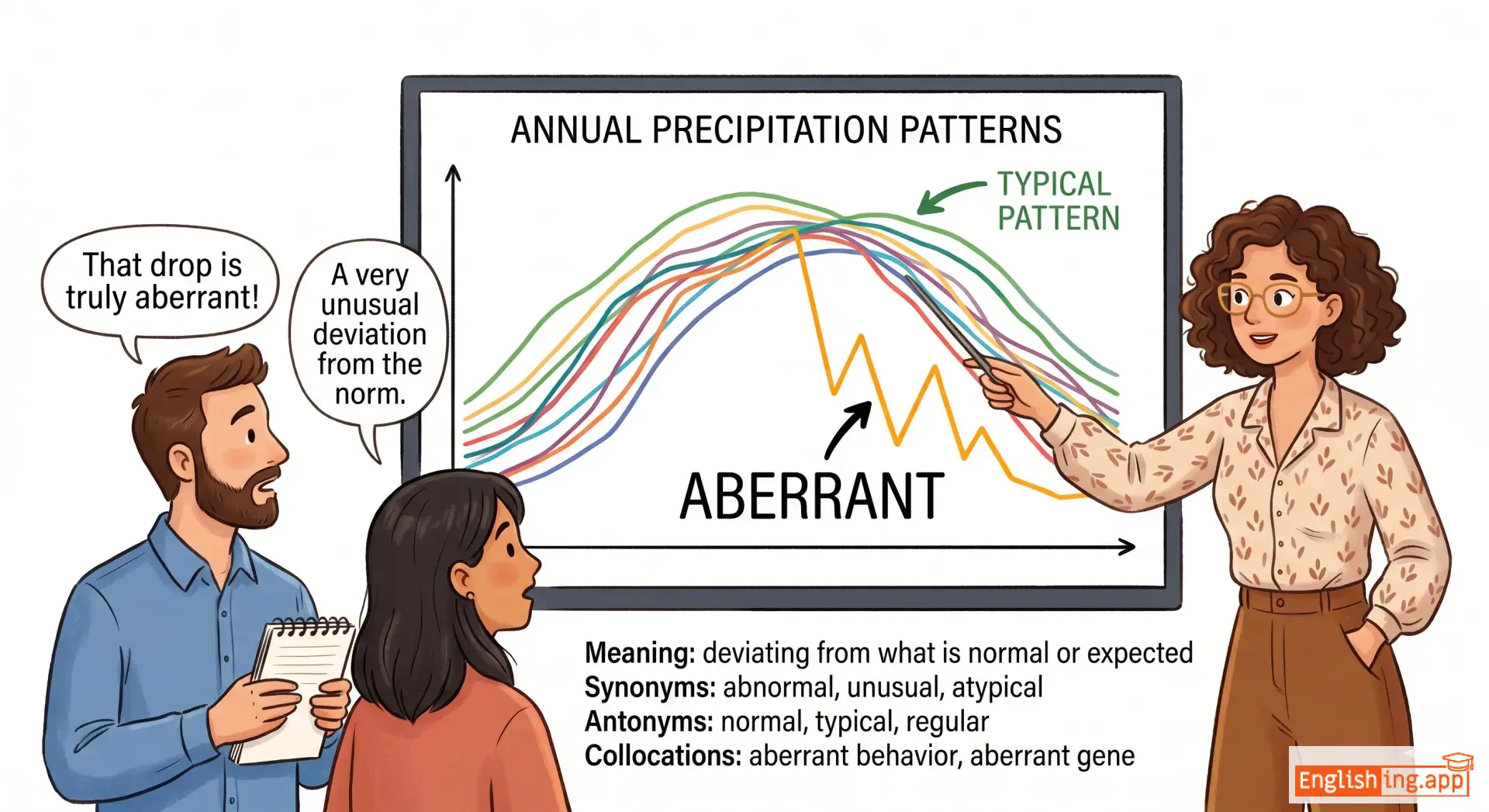
aberrant definition card — visual illustration of the meaning
adjective
/ˈæb.ə.rənt/
aberrant (aberrant)

deviating from what is normal or expected; abnormal

"His aberrant behavior shocked everyone at the meeting."

"Son comportement aberrant a choqué tout le monde à la réunion." (Son comportement aberrant a choqué tout le monde à la réunion.)
aberration definition card — visual illustration of the meaning
noun
/ˌæb.əˈreɪ.ʃən/
anomalie (anomalie)

a departure from what is normal, usual, or expected; an anomaly

"The sudden drop in temperature was an aberration for this season."

"La chute soudaine de la température était une anomalie pour cette saison." (La chute soudaine de la temperature etait une anomalie pour cette saison.)
verb
/əˈbɛt/
encourager un crime (encourager un crime)

to encourage or assist someone to commit a crime or wrongdoing

"He was accused of abetting the criminals in their escape."

"Il a été accusé d'avoir aidé les criminels dans leur fuite." (Il a été accusé d'avoir aidé les criminels dans leur fuite.)
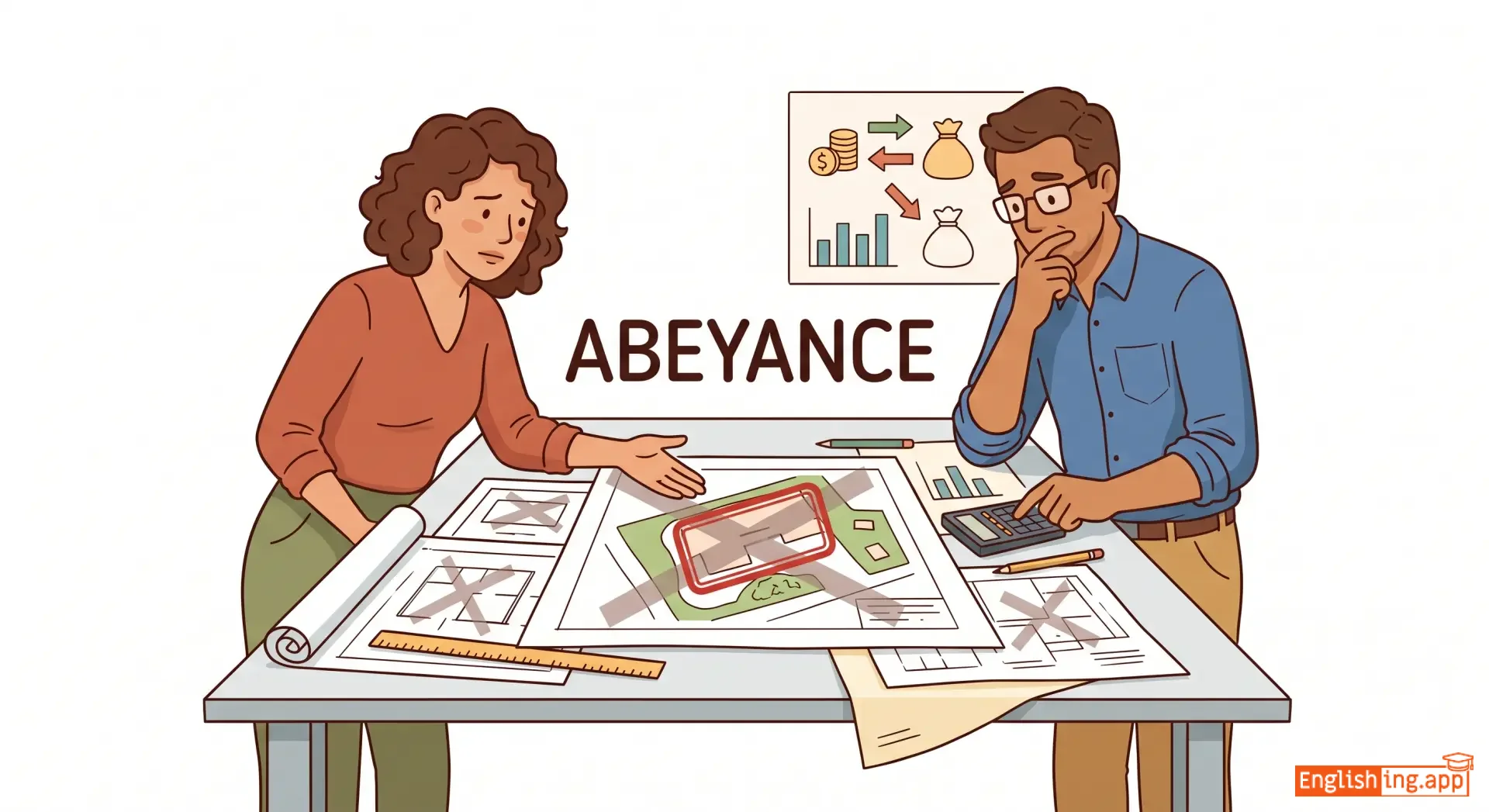
abeyance definition card — visual illustration of the meaning
noun
/əˈbeɪəns/
suspension temporaire (suspension temporaire)

a state of temporary suspension or inactivity

"The project was held in abeyance until funds became available."

"Le projet a été suspendu jusqu'à ce que les fonds deviennent disponibles." (Le projet a été suspendu jusqu'à ce que les fonds deviennent disponibles.)
verb
/əbˈhɔːr/
abhorrer (abhorrer)

to regard with disgust and hatred

"She abhors cruelty to animals."

"Elle abhorre la cruauté envers les animaux." (Elle abhorre la cruauté envers les animaux.)
noun
/əbˈhɒrəns/
abhorrence (abhorrence)

a feeling of strong disgust or hatred

"He expressed his abhorrence of racial discrimination."

"Il a exprimé son abhorrence de la discrimination raciale." (Il a exprime son abhorrence de la discrimination raciale.)
adjective
/əbˈhɒrənt/
répugnant (repugnant)

causing or deserving strong dislike or hatred

"Such cruelty is abhorrent to civilized society."

"Une telle cruauté est répugnante pour une société civilisée." (Une telle cruauté est répugnante pour une société civilisée.)
noun
/əˈbaɪdəns/
obéissance (obeissance)

the act of following, accepting, or complying with something

"Her abidance by the rules impressed the committee."

"Son obéissance aux règles a impressionné le comité." (Son obéissance aux règles a impressionné le comité.)
verb
/əˈbaɪd/
respecter (respecter)

to accept, tolerate, or remain faithful to something

"Citizens must abide by the laws of their country."

"Les citoyens doivent respecter les lois de leur pays." (Les citoyens doivent respecter les lois de leur pays.)
adjective
/əˈbaɪdɪŋ/
perpétuel (perpetuel)

lasting for a long time; enduring

"She had an abiding love for her hometown."

"Elle avait un amour perpétuel pour sa ville natale." (Elle avait un amour perpétuel pour sa ville natale.)
noun
/əˈbɪləti/
capacité (capacite)

the power, skill, or capacity to do something

"Her ability to solve problems quickly impressed everyone."

"Sa capacité à résoudre les problèmes rapidement a impressionné tout le monde." (Sa capacite a resoudre les problemes rapidement a impressionne tout le monde.)
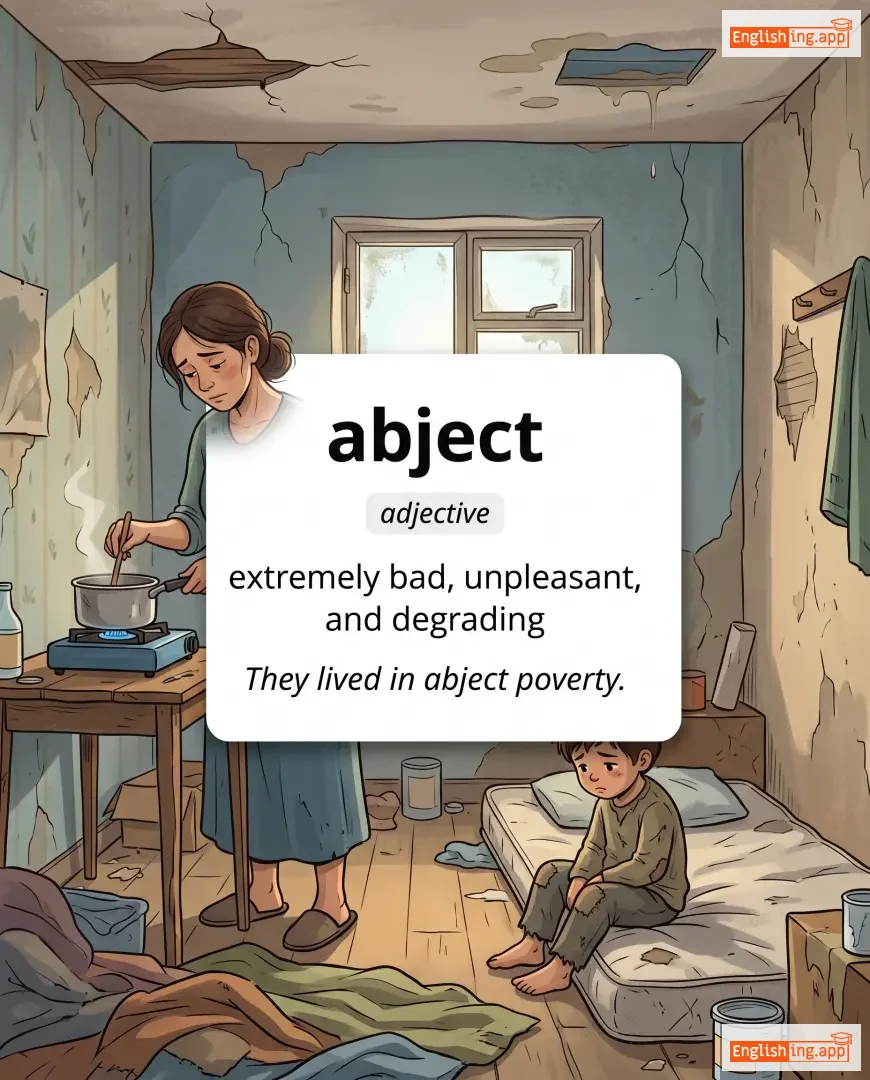
abject definition card — visual illustration of the meaning
adjective
/ˈæbdʒɛkt/
abject (abject)

extremely bad, unpleasant, and degrading

"They lived in abject poverty."

"Ils vivaient dans une pauvreté abjecte." (Ils vivaient dans une pauvreté abjecte.)
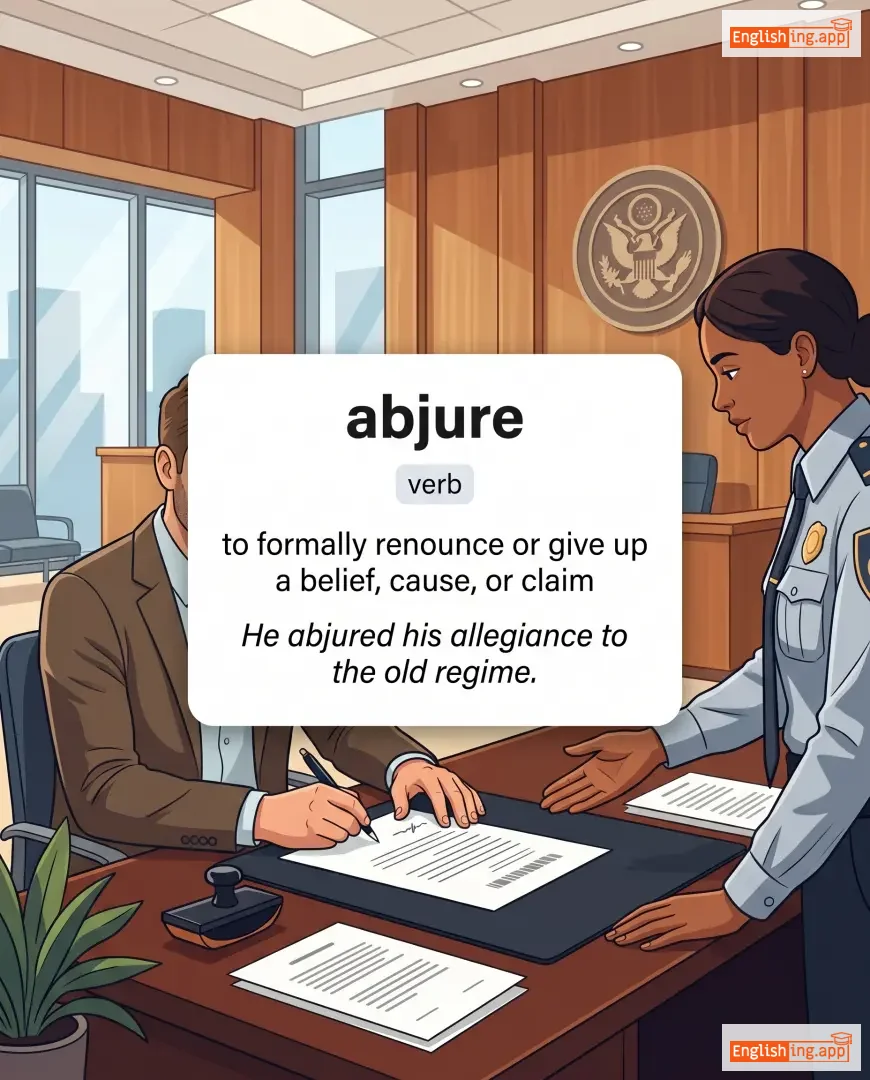
abjure definition card — visual illustration of the meaning
verb
/æbˈdʒʊər/
abjurer (ab-jurer)

to formally renounce or give up a belief, cause, or claim

"He abjured his allegiance to the old regime."

"Il renonça à sa fidélité au vieux régime." (Il renonça à sa fidélité au vieux régime.)
adjective
/ˈeɪbl/
capable (capable)

having the power, skill, or means to do something

"She is able to speak three languages fluently."

"Elle est capable de parler trois langues couramment." (Elle est capable de parler trois langues couramment.)
adjective
/ˌeɪ.bəlˈbɒd.id/
corporellement capable (corporellement capable)

physically strong and healthy, not disabled

"The company is looking for able-bodied workers for the construction site."

"L'entreprise recherche des travailleurs physiquement capables pour le chantier." (L'entreprise recherche des travailleurs physiquement capables pour le chantier.)
noun
/əˈbluːʃən/
ablution (ablution)

the act of washing oneself, often for religious purposes

"He performed his morning ablution before the prayer."

"Il a effectué son ablution matinale avant la prière." (Il a effectue son ablution matinale avant la prière.)
verb
/ˈæbnɪˌɡeɪt/
abnéguer (abneguer)

to deny or renounce something, especially a right or desire

"She chose to abnegate her personal interests for the sake of the team."

"Elle a choisi d'abnéguer ses intérêts personnels pour le bien de l'équipe." (Elle a choisi d'abnéguer ses intérêts personnels pour le bien de l'équipe.)
noun
/ˌæbnɪˈɡeɪʃən/
abnégation (abnegation)

the act of renouncing or rejecting something, especially self-denial

"The monk’s life was one of complete abnegation of worldly pleasures."

"La vie du moine était une complète abnégation des plaisirs mondains." (La vie du moine etait une complete abnegation des plaisirs mondains.)
adjective
/æbˈnɔːr.məl/
anormal (anormal)

deviating from what is normal or usual, typically in a way that is undesirable

"The doctor noticed an abnormal growth in the patient’s lung."

"Le médecin a remarqué une croissance anormale dans les poumons du patient." (Le médecin a remarqué une croissance anormale dans les poumons du patient.)
noun
/əˈboʊd/
domicile (domicile)

a place of residence; a home

"They invited us to their humble abode."

"Ils nous ont invités dans leur humble domicile." (Ils nous ont invités dans leur humble domicile.)
verb
/əˈbɑː.lɪʃ/
abolir (abolir)

to formally put an end to a system, practice, or institution

"The government decided to abolish the old tax system."

"Le gouvernement a décidé d'abolir le vieux système fiscal." (Le gouvernement a décidé d'abolir le vieux système fiscal.)
noun
/ˌæbəˈlɪʃən/
abolition (abolition)

the act of formally ending or eliminating a system, practice, or institution

"The abolition of slavery was a major milestone in human rights history."

"L’abolition de l’esclavage a été une étape majeure de l’histoire des droits humains." (l abolition de l esclavage a ete une etape majeure de l histoire des droits humains)
adjective
/əˈbɑː.mə.nə.bəl/
abominable (abominable)

causing moral revulsion; extremely unpleasant

"The prisoners were kept in abominable conditions."

"Les prisonniers ont été gardés dans des conditions abominables." (Les prisonniers ont été gardés dans des conditions abominables.)
verb
/əˈbɑː.mə.neɪt/
abominer (abominer)

to feel hatred or loathing for something

"She abominates cruelty to animals."

"Elle abhorre la cruauté envers les animaux." (Elle abhorre la cruauté envers les animaux.)
noun
/əˌbɑː.məˈneɪ.ʃən/
abomination (abomination)

a thing that causes disgust or hatred

"Slavery was considered an abomination."

"L'esclavage était considéré comme une abomination." (L'esclavage etait considere comme une abomination.)
adjective
/ˌæbəˈrɪdʒənəl/
aborigène (aborijene)

Relating to the original inhabitants of a region.

"The museum has a large collection of aboriginal art."

"Le musée possède une grande collection d'art aborigène." (Le musée possède une grande collection d'art aborigène.)
noun
/ˌæbəˈrɪdʒəniːz/
aborigènes (aborigènes)

The original inhabitants of a land, especially in Australia.

"The aborigines have preserved their traditions for thousands of years."

"Les aborigènes ont préservé leurs traditions pendant des milliers d'années." (Les aborigènes ont préservé leurs traditions pendant des milliers d'années.)
verb
/əˈbɔːrt/
avorter; annuler (avorter; annuler)

to stop a process or action before it is completed; to end a pregnancy deliberately

"The pilot decided to abort the mission due to bad weather."

"Le pilote a décidé d’avorter la mission à cause du mauvais temps." (Le pilote a decide d avorter la mission a cause du mauvais temps)
noun
/əˈbɔːrʃən/
avortement (avortement)

The deliberate termination of a human pregnancy, usually performed during the first 28 weeks.

"The debate about abortion continues to divide public opinion."

"Le débat sur l'avortement continue de diviser l'opinion publique." (Le debat sur l'avortement continue de diviser l'opinion publique.)
adjective
/əˈbɔːrtɪv/
avorté (avorte)

Failing to produce the intended result; unsuccessful.

"Their abortive attempt to climb the mountain ended in retreat."

"Leur tentative avortée de gravir la montagne s'est terminée par une retraite." (Leur tentative avortée de gravir la montagne s'est terminée par une retraite.)
verb
/əˈbaʊnd/
abonder (abonder)

To exist in large numbers or amounts.

"Opportunities abound in the field of technology."

"Les opportunités abondent dans le domaine de la technologie." (Les opportunités abondent dans le domaine de la technologie.)
preposition, adverb
/əˈbaʊt/
à propos de (a propos de)

concerning; on the subject of; approximately

"We talked about the new project yesterday."

"Nous avons parlé du nouveau projet hier." (Nous avons parlé du nouveau projet hier.)