Vocabulaires

Découvrez, apprenez et maîtrisez le vocabulaire anglais

adjective
/juːˈbɪkwɪtəs/
omniprésent (omnipresent)

Present, appearing, or found everywhere.

"Smartphones have become ubiquitous in modern society."

"Les smartphones sont devenus omniprésents dans la société moderne." (Les smartphones sont devenus omniprésents dans la société moderne.)
adjective
/juːˈbɪkwɪtəs/
omniprésent (omnipresent)

Existing or being everywhere at the same time.

"Social media has become ubiquitous among young people."

"Les médias sociaux sont devenus omniprésents parmi les jeunes." (Les médias sociaux sont devenus omniprésents parmi les jeunes.)
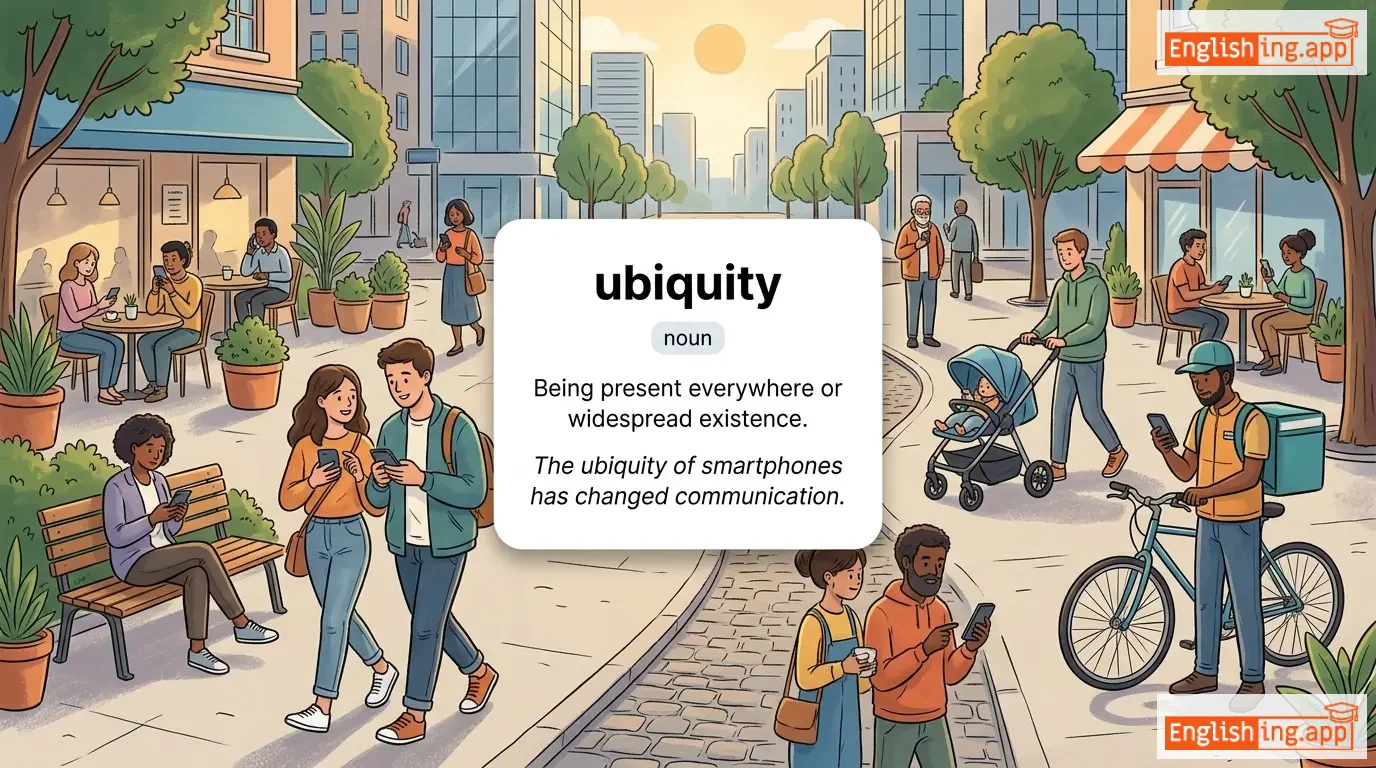
ubiquity definition card — visual illustration of the meaning
noun
/juːˈbɪk.wɪ.ti/
ubiquité (ubiquité)

Being present everywhere or widespread existence.

"The ubiquity of smartphones has changed communication."

"L'ubiquité des smartphones a changé la communication." (L'ubiquité des smartphones a changé la communication.)
adjective
/ˈʌɡli/
laid (laid)

unpleasant or repulsive in appearance

"The house had an ugly view of the street."

"La maison avait une vue moche de la rue." (La maison avait une vue moche de la rue.)
interjection
/ʌ/
euh (euh)

a sound people make when they hesitate or are unsure what to say next.

"Uh, I’m not sure if that’s the right answer."

"Euh, je ne suis pas sûr si c'est la bonne réponse." (Euh, je ne suis pas sûr si c'est la bonne réponse.)
noun
/juːˈkeɪs/
décret (decret)

An authoritative decree or order, especially one issued by a sovereign or government.

"The czar issued a ukase restricting the freedom of the press."

"Le tsar a émis un décret restreignant la liberté de la presse." (Le tsar a émis un décret restreignant la liberté de la presse.)
noun
/ˈʌlsər/
ulcère (ulcere)

a sore on the skin or a mucous membrane that does not heal easily

"The doctor prescribed medicine to treat the stomach ulcer."

"Le médecin a prescrit des médicaments pour traiter l'ulcère de l'estomac." (Le medecin a prescrit des medicaments pour traiter l ulcere de lestomac)
adjective
/ʌlˈtɪəriər/
motif caché (motif cache)

hidden or secret, often with a selfish motive

"He invited her with an ulterior motive."

"Il l'a invitée avec un motif caché." (Il l'a invitee avec un motif cache.)
adjective
/ˈʌltɪmət/
ultime (ultim)

being the best, final, or most extreme

"Success is the ultimate goal of hard work."

"Le succès est le but ultime du travail acharné." (Le succes est le but ultime du travail acharne.)
adverb
/ˈʌltəmətli/
finalement (finalement)

in the end, after everything else

"Ultimately, we decided to go ahead with the project."

"Finalement, nous avons décidé de poursuivre le projet." (Finalement, nous avons decide de poursuivre le projet.)
noun
/ˌʌltɪˈmeɪtəm/
ultimatum (ultimatum)

a final demand or statement of terms

"The workers gave the company an ultimatum to raise their wages."

"Les travailleurs ont donné à l'entreprise un ultimatum pour augmenter leurs salaires." (Les travailleurs ont donne a l'entreprise un ultimatum pour augmenter leurs salaires.)
adjective
/ˌʌltrəˈmɒnteɪn/
partisan du Pape (partisan du Pape)

beyond the mountains, especially referring to support for the Pope over local church authority

"The debate highlighted the ultramontane position in church politics."

"Le débat a mis en lumière la position ultramontaine dans la politique ecclésiastique." (Le debat a mis en lumiere la position ultramontaine dans la politique ecclesiastique.)
adjective
/ˌʌltrəˈmʌndeɪn/
ultramondain (ultramondain)

Relating to things beyond the physical world; supernatural or transcendental.

"Philosophers often discuss ultramundane realities beyond human perception."

"Les philosophes discutent souvent des réalités ultramondaines au-delà de la perception humaine." (Les philosophes discutent souvent des realites ultramondaines au-dela de la perception humaine.)
noun
/ˈʌm.brə/
ombre totale, région sombre d'une tache solaire (ombre totale, region sombre d'une tache solaire)

the fully shaded inner region of a shadow cast by an opaque object; the dark center of a sunspot

"During the eclipse, we stood in the moon's umbra."

"Pendant l'éclipse, nous nous sommes tenus dans l'ombre de la lune." (Pendant l'éclipse, nous nous sommes tenus dans l'ombre de la lune.)
noun
/ˈʌmbrɪdʒ/
mécontentement, offense (mécontentement, offense)

A feeling of resentment or offense.

"She took umbrage at his rude remark."

"Elle s'est vexée par sa remarque grossière." (Elle s'est vexée par sa remarque grossière.)
noun
/ʌmˈbrɛlə/
parapluie (parapluie)

A device used for protection against rain or sun, typically consisting of a collapsible canopy mounted on a central rod.

"She opened her umbrella as it started to rain."

"Elle a ouvert son parapluie quand il a commencé à pleuvoir." (Elle a ouvert son parapluie quand il a commence a pleuvoir.)
noun
/ʌnəˈbɪləti/
incapacité (incapacite)

the state of being unable to do something; incapacity

"His unability to solve the problem caused delays in the project."

"Son incapacité à résoudre le problème a causé des retards dans le projet." (Son incapacite a resoudre le probleme a cause des retards dans le projet)
🙅‍♀️

Unable (ʌˈneɪbl)

adjective
/ʌˈneɪbl/
incapable (incapable)

not able to do something

"She was unable to attend the meeting."

"Elle n'a pas pu assister à la réunion." (Elle n'a pas pu assister à la réunion.)
adjective
/ˌʌnəkˈsɛptəbl/
inacceptable (inacceptable)

not satisfactory or allowable

"The behavior displayed by the employee was completely unacceptable."

"Le comportement montré par l'employé était complètement inacceptable." (Le comportement montré par l'employé était complètement inacceptable.)
adjective
/ˌʌnəˈkaʊntəbl/
inexplicable (inexplicable)

Not able to be explained or justified.

"She felt an unaccountable fear as she entered the dark room."

"Elle ressentait une peur inexplicable en entrant dans la pièce sombre." (Elle ressentait une peur inexplicable en entrant dans la pièce sombre.)
adjective
/ˌʌnəkˈnɒlɪdʒd/
non reconnu (non reconnu)

Not recognized, admitted, or accepted; ignored or unnoticed

"Her contributions to the project went unacknowledged."

"Ses contributions au projet sont restées non reconnues." (Ses contributions au projet sont restees non reconnues.)
adjective
/ˌʌnəˈdɔːrnd/
simple, sans décorations (simple, san dekorations)

Plain and simple; not decorated.

"The room was unadorned, with only a table and a chair."

"La pièce était simple, avec seulement une table et une chaise." (La piece etait simple, avec seulement une table et une chaise.)
adjective
/ˌʌn.əˈdʌl.tə.reɪ.tɪd/
pur (pur)

not mixed or diluted with any different or extra elements; pure

"She felt unadulterated joy when she heard the news."

"Elle a ressenti une joie pure lorsqu'elle a entendu la nouvelle." (Elle a ressenti une joie pure lorsqu'elle a entendu la nouvelle.)
adjective
/ˌʌnəˈfɛktɪd/
insensible, naturel (insensible, naturel)

Not influenced or touched by something; genuine and natural.

"He remained unaffected by the criticism and kept working hard."

"Il est resté impassible face à la critique et a continué à travailler dur." (Il est resté impassible face à la critique et a continué à travailler dur.)
adjective
/ʌnəˈfreɪd/
intrépide (intrepide)

Not feeling fear; brave or courageous

"She walked into the dark room, unafraid of what might be inside."

"Elle est entrée dans la pièce sombre, intrépide de ce qui pourrait être à l'intérieur." (Elle est entree dans la piece sombre, intrepide de ce qui pourrait etre a l'interieur.)
adjective
/ʌnˈælɔɪd/
pur (pur)

Pure, complete, and not mixed with anything else.

"She felt unalloyed joy at the news of her success."

"Elle a ressenti une joie pure en entendant la nouvelle de son succès." (Elle a ressenti une joie pure en entendant la nouvelle de son succès.)
noun
/ˌjuːnəˈnɪməti/
unanimité (unanimité)

Complete agreement by everyone in a group.

"The proposal was accepted with complete unanimity."

"La proposition a été acceptée à l'unanimité." (La proposition a été acceptée à l'unanimité.)
adjective
/juːˈnænɪməs/
unanime (unanime)

Fully in agreement; with everyone sharing the same opinion.

"The jury reached a unanimous verdict."

"Le jury a rendu un verdict unanime." (Le jury a rendu un verdict unanime.)
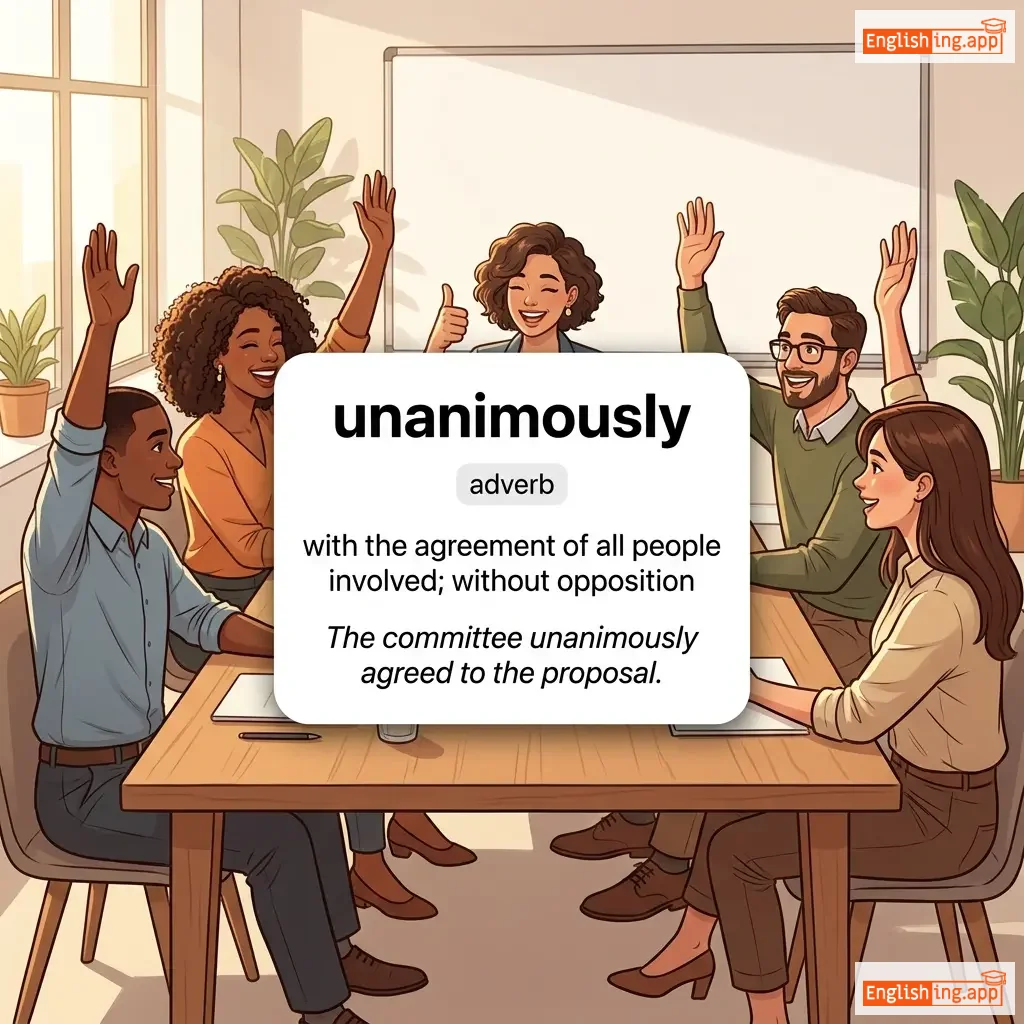
unanimously definition card — visual illustration of the meaning
adverb
/juːˈnænɪməsli/
à l'unanimité (a l'unanimite)

with the agreement of all people involved; without opposition

"The committee unanimously agreed to the proposal."

"Le comité a approuvé la proposition à l'unanimité." (Le comite a approuvé la proposition à l'unanimité.)
adjective
/ʌnəˈpiːzd/
insatisfait (insatisfait)

Not satisfied or calmed; still feeling discontent or anger

"Despite the apology, she remained unappeased."

"Malgré les excuses, elle est restée insatisfaite." (Malgre les excuses, elle est restee insatisfaite)
verb
/ʌnˈɑːrm/
désarmer (desarmer)

to remove weapons from someone or to deprive of means of attack or defense

"The soldiers were ordered to unarm the prisoners."

"Les soldats ont reçu l'ordre de désarmer les prisonniers." (Les soldats ont recu l'ordre de desarmer les prisonniers)
adjective
/ʌnˈɑːrmd/
désarmé (desarme)

Not equipped with or carrying weapons

"The police found the suspect unarmed during the search."

"La police a trouvé le suspect désarmé pendant la fouille." (La police a trouve le suspect desarme pendant la fouille.)
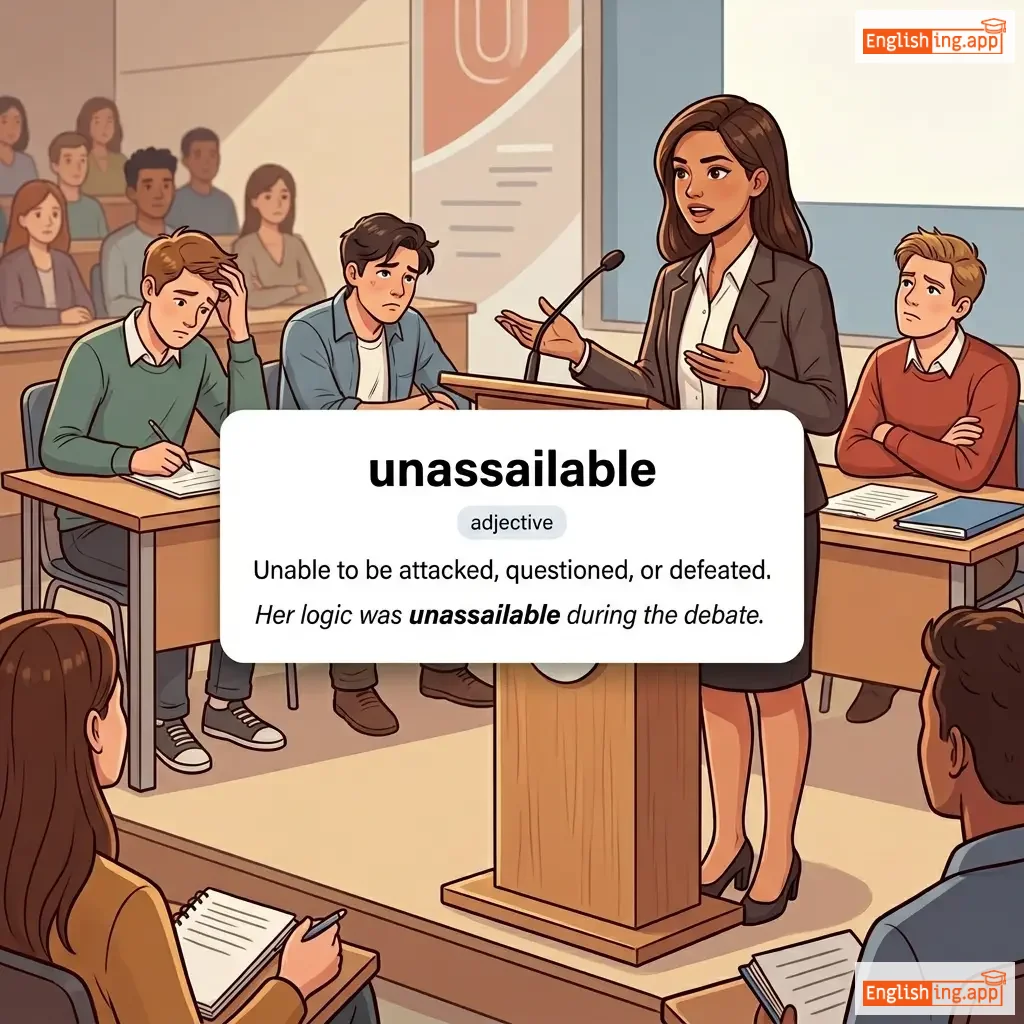
unassailable definition card — visual illustration of the meaning
adjective
/ˌʌnəˈseɪləbl/
inattaquable (inattaquable)

Unable to be attacked, questioned, or defeated.

"Her logic was unassailable during the debate."

"Sa logique était inattaquable pendant le débat." (Sa logique était inattaquable pendant le débat.)
adjective
/ˌʌnəˈsweɪdʒd/
inquiet (inquiet)

Not made less intense or relieved; unrelieved.

"His grief remained unassuaged despite the passage of time."

"Sa douleur est restée inquiète malgré le passage du temps." (Sa douleur est restée inquiète malgré le passage du temps.)
adjective
/ˌʌnəˈsjuːmɪŋ/
modeste (modeste)

Not pretentious or arrogant; modest.

"Despite his success, he remained unassuming and humble."

"Malgré son succès, il est resté modeste et humble." (Malgré son succès, il est resté modeste et humble.)
adjective
/ˌʌnəˈʃʊəd/
incertain (incertain)

Lacking confidence or certainty.

"She gave an unassured answer during the interview."

"Elle a donné une réponse incertaine lors de l'entretien." (Elle a donné une réponse incertaine lors de l'entretien.)
adjective
/ˌʌnəˈteɪnəbl/
inaccessible (inaccessible)

impossible to achieve, reach, or accomplish

"For many, becoming a professional athlete remains an unattainable dream."

"Pour beaucoup, devenir un athlète professionnel reste un rêve inaccessible." (Pour beaucoup, devenir un athlète professionnel reste un rêve inaccessible.)
noun
/ˌʌnəˌveɪləˈbɪləti/
indisponibilité (indisponibilite)

The state of being not available or not accessible.

"The unavailability of the manager caused a delay in the project."

"L'indisponibilité du gestionnaire a causé un retard dans le projet." (L'indisponibilite du gestionnaire a cause un retard dans le projet)
adjective
/ˌʌnəˈveɪləbəl/
indisponible (indisponible)

Not able to be obtained, reached, or used; not present or accessible.

"The manager was unavailable to take calls during the meeting."

"Le directeur n'était pas disponible pour répondre aux appels pendant la réunion." (Le directeur n'etait pas disponible pour repondre aux appels pendant la reunion.)
adjective
/ˌʌnəˈvɔɪdəbl/
inévitable (inevitable)

Impossible to avoid or prevent.

"Delays were unavoidable due to heavy rain."

"Les retards étaient inévitables en raison de la forte pluie." (Les retards étaient inévitables en raison de la forte pluie.)
🤷‍♂️

Unaware (anawer)

adjective
/ˌʌnəˈweər/
inconscient; ignorant; sans savoir (inconscient; ignorant; san savoir)

not knowing or realizing; having no knowledge of something

"She was completely unaware of the danger."

"Elle était complètement inconsciente du danger." (Elle était complètement inconsciente du danger.)
adjective
/ʌnˈbæləns/
déséquilibré; instable (déséquilibré; instable)

not balanced; lacking stability or equilibrium; mentally unstable

"The unbalanced table kept wobbling."

"La table déséquilibrée continua à osciller." (La table déséquilibrée continua à osciller.)
adjective
/ʌnˈbeərəbl/
insupportable (insupportable)

Too difficult or unpleasant to endure.

"The heat was unbearable in the afternoon."

"La chaleur était insupportable l'après-midi." (La chaleur etait insupportable l'apres-midi.)
adjective
/ʌnˈbiːtən/
invaincu; non défait (invaincu; non défait)

not defeated; having never lost; undefeated

"The team remains unbeaten this season."

"L'équipe reste invaincue cette saison." (L'équipe reste invaincue cette saison.)
adjective
/ˌʌnbɪˈkʌmɪŋ/
inapproprié (inapproprie)

Not proper or appropriate for a person; unsuitable.

"His rude behavior was unbecoming of a leader."

"Son comportement grossier était inapproprié pour un leader." (Son comportement grossier était inapproprié pour un leader.)
noun
/ˌʌnbɪˈliːf/
incrédulité (incredulite)

A lack of belief, especially in religious faith.

"His heart was full of doubt and unbelief."

"Son cœur était rempli de doute et d'incrédulité." (Son coeur etait rempli de doute et d'incredulite.)
adjective
/ˌʌnbɪˈliːvəbəl/
incroyable (incroyable)

impossible to believe; extremely surprising or remarkable

"The magician's performance was absolutely unbelievable."

"La performance du magicien était absolument incroyable." (La performance du magicien etait absolument incroyable.)
adjective
/ˌʌnbɪˈliːvɪŋ/
incrédule (incredule)

Not willing or able to believe; skeptical or doubtful

"She gave him an unbelieving look when he claimed to have met a celebrity."

"Elle lui a lancé un regard incrédule lorsqu'il a affirmé avoir rencontré une célébrité." (Elle lui a lance un regard incredule lorsqu'il a affirme avoir rencontre une celebrité.)
adjective
/ʌnˈbaɪəst/
impartiale (impartiale)

Not showing prejudice; impartial and fair.

"The report gave an unbiased view of the situation."

"Le rapport a donné un point de vue impartial de la situation." (Le rapport a donné un point de vue impartial de la situation.)
adjective
/ʌnˈblʌʃɪŋ/
effronté; sans vergogne (effronte; sans vergogne)

showing no shame or embarrassment; boldly shameless

"He told the unblushing lie without any hesitation."

"Il a dit le mensonge effronté sans hésitation." (Il a dit le mensonge effronte sans hesiter.)