Vocabulaires

Découvrez, apprenez et maîtrisez le vocabulaire anglais

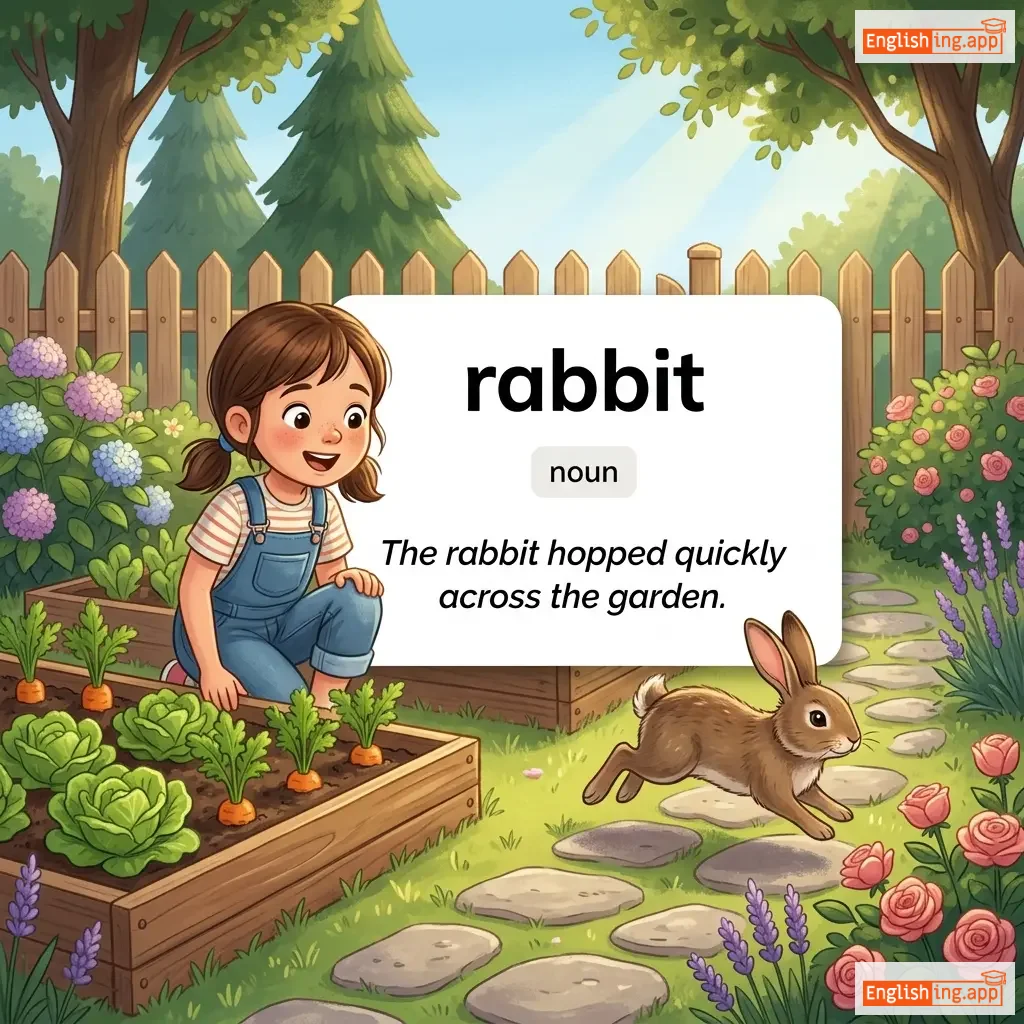
rabbit definition card — visual illustration of the meaning
noun
/ˈræbɪt/
lapin (lapin)

a small furry animal with long ears that lives in holes in the ground and moves by hopping

"The rabbit hopped quickly across the garden."

"Le lapin a sauté rapidement à travers le jardin." (Le lapin a saute rapidement a travers le jardin.)
noun
/ˈræb.əl/
foule désordonnée (foule desordonnee)

A disorderly crowd or mob; the common people regarded as noisy or unruly.

"A rabble gathered in the streets to protest the decision."

"Une foule désordonnée s'est rassemblée dans les rues pour protester contre la décision." (Une foule désordonnée s'est rassemblée dans les rues pour protester contre la décision.)
adjective
/ˈræb.ɪd/
enragé (enrage)

Having extreme or fanatical support for something; relating to or suffering from rabies.

"He was a rabid fan of the football team."

"Il était un fan enragé de l'équipe de football." (Il etait un fan enrage de l'equipe de football.)
noun
/ˈreɪ.biːz/
rage (rage)

A viral disease that causes inflammation of the brain in humans and other mammals, usually transmitted through animal bites.

"The dog was vaccinated against rabies."

"Le chien a été vacciné contre la rage." (Le chien a été vacciné contre la rage.)
noun
/reɪs/
course (course)

a competition of speed, or a group of people with similar characteristics

"The race was very exciting, with many competitors."

"La course était très excitante, avec de nombreux concurrents." (La course était très excitante, avec de nombreux concurrents.)
adjective
/ˈreɪʃəl/
racial (racial)

relating to a race of people

"Racial equality is an important issue in many societies."

"L'égalité raciale est un problème important dans de nombreuses sociétés." (L'égalité raciale est un problème important dans de nombreuses sociétés.)
noun
/ˈreɪsɪzəm/
racisme (racisme)

the belief that some races are superior to others, leading to unfair treatment or prejudice

"The organization works to eliminate racism in all forms."

"L'organisation travaille pour éliminer le racisme sous toutes ses formes." (L'organisation travaille pour éliminer le racisme sous toutes ses formes.)
adjective
/ˈreɪsɪst/
raciste (raciste)

showing or feeling discrimination or prejudice against people of other races

"He was accused of making racist comments."

"Il a été accusé de faire des commentaires racistes." (Il a été accusé de faire des commentaires racistes.)
noun
/ræk/
porte-vêtements (porte-vetements)

a frame or stand used to hold or store things

"She placed her wet clothes on the drying rack."

"Elle a mis ses vêtements mouillés sur le porte-vêtements pour les faire sécher." (Elle a mis ses vêtements mouillés sur le porte-vêtements pour les faire sécher.)
noun
/ˈrækɪt/
raquette / tapage (raquette / tapage)

A piece of equipment used to hit the ball in sports like tennis or badminton; also a loud noise or an illegal scheme.

"He bought a new tennis racket for the match."

"Il a acheté une nouvelle raquette de tennis pour le match." (Il a achete une nouvelle raquette de tennis pour le match.)
noun
/ˌræk.ɒnˈtɜːr/
raconteur habile (raconteur habile)

A person who tells anecdotes in a skillful and amusing way.

"The professor was a brilliant raconteur who kept his audience entertained."

"Le professeur était un raconteur brillant qui divertissait son public." (Le professeur était un raconteur brillant qui divertissait son public.)
adjective
/ˈreɪ.si/
osé (ose)

Lively, entertaining, or slightly shocking (especially in a sexual way).

"The novel was full of racy dialogues."

"Le roman était plein de dialogues osés." (Le roman était plein de dialogues osés.)
noun
/ˈreɪdɑːr/
radar (radar)

a system that uses radio waves to detect the position and speed of objects

"The plane was detected by the airport's radar system."

"L'avion a été détecté par le système radar de l'aéroport." (L'avion a ete detecte par le systeme radar de l'aeroport.)
noun
/ˈreɪdiəns/
radiance (radiance)

the quality of shining with bright light; a glowing or beaming quality

"Her face was filled with radiance after hearing the good news."

"Son visage était rempli de radiance après avoir entendu les bonnes nouvelles." (Son visage était rempli de radiance après avoir entendu les bonnes nouvelles.)
adjective
/ˈreɪdiənt/
radieux / radieuse (radieux / radieuse)

Shining brightly; expressing great happiness.

"She looked radiant in her wedding dress."

"Elle avait l'air radieuse dans sa robe de mariée." (Elle avait l'air radieuse dans sa robe de mariée.)
verb
/ˈreɪdieɪt/
rayonner (rayonner)

to emit energy or light; to spread out from a center

"The fireplace radiates warmth throughout the room."

"La cheminée rayonne de chaleur dans toute la pièce." (La cheminee rayonne de chaleur dans toute la piece.)
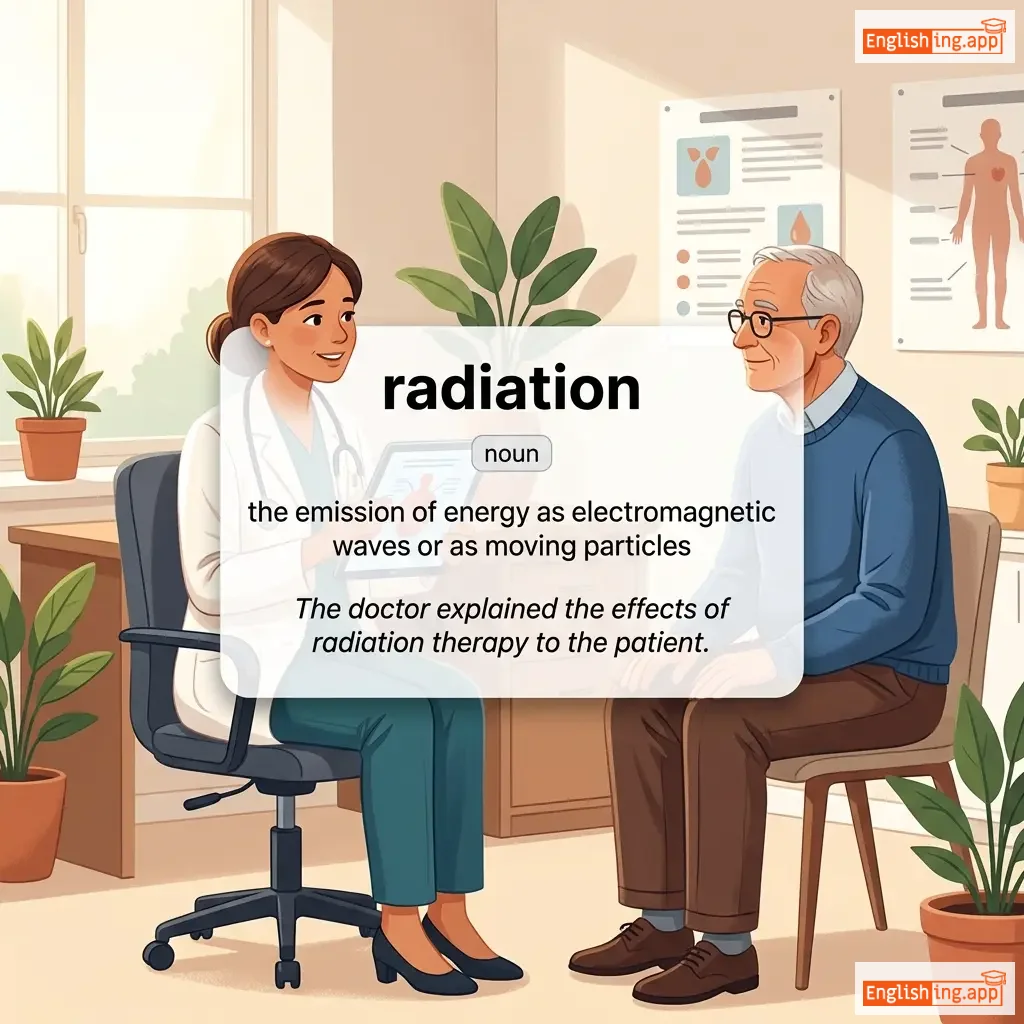
radiation definition card — visual illustration of the meaning
noun
/ˌreɪdiˈeɪʃən/
radiation (radiation)

the emission of energy as electromagnetic waves or as moving particles

"The doctor explained the effects of radiation therapy to the patient."

"Le médecin a expliqué les effets de la radiothérapie au patient." (Le medecin a explique les effets de la radiotherapie au patient.)
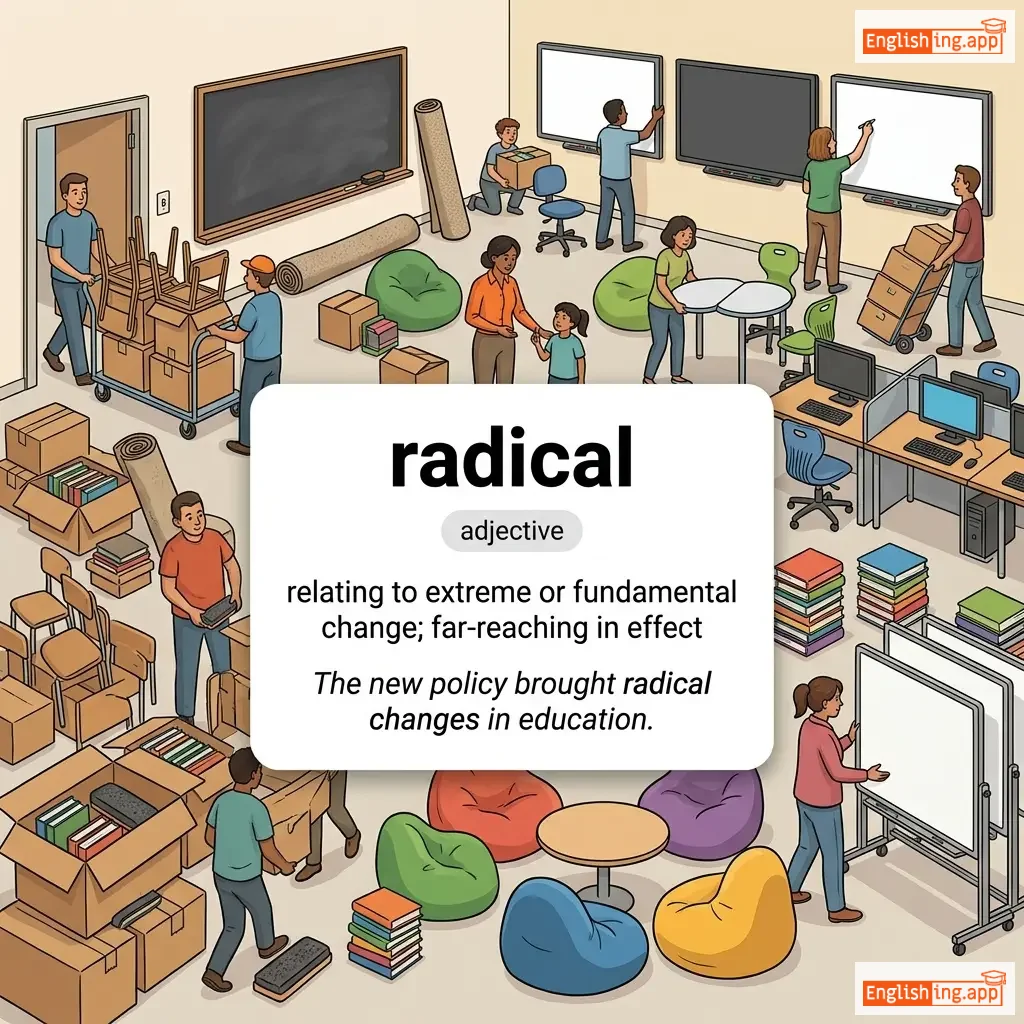
radical definition card — visual illustration of the meaning
adjective
/ˈrædɪkl/
radical (radikal)

relating to extreme or fundamental change; far-reaching in effect

"The new policy brought radical changes in education."

"La nouvelle politique a apporté des changements radicaux dans l'éducation." (La nouvelle politique a apporte des changements radicaux dans l education)
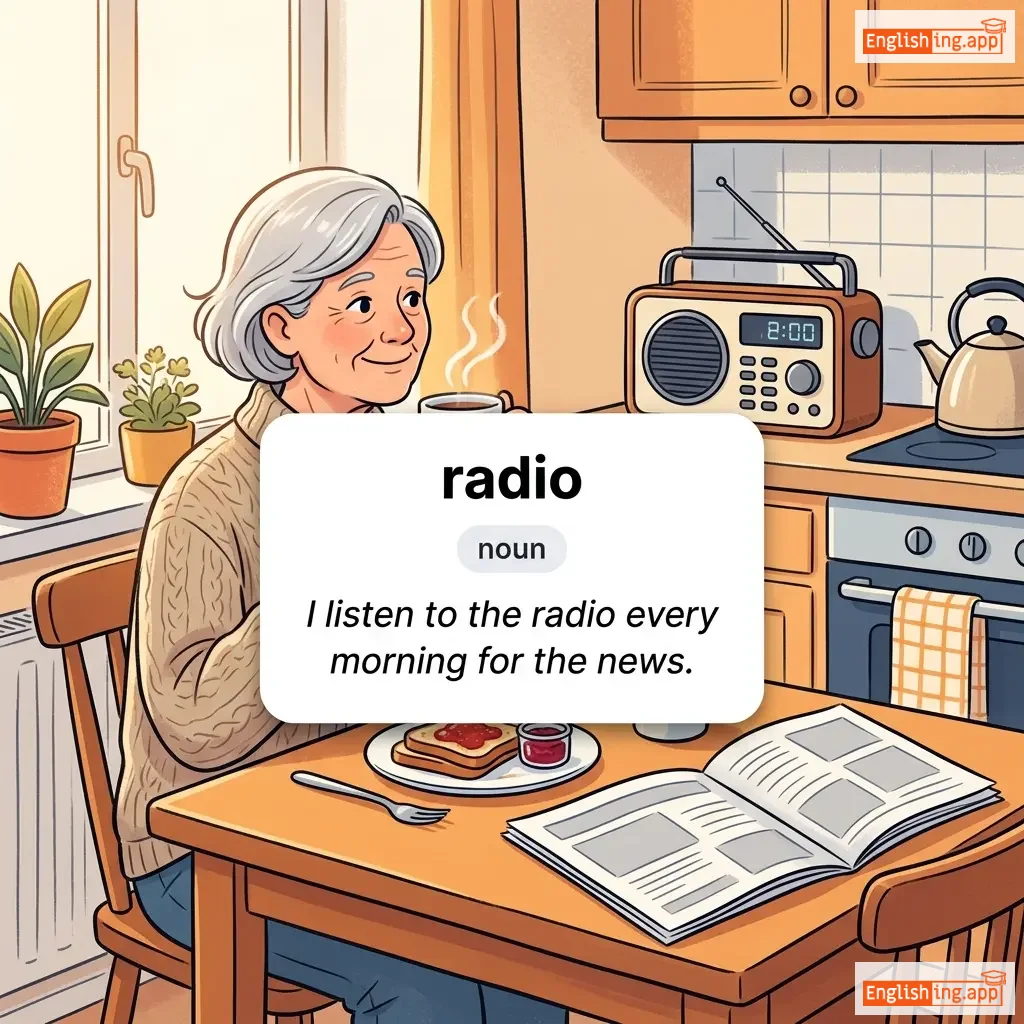
radio definition card — visual illustration of the meaning
noun
/ˈreɪdioʊ/
radio (radio)

a device for receiving or transmitting radio signals, or the use of such signals for communication

"I listen to the radio every morning for the news."

"J'écoute la radio tous les matins pour les nouvelles." (J'écoute la radio tous les matins pour les nouvelles.)
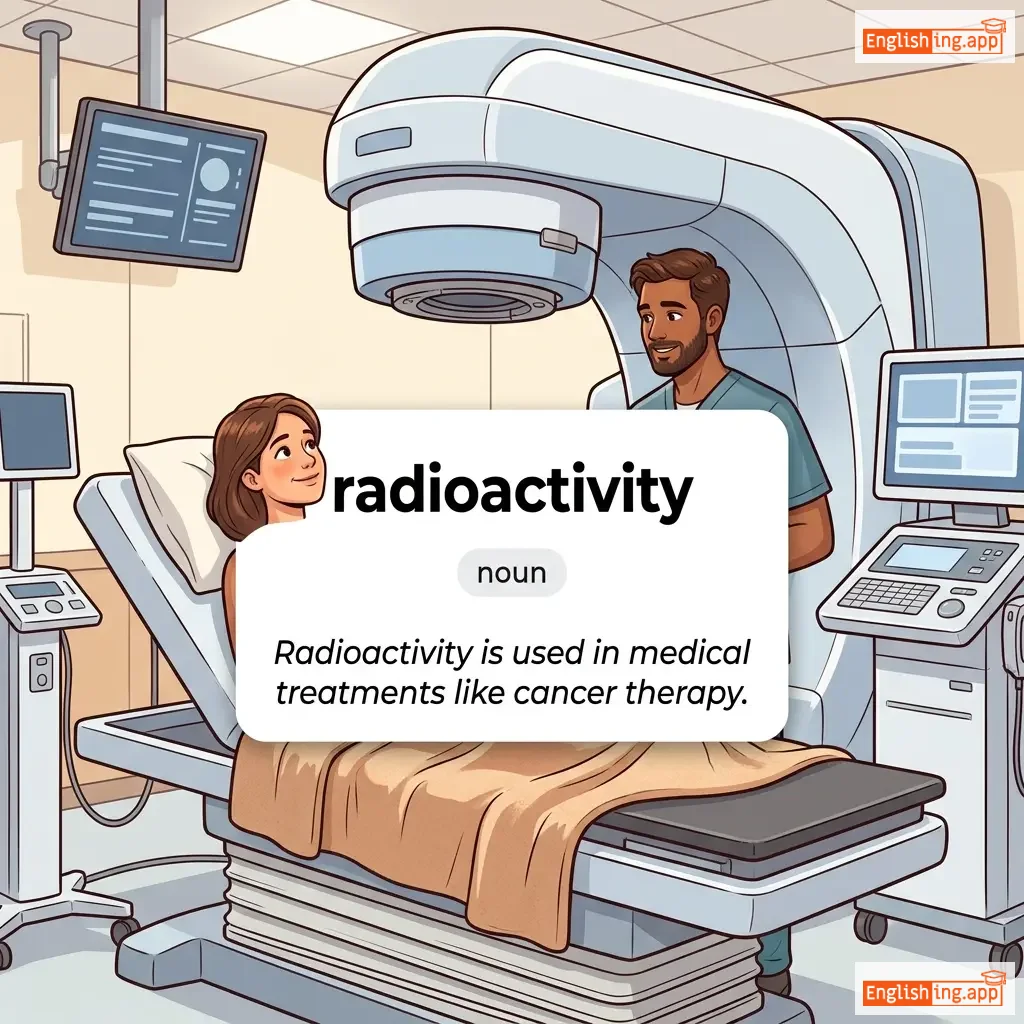
radioactivity definition card — visual illustration of the meaning
noun
ˌreɪ.di.oʊ.ækˈtɪv.ə.ti
radioactivité (radioactivite)

The emission of ionizing radiation or particles caused by the spontaneous disintegration of atomic nuclei.

"Radioactivity is used in medical treatments like cancer therapy."

"La radioactivité est utilisée dans des traitements médicaux comme la thérapie du cancer." (La radioactivite est utilisee dans des traitements medicaux comme la therapie du cancer.)
noun
/'ræd.ɪʃ/
radis (radis)

a small pungent edible root vegetable with white or red skin

"The farmer harvested fresh radishes from the garden."

"Le fermier a récolté des radis frais du jardin." (Le fermier a récolté des radis frais du jardin.)
noun
/ˈreɪdɪks/
base (base)

the base or root of something; the number on which a system of numeration is built

"In mathematics, the decimal system has a radix of ten."

"En mathématiques, le système décimal a une base de dix." (En mathematiques, le systeme decimal a une base de dix.)
adjective
/ˈræfɪʃ/
non conventionnel et légèrement discrédité mais attrayant (non conventionnel et légèrement discrédité mais attrayant)

unconventional and slightly disreputable but attractive

"He had a raffish charm that made him popular in the city."

"Il avait un charme raffish qui le rendait populaire dans la ville." (Il avait un charme raffish qui le rendait populaire dans la ville.)
noun/verb
/ˈræfəl/
vente de billets de tombola (vente de billets de tombola)

A means of raising money by selling numbered tickets, one or more of which are drawn at random for a prize; to sell something in such a lottery.

"The charity decided to raffle a bicycle to raise funds."

"La charité a décidé de vendre un vélo à travers une tombola pour collecter des fonds." (La charité a décidé de vendre un vélo à travers une tombola pour collecter des fonds.)
noun/verb
/ræft/
radeau (radeau)

A flat structure made of logs or planks tied together, used as a boat or floating platform; to travel or transport on such a structure.

"They built a raft to cross the river."

"Ils ont construit un radeau pour traverser la rivière." (Ils ont construit un radeau pour traverser la rivière.)
noun
/ˈræftər/
poutre (poutre)

One of the sloping beams that supports a roof.

"The old barn’s rafters were exposed."

"Les poutres du vieux grenier étaient exposées." (Les poutres du vieux grenier étaient exposées.)
noun/verb
/ræɡ/
chiffon (chiffon)

A piece of old, torn cloth; to tease or scold someone in a playful way.

"She used an old rag to clean the table."

"Elle a utilisé un vieux chiffon pour nettoyer la table." (Elle a utilisé un vieux chiffon pour nettoyer la table.)
noun
/ˈræɡəmʌfɪn/
enfant négligé (enfant négligé)

A person, typically a child, in ragged, dirty clothes.

"The little ragamuffin begged for food on the street."

"Le petit enfant négligé mendiait de la nourriture dans la rue." (Le petit enfant négligé mendiait de la nourriture dans la rue.)
noun
/reɪdʒ/
colère (colere)

intense anger or fury

"She shouted in a fit of rage after hearing the news."

"Elle a crié dans un accès de colère après avoir entendu les nouvelles." (Elle a crie dans un acces de colere apres avoir entendu les nouvelles.)
adjective
/ˈræɡɪd/
déchiré (dechire)

torn, worn out, or in poor condition

"The homeless man wore a ragged coat."

"L'homme sans-abri portait un manteau déchiré." (L'homme sans-abri portait un manteau déchiré.)
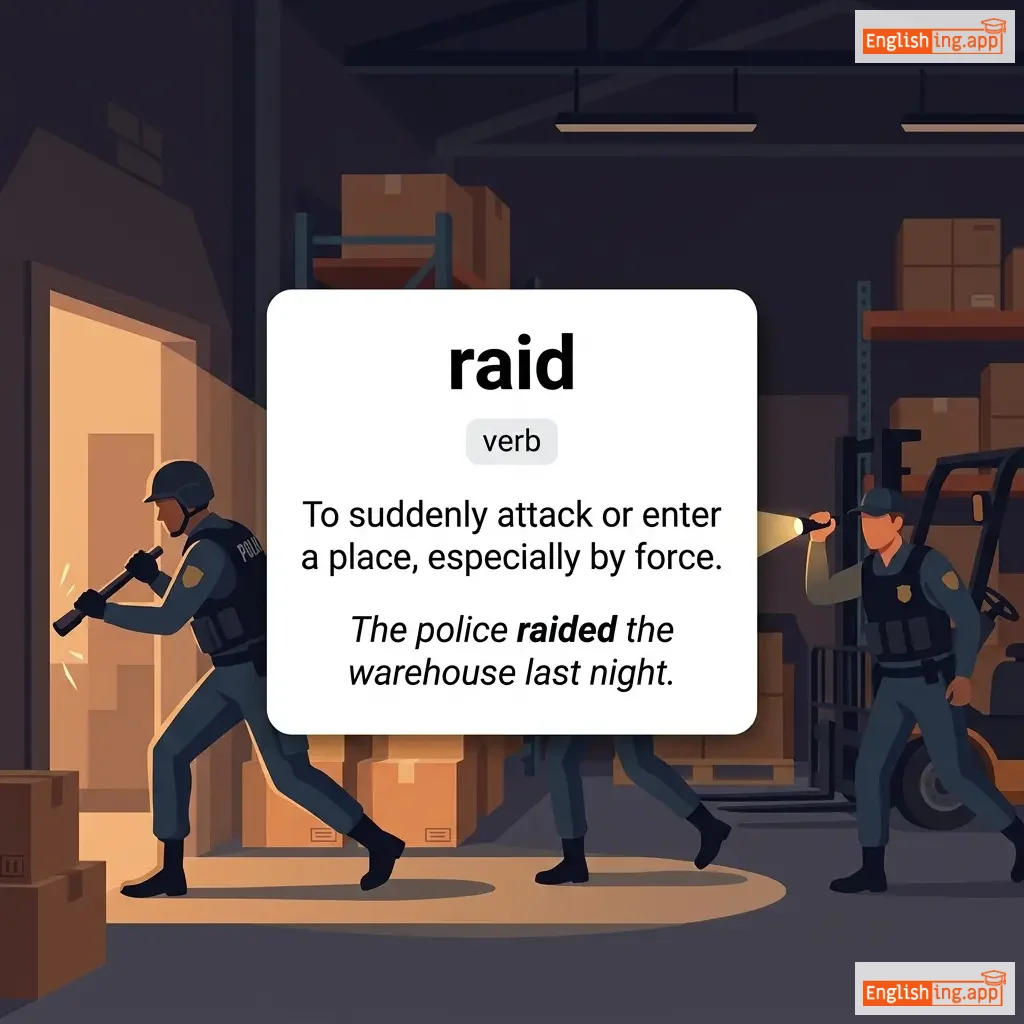
raid definition card — visual illustration of the meaning
verb
/reɪd/
raid (raid)

To suddenly attack or enter a place, especially by force.

"The police raided the warehouse last night."

"La police a fait une descente dans l'entrepôt la nuit dernière." (La police a fait une descente dans l'entrepôt la nuit dernière.)
verb
/reɪl/
se plaindre (se plaindre)

to complain or protest strongly about something

"He railed against the unfair decision."

"Il s'est plaint contre la décision injuste." (Il s'est plaint contre la décision injuste.)
noun
/ˈreɪləri/
moqueries amicales (moqueries amicales)

good-humored teasing or joking

"Their friendship was full of light-hearted raillery."

"Leur amitié était pleine de railleries légères." (Leur amitié était pleine de railleries légères.)
noun
/ˈreɪlˌroʊd/
voie ferrée (voie ferree)

a track or system of tracks made of steel rails along which trains run

"The railroad connects the city to several nearby towns."

"La voie ferrée relie la ville à plusieurs villes voisines." (La voie ferree relie la ville a plusieurs villes voisines.)
noun
/ˈreɪl.weɪ/
chemin de fer (shuhman duh fer)

a track made of steel rails along which trains run; a system of tracks with trains, stations, and other facilities

"The railway connects major cities across the country."

"Le chemin de fer relie les grandes villes du pays." (le shuhman duh fer reli le grand vil duh pei)
noun
/ˈreɪmənt/
vêtements (vetements)

clothing, especially fine or formal wear

"The king wore royal raiment during the ceremony."

"Le roi portait des vêtements royaux pendant la cérémonie." (Le roi portait des vetements royaux pendant la ceremonie.)
noun
/reɪn/
la pluie (la pluie)

water droplets that fall from the sky as a result of condensation in the atmosphere

"The rain started pouring just as we reached the park."

"La pluie a commencé à tomber juste au moment où nous sommes arrivés au parc." (La pluie a commence a tomber juste au moment ou nous sommes arrives au parc)
noun
/ˈreɪn.boʊ/
arc-en-ciel (ark-ahn-syel)

an arch of colors formed in the sky by sunlight shining through rain

"After the storm, a beautiful rainbow appeared in the sky."

"Après la tempête, un magnifique arc-en-ciel est apparu dans le ciel." (Apre la tempête, un magnifique ark-en-ciel é apparu dans le syel.)
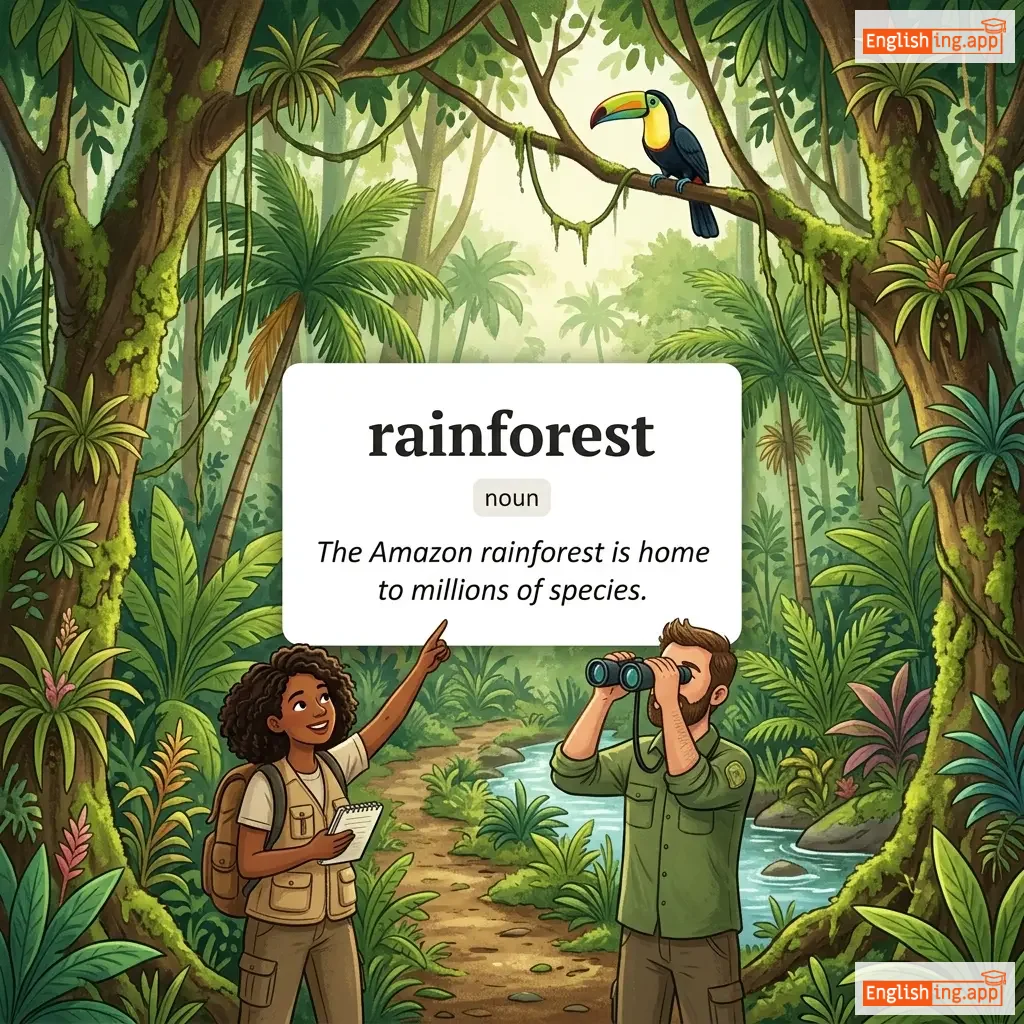
rainforest definition card — visual illustration of the meaning
noun
ˈreɪn.fɒr.ɪst
forêt tropicale (foret tropicale)

A luxuriant, dense forest rich in biodiversity, found typically in tropical areas with consistently heavy rainfall.

"The Amazon rainforest is home to millions of species."

"La forêt tropicale amazonienne abrite des millions d'espèces." (La forêt tropicale amazonienne abrite des millions d'espèces.)
adjective
/ˈreɪ.ni/
pluvieux (pluvieux)

characterized by rain; wet from rain; having much rain

"It was a rainy day, so we stayed indoors."

"C'était un jour pluvieux, alors nous sommes restés à l'intérieur." (C'était un jour pluvieux, alors nous sommes restés à l'intérieur.)
verb
/reɪz/
élever / augmenter (elever / augmenter)

To lift or move something to a higher position; to increase; to bring up.

"She raised her hand to ask a question."

"Elle leva la main pour poser une question." (Elle leva la main pour poser une question.)
noun
/ˈreɪ.zən/
raisin sec (raisin sec)

a dried grape, often eaten as a snack or used in cooking and baking

"She added raisins to the cake batter for extra sweetness."

"Elle a ajouté des raisins secs à la pâte à gâteau pour plus de douceur." (Elle a ajoute des raisins secs a la pate a gateau pour plus de douceur.)
noun
/ˈreɪ.zɪnz/
raisins secs (raisins secs)

dried grapes, often used in cooking and baking

"She added raisins to the oatmeal cookies for extra sweetness."

"Elle a ajouté des raisins secs aux biscuits à l'avoine pour plus de douceur." (Elle a ajouté des raisins secs aux biscuits à l'avoine pour plus de douceur.)
verb
/reɪk/
ramasser avec un râteau; gratter ou lisser une surface (ramasser avec un râteau; gratter ou lisser une surface)

to collect or gather with a rake; to scrape or smooth a surface

"He raked the leaves into a pile."

"Il a rassemblé les feuilles dans un tas." (Il a rassemblé les feuilles dans un tas.)
adjective
/ˈreɪ.kɪʃ/
d'apparence élégante, confiante et légèrement déshonorée (d'apparence elegante, confiante et legerement deshonoree)

having a stylish, confident, and slightly disreputable appearance

"He walked in with a rakish smile and tilted hat."

"Il entra avec un sourire rakish et un chapeau incliné." (Il entra avec un sourire rakish et un chapeau incline.)
verb
/ˈræl.i/
se rassembler / se regagner en force (se rassembler / se regagner en force)

to come together for a common purpose or to recover strength or spirit

"The team rallied after halftime and won the match."

"L'équipe s'est redressée après la mi-temps et a gagné le match." (L'equipe s'est redressee apres la mi-temps et a gagne le match.)
verb
/ræm/
heurter (heurter)

to strike or push something with great force

"The truck rammed into the wall."

"Le camion a percuté le mur." (Le camion a percuté le mur.)
verb
/ˈræm.bəl/
parler ou écrire pendant longtemps de manière confuse ou sans conséquence; marcher pour le plaisir sans itinéraire fixe (parler ou écrire pendant longtemps de manière confuse ou sans conséquence; marcher pour le plaisir sans itinéraire fixe)

to talk or write at length in a confused or inconsequential way; to walk for pleasure without a fixed route.

"He rambled on about his childhood for hours."

"Il a parlé pendant des heures de son enfance de manière confuse." (Il a parlé pendant des heures de son enfance de manière confuse.)
adjective
/ræmˈbʌŋk.ʃəs/
bruyant (bruyant)

boisterous, energetic, and difficult to control.

"The rambunctious children filled the house with noise."

"Les enfants bruyants ont rempli la maison de bruit." (Les enfants bruyants ont rempli la maison de bruit.)
noun
/ræmˈbuːtən/
ramboutan (ramboutan)

a tropical fruit with red spiky skin and white translucent sweet flesh similar to litchi

"The rambutan looks scary with its hairy skin but tastes very sweet inside."

"Le rambutan a l'air effrayant avec sa peau poilue, mais il a un goût très sucré à l'intérieur." (Le rambutan a l'air effrayant avec sa peau poilue, mais il a un goût très sucré à l'intérieur.)