वोकैबुलरीज

इंग्लिश वोकैबुलरी डिस्कवर, लर्न और मास्टर करें

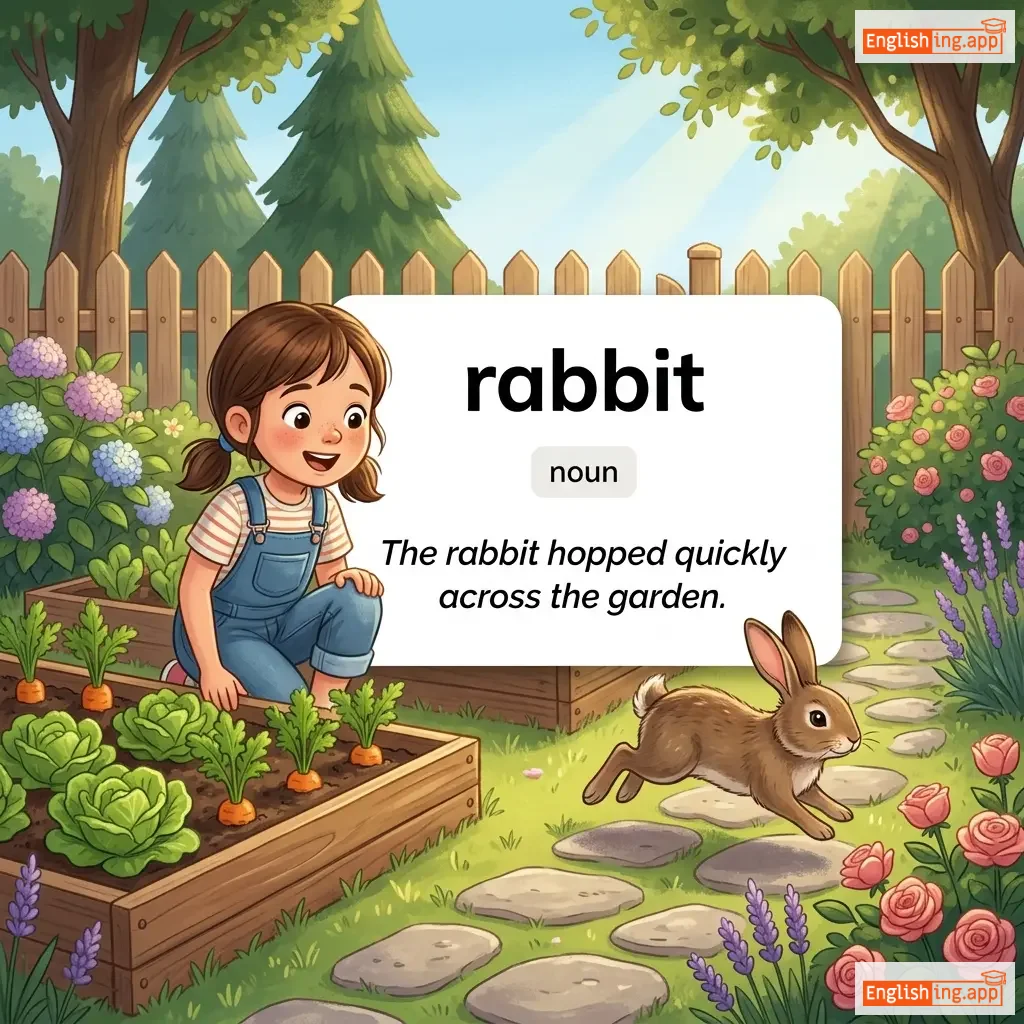
rabbit definition card — visual illustration of the meaning
noun
/ˈræbɪt/
खरगोश (khargosh)

a small furry animal with long ears that lives in holes in the ground and moves by hopping

"The rabbit hopped quickly across the garden."

"खरगोश जल्दी से बग़ीचे में कूदते हुए चला गया।" (Khargosh jaldi se bageeche mein koodte huye chala gaya.)
noun
/ˈræb.əl/
अराजक भीड़ (arajak bheed)

A disorderly crowd or mob; the common people regarded as noisy or unruly.

"A rabble gathered in the streets to protest the decision."

"एक अराजक भीड़ निर्णय के खिलाफ सड़कों पर इकट्ठा हो गई थी।" (ek arajak bheed nirnay ke khilaf sadkon par ikattha ho gayi thi.)
adjective
/ˈræb.ɪd/
उन्मत्त (unmatt)

Having extreme or fanatical support for something; relating to or suffering from rabies.

"He was a rabid fan of the football team."

"वह फुटबॉल टीम का एक उन्मत्त प्रशंसक था।" (vah football team ka ek unmatt prashansak tha.)
noun
/ˈreɪ.biːz/
रेबीज़ (rebiz)

A viral disease that causes inflammation of the brain in humans and other mammals, usually transmitted through animal bites.

"The dog was vaccinated against rabies."

"कुत्ते को रेबीज़ के खिलाफ टीका लगाया गया था।" (kutte ko rebiz ke khilaf tika lagaya gaya tha.)
noun
/reɪs/
दौड़ (daud)

a competition of speed, or a group of people with similar characteristics

"The race was very exciting, with many competitors."

"रेस बहुत रोमांचक थी, बहुत सारे प्रतियोगी थे।" (Res bahut romanchak thi, bahut saare protijogi the.)
adjective
/ˈreɪʃəl/
जातीय (jātiya)

relating to a race of people

"Racial equality is an important issue in many societies."

"जातीय समानता कई समाजों में एक महत्वपूर्ण मुद्दा है।" (Jātiya samāntā kaī samājōṁ mēṁ ēk mahatvapūrṇi mudda hai.)
noun
/ˈreɪsɪzəm/
नस्लवाद (naslvaad)

the belief that some races are superior to others, leading to unfair treatment or prejudice

"The organization works to eliminate racism in all forms."

"संगठन सभी रूपों में नस्लवाद को समाप्त करने के लिए काम करता है।" (Sangathan sabhi roopon mein naslvaad ko samaapt karne ke liye kaam karta hai.)
adjective
/ˈreɪsɪst/
जातिवादी (jativadi)

showing or feeling discrimination or prejudice against people of other races

"He was accused of making racist comments."

"उन्हें जातिवादी टिप्पणियाँ करने का आरोप लगाया गया था।" (Unhein jativadi tippaniyan karne ka aarop lagaya gaya tha.)
noun
/ræk/
रैक / स्टैंड (raik / stand)

a frame or stand used to hold or store things

"She placed her wet clothes on the drying rack."

"उसने अपने गीले कपड़े सुखाने के लिए रैक पर रख दिए।" (Usne apne geele kapde sukhane ke liye raik par rakh diye.)
noun
/ˈrækɪt/
रैकेट / शोरगुल (racket / shorgul)

A piece of equipment used to hit the ball in sports like tennis or badminton; also a loud noise or an illegal scheme.

"He bought a new tennis racket for the match."

"उसने मैच के लिए एक नया टेनिस रैकेट खरीदा।" (Usne match ke liye ek naya tenis racket kharida.)
noun
/ˌræk.ɒnˈtɜːr/
कला से कहानियाँ सुनाने वाला व्यक्ति (kala se kahaniyan sunane wala vyakti)

A person who tells anecdotes in a skillful and amusing way.

"The professor was a brilliant raconteur who kept his audience entertained."

"प्रोफेसर एक शानदार कहानीकार थे जिन्होंने अपने श्रोताओं को मनोरंजन में रखा।" (professor ek shandaar kahaanikaar the jinhone apne shrotaon ko manoranjan mein rakha.)
adjective
/ˈreɪ.si/
रोमांचक (romanchak)

Lively, entertaining, or slightly shocking (especially in a sexual way).

"The novel was full of racy dialogues."

"उपन्यास रोमांचक संवादों से भरा था।" (upanyas romanchak samvadon se bhara tha.)
noun
/ˈreɪdɑːr/
रेडार (radar)

a system that uses radio waves to detect the position and speed of objects

"The plane was detected by the airport's radar system."

"विमान को हवाई अड्डे के रडार सिस्टम द्वारा पहचाना गया।" (Vimaan ko havai adde ke radar system dwara pehchana gaya.)
noun
/ˈreɪdiəns/
प्रकाश (prakash)

the quality of shining with bright light; a glowing or beaming quality

"Her face was filled with radiance after hearing the good news."

"अच्छी खबर सुनने के बाद उसका चेहरा प्रकाश से भर गया था।" (Achhi khabar sunne ke baad uska chehra prakash se bhar gaya tha.)
adjective
/ˈreɪdiənt/
चमकदार (chamakdaar)

Shining brightly; expressing great happiness.

"She looked radiant in her wedding dress."

"वह अपनी शादी की ड्रेस में बहुत ही चमकदार लग रही थी।" (Vah apnī śādī kī ḍres men bahut hī chamakdār lag rahī thī.)
verb
/ˈreɪdieɪt/
विकिरण करना (vikiran karna)

to emit energy or light; to spread out from a center

"The fireplace radiates warmth throughout the room."

"फायरप्लेस पूरे कमरे में गर्मी उत्सर्जित करता है।" (fireplace poore kamre mein garmi utsarjit karta hai.)
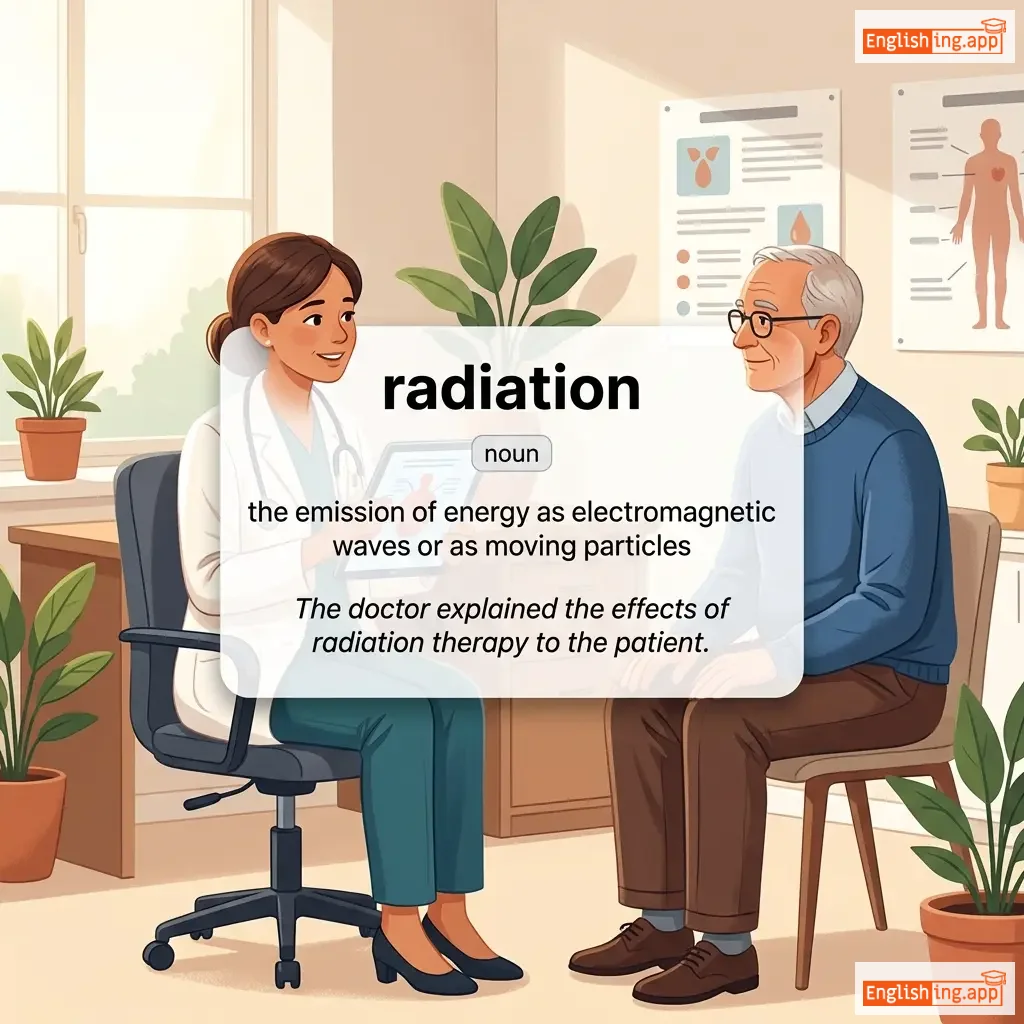
radiation definition card — visual illustration of the meaning
noun
/ˌreɪdiˈeɪʃən/
किरण विकिरण (kiran vikiran)

the emission of energy as electromagnetic waves or as moving particles

"The doctor explained the effects of radiation therapy to the patient."

"डॉक्टर ने रोगी को रेडिएशन थेरेपी के प्रभावों को समझाया।" (Doktor ne rogi ko radiation therapy ke prabhavon ko samjhaya.)
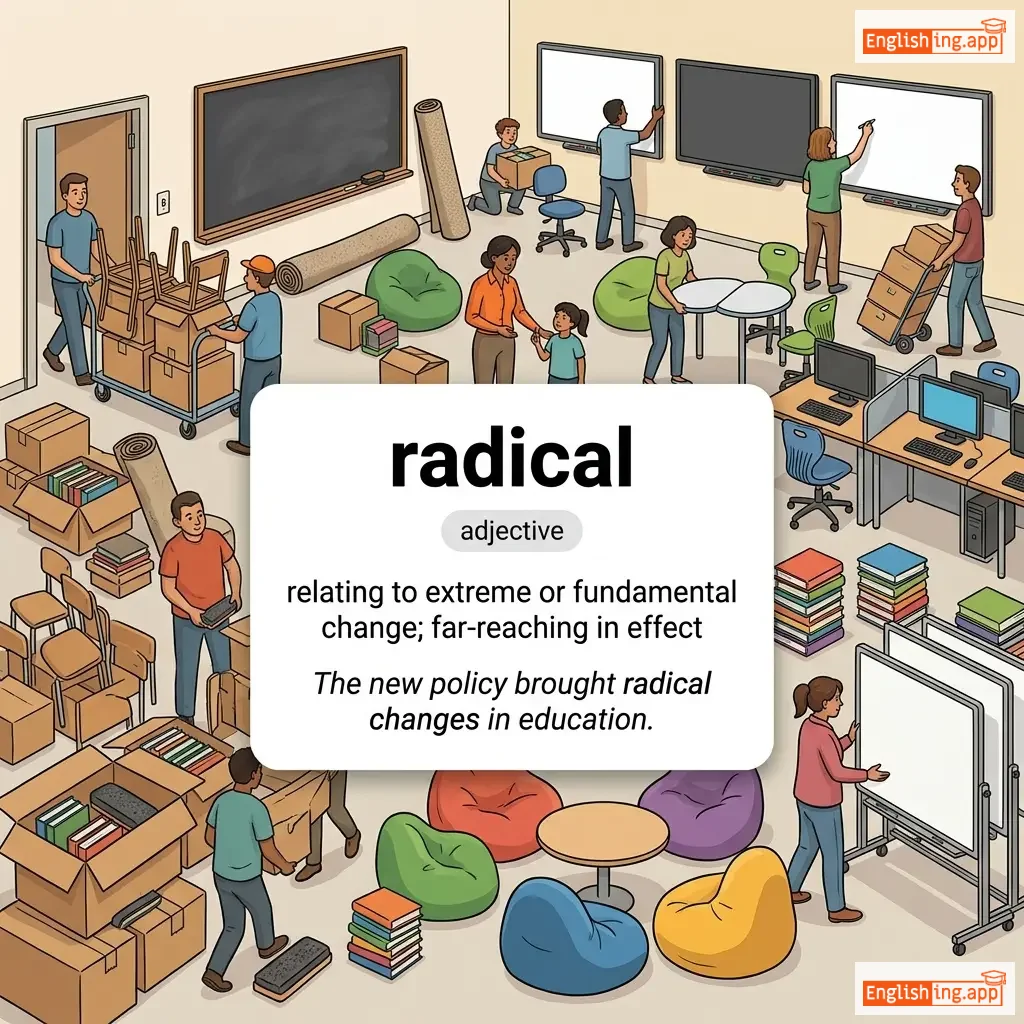
radical definition card — visual illustration of the meaning
adjective
/ˈrædɪkl/
क्रांतिकारी (redikal)

relating to extreme or fundamental change; far-reaching in effect

"The new policy brought radical changes in education."

"नई नीति ने शिक्षा में क्रांतिकारी परिवर्तन लाए।" (nai niti ne shiksha mein krantikaari parivartan lae)
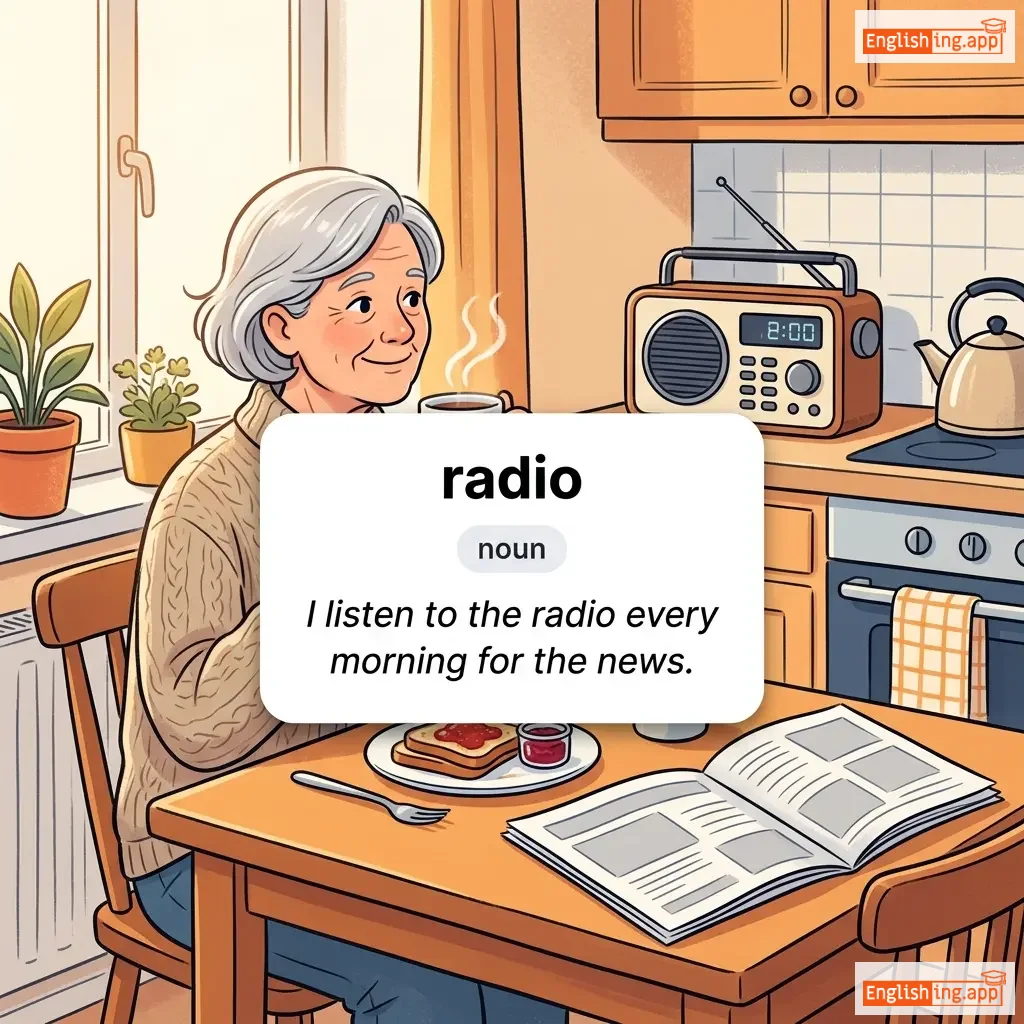
radio definition card — visual illustration of the meaning
noun
/ˈreɪdioʊ/
रेडियो (radio)

a device for receiving or transmitting radio signals, or the use of such signals for communication

"I listen to the radio every morning for the news."

"मैं हर सुबह समाचार के लिए रेडियो सुनता हूँ।" (Main har subah samachar ke liye radio sunta hoon.)
radioactivity definition card — visual illustration of the meaning
noun
ˌreɪ.di.oʊ.ækˈtɪv.ə.ti
रेडियोधर्मिता (rediodharmita)

The emission of ionizing radiation or particles caused by the spontaneous disintegration of atomic nuclei.

"Radioactivity is used in medical treatments like cancer therapy."

"रेडियोऐक्टिविटी कैंसर चिकित्सा जैसे मेडिकल उपचारों में उपयोग की जाती है।" (Redioaiktivity cancer chikitsa jaise medical upcharon mein upyog ki jati hai.)
noun
/'ræd.ɪʃ/
मूली (mooli)

a small pungent edible root vegetable with white or red skin

"The farmer harvested fresh radishes from the garden."

"किसान ने बाग़ीचे से ताजे मूली निकाले।" (kisaan ne baagiche se tazey mooli nikaale)
noun
/ˈreɪdɪks/
आधार (aadhar)

the base or root of something; the number on which a system of numeration is built

"In mathematics, the decimal system has a radix of ten."

"गणित में, दशमलव प्रणाली का आधार दस है।" (Ganit mein, dashamlav pranali ka aadhar das hai.)
adjective
/ˈræfɪʃ/
असामान्य और थोड़ा बदनाम लेकिन आकर्षक (asaamanya aur thoda badnaam lekin aakarshak)

unconventional and slightly disreputable but attractive

"He had a raffish charm that made him popular in the city."

"वह शहर में लोकप्रिय होने के लिए रैफिश आकर्षण रखता था।" (Vah shahar mein lokpriya hone ke liye raifish aakarshan rakhta tha.)
noun/verb
/ˈræfəl/
लॉटरी टिकट बेचना (lottari tiket bechna)

A means of raising money by selling numbered tickets, one or more of which are drawn at random for a prize; to sell something in such a lottery.

"The charity decided to raffle a bicycle to raise funds."

"चैरिटी ने धन इकट्ठा करने के लिए एक साइकिल रैफल करने का फैसला किया।" (Charity ne dhan ikattha karne ke liye ek cycle raffle karne ka faisla kiya.)
noun/verb
/ræft/
बेड़ा (beda)

A flat structure made of logs or planks tied together, used as a boat or floating platform; to travel or transport on such a structure.

"They built a raft to cross the river."

"उन्होंने नदी पार करने के लिए एक बेड़ा बनाया।" (Unhone nadi paar karne ke liye ek beda banaya.)
noun
/ˈræftər/
राफ्टर (rafter)

One of the sloping beams that supports a roof.

"The old barn’s rafters were exposed."

"पुरानी गोशाले के राफ्टर दिखाई दे रहे थे।" (Purani goshale ke rafter dikhai de rahe the.)
noun/verb
/ræɡ/
चिथड़ा (chithda)

A piece of old, torn cloth; to tease or scold someone in a playful way.

"She used an old rag to clean the table."

"वह टेबल साफ करने के लिए एक पुराना चिथड़ा इस्तेमाल कर रही थी।" (Vah table saaf karne ke liye ek purana chithda istemal kar rahi thi.)
noun
/ˈræɡəmʌfɪn/
चिथड़े पहने बच्चा (chithde pehne bachcha)

A person, typically a child, in ragged, dirty clothes.

"The little ragamuffin begged for food on the street."

"वह छोटा चिथड़े पहने बच्चा सड़क पर खाना मांग रहा था।" (Wah chhota chithde pehne bachcha sadak par khana maang raha tha.)
noun
/reɪdʒ/
क्रोध (krodh)

intense anger or fury

"She shouted in a fit of rage after hearing the news."

"खबर सुनने के बाद वह गुस्से में चिल्लाई।" (Khobar sunne ke baad vah gusse mein chhilaayi.)
adjective
/ˈræɡɪd/
फटा हुआ (fata hua)

torn, worn out, or in poor condition

"The homeless man wore a ragged coat."

"बेघर आदमी ने एक फटा हुआ कोट पहना था।" (Beghar aadmi ne ek fata hua coat pehna tha.)
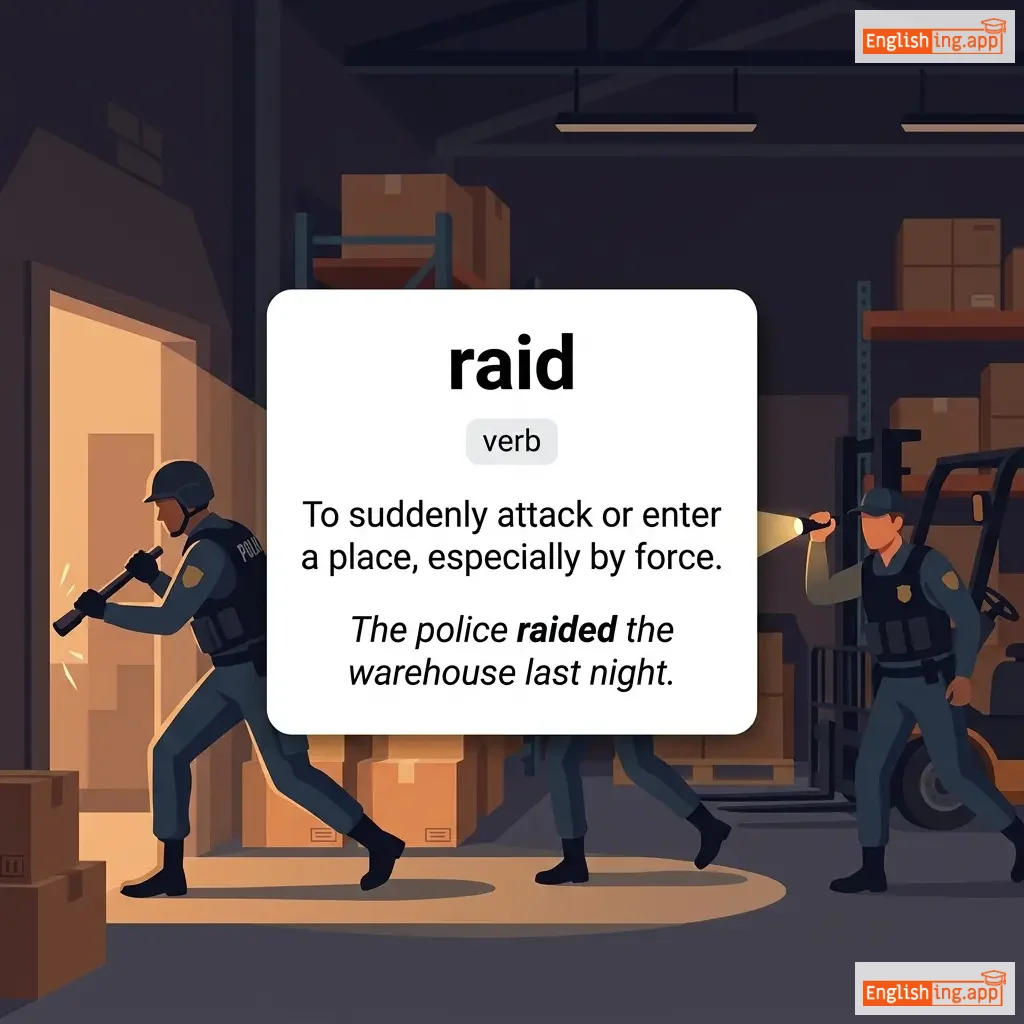
raid definition card — visual illustration of the meaning
verb
/reɪd/
छापा (chaapa)

To suddenly attack or enter a place, especially by force.

"The police raided the warehouse last night."

"पुलिस ने कल रात गोदाम पर छापा मारा।" (Police ne kal raat godaam par chaapa maara.)
verb
/reɪl/
विरोध करना (virodh karna)

to complain or protest strongly about something

"He railed against the unfair decision."

"उसने अन्यायपूर्ण निर्णय के खिलाफ तीव्र विरोध किया।" (Usne anyaypoorn nirnay ke khilaf teevr virodh kiya.)
noun
/ˈreɪləri/
मज़ाक-मस्ती (mazaak-masti)

good-humored teasing or joking

"Their friendship was full of light-hearted raillery."

"उनकी दोस्ती हल्की-फुल्की रैलरी से भरी हुई थी।" (Unki dosti halki-phulki raillery se bhari hui thi.)
noun
/ˈreɪlˌroʊd/
रेल मार्ग (rel maarg)

a track or system of tracks made of steel rails along which trains run

"The railroad connects the city to several nearby towns."

"रेलमार्ग शहर को कई नजदीकी कस्बों से जोड़ता है।" (Relmaarg shahar ko kai najdeeki kasbon se jodta hai.)
noun
/ˈreɪl.weɪ/
रेलमार्ग (relmarg)

a track made of steel rails along which trains run; a system of tracks with trains, stations, and other facilities

"The railway connects major cities across the country."

"रेलमार्ग देश के प्रमुख शहरों को जोड़ता है।" (relmarg desh ke pramukh shahron ko jodata hai)
noun
/ˈreɪmənt/
वस्त्र (vastr)

clothing, especially fine or formal wear

"The king wore royal raiment during the ceremony."

"राजा ने समारोह में शाही वस्त्र पहने।" (Raja ne samaroh mein shaahi vastr pehene.)
noun
/reɪn/
बारिश (rain)

water droplets that fall from the sky as a result of condensation in the atmosphere

"The rain started pouring just as we reached the park."

"जैसे ही हम पार्क पहुँचे, बारिश शुरू हो गई" (jaise hi ham park pahunchhe, baarish shuru ho gai)
noun
/ˈreɪn.boʊ/
इन्द्रधनुष (indradhanush)

an arch of colors formed in the sky by sunlight shining through rain

"After the storm, a beautiful rainbow appeared in the sky."

"आंधी के बाद, आकाश में एक सुंदर इन्द्रधनुष दिखाई दिया।" (aandhi ke baad, aakash mein ek sundar indradhanush dikhai diya.)
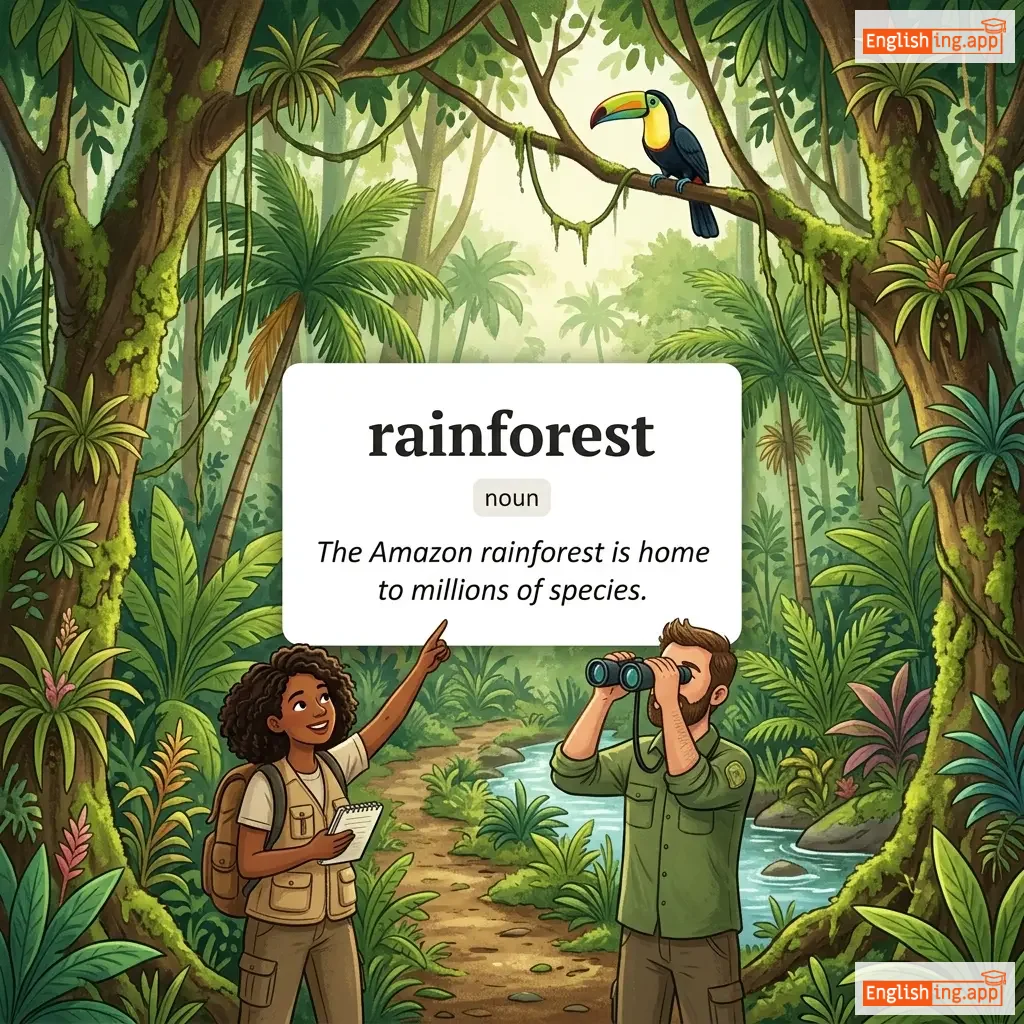
rainforest definition card — visual illustration of the meaning
noun
ˈreɪn.fɒr.ɪst
वृष्टि वन (vrishti van)

A luxuriant, dense forest rich in biodiversity, found typically in tropical areas with consistently heavy rainfall.

"The Amazon rainforest is home to millions of species."

"अमेज़न वर्षा वन लाखों प्रजातियों का घर है।" (Amazon varsha van lakhon prajatiyon ka ghar hai.)
adjective
/ˈreɪ.ni/
वर्षाजनक (varshaajanak)

characterized by rain; wet from rain; having much rain

"It was a rainy day, so we stayed indoors."

"यह एक वर्षा वाला दिन था, इसलिए हम घर के अंदर रहे।" (yah ek varsha wala din tha, isliye hum ghar ke andar rahe.)
verb
/reɪz/
उठाना / बढ़ाना (uthana / badhana)

To lift or move something to a higher position; to increase; to bring up.

"She raised her hand to ask a question."

"उसने सवाल पूछने के लिए अपना हाथ उठाया।" (Usne sawal poochne ke liye apna haath uthaya.)
noun
/ˈreɪ.zən/
किशमिश (kishmish)

a dried grape, often eaten as a snack or used in cooking and baking

"She added raisins to the cake batter for extra sweetness."

"उसने केक के बैटर में अतिरिक्त मिठास के लिए किशमिश डाली।" (Usne cake ke batter mein atirikt mithas ke liye kishmish daali.)
noun
/ˈreɪ.zɪnz/
किशमिश (kishmish)

dried grapes, often used in cooking and baking

"She added raisins to the oatmeal cookies for extra sweetness."

"उसने ओटमील कुकीज़ में अतिरिक्त मिठास के लिए किशमिश डाली।" (usne otmeal cookies mein atirikt mithas ke liye kishmish daali)
verb
/reɪk/
पत्तियां इकट्ठा करने का यंत्र से इकट्ठा करना (pattiyan ikattha karne ka yantra se ikattha karna)

to collect or gather with a rake; to scrape or smooth a surface

"He raked the leaves into a pile."

"उसने पत्तियों को एक ढेर में इकट्ठा किया।" (Usne pattiyon ko ek dher mein ikattha kiya.)
adjective
/ˈreɪ.kɪʃ/
स्टाइलिश, आत्मविश्वास से भरा और हल्का सा विवादास्पद रूप (stailish, atmvishwas se bhara aur halka sa vivaadaspad roop)

having a stylish, confident, and slightly disreputable appearance

"He walked in with a rakish smile and tilted hat."

"वह एक रेकिश मुस्कान और झुकी हुई टोपी के साथ अंदर आया।" (Vah ek rekish muskaan aur jhuki hui topi ke saath andar aaya.)
verb
/ˈræl.i/
संगठित होना / पुनः शक्ति प्राप्त करना (sangathit hona / punah shakti prapt karna)

to come together for a common purpose or to recover strength or spirit

"The team rallied after halftime and won the match."

"टीम हाफटाइम के बाद rally की और मैच जीत लिया।" (Team halftime ke baad rally ki aur match jeet liya.)
verb
/ræm/
धक्का मारना (dhakka marna)

to strike or push something with great force

"The truck rammed into the wall."

"ट्रक ने दीवार में ज़ोर से टक्कर मारी।" (Truck ne deewar mein zor se takkar maari.)
verb
/ˈræm.bəl/
लंबे समय तक उलझनपूर्ण या बेमानी तरीके से बोलना या लिखना; बिना निश्चित रास्ते के लिए घूमना (lambe samay tak uljhanpurn ya bemani tareeke se bolna ya likhna; bina nishchit raste ke liye ghoomna)

to talk or write at length in a confused or inconsequential way; to walk for pleasure without a fixed route.

"He rambled on about his childhood for hours."

"वह घंटे भर अपने बचपन के बारे में उलझनपूर्ण तरीके से बोलता रहा।" (Wah ghante bhar apne bachpan ke baare mein uljhanpurn tareeke se bolta raha.)
adjective
/ræmˈbʌŋk.ʃəs/
अशांत (ashant)

boisterous, energetic, and difficult to control.

"The rambunctious children filled the house with noise."

"शरारती बच्चे घर को शोर से भर रहे थे।" (Shararati bachche ghar ko shor se bhar rahe the.)
noun
/ræmˈbuːtən/
रामबुटान (rambutan)

a tropical fruit with red spiky skin and white translucent sweet flesh similar to litchi

"The rambutan looks scary with its hairy skin but tastes very sweet inside."

"रैम्बूटान अपनी बालों वाली त्वचा के साथ डरावना दिखता है, लेकिन अंदर बहुत मीठा स्वाद होता है।" (rambutan apni balon wali tvacha ke saath daravna dikhata hai, lekin andar bahut meetha swaad hota hai.)