वोकैबुलरीज

इंग्लिश वोकैबुलरी डिस्कवर, लर्न और मास्टर करें

pronoun
/aɪ/
मैं (main)

used by a speaker to refer to himself or herself

"I am learning English every day."

"मैं हर दिन अंग्रेजी सीख रहा हूँ।" (main har din angreji seekh raha hoon.)
noun
/aɪs/
बर्फ (barf)

frozen water, a solid form of water

"The lake was covered with thick ice in winter."

"झील सर्दियों में मोटी बर्फ से ढकी हुई थी।" (jheel sardiyn mein moti barf se dhaki hui thi.)
noun
/ˈaɪs kriːm/
आइस क्रीम (ice-cream)

a frozen sweet dessert made from dairy products, usually served cold

"Children love to eat ice-cream on hot summer days."

"बच्चे गर्मी के दिनों में आइस क्रीम खाना पसंद करते हैं।" (bachche garmi ke dinon mein ice-cream khana pasand karte hain.)
adjective
/ˈɪkθiɪk/
मछली जैसा (machhli jaisa)

Relating to or resembling fish.

"The artist's painting had an ichthyic quality."

"कला के चित्र में मछली जैसा गुण था।" (Kala ke chitra mein machhli jaisa gun tha.)
noun
/ˌɪkθiˈɒlədʒɪst/
मच्छीशास्त्री (machchhishastri)

A scientist who studies fish.

"The ichthyologist discovered a new species of fish in the river."

"मच्छीशास्त्री ने नदी में मछलियों की एक नई प्रजाति का पता लगाया।" (Machchhishastri ne nadi mein machhliyon ki ek nai prajati ka pata lagaya.)
noun
/ˌɪkθiˈɒlədʒi/
मछली विज्ञान (machhli vigyaan)

The branch of zoology that deals with fish.

"He pursued a degree in ichthyology at the university."

"उसने विश्वविद्यालय में मछली विज्ञान में डिग्री प्राप्त की।" (Usne vishwavidyalay mein machhli vigyaan mein degree praapt ki.)
noun
/ˈɪkθiəˌsɔːrz/
इक्षीओसॉर्स (एक प्रकार की विलुप्त समुद्री सरीसृप) (ikthiosors)

Extinct marine reptiles that resembled fish and dolphins, dominant during the Mesozoic era.

"Ichthyosaurs were swift predators of the ancient seas."

"इक्षीओसॉर्स प्राचीन सागरों के तेज़ शिकारी थे।" (Ikthiosors prachin sagaron ke tez shikari the.)
adverb
/ˈaɪsɪli/
ठंडे तरीके से (thande tareeke se)

In a very cold, unfriendly, or hostile manner.

"She replied icily to his question."

"उसने उसके सवाल का जवाब ठंडे तरीके से दिया।" (Usne uske sawal ka jawab thande tareeke se diya.)
noun
/ˈaɪsinəs/
ठंडक (thandak)

The state of being cold in manner or temperature.

"There was a distinct iciness in his voice."

"उसकी आवाज़ में एक स्पष्ट ठंडक थी।" (Uski aawaaz mein ek spashth thandak thi.)
noun
/ˈaɪkɒn/
प्रतीक, प्रतिमा (prateek, prateema)

A person or thing regarded as a symbol of something, or a graphic symbol on a screen.

"The singer became a cultural icon."

"गायक एक सांस्कृतिक प्रतीक बन गए।" (Gaayak ek sanskritik prateek ban gaye.)
iconic definition card — visual illustration of the meaning
adjective
aɪˈkɒn.ɪk
प्रसिद्ध (prasiddh)

Symbolic, legendary, famous, representing something significant or characteristic.

"The Eiffel Tower is an iconic landmark of France."

"एiffel टॉवर फ्रांस का एक आइकोनिक स्थलचिह्न है।" (Eiffel Tower France ka ek iconic sthalchihn hai.)
noun
/aɪˈkɒnəklæst/
प्रथाभंग करने वाला (prathabhang karne wala)

A person who attacks or criticizes cherished beliefs, traditions, or institutions.

"He was known as an iconoclast who challenged old traditions."

"उसे एक प्रथाभंग करने वाले के रूप में जाना जाता था जो पुरानी परंपराओं को चुनौती देता था।" (Use ek prathabhang karne wale ke roop mein jaana jaata tha jo purani paramparaon ko chunauti deta tha.)
iconoclastic definition card — visual illustration of the meaning
adjective
/ˌaɪ.kə.nəˈklæs.tɪk/
प्रचलित विश्वासों या परंपराओं को चुनौती देने वाली विशेषता (iconoclastic)

Characterized by attacking or rejecting cherished beliefs, traditions, or established values.

"Her iconoclastic views challenged the conventional wisdom of the industry."

"उसके आइकोनोक्लास्टिक दृष्टिकोण ने उद्योग की पारंपरिक समझ को चुनौती दी।" (uske iconoclastic drishtikon ne udhyog ki paramparik samajh ko chunauti di.)
adjective
/ˈaɪsi/
बर्फ से ढका हुआ; अत्यधिक ठंडा; शत्रुतापूर्ण (barf se dhaka hua; atyadhik thanda; shatrutapurn)

extremely cold; covered with ice; unfriendly or hostile

"The icy wind made everyone shiver."

"बर्फीली हवा ने सभी को कांपने पर मजबूर कर दिया।" (barfili hawa ne sabhi ko kampne par majbur kar diya)
noun
/aɪˈdiː/
पहचान पत्र (pehchan patra)

identification; a document or number used to prove who someone is

"Please show your ID at the entrance."

"कृपया प्रवेश द्वार पर अपना पहचान पत्र दिखाएं।" (kripya pravesh dwar par apna pehchan patra dikhayein)
noun
/aɪˈdiːə/
विचार (vichar)

A thought, plan, or suggestion about what to do.

"She had a brilliant idea for a new business."

"उसके पास एक नए व्यवसाय के लिए शानदार विचार था।" (Uske paas ek naye vyavsay ke liye shandaar vichar tha.)
adjective
/aɪˈdiːəl/
आदर्श (adarsh)

the best possible; perfect for a situation

"This place is ideal for a picnic."

"यह स्थान पिकनिक के लिए आदर्श है।" (Yah sthan picnic ke liye adarsh hai.)
ideal environment definition card — visual illustration of the meaning
adjective + noun
aɪˈdiːəl ɪnˈvaɪrənmənt
आदर्श पर्यावरण (adarsh paryavaran)

Perfect or most suitable conditions for growth or development

"Winter creates an ideal environment for vegetable growth."

"सर्दी का मौसम सब्ज़ियों की वृद्धि के लिए आदर्श पर्यावरण बनाता है।" (sardi ka mausam sabzion ki vruddhi ke liye adarsh paryavaran banata hai.)
noun
/aɪˈdiː.ə.lɪ.zəm/
आदर्शवाद; विचारवाद (adarshavad, vicharvad)

the pursuit of high principles and noble goals; unrealistic pursuit of perfection

"His youthful idealism motivated him to join various social justice movements."

"उसकी युवावस्था का आदर्शवाद उसे विभिन्न सामाजिक न्याय आंदोलनों में शामिल होने के लिए प्रेरित करता था।" (uski yuvastha ka adarshavad use vibhinn samajik nyay aandolnon mein shamil hone ke liye prerit karta tha.)
adjective
/ˌaɪdiəˈlɪstɪk/
आदर्शवादी (adarshvadi)

pursuing high principles or ideals; unrealistically optimistic

"She has an idealistic view of changing the world."

"उसका दुनिया को बदलने का आदर्शवादी दृष्टिकोण है।" (uska duniya ko badalne ka adarshvadi drishtikon hai)
verb
/aɪˈdiː.ə.laɪz/
आदर्श बनाना (aadarsh banana)

To regard or represent something as perfect or better than it really is.

"Children often idealize their parents."

"बच्चे अक्सर अपने माता-पिता को आदर्श मानते हैं।" (bachche aksar apne mata-pita ko aadarsh maante hain.)
ideation definition card — visual illustration of the meaning
noun
/ˌaɪdiˈeɪʃən/
विचार निर्माण (vichar nirmaan)

The process of forming ideas or concepts.

"The workshop focused on ideation and brainstorming."

"कार्यशाला विचार निर्माण और मंथन पर केंद्रित थी।" (Karyashala vichar nirmaan aur manthan par kendrit thi.)
adjective
/aɪˈdentɪkl/
समान (samaan)

Exactly the same in every detail.

"The twins wore identical clothes."

"जुड़वां भाइयों ने समान कपड़े पहने थे।" (Judwa bhaiyon ne samaan kapde pehne the.)
noun
/aɪˌdɛntɪfɪˈkeɪʃən/
पहचान (pehchaan)

the process of recognizing or proving who or what someone or something is

"You need proper identification to enter the building."

"आपको भवन में प्रवेश के लिए उचित पहचान की आवश्यकता है।" (Aapko bhavan mein pravesh ke liye uchit pehchaan ki avashyakta hai.)
identified definition card — visual illustration of the meaning
verb
aɪˈdɛntɪfaɪd
पहचानना (pehchanna)

To recognize or establish who or what someone or something is.

"The root causes of the issue need to be identified."

"समस्या के मूल कारणों को पहचाना जाना चाहिए।" (Samasya ke mool kaarano ko pehchaana jaana chahiye.)
identify definition card — visual illustration of the meaning
verb
/aɪˈdɛntɪfaɪ/
पहचानना (pehchanna)

to recognize or establish what something or someone is

"The police could not identify the suspect."

"पुलिस संदिग्ध को पहचान नहीं सकी।" (police sandigdh ko pehchaan nahin sakee.)
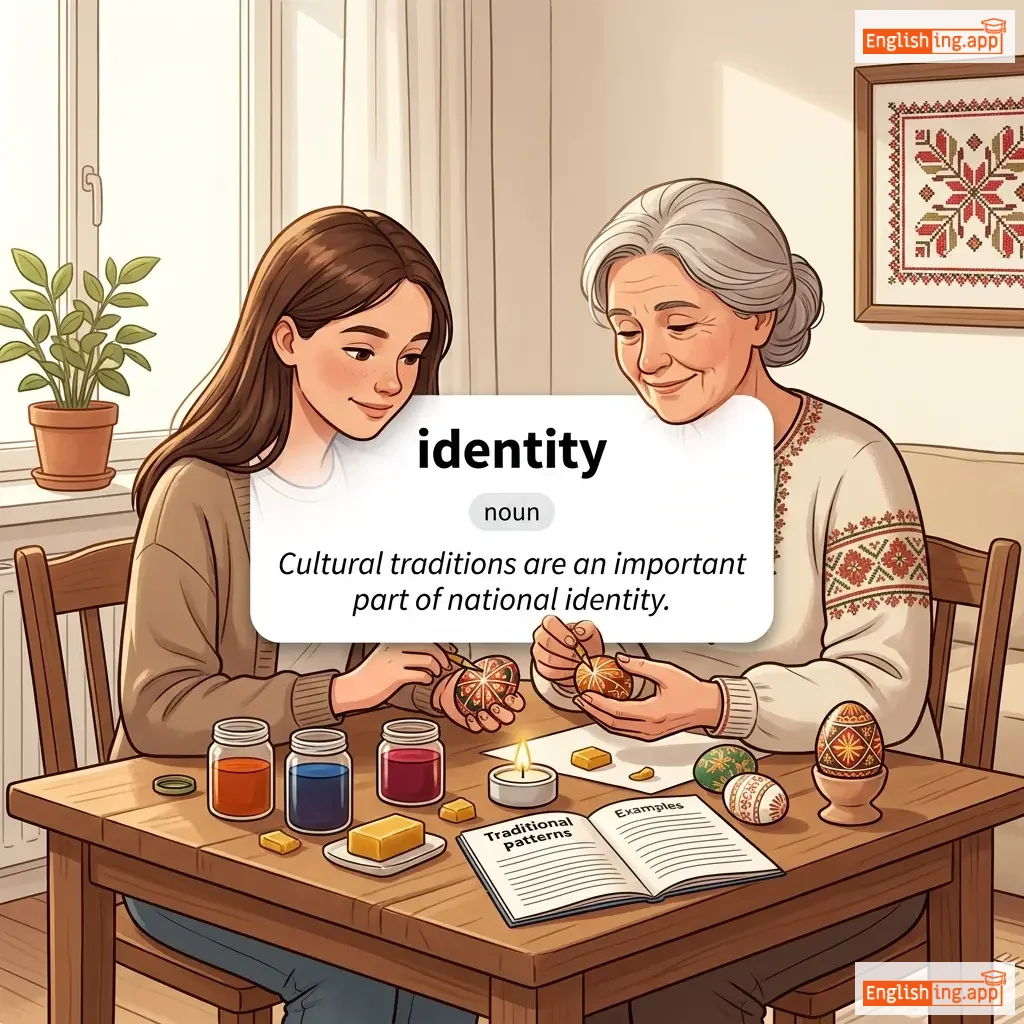
identity definition card — visual illustration of the meaning
noun
/aɪˈdɛntɪti/
पहचान (pehchaan)

the characteristics, feelings, or beliefs that make a person or group different from others

"Cultural traditions are an important part of national identity."

"सांस्कृतिक परंपराएँ राष्ट्रीय पहचान का एक महत्वपूर्ण हिस्सा हैं।" (sanskrutik paramparaayein raashtreey pehchaan ka ek mahatvapurn hissa hain)
adjective
/ˌaɪ.di.əˈlɒdʒ.ɪ.kəl/
वैचारिक (vaicharik)

Relating to or based on a system of ideas or beliefs.

"The two parties are divided by deep ideological differences."

"दोनों पार्टियां गहरे वैचारिक मतभेदों से विभाजित हैं।" (donon partiyan gahre vaicharik matbhedon se vibhajit hain.)
noun
/ˌaɪ.diˈɒl.ə.dʒi/
विचारधारा (vichardhara)

A system of ideas and ideals, especially one that forms the basis of economic or political theory and policy.

"Democracy is based on the ideology of freedom and equality."

"लोकतंत्र स्वतंत्रता और समानता के विचारधारा पर आधारित है।" (loktantra svatantrata aur samaanta ke vichardhara par aadharit hai.)
noun
/ˈɪd.i.ə.si/
मूर्खता (murkhata)

extremely stupid behavior or actions; foolishness

"The decision to ignore safety protocols was pure idiocy that endangered everyone."

"सुरक्षा प्रोटोकॉल्स की अनदेखी करने का निर्णय शुद्ध मूर्खता था जिसने सभी को खतरे में डाला।" (suraksha protocols ki andekhi karne ka nirnay shuddh murkhata tha jismein sabhi ko khatre mein dala.)
noun
/ˈɪd.i.əm/
मुहावरा (muhavara)

A group of words whose meaning is different from the meanings of the individual words.

"The idiom 'break the ice' means to start a conversation in a friendly way."

"मुहावरा 'ब्रेक द आइस' का मतलब होता है किसी बातचीत की शुरुआत करना एक दोस्ताना तरीके से।" (Muhavara 'break the ice' ka matlab hota hai kisi baatcheet ki shuruat karna ek dostana tareeke se.)
noun
/ˌɪdiəˈsɪŋkrəsi/
विशेषता (visheshta)

A distinctive or peculiar characteristic, habit, or mannerism unique to an individual.

"One of her idiosyncrasies was humming while working."

"उसकी एक आदत थी काम करते समय गुनगुनाना।" (Uski ek aadat thi kaam karte samay gungunaana.)
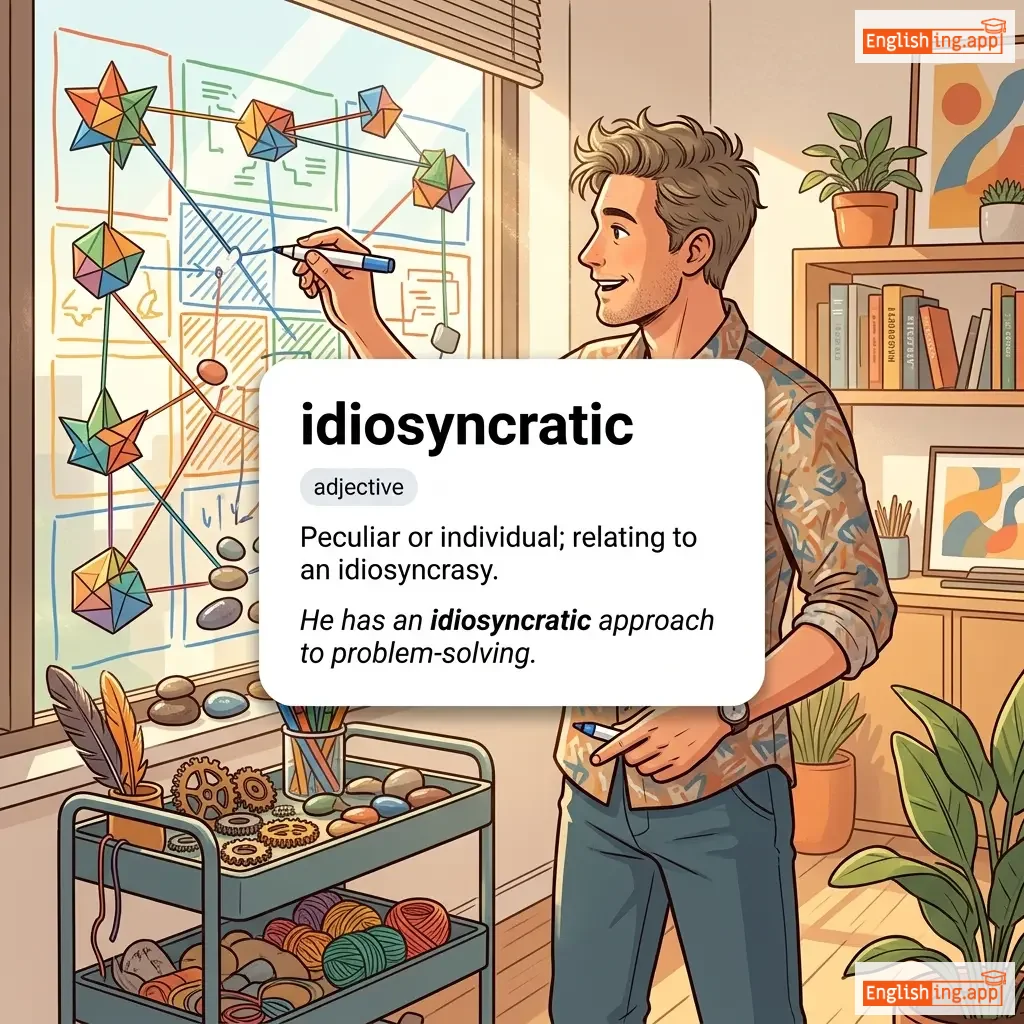
idiosyncratic definition card — visual illustration of the meaning
adjective
/ˌɪdiəsɪnˈkrætɪk/
अजीब स्वभाव वाला (ajeeb swabhav wala)

Peculiar or individual; relating to an idiosyncrasy.

"He has an idiosyncratic approach to problem-solving."

"उसका समस्या हल करने का तरीका अजीब है।" (uska samasya hal karne ka tareeka ajeeb hai.)
noun
/ˈɪdɪət/
मूर्ख (moorkh)

a person who acts in a way that is considered very stupid or foolish

"He acted like an idiot at the party last night."

"उसने पिछले रात पार्टी में एक मूर्ख की तरह बर्ताव किया।" (Usne pichhle raat party mein ek moorkh ki tarah bartav kiya.)
adjective
/ˌɪd.iˈɒt.ɪk/
मूर्खतापूर्ण (moorkhatapurn)

extremely stupid; foolish; senseless

"His idiotic behavior embarrassed everyone at the meeting."

"उसका मूर्खतापूर्ण व्यवहार मीटिंग में सभी को शर्मिंदा कर गया।" (uska moorkhatapurn vyavhaar meeting mein sabhi ko sharminda kar gaya)
adjective, verb
/ˈaɪd(ə)l/
आलसी (aalsi)

Adjective: not active or in use; lazy. Verb: to spend time doing nothing.

"The workers sat idle during the power outage."

"बिजली कटने के दौरान श्रमिक आलसी हो गए थे।" (bijli katne ke dauran shramik aalsi ho gaye the.)
noun
/ˈaɪdlər/
आलसी व्यक्ति (aalsi vyakti)

A person who avoids work or spends time lazily.

"He was known as an idler who wasted his days."

"वह एक ऐसा आदमी था जिसे आलसी कहा जाता था जो अपने दिन बर्बाद करता था।" (Vah ek aisa aadmi tha jise aalsi kaha jaata tha jo apne din barbaad karta tha.)
noun
/ˈaɪ.dəl/
प्रतिमा; आदर्श व्यक्ति; (pratima, aadarsh vyakti)

an image or representation of a god used as an object of worship; a person who is greatly admired

"The singer became a teenage idol after her hit song topped the charts worldwide."

"गायक एक किशोरी आइडल बन गई जब उसका हिट गाना दुनिया भर में चार्ट्स पर शीर्ष पर पहुंच गया।" (gaayak ek kishori idol ban gayi jab uska hit gaana duniya bhar mein charts par sheersh par pahuch gaya.)
adjective
/ˌaɪdəˈlɑːtrɪəs/
मूर्ति पूजा करने वाला (moorti pooja karne wala)

Excessively devoted or reverent towards idols or false gods.

"The ancient tribe was known for its idolatrious practices."

"प्राचीन जनजाति अपनी मूर्ति पूजा प्रथाओं के लिए प्रसिद्ध थी।" (Prachin janjati apni moorti pooja prathao ke liye prasiddh thi.)
verb
/aɪˈdɒləˌtraɪz/
मूर्ति पूजा करना (moorti pooja karna)

To worship idols; to regard with excessive devotion or admiration.

"They began to idolatrize the statue as a deity."

"उन्होंने उस मूर्ति को देवी के रूप में पूजना शुरू कर दिया।" (unhone us moorti ko devi ke roop mein poojna shuru kar diya.)
adjective
/aɪˈdɒlətrəs/
मूर्ति पूजा करने वाला (moorti pooja karne wala)

Excessively admiring or worshipping someone or something as an idol.

"The king was criticized for his idolatrous devotion to wealth."

"राजा को संपत्ति के प्रति अपनी मूर्तिपूजक भक्ति के लिए आलोचना की गई।" (Raja ko sampatti ke prati apni moortipoojak bhakti ke liye alochana ki gayi.)
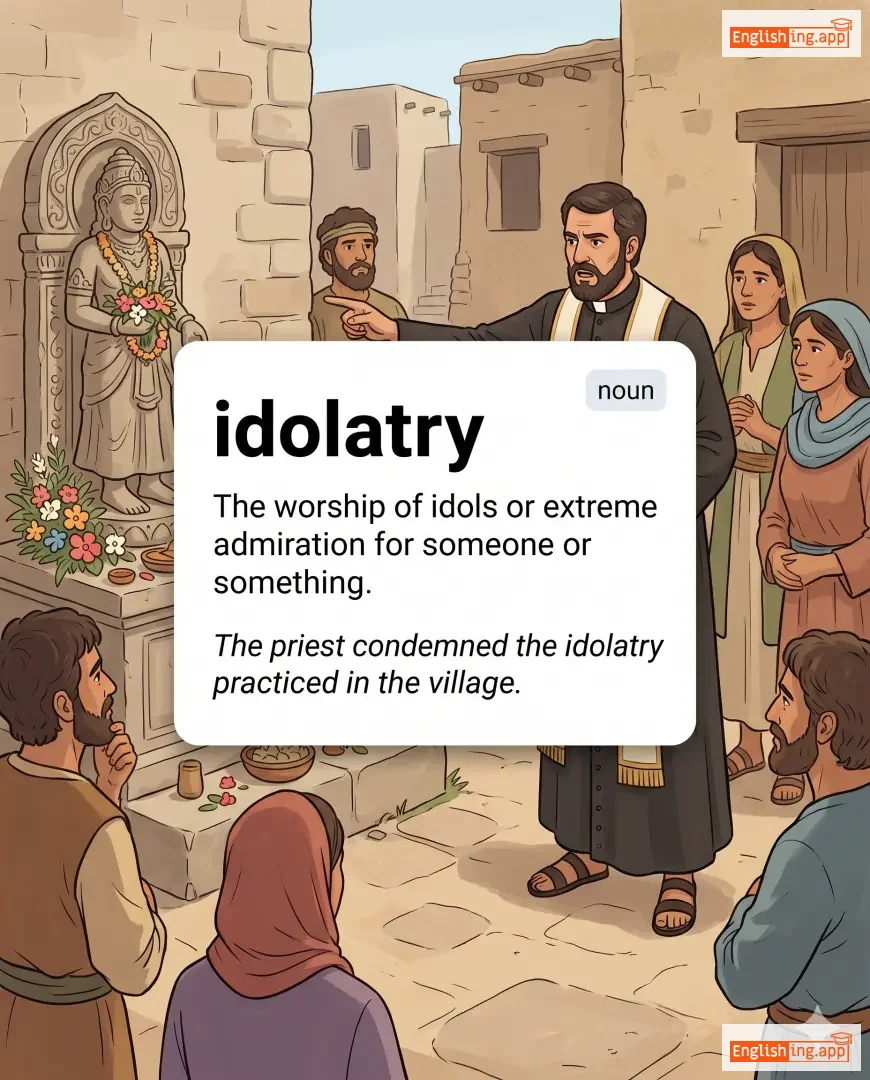
idolatry definition card — visual illustration of the meaning
noun
/aɪˈdɒlətri/
प्रतिमा पूजा (pratima pooja)

The worship of idols or extreme admiration for someone or something.

"The priest condemned the idolatry practiced in the village."

"पुरोहित ने गाँव में की जा रही प्रतिमा पूजा की निंदा की।" (Purohit ne gaon mein ki ja rahi pratima pooja ki ninda ki.)
verb
/ˈaɪdəlaɪz/
अति भक्ति करना (ati bhakti karna)

To admire or worship someone excessively.

"Fans often idolize celebrities for their talent and lifestyle."

"फैन्स अक्सर अपनी प्रतिभा और जीवनशैली के लिए सेलिब्रिटियों को अत्यधिक पूजते हैं।" (Fans aksar apni pratibha aur jeevanshailee ke liye celebrityon ko atidhik poojte hain.)
noun
/ˈaɪdɪl/
शांतिपूर्ण सुखमय दृश्य (shantipoorn sukhmay drishya)

An extremely happy, peaceful, or picturesque episode or scene, often idealized.

"Their honeymoon was an idyll on a tropical island."

"उनकी हनीमून एक उष्णकटिबंधीय द्वीप पर एक आदर्श सुखमय दृश्य था।" (Unki honeymoon ek ushnakateebandhiy dweep par ek aadarsh sukhmay drishya tha.)
adjective
/aɪˈdɪlɪk/
आनंदमय और सुंदर (aanandamay aur sundar)

Like an idyll; extremely happy, peaceful, or picturesque.

"They enjoyed an idyllic vacation by the sea."

"उन्होंने समुद्र के किनारे एक आनंदमय छुट्टी का आनंद लिया।" (Unhone samudra ke kinare ek aanandmay chhutti ka aanand liya.)
abbreviation
/ˌaɪˈiː/
यानी (yani)

That is to say; used to clarify or explain something more precisely.

"Many amphibians, i.e., frogs and salamanders, can live both in water and on land."

"कई उभयचरों, यानी, मेंढक और सलामैंडर, पानी और भूमि दोनों पर रह सकते हैं।" (Kai ubhayacharon, yani, mendhak aur salaamandar, paani aur bhumi dono par rah sakte hain.)
conjunction
/ɪf/
यदि (yadi)

used to introduce a condition or supposition

"If it rains tomorrow, we will stay home."

"यदि कल बारिश होती है, तो हम घर पर रहेंगे।" (Yadi kal barish hoti hai, to hum ghar par rahenge.)
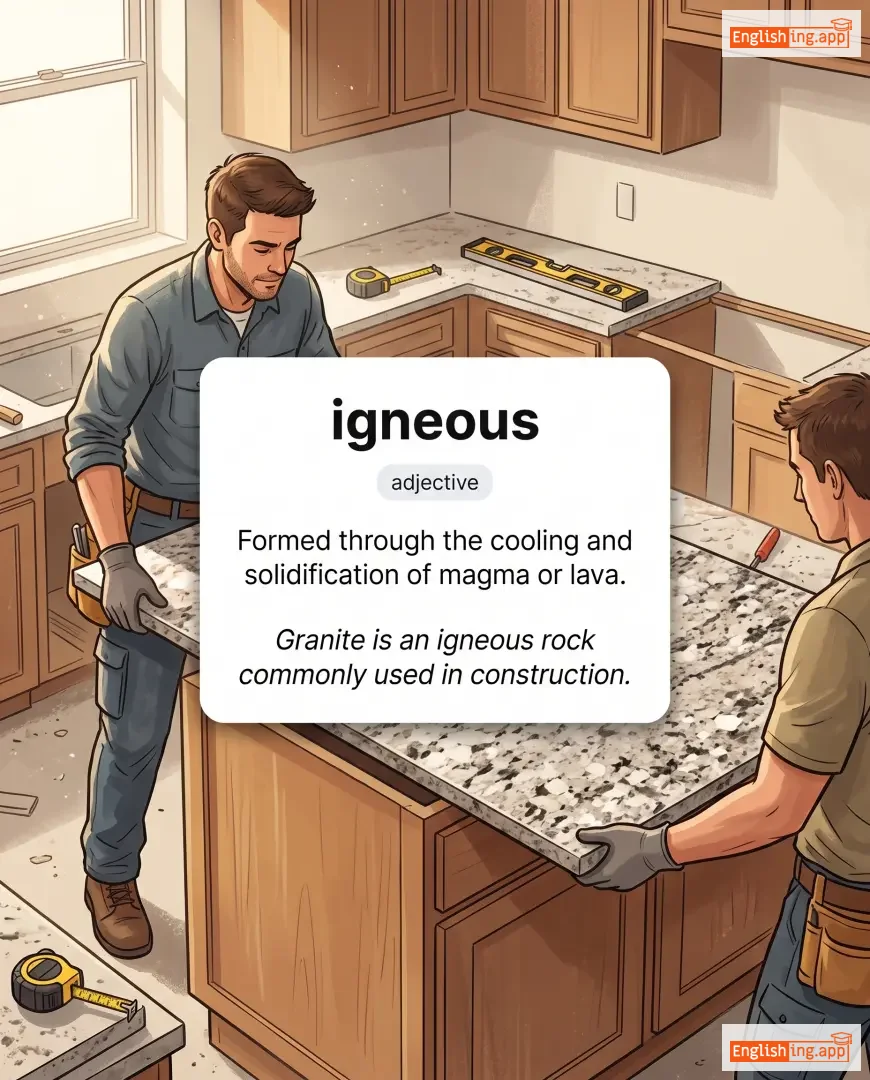
igneous definition card — visual illustration of the meaning
adjective
/ˈɪɡ.ni.əs/
आग्नेय (agneya)

Formed through the cooling and solidification of magma or lava.

"Granite is an igneous rock commonly used in construction."

"ग्रेनाइट एक आग्नेय चट्टान है जिसका उपयोग आमतौर पर निर्माण में किया जाता है।" (Granite ek agneya chattan hai jiska upyog aamtaur par nirmaan mein kiya jaata hai.)
verb
/ɪɡˈnaɪt/
जलाना (jalana)

To catch fire or cause to catch fire; to start or arouse.

"The sparks ignited the dry leaves in seconds."

"चिंगारियों ने कुछ ही सेकंड में सूखे पत्तों में आग लगा दी।" (Chingariyon ne kuch hi second mein sukhe patton mein aag laga di.)
adjective
/ɪɡˈnoʊ.bəl/
नीच (neech)

Dishonorable, shameful, or lacking nobility.

"His ignoble actions ruined his reputation."

"उसके नीच कृत्यों ने उसकी प्रतिष्ठा को नष्ट कर दिया।" (Uske neech krityon ne uski pratishtha ko nasht kar diya.)