वोकैबुलरीज

इंग्लिश वोकैबुलरी डिस्कवर, लर्न और मास्टर करें

verb
/ˈdæb.əl/
संगति से काम करना (sangati se kaam karna)

To take part in an activity in a casual or superficial way.

"He dabbled in painting during his college days."

"उसने कॉलेज के दिनों में पेंटिंग में शौकिया काम किया।" (Usne college ke dino mein painting mein shaukia kaam kiya.)
noun
/dəˈkɔɪt/
डाकू (daaku)

a member of an armed gang of robbers; a bandit, especially in India and Myanmar

"The village was terrorized by a gang of dacoits who robbed travelers."

"गाँव को डाकुओं के एक गिरोह ने आतंकित कर दिया था जिन्होंने यात्रियों को लूटा।" (Gaav ko daakoon ke ek giroh ne aatankit kar diya tha jinhone yatrion ko lootaa.)
noun
/dæd/
पापा (papa)

an informal term for father

"My dad taught me how to ride a bike."

"मेरे पापा ने मुझे साइकिल चलाना सिखाया।" (Mere papa ne mujhe saikil chalana sikhaya.)
noun
/ˈdæf.ə.dɪl/
नरगिस फूल (nargis phool)

A bright yellow spring flower with a trumpet-shaped center, symbolizing rebirth and new beginnings

"The daffodils bloomed early this spring in the meadow."

"इस वसंत में मैदान में नरगिस फूल जल्दी खिले थे।" (is vasant mein maidan mein nargis phool jaldi khile the)
adjective
/dæft/
मूर्ख (moorkh)

Silly or foolish.

"It was a daft idea to go hiking without water."

"पानी के बिना हाइकिंग पर जाना एक मूर्खतापूर्ण विचार था।" (Pani ke bina hiking par jana ek moorkhatapurn vichar tha.)
noun
/ˈdæɡər/
कुंआ (kunaa)

a short knife with a pointed and edged blade, used as a weapon

"The assassin concealed a dagger beneath his cloak."

"हत्यारा अपनी चादर के नीचे एक कुंआ छिपा कर रखा था।" (hatyaara apni chadar ke neeche ek kunaa chhupa kar rakha tha)
noun
/dəˈɡerəˌtaɪp/
प्राचीन फोटोग्राफ (prachin photograph)

An early type of photograph produced on a silver or silver-covered copper plate.

"The museum displayed a rare daguerreotype of Abraham Lincoln."

"संग्रहालय में अब्राहम लिंकन की एक दुर्लभ डेगेरोटाइप प्रदर्शित की गई थी।" (Sangrahalay mein Abraham Lincoln ki ek durlabh daguerreotype pradarshit ki gayi thi.)
noun
/ˈdeɪ.li.ə/
डाहलिया (dahlia)

a garden plant with brightly colored flowers that bloom in summer and autumn

"She planted colorful dahlias in her garden last summer."

"उसने पिछले ग्रीष्मकाल में अपने बग़ीचे में रंगीन डाहलियास लगाए।" (usne pichhle grishmakal mein apne bagiche mein rangin dahlia lagaaye)
adjective/adverb
/ˈdeɪli/
दैनिक (dainik)

happening every day

"She reads the newspaper daily."

"वह हर दिन समाचार पत्र पढ़ती है।" (Wah har din samachar patra padhti hai.)
adjective
/ˈdeɪnti/
नाज़ुक और सुंदर (naazuk aur sundar)

Delicately small, pretty, and often considered elegant.

"She wore a dainty necklace made of pearls."

"उसने मोती से बनी एक सुंदर हार पहना था।" (Usne moti se bani ek sundar haar pehna tha.)
noun
/ˈdɛəri/
डेयरी (dairy)

a place where milk and milk products are produced or sold

"They visited the local dairy for fresh milk."

"वे ताजे दूध के लिए स्थानीय डेयरी में गए थे।" (ve taje doodh ke liye sthaanee dairy mein gaye the.)
noun
/ˈdeɪ.ɪs/ or /ˈdeɪ.əs/
मंच (manch)

A raised platform in a hall or room, usually where speakers or honored guests sit.

"The speaker stood on the dais to address the audience."

"वक्ता ने श्रोताओं को संबोधित करने के लिए मंच पर खड़े होकर भाषण दिया।" (Vakta ne shrotahon ko sambodhit karne ke liye manch par khade hokar bhashan diya.)
noun
/ˈdæliəns/
संक्षिप्त रोमांटिक संबंध (sankshipt romantic sambandh)

A casual romantic or sexual relationship; also frivolous or playful behavior.

"Their dalliance during the summer was brief but intense."

"गर्मी के मौसम में उनका संबंध संक्षिप्त था लेकिन तीव्र था।" (Garmi ke mausam mein unka sambandh sankshipt tha lekin teevra tha.)
verb
/ˈdæli/
आलस्य करना (aalsi karna)

To act or move slowly; to waste time; also to engage in a casual romantic relationship.

"He dallied in the garden instead of starting his work."

"वह अपने काम की शुरुआत करने की बजाय बग़ीचे में समय बर्बाद कर रहा था।" (Wah apne kaam ki shuruat karne ki bajay bageeche mein samay barbaad kar raha tha.)
noun
/dæm/
बांध (bandh)

a barrier built to hold back water and raise its level

"The dam provides electricity to nearby towns."

"डेम नजदीकी शहरों को बिजली प्रदान करता है।" (Dem najdiki shahron ko bijli pradan karta hai.)
verb
/ˈdæmɪdʒ/
नुकसान (nuksan)

To cause physical harm to something.

"The storm damaged several houses in the village."

"तूफान ने गाँव में कई घरों को नुकसान पहुँचाया।" (Toofan ne gaanv mein kai gharon ko nuksan pahunchaya.)
adjective
/ˈdæmɪdʒɪŋ/
हानिकारक (haanikarak)

causing harm or injury

"The storm caused damaging effects to the crops."

"तूफान ने फसलों पर नुकसान पहुँचाने वाले प्रभाव डाले।" (Toofan ne faslon par nuksan pahunchane wale prabhav dale.)
verb
/dæm/
शाप देना / गाली (shaap dena / gaali)

to condemn or criticize strongly; used as an expletive to express anger or emphasis

"He damned the unfair system in his speech."

"उसने अपने भाषण में अन्यायपूर्ण प्रणाली को शाप दिया।" (Usne apne bhashan mein anyayapoorn pranali ko shaap diya.)
noun
/dæmˈneɪ.ʃən/
नर्क में शरण; विनाश (nark mein sharan; vinash)

condemnation to eternal punishment in hell; something that causes ruin or failure

"The preacher spoke about salvation and damnation in his sermon."

"धर्मोपदेशक ने अपने उपदेश में उद्धार और नर्क की सजा के बारे में बात की।" (dharmopadeshak ne apne updesh mein uddhar aur nark ki saza ke baare mein baat ki.)
adjective
/dæmp/
गीला (geela)

slightly wet, often in an unpleasant way

"The room felt cold and damp after the rain."

"कमरा बारिश के बाद ठंडा और गीला महसूस हो रहा था।" (Kamra barish ke baad thanda aur geela mehsoos ho raha tha.)
verb
/ˈdæmpən/
गीला करना, कम करना (geela karna, kam karna)

to make something slightly wet; to make something less strong, active, or intense

"The rain dampened the excitement of the outdoor concert."

"बारिश ने आउटडोर कॉन्सर्ट के उत्साह को कम कर दिया।" (Barish ne outdoor concert ke utsah ko kam kar diya.)
noun
/ˈdæmpər/
वह चीज जो बल, प्रभाव या उत्तेजना को कम करती है (vah cheez jo bal, prabhav ya uttejana ko kam karti hai)

something that reduces or lessens the force, effect, or excitement

"The cancellation of the trip put a damper on their enthusiasm."

"यात्रा के रद्द होने से उनकी उत्साही भावना में कमी आ गई।" (Yatra ke radd hone se unki utsahi bhavna mein kami aa gayi.)
verb/noun
/dæns/
सुख (sukh)

to move rhythmically to music, typically following a set sequence of steps

"They danced all night at the wedding."

"उसे पुरस्कार मिलने पर वह अपनी खुशी को छुपा नहीं पाई।" (Use puraskar milne par vah apni khushi ko chhupa nahi pai.)
noun
/ˈdænsər/
नर्तकी (nartaki)

a person who dances or performs dancing professionally or as a hobby

"The dancer moved gracefully across the stage."

"नर्तकी ने मंच पर gracefully मूव किया।" (nartaki ne manch par gracefully move kiya.)
noun
/ˈdænsɪŋ/
नृत्य (daansing)

the activity of moving the body rhythmically to music

"They spent the evening dancing at the party."

"वे पार्टी में शाम डांस करते हुए बिताते थे" (ve paarti mein shaam daansing karte hue bitate the)
noun
/ˈdæn.drʌf/
रूसी, बालों से गिरने वाली मृत त्वचा की सफेद या ग्रे परतें (khushki, mathar khushki)

small white or grey flakes of dead skin that form on the scalp and fall from the hair

"He used a special shampoo to treat his persistent dandruff problem."

"उसने अपनी स्थायी डैंड्रफ समस्या का इलाज करने के लिए एक विशेष शैम्पू का इस्तेमाल किया।" (Usne apni sthayi dandruff samasya ka ilaaj karne ke liye ek vishesh shampoo ka istemal kiya.)
noun
/ˈdændi/
अत्यधिक फैशन प्रिय पुरुष (atyadhik fashion priya purush)

a man who gives too much attention to his appearance and clothes

"The young dandy spent hours grooming himself before the party."

"युवक डैंडी पार्टी से पहले घंटों खुद को संवारने में बिताता है।" (Yuvak dandy party se pehle ghanton khud ko sanwarne mein bitata hai.)
noun
/ˈdeɪn.dʒər/
खतरा (khatra)

The possibility of harm, injury, or loss.

"The hikers were in great danger during the storm."

"तूफान के दौरान यात्री बड़े खतरे में थे।" (Toofaan ke dauraan yaatri bade khatre mein the.)
adjective
/ˈdeɪndʒərəs/
खतरनाक (khatarnak)

likely to cause harm or injury; unsafe

"Driving fast on icy roads is dangerous."

"बर्फीले रास्तों पर तेज़ गाड़ी चलाना खतरनाक है।" (Barfile raste par tez gadi chalana khatarnak hai.)
adverb
/ˈdeɪndʒərəsli/
खतरनाक तरीके से (khatarnak tareeke se)

in a way that could cause harm or injury; riskily

"He was driving dangerously fast on the highway."

"वह हाईवे पर खतरनाक तरीके से तेज़ चला जा रहा था।" (vah highway par khatarnak tareeke se tez chala ja raha tha)
verb
/ˈdæŋɡəl/
लटकना (latakna)

to hang loosely or swing freely

"The keys dangled from his belt."

"चाबियाँ उसके बेल्ट से लटक रही थीं।" (Chaabiyaan uske belt se latak rahi thiin.)
adjective
/dæŋk/
नम और ठंडा (nam aur thanda)

unpleasantly damp and cold

"The basement was dark and dank, filled with a musty smell."

"बेसमेंट अंधेरा और नम था, जिसमें एक बदबूदार गंध फैली हुई थी।" (Basement andhera aur nam tha, jismein ek badbudar gandh phaili hui thi.)
adjective
/ˈdæpər/
स्मार्ट और परफेक्ट (smart aur perfect)

Neat, stylish, and well-dressed in appearance.

"He looked very dapper in his new suit."

"वह अपनी नई सूट में बहुत स्मार्ट और परफेक्ट लग रहा था।" (Wah apni nai suit mein bahut smart aur perfect lag raha tha.)
adjective
/ˈdæpəld/
धब्बेदार (dhabbedar)

Marked with spots or patches of light and shade or different colors.

"The forest floor was dappled with sunlight."

"जंगल की ज़मीन सूरज की रोशनी से धब्बेदार थी।" (Jangal ki zameen suraj ki roshni se dhabbedar thi.)
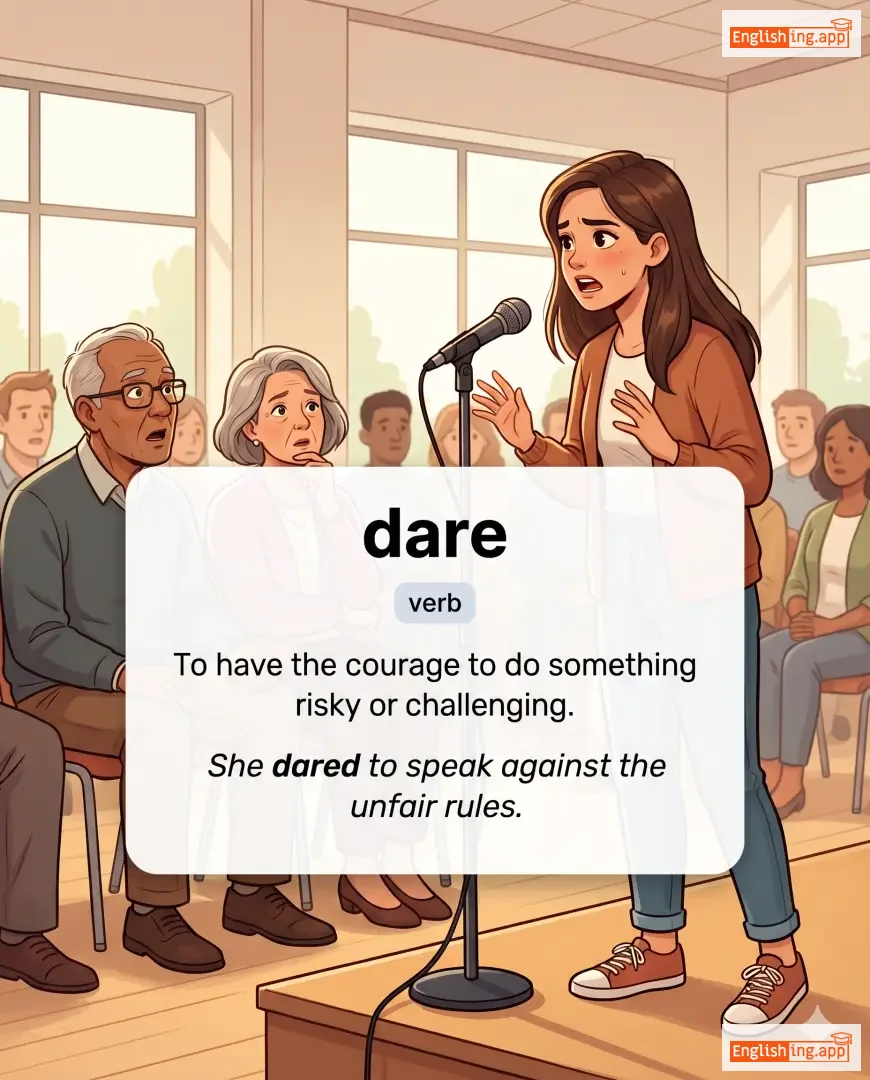
dare definition card — visual illustration of the meaning
verb
/der/
साहस करना (sahas karna)

To have the courage to do something risky or challenging.

"She dared to speak against the unfair rules."

"वह अन्यायपूर्ण नियमों के खिलाफ बोलने का साहस करती थी।" (Woh anyaypurn niyamon ke khilaf bolne ka sahas karti thi.)
noun
/ˈderˌdevəl/
जोखिम लेने वाला व्यक्ति (jokhim lene wala vyakti)

A person who enjoys doing dangerous or risky things.

"The stunt was performed by a famous daredevil."

"स्टंट एक प्रसिद्ध डेयरडेविल द्वारा किया गया था।" (Stunt ek prasiddh daredevil dwara kiya gaya tha.)
adjective
/ˈderɪŋ/
साहसी (sahasi)

Willing to take risks; bold and adventurous.

"Her daring plan surprised everyone."

"उसकी साहसी योजना ने सभी को हैरान कर दिया।" (Uski sahasi yojna ne sabhi ko hairan kar diya.)
adjective
/dɑːrk/
अंधेरा (andhera)

with little or no light; gloomy or mysterious

"The room was dark after the lights went out."

"बत्तियाँ बुझने के बाद कमरा अंधेरा हो गया।" (battiya bujhne ke baad kamra andhera ho gaya.)
adjective
/dɑːrk bluː/
गहरा नीला (gahara neela)

a deep shade of blue color

"She wore a dark blue dress to the party."

"उसने पार्टी में एक गहरा नीला ड्रेस पहनी थी।" (usne party mein ek gahra neela dress pehni thi.)
verb
/ˈdɑːrkən/
अंधेरा करना (andhera karna)

to make or become dark; to reduce brightness or light

"The clouds began to darken the sky before the storm."

"तूफान से पहले बादलों ने आसमान को अंधेरा कर दिया।" (toofan se pehle badlon ne aasmaan ko andhera kar diya)
adverb
/ˈdɑːrklɪŋ/
अंधेरे में (andhere mein)

In the dark or growing dark; dimly.

"The forest creatures moved darkling through the night."

"जंगल के प्राणी रात में अंधेरे में चल रहे थे।" (Jangal ke prani raat mein andhere mein chal rahe the.)
noun
/ˈdɑːrk.nəs/
अंधकार (andhkaar)

The absence of light; the state of being dark.

"The room was filled with darkness after the lights went out."

"कमरे में बत्तियाँ बंद होने के बाद अंधकार छा गया था।" (Kamre mein battiyan band hone ke baad andhkaar chha gaya tha.)
verb, noun
/dɑːrt/
तीर/तेज़ी से दौड़ना (tir/tezī se dauṛnā)

to move suddenly and quickly; a small pointed missile thrown at a target

"The cat darted across the street to avoid the car."

"बिल्ली कार से बचने के लिए सड़क पार करते हुए तेज़ी से दौड़ गई।" (Billī kār se bacnē kē liye sadak pār karte huye tezī se dauṛ gayī.)
noun
/ˈdɑːrwɪnɪzəm/
डार्विनवाद (Darvinvaad)

the theory of biological evolution developed by Charles Darwin, emphasizing natural selection

"Darwinism revolutionized the way scientists understood the origin of species."

"डार्विनवाद ने वैज्ञानिकों के प्रजातियों की उत्पत्ति को समझने के तरीके में क्रांतिकारी बदलाव किया।" (Darwinvaad ne vaigyanikon ke prajatiyon ki utpatti ko samjhne ke tareeke mein krantikari badlav kiya.)
verb
/dæʃ/
तेज़ी से दौड़ना और अचानक कोई चीज़ तोड़ना (tezī se daudnā aur achānak koī chīz ṭoṛnā)

to move quickly and suddenly; to strike or break something violently

"She dashed across the street to catch the bus."

"वह बस पकड़ने के लिए सड़क पार करते हुए तेजी से दौड़ी।" (Vah bas pakadane ke liye sadak paar karte hue tezī se daudī.)
adjective
/ˈdæʃ.ɪŋ/
शानदार; आकर्षक; आत्मविश्वासी; (shandar; aakarshak; aatmavishwasi)

stylish and confident; lively and energetic; attractive and charming

"He looked dashing in his new suit."

"वह अपने नए सूट में शानदार दिख रहे थे।" (vah apne naye suit mein shandar dikh rahe the.)
noun
/ˈdæstərd/
कायर (kayar)

a cowardly or dishonorable person

"Only a dastard would betray his closest friend."

"केवल एक कायर ही अपने सबसे करीबी दोस्त को धोखा देगा।" (Keval ek kayar hi apne sabse kareebi dost ko dhokha dega.)
noun
/ˈdeɪ.tə/ or /ˈdæt.ə/
डेटा (data)

Facts, statistics, or information collected for reference or analysis.

"The scientists analyzed the data to find patterns."

"वैज्ञानिकों ने पैटर्न खोजने के लिए डेटा का विश्लेषण किया।" (Vaigyanikon ne pattern khojne ke liye data ka vishleshan kiya.)
data breach definition card — visual illustration of the meaning
noun
/ˈdeɪ.tə briːtʃ/
डेटा उल्लंघन (data ullanghan)

Unauthorized disclosure of sensitive information through security violation

"A data breach exposed millions of users' passwords."

"एक डेटा उल्लंघन ने लाखों उपयोगकर्ताओं के पासवर्ड्स का खुलासा कर दिया।" (Ek data ullanghan ne lakhon upyogkartao ke passwords ka khulasa kar diya.)
noun
/ˈdeɪtəbeɪs/
डेटाबेस (database)

a structured collection of data stored and accessed electronically

"The company's customer details are stored in a secure database."

"कंपनी के ग्राहक विवरण एक सुरक्षित डेटाबेस में संग्रहीत हैं।" (Kampani ke grahak vivaran ek surakshit database mein sangrahit hain.)