語彙集

英単語辞書 | 単語の意味、定義、例文

verb
/ˈdæb.əl/
軽く取り組む (karuku torikumu)

To take part in an activity in a casual or superficial way.

"He dabbled in painting during his college days."

"彼は大学時代に絵を描くことを楽しんでいた。" (Kare wa daigaku jidai ni e o kaku koto o tanoshinde ita.)
noun
/dəˈkɔɪt/
盗賊 (tōzoku)

a member of an armed gang of robbers; a bandit, especially in India and Myanmar

"The village was terrorized by a gang of dacoits who robbed travelers."

"その村は、旅行者を強盗した強盗団によって恐怖に陥れられました。" (Sono mura wa, ryokōsha o gōtō shita gōtōdan ni yotte kyōfu ni ochirerarimashita.)
noun
/dæd/
お父さん (otōsan)

an informal term for father

"My dad taught me how to ride a bike."

"私のお父さんは自転車の乗り方を教えてくれました。" (Watashi no otōsan wa jitensha no norikata o oshiete kuremashita.)
noun
/ˈdæf.ə.dɪl/
スイセン (suisen)

A bright yellow spring flower with a trumpet-shaped center, symbolizing rebirth and new beginnings

"The daffodils bloomed early this spring in the meadow."

"この春、スイセンは草原で早く咲きました。" (Kono haru, suisen wa sōgen de hayaku sakimashita.)
adjective
/dæft/
ばか (baka)

Silly or foolish.

"It was a daft idea to go hiking without water."

"水なしでハイキングに行くのはばかげた考えでした。" (Mizu nashi de haikingu ni iku no wa bakageta kangae deshita.)
noun
/ˈdæɡər/
短剣 (tanken)

a short knife with a pointed and edged blade, used as a weapon

"The assassin concealed a dagger beneath his cloak."

"暗殺者はマントの下に短剣を隠していた。" (ansatsusha wa mantō no shita ni tanken wo kakushite ita)
noun
/dəˈɡerəˌtaɪp/
古い写真 (furui shashin)

An early type of photograph produced on a silver or silver-covered copper plate.

"The museum displayed a rare daguerreotype of Abraham Lincoln."

"博物館にはアブラハム・リンカーンの珍しいダゲレオタイプが展示されていました。" (Hakubutsukan ni wa Aburahamu Rinkān no mezurashī dagereotai-pu ga tenji sarete imashita.)
noun
/ˈdeɪ.li.ə/
ダリア (daria)

a garden plant with brightly colored flowers that bloom in summer and autumn

"She planted colorful dahlias in her garden last summer."

"彼女は昨年の夏に庭にカラフルなダリアを植えました。" (Kanojo wa sakunen no natsu ni niwa ni karafuru na dahlia o uemashita.)
adjective/adverb
/ˈdeɪli/
毎日の (mainichi no)

happening every day

"She reads the newspaper daily."

"彼女は毎日新聞を読んでいます。" (Kanojo wa mainichi shinbun o yondeimasu.)
adjective
/ˈdeɪnti/
優雅で可愛らしい (yūga de kawairashii)

Delicately small, pretty, and often considered elegant.

"She wore a dainty necklace made of pearls."

"彼女は真珠でできた繊細なネックレスをしていました。" (Kanojo wa shinju de dekita sensai na nekkuresu o shiteimashita.)
noun
/ˈdɛəri/
乳製品工場 (nyūseihin kōjō)

a place where milk and milk products are produced or sold

"They visited the local dairy for fresh milk."

"彼らは新鮮な牛乳を求めて地元の乳製品工場を訪れました。" (Karera wa shinsen na gyūnyū o motomete jimoto no nyūseihin kōjō o otozuremashita.)
noun
/ˈdeɪ.ɪs/ or /ˈdeɪ.əs/
舞台 (butai)

A raised platform in a hall or room, usually where speakers or honored guests sit.

"The speaker stood on the dais to address the audience."

"スピーカーは観客に話すために舞台に立ちました。" (Su-pee-kaa wa kankyaku ni hanasu tame ni butai ni tachimashita.)
noun
/ˈdæliəns/
束の間のロマンチックな関係 (tsukino-ma no romanchikku na kankei)

A casual romantic or sexual relationship; also frivolous or playful behavior.

"Their dalliance during the summer was brief but intense."

"夏の間の彼らの関係は短かったが、強烈だった。" (Natsu no aida no karera no kankei wa mijikakatta ga, kyōretsu datta.)
verb
/ˈdæli/
無駄にする (mudan suru)

To act or move slowly; to waste time; also to engage in a casual romantic relationship.

"He dallied in the garden instead of starting his work."

"彼は仕事を始める代わりに庭で時間を無駄にしていました。" (Kare wa shigoto o hajimeru kawari ni niwa de jikan o mudani shite imashita.)
noun
/dæm/
ダム (damu)

a barrier built to hold back water and raise its level

"The dam provides electricity to nearby towns."

"ダムは近隣の町に電力を供給しています。" (Damu wa kinrin no machi ni denryoku o kyōkyū shiteimasu.)
verb
/ˈdæmɪdʒ/
損害 (sonnai)

To cause physical harm to something.

"The storm damaged several houses in the village."

"嵐が村のいくつかの家を壊しました。" (Arashi ga mura no ikutsu ka no ie wo kowashimashita.)
adjective
/ˈdæmɪdʒɪŋ/

causing harm or injury

"The storm caused damaging effects to the crops."

😡

damn

verb
/dæm/

to condemn or criticize strongly; used as an expletive to express anger or emphasis

"He damned the unfair system in his speech."

noun
/dæmˈneɪ.ʃən/
永遠の罰; 破滅 (eien no batsu; hametsu)

condemnation to eternal punishment in hell; something that causes ruin or failure

"The preacher spoke about salvation and damnation in his sermon."

"説教者はその説教で救いと永遠の罰について話しました。" (Sekkyousha wa sono sekkyou de suki to eien no batsu ni tsuite hanashimashita.)
adjective
/dæmp/
湿った (shimetta)

slightly wet, often in an unpleasant way

"The room felt cold and damp after the rain."

"雨の後、部屋は冷たくて湿っていると感じました。" (Ame no ato, heya wa tsumetakute shimette iru to kanjimashita.)
verb
/ˈdæmpən/
湿らせる, 和らげる (shimerareru, yawarageru)

to make something slightly wet; to make something less strong, active, or intense

"The rain dampened the excitement of the outdoor concert."

"雨が屋外コンサートの興奮を和らげました。" (Ame ga okugai konsāto no kōfun o yawaragemashita.)
noun
/ˈdæmpər/
力、効果、または興奮を減少または抑制するもの (chikara, kōka, matawa kōfun o genshō matawa yokusei suru mono)

something that reduces or lessens the force, effect, or excitement

"The cancellation of the trip put a damper on their enthusiasm."

"旅行のキャンセルは彼らの熱意をそぐことになった。" (Ryokō no kyanseru wa karera no netsui o sogu koto ni natta.)
verb/noun
/dæns/
幸福 (kōfuku)

to move rhythmically to music, typically following a set sequence of steps

"They danced all night at the wedding."

"彼女は賞を受け取ったとき、幸せを隠すことができませんでした。" (Kanojo wa shō o uketotta toki, kōfuku o kakusu koto ga dekimasen deshita.)
noun
/ˈdænsər/
ダンサー (dansā)

a person who dances or performs dancing professionally or as a hobby

"The dancer moved gracefully across the stage."

"ダンサーは舞台を優雅に動きました。" (Dansā wa butai o yūga ni ugokimashita.)
noun
/ˈdænsɪŋ/

the activity of moving the body rhythmically to music

"They spent the evening dancing at the party."

noun
/ˈdæn.drʌf/
フケ (dandorafu)

small white or grey flakes of dead skin that form on the scalp and fall from the hair

"He used a special shampoo to treat his persistent dandruff problem."

"彼は慢性的なフケの問題を治すために、特別なシャンプーを使った。" (kare wa manseitekina fuke no mondai o naosu tame ni tokubetsu na shanpuu o tsukatta)
noun
/ˈdændi/
外見と服装に過剰に気を使う男性 (gaiken to fukusou ni kajou ni ki wo tsukau dansei)

a man who gives too much attention to his appearance and clothes

"The young dandy spent hours grooming himself before the party."

"若いダンディはパーティーの前に何時間も自分を整えるのに費やした。" (Wakai dandy wa pātī no mae ni nan-jikan mo jibun wo totonoeru noni費やした。)
noun
/ˈdeɪn.dʒər/
危険 (kiken)

The possibility of harm, injury, or loss.

"The hikers were in great danger during the storm."

"登山者は嵐の中で大きな危険にさらされていました。" (Tozan-sha wa arashi no naka de ookina kiken ni sarasarete imashita.)
adjective
/ˈdeɪndʒərəs/
危険 (kiken)

likely to cause harm or injury; unsafe

"Driving fast on icy roads is dangerous."

"氷の道路で速く運転するのは危険です。" (Kōri no dōro de hayaku unten suru no wa kiken desu.)
adverb
/ˈdeɪndʒərəsli/
危険に (kiken ni)

in a way that could cause harm or injury; riskily

"He was driving dangerously fast on the highway."

"彼は高速道路で危険に速く運転していた。" (kare wa kousoku douro de kiken ni hayaku unten shite ita)
verb
/ˈdæŋɡəl/
ぶら下がる (burasagaru)

to hang loosely or swing freely

"The keys dangled from his belt."

"鍵がベルトからぶら下がっていました。" (Kagi ga beruto kara burasagatte imashita.)
adjective
/dæŋk/
湿っていて寒い (shittete ite samui)

unpleasantly damp and cold

"The basement was dark and dank, filled with a musty smell."

"地下室は暗くて湿っていて、悪臭が充満していました。" (Chikashitsu wa kurakute shittete ite, akushū ga jūman shite imashita.)
adjective
/ˈdæpər/
おしゃれで清潔 (oshare de seiketsu)

Neat, stylish, and well-dressed in appearance.

"He looked very dapper in his new suit."

"彼は新しいスーツでとてもおしゃれに見えた。" (Kare wa atarashī sūtsu de totemo oshare ni mieta.)
adjective
/ˈdæpəld/
斑点模様 (hanten moyou)

Marked with spots or patches of light and shade or different colors.

"The forest floor was dappled with sunlight."

"森の地面は日光で斑点模様ができていた。" (Mori no jimen wa nikkou de hanten moyou ga dekite ita.)
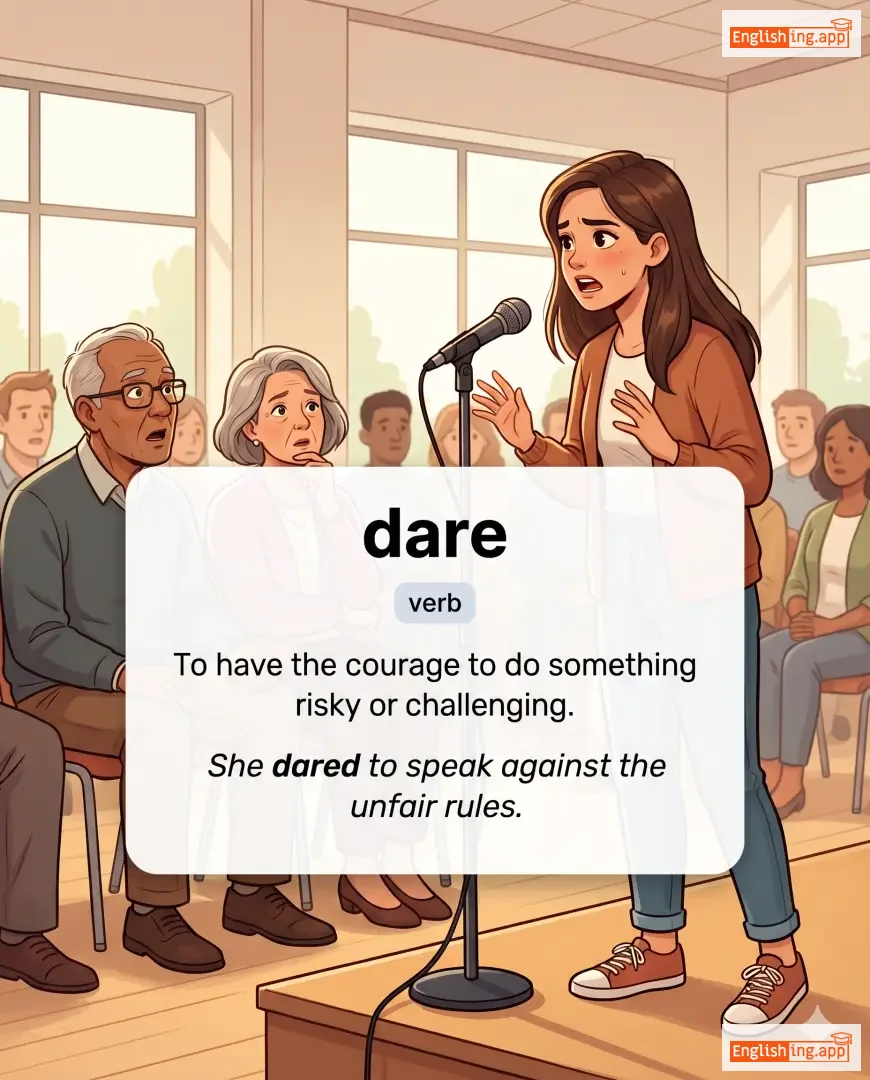
dare definition card — visual illustration of the meaning
verb
/der/
挑戦する (chōsen suru)

To have the courage to do something risky or challenging.

"She dared to speak against the unfair rules."

"彼女は不公平なルールに反対する勇気を持って話しました。" (Kanojo wa fukōhei na rūru ni hantai suru yūki o motte hanashimashita.)
noun
/ˈderˌdevəl/
危険を冒す人 (kiken o okasu hito)

A person who enjoys doing dangerous or risky things.

"The stunt was performed by a famous daredevil."

"そのスタントは有名なデアデビルによって行われました。" (Sono sutanto wa yūmei na deadebiru ni yotte okonawaremashita.)
adjective
/ˈderɪŋ/
大胆 (daitan)

Willing to take risks; bold and adventurous.

"Her daring plan surprised everyone."

"彼女の大胆な計画は皆を驚かせた。" (Kanojo no daitan na keikaku wa mina o odorokaseta.)
adjective
/dɑːrk/
暗い (kurai)

with little or no light; gloomy or mysterious

"The room was dark after the lights went out."

"電気が消えた後、部屋は暗くなった。" (denki ga kieta ato, heya wa kuraku natta.)
adjective
/dɑːrk bluː/
ダークブルー (daakuburuu)

a deep shade of blue color

"She wore a dark blue dress to the party."

"彼女はパーティーにダークブルーのドレスを着て行った。" (Kanojo wa paatii ni daakuburuu no doresu o kite itta.)
verb
/ˈdɑːrkən/
暗くする (kuraku suru)

to make or become dark; to reduce brightness or light

"The clouds began to darken the sky before the storm."

"嵐の前に雲が空を暗くし始めた。" (arashi no mae ni kumo ga sora o kuraku shi hajimeta)
adverb
/ˈdɑːrklɪŋ/
暗闇の中で (kurayami no naka de)

In the dark or growing dark; dimly.

"The forest creatures moved darkling through the night."

"森の生き物は夜に暗闇の中で動いていた。" (Mori no ikimono wa yoru ni kurayami no naka de ugoite ita.)
noun
/ˈdɑːrk.nəs/
暗闇 (kurayami)

The absence of light; the state of being dark.

"The room was filled with darkness after the lights went out."

"ライトが消えると部屋は暗闇に包まれた。" (Raito ga kieru to heya wa kurayami ni tsutsumareta.)
verb, noun
/dɑːrt/
ダート/急に走る (dāto/kyū ni hashiru)

to move suddenly and quickly; a small pointed missile thrown at a target

"The cat darted across the street to avoid the car."

"猫は車を避けるために急いで道路を横切りました。" (Neko wa kuruma o yokeru tame ni isoi de dōro o yokogirimashita.)
noun
/ˈdɑːrwɪnɪzəm/
ダーウィニズム (Dāwinizumu)

the theory of biological evolution developed by Charles Darwin, emphasizing natural selection

"Darwinism revolutionized the way scientists understood the origin of species."

"ダーウィニズムは科学者たちが種の起源を理解する方法を革命的に変えました。" (Dāwinizumu wa kagakusha-tachi ga shuno kigen o rikai suru hōhō o kakumei-teki ni kaemashita.)
💨

dash

verb
/dæʃ/

to move quickly and suddenly; to strike or break something violently

"She dashed across the street to catch the bus."

adjective
/ˈdæʃ.ɪŋ/
魅力的; スタイリッシュ; 自信に満ちた; (miryokuteki; sutairisshu; jishin ni michita)

stylish and confident; lively and energetic; attractive and charming

"He looked dashing in his new suit."

"彼は新しいスーツで魅力的に見えました。" (Kare wa atarashii suutsu de miryokuteki ni miemashita.)
noun
/ˈdæstərd/
卑怯者 (hikyou-sha)

a cowardly or dishonorable person

"Only a dastard would betray his closest friend."

"裏切るのは卑怯者だけだ。" (Urigiru no wa hikyou-sha dake da.)
noun
/ˈdeɪ.tə/ or /ˈdæt.ə/
データ (deta)

Facts, statistics, or information collected for reference or analysis.

"The scientists analyzed the data to find patterns."

"科学者たちはパターンを見つけるためにデータを分析しました。" (Kagakusha-tachi wa patān o mitsukeru tame ni dēta o bunseki shimashita.)
data breach definition card — visual illustration of the meaning
noun
/ˈdeɪ.tə briːtʃ/
データ漏洩 (dēta rōei)

Unauthorized disclosure of sensitive information through security violation

"A data breach exposed millions of users' passwords."

"データ漏洩により何百万人ものユーザーのパスワードが公開されました。" (Dēta rōei ni yori nanbyakumannin mo no yūzā no pasuwādo ga kōkai saremashita.)
noun
/ˈdeɪtəbeɪs/
データベース (dētābēsu)

a structured collection of data stored and accessed electronically

"The company's customer details are stored in a secure database."

"会社の顧客情報は安全なデータベースに保存されています。" (Kaisha no kokyaku jōhō wa anzen na dētābēsu ni hozon sareteimasu.)