語彙集

英単語辞書 | 単語の意味、定義、例文

noun
/səˈbætɪkəl/
学習や旅行のための休暇 (gakushuu ya ryokou no tame no kyuuka)

A period of paid leave granted to a teacher or worker for study or travel, traditionally every seventh year.

"She took a sabbatical to research her new book."

"彼女は新しい本を研究するためにサバティカルを取った。" (Kanojo wa atarashī hon o kenkyū suru tame ni sabatikaru o totta.)
verb
/ˈsæbətɑːʒ/
破壊活動 (hakai katsudou)

To deliberately destroy, damage, or obstruct something, especially for political or military advantage.

"The rebels tried to sabotage the railway lines."

"反乱者たちは鉄道の線路をサボタージュしようとした。" (Hanransha-tachi wa tetsudou no senro o sabotāju shiyou to shita.)
noun
/ˌsæbəˈtɜːr/
破壊工作員 (hakai kōsakuin)

A person who engages in sabotage.

"The saboteur was arrested before he could plant the bomb."

"破壊工作員は爆弾を設置する前に逮捕されました。" (Hakai kōsakuin wa bakudan o secchi suru mae ni taiho saremashita.)
adjective
/ˈsækərɪn/
幸せ (shiawase)

Excessively sweet or sentimental.

"His saccharine smile seemed insincere."

"彼女は賞を受け取ったとき、自分の幸せを隠せなかった。" (Kanojo wa shō o uketotta toki, jibun no shiawase o kakusenakatta.)
adjective
/ˌsæsərˈdoʊtl/
神職に関する (shinshoku ni kansuru)

Relating to priests or the priesthood.

"The ritual had a distinctly sacerdotal character."

"その儀式には明確な神職に関する特徴がありました。" (Sono gishiki ni wa meikaku na shinshoku ni kansuru tokuchō ga arimashita.)
noun
/sæk/
(fukuro)

a large bag made of strong material for holding things

"He carried a sack of rice on his shoulder."

"彼は肩に米の袋を持っていました。" (Kare wa kata ni kome no fukuro wo motteimashita.)
adjective
/ˈseɪkrɪd/
神聖な (shinsei na)

connected with God or a religion and considered holy or deserving respect

"The temple is a sacred place for the community."

"その寺院は地域社会にとって神聖な場所です。" (Sono jiin wa chiikishakai ni totte shinsei na basho desu.)
sacrifice definition card — visual illustration of the meaning
🕯️

sacrifice

noun, verb
/ˈsækrɪfaɪs/

To give up something valuable for the sake of others or a higher purpose.

"Parents often sacrifice their own comfort for their children."

adjective
/ˌsækrɪˈfɪʃəl/
犠牲的な (giseiteki na)

Relating to or involving sacrifice.

"The lamb was used as a sacrificial offering in the ritual."

"その羊は儀式で犠牲的な捧げ物として使われました。" (Sono hitsuji wa gishiki de giseiteki na sasagemono toshite tsukawaremashita.)
noun
/ˈsækrɪlɪdʒ/
冒涜 (bōtoku)

Violation or misuse of what is regarded as sacred.

"Stealing from the temple was considered an act of sacrilege."

"寺院から盗むことは冒涜と見なされていました。" (jiin kara nusumu koto wa bōtoku to minasarete imashita.)
adjective
/ˌsækrəˈlɪdʒəs/
冒涜的 (bōtoku teki)

Showing disrespect or irreverence toward something sacred.

"The painting was criticized as being sacrilegious."

"その絵画は冒涜的だと批判されました。" (sono kaiga wa bōtoku teki da to hihan saremashita.)
noun
/ˈsækrɪsti/
サクリスティ (sakurisuti)

a room in a church where sacred vessels and vestments are kept

"The priest entered the sacristy before the mass began."

"司祭はミサが始まる前にサクリスティに入った。" (Shisai wa misa ga hajimaru mae ni sakurisuti ni haitta.)
adjective
/ˈsæk.rəˌsæŋkt/
神聖不可侵 (shinsei fukashin)

Regarded as too important or valuable to be interfered with; sacred.

"Freedom of speech is considered sacrosanct in democratic societies."

"言論の自由は民主主義社会では神聖不可侵と見なされています。" (Genron no jiyuu wa minshushugi shakai dewa shinsei fukashin to minasareteimasu.)
adjective
/sæd/
悲しい (kanashii)

feeling or showing sorrow; unhappy

"She felt sad after hearing the bad news."

"悪いニュースを聞いて、彼女は悲しい気持ちになった。" (Warui nyūsu wo kiite, kanojo wa kanashii kimochi ni natta.)
noun/verb
/ˈsæd.əl/
馬の鞍; 誰かに責任を負わせる (uma no kura; dareka ni sekinin wo owaseru)

A seat fastened on the back of a horse for riding; to burden someone with a responsibility.

"He saddled the horse before going for a ride."

"彼は乗馬の前に馬にサドルをつけた。" (Kare wa jōba no mae ni uma ni saddoru wo tsuketa.)
adjective
/səˈdɪs.tɪk/
サディスティック (sadesutikku)

Deriving pleasure from inflicting pain or suffering on others.

"The villain had a sadistic smile while hurting his enemies."

"悪党は敵に痛みを与えている間、サディスティックな笑顔を浮かべていた。" (Akutō wa teki ni itami o ataete iru aida, sadesutikku na egao o ukabete ita.)
adverb
/ˈsædli/
悲しそうに (kanashisou ni)

in a sorrowful or unhappy manner

"She sadly waved goodbye as the train departed."

"彼女は電車が出発するとき、悲しそうに手を振った。" (Kanojo wa densha ga shuppatsu suru toki, kanashisou ni te o futta.)
noun
/ˈsæd.nəs/
悲しみ、哀しみ、痛み (kanashimi, kanashimi, itami)

feeling of sorrow, unhappiness, or grief

"Her sadness was evident after hearing the bad news."

"悪いニュースを聞いた後、彼女の悲しみは明らかでした。" (Warui nyūsu o kiita ato, kanojo no kanashimi wa akiraka deshita.)
adjective
/seɪf/
安全 (anzen)

free from harm or danger

"Make sure your belongings are safe during the trip."

"旅行中にあなたの持ち物が安全であることを確認してください。" (Ryokō-chū ni anata no mochimono ga anzen de aru koto o kakunin shite kudasai.)
noun/verb
/ˈseɪf.ɡɑːrd/
守る (mamoru)

To protect from harm or damage; a measure taken to ensure safety.

"Laws exist to safeguard the rights of children."

"法律は子供たちの権利を守るために存在します。" (Hōritsu wa kodomotachi no kenri o mamoru tame ni sonzai shimasu.)
adverb
/ˈseɪfli/
安全に (anzen ni)

in a way that is not dangerous or likely to cause harm

"The children crossed the road safely."

"子供たちは安全に道路を渡りました。" (Kodomotachi wa anzen ni dōro o watarimashita.)
noun
/ˈseɪfti/

the condition of being protected from harm or danger

"The safety of passengers is our top priority."

noun
/ˈsæf.rən/
サフラン (safuran)

A spice derived from the flower of Crocus sativus, used for flavoring and coloring food.

"She added saffron to the rice for flavor and color."

"彼女は味と色のためにご飯にサフランを加えました。" (Kanojo wa aji to iro no tame ni gohan ni safuran o kuwaemashita.)
noun
/ˈsɑːɡə/
長い物語 (nagai monogatari)

A long story of heroic achievement, or a long, complex series of events.

"The company's rise and fall became a corporate saga."

"会社の興隆と衰退は企業のサガとなった。" (Kaisha no kōryū to suitai wa kigyō no saga to natta.)
sagacious definition card — visual illustration of the meaning
adjective
/səˈɡeɪʃəs/
賢明な (kenmei na)

Having or showing keen mental discernment and good judgment; wise.

"The sagacious leader guided the team through difficult times."

"賢明なリーダーは困難な時期をチームと共に乗り越えました。" (Kenmei na rīdā wa konnan na jiki o chīmu to tomoni norikoemashita.)
sagacity definition card — visual illustration of the meaning
noun
/səˈɡæs.ə.t̬i/
深い知恵 (fukai chie)

The quality of being sagacious; having or showing keen mental discernment and good judgment.

"His sagacity made him a great leader."

"彼のサガシティは彼を偉大なリーダーにしました。" (Kare no sagasiti wa kare o idaina rīdā ni shimashita.)
Sage definition card — visual illustration of the meaning
noun
/seɪdʒ/
賢者 (kenja)

A profoundly wise person, or wise through reflection and experience.

"The old sage was respected for his wisdom."

"その古い賢者はその知恵で尊敬されていました。" (Sono furui kenja wa sono chie de sonkei sarete imashita.)
noun
/ˈseɪ.ɡoʊ/
サゴ (sago)

starchy foodstuff obtained from the pith of various tropical palm stems

"She prepared sago pudding for dessert."

"彼女はデザートにサゴプディングを準備しました。" (Kanojo wa dezato ni sago pudding wo junbi shimashita.)
verb
/seɪl/
帆を使って旅行する (ho wo tsukatte ryokou suru)

to travel on water in a boat or ship using sails or by wind power

"They sailed across the Atlantic Ocean last summer."

"彼らは昨年の夏、アトランティックオーシャンを渡りました。" (Karera wa sakunen no natsu, Atorantikku Ōshan wo watarimashita.)
noun, verb
/ˈseɪ.lɪŋ/
帆走 (hansou)

The act of traveling in a boat or ship using sails; the sport or activity of navigating a boat with sails.

"We went sailing on the lake during the summer."

"私たちは夏に湖で帆走をしました。" (Watashitachi wa natsu ni mizuumi de hansou wo shimashita)
noun
/ˈseɪ.lər/
船員 (sen'in)

a person who works on a ship or boat; a member of a navy

"The experienced sailor navigated the ship through the storm."

"経験豊富な船員が嵐を乗り越えて船を操縦した。" (Keiken hōfu na sen'in ga arashi o norikoete fune o sōjū shita.)
noun
/seɪnt/
聖人 (seijin)

a person recognized for their holiness or virtue, often canonized in the Christian faith

"The saint was revered by the community for his acts of kindness."

"その聖人はコミュニティによってその優しさと親切な行為で尊敬されていました。" (Sono seijin wa komyuniti ni yotte sono yasashisa to shinsetsu na koui de sonkei sarete imashita.)
noun
/seɪk/
ため (tame)

for the purpose or reason of something

"He did it for the sake of his family."

"彼は家族のためにそれをしました。" (Kare wa kazoku no tame ni sore o shimashita.)
salacious definition card — visual illustration of the meaning
adjective
/səˈleɪʃəs/
わいせつな (waisetsu na)

Having or conveying undue or inappropriate sexual interest.

"The tabloid published a salacious story about the celebrity."

"タブロイドはそのセレブに関するわいせつな話を公開した。" (Taburoido wa sono serebu ni kansuru waisetsu na hanashi o kōkai shita.)
noun
/ˈsæləd/
サラダ (sarada)

a dish consisting of various ingredients, typically including vegetables, which are usually mixed with a dressing

"She made a fresh salad with lettuce, tomatoes, and cucumbers."

"彼女はレタス、トマト、きゅうりを使って新鮮なサラダを作りました。" (Kanojo wa retasu, tomato, kyūri o tsukatte shinsen na sarada o tsukurimashita.)
noun
/ˈsæləri/
給料 (kyūryō)

a fixed regular payment, typically paid monthly or annually, made by an employer to an employee

"He receives a monthly salary for his work as a teacher."

"彼は教師として働くための月給を受け取っています。" (Kare wa kyōshi toshite hataraku tame no gekkyū o uketotte imasu.)
noun
/seɪl/
販売 (hanbai)

the exchange of a commodity for money; the action of selling something

"The store is having a sale on winter clothing."

"その店は冬物衣料のセールを行っています。" (Sono mise wa fuyu-mono iryō no sēru o okonatteimasu.)
📊

sales

noun
/seɪlz/

activities related to selling products or services

"The company saw a significant increase in sales during the holiday season."

noun
/ˈseɪ.li.əns/
顕著性 (kenchosei)

The quality of being particularly noticeable or important; prominence.

"The salience of the issue was highlighted in the debate."

"その問題の顕著性は討論で強調されました。" (Sono mondai no kenchosei wa tōron de kyōchō saremashita.)
salient definition card — visual illustration of the meaning
adjective
/ˈseɪ.li.ənt/
顕著な特徴 (kenchona tokuchou)

Most noticeable or important; standing out prominently.

"The most salient feature of the report was its emphasis on sustainability."

"報告書で最も顕著な特徴は、持続可能性に重点を置いたことでした。" (Houkokusho de mottomo kenchona tokuchou wa, jizoku kanousei ni juuten wo oita koto deshita.)
adjective
/ˈseɪ.liːn/
生理食塩水 (seirishien-sui)

Containing or resembling salt; salty.

"Doctors often use saline solution to clean wounds."
"医師は傷をきれいにするために生理食塩水をよく使用します。" (Ishi wa kizu o kirei ni suru tame ni seirishien-sui o yoku shiyou shimasu.)
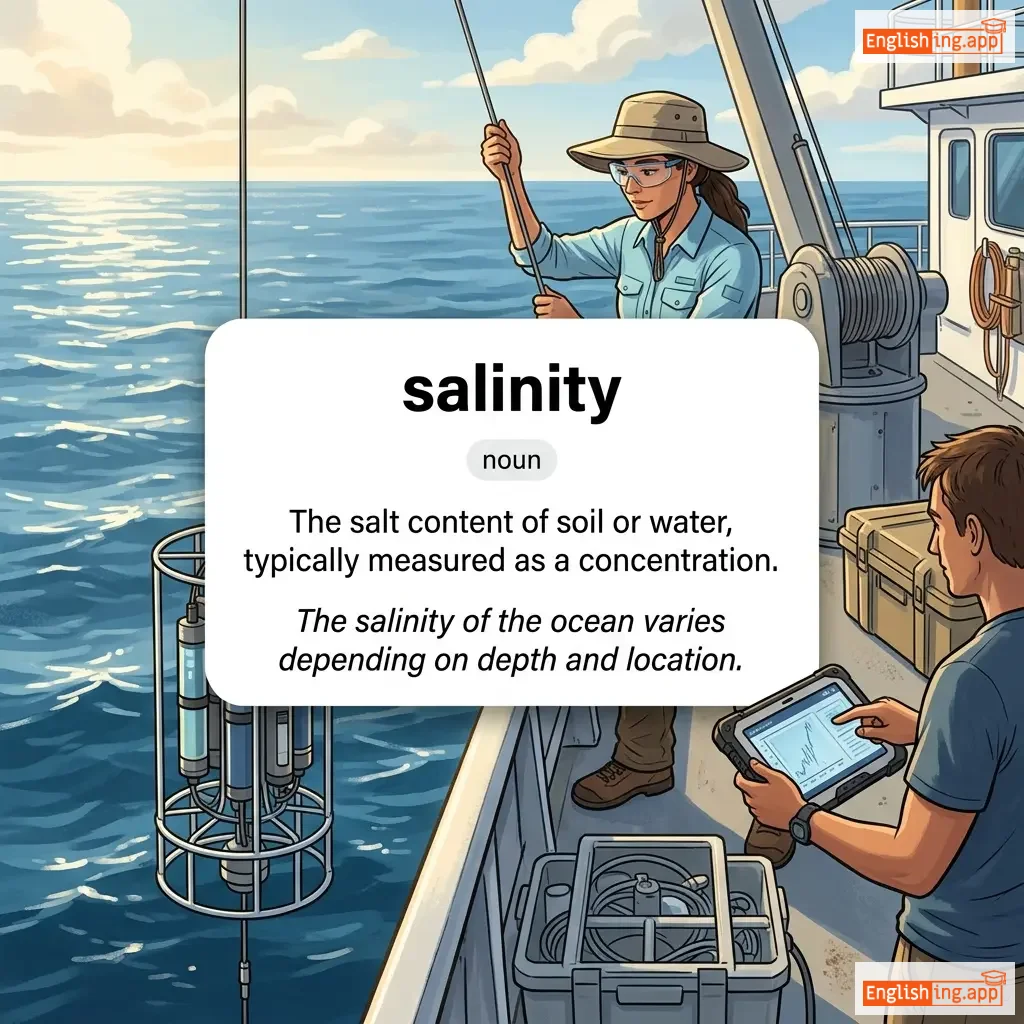
salinity definition card — visual illustration of the meaning
noun
/səˈlɪn.ə.t̬i/
塩分, 塩濃度 (enbun, en nōdo)

The salt content of soil or water, typically measured as a concentration.

"The salinity of the ocean varies depending on depth and location."
"海洋の塩分は深さと場所によって異なります。" (Kaiyō no enbun wa fukasa to basho ni yotte kotonarimasu.)
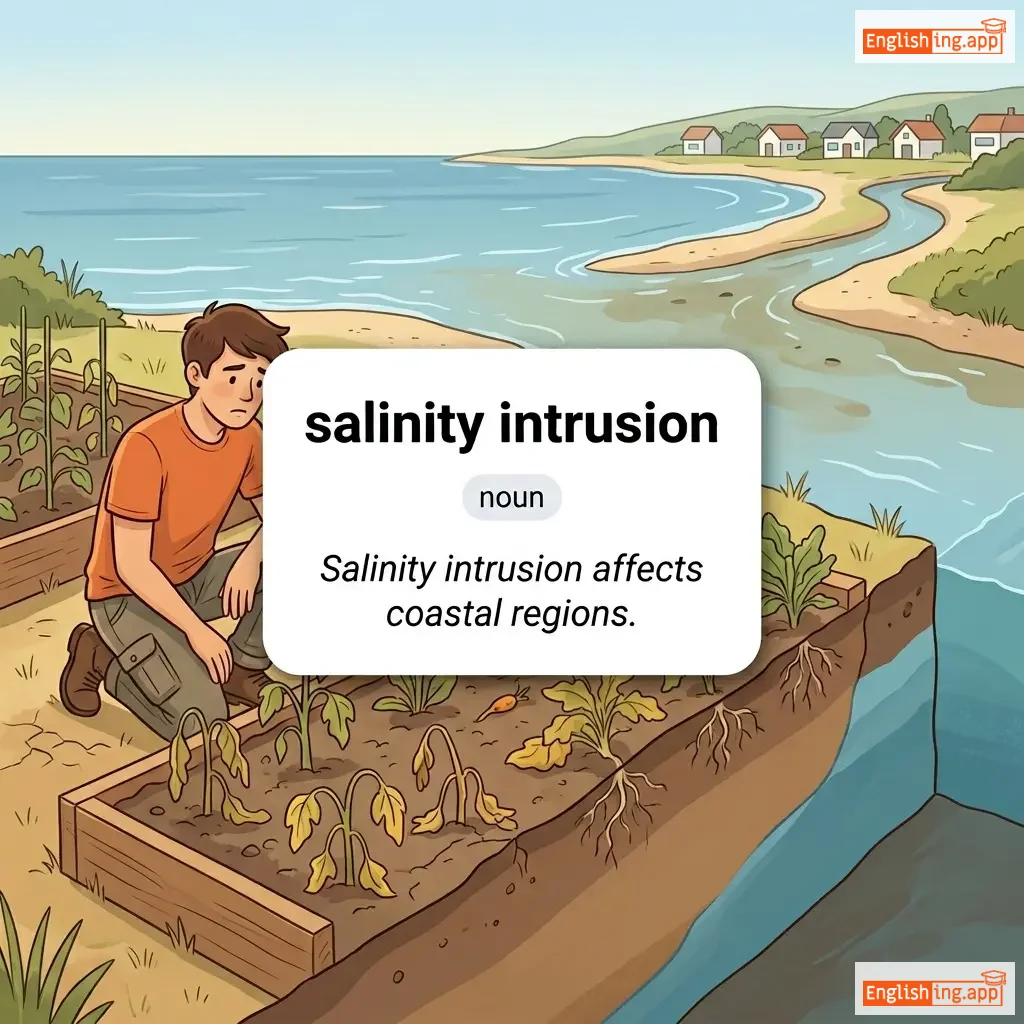
salinity intrusion definition card — visual illustration of the meaning
noun
səˈlɪnɪti ɪnˈtruːʒən
塩分侵入 (enbun shin'nyū)

The movement of salt water into freshwater areas, typically affecting coastal regions.

"Salinity intrusion affects coastal regions."
"塩分侵入は沿岸地域に影響を与える。" (Enbun shin'nyū wa engan chiiki ni eikyō o ataeru.)
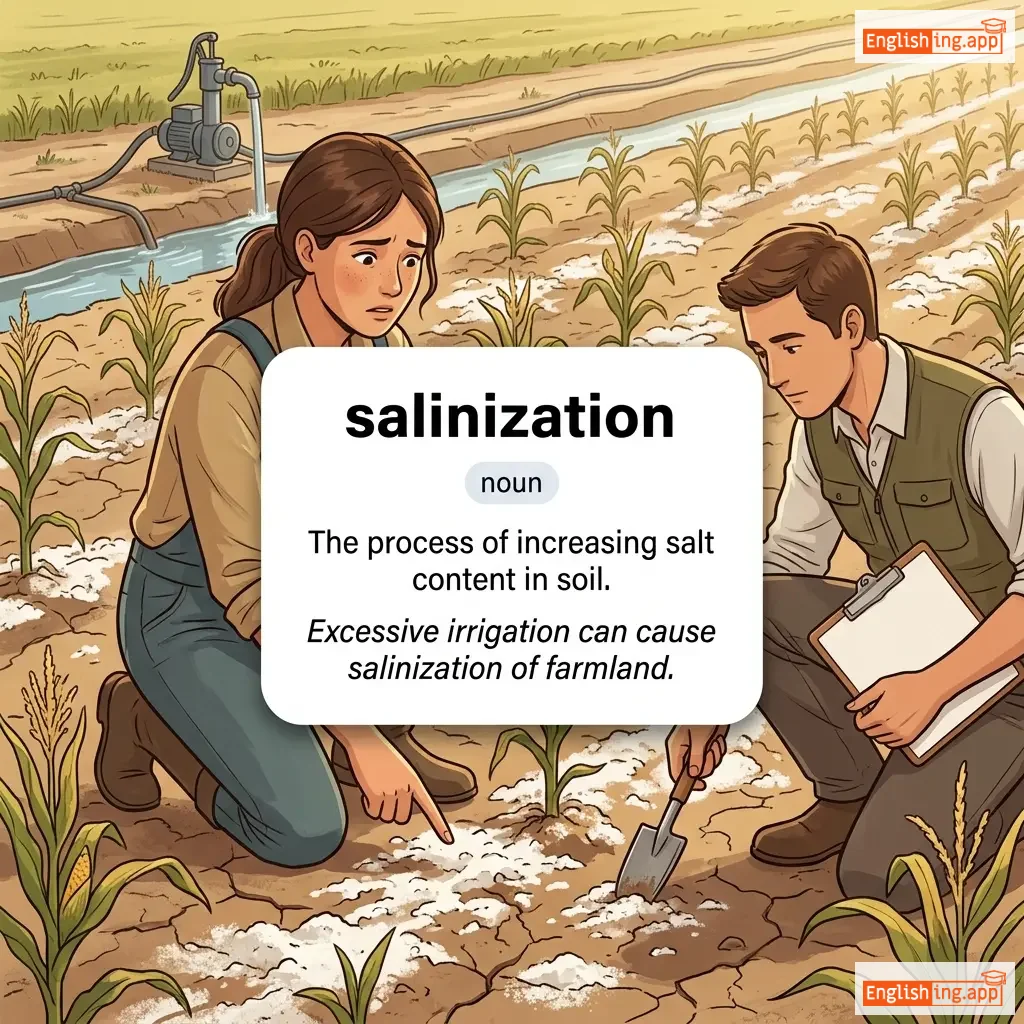
salinization definition card — visual illustration of the meaning
noun
/ˌsæl.ɪ.naɪˈzeɪ.ʃən/
塩分増加 (enbun zouka)

The process of increasing salt content in soil.

"Excessive irrigation can cause salinization of farmland."

"過剰な灌漑は農地の塩分増加を引き起こす可能性があります。" (Kajou na kangai wa nouchi no enbun zouka wo hikiokosu kanousei ga arimasu.)
noun
/səˈlaɪ.və/
唾液 (sariva)

the watery liquid secreted into the mouth by glands

"The dentist asked her to rinse the saliva from her mouth."

"歯科医は彼女に口の中の唾液をすすぐように言った。" (shikai wa kanojo ni kuchi no naka no daeki o susugu you ni itta)
adjective
/ˈsæ.loʊ/
黄白色 (ōbaku-shoku)

Of an unhealthy yellow or pale brown color, often referring to skin.

"His sallow complexion made him look tired and sickly."

"彼の黄白色の肌は、疲れて病気のように見えました。" (Kare no ōbaku-shoku no hada wa, tsukarete byōki no yō ni miemashita.)
noun
/ˈsæm.ən/
サーモン (saamon)

A large fish with pink flesh, often eaten as food.

"They served grilled salmon for dinner."

"彼らは夕食にグリルしたサーモンを出しました。" (Karera wa yūshoku ni guriru shita saamon o dashimashita.)
noun
/ˈsæl.mən fɪʃ / ˈroʊ.huː/
ロフ魚 (Rofu uo)

a freshwater fish popular in South Asian cuisine; also refers to salmon which is a different species

"Rohu fish is commonly prepared with spices in Bengali households."

"ロフ魚はベンガルの家庭でよく香辛料と一緒に調理されます。" (Rofu uo wa Bengaru no katei de yoku koshinryo to issho ni chori saremasu.)
noun
/sɔːlt/
(shio)

a white crystalline substance used for seasoning and preserving food

"She added a pinch of salt to the soup for extra flavor."

"彼女はスープに味を増すために塩を一つまみ加えた。" (Kanojo wa suupu ni aji wo masu tame ni shio wo hitotsu mami kuwaeta.)
noun
/ˈsɔːl.tɪd fɪʃ/
塩漬けの魚 (shiozuke no sakana)

fish preserved with salt; dried and salted fish for storage

"Salted fish is a traditional way to preserve seafood."

"塩漬けの魚はシーフードを保存する伝統的な方法です。" (shiozuke no sakana wa shiifudo o hozon suru dentoteki na hoho desu)