語彙集

英単語辞書 | 単語の意味、定義、例文

adjective
/məˈkɑːbrə/
恐ろしい (osoroshii)

disturbing and horrifying because of involvement with or depiction of death and injury

"The horror movie had a macabre ending."

"ホラー映画には恐ろしい結末がありました。" (Horā eiga ni wa osoroshī ketsumatsu ga arimashita.)
verb
/məˈkadəˌmaɪz/
砕石で道路を覆う (saisu de dōro o ōu)

to construct or cover a road with broken stone

"The government decided to macadamize the old rural roads."

"政府は古い田舎道を砕石で覆うことを決定した。" (Seifu wa furui inakamichi o saisu de ōu koto o kettei shita.)
noun
/meɪs/
メイス / 王杖 (meisu / ōjō)

a ceremonial staff carried as a symbol of authority or a weapon similar to a club

"The guard carried a mace as a symbol of authority."

"ガードは権威の象徴としてメイスを持っていた。" (Gādo wa ken'i no shōchō to shite meisu o motte ita.)
verb
/ˈmæsəˌreɪt/
浸す (hitasu)

to soften or break up something, especially food, by soaking in liquid

"The chef macerated the fruit in wine before serving."

"シェフは果物をワインにマセレートしてから提供しました。" (Shefu wa kudamono o wain ni maserēto shite kara teikyō shimashita.)
machiavellian definition card — visual illustration of the meaning
adjective
/ˌmækɪəˈvɛliən/
陰謀的で計略的、特に政治や自分のキャリアを進めるために倫理を無視する (makyaverian)

cunning, scheming, and unscrupulous, especially in politics or in advancing one's career

"The politician was known for his Machiavellian tactics."

"その政治家はマキャヴェリアンな戦術で知られていた。" (Sono seijika wa makyaverian na senjutsu de shirareteita.)
verb
/ˈmæk.ɪ.neɪt/
陰謀を企てる (inbō o kitediru)

to engage in plots or schemes, usually for harmful or evil purposes

"The rebels tried to machinate against the king."

"反乱者たちは王に対して陰謀を企てようとした。" (Hanran-sha-tachi wa ō ni taishite inbō o kitedeyō to shita.)
noun
/ˌmæk.ɪˈneɪ.ʃən/
陰謀 (inbō)

a secret plan or scheme intended to accomplish something, especially something evil

"The detective uncovered the villain's machination."

"探偵は悪党の陰謀を暴露した。" (Tantei wa akutō no inbō o bakuro shita.)
machinations definition card — visual illustration of the meaning
noun (plural)
/ˌmæk.ɪˈneɪ.ʃənz/
陰謀 (inbō)

complicated and secret plans, often intended to cause harm

"The politician was brought down by his own machinations."

"その政治家は自分の陰謀によって倒れた。" (Sono seijika wa jibun no inbō ni yotte taoreta.)
noun
/məˈʃiːn/
機械 (kikai)

A device with moving parts that uses energy to perform a particular task.

"This washing machine is very efficient."

"この洗濯機は非常に効率的です。" (Kono sentakuki wa hijō ni kōritsutekidesu.)
noun
/məˈʃiː.nər.i/

machines collectively, or the parts of a machine; also, the system or process by which something works

"The factory invested in new machinery to increase production."

noun
/məˈʃiː.nɪst/
機械工 (kikai kou)

a person who operates machine tools or makes and repairs machines

"The machinist carefully adjusted the gears on the lathe."

"マシニストは旋盤のギアを慎重に調整しました。" (Mashinisuto wa senban no gia o shinchou ni chousei shimashita.)
noun
/ˈmæk.ər.əl/
サバ (saba)

a streamlined marine fish with a forked tail and wavy stripes

"Mackerel is rich in omega-3 fatty acids."

"サバはオメガ3脂肪酸が豊富です。" (saba wa omega suri shibo san ga ho fu desu)
noun
/ˈmækɪntɒʃ/
レインコート (rein koto)

a waterproof raincoat, originally made from rubberized fabric

"He wore a mackintosh to stay dry in the rain."

"彼は雨の中で乾いたままでいるためにマッキントッシュを着ていました。" (Kare wa ame no naka de kawaita mamade iru tame ni makkintoshu o kite imashita.)
noun
/ˈmæk.rəˌkɒz.əm/
マクロコスモス (makurokosumosu)

The whole universe considered as a large, complex system; a large-scale representation of something.

"The macrocosm of the universe reflects the microcosm of human life."

"宇宙のマクロコスモスは人間の生活のミクロコスモスを反映しています。" (Uchū no makurokosumosu wa ningen no seikatsu no mikurokosumosu o han'ei shiteimasu.)
macroeconomic definition card — visual illustration of the meaning
adjective
/ˌmæk.rəʊ.iː.kəˈnɒm.ɪk/
マクロ経済学的 (makuro keizaigakuteki)

Relating to macroeconomics or the large-scale or general economic factors, such as interest rates and national productivity.

"Macroeconomic policies influence inflation and employment rates."

"マクロ経済政策はインフレと雇用率に影響を与えます。" (Makuro keizai seisaku wa infure to koyō ritsu ni eikyō o ataemasu.)
macronutrients definition card — visual illustration of the meaning
noun
/ˈmæk.rəʊˌnjuː.tri.ənts/
マクロン栄養素 (makuron eiyouso)

Nutrients that are needed in large amounts to provide energy and building materials for the body, including carbohydrates, proteins, and fats.

"Proteins, fats, and carbohydrates are vital macronutrients."

"タンパク質、脂肪、炭水化物は重要なマクロン栄養素です。" (Tanpakushitsu, shibou, tansuikabutsu wa juuyou na makuron eiyouso desu.)
verb
/ˈmæk.jʊˌleɪt/
汚す (yogosu)

To stain, spot, or pollute something.

"The white cloth was maculated by ink stains."

"白い布はインクのシミで汚れました。" (Shiroi nuno wa inku no shimi de yogoremashita.)
adjective
/ˈmæk.jʊˌleɪ.tɪd/
斑点のある (hanten no aru)

Spotted or stained; marked with blemishes.

"The maculated surface of the old mirror gave it a unique charm."

"古い鏡の斑点のある表面は、独特の魅力を与えました。" (Furui kagami no hanten no aru hyoumen wa, dokutoku no miryoku o ataemashita.)
adjective
/mæd/
怒っている / 狂っている (okotteiru / kurutteiru)

Very angry, insane, or foolish.

"She was mad at her brother for breaking the vase."

"彼女は兄が花瓶を壊したことで怒っていた。" (Kanojo wa ani ga kabin o kowashita koto de okotteita.)
verb
/ˈmæd.ən/
怒らせる (okoraseru)

To make someone very angry or extremely annoyed.

"The constant noise maddened him."

"絶え間ない音が彼を怒らせた。" (Taemanai oto ga kare o okoraseta.)
noun
/ˈmædnəs/
狂気 (kyōki)

the state of being mentally ill or acting in a very foolish way

"It would be madness to drive in such dangerous weather."

"こんな危険な天候で運転するのは狂気だ。" (Konna kiken na tenkō de unten suru no wa kyōki da.)
noun
/məˈdɒn.ə/
マドンナ (聖母マリア) (madonna (seibo maria))

An artistic representation of the Virgin Mary; also used as a respectful form of address for a woman in Italian culture.

"The Renaissance painting depicts a Madonna holding child Jesus."
"ルネサンスの絵画は、イエスの子供を抱いているマドンナを描いています。" (Renessansu no kaiga wa, Iesu no kodomo o daite iru Madonna o egaiteimasu.)
noun
/ˈmædrɪɡəl/

A short, lyrical poem set to music, typically from the Renaissance period.

"The choir performed a beautiful madrigal from the 16th century."

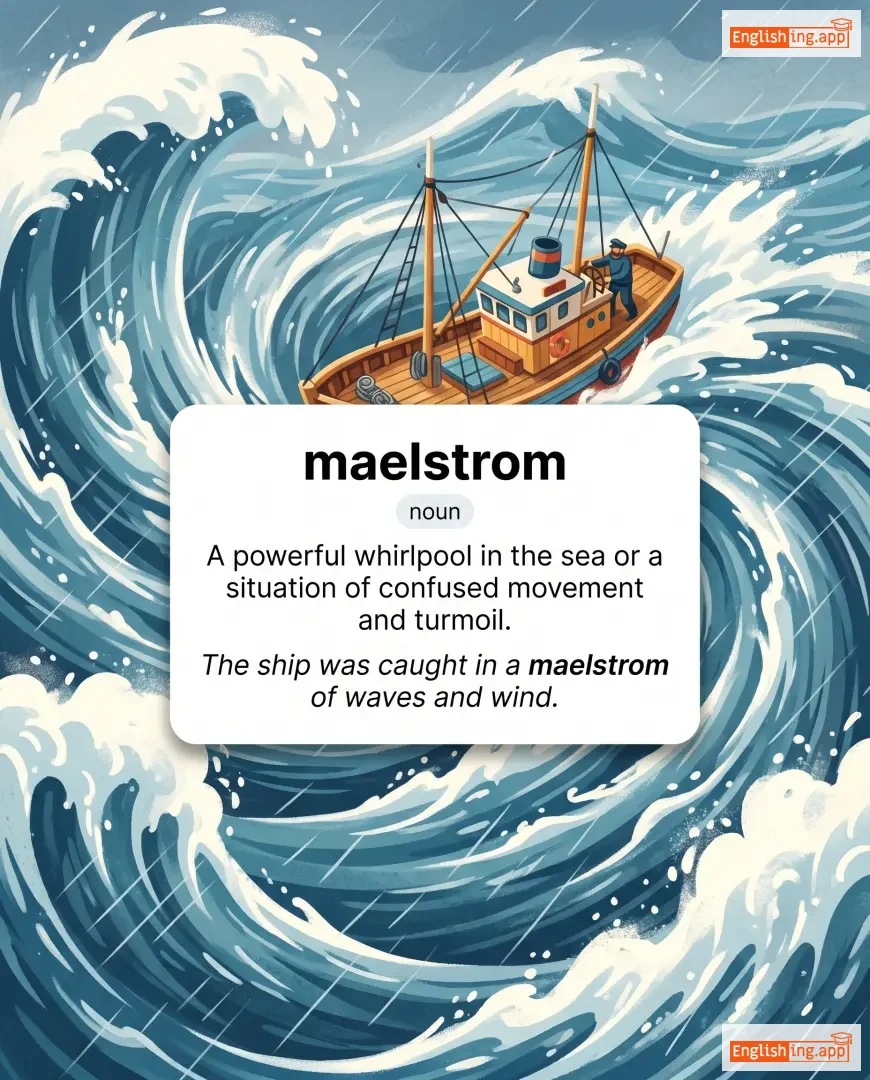
maelstrom definition card — visual illustration of the meaning
noun
/ˈmeɪlstrəm/
旋風 (senpū)

A powerful whirlpool in the sea or a situation of confused movement and turmoil.

"The ship was caught in a maelstrom of waves and wind."

"船は波と風の旋風に巻き込まれました。" (Fune wa nami to kaze no senpū ni makikomarimashita.)
noun
/ˈmæɡəziːn/
雑誌 (zasshi)

A periodical publication containing articles, photographs, and advertisements.

"She bought a fashion magazine at the store."

"彼女は店でファッション雑誌を買いました。" (Kanojo wa mise de fasshon zasshi o kaimashita.)
adjective
/məˈdʒen.tə/
マゼンタ色 (majenta iro)

a bright purplish-red color

"She wore a beautiful magenta dress to the party."

"彼女はパーティーに美しいマジェンタ色のドレスを着て行った。" (Kanojo wa pātī ni utsukushī majenta iro no doresu o kite itta.)
noun
/ˈmædʒɪk/
魔法 (mahou)

the use of mysterious or supernatural powers to influence events

"The magician amazed the crowd with his magic."

"マジシャンは彼のマジックで観客を驚かせました。" (Majishan wa kare no majikku de kankyaku o odorokasemashita.)
adjective
/ˈmædʒɪkəl/

having or producing the charm, beauty, or power of magic

"The sunset over the mountains was a magical sight."

noun
/məˈdʒɪʃən/
マジシャン (majishan)

A person who performs tricks and illusions for entertainment or one believed to have magical powers.

"The magician pulled a rabbit out of his hat."

"マジシャンは帽子からウサギを取り出しました。" (Majishan wa bōshi kara usagi o toridashimashita.)
adjective
/ˌmædʒɪˈstɪəriəl/
権威的 (ken'iteki)

Having the characteristics of a master or authority; commanding and dignified.

"The professor spoke in a magisterial tone during the lecture."

"教授は講義中に権威的な口調で話しました。" (Kyōju wa kōgichū ni ken'iteki na kuchō de hanashimashita.)
noun
/ˈmædʒɪstrəsi/
裁判所の事務所 (saibansho no jimusho)

The office, authority, or district of a magistrate.

"He was proud to serve in the local magistracy for over a decade."

"彼は10年以上にわたって地元の裁判所の事務所で働いていることを誇りに思っていました。" (Kare wa juunen ijou ni watatte jimoto no saibansho no jimusho de hataraite iru koto wo hokori ni omotte imashita.)
noun
/ˈmædʒɪstreɪt/
裁判官 (saibankan)

A civil officer who administers the law, often with limited judicial authority.

"The magistrate presided over the minor criminal case."
"裁判官は軽犯罪の事件を審理しました。" (Saibankan wa keihanzai no jiken o shinri shimashita.)
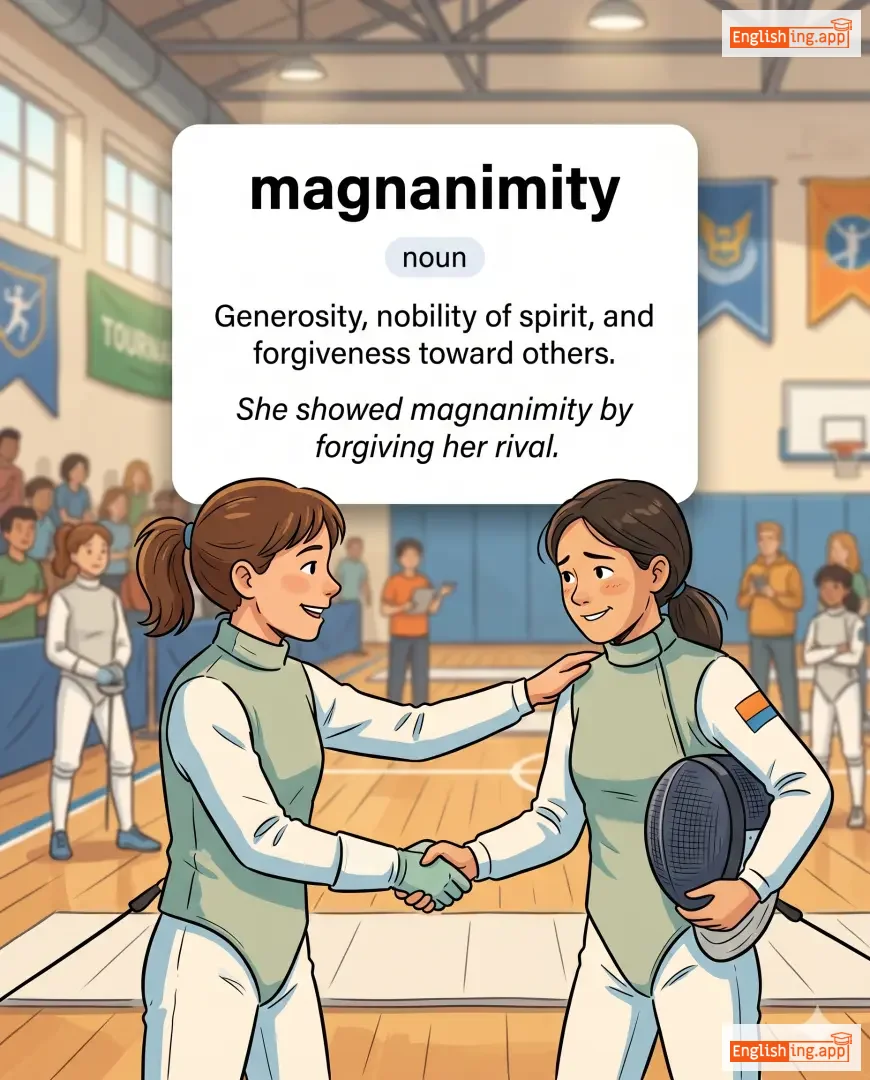
magnanimity definition card — visual illustration of the meaning
noun
/ˌmæɡnəˈnɪmɪti/
寛大さ (kandaisa)

Generosity, nobility of spirit, and forgiveness toward others.

"She showed magnanimity by forgiving her rival."

"彼女はライバルを許して寛大さを示しました。" (Kanojo wa raibaru o yurushite kandaisa o shimashita.)
magnanimous definition card — visual illustration of the meaning
adjective
/mæɡˈnænɪməs/
寛大 (kandai)

Generous or forgiving, especially toward a rival or less powerful person.

"He was magnanimous in victory, praising his opponent."

"彼は勝利において寛大で、対戦相手を称賛していた。" (Kare wa shouri ni oite kandai de, taisen aite wo shousan shiteita.)
noun
/ˈmæɡneɪt/
富豪 (fugou)

A wealthy and influential person, especially in business or industry.

"The oil magnate donated millions to charity."

"石油の富豪は慈善活動に何百万ドルも寄付しました。" (Sekiyu no fugou wa jizen katsudō ni nan byakuman doru mo kifushimashita.)
noun
/ˈmæɡnət/
磁石 (jishaku)

An object that produces a magnetic field and attracts metals like iron.

"The magnet held the paper to the fridge door."

"磁石は紙を冷蔵庫のドアに引き寄せました。" (Jishaku wa kami wo reizoko no doa ni hikiyosemashita.)
adjective
/mæɡˈnɛtɪk/
磁気 (jiki)

having the power to attract metal objects or to attract people or things in a strong way

"The magnetic field of the Earth protects us from harmful solar radiation."

"地球の磁場は有害な太陽放射から私たちを守ります。" (Chikyū no jiba wa yūgaina taiyō hōsha kara watashitachi o mamorimasu.)
verb
/ˈmæɡnɪtaɪz/
磁化する (jikasu)

to make something magnetic or to strongly attract

"The scientist managed to magnetize the iron rod."

"科学者は鉄の棒を磁化することに成功した。" (Kagakusha wa tetsu no bō o jikasu koto ni seikō shita.)
noun
/mæɡˈnɪfɪsəns/
壮麗 (sōrei)

splendor, grandeur, or impressive beauty

"The magnificence of the palace left everyone speechless."

"宮殿の壮麗さに誰もが言葉を失った。" (Kyūden no sōrei-sa ni daremo ga kotoba o ushinatta.)
adjective
/mæɡˈnɪfɪsənt/
素晴らしい (subarashii)

extremely beautiful, impressive, or splendid

"The view from the mountain was truly magnificent."

"山からの景色は本当に素晴らしかった。" (Yama kara no keshiki wa hontou ni subarashikatta.)
verb
/ˈmæɡnɪfaɪ/
拡大する (kakudai suru)

to make something appear larger or more important than it really is

"The microscope can magnify tiny cells."

"顕微鏡は小さな細胞を拡大できます。" (Kenbikyō wa chiisana saibo o kakudai dekimasu.)
adjective
/mæɡˈnɪləkwənt/
誇張した言葉 (kochou shita kotoba)

using high-flown or pompous language

"The politician’s magniloquent speech impressed the crowd."

"その政治家の誇張したスピーチは群衆に印象を与えた。" (Sono seijika no kochou shita supīchi wa gunshū ni inshō o ataeta.)
noun
/ˈmæɡnɪtuːd/
規模 (kibo)

the great size, extent, or importance of something

"The magnitude of the earthquake shocked the nation."

"地震の規模は国を驚かせました。" (Jishin no kibo wa kuni o odorokasemashita.)
noun
/ˌmɑːhəˈrɑːdʒə/
マハラジャ (maharaja)

A great king, especially a ruler of one of the principal states in India.

"The maharaja lived in a grand palace surrounded by gardens."

"マハラジャは庭園に囲まれた豪華な宮殿に住んでいました。" (Maharaja wa teien ni kakomareta gōka na kyūden ni sunde imashita.)
noun
/ˈmeɪdənˌhʊd/
処女性 (shojosei)

The state of being a maiden; girlhood or virginity.

"The poem celebrated the innocence of maidenhood."

"その詩は処女性の無垢を讃えました。" (Sono shi wa shojosei no muku o tataemashita.)
noun/verb
/meɪl/
郵便 / 手紙 (yūbin / tegami)

Letters, packages, or email messages sent or delivered to someone.

"I received an important letter in the mail."

"私は郵便で重要な手紙を受け取りました。" (Watashi wa yūbin de jūyōna tegami o uketorimashita.)
noun
/meɪl treɪn/
郵便列車 (yūbin ressha)

a train that carries mail and postal packages

"The mail train departs every evening to deliver letters across the country."

"メール列車は毎晩、国内中に手紙を届けるために出発します。" (Mēru ressha wa maiban, kokunai jū ni tegami o todokeru tame ni shuppatsu shimasu.)
verb
/meɪm/
重傷を負わせる (jūshō o owaseru)

To wound or injure someone so that part of the body is permanently damaged.

"The accident maimed several passengers."

"事故は数人の乗客を負傷させました。" (Jiko wa suunin no jōkyaku o fushō saseru mashita.)
adjective
/meɪn/
主要な (shuyō na)

most important; chief in size, extent, or importance

"The main reason for his success is hard work."

"彼の成功の主な理由は、努力したことです。" (kare no seikō no omona riyū wa, doryoku shita koto desu.)
noun
/ˈmeɪnˌlænd/

the principal landmass of a country or continent, as opposed to the surrounding islands

"The mainland of Australia is home to most of its population."