वोकैबुलरीज

इंग्लिश वोकैबुलरी डिस्कवर, लर्न और मास्टर करें

noun
/səˈbætɪkəl/
अध्ययन या यात्रा के लिए अवकाश (adhyayan ya yatra ke liye avkash)

A period of paid leave granted to a teacher or worker for study or travel, traditionally every seventh year.

"She took a sabbatical to research her new book."

"उसने अपनी नई किताब पर शोध करने के लिए एक सैबेटिकल लिया।" (Usne apni nai kitaab par shodh karne ke liye ek sabbatical liya.)
verb
/ˈsæbətɑːʒ/
विनाशकारी कार्य (vinashkari kary)

To deliberately destroy, damage, or obstruct something, especially for political or military advantage.

"The rebels tried to sabotage the railway lines."

"विद्रोहियों ने रेलवे लाइनों को नष्ट करने की कोशिश की।" (Vidrohiyon ne relvey laino ko nasht karne ki koshish ki.)
noun
/ˌsæbəˈtɜːr/
विध्वंसक (vidhwanśak)

A person who engages in sabotage.

"The saboteur was arrested before he could plant the bomb."

"विध्वंसक को बम लगाने से पहले गिरफ्तार कर लिया गया था।" (Vidhwansak ko bam lagane se pehle giraftar kar liya gaya tha.)
adjective
/ˈsækərɪn/
खुशी (khushi)

Excessively sweet or sentimental.

"His saccharine smile seemed insincere."

"जब उसने पुरस्कार प्राप्त किया, तो वह अपनी खुशी को छुपा नहीं पाई।" (Jab usne puraskaar prapt kiya, to woh apni khushi ko chhupa nahi pai.)
adjective
/ˌsæsərˈdoʊtl/
पुरोहितसंबंधी (purohitsambandhi)

Relating to priests or the priesthood.

"The ritual had a distinctly sacerdotal character."

"अनुष्ठान में एक स्पष्ट पुरोहितसंबंधी चरित्र था।" (anushthan mein ek spasht purohitsambandhi charitra tha.)
noun
/sæk/
बोरी (boree)

a large bag made of strong material for holding things

"He carried a sack of rice on his shoulder."

"उसने अपने कंधे पर चावल से भरी एक बोरी उठाई।" (Usne apne kandhe par chawal se bhari ek bori uthai.)
adjective
/ˈseɪkrɪd/
पवित्र (pavitra)

connected with God or a religion and considered holy or deserving respect

"The temple is a sacred place for the community."

"द मंदिर समुदाय के लिए एक पवित्र स्थान है।" (Da mandir samudaay ke liye ek pavitra sthaan hai.)
sacrifice definition card — visual illustration of the meaning
noun, verb
/ˈsækrɪfaɪs/
बलिदान (balidan)

To give up something valuable for the sake of others or a higher purpose.

"Parents often sacrifice their own comfort for their children."

"माता-पिता अक्सर अपने बच्चों के लिए अपनी आरामदायक स्थिति की बलि देते हैं।" (maata-pitaa aksar apne bachcho ke liye apni aaraamdayak sthiti ki bali dete hain.)
adjective
/ˌsækrɪˈfɪʃəl/
बलिदानी (balidani)

Relating to or involving sacrifice.

"The lamb was used as a sacrificial offering in the ritual."

"मेमने को अनुष्ठान में एक बलिदानी चढ़ावा के रूप में उपयोग किया गया था।" (memane ko anushthan mein ek balidani chadhawa ke roop mein upyog kiya gaya tha.)
noun
/ˈsækrɪlɪdʒ/
पवित्र का उल्लंघन (pavitra ka ullanghan)

Violation or misuse of what is regarded as sacred.

"Stealing from the temple was considered an act of sacrilege."

"मंदिर से चोरी करना पवित्र का उल्लंघन माना जाता था।" (mandir se chori karna pavitra ka ullanghan maana jaata tha.)
adjective
/ˌsækrəˈlɪdʒəs/
अपवित्रतापूर्ण (apavitratapurn)

Showing disrespect or irreverence toward something sacred.

"The painting was criticized as being sacrilegious."

"चित्रकला को अपवित्रतापूर्ण के रूप में आलोचना की गई थी।" (chitrakala ko apavitratapurn ke roop mein alochna ki gayi thi.)
noun
/ˈsækrɪsti/
चर्च का कक्ष (church ka kaksh)

a room in a church where sacred vessels and vestments are kept

"The priest entered the sacristy before the mass began."

"पुजारी मास शुरू होने से पहले साक्रिस्टि में प्रवेश किया।" (Pujari mass shuru hone se pehle sakristi mein pravesh kiya.)
adjective
/ˈsæk.rəˌsæŋkt/
अलिंघनीय (alinghaniya)

Regarded as too important or valuable to be interfered with; sacred.

"Freedom of speech is considered sacrosanct in democratic societies."

"लोकतांत्रिक समाजों में अभिव्यक्ति की स्वतंत्रता को अलिंघनीय माना जाता है।" (Loktantrik samajon mein abhivyakti ki svatantrata ko alinghaniya mana jata hai.)
adjective
/sæd/
उदास (udas)

feeling or showing sorrow; unhappy

"She felt sad after hearing the bad news."

"बुरी खबर सुनने के बाद वह उदास महसूस कर रही थी।" (Buri khabar sunne ke baad vah udas mehsoos kar rahi thi.)
noun/verb
/ˈsæd.əl/
घोड़े की पीठ पर बैठने की सीट; किसी को जिम्मेदारी देना (ghode ki peeth par baithne ki seat; kisi ko jimmedari dena)

A seat fastened on the back of a horse for riding; to burden someone with a responsibility.

"He saddled the horse before going for a ride."

"उसने घोड़े को सवारी पर जाने से पहले सैडल किया।" (Usne ghode ko sawari par jaane se pehle saddle kiya.)
adjective
/səˈdɪs.tɪk/
क्रूर (kroor)

Deriving pleasure from inflicting pain or suffering on others.

"The villain had a sadistic smile while hurting his enemies."

"विलेन का क्रूर मुस्कान था जब वह अपने दुश्मनों को पीड़ा दे रहा था।" (Vilen ka kroor muskaan tha jab wah apne dushmanon ko peeda de raha tha.)
adverb
/ˈsædli/
दुखी होकर (dukhi hokar)

in a sorrowful or unhappy manner

"She sadly waved goodbye as the train departed."

"उसने दुखी होकर विदा दी जब ट्रेन रवाना हुई।" (Usne dukhi hokar vida di jab train ravaan hui.)
noun
/ˈsæd.nəs/
दुःख, शोक, उदासी (dukh, shok, udaasi)

feeling of sorrow, unhappiness, or grief

"Her sadness was evident after hearing the bad news."

"उसके दुःख को बुरी खबर सुनने के बाद देखा गया।" (uske dukh ko buri khabar sunne ke baad dekha gaya)
adjective
/seɪf/
सुरक्षित (surakṣit)

free from harm or danger

"Make sure your belongings are safe during the trip."

"यात्रा के दौरान अपनी चीजें सुरक्षित रखें।" (Yātrā kē daurān apnī chīzēṁ surakṣit rakhēṁ.)
noun/verb
/ˈseɪf.ɡɑːrd/
सुरक्षा करना (suraksha karna)

To protect from harm or damage; a measure taken to ensure safety.

"Laws exist to safeguard the rights of children."

"कानून बच्चों के अधिकारों की सुरक्षा करने के लिए अस्तित्व में हैं।" (Kanoon bachon ke adhikar ki suraksha karne ke liye astitv mein hain.)
adverb
/ˈseɪfli/
सुरक्षित (surakshit)

in a way that is not dangerous or likely to cause harm

"The children crossed the road safely."

"बच्चों ने सड़क को सुरक्षित रूप से पार किया।" (bachchon ne sadak ko surakshit roop se paar kiya.)
noun
/ˈseɪfti/
सुरक्षा (sefti)

the condition of being protected from harm or danger

"The safety of passengers is our top priority."

"यात्रियों की सुरक्षा हमारी सबसे बड़ी प्राथमिकता है।" (yaatriyon ki suraksha hamari sabse badi prathamikta hai)
noun
/ˈsæf.rən/
केसर (kesar)

A spice derived from the flower of Crocus sativus, used for flavoring and coloring food.

"She added saffron to the rice for flavor and color."

"उसने चावल में स्वाद और रंग के लिए केसर डाला।" (Usne chawal mein swad aur rang ke liye kesar dala.)
noun
/ˈsɑːɡə/
दीर्घ कथा (dirgh katha)

A long story of heroic achievement, or a long, complex series of events.

"The company's rise and fall became a corporate saga."

"कंपनी का उत्थान और पतन एक कॉर्पोरेट सागा बन गया।" (Company ka utthan aur patan ek corporate saga ban gaya.)
sagacious definition card — visual illustration of the meaning
adjective
/səˈɡeɪʃəs/
ज्ञानी (gyani)

Having or showing keen mental discernment and good judgment; wise.

"The sagacious leader guided the team through difficult times."

"ज्ञानी नेता ने टीम को कठिन समय में मार्गदर्शन किया।" (Gyani neta ne team ko kathin samay mein margdarshan kiya.)
sagacity definition card — visual illustration of the meaning
noun
/səˈɡæs.ə.t̬i/
गंभीर ज्ञान (gambhir gyaan)

The quality of being sagacious; having or showing keen mental discernment and good judgment.

"His sagacity made him a great leader."

"उसकी सगैसिटी ने उसे महान नेता बना दिया।" (Uski sagacity ne use mahaan neta bana diya.)
Sage definition card — visual illustration of the meaning
noun
/seɪdʒ/
ज्ञानी, मुनि (gyani, muni)

A profoundly wise person, or wise through reflection and experience.

"The old sage was respected for his wisdom."

"वृद्ध ज्ञानी अपनी बुद्धिमत्ता के लिए सम्मानित थे।" (Vriddh gyani apni buddhimatta ke liye sammanit the.)
noun
/ˈseɪ.ɡoʊ/
सागो (sago)

starchy foodstuff obtained from the pith of various tropical palm stems

"She prepared sago pudding for dessert."

"उसने डेसर्ट के लिए सागो पुडिंग तैयार किया।" (Usne dessert ke liye sago pudding tayar kiya.)
verb
/seɪl/
पाल से यात्रा करना (paal se yatra karna)

to travel on water in a boat or ship using sails or by wind power

"They sailed across the Atlantic Ocean last summer."

"वे पिछले ग्रीष्मकाल में अटलांटिक महासागर को पार किए थे।" (ve pichle grishmkal mein atlantik mahasagar ko paar kiye the.)
noun, verb
/ˈseɪ.lɪŋ/
पाल द्वारा नौकायन (paal dwara naukayan)

The act of traveling in a boat or ship using sails; the sport or activity of navigating a boat with sails.

"We went sailing on the lake during the summer."

"हमने गर्मियों में झील पर पाल द्वारा नौकायन किया।" (hamne garmiyon me jheel par paal dwara naukayan kiya)
noun
/ˈseɪ.lər/
मल्लाह (mallah)

a person who works on a ship or boat; a member of a navy

"The experienced sailor navigated the ship through the storm."

"अनुभवी मल्लाह ने तूफान के बीच जहाज को नेविगेट किया।" (anubhavi mallah ne toofan ke beech jahaj ko navigate kiya.)
noun
/seɪnt/
पवित्र व्यक्ति (pavitra vyakti)

a person recognized for their holiness or virtue, often canonized in the Christian faith

"The saint was revered by the community for his acts of kindness."

"संत को समुदाय ने उसकी दया और अच्छाई के कृत्यों के लिए सम्मानित किया।" (Sant ko samudaay ne uski daya aur acchai ke krityon ke liye sammanit kiya.)
noun
/seɪk/
भला (bhala)

for the purpose or reason of something

"He did it for the sake of his family."

"उसने अपने परिवार के भले के लिए ऐसा किया।" (Usne apne parivār ke bhale ke liye aisā kiyā.)
salacious definition card — visual illustration of the meaning
adjective
/səˈleɪʃəs/
लैंगिक रूप से उत्तेजक (laingik roop se uttejak)

Having or conveying undue or inappropriate sexual interest.

"The tabloid published a salacious story about the celebrity."

"टैब्लॉइड ने सेलेब्रिटी के बारे में एक उत्तेजक कहानी प्रकाशित की।" (Tabloid ne celebrity ke baare mein ek uttejak kahani prakaashit ki.)
noun
/ˈsæləd/
सालाड (salad)

a dish consisting of various ingredients, typically including vegetables, which are usually mixed with a dressing

"She made a fresh salad with lettuce, tomatoes, and cucumbers."

"उसने लेटस, टमाटर और खीरे से ताजे सलाद बनाए।" (Usne lettuce, tamatar aur kheere se taze salad banaye.)
noun
/ˈsæləri/
वेतन (vetan)

a fixed regular payment, typically paid monthly or annually, made by an employer to an employee

"He receives a monthly salary for his work as a teacher."

"वह अपने काम के लिए मासिक वेतन प्राप्त करता है।" (Vah apne kaam ke liye masik vetan prapt karta hai.)
noun
/seɪl/
बिक्री (bikri)

the exchange of a commodity for money; the action of selling something

"The store is having a sale on winter clothing."

"दुकान पर सर्दी के कपड़ों पर एक बिक्री हो रही है।" (Dukaan par sardi ke kapdon par ek bikri ho rahi hai.)
noun
/seɪlz/
बिक्री (bikri)

activities related to selling products or services

"The company saw a significant increase in sales during the holiday season."

"कंपनी ने छुट्टियों के मौसम के दौरान बिक्री में एक महत्वपूर्ण वृद्धि देखी।" (kampani ne chhuttiyon ke mausam ke dauran bikri mein ek mahatvapurn vriddhi dekhi.)
noun
/ˈseɪ.li.əns/
प्रमुखता (pramukhata)

The quality of being particularly noticeable or important; prominence.

"The salience of the issue was highlighted in the debate."

"इस मुद्दे की प्रमुखता बहस में उजागर की गई थी।" (Is mudde ki pramukhata bahas mein ujagar ki gayi thi.)
salient definition card — visual illustration of the meaning
adjective
/ˈseɪ.li.ənt/
प्रमुख विशेषता (pramukh visheshata)

Most noticeable or important; standing out prominently.

"The most salient feature of the report was its emphasis on sustainability."

"रिपोर्ट की सबसे प्रमुख विशेषता इसकी स्थिरता पर जोर था।" (Report ki sabse pramukh visheshata iski sthirata par zor tha.)
adjective
/ˈseɪ.liːn/
नमकीन (namkeen)

Containing or resembling salt; salty.

"Doctors often use saline solution to clean wounds."

"डॉक्टर अक्सर घावों को साफ करने के लिए सैलिन समाधान का उपयोग करते हैं।" (Doktor aksar ghavon ko saaf karne ke liye saline samaadhan ka upyog karte hain.)
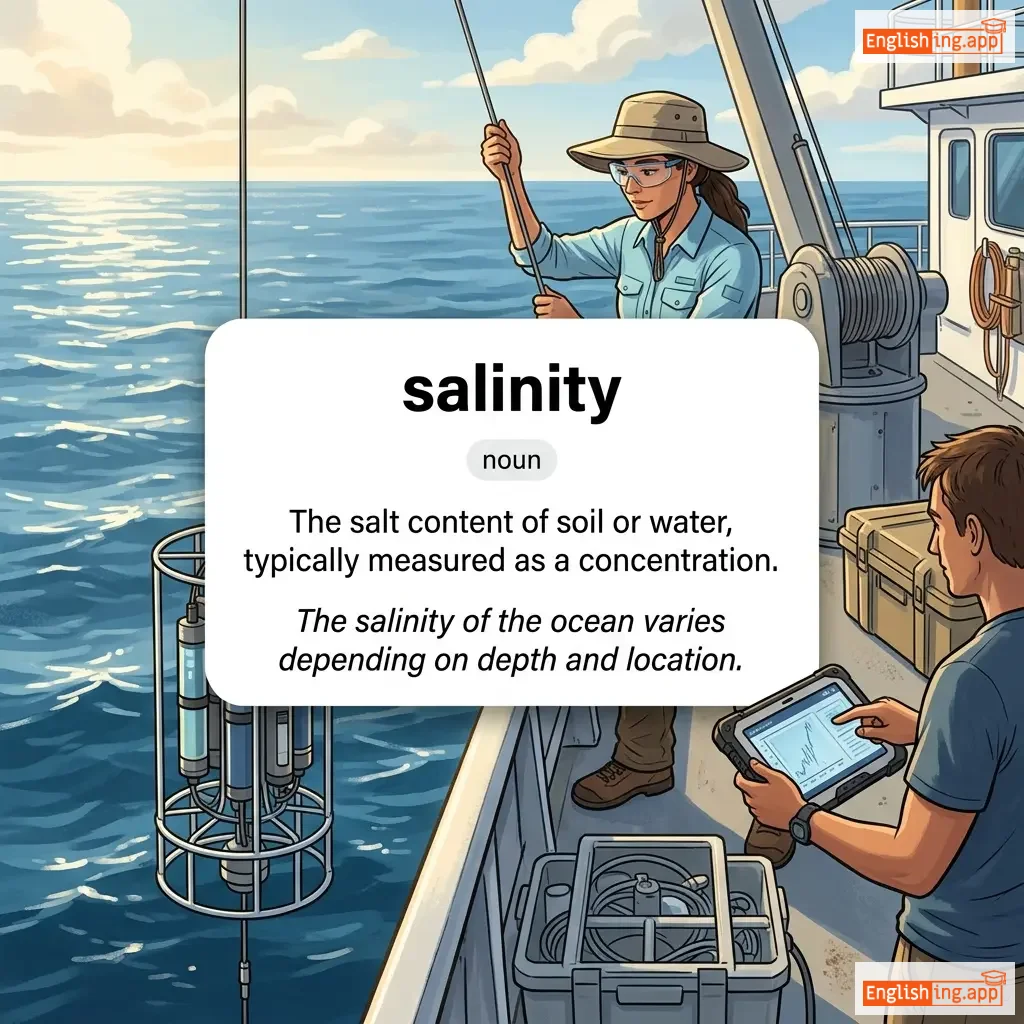
salinity definition card — visual illustration of the meaning
noun
/səˈlɪn.ə.t̬i/
नमकीनता, नमक की सांद्रता (namkeenta, namak ki sandrata)

The salt content of soil or water, typically measured as a concentration.

"The salinity of the ocean varies depending on depth and location."

"महासागर की नमकीनता गहराई और स्थान के आधार पर बदलती है।" (mahasagar ki namkeenta gahraai aur sthaan ke aadhar par badalti hai.)
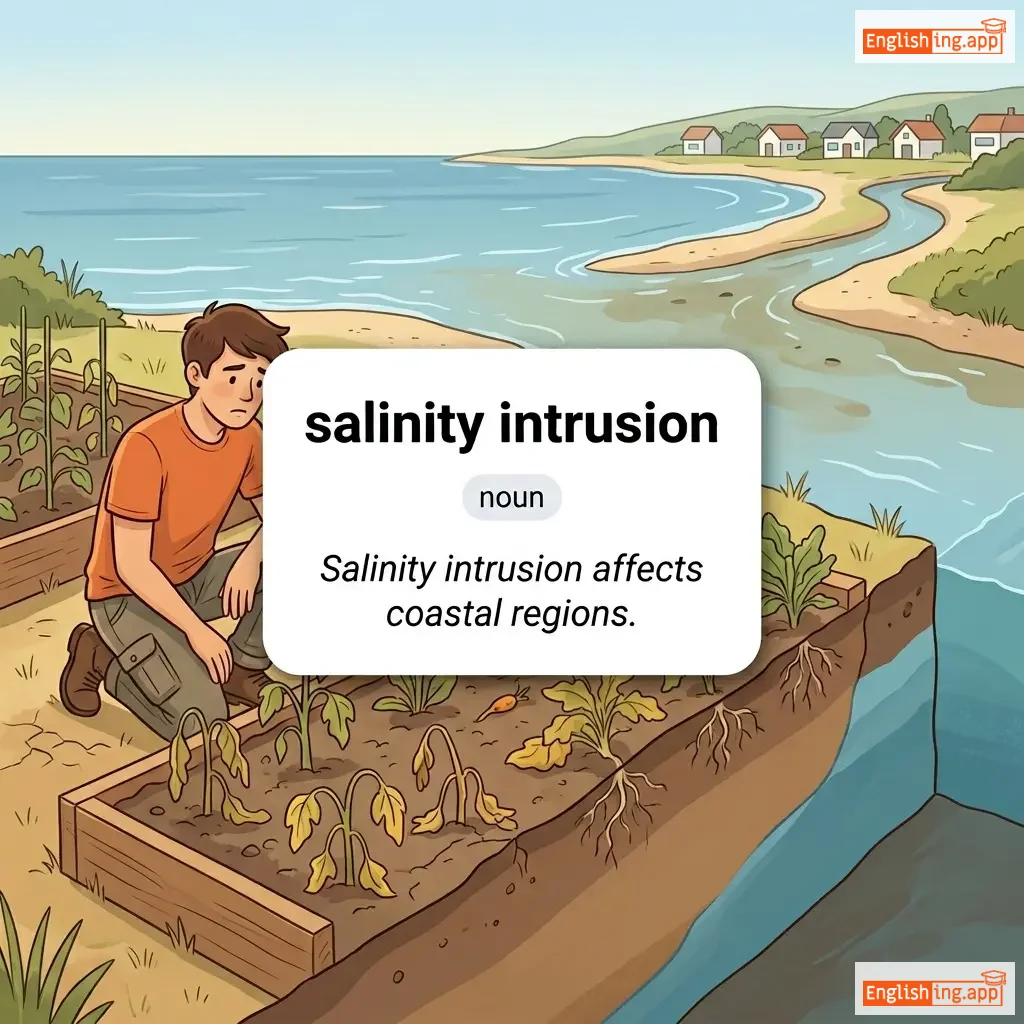
salinity intrusion definition card — visual illustration of the meaning
noun
səˈlɪnɪti ɪnˈtruːʒən
नमकता घुसपैठ (namakta ghuspaith)

The movement of salt water into freshwater areas, typically affecting coastal regions.

"Salinity intrusion affects coastal regions."

"नमकता घुसपैठ तटीय क्षेत्रों को प्रभावित करता है।" (Namakta ghuspaith tatiy kshetron ko prabhavit karta hai.)
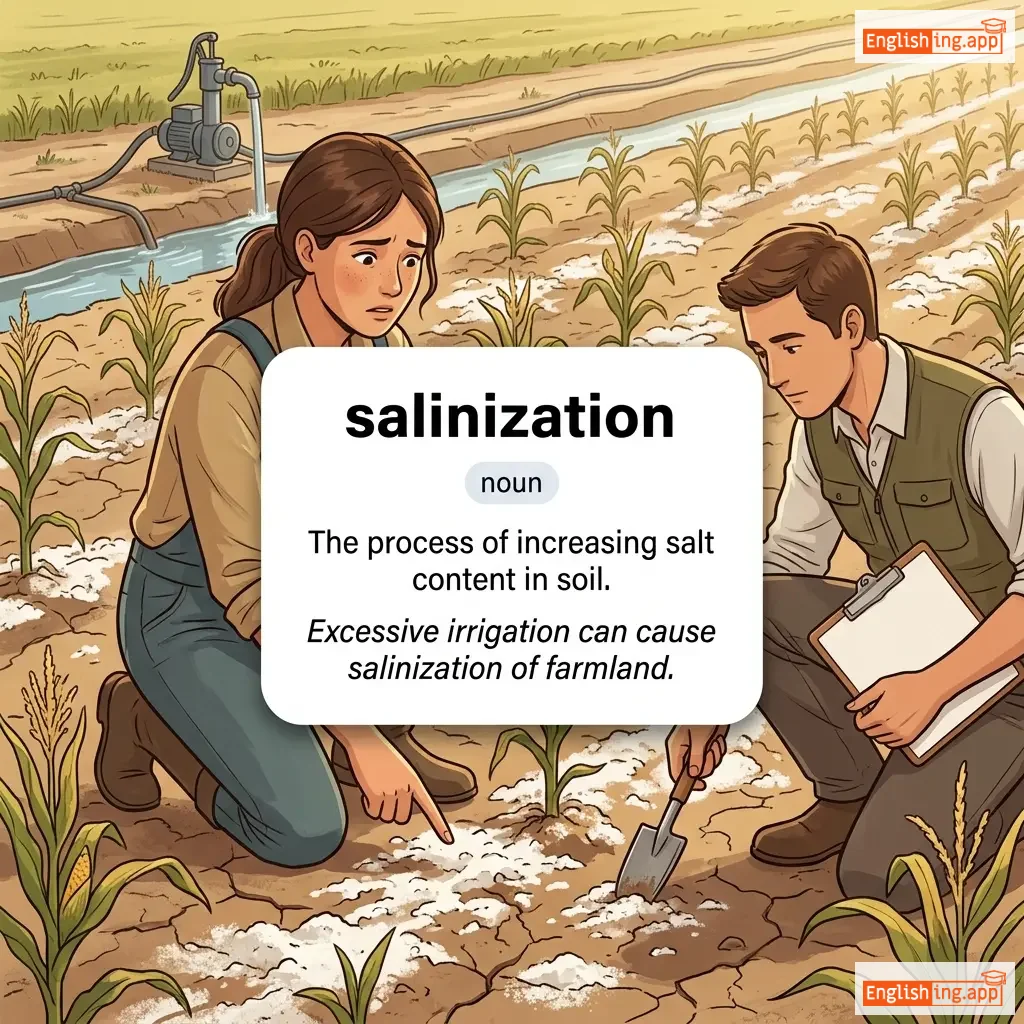
salinization definition card — visual illustration of the meaning
noun
/ˌsæl.ɪ.naɪˈzeɪ.ʃən/
नमकीनता वृद्धि (namkeenata vruddhi)

The process of increasing salt content in soil.

"Excessive irrigation can cause salinization of farmland."

"अत्यधिक सिंचाई से खेतों में नमकीनता वृद्धि हो सकती है।" (Atyadhik sinchai se kheton mein namkeenata vruddhi ho sakti hai.)
noun
/səˈlaɪ.və/
लार (saliva)

the watery liquid secreted into the mouth by glands

"The dentist asked her to rinse the saliva from her mouth."

"डेंटिस्ट ने उसे अपने मुँह से लार कुल्ला करने के लिए कहा।" (dentist ne use apne munh se laar kulla karne ke liye kaha)
adjective
/ˈsæ.loʊ/
पीला (peela)

Of an unhealthy yellow or pale brown color, often referring to skin.

"His sallow complexion made him look tired and sickly."

"उसकी पीली त्वचा उसे थका और बीमार दिखाती थी।" (Uski peeli tvacha use thaka aur beemar dikhati thi.)
noun
/ˈsæm.ən/
सैल्मन मछली (salmon machhli)

A large fish with pink flesh, often eaten as food.

"They served grilled salmon for dinner."

"उन्होंने रात के खाने के लिए ग्रिल्ड सैल्मन परोसा।" (Unhone raat ke khane ke liye grilled salmon parosa.)
noun
/ˈsæl.mən fɪʃ / ˈroʊ.huː/
रोहू मछली (rohu machhli)

a freshwater fish popular in South Asian cuisine; also refers to salmon which is a different species

"Rohu fish is commonly prepared with spices in Bengali households."

"रोहू मछली आमतौर पर बंगाली घरों में मसाले के साथ तैयार की जाती है।" (Rohu machhli aamtour par Bangali gharon mein masale ke saath tayar ki jati hai.)
noun
/sɔːlt/
नमक (namak)

a white crystalline substance used for seasoning and preserving food

"She added a pinch of salt to the soup for extra flavor."

"उसने सूप में अतिरिक्त स्वाद के लिए एक चुटकी नमक डाला।" (Usne soop mein atirikt swad ke liye ek chutki namak dala.)
noun
/ˈsɔːl.tɪd fɪʃ/
नमकीन मछली (namkeen machhli)

fish preserved with salt; dried and salted fish for storage

"Salted fish is a traditional way to preserve seafood."

"नमकीन मछली समुद्री भोजन को संरक्षित करने का पारंपरिक तरीका है।" (namkeen machhli samudri bhojan ko sanrakshit karne ka paramparik tareeka hai)