वोकैबुलरीज

इंग्लिश वोकैबुलरी डिस्कवर, लर्न और मास्टर करें

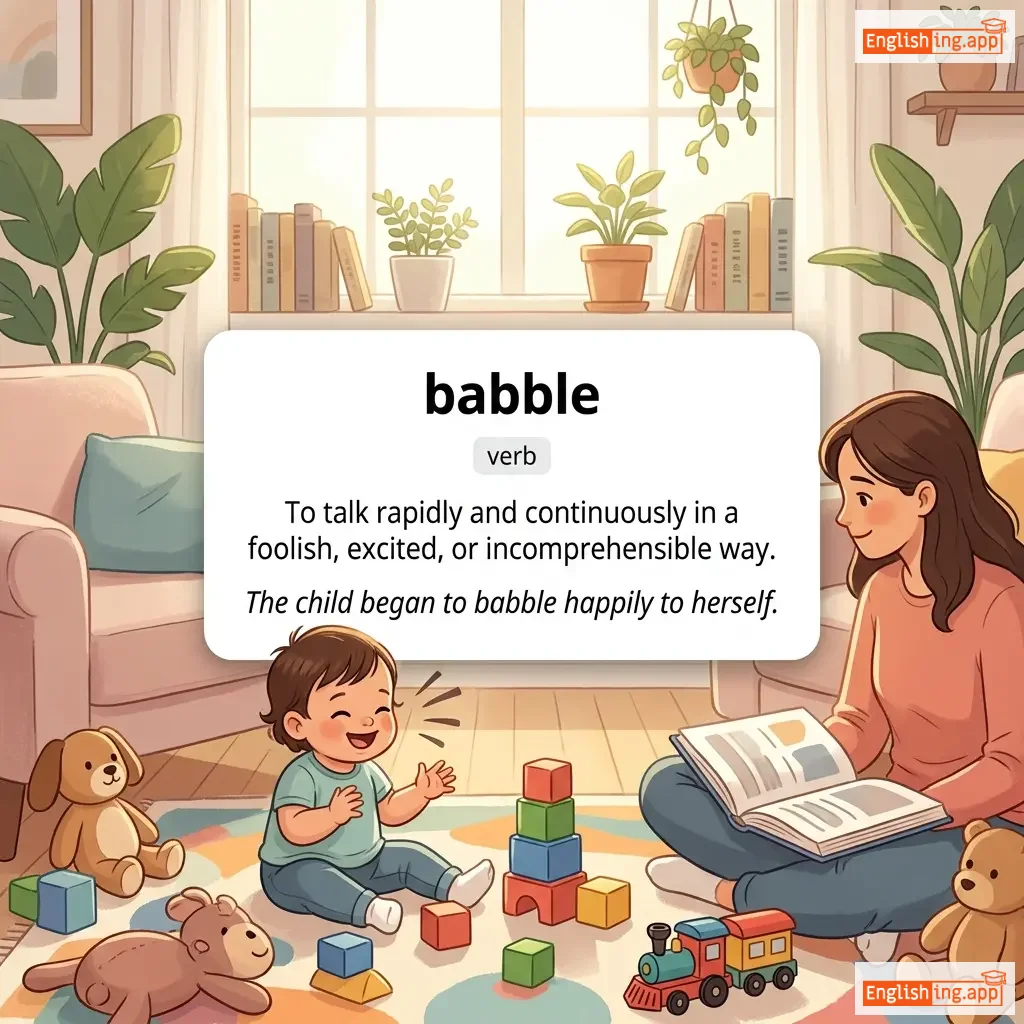
babble definition card — visual illustration of the meaning
verb
/ˈbæbəl/
अर्थहीन बकबक करना (arthheen bakbak karna)

To talk rapidly and continuously in a foolish, excited, or incomprehensible way.

"The child began to babble happily to herself."

"बच्ची खुशी से खुद से बकबक करने लगी।" (bachchi khushi se khud se bakbak karne lagi.)
noun
/bəˈbuːn/
बबून (baboon)

a large African and Arabian primate with a dog-like snout and colorful buttocks

"The baboon troop gathered around the watering hole in the savanna."

"बबून का झुंड सवाना में पानी के गड्ढे के चारों ओर इकट्ठा हुआ।" (baboon ka jhund savana mein paani ke gaddhe ke chaaron or ikattha hua.)
noun
/ˈbeɪbi/
शिशु (shishu)

a very young child, especially one newly or recently born

"The baby is sleeping peacefully in the crib."

"बच्चा शांति से पालने में सो रहा है।" (bachcha shanti se paalne mein so raha hai.)
noun
/ˈbækənæl/
उत्तेजक पार्टी (uttejak party)

A noisy party involving drinking and revelry.

"The festival turned into a wild bacchanal by midnight."

"त्योहार आधी रात तक एक उन्मत्त उत्तेजक पार्टी में बदल गया।" (Tyohar aadhi raat tak ek unmatt uttejak party mein badal gaya.)
noun
/ˌbækəˈneɪliə/
मदिरापान और आनंद के साथ रोमानी उत्सव (madirapan aur anand ke saath romani utsav)

A Roman festival of Bacchus celebrated with dancing, drinking, and revelry; any occasion of wild and drunken revelry.

"The novel describes the party as a bacchanalia of excess and joy."

"उपन्यास पार्टी का वर्णन अत्यधिकता और आनंद के एक मदिरापान और खुशी के उत्सव के रूप में करता है।" (Upanyas party ka varnan atyantata aur anand ke ek madirapan aur khushi ke utsav ke roop mein karta hai.)
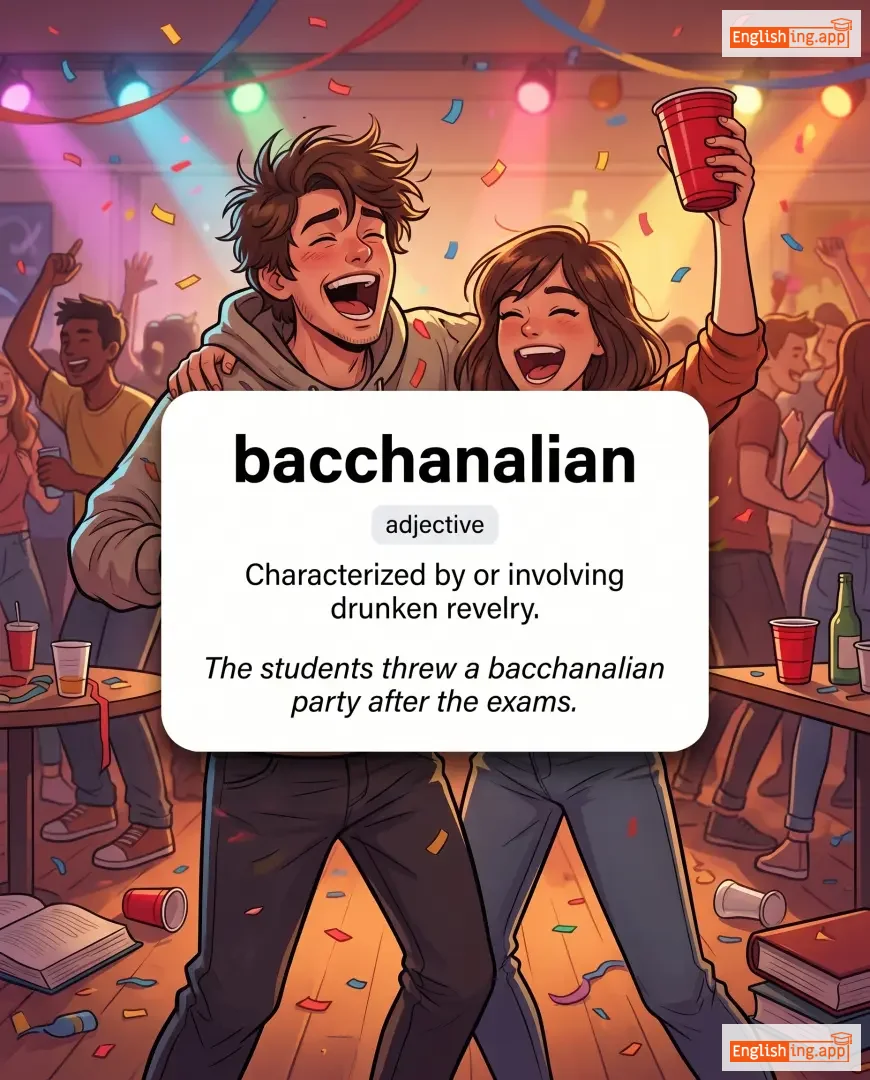
bacchanalian definition card — visual illustration of the meaning
adjective
/ˌbækəˈneɪliən/
मदिरापान से संबंधित (madhirapan se sambandhit)

Characterized by or involving drunken revelry.

"The students threw a bacchanalian party after the exams."

"छात्रों ने परीक्षा के बाद एक मदिरापान से संबंधित पार्टी आयोजित की।" (Chhatron ne pariksha ke baad ek madhirapan se sambandhit party aayojit ki.)
noun
/ˈbætʃələr/
अविवाहित पुरुष; स्नातक (avivahit purush; snatak)

an unmarried man; a person who holds a first degree from a university

"He remained a bachelor all his life and earned a bachelor's degree in engineering."

"वह अपना जीवन एक बैचलर के रूप में जीते रहे और इंजीनियरिंग में स्नातक डिग्री प्राप्त की।" (Wah apna jeevan ek bachelor ke roop mein jeete rahe aur engineering mein snatak degree prapt ki.)
noun/verb/adverb/adjective
/bæk/
पीठ / लौटना (peeth / lautna)

the rear surface of the human body; to support; to return to a place

"He turned back to help his friend."

"वह अपने दोस्त की मदद करने के लिए पीछे मुड़ा।" (Wah apne dost ki madad karne ke liye peeche mudha.)
phrasal verb
/bæk ʌp/
समर्थन करना; डेटा की प्रति बनाना; पीछे हटना (samarthan karna; data ki prati banana; pichhe hatna)

to support or help someone; to make a copy of data for safety; to move backward

"Please back up your files before updating the system."

"सिस्टम अपडेट करने से पहले अपनी फाइलों का बैक अप लें।" (system update karne se pehle apni files ka back up len)
verb
/ˈbækbaɪt/
पीठ पीछे बुराई करना (peeth peeche burai karna)

to speak negatively about someone who is not present; to slander behind someone’s back

"It is wrong to backbite your colleagues behind their backs."

"सहकर्मियों की पीठ पीछे बुराई करना गलत है।" (sahkarmiyon ki peeth peeche burai karna galat hai)
noun
/ˈbækboʊn/
रीढ़ की हड्डी (reed ki haddi)

the spine; the chief support or mainstay; strength of character

"Education is the backbone of a nation."

"शिक्षा एक राष्ट्र की रीढ़ की हड्डी है।" (Shiksha ek rashtr ki reed ki haddi hai.)
noun
/ˈbækdrɒp/
पृष्ठभूमि (prishthabhoomi)

a painted cloth or other structure used behind a stage

"The backdrop for the play was a beautiful mountain scene."

"नाटक के लिए बैकरॉप एक सुंदर पर्वत दृश्य था।" (Natak ke liye backdrop ek sundar parvat drishya tha.)
noun
/ˈbækɡraʊnd/
पृष्ठभूमि (prishthabhoomi)

the circumstances, environment, or past history of a person or thing; the part behind the main subject in an image

"She comes from a strong academic background."

"वह एक मजबूत शैक्षिक पृष्ठभूमि से आती है।" (Woh ek majboot shaikshik prishthabhoomi se aati hai.)
adjective
/ˈbækˌhændɪd/
अप्रत्यक्ष या व्यंग्यात्मक (aprtyaksh ya vyangyatak)

Indirect or sarcastic, often appearing as praise but actually insulting.

"She gave him a backhanded compliment about his work."

"उसने उसके काम पर एक व्यंग्यात्मक प्रशंसा दी।" (Usne uske kaam par ek vyangyatak prashansa di.)
noun
/ˈbækɪŋ/
समर्थन (samarthan)

support or approval for a plan, person, or idea

"The project received strong backing from the investors."

"प्रकल्प को निवेशकों से मजबूत समर्थन मिला।" (Prakalp ko niveshkon se majboot samarthan mila.)
noun
/ˈbækˌsaɪd/
पीछे (peeche)

the rear part or surface of something; informal term for the buttocks

"The kids slid down the hill on their backside."

"बच्चे पहाड़ से अपने पिछवाड़े पर स्लाइड कर गए।" (Bachche pahaad se apne pichwade par slide kar gaye.)
verb
/ˈbækˌslaɪd/
पतन (patan)

To relapse into bad habits, undesirable practices, or moral decline.

"After months of progress, he began to backslide into old habits."

"कुछ महीनों की प्रगति के बाद, वह पुराने आदतों में वापस लौटने लगा।" (Kuch mahino ki pragati ke baad, vah purane aadaton mein wapas lautne laga.)
noun
/ˈbækʌp/
बैकअप (backup)

a copy of data stored separately to protect against loss

"Make sure to have a backup of your important files."

"अपने महत्वपूर्ण फ़ाइलों का बैकअप रखें।" (Apne mahatvapurn files ka backup rakhen.)
adverb
/ˈbækwərdz/
पीछे की ओर (peeche ki or)

Toward the back or in the reverse direction.

"He accidentally fell backwards into the chair."

"वह गलती से पीछे की ओर कुर्सी में गिर गया।" (Wah galti se peeche ki or kursi mein gir gaya.)
noun
/ˌbækˈjɑːrd/
खुशी (khushi)

an area of land behind a house, typically used for recreation or gardening

"The children played football in the backyard."

"वह जब पुरस्कार प्राप्त करती तो अपनी खुशी छिपा नहीं पाई।" (Vah jab puraskar prapt karti to apni khushi chhupa nahi pai.)
adjective
/beɪˈkoʊniən/
बेकनियन (Baconian)

Relating to the philosopher Francis Bacon or his method of scientific reasoning.

"The researcher followed a Baconian approach to observation and experimentation."

"शोधकर्ता ने अवलोकन और प्रयोगात्मकता के लिए बेकोनियन दृष्टिकोण अपनाया।" (Shodhakarta ne avlokan aur prayogatmakta ke liye Baconian drishtikon apnaya.)
bacteria definition card — visual illustration of the meaning
noun
/bækˈtɪəriə/
बैक्टीरिया (bacteria)

Microscopic single-celled organisms that can be beneficial or harmful.

"Some bacteria in the human gut help with digestion."

"कुछ बैक्टीरिया मानव आंत में पाचन में मदद करते हैं।" (Kuch bacteria manav aant mein pachan mein madad karte hain.)
noun
/bækˈtɪəriəm/
बैटीरिया (bakteria)

A single microscopic organism belonging to the group of bacteria.

"The doctor explained that a single bacterium can multiply rapidly under the right conditions."

"डॉक्टर ने समझाया कि एकल बैक्टीरियम सही परिस्थितियों में तेजी से बढ़ सकता है।" (Doktor ne samjhaya ki ekal bakterium sahi paristhitiyon mein tezi se badh sakta hai.)
adjective
/bæd/
खराब (kharab)

not good; unpleasant, harmful, or of poor quality

"The milk smells bad, so don’t drink it."

"दूध बुरा महकता है, इसलिए इसे मत पीना।" (Doodh bura mahakta hai, isliye ise mat peena.)
noun
/bædʒ/
बैज (baij)

A small emblem or sign worn to show membership, authority, or achievement.

"The police officer showed his badge to identify himself."

"पुलिस अधिकारी ने अपनी बैज से खुद को पहचाना।" (Police adhikari ne apni baij se khud ko pehchana.)
verb
/ˈbædʒər/
परेशान करना, तंग करना (pareshan karna, tang karna)

To repeatedly ask or annoy someone with demands or questions.

"The reporter kept badgering the politician with questions."

"रिपोर्टर ने राजनेता को सवालों से परेशान किया।" (Reporter ne rajneeta ko sawalon se pareshan kiya.)
noun
/ˌbædɪˈnɑːʒ/
हंसी मजाक, मज़ेदार बातचीत (hansi mazak, mazedar baatcheet)

Playful and humorous conversation; banter.

"The friends enjoyed a light badinage over coffee."

"दोस्तों ने कॉफ़ी पर हल्की हंसी मजाक का आनंद लिया।" (Doston ne coffee par halki hansi mazak ka anand liya.)
adverb
/ˈbædli/
बुरी तरह से (buri tarah se)

in a way that is not good; poorly or severely

"He performed badly in the exam."

"उसने परीक्षा में बुरी तरह से प्रदर्शन किया।" (Usne pariksha mein buri tarah se pradarshan kiya.)
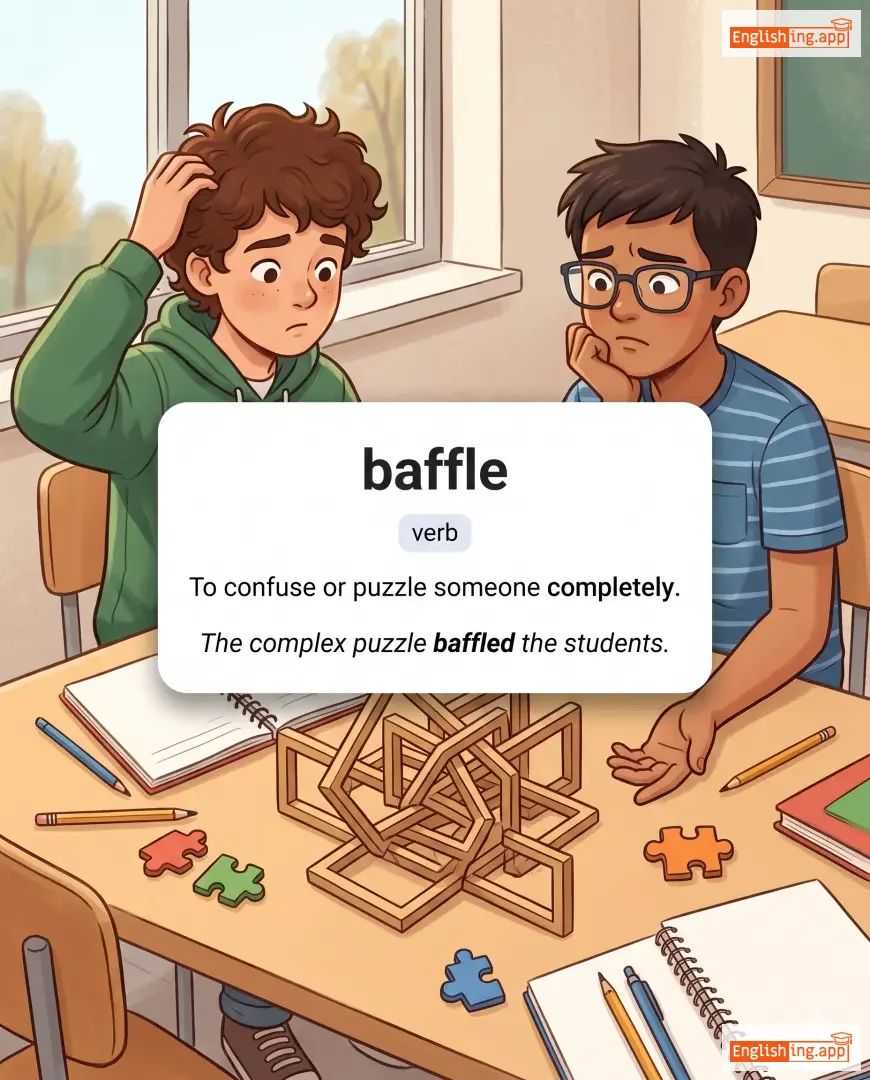
baffle definition card — visual illustration of the meaning
verb
/ˈbæfəl/
भ्रमित करना (bharmit karna)

To confuse or puzzle someone completely.

"The complex puzzle baffled the students."

"जटिल पहेली ने छात्रों को पूरी तरह से भ्रमित कर दिया।" (Jatil paheli ne chhatron ko puri tarah se bhramit kar diya.)
noun
/bæɡ/
बैग (bag)

a container made of flexible material, used for carrying items

"She carried her books in a bag."

"उसने अपनी किताबों को एक बैग में रखा।" (Usne apni kitaabon ko ek bag mein rakha.)
noun
/ˈbæɡɪdʒ/
सामान; यात्रा का सामान; (samaan; yatra ka samaan;)

suitcases and bags containing personal belongings; past experiences or problems that affect behavior

"Please collect your baggage from the conveyor belt at the airport."

"कृपया एयरपोर्ट पर कन्वेयर बेल्ट से अपना बैगेज ले लीजिए।" (Kripya airport par conveyor belt se apna baggage le lijiye.)
noun
/beɪl/
जमानत (jamanat)

the temporary release of an accused person awaiting trial, often with a financial guarantee

"He was granted bail after his arrest."

"उसे गिरफ्तारी के बाद जमानत मिल गई।" (Use girftari ke baad jamanat mil gayi.)
noun
/ˌbeɪˈliː/
जमानत में वस्तु प्राप्त करने वाला (jamanat mein vastu prapt karne wala)

a person or party who temporarily receives possession of goods or property from another under a legal agreement

"The bailee must take reasonable care of the goods while they are in his possession."

"बेइली को वस्तुओं की उचित देखभाल करनी चाहिए।" (beili ko vastuon ki uchit dekhbhaal karni chahiye)
noun
/ˈbeɪlɪf/
न्यायालय कर्मचारी (nyayalay karyakari)

An official who keeps order in a court, carries out court orders, or collects debts.

"The bailiff asked everyone to rise as the judge entered the courtroom."

"जब न्यायधीश न्यायालय में प्रवेश करते हैं, तो बैलिफ ने सभी से खड़े होने को कहा।" (Jab nyayadhish nyayalay mein pravesh karte hain, to bailiff ne sabhi se khade hone ko kaha.)
noun
/ˈbeɪlɔːr/
जमानतदाता (jamanatdata)

a person who temporarily transfers possession of goods or property to another under a bailment agreement

"The bailor entrusted the valuable artwork to the museum for safekeeping."

"जमानतदाता ने मूल्यवान कला कृति को संग्रहालय को सौंपा।" (jamanatdata ne mulyavan kala kriti ko sangrahalay ko saunpa)
noun/verb
/beɪt/
मछली या जानवर को आकर्षित करने के लिए खाना या चारा; जानबूझकर परेशान करना। (machhli ya jaanwar ko aakarshit karne ke liye khana ya chaara; jaanbujhkar pareshan karna.)

Food or lure used to attract fish or animals; to deliberately provoke or annoy.

"He used worms as bait to catch fish."

"उसने मछली पकड़ने के लिए कीड़ों को बait के रूप में इस्तेमाल किया।" (Usne machhli pakadne ke liye keedo ko bait ke roop mein istemaal kiya.)
noun
/beɪz/
एक प्रकार का मोटा ऊनी कपड़ा (ek prakar ka mota ooni kapda)

A type of coarse woolen cloth, often green, used for covering tables such as billiard tables.

"The old card table was covered with worn baize."

"पुराना कार्ड टेबल पहनने वाले बाईज़ से ढका हुआ था।" (Purana card table pehanna wale baize se dhaka hua tha.)
verb
/beɪk/
बेक करना (bek karna)

to cook food using dry heat, usually in an oven

"She baked a cake for her friend's birthday."

"उसने अपनी दोस्त के जन्मदिन के लिए एक केक बेक किया।" (Usne apni dost ke janmdin ke liye ek kek bek kiya.)
noun
/beɪkt miːt/
बेक्ड मीट (baked meet)

meat that has been cooked in an oven using dry heat

"The baked meat was tender and flavorful."

"बेक्ड मीट नरम और स्वादिष्ट था।" (baked meet naram aur swadisht tha)
noun
/ˈbeɪ.kɪŋ ˈpaʊ.dər/
बेकिंग पाउडर (baking powder)

a dry chemical leavening agent used to increase volume and lighten texture in baked goods

"The recipe calls for two teaspoons of baking powder."

"रेसिपी में दो चम्मच बेकिंग पाउडर की आवश्यकता है।" (resipi mein do chammach baking powder ki avashyakta hai.)
noun
/ˈbeɪ.kɪŋ ˈsoʊ.də/
बेकिंग सोडा (baking soda)

sodium bicarbonate used in cooking and baking as a leavening agent

"Add a teaspoon of baking soda to make the cake fluffy."

"केक को फुलाने के लिए बेकिंग सोडा का एक चम्मच डालें।" (kek ko fulane ke liye baking soda ka ek chammach daalein.)
noun
/bəˈkuːl/
बकुल फूल (bakul phool)

a fragrant white flower native to South Asia, scientifically known as Mimusops elengi

"The sweet fragrance of bakul flowers filled the evening air in the village."

"गाँव में बकुल फूलों की मीठी खुशबू ने शाम की हवा को महकाया।" (gaon mein bakul phoolon ki meethi khushboo ne shaam ki hawa ko mehkaaya.)
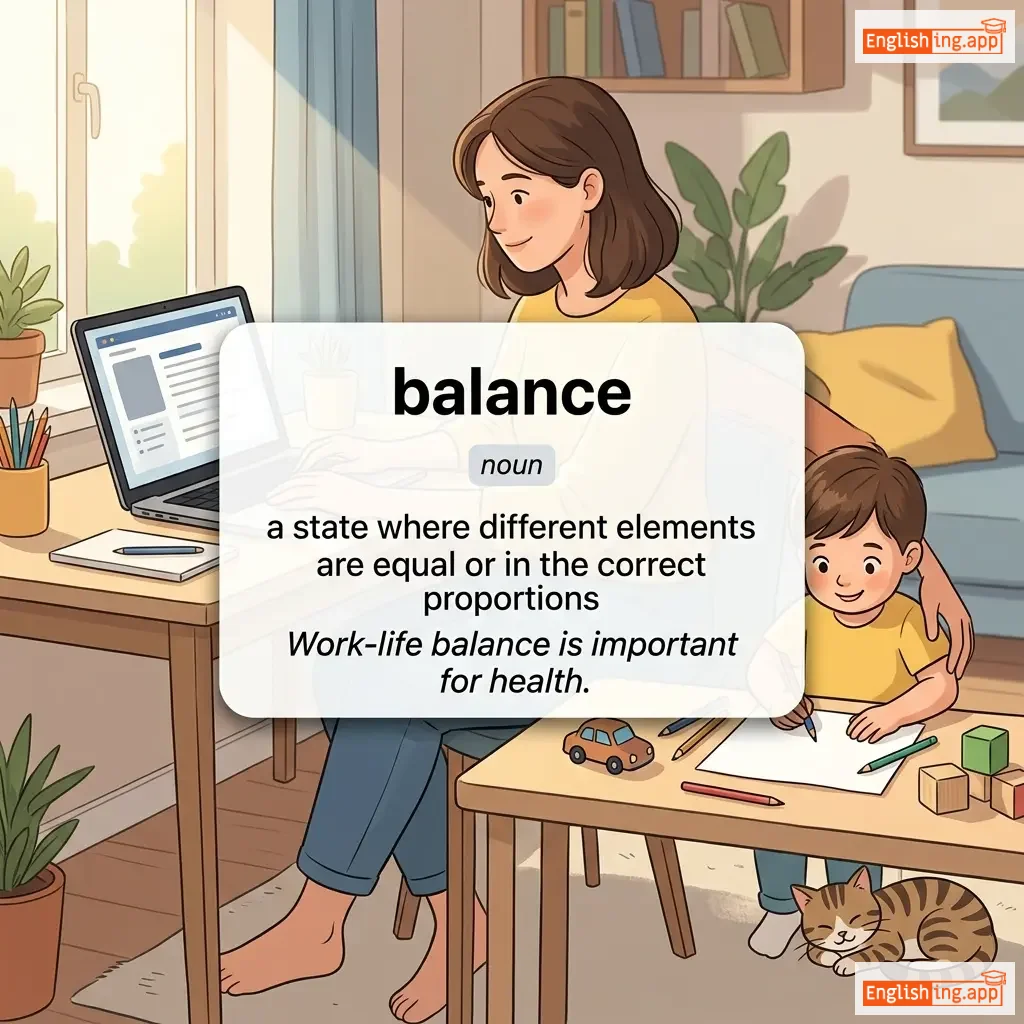
balance definition card — visual illustration of the meaning
noun
/ˈbæləns/
संतुलन (santulan)

a state where different elements are equal or in the correct proportions

"Work-life balance is important for health."

"कार्य-जीवन संतुलन स्वास्थ्य के लिए महत्वपूर्ण है।" (karya-jeevan santulan swasthya ke liye mahatvapurn hai.)
adjective
/ˈbælənst/
संतुलित (santulit)

keeping or showing a sensible and fair view or position; evenly arranged

"A balanced diet is essential for good health."

"स्वस्थ रहने के लिए एक संतुलित आहार आवश्यक है।" (Swasth rehne ke liye ek santulit aahar avashyak hai.)
balanced diet definition card — visual illustration of the meaning
noun
ˈbæl.ənst daɪ.ət
संतुलित आहार (santulit aahaar)

A diet consisting of the proper quantities and proportions of foods needed to maintain health or growth.

"A balanced diet is essential for maintaining good health."

"एक संतुलित आहार अच्छे स्वास्थ्य को बनाए रखने के लिए आवश्यक है।" (Ek santulit aahaar achhe swasthya ko banaye rakhne ke liye aavashyak hai.)
noun
/beɪl/
बैल (bail)

A large bundle of goods tightly wrapped and bound.

"The workers loaded the bale of cotton onto the truck."

"कर्मचारियों ने सूती के बैल को ट्रक में लाद लिया।" (Karmachariyon ne sooti ke bail ko truck mein laad liya.)
adjective
/ˈbeɪlfəl/
हानिकारक (haanikarak)

Threatening harm; menacing or expressing hatred.

"She gave him a baleful look after the insult."

"अपमान के बाद उसने उसे एक हानिकारक नजर दी।" (Apmaan ke baad usne use ek haanikarak nazar di.)
verb
/bɔːk/
अस्वीकार करना (asweekar karna)

to hesitate or refuse to proceed or comply

"She balked at signing the contract without reading it fully."

"वह अनुबंध पर बिना पूरी तरह से पढ़े हस्ताक्षर करने में झिझकी।" (Vah anubandh par bina puri tarah se padhe hastakshar karne mein jhijhki.)
adjective
/ˈbɔːlki/
जिद्दी (ziddi)

difficult, uncooperative, or stubborn

"The balky printer refused to work when needed most."

"जिद्दी प्रिंटर ने सबसे ज़्यादा ज़रूरत के समय काम करने से मना कर दिया।" (Ziddi printer ne sabse zyada zarurat ke samay kaam karne se mana kar diya.)
noun
/bɔːl/
गेंद (gend)

a round object used in games or sports

"The children played with a ball in the park."

"बच्चों ने पार्क में एक गेंद से खेला।" (bachon ne park mein ek gend se khela.)