ভোকাবুলারিসমূহ

ইংরেজি শব্দের বাংলা অর্থ | English to Bangla Word Meaning Dictionary

verb
/ˈdæb.əl/
শখের বসে করা (shokher bose kora)

To take part in an activity in a casual or superficial way.

"He dabbled in painting during his college days."

"কলেজ জীবনে সে শখের বসে আঁকাআঁকি করত।" (College jibone se shokher bose ankaanki korto.)
noun
/dəˈkɔɪt/
ডাকাত; দস্যু; (dakaat, doshyu)

a member of an armed gang of robbers; a bandit, especially in India and Myanmar

"The village was terrorized by a gang of dacoits who robbed travelers."

"গ্রামটি ডাকাত দলের দ্বারা নির্যাতিত হয়েছিল যারা ভ্রমণকারীদের ডাকাতি করত।" (gramti dakaat doler dwara nirjatito hoyechhilo jara bhromankarider dakaati korto.)
noun
/dæd/
বাবা (baba)

an informal term for father

"My dad taught me how to ride a bike."

"আমার বাবা আমাকে সাইকেল চালাতে শিখিয়েছিলেন।" (Amar baba amake saikel chalate shikhiechilen.)
noun
/ˈdæf.ə.dɪl/
নরগিসফুল / ড্যাফোডিল (norgishphul)

A bright yellow spring flower with a trumpet-shaped center, symbolizing rebirth and new beginnings

"The daffodils bloomed early this spring in the meadow."

"এই বসন্তে তৃণভূমিতে নরগিসফুলগুলো তাড়াতাড়ি ফুটেছিল।" (ei boshonte trinbhumite norgishphulgulo taratari futechchilo)
adjective
/dæft/
বোকা (boka)

Silly or foolish.

"It was a daft idea to go hiking without water."

"পানি ছাড়া হাইকিং এ যাওয়া ছিল একেবারে বোকামি।" (Pani chhara hiking e jaoya chilo akebare bokami.)
noun
/ˈdæɡər/
ছোরা (chhora)

a short knife with a pointed and edged blade, used as a weapon

"The assassin concealed a dagger beneath his cloak."

"হত্যাকারী তার চাদরের নিচে একটি ছোরা লুকিয়ে রেখেছিল।" (hotta-kari tar chadorer niche ekti chhora lukiye rekhechhilo)
noun
/dəˈɡerəˌtaɪp/
প্রাচীন আলোকচিত্র (prachin alokchitro)

An early type of photograph produced on a silver or silver-covered copper plate.

"The museum displayed a rare daguerreotype of Abraham Lincoln."

"জাদুঘরে আব্রাহাম লিংকনের একটি বিরল ডাগেরিওটাইপ প্রদর্শিত হয়েছিল।" (Jadughore Abraham Linkoner ekti biral dageriotype prodorshito hoyechhilo.)
noun
/ˈdeɪ.li.ə/
ডালিয়া (dahlia)

a garden plant with brightly colored flowers that bloom in summer and autumn

"She planted colorful dahlias in her garden last summer."

"তিনি গত গ্রীষ্মে তার বাগানে রঙিন ডালিয়া রোপণ করেছিলেন।" (tini goto grisshome tar bagane rongin dahlia ropon korechilen)
adjective/adverb
/ˈdeɪli/
দৈনিক (doinik)

happening every day

"She reads the newspaper daily."

"সে প্রতিদিন সংবাদপত্র পড়ে।" (Se protidin songbadpotro pore.)
adjective
/ˈdeɪnti/
সুন্দর এবং কোমল (sundor ebong komol)

Delicately small, pretty, and often considered elegant.

"She wore a dainty necklace made of pearls."

"সে মুক্তো দিয়ে তৈরি একটি কোমল হার পরেছিল।" (Se mukto diye toiri ekti komol har porechhilo.)
noun
/ˈdɛəri/
দুধের খামার (dudher khamar)

a place where milk and milk products are produced or sold

"They visited the local dairy for fresh milk."

"তারা তাজা দুধের জন্য স্থানীয় দুধের খামারে গিয়েছিল।" (Tara taja dudher jonyo sthaniyo dudher khamare giyechhilo.)
noun
/ˈdeɪ.ɪs/ or /ˈdeɪ.əs/
মঞ্চ (moncho)

A raised platform in a hall or room, usually where speakers or honored guests sit.

"The speaker stood on the dais to address the audience."

"বক্তা শ্রোতাদের উদ্দেশে বক্তব্য রাখতে ডায়াসে দাঁড়িয়েছিলেন।" (Bokta srotader uddeshe boktobbo rakhte dayase dariyechhilen.)
noun
/ˈdæliəns/
অস্থায়ী প্রেম (osthai prem)

A casual romantic or sexual relationship; also frivolous or playful behavior.

"Their dalliance during the summer was brief but intense."

"গ্রীষ্মকালে তাদের সম্পর্ক সংক্ষিপ্ত হলেও তীব্র ছিল।" (Grishmokale tader somporko shonkhipto holeo tibro chhilo.)
verb
/ˈdæli/
আলসেমি করা (alsemi kora)

To act or move slowly; to waste time; also to engage in a casual romantic relationship.

"He dallied in the garden instead of starting his work."

"সে তার কাজ শুরু করার পরিবর্তে বাগানে সময় নষ্ট করছিল।" (Se tar kaj shuru korar poriborte bagane somoy nosto korchhilo.)
noun
/dæm/
বাঁধ (bandh)

a barrier built to hold back water and raise its level

"The dam provides electricity to nearby towns."

"ড্যাম কাছাকাছি শহরগুলোতে বিদ্যুৎ সরবরাহ করে।" (Dam kachakachi shohorgulote bidyut sorborah kore.)
verb
/ˈdæmɪdʒ/
ক্ষতি (khoti)

To cause physical harm to something.

"The storm damaged several houses in the village."

"ঝড়ে গ্রামের অনেক বাড়ি ক্ষতিগ্রস্ত হয়েছে।" (Jhore gram er onek bari khotigrasto hoyeche.)
adjective
/ˈdæmɪdʒɪŋ/
ক্ষতিকর (kshotikor)

causing harm or injury

"The storm caused damaging effects to the crops."

"ঝড়ের কারণে ফসলের ওপর ক্ষতিকর প্রভাব পড়েছিল।" (Jhorer karone fosholer opor kshotikor probhab porechhilo.)
verb
/dæm/
অভিশাপ দেওয়া / গালি (abhishap dewa / gali)

to condemn or criticize strongly; used as an expletive to express anger or emphasis

"He damned the unfair system in his speech."

"সে তার বক্তৃতায় অন্যায্য ব্যবস্থাকে অভিশাপ দিয়েছিল।" (Se tar boktritay onnyayo byabosthake abhishap diyechhilo.)
noun
/dæmˈneɪ.ʃən/
নরকে নিক্ষেপ; ধ্বংস; (noroke nikkhep, dhongso)

condemnation to eternal punishment in hell; something that causes ruin or failure

"The preacher spoke about salvation and damnation in his sermon."

"ধর্মপ্রচারক তার ধর্মোপদেশে মুক্তি এবং অভিশাপ নিয়ে কথা বলেছিলেন।" (dharmoprocharak tar dharmopadesh mukhti ebong obhishap niye kotha bolechhilen.)
adjective
/dæmp/
আর্দ্র / স্যাঁতসেঁতে (ardro / syaat-saente)

slightly wet, often in an unpleasant way

"The room felt cold and damp after the rain."

"বৃষ্টির পর ঘরটা ঠান্ডা ও স্যাঁতসেঁতে লাগছিল।" (Brishtir por ghorta thanda o syaat-saente lagchhilo.)
verb
/ˈdæmpən/
ভেজানো, কমানো (bhejano, komano)

to make something slightly wet; to make something less strong, active, or intense

"The rain dampened the excitement of the outdoor concert."

"বৃষ্টি বাইরের কনসার্টের উত্তেজনা কমিয়ে দিল।" (Brishti bairer konserter uttejana komiye dilo.)
noun
/ˈdæmpər/
নিয়ন্ত্রক / উত্তেজনা কমানোর কিছু (niyontrôk / uttejana komanor kichu)

something that reduces or lessens the force, effect, or excitement

"The cancellation of the trip put a damper on their enthusiasm."

"ভ্রমণ বাতিল তাদের উৎসাহে বাঁধা সৃষ্টি করেছিল।" (Bhramon batil tader utsahe bandha srishti korechhilo.)
verb/noun
/dæns/
নাচ (nach)

to move rhythmically to music, typically following a set sequence of steps

"They danced all night at the wedding."

"তারা বিয়েতে সারা রাত নেচেছিল।" (Tara biyete sara rat nechchilo.)
noun
/ˈdænsər/
নৃত্যশিল্পী (nrityoshilpi)

a person who dances or performs dancing professionally or as a hobby

"The dancer moved gracefully across the stage."

"নৃত্যশিল্পী মঞ্চ জুড়ে সুন্দরভাবে নড়ছিল।" (Nrityoshilpi moncho jure sundorvabe norchhilo.)
noun
/ˈdænsɪŋ/
নাচ (nach)

the activity of moving the body rhythmically to music

"They spent the evening dancing at the party."

"তারা পার্টিতে সন্ধ্যাটা নাচ করে কাটিয়েছিল।" (Tara partite sondhyata nach kore katiyechhilo.)
noun
/ˈdæn.drʌf/
খুশকী; মাথার খুশকি; (khushki, mathar khushki)

small white or grey flakes of dead skin that form on the scalp and fall from the hair

"He used a special shampoo to treat his persistent dandruff problem."

"তিনি তার দীর্ঘস্থায়ী খুশকির সমস্যার চিকিৎসার জন্য একটি বিশেষ শ্যাম্পু ব্যবহার করেছিলেন।" (tini tar dirghosthayi khushkir shomoshyar chikitshar jonno ekti bishesh shampoo bybohar korechhilen.)
noun
/ˈdændi/
অতিরিক্ত ফ্যাশনপ্রিয় পুরুষ (otirikto fashionpriyo purush)

a man who gives too much attention to his appearance and clothes

"The young dandy spent hours grooming himself before the party."

"তরুণ ড্যান্ডি পার্টির আগে নিজেকে সাজাতে ঘণ্টার পর ঘণ্টা কাটিয়েছিল।" (Torun dandy partyr age nije-ke sajate ghontar por ghonta katiyechhilo.)
noun
/ˈdeɪn.dʒər/
বিপদ (bipad)

The possibility of harm, injury, or loss.

"The hikers were in great danger during the storm."

"ঝড়ের সময় হাইকাররা বড় বিপদের মধ্যে ছিল।" (Jhorrer somoy hikerra boro bipoder moddhe chilo.)
adjective
/ˈdeɪndʒərəs/
বিপজ্জনক (bipojjonok)

likely to cause harm or injury; unsafe

"Driving fast on icy roads is dangerous."

"বরফে ঢাকা রাস্তায় দ্রুত গাড়ি চালানো বিপজ্জনক।" (Borofe dhaka rastay druto gari chalano bipojjonok.)
adverb
/ˈdeɪndʒərəsli/
বিপজ্জনকভাবে; (bipojonnokovabe)

in a way that could cause harm or injury; riskily

"He was driving dangerously fast on the highway."

"সে হাইওয়েতে বিপজ্জনকভাবে দ্রুত গাড়ি চালাচ্ছিল।" (she highway te bipojonnokovabe druto gari chalachhilo)
verb
/ˈdæŋɡəl/
ঝুলে থাকা (jhule thaka)

to hang loosely or swing freely

"The keys dangled from his belt."

"চাবিগুলো তার বেল্ট থেকে ঝুলে ছিল।" (Chabigulo tar belt theke jhule chilo.)
adjective
/dæŋk/
স্যাঁতসেঁতে ও অন্ধকারাচ্ছন্ন (syaat-saente o andhakarachchhanno)

unpleasantly damp and cold

"The basement was dark and dank, filled with a musty smell."

"বেসমেন্টটি অন্ধকারাচ্ছন্ন ও স্যাঁতসেঁতে ছিল, যেখানে একটি বাজে গন্ধ ভরেছিল।" (Basementti andhakarachchhanno o syaat-saente chhilo, jekhane ekti baje gondho bhorechhilo.)
adjective
/ˈdæpər/
স্মার্ট এবং পরিপাটি (smart ebong poripati)

Neat, stylish, and well-dressed in appearance.

"He looked very dapper in his new suit."

"সে তার নতুন স্যুটে খুব পরিপাটি দেখাচ্ছিল।" (Se tar notun suite khub poripati dekhachhilo.)
adjective
/ˈdæpəld/
ছোপ ছোপ (chop chop)

Marked with spots or patches of light and shade or different colors.

"The forest floor was dappled with sunlight."

"জঙ্গলের মাটিতে সূর্যের আলো ছোপ ছোপ পড়েছিল।" (Jongoler matite surjer alo chop chop porechhilo.)
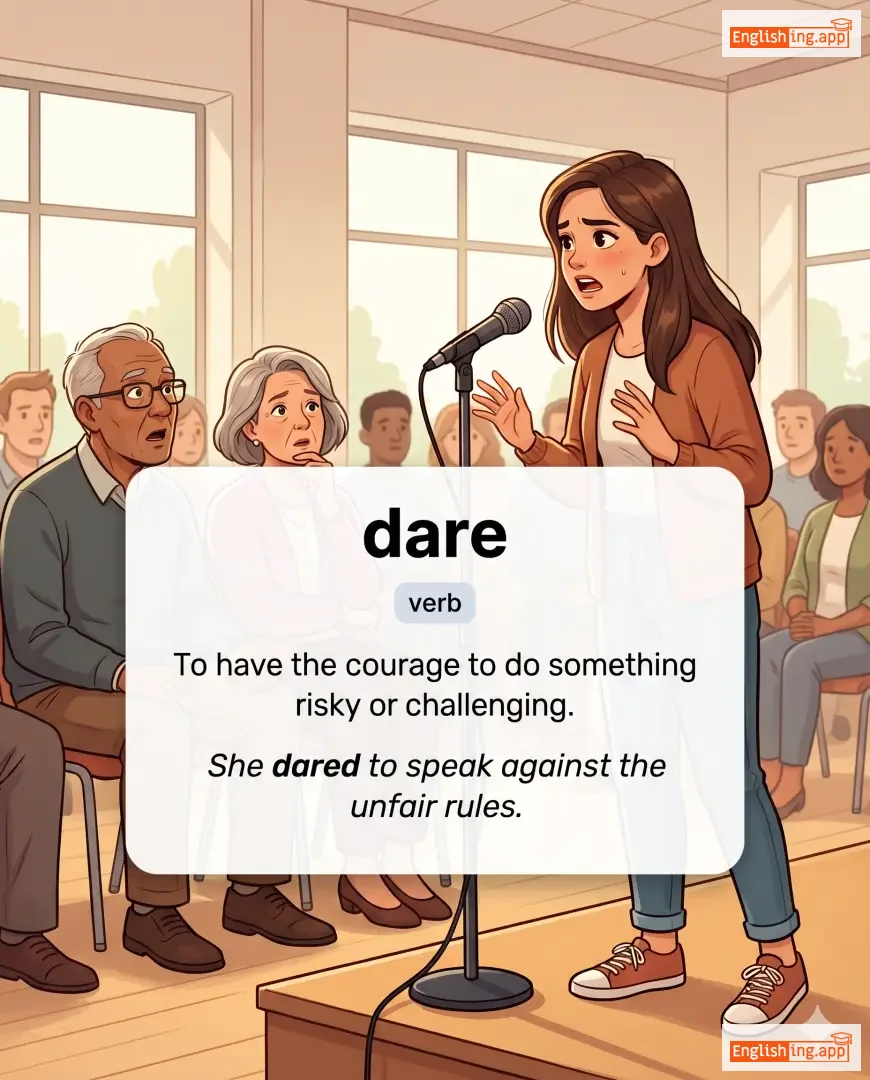
dare definition card — visual illustration of the meaning
verb
/der/
সাহস করা (sahas kora)

To have the courage to do something risky or challenging.

"She dared to speak against the unfair rules."

"সে অন্যায় নিয়মের বিরুদ্ধে কথা বলার সাহস করেছিল।" (Se onnyay niyomer biruddhe kotha bolar sahas korechilo.)
noun
/ˈderˌdevəl/
ঝুঁকিপ্রবণ ব্যক্তি (jhuki pronon bekti)

A person who enjoys doing dangerous or risky things.

"The stunt was performed by a famous daredevil."

"স্টান্টটি একজন বিখ্যাত ঝুঁকিপ্রবণ ব্যক্তি করেছিলেন।" (Stunt ti ekjon bikhato jhuki pronon bekti korechhilen.)
adjective
/ˈderɪŋ/
সাহসী (sahosi)

Willing to take risks; bold and adventurous.

"Her daring plan surprised everyone."

"তার সাহসী পরিকল্পনা সবাইকে অবাক করেছিল।" (Tar sahosi porikalpona sobaike obak korechhilo.)
adjective
/dɑːrk/
অন্ধকার (ondhokar)

with little or no light; gloomy or mysterious

"The room was dark after the lights went out."

"বাতি নিভে যাওয়ার পর ঘরটি অন্ধকার হয়ে গেল।" (Bati nibhe jawar por ghorti ondhokar hoye gelo.)
adjective
/dɑːrk bluː/
শ্যামল নীল (shyamol nil)

a deep shade of blue color

"She wore a dark blue dress to the party."

"সে পার্টিতে একটি শ্যামল নীল পোশাক পরেছিল।" (she partite ekti shyamol nil poshak porechilo.)
verb
/ˈdɑːrkən/
অন্ধকার করা (ondhokar kora)

to make or become dark; to reduce brightness or light

"The clouds began to darken the sky before the storm."

"ঝড়ের আগে মেঘগুলো আকাশকে অন্ধকার করতে শুরু করল।" (jhorer age meghgulo akashke ondhokar korte shuru korlo)
adverb
/ˈdɑːrklɪŋ/
অন্ধকারে (ondhokare)

In the dark or growing dark; dimly.

"The forest creatures moved darkling through the night."

"বনের প্রাণীরা অন্ধকারে রাত পার হচ্ছিল।" (Boner pranira ondhokare rat par hochhilo.)
noun
/ˈdɑːrk.nəs/
অন্ধকার (ondhokar)

The absence of light; the state of being dark.

"The room was filled with darkness after the lights went out."

"বাতি নিভে গেলে ঘরটি অন্ধকারে ভরে গিয়েছিল।" (Bati nibhe gele ghorti ondhokare bhore giyechilo.)
verb, noun
/dɑːrt/
তীর/হঠাৎ ছুটে যাওয়া (tir/hotat chute jaoya)

to move suddenly and quickly; a small pointed missile thrown at a target

"The cat darted across the street to avoid the car."

"গাড়ি এড়াতে বিড়ালটি রাস্তা পার হয়ে হঠাৎ দৌড়ে গেল।" (Gari erate biralti rastaa par hoye hotat dourye gelo.)
noun
/ˈdɑːrwɪnɪzəm/
ডারউইনের বিবর্তনবাদ (Darwiner bibortonbad)

the theory of biological evolution developed by Charles Darwin, emphasizing natural selection

"Darwinism revolutionized the way scientists understood the origin of species."

"ডারউইনিজম প্রজাতির উৎপত্তি সম্পর্কে বিজ্ঞানীদের ধারণাকে আমূল পরিবর্তন করেছিল।" (Darwinism projatir utpotti somporke bigganider dharanake amul poriborton korechilo.)
verb
/dæʃ/
দ্রুত দৌড়ানো, ভেঙে ফেলা (druto dourano, venge fela)

to move quickly and suddenly; to strike or break something violently

"She dashed across the street to catch the bus."

"সে বাস ধরার জন্য রাস্তাটি দ্রুত অতিক্রম করল।" (Se bas dhorar jonno rastati druto otikrom korlo.)
adjective
/ˈdæʃ.ɪŋ/
চটপটে; সাহসী; আকর্ষণীয়; (chotpote)

stylish and confident; lively and energetic; attractive and charming

"He looked dashing in his new suit."

"তিনি তার নতুন স্যুটে চটপটে দেখাচ্ছিলেন।" (tini tar notun syute chotpote dekhacchilen.)
noun
/ˈdæstərd/
কাপুরুষ (kapurush)

a cowardly or dishonorable person

"Only a dastard would betray his closest friend."

"শুধুমাত্র একজন কাপুরুষই তার সবচেয়ে ঘনিষ্ঠ বন্ধুকে বিশ্বাসঘাতকতা করবে।" (Shudhumatro ekjon kapurushi tar sobcheye ghanistho bondhuke bishashghatakota korbe.)
noun
/ˈdeɪ.tə/ or /ˈdæt.ə/
তথ্য (tottho)

Facts, statistics, or information collected for reference or analysis.

"The scientists analyzed the data to find patterns."

"বিজ্ঞানীরা প্যাটার্ন খুঁজতে ডেটা বিশ্লেষণ করেছিলেন।" (Bigganira pattern khujte data bishleshon korechilen.)
data breach definition card — visual illustration of the meaning
noun
/ˈdeɪ.tə briːtʃ/
তথ্য ফাঁস বা তথ্য চুরি (tothyo phash ba tothyo churi)

Unauthorized disclosure of sensitive information through security violation

"A data breach exposed millions of users' passwords."

"একটি তথ্য ফাঁসে লক্ষাধিক ব্যবহারকারীর পাসওয়ার্ড ফাঁস হয়ে যায়।" (Ekti tothyo phase lokkhadhik byaboharkarir password phash hoye jay.)
noun
/ˈdeɪtəbeɪs/
তথ্যভাণ্ডার (tathyabhandar)

a structured collection of data stored and accessed electronically

"The company's customer details are stored in a secure database."

"কোম্পানির কাস্টমারদের তথ্য একটি সুরক্ষিত ডেটাবেসে সংরক্ষিত আছে।" (Companyr customerder tothyo ekta surakhito database e songrokhito ache.)