ভোকাবুলারিসমূহ

ইংরেজি শব্দের বাংলা অর্থ | English to Bangla Word Meaning Dictionary

noun
/læb/
প্রयोगশালা (proyogshala)

a place equipped for scientific experiments, research, or teaching

"The students conducted an experiment in the chemistry lab."

"শিক্ষার্থীরা রসায়ন ল্যাবে একটি পরীক্ষা পরিচালনা করেছিল।" (Shikkharthira rashayon labe ekti porikkha porichalona korechilo.)
noun/verb
/ˈleɪ.bəl/
লেবেল (lebel)

a small piece of paper, fabric, or material attached to an object giving information about it; to attach such a tag or to describe someone or something in a particular way

"She labeled the boxes to make moving easier."

"সে বাক্সগুলোতে লেবেল লাগিয়েছিল যাতে স্থানান্তর সহজ হয়।" (Se baksgulote lebel lagiyechilo jate sthanantor sohoj hoy.)
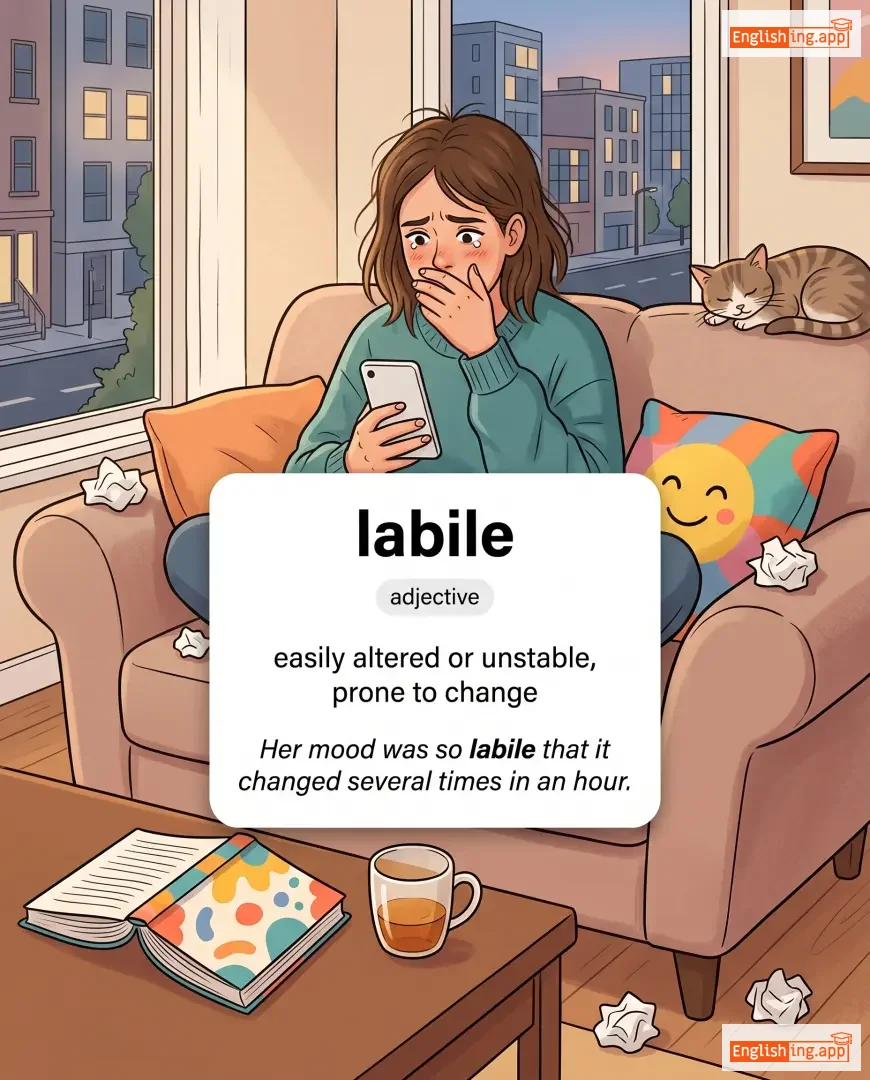
labile definition card — visual illustration of the meaning
adjective
/ˈleɪ.baɪl/ or /ˈlæb.aɪl/
অস্থিতিশীল (oshthitishil)

easily altered or unstable; prone to change

"Her mood was so labile that it changed several times in an hour."

"তার মেজাজ এত অস্থিতিশীল ছিল যে এক ঘন্টার মধ্যে বহুবার পরিবর্তিত হয়েছে।" (Tar mejaj eto oshthitishil chilo je ek ghontar moddhe bohubar poribortito hoyeche.)
noun/verb
/ˈleɪ.bər/
শ্রম (shrom)

work, especially hard physical work; to work hard

"The workers labored in the hot sun all day."

"শ্রমিকরা সারাদিন প্রচণ্ড রোদে কাজ করেছে।" (Shromikra saradin prochondo rode kaj koreche.)
laboratories definition card — visual illustration of the meaning
noun
ˈlæbrətɔːriz
গবেষণাগার (gobeshonagar)

A room or building equipped for scientific experiments, research, or teaching, or for the manufacture of drugs or chemicals.

"Advanced laboratories enabled groundbreaking discoveries."

"উন্নত গবেষণাগার যুগান্তকারী আবিষ্কার সম্ভব করেছে।" (Unnoto gobeshonagar yugantokari abishkar shombhob koreche.)
noun
/ˈlæbrətɔːri/
প্রयोगশালা (proyogshala)

A room or building equipped for scientific experiments, research, or teaching.

"The students conducted the experiment in the chemistry laboratory."

"শিক্ষার্থীরা রসায়নের ল্যাবরেটরিতে পরীক্ষা পরিচালনা করেছিল।" (Shikkharthira rashayon er laboratory te porikkha porichalona korechilo.)
noun
/ləˈbɔːr.ə.tɔːr.i/
প্রয়োগশালা; গবেষণাগার; (proyogshala, gobeshonagar)

a room or building equipped for scientific experiments, research, or teaching

"The scientists conducted their experiments in the well-equipped laboratory."

"বিজ্ঞানীরা তাদের পরীক্ষা-নিরীক্ষা সুসজ্জিত গবেষণাগারে পরিচালনা করেছিলেন।" (bigganirah tader porikha-nirikha shushojjito gobeshonagare porichalona korechhilen.)
adjective/verb
/ˈleɪ.bərd/
কষ্টসাধ্য (koshtoshadhyo)

done with great effort and difficulty; or past tense of labor

"He gave a labored explanation that confused the audience."

"সে একটি কষ্টসাধ্য ব্যাখ্যা দিয়েছিল যা শ্রোতাদের বিভ্রান্ত করেছিল।" (Se ekti koshtoshadhyo byakkha diyechilo ja shrotader bivhranto korechilo.)
noun
/ˈleɪbərər/
শ্রমিক (sromik)

a person who does physical work, especially work that requires strength rather than skill

"The laborer worked long hours at the construction site."

"শ্রমিকটি নির্মাণস্থলে দীর্ঘ সময় কাজ করেছে।" (sromikti nirmanshole dirgho shomoy kaj koreche)
adjective
/ləˈbɔːr.i.əs/
কষ্টসাধ্য (koshtoshadhyo)

requiring considerable effort and time; difficult and hard-working

"Writing the long report was a laborious task."

"দীর্ঘ রিপোর্ট লেখা ছিল একটি কষ্টসাধ্য কাজ।" (Dirgho report lekha chilo ekti koshtoshadhyo kaj.)
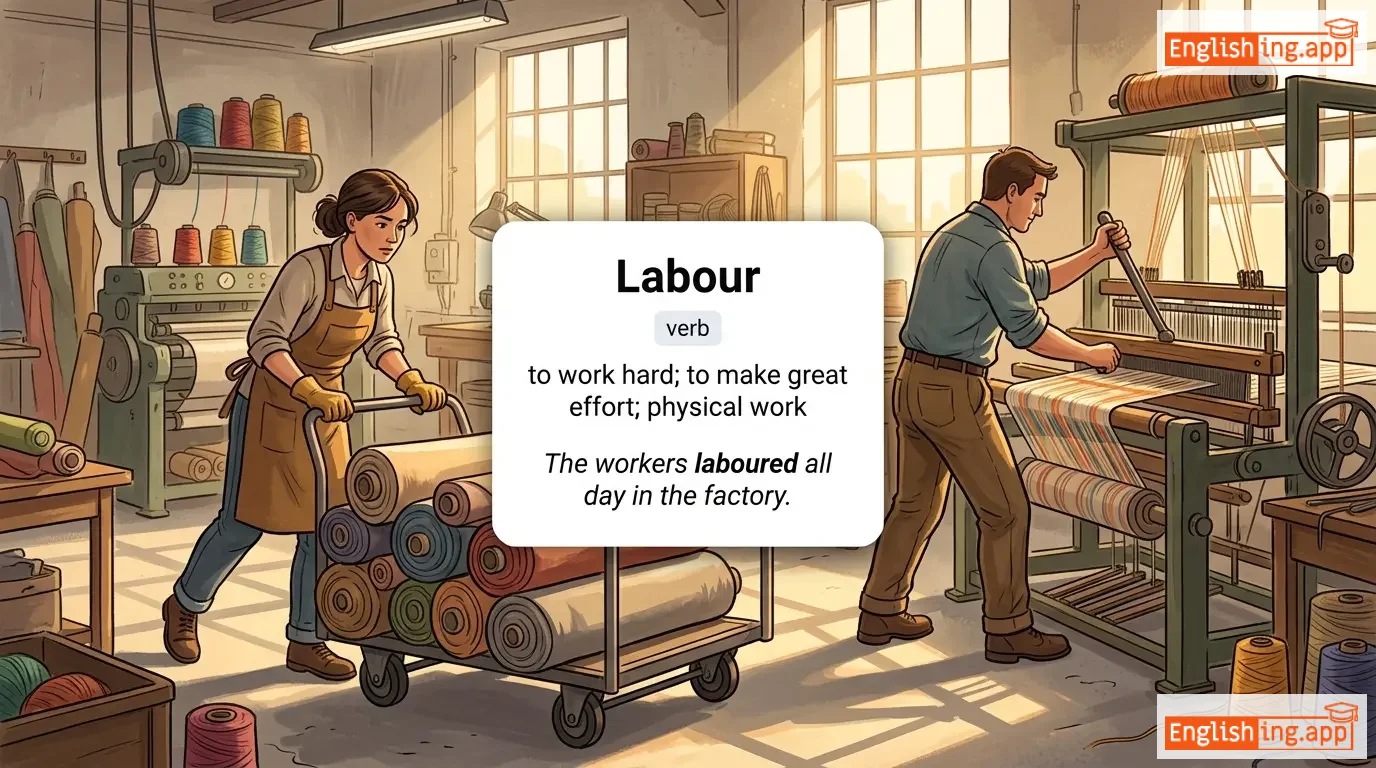
Labour definition card — visual illustration of the meaning
noun
/ˈleɪ.bər/
শারীরিক ও মানসিক শ্রম; (sharirik o manoshik shrom)

work involving physical or mental effort; workers as a group

"The construction required months of hard labour to complete."

"নির্মাণকাজ সম্পূর্ণ করতে কয়েক মাসের কঠিন শ্রমের প্রয়োজন হয়েছিল।" (nirmankoj shompurno korte koyak masher kothin shromer proyojon hoyechhilo.)
noun
/ˈleɪ.bər.ər/
মজুর (mojur)

a person who does unskilled physical work for wages

"The labourer worked hard all day at the construction site."

"মজুরটি নির্মাণ সাইটে সারাদিন কঠিন পরিশ্রম করেছিল।" (mojurti nirman saite sharaadin kothin porishrom korechilo)
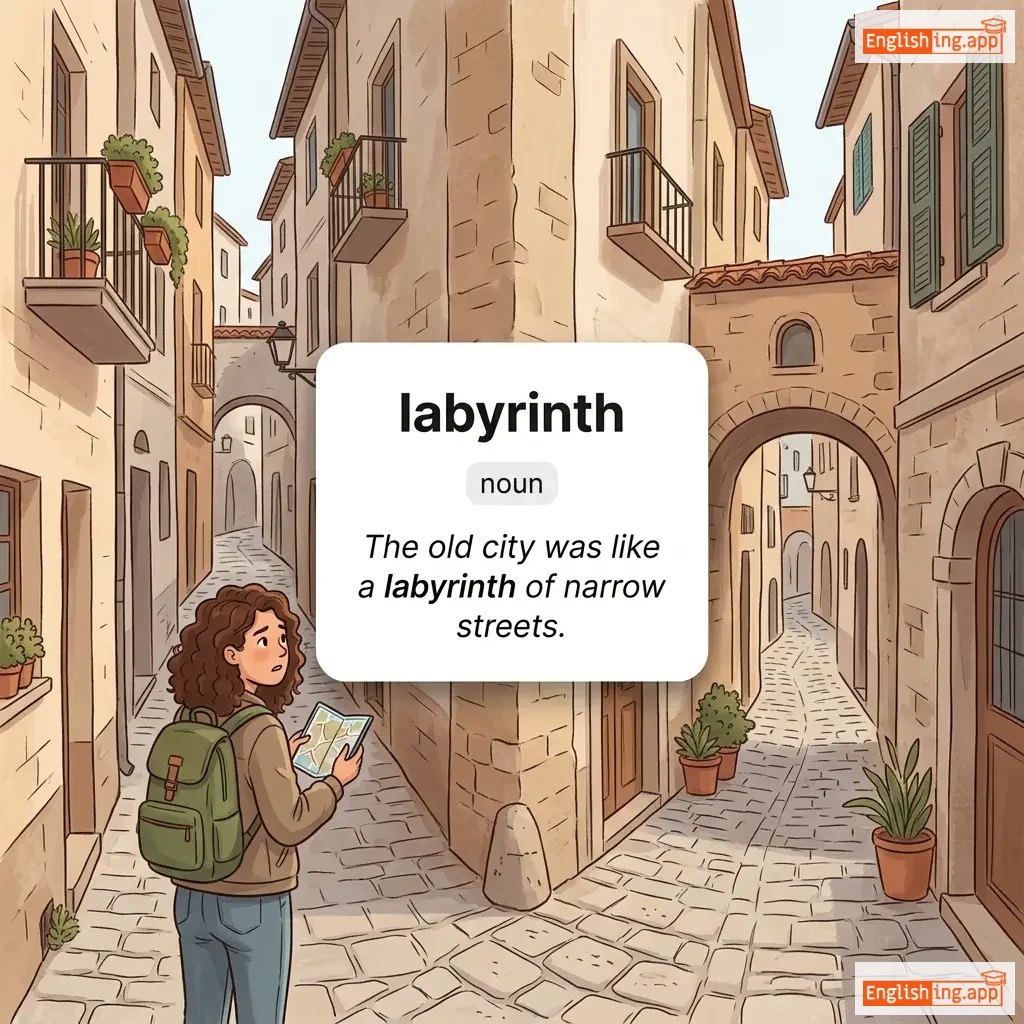
labyrinth definition card — visual illustration of the meaning
noun
/ˈlæb.ə.rɪnθ/
গোলকধাঁধা (golokdhadha)

a complex, confusing network of paths or passages; something very intricate or confusing

"The old city was like a labyrinth of narrow streets."

"পুরোনো শহরটি সংকীর্ণ রাস্তার এক গোলকধাঁধার মতো ছিল।" (Purono shohorti sonkirno rastar ek golokdhadhar moto chhilo.)
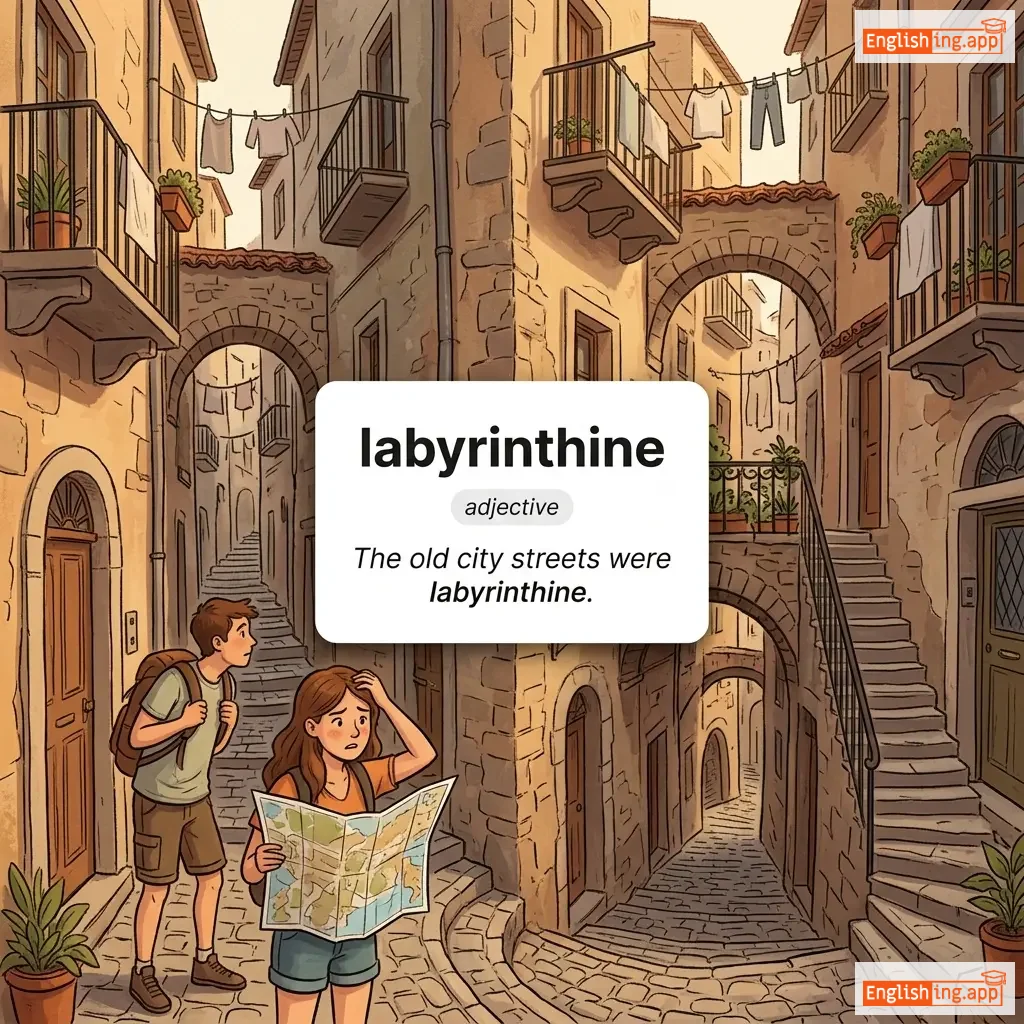
labyrinthine definition card — visual illustration of the meaning
adjective
ˌlæb.əˈrɪn.θaɪn
জটিল (jotil)

Like a labyrinth; complicated and confusing; having many interconnected paths or passages.

"The old city streets were labyrinthine."

"পুরাতন শহরের রাস্তাগুলো ল্যাবিরিন্থাইন ছিল।" (Puraton shohorer rastagulo labyrinthine chhilo.)
noun/verb
/leɪs/
ফিতা, লেস কাপড় (fita, les kapor)

a delicate fabric made of threads; or to fasten or tie with a lace

"She laced up her shoes before leaving."

"বের হওয়ার আগে সে তার জুতো ফিতার সাথে বেঁধেছিল।" (Ber howar age se tar juto fitar sathe bendhechhilo.)
verb
/ˈlæs.ə.reɪt/
ছিন্নভিন্ন করা, ক্ষত-বিক্ষত করা (chinnobhinnno kora, khoto-bikhoto kora)

to tear or cut deeply in the skin or flesh

"The broken glass lacerated his hand."

"ভাঙা কাঁচ তার হাতকে ক্ষতবিক্ষত করেছিল।" (Bhanga kanch tar hatke khotobikhoto korechhilo.)
noun
/ˌlæs.əˈreɪ.ʃən/
ক্ষতবিক্ষত কাটা (khotobikhoto kata)

a deep cut or tear in skin or flesh

"He needed stitches for a laceration on his leg."

"তার পায়ের ক্ষতবিক্ষত কাটা সেলাইয়ের প্রয়োজন ছিল।" (Tar payer khotobikhoto kata selaier proyojon chhilo.)
adjective
/ˈlæk.rɪ.moʊs/
অশ্রুসিক্ত, শোকার্ত (oshrushikto, shokarta)

tearful or given to weeping; sad and mournful

"The movie's lachrymose ending left the audience in tears."

"সিনেমার শোকার্ত সমাপ্তি দর্শকদের কাঁদিয়ে তুলেছিল।" (Cinemar shokarta somapti dorkhokder kandie tulchhilo.)
noun/verb
/læk/
অভাব (abhav)

The state of being without or not having enough of something.

"He failed the exam due to a lack of preparation."

"প্রস্তুতির অভাবে সে পরীক্ষায় ব্যর্থ হয়েছিল।" (Prostutir abhabe se porikkhaya byartho hoyechilo.)
adjective
/ˌlækəˈdeɪzɪkəl/
অলস বা উদাসীন (olos ba udashin)

lacking enthusiasm, energy, or determination; careless or lazy

"His lackadaisical attitude toward work annoyed his boss."

"তার কাজের প্রতি উদাসীন মনোভাব তার বসকে বিরক্ত করেছিল।" (tar kajer proti udashin monobhav tar boske birokt korechilo.)
noun
/ˈlæki/
চাকর বা দাস (chakar ba das)

a person who is overly willing to serve or obey someone else

"He treated his assistant like a mere lackey."

"সে তার সহকারীকে শুধুমাত্র চাকরের মতো ব্যবহার করেছিল।" (se tar shohokarike shudhumatro chakorer moto byabohar korechilo.)
adjective
/ˈlækɪŋ/
অভাব (abhav)

not having enough of something; missing

"His report was lacking in detail."

"তার প্রতিবেদনে বিস্তারিতের অভাব ছিল।" (Tar protibedone bistriter abhab chhilo.)
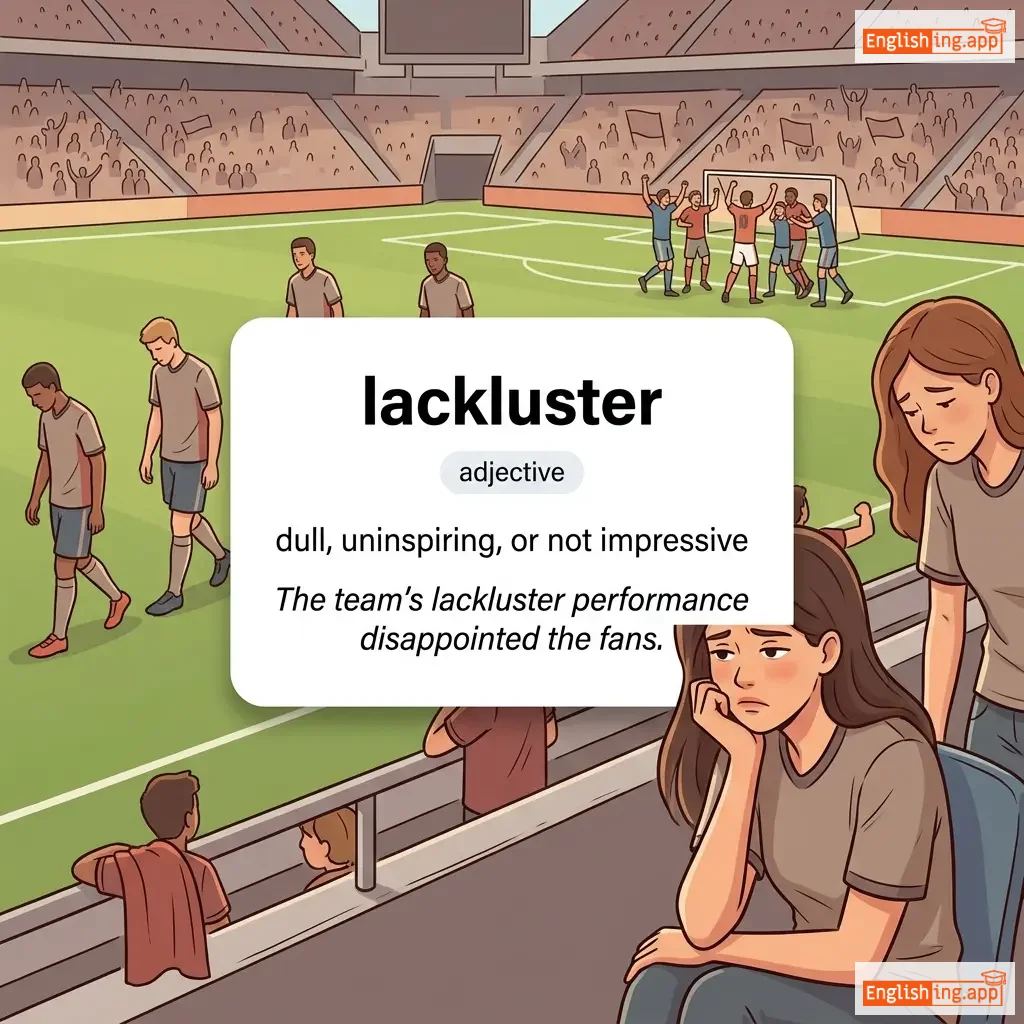
lackluster definition card — visual illustration of the meaning
adjective
/ˈlækˌlʌstər/
নিষ্প্রভ বা অনুজ্জ্বল (nishprôbhô ba onujjol)

dull, uninspiring, or not impressive

"The team's lackluster performance disappointed the fans."

"দলের নিষ্প্রভ পারফরম্যান্স ভক্তদের হতাশ করেছিল।" (doler nishprôbhô performance bhoktader hotash korechilo.)
laconic definition card — visual illustration of the meaning
adjective
/ləˈkɒnɪk/
সংক্ষিপ্তভাষী (songkhiptobhashi)

using very few words; concise to the point of seeming rude or mysterious

"His laconic reply ended the conversation quickly."

"তার সংক্ষিপ্ত উত্তর দ্রুত কথোপকথন শেষ করেছিল।" (tar songkhipto uttor druto kothopokothon shesh korechilo.)
noun
/lækˈteɪʃən/
দুধ নিঃসরণ (dudh nihshoron)

the secretion of milk by the mammary glands of female mammals

"The doctor explained that lactation is a natural process after childbirth."

"ডাক্তার ব্যাখ্যা করেছিলেন যে সন্তান জন্মের পর দুধ নিঃসরণ একটি স্বাভাবিক প্রক্রিয়া।" (daktar byakkha korechilen je shontan jonmer por dudh nihshoron ekti shabhavik prokriya.)
adjective
/ˈlæk.ti.əl/
দুধজাতীয় বা দুধের মতো (dudhjatio ba dudher moto)

Relating to or resembling milk; conveying chyle or milky fluid.

"The lacteal vessels in the small intestine absorb dietary fats."

"ক্ষুদ্রান্ত্রের ল্যাকটিয়াল নালী খাদ্য চর্বি শোষণ করে।" (Khudro antrer lacteal nali khaddo chorbi shoson kore.)
adjective
/ˈlæk.tɪk/
দুধজাতীয় বা ল্যাকটিক এসিড সম্পর্কিত (dudhjatio ba lactic acid somprokito)

Relating to milk or lactic acid.

"Intense exercise can lead to a buildup of lactic acid in the muscles."

"তীব্র ব্যায়াম পেশীতে ল্যাকটিক এসিড জমে যেতে পারে।" (Tibro byayam peshite lactic acid jome jete pare.)
noun
/læd/
ছেলে (chele)

a boy or young man; a male youth

"The young lad helped his father in the shop."

"যুবক ছেলেটি তার বাবাকে দোকানে সাহায্য করেছিল।" (jubok cheletii tar babake dokane sahajjo korechhilo)
noun
/ˈlædər/
সিঁড়ি (siri)

a structure with steps used for climbing up or down

"He used a ladder to reach the roof."

"সে ছাদে উঠতে একটি সিঁড়ি ব্যবহার করেছিল।" (Se chade uthte ekti siri byabohar korechhilo.)
noun
/ˈlæd.i/
ছোট ছেলে (choto chele)

A young boy or lad.

"The old man gave the young laddie a kind smile."

"বৃদ্ধ লোকটি ছোট ছেলেটিকে একটি সদয় হাসি দিল।" (Bridho lokti choto cheletike ekti shodoy hasi dilo.)
noun, verb
/ˈleɪ.dl̩/
সুপ খাওয়ার বড় চামচ (sup khawar boro chamoch)

A large spoon for serving soup or liquids; to serve with such a spoon.

"She used a ladle to serve the hot soup into bowls."

"সে বড় চামচ দিয়ে গরম স্যুপ বাটিতে পরিবেশন করল।" (Se boro chamoch diye gorom sup batite poribeshon korlo.)
noun
/ˈleɪdi/
ভদ্রমহিলা (bhodromohila)

A polite or formal way of referring to a woman.

"The lady at the counter was very helpful."

"কাউন্টারের ভদ্রমহিলা খুব সহায়ক ছিলেন।" (Counter er bhodromohila khub shahayok chhilen.)
verb, noun
/læɡ/
ধীরগতি বা বিলম্ব (dhirgoti ba bilomb)

To fall behind in movement, progress, or development; a delay or period of falling behind.

"The old computer tends to lag when running new software."

"পুরনো কম্পিউটার নতুন সফটওয়্যার চালানোর সময় প্রায়ই ধীর হয়ে যায়।" (Purono computer notun software chalanor somoy prayoi dhir hoye jay.)
noun
/ˈlæɡərd/
পিছিয়ে থাকা ব্যক্তি (pichiye thaka bekti)

A person or thing that is slow or falls behind others.

"The company has been a laggard in adopting new technology."

"কোম্পানিটি নতুন প্রযুক্তি গ্রহণে পিছিয়ে রয়েছে।" (Companyti notun projukti grohone pichiye royeche.)
noun
/ˈlænjæp/
অতিরিক্ত উপহার (otirikto upohar)

A small gift or bonus given by a seller to a customer.

"The shopkeeper offered a piece of candy as a lagniappe."

"দোকানদার একটি ক্যান্ডি উপহার হিসেবে দিলেন।" (Dokandar ekti candy upohar hisebe dilen.)
noun
/ləˈɡuːn/
লাগুন (lagun)

A shallow body of water separated from the sea by sandbars or reefs.

"We swam in the calm waters of the lagoon."

"আমরা লাগুনের শান্ত পানিতে সাঁতার কাটলাম।" (Amra laguner shanto panite satar katlam.)
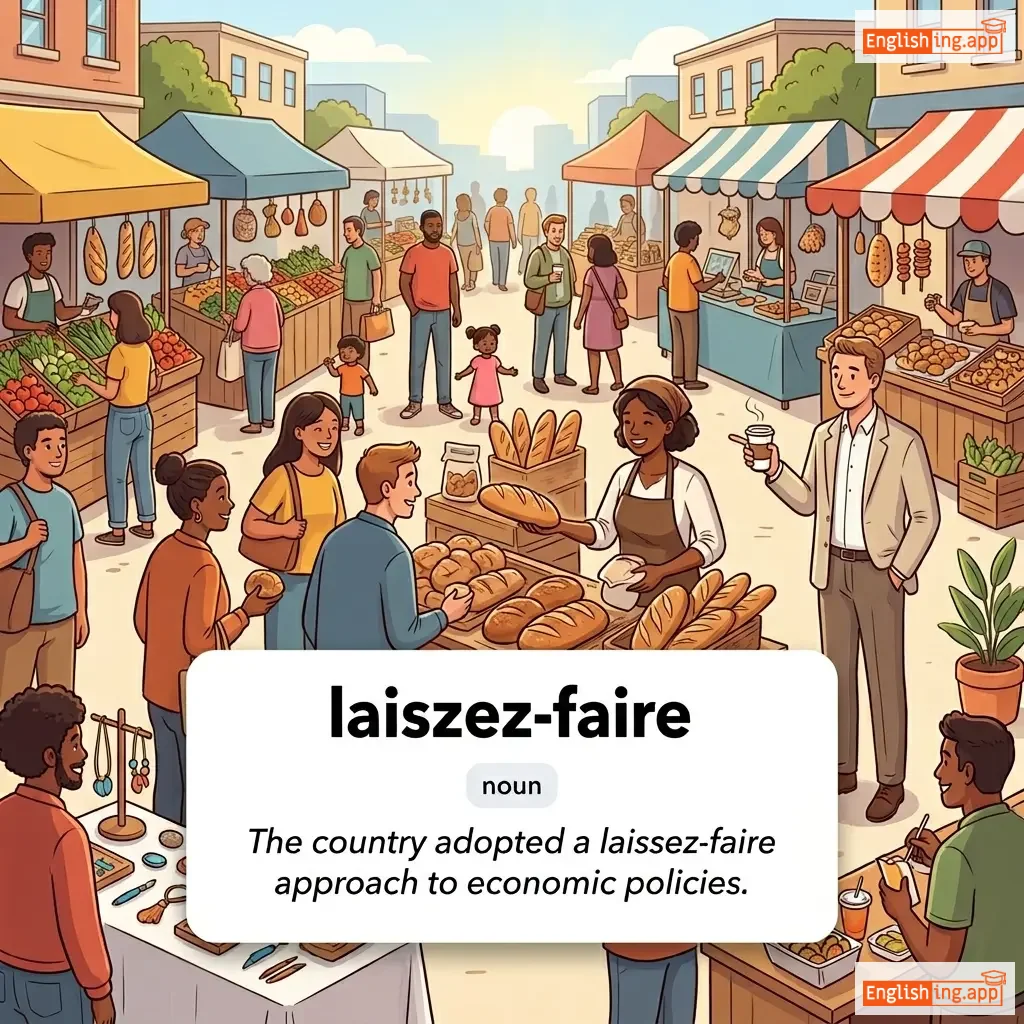
laissez-faire definition card — visual illustration of the meaning
noun
/ˌlɛ.seɪˈfɛər/
অহস্তক্ষেপবাদ (ohastokkhepobaad)

A free-market policy of minimal government intervention in economic affairs, characterized by non-interventionism and capitalism.

"The country adopted a laissez-faire approach to economic policies."

"দেশটি অর্থনৈতিক নীতিতে অহস্তক্ষেপবাদ গ্রহণ করেছে।" (Deshti orthonoitik nitite ohastokkhepobaad grohon koreche.)
noun
/ˈleɪ.ɪ.ti/
ধর্মীয় সাধারণ জনগণ (dhormiyo samanno jonogon)

Ordinary members of a religious community who are not clergy.

"The church welcomed the laity to participate in the event."

"চার্চটি সাধারণ মানুষকে অনুষ্ঠানে অংশগ্রহণের জন্য স্বাগত জানিয়েছিল।" (Churchti samanno manushke onusthane ongshogrohon er jonno swagat janiechhilo.)
noun
/leɪk/
হ্রদ (hrod)

A large area of water surrounded by land.

"They enjoyed boating on the lake during summer."

"গ্রীষ্মকালে তারা হ্রদে নৌকা চালাতে আনন্দ পেয়েছিল।" (Grishmokale tara hrode nouka chalate anondo peyechhilo.)
noun
/læm/
ভেড়ার বাচ্চা (verar bachcha)

a young sheep; meat from a young sheep

"The little lamb followed its mother everywhere."

"ছোট ভেড়ার বাচ্চাটি সর্বত্র তার মায়ের পেছনে পেছনে যেত।" (chhoto verar bachhati sorbotro tar mayer pechhone pechhone jeto)
verb
/læmˈbæst/
কঠোর সমালোচনা করা (kothor somalochona kora)

To criticize harshly or to beat severely.

"The coach lambasted the team for their poor performance."

"কোচ দলকে খারাপ পারফরম্যান্সের জন্য কঠোরভাবে সমালোচনা করলেন।" (Coach dolke kharap performance er jonno kothorbabe somalochona korlen.)
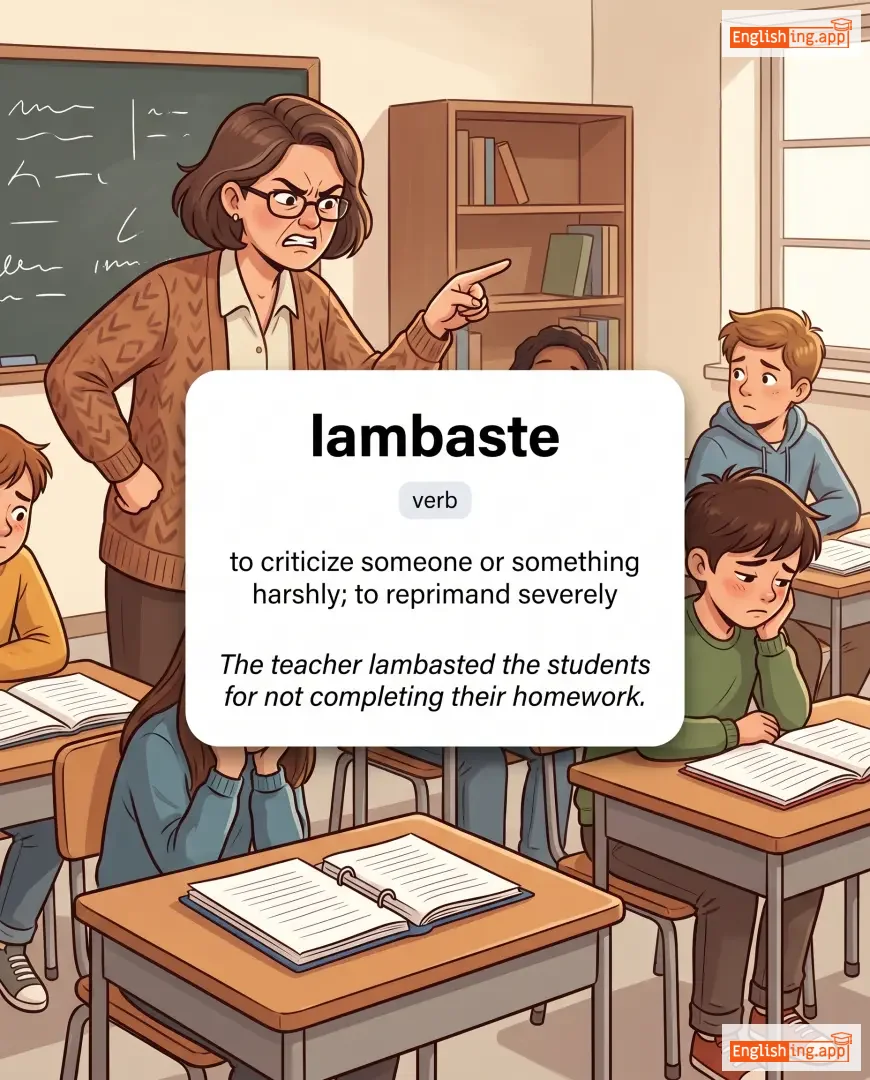
lambaste definition card — visual illustration of the meaning
verb
/læmˈbeɪst/
তীব্র সমালোচনা করা (tibro samalochona kora)

to criticize someone or something harshly; to reprimand severely

"The teacher lambasted the students for not completing their homework."

"শিক্ষক ছাত্রদের বাড়ির কাজ না করার জন্য তীব্রভাবে সমালোচনা করেছিলেন।" (Shikkhok chatroder barir kaj na korar jonno tibrobabe samalochona korechilen.)
adjective
/ˈlæmbənt/
মৃদু জ্যোতির্ময় (mridu jyotirmoy)

glowing or flickering softly; having a gentle radiance

"The lambent light of the candle filled the room with warmth."

"মোমবাতির মৃদু জ্যোতির্ময় আলো ঘরটিকে উষ্ণতায় ভরে দিল।" (Mombatir mridu jyotirmoy alo ghortike ushnotay bhore dilo.)
adjective
/leɪm/
পঙ্গু; খোঁড়া; (pongu)

unable to walk normally because of an injury or illness affecting the leg or foot; weak and unconvincing

"The injured horse was lame and couldn't walk properly."

"আহত ঘোড়াটি খোঁড়া ছিল এবং সঠিকভাবে হাঁটতে পারছিল না।" (Ahoto ghoratee khora chilo ebong shothikbhabe hantey parchilo na.)
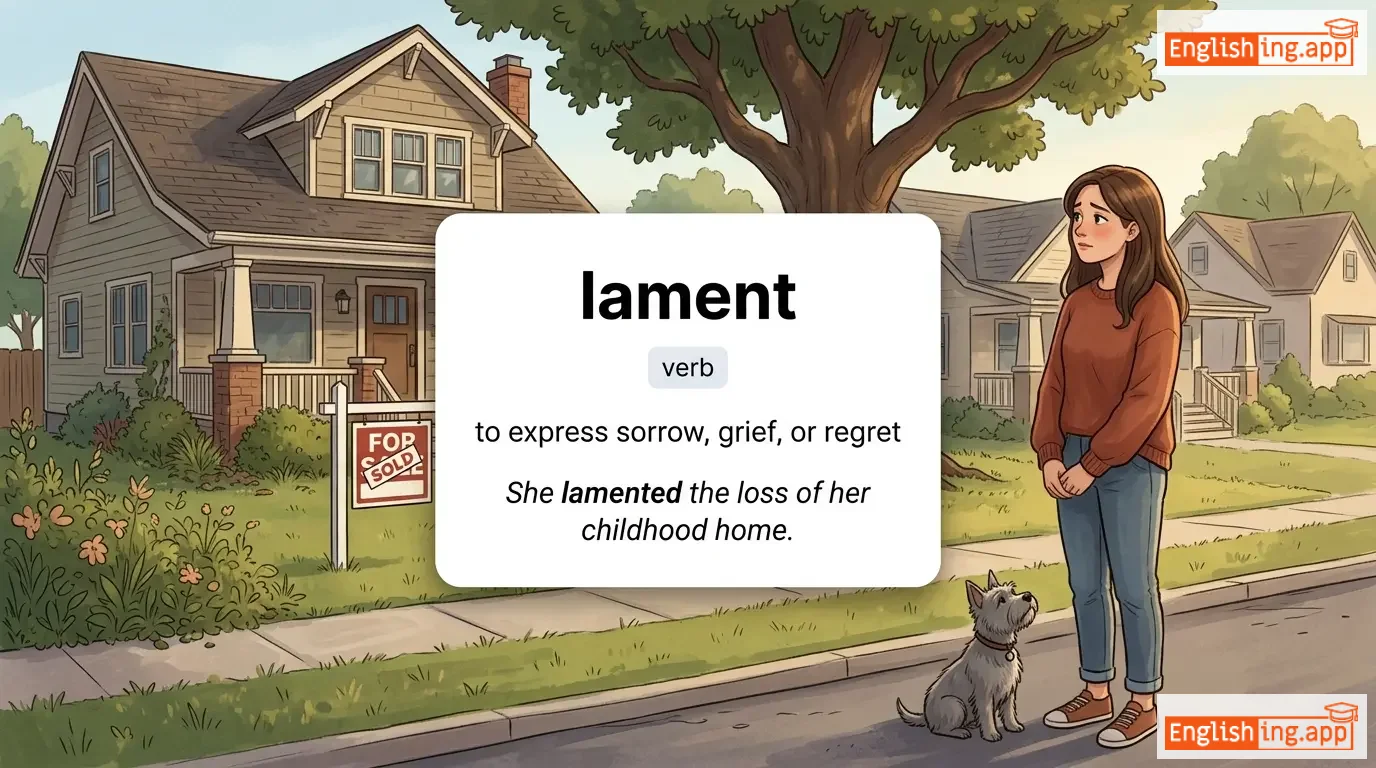
lament definition card — visual illustration of the meaning
verb
/ləˈmɛnt/
বিলাপ করা (bilap kora)

to express sorrow, grief, or regret

"She lamented the loss of her childhood home."

"সে তার শৈশবের বাড়ি হারানোর জন্য বিলাপ করেছিল।" (Se tar shoishober bari haranor jonno bilap korechilo.)
adjective
/ˈlæm.ən.tə.bəl/
দুঃখজনক (dukkhojonok)

deserving to be criticized or regretted; unfortunate

"The team’s lamentable performance disappointed their fans."

"দলের দুঃখজনক পারফরম্যান্স তাদের ভক্তদের হতাশ করেছিল।" (Doler dukkhojonok performance tader bhokto der hotash korechilo.)
verb
/ˈlæmɪˌneɪt/
প্লাস্টিক দিয়ে মোড়ানো (plastic diye morano)

to cover or enclose something with a protective layer, usually plastic

"She laminated her important documents to protect them from damage."

"সে তার গুরুত্বপূর্ণ নথিপত্র ক্ষতি থেকে রক্ষা করতে প্লাস্টিক দিয়ে মোড়াল।" (Se tar guruttopurno nothipotro khoti theke rokha korte plastic diye moralo.)
noun
/læmp/
বাতি (bati)

a device that produces light, often using electricity

"She turned on the lamp beside the bed."

"সে বিছানার পাশে থাকা বাতিটি জ্বালালো।" (Se bichanar pashe thaka batiti jwalalo.)
verb
/læmˈpuːn/
ব্যঙ্গ করা (byango kora)

to publicly criticize or ridicule someone or something with humor, irony, or sarcasm

"The cartoonist lampooned the politician for his contradictory statements."

"কার্টুনিস্ট রাজনীতিবিদকে তার পরস্পরবিরোধী বক্তব্যের জন্য ব্যঙ্গ করেছিলেন।" (Cartoonist rajnitibidke tar porosporbirodhi boktober jonno byango korechilen.)
noun
/læns/
বর্শা (borsha)

a long weapon with a pointed tip used by knights or soldiers on horseback

"The knight lowered his lance before charging at the opponent."

"নাইট প্রতিপক্ষের দিকে ঝাঁপিয়ে পড়ার আগে তার বর্শা নামিয়ে দিল।" (Knight protipokker dike jhapiye porar age tar borsha namiye dilo.)