Vocabulaires

Découvrez, apprenez et maîtrisez le vocabulaire anglais

interjection
/hɑː/
Ha ! (Exclamation de surprise ou de joie) (Ha ! (Exclamation de surprise ou de joie))

used to express amusement, surprise, or triumph

"Ha! I knew you couldn’t resist joining us."

"Ha ! Je savais que tu ne pourrais pas résister à nous rejoindre." (Ha ! Je savais que tu ne pourrais pas resister a nous rejoindre.)
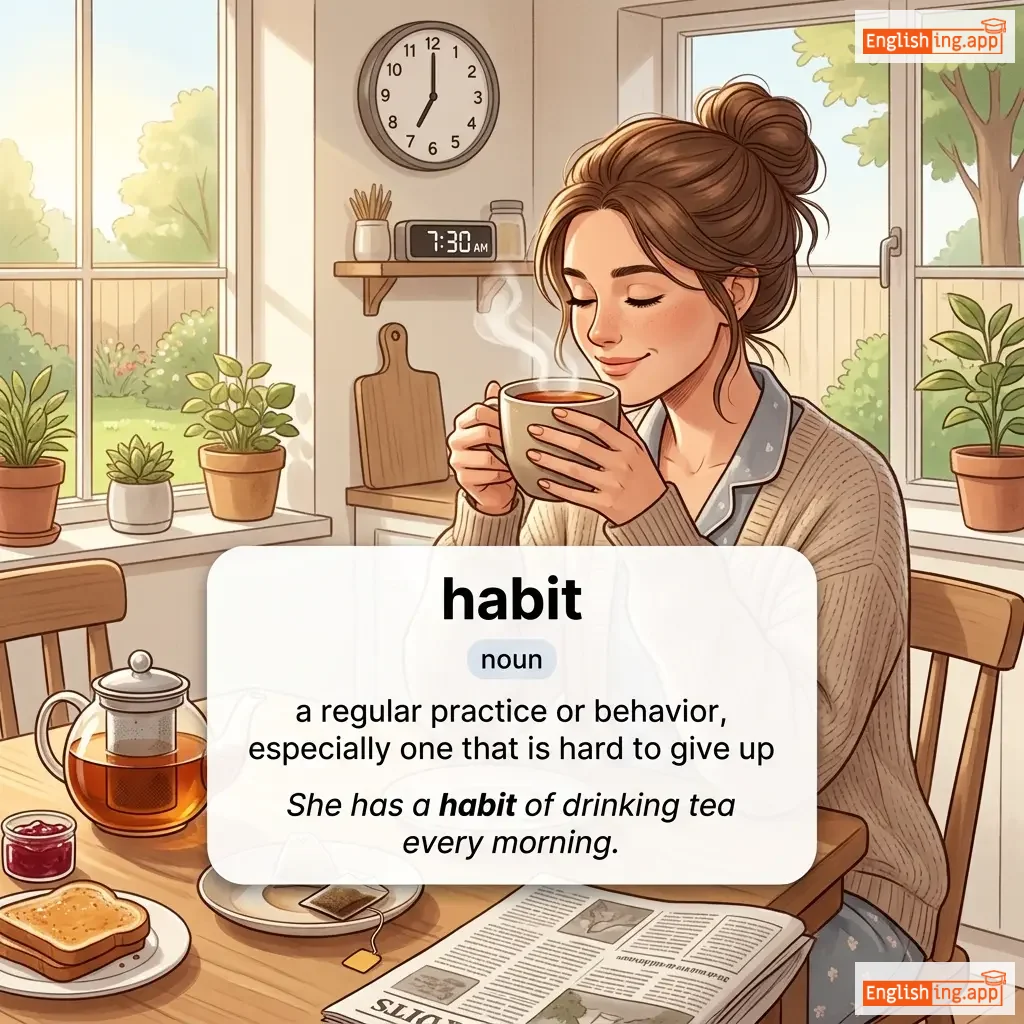
habit definition card — visual illustration of the meaning
noun
/ˈhæb.ɪt/
habitude (habitude)

a regular practice or behavior, especially one that is hard to give up

"She has a habit of drinking tea every morning."

"Elle a l'habitude de boire du thé chaque matin." (Elle a l'habitude de boire du thé chaque matin.)
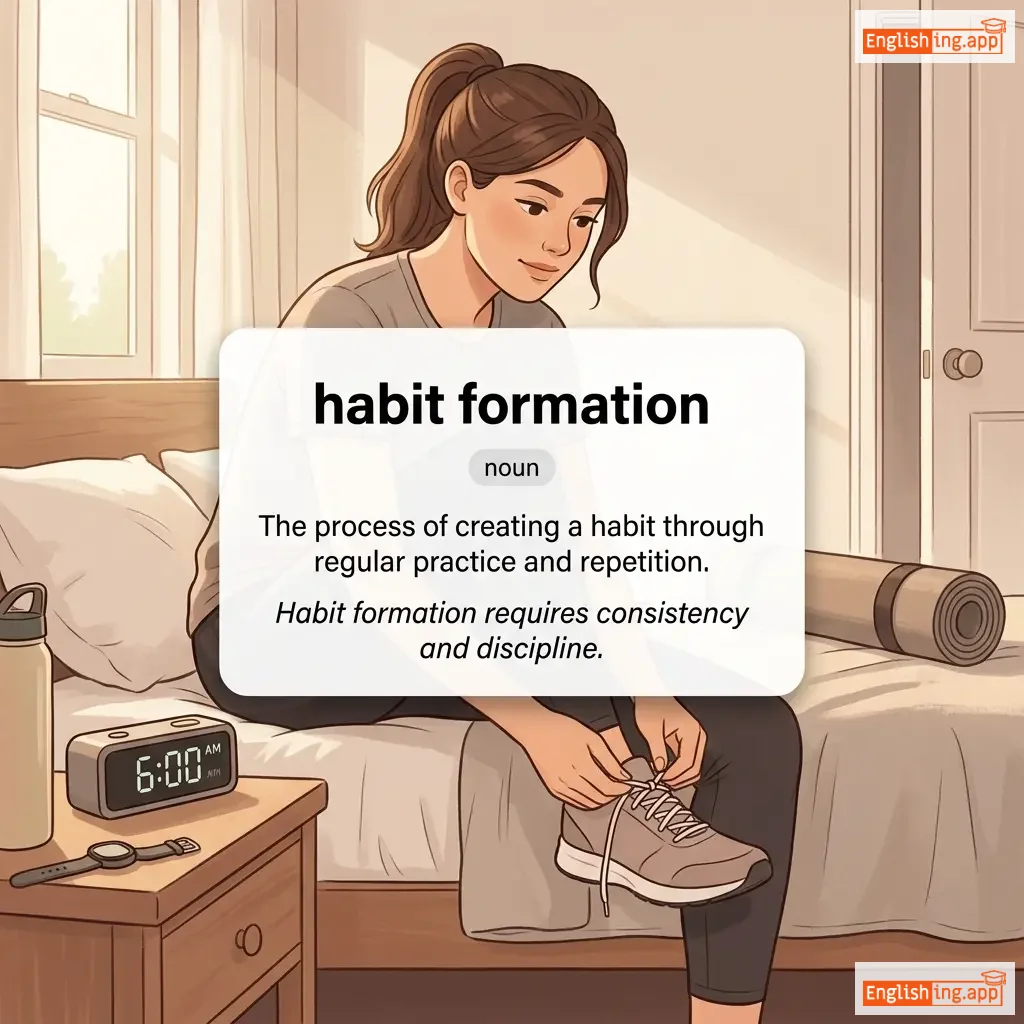
habit formation definition card — visual illustration of the meaning
noun
ˈhæb.ɪt fɔːrˌmeɪ.ʃən
formation d'habitudes (formation d'habitudes)

The process of creating a habit through regular practice and repetition.

"Habit formation requires consistency and discipline."

"La formation des habitudes nécessite de la constance et de la discipline." (La formation des habitudes necessite de la constance et de la discipline.)
adjective
/ˈhæbɪtəbl/
habitable (habitable)

Suitable to live in; capable of sustaining life.

"Scientists are searching for habitable planets beyond our solar system."

"Les scientifiques recherchent des planètes habitables au-delà de notre système solaire." (Les scientifiques recherchent des planètes habitables au-delà de notre système solaire.)
👨‍👩‍👧‍👦

habitant (abitɑ̃)

noun
/ˈhæbɪtənt/
habitant (habitant)

An inhabitant; a person or animal that lives in a particular place.

"The habitants of the village were friendly and welcoming."

"Les habitants du village étaient amicaux et accueillants." (Les habitants du village étaient amicaux et accueillants.)
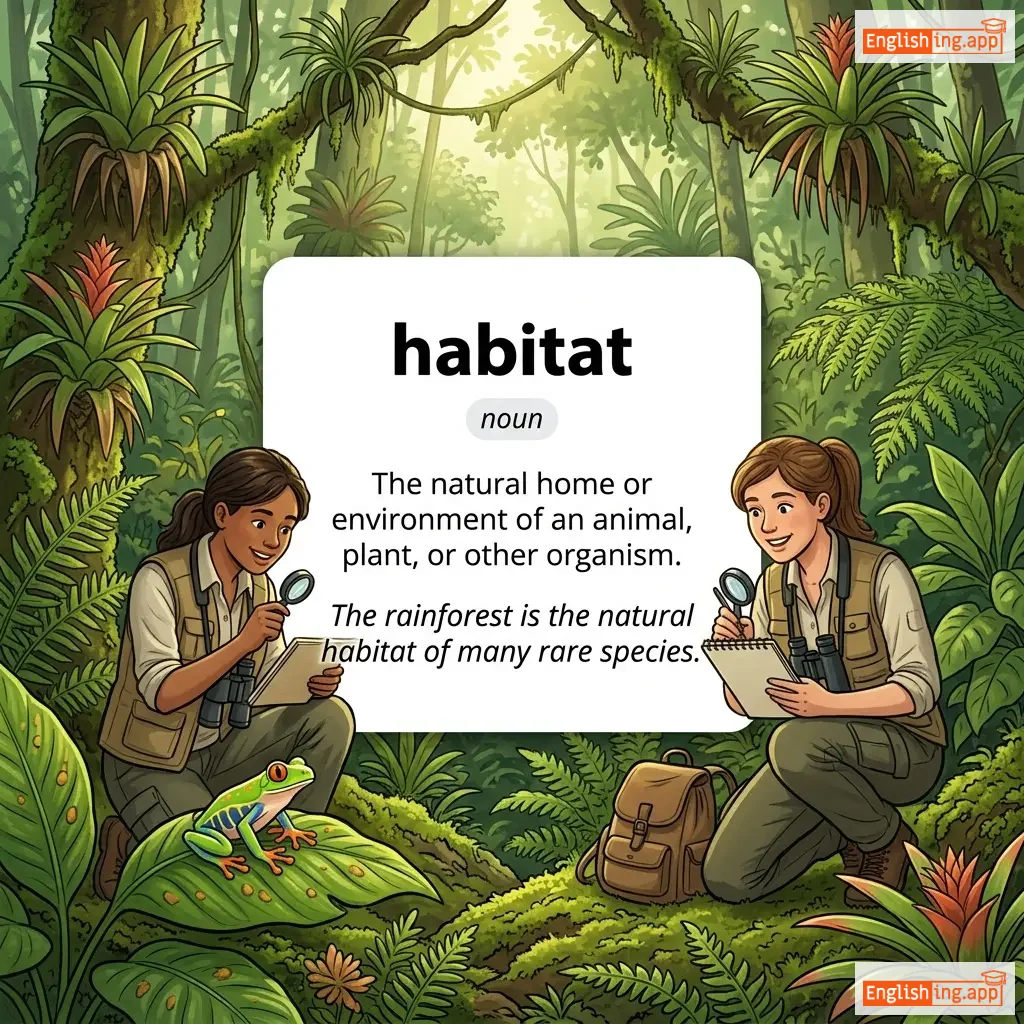
habitat definition card — visual illustration of the meaning
noun
/ˈhæbɪˌtæt/
habitat (habitat)

The natural home or environment of an animal, plant, or other organism.

"The rainforest is the natural habitat of many rare species."

"La forêt tropicale est l'habitat naturel de nombreuses espèces rares." (La forêt tropicale est l'habitat naturel de nombreuses espèces rares.)
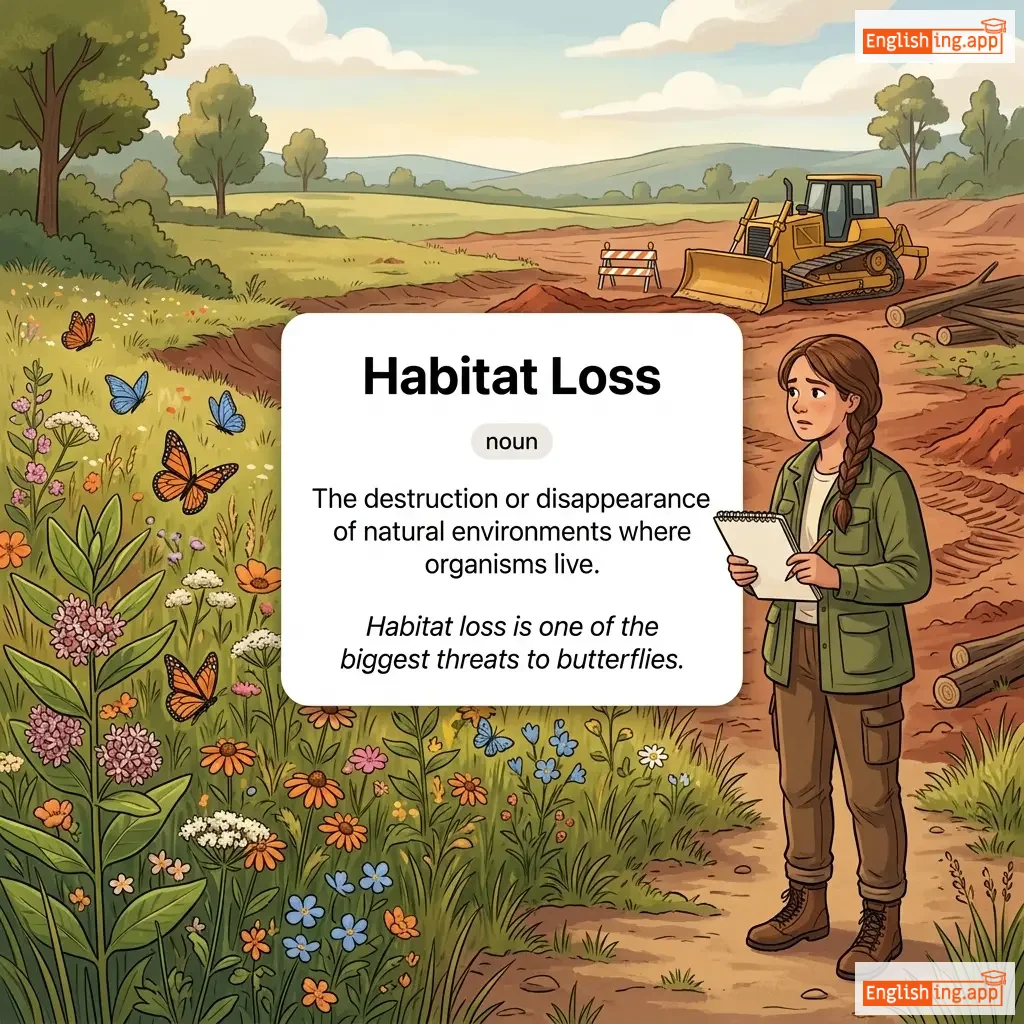
Habitat Loss definition card — visual illustration of the meaning
noun
ˈhæbɪtæt lɒs
perte de l'habitat (perte de l'habitat)

The destruction or disappearance of natural environments where organisms live.

"Habitat loss is one of the biggest threats to butterflies."

"La perte d'habitat est l'une des plus grandes menaces pour les papillons." (La perte d'habitat est l'une des plus grandes menaces pour les papillons.)
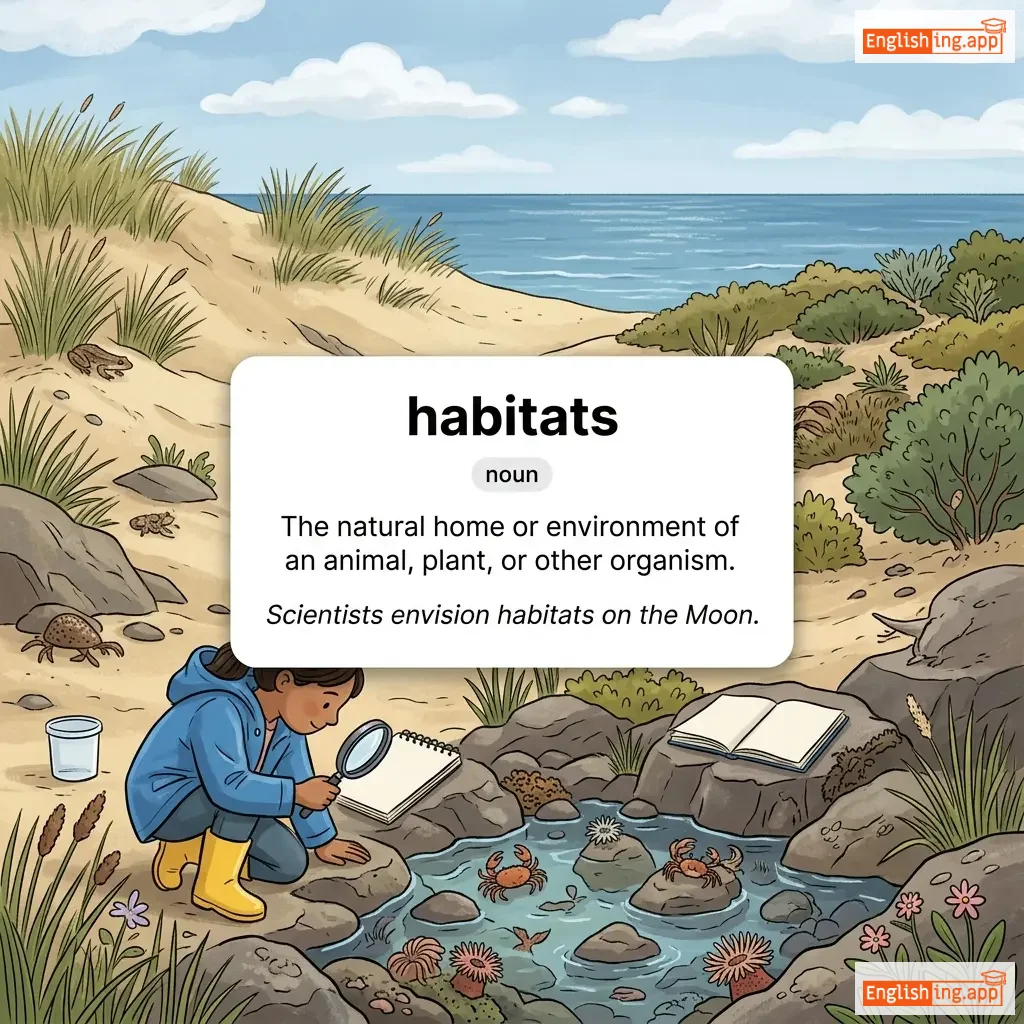
habitats definition card — visual illustration of the meaning
noun
ˈhæb.ɪ.tæts
habitat (habitát)

The natural home or environment of an animal, plant, or other organism.

"Scientists envision habitats on the Moon."

"Les scientifiques imaginent des habitats sur la Lune." (Les scientifiques imaginent des habitats sur la Lune.)
adjective
/həˈbɪtʃuəl/
habituel (habituel)

Done or doing constantly or as a habit; customary.

"He was a habitual latecomer to class."

"Il était un retardataire habituel en classe." (Il était un retardataire habituel en classe.)
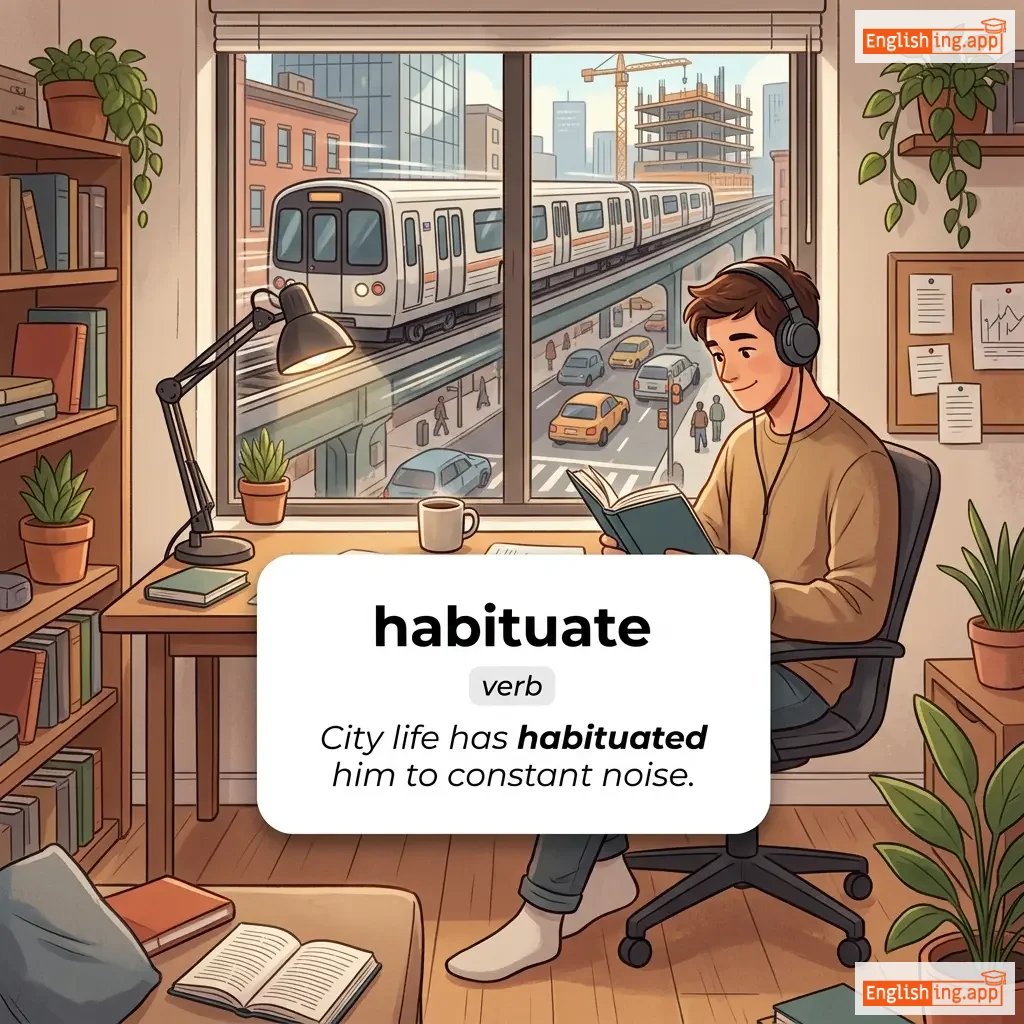
habituate definition card — visual illustration of the meaning
verb
/həˈbɪtʃueɪt/
habituer (habituer)

to accustom someone or oneself to something through frequent exposure or experience

"City life has habituated him to constant noise."

"La vie en ville l'a habitué au bruit constant." (La vie en ville l'a habitué au bruit constant.)
noun
/ˈhæbɪtjuːd/
habitude, coutume (habitude, coutume)

a customary condition or mode of life; habitual practice

"He lived in a quiet habitude, avoiding the noise of the city."

"Il vivait dans une habitude tranquille, évitant le bruit de la ville." (Il vivait dans une habitude tranquille, evitant le bruit de la ville.)
verb
/hæk/
couper, accéder sans autorisation à un système informatique (couper, acceder sans autorisation a un systeme informatique)

to cut or chop roughly; to gain unauthorized access to a computer system

"The programmer managed to hack into the system."

"Le programmeur a réussi à pirater le système." (Le programmeur a reussi a pirater le systeme.)
noun
/ˈhækəlz/
les poils à l'arrière du cou d'un animal qui se dressent lorsqu'il est en colère ou alarmé; figurativement, des sentiments de colère ou de ressentiment (les poils à l'arrière du cou d'un animal qui se dressent lorsqu'il est en colère ou alarmé; figurativement, des sentiments de colère ou de ressentiment)

the hairs on the back of an animal’s neck that rise when it is angry or alarmed; figuratively, feelings of anger or resentment

"His rude comment raised my hackles."

"Son commentaire grossier a levé mes hackles." (Son commentaire grossier a levé mes hackles.)
noun
/ˈhæknɪ/
cheval de location, usé (cheval de location, use)

a horse kept for ordinary riding or hire; also used for something overused or trite

"The old hackney was still pulling the carriage."

"Le vieux cheval de location tirait encore la carriole." (Le vieux cheval de location tirait encore la carriole.)
noun
/ˈhæk.ni ˈkær.ɪdʒ/
voiture de location (voiture de location)

A taxi; a car licensed to carry passengers for hire

"I called a hackney carriage to get to the airport."

"J'ai appelé une voiture de location pour aller à l'aéroport." (J'ai appelé une voiture de location pour aller à l'aéroport.)
adjective
/ˈhæk.nid/
usé (use)

Used too often and therefore lacking originality or freshness.

"The speech was filled with hackneyed phrases that failed to inspire the audience."

"Le discours était rempli de phrases usées qui n'ont pas réussi à inspirer le public." (Le discours était rempli de phrases usées qui n'ont pas réussi à inspirer le public.)
🧙‍♀️

Hag (hɑɡ)

noun
/hæɡ/
sorcière (sorcière)

an ugly old woman, especially a vicious or malicious one; a witch

"In the fairy tale, the wicked hag lived alone in a cottage deep in the forest."

"Dans le conte de fées, la méchante sorcière vivait seule dans une cabane au fond de la forêt." (Dans le conte de fées, la méchante sorcière vivait seule dans une cabane au fond de la forêt.)
adjective
/ˈhæɡ.ərd/
épuisé (epuize)

Looking exhausted, unwell, or worn out, especially from fatigue or suffering.

"After working all night, she looked pale and haggard."

"Après avoir travaillé toute la nuit, elle avait l'air pâle et épuisée." (Apres avoir travaille toute la nuit, elle avait l'air pale et epuisee.)
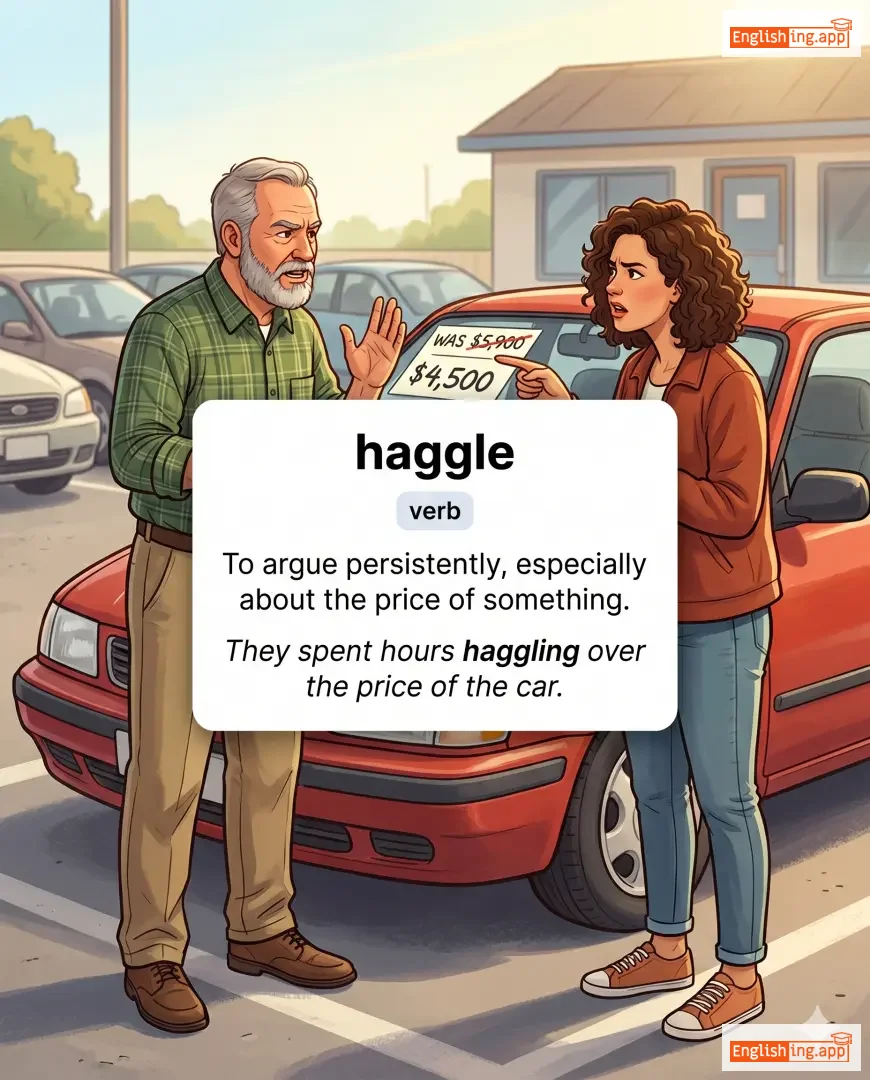
haggle definition card — visual illustration of the meaning
verb
/ˈhæɡ.l̩/
marchander (marchander)

To argue persistently, especially about the price of something.

"They spent hours haggling over the price of the car."

"Ils ont passé des heures à marchander le prix de la voiture." (Ils ont passé des heures à marchander le prix de la voiture.)
adjective
/ˌhæɡ.i.əˈɡræf.ɪk/
excessivement élogieux (excessivement elogieux)

Excessively flattering or idealized, often in a biography or portrayal of someone.

"The documentary was criticized for its hagiographic portrayal of the leader."

"Le documentaire a été critiqué pour sa représentation excessivement élogieuse du leader." (Le documentaire a été critiqué pour sa représentation excessivement élogieuse du leader.)
verb
/heɪl/
saluer / acclamer (saluer / acclamer)

To call out to attract attention or to praise enthusiastically.

"The athlete was hailed as a hero after the victory."

"L'athlète a été acclamé comme un héros après la victoire." (L'athlete a ete acclaime comme un heros apres la victoire.)
noun
/ˈheɪl.stɔːrm/
tempête de grêle (tempete de grele)

a violent storm with hail falling from the sky

"The hailstorm damaged many cars in the parking lot."

"La tempête de grêle a endommagé de nombreuses voitures dans le parking." (La tempête de grêle a endommagé de nombreuses voitures dans le parking.)
noun
/hɛər/
cheveux (cheveux)

the fine threads growing from the skin of humans and animals

"She has long, black hair."

"Elle a les cheveux longs et noirs." (Elle a les cheveux longs et noirs.)
noun
/ˈher ˌpɪn/
épingle à cheveux (epingle a cheveux)

a thin piece of metal or plastic used to hold hair in place

"She used several hair pins to secure her elegant updo."

"Elle a utilisé plusieurs épingles à cheveux pour fixer son élégant chignon." (Elle a utilise plusieurs epingles a cheveux pour fixer son elegant chignon.)
noun
/ˈheəkʌt/
coupe de cheveux (coupe de cheveux)

the act or style of cutting hair

"I got a haircut before the wedding."

"Je me suis fait une coupe de cheveux avant le mariage." (je me suis fait une coupe de cheveux avant le mariage)
noun
/ˈheəˌkʌtər/
coiffeur (coiffeur)

a person whose job is to cut and style hair; barber or hairdresser

"The haircutter gave me a neat and stylish haircut."

"Le coiffeur m’a fait une belle coupe." (le coiffeur ma fait une belle coupe)
noun
/ˈherˌdrɛsər/
coiffeur; coiffeuse (coiffeur; coiffeuse)

a person whose job is to cut, style, and treat hair

"The hairdresser gave me a stylish haircut before the wedding."

"Le coiffeur m’a fait une coupe élégante avant le mariage." (Le coiffeur m a fait une coupe elegante avant le mariage)
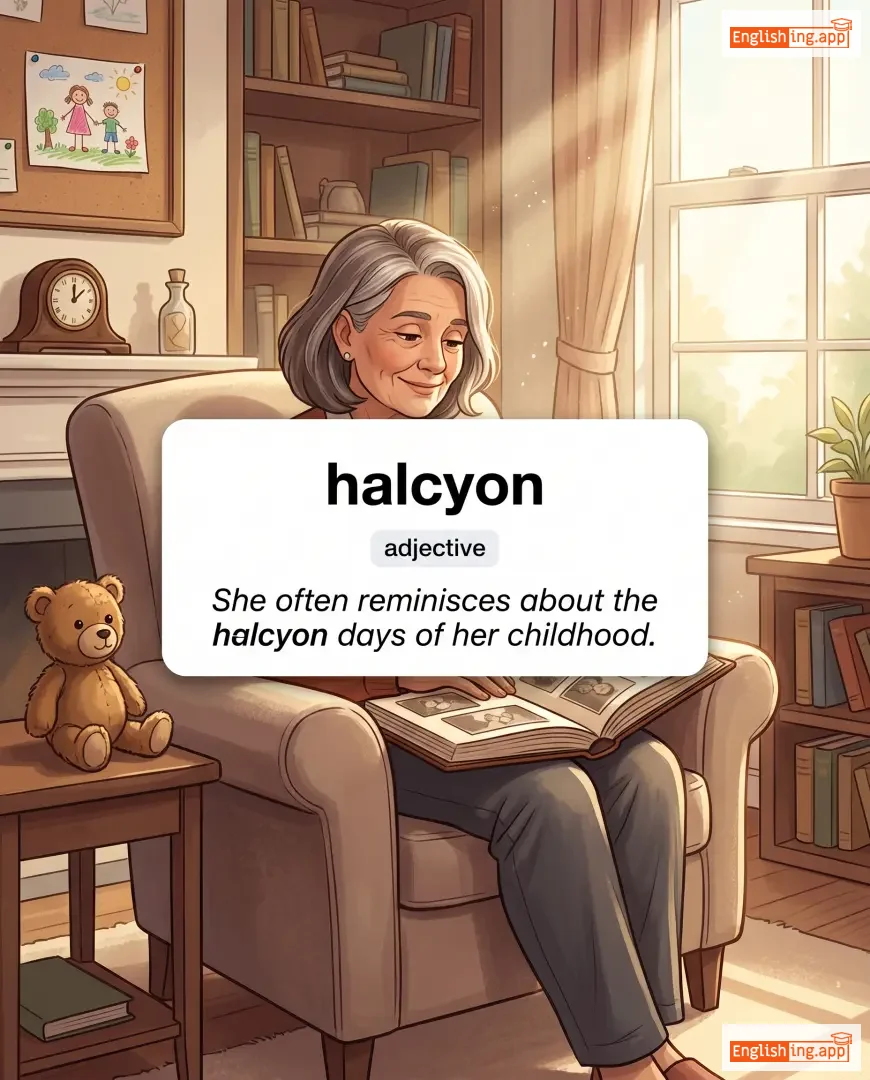
halcyon definition card — visual illustration of the meaning
adjective
/ˈhæl.si.ən/
serein (serein)

calm, peaceful, and happy; denoting a period of time in the past that was idyllically happy and peaceful

"She often reminisces about the halcyon days of her childhood."

"Elle se souvient souvent des jours sereins de son enfance." (Elle se souvient souvent des jours sereins de son enfance.)
adjective
/heɪl/
vital (vital)

strong and healthy, especially of an elderly person

"Despite his age, the man remained hale and active."

"Malgré son âge, l'homme est resté en bonne santé et actif." (Malgré son âge, l'homme est resté en bonne santé et actif.)
noun, adjective
/hæf/
moitié (moitie)

one of two equal parts of something

"He ate half of the cake."

"Il a mangé la moitié du gâteau." (Il a mange la moitie du gateau.)
adjective
/ˌhæfˈbeɪkt/
à moitié cuit (a moitie cuit)

poorly thought out or badly planned

"The manager quickly rejected his half-baked proposal."

"Le manager a rapidement rejeté sa proposition à moitié cuite." (Le manager a rapidement rejete sa proposition a moitie cuite.)
adjective
/ˌhæfˈhɑːr.tɪd/
démotivé (demotive)

lacking enthusiasm or determination; unenthusiastic

"His halfhearted attempt to study did not bring good results."

"Son essai démotivé pour étudier n'a pas donné de bons résultats." (Son essai démotivé pour étudier n'a pas donné de bons résultats.)
adverb
/ˌhæfˈweɪ/
à mi-chemin (a mi-chemin)

at or to a point equal in distance between two points

"We met halfway between the two towns."

"Nous nous sommes rencontrés à mi-chemin entre les deux villes." (Nous nous sommes rencontrés à mi-chemin entre les deux villes.)
noun
/hɔːl/
hall (hall)

a large room or building for public gatherings, events, or passage

"The graduation ceremony was held in the university hall."

"La cérémonie de remise des diplômes a eu lieu dans le hall de l'université." (La ceremonie de remise des diplomes a eu lieu dans le hall de l'universite.)
noun
/ˈhɔːl.mɑːrk/
caractéristique distinctive (caracteristique distinctive)

a typical characteristic or feature of someone or something

"Honesty is the hallmark of a good leader."

"L'honnêteté est la caractéristique distinctive d'un bon leader." (L'honnêteté est la caractéristique distinctive d'un bon leader.)
verb
/ˈhæloʊ/
sanctifier (sanctifier)

to honor as holy; to make sacred or greatly respected

"The ancient temple was hallowed by centuries of worship."

"L'ancien temple a été sanctifié par des siècles de dévotion." (L'ancien temple a été sanctifié par des siècles de dévotion.)
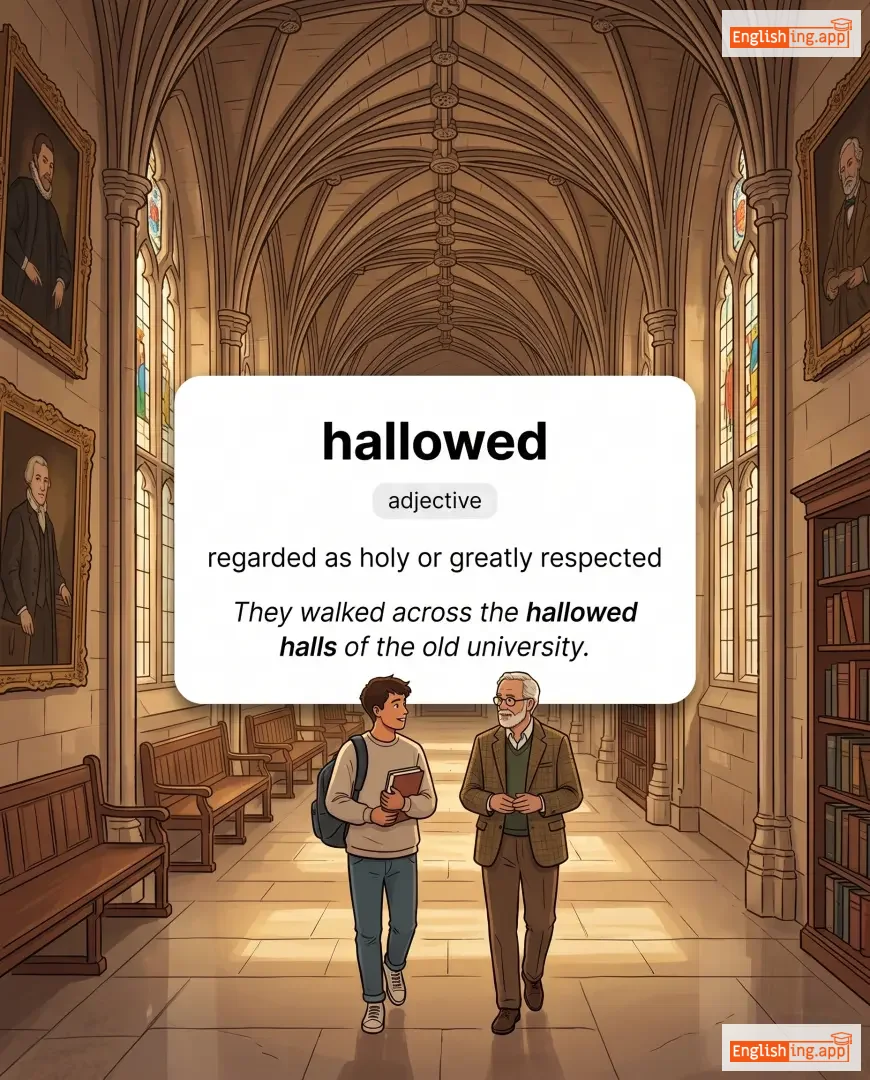
hallowed definition card — visual illustration of the meaning
adjective
/ˈhæloʊd/
sacré (sacre)

regarded as holy or greatly respected

"They walked across the hallowed halls of the old university."

"Ils ont traversé les sacrés couloirs de la vieille université." (Ils ont traverse les sacres couloirs de la vieille universite.)
verb
/həˈluːsɪneɪt/
halluciner (halluciner)

to see, hear, or sense things that are not actually present, often due to illness or drugs

"After taking the medicine, he began to hallucinate strange shapes."

"Après avoir pris le médicament, il a commencé à halluciner des formes étranges." (Apres avoir pris le medicament, il a commence a halluciner des formes etranges.)
noun
/həˌluːsɪˈneɪʃən/
hallucination (hallucination)

a false perception of objects or events, usually caused by mental illness or drugs

"After the medication, he began to experience vivid hallucinations."

"Après le médicament, il a commencé à vivre des hallucinations vives." (Apres le medicament, il a commence a vivre des hallucinations vives.)
noun
/ˈhɔːlweɪ/
couloir (couloir)

a corridor in a building that connects rooms

"The kids left their shoes in the hallway."

"Les enfants ont laissé leurs chaussures dans le couloir." (Les enfants ont laissé leurs chaussures dans le couloir.)
verb
/hɔːlt/
arrêter (arreter)

to stop or bring to a stop

"The train suddenly halted at the station."

"Le train s'est arrêté soudainement à la station." (Le train s'est arrêté soudainement à la station.)
adjective
/ˈhɔːltɪŋ/
hésitant (hesitant)

slow and hesitant, especially due to lack of confidence

"She gave a halting reply during the interview."

"Elle a donné une réponse hésitante lors de l'entretien." (Elle a donné une réponse hésitante lors de l'entretien.)
adjective
/ˈhæm ˌhændɪd/
maladroit (maladroit)

clumsy or inept in handling things or situations

"His ham-handed attempt to fix the computer made it worse."

"Sa tentative maladroite de réparer l'ordinateur l'a empiré." (Sa tentative maladroite de réparer l'ordinateur l'a empiré.)
noun
/ˈhæm.lət/
petit hameau (petit hameau)

a small rural settlement, smaller than a village; a small community

"The tiny hamlet nestled in the valley had only a dozen houses and one small church."

"Le petit hameau niché dans la vallée n'avait qu'une douzaine de maisons et une petite église." (Le petit hameau niche dans la vallee n'avait qu'une douzaine de maisons et une petite eglise.)
noun, verb
/ˈhæmər/
marteau (marteau)

a tool with a heavy metal head used for breaking things or driving in nails; to hit something forcefully with a hammer or similar object.

"He used a hammer to fix the broken chair."

"Il a utilisé un marteau pour réparer la chaise cassée." (Il a utilisé un marteau pour réparer la chaise cassée.)
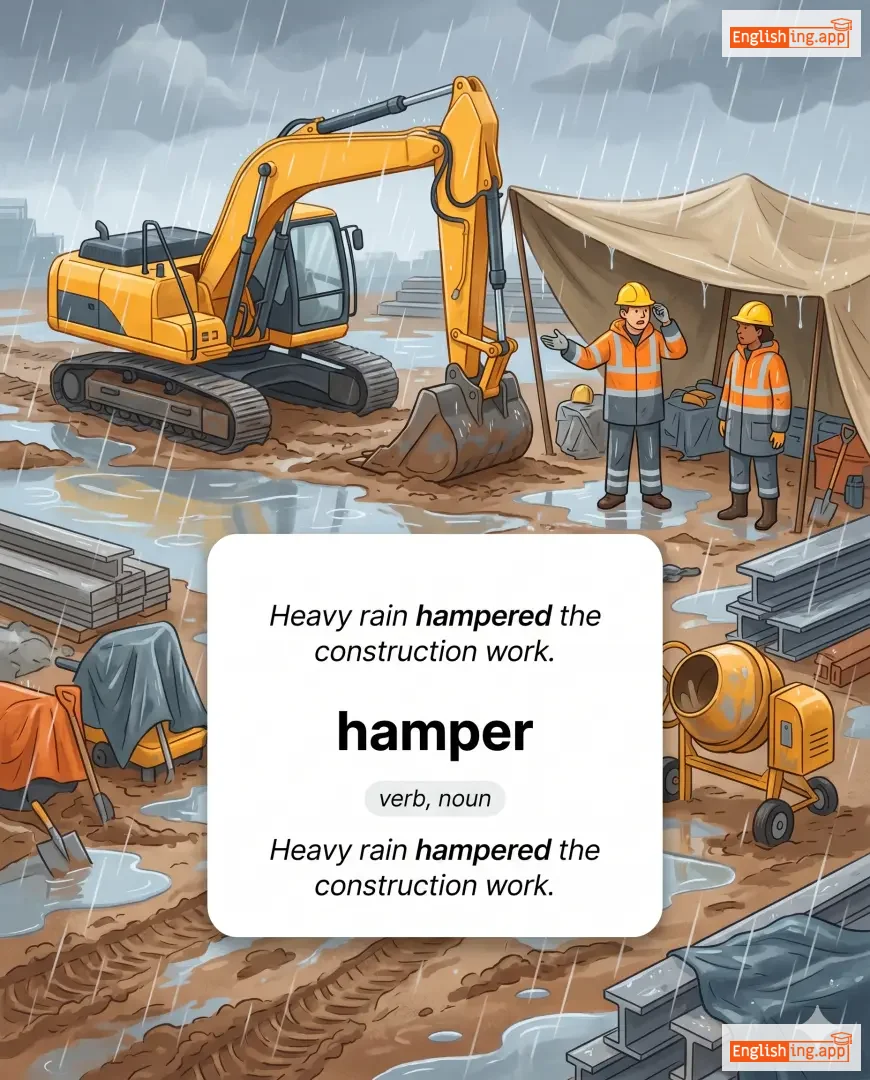
hamper definition card — visual illustration of the meaning
verb, noun
/ˈhæmpər/
entraver, panier à linge (entraver, panier a linge)

to prevent or slow down the progress of something; also, a basket with a lid, typically for laundry.

"Heavy rain hampered the construction work."

"La pluie forte a entravé les travaux de construction." (La pluie forte a entravé les travaux de construction.)
noun, verb
/ˈhæmstrɪŋ/
tendon à l'arrière de la cuisse; en tant que verbe, rendre quelqu'un ou quelque chose inefficace ou l'empêcher de fonctionner efficacement (tendon a l'arriere de la cuisse; en tant que verbe, rendre quelqu'un ou quelque chose inefficace ou l'empecher de fonctionner efficacement)

a tendon at the back of the thigh; as a verb, to cripple or severely restrict the effectiveness of someone or something.

"Budget cuts hamstrung the organization’s plans."

"Les réductions budgétaires ont affaibli les plans de l'organisation." (Les reductions budgetaires ont affaibli les plans de l'organisation.)
verb (past tense, past participle), adjective
/ˈhæmstrʌŋ/
paralysé ou limité (paralyse ou limite)

crippled or severely restricted in movement or progress.

"The team was hamstrung by lack of resources."

"L'équipe était limitée par un manque de ressources." (L'equipe etait limitee par un manque de ressources.)
noun, verb
/hænd/
main (main)

the part of the body at the end of the arm used for holding things

"She raised her hand to ask a question."

"Elle leva sa main pour poser une question." (Elle leva sa main pour poser une question.)
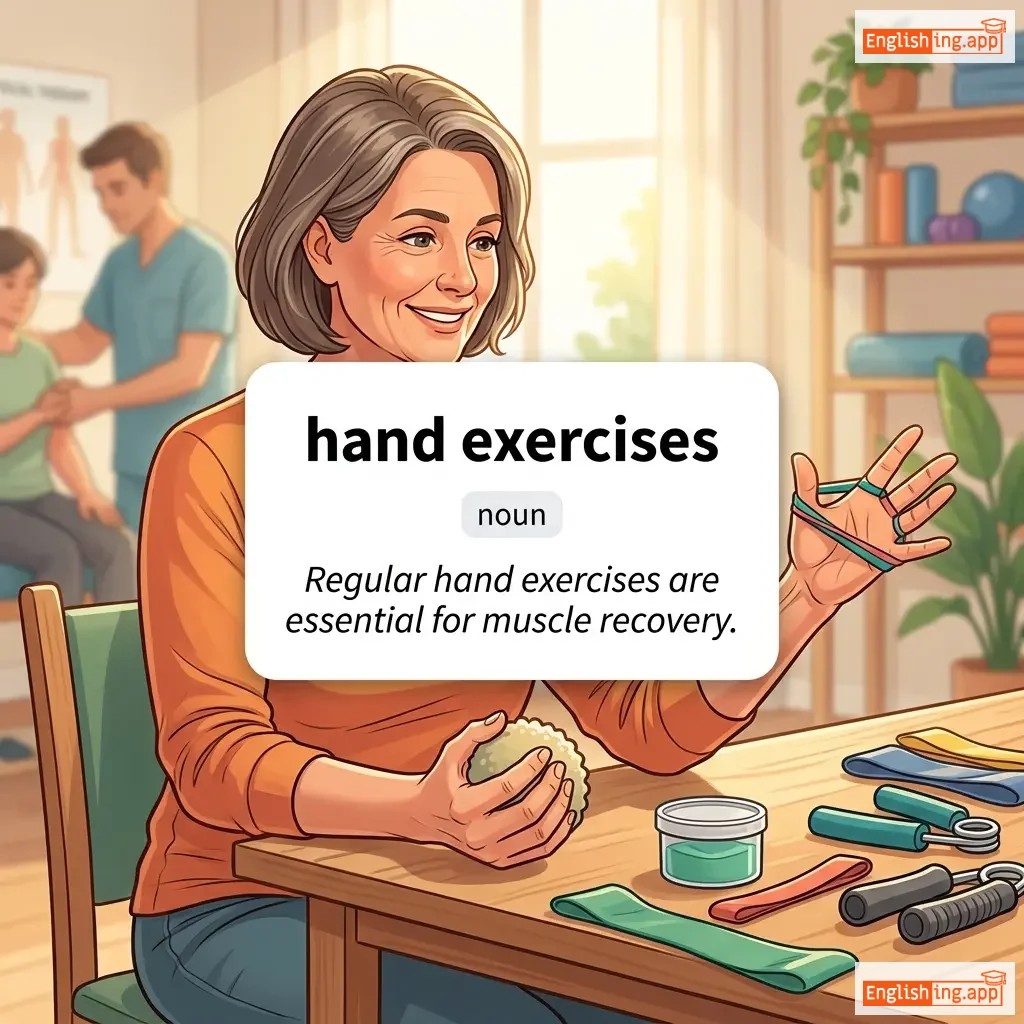
hand exercises definition card — visual illustration of the meaning
noun
হ্যান্ড এক্সারসাইজেস
exercices de main (exercices de main)

Physical activities designed to strengthen, stretch, and improve the flexibility of hand and finger muscles.

"Regular hand exercises are essential for muscle recovery."

"Les exercices réguliers de la main sont essentiels pour la récupération musculaire." (Les exercices réguliers de la main sont essentiels pour la récupération musculaire.)