Vocabulaires

Découvrez, apprenez et maîtrisez le vocabulaire anglais

🏃‍♀️

pace (pays)

noun
/peɪs/
rythme (rythme)

the speed at which something happens or is done

"She walked at a slow pace."

"Elle marchait à un rythme lent." (Elle marchait a un rythme lent.)
noun
/ˈpæk.ɪ.dɜːrm/
grand mammifère à peau épaisse (grand mammifere a peau epaisse)

a large mammal with thick skin, such as an elephant, rhinoceros, or hippopotamus

"The zoo had several pachyderms, including elephants and rhinos."

"Le zoo avait plusieurs pachydermes, y compris des éléphants et des rhinocéros." (Le zoo avait plusieurs pachydermes, y compris des elephants et des rhinoceros.)
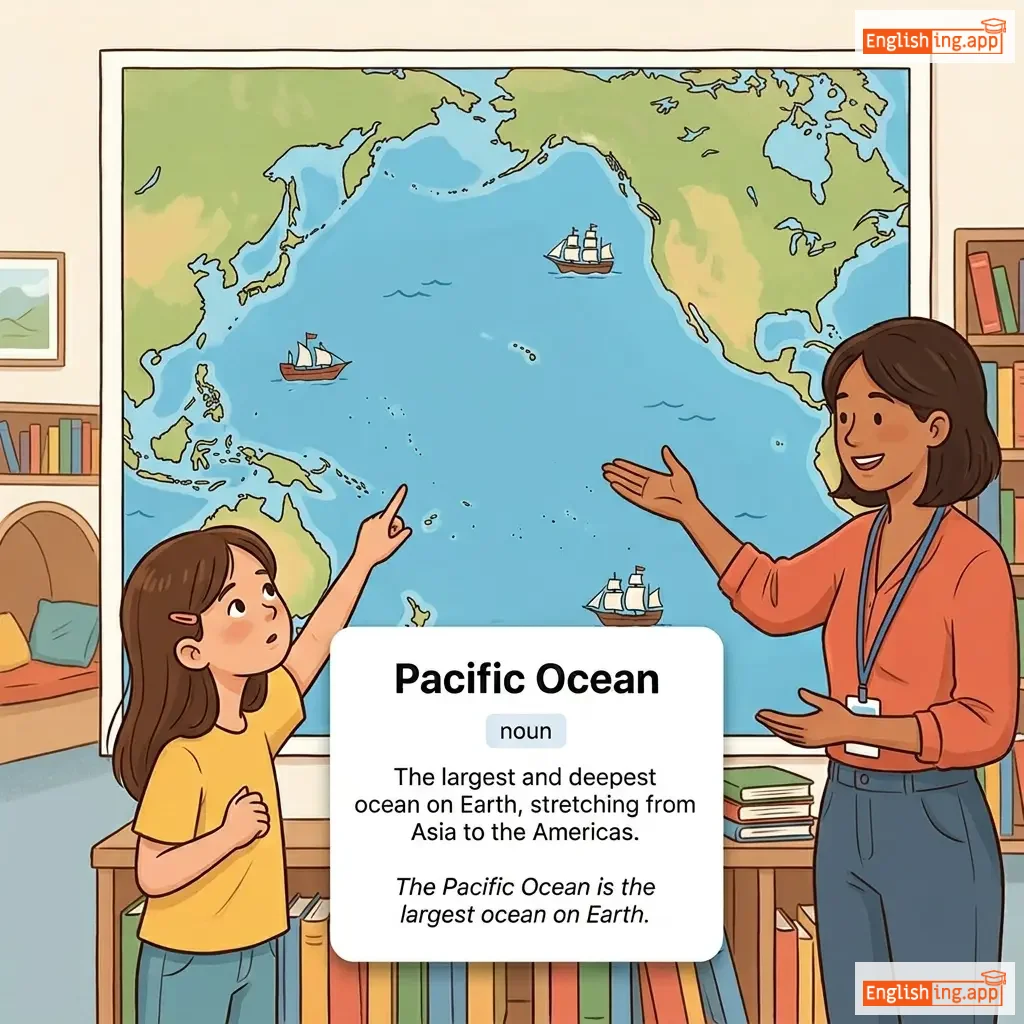
Pacific Ocean definition card — visual illustration of the meaning
noun
/pəˈsɪf.ɪk ˈoʊ.ʃən/
Océan Pacifique (Oceano Pacifico)

The largest and deepest ocean on Earth, stretching from Asia to the Americas.

"The Pacific Ocean is the largest ocean on Earth."

"L'océan Pacifique est le plus grand océan de la Terre." (L'ocean Pacifique est le plus grand ocean de la Terre.)
noun
/ˈpæs.ɪ.fɪst/
pacifiste (pacifiste)

a person who believes in peace and opposes war or violence

"She is a committed pacifist who campaigns against armed conflict."

"Elle est une pacifiste engagée qui fait campagne contre les conflits armés." (Elle est une pacifiste engagée qui fait campagne contre les conflits armés.)
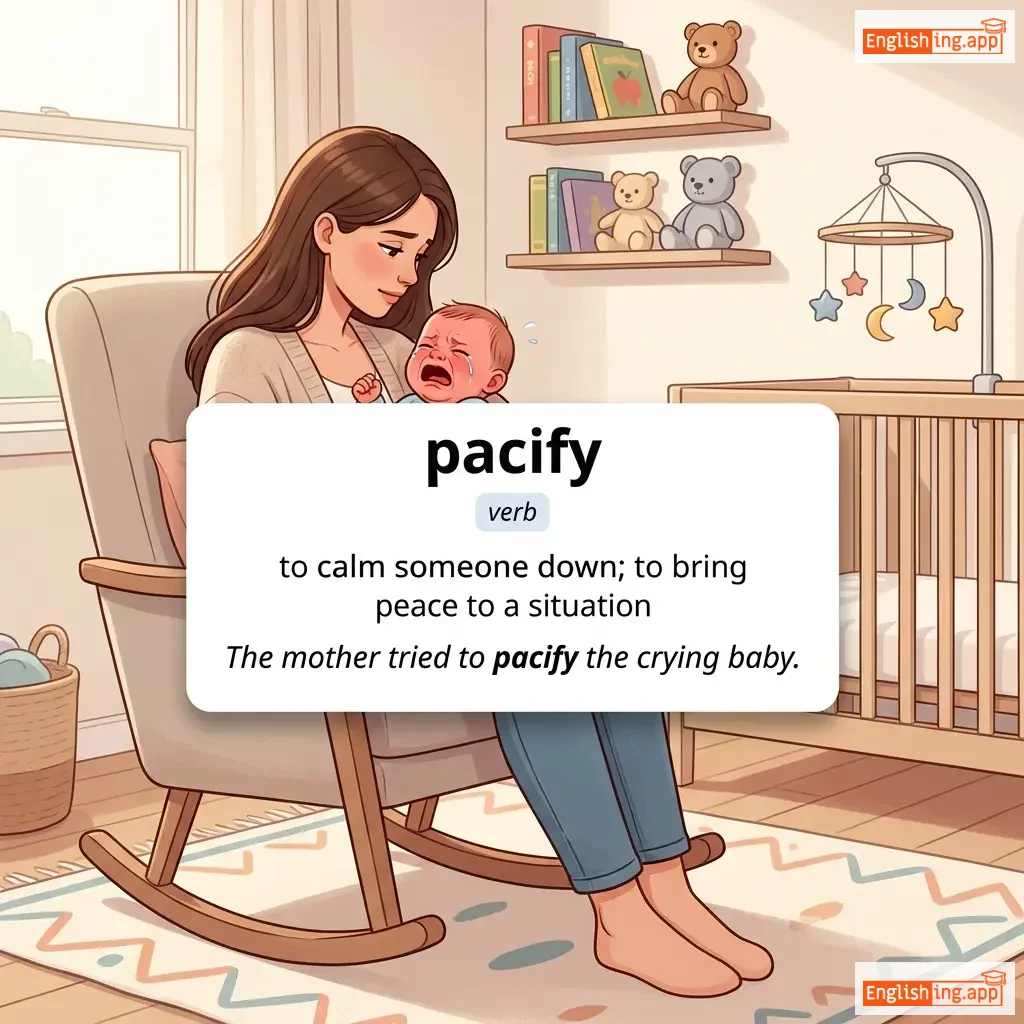
pacify definition card — visual illustration of the meaning
verb
/ˈpæs.ɪ.faɪ/
calmer (calmer)

to calm someone down; to bring peace to a situation

"The mother tried to pacify the crying baby."

"La mère a essayé de calmer le bébé qui pleurait." (La mère a essayé de calmer le bébé qui pleurait.)
verb,noun
/pæk/
emballer (emballer)

to put things into a container for storage or transport; a collection of items kept together

"She packed her clothes into a suitcase for the trip."

"Elle a emballé ses vêtements dans une valise pour le voyage." (Elle a emballé ses vêtements dans une valise pour le voyage.)
noun
/ˈpækɪdʒ/
paquet (paquet)

a container or wrapping in which something is packed

"He received a package in the mail."

"Il a reçu un paquet par la poste." (Il a reçu un paquet par la poste.)
noun
/ˈpæk.ɪt/
paquet (paquet)

a small package or container holding items or information

"He bought a packet of biscuits from the shop."

"Il a acheté un paquet de biscuits au magasin." (Il a acheté un paquet de biscuits au magasin.)
noun
/pækt/
pacte (pacte)

a formal agreement or promise between parties

"The two countries signed a peace pact."

"Les deux pays ont signé un pacte de paix." (Les deux pays ont signé un pacte de paix.)
noun
/pæd/
bloc (blok)

a small cushion or block of soft material; also a set of sheets of paper fastened together

"He wrote her phone number on a yellow pad."

"Il a écrit son numéro de téléphone sur un bloc jaune." (Il a écrit son numéro de téléphone sur un bloc jaune.)
noun
/ˈpæd.ɪŋ/
rembourrage / matelassage (rembourrage / matelassage)

soft material added for comfort, protection, or to fill space

"The chair had extra padding for comfort."

"La chaise avait des coussins supplémentaires pour plus de confort." (La chaise avait des coussins supplementaires pour plus de confort.)
noun
/ˈpæd.ək/
champ clos pour chevaux ou autres animaux (champ clos pour chevaux ou autres animaux)

a small enclosed field where horses or other animals are kept

"The horses were grazing in the paddock."

"Les chevaux broutaient dans le paddock." (Les chevaux broutaient dans le paddock.)
noun
/ˈpæd.i/
riz en coque (riz en coque)

rice grains that are still in their hulls; unhusked rice

"The farmer harvested paddy from the flooded fields."

"Le fermier a récolté du riz en coque dans les champs inondés." (Le fermier a recolte du riz en coque dans les champs inondes)
noun
/ˈpɑːdreɪ/
prêtre (pretre)

A title for a priest, especially in the Roman Catholic Church; also used informally for 'father'.

"The soldiers attended mass led by the padre."

"Les soldats ont assisté à la messe dirigée par le prêtre." (Les soldats ont assiste a la messe dirigee par le pretre.)
noun
/ˈpiːən/
hymne de louange (hymne de louange)

A song or piece of writing expressing great praise or triumph.

"The article was a paean to the beauty of nature."

"L'article était un hymne à la beauté de la nature." (L'article était un hymne à la beauté de la nature.)
noun
/ˈpeɪɡən/
païen (paien)

A person holding religious beliefs other than those of the main world religions.

"The village still kept some pagan traditions alive."

"Le village maintenait encore certaines traditions païennes en vie." (Le village maintenait encore certaines traditions païennes en vie.)
noun
/peɪdʒ/
page (page)

one side of a sheet of paper, or a single sheet of paper in a book or document

"Turn to the next page for more information."

"Allez à la page suivante pour plus d'informations." (Allez à la page suivante pour plus d'informations.)
noun
/ˈpædʒənt/
concours de beauté (concours de beauté)

A public entertainment consisting of a procession of people in elaborate costumes, or a beauty contest.

"She won first place in the beauty pageant."

"Elle a remporté la première place au concours de beauté" (elle a remporté la première place au concours de beauté)
noun
/peɪn/
douleur (douleur)

physical suffering or discomfort caused by illness or injury

"She felt a sharp pain in her chest."

"Elle a ressenti une douleur aiguë dans sa poitrine." (Elle a ressenti une douleur aigue dans sa poitrine.)
adjective
/ˈpeɪn.fəl/
douloureux (douloureux)

causing physical or emotional pain

"The injury was very painful, and he needed immediate care."

"La blessure était très douloureuse et il avait besoin de soins immédiats." (La blessure etait tres douloureuse et il avait besoin de soins immediats.)
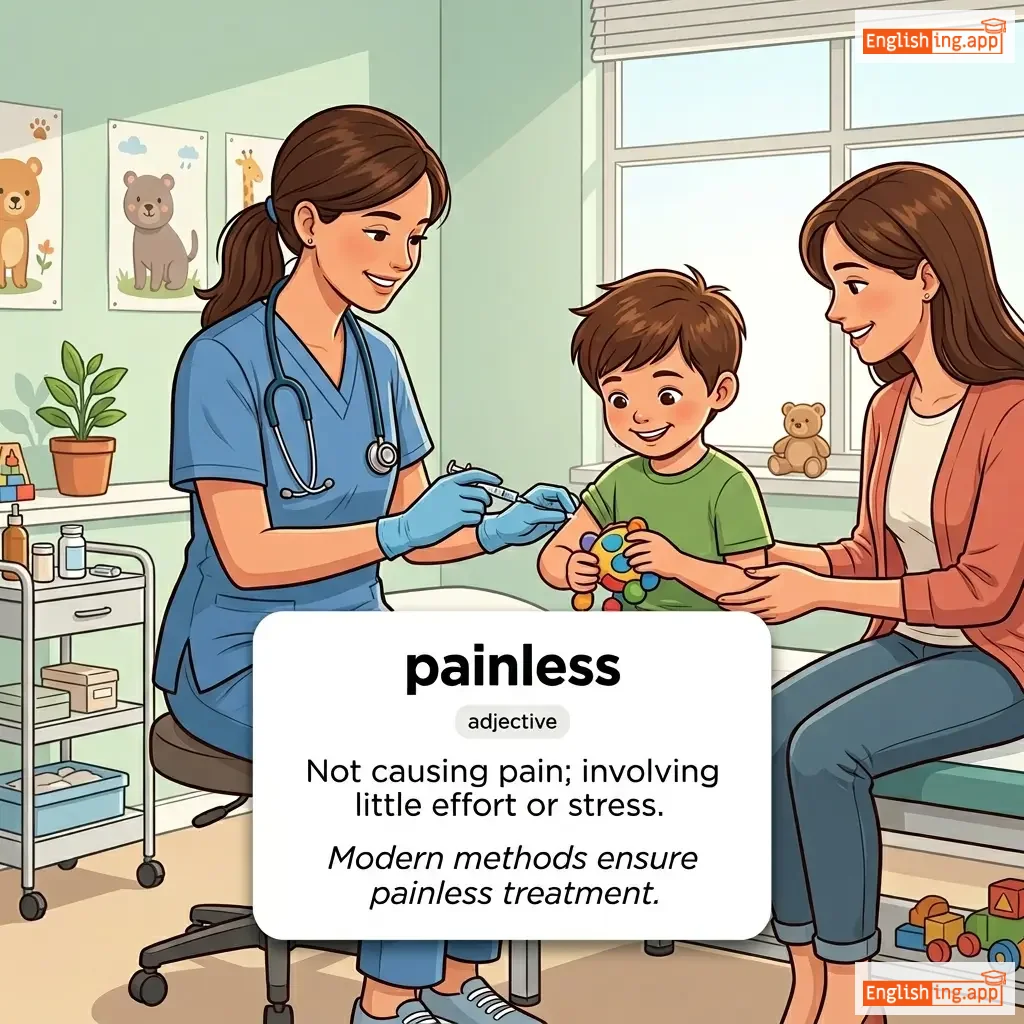
painless definition card — visual illustration of the meaning
adjective
ˈpeɪn.ləs
sans douleur (sans douleur)

Not causing pain; involving little effort or stress.

"Modern methods ensure painless treatment."

"Les méthodes modernes assurent un traitement sans douleur." (Les methodes modernes assurent un traitement sans douleur.)
adjective
/ˈpeɪnzˌteɪkɪŋ/
avec soin (avec soin)

Done with great care and thoroughness.

"The artist completed the project with painstaking detail."

"L'artiste a terminé le projet avec beaucoup de soin." (L'artiste a terminé le projet avec beaucoup de soin.)
verb
/peɪnt/
peindre (peindre)

to apply a colored substance to a surface

"She loves to paint landscapes in her free time."

"Elle aime peindre des paysages pendant son temps libre." (Elle aime peindre des paysages pendant son temps libre.)
noun
/ˈpeɪn.tər/
peintre (peintr)

a person who paints pictures, or paints walls, buildings, etc.

"The painter spent hours working on the portrait."

"Le peintre a passé des heures à travailler sur le portrait." (Le peintre a passé des heures à travailler sur le portrait.)
noun
/ˈpeɪntɪŋ/
peinture (peinture)

a picture or design made using paint

"The painting on the wall was created by a famous artist."

"La peinture sur le mur a été créée par un artiste célèbre." (La peinture sur le mur a été créée par un artiste célèbre.)
noun
/per/
paire (paire)

two things of the same kind that are used together

"She wore a matching pair of shoes."

"Elle portait une paire de chaussures assorties." (Elle portait une paire de chaussures assorties.)
noun
/ˈpælɪs/
palais (palais)

a large and impressive building that is the official home of a king, queen, or other ruler

"The royal family lives in a magnificent palace."

"La famille royale vit dans un magnifique palais." (La famille royale vit dans un magnifique palais.)
noun
/ˌpæl.ənˈkiːn/
palanquin (palanquin)

a covered chair or bed carried on poles by bearers

"The bride was carried to the wedding ceremony in an ornate palanquin."

"La mariée a été transportée à la cérémonie de mariage dans un palanquin orné." (La mariée a été transportée à la cérémonie de mariage dans un palanquin orné.)
adjective
/ˈpæl.ə.tə.bəl/
agréable (agreable)

pleasant or acceptable to the taste, mind, or feelings

"The meal was simple but quite palatable."

"Le repas était simple mais assez agréable." (Le repas etait simple mais assez agreable.)
noun
/ˈpæl.ə.tə.bəl miːt/
viande savoureuse (viande savoureuse)

Meat that is pleasant to taste; appetizing meat dish

"The chef prepared palatable meat dishes for the dinner party."

"Le chef a préparé des plats de viande savoureux pour la fête du dîner." (Le chef a préparé des plats de viande savoureux pour la fête du dîner.)
noun
/ˈpæl.ət/
palais (palais)

the roof of the mouth; a person's appreciation of taste and flavor

"She has a refined palate for fine wines."

"Elle a un palais raffiné pour les bons vins." (Elle a un palais raffiné pour les bons vins.)
adjective
/pəˈleɪ.ʃəl/
palatial (palatial)

resembling a palace in being spacious and splendid

"They stayed in a palatial hotel during their vacation."

"Ils ont séjourné dans un hôtel palais pendant leurs vacances." (Ils ont séjourné dans un hôtel palais pendant leurs vacances.)
noun
/pəˈlæv.ər/
discussion inutile / agitation (discussion inutile / agitation)

prolonged and idle discussion; fuss or unnecessary talk

"After much palaver, they finally agreed on the plan."

"Après beaucoup de discussion inutile, ils ont finalement accepté le plan." (Apres beaucoup de discussion inutile, ils ont finalement accepte le plan.)
👩‍🦰

Pale (pèl)

adjective
/peɪl/
pâle (pale)

having a light or dull color, especially when compared with something else

"She looked pale after the long illness."

"Elle avait l'air pâle après la longue maladie." (Elle avait l'air pale apres la longue maladie.)
noun
/ˌpeɪ.li.ɒnˈtɒl.ə.dʒi/
paléontologie (paleontologie)

the branch of science concerned with fossil animals and plants

"She decided to study paleontology at university."

"Elle a décidé d'étudier la paléontologie à l'université." (Elle a decide d'etudier la paleontologie a l'universite.)
adjective
/pælɛˈstɪnɪən/
palestinien (palestinien)

relating to Palestine or its people

"The Palestinian people have a rich cultural heritage."

"Le peuple palestinien a un riche héritage culturel." (Le peuple palestinien a un riche héritage culturel.)
noun
/ˈpælət/
palette (palette)

a thin board or surface on which an artist sets and mixes colors; also a range of colors used in art or design

"The artist mixed vibrant shades on her palette before starting the painting."

"L'artiste a mélangé des teintes vibrantes sur sa palette avant de commencer la peinture." (L'artiste a mélangé des teintes vibrantes sur sa palette avant de commencer la peinture.)
noun
/ˈpælɪmpsɛst/
palimpseste (palimpseste)

a manuscript or document that has been written over but still bears traces of earlier writing; something reused or altered but still retaining traces of its earlier form

"The ancient manuscript was a palimpsest, showing faint traces of previous texts beneath the new writing."

"Le manuscrit ancien était un palimpseste, montrant des traces subtiles de textes précédents sous la nouvelle écriture." (Le manuscrit ancien était un palimpseste, montrant des traces subtiles de textes précédents sous la nouvelle écriture.)
noun
/ˈpælɪˌnoʊd/
palinodie (palinodie)

a poem or statement in which the writer retracts something said in an earlier work

"The poet wrote a palinode to apologize for his earlier harsh words."

"Le poète a écrit une palinodie pour s'excuser de ses paroles sévères précédentes." (Le poete a ecrit une palinodie pour s'excuser de ses paroles severes precedentes.)
verb, noun
/pɔːl/
déclin, tissu sur un cercueil (declin, tissu sur un cercueil)

to lose strength or interest; to become dull or tiresome; also a cloth spread over a coffin

"The excitement of the festival began to pall after several days."

"L'excitation du festival a commencé à se faner après plusieurs jours." (L'excitation du festival a commence a se faner apres plusieurs jours.)
noun
/ˈpælɪt/
palette (palette)

a flat wooden platform used for moving or storing goods; also a makeshift bed

"The boxes were stacked on a wooden pallet for easy transport."

"Les boîtes ont été empilées sur une palette en bois pour un transport facile." (Les boîtes ont été empilées sur une palette en bois pour un transport facile.)
verb
/ˈpælieɪt/
atténuer (attenuer)

to make a disease, symptoms, or problem less severe without removing the cause

"The doctor prescribed medicine to palliate the patient's pain."

"Le médecin a prescrit des médicaments pour atténuer la douleur du patient." (Le médecin a prescrit des médicaments pour atténuer la douleur du patient.)
noun
/ˌpæliˈeɪʃən/
soulagement (soulagement)

relief of symptoms without curing the underlying disease or problem

"Palliation is often the focus of care for terminally ill patients."

"Le soulagement est souvent l'objectif principal des soins pour les patients en phase terminale." (Le soulagement est souvent l'objectif principal des soins pour les patients en phase terminale.)
adjective
/ˈpælɪd/
pâle (pale)

pale, typically because of poor health or lack of vitality

"The patient looked pallid after weeks of illness."

"Le patient semblait pâle après des semaines de maladie." (Le patient semblait pâle après des semaines de maladie.)
noun
/pɑːm/
paume de la main / palmier (paume de la main / palmier)

the inner surface of the hand; also a tropical tree with large leaves

"He placed the coin in the palm of her hand."

"Il a mis la pièce dans la paume de sa main." (Il a mis la pièce dans la paume de sa main.)
adjective
/ˈpɑːmi/
prospère / glorieux (prospère / glorieux)

prosperous, flourishing, or relating to palm trees

"He often reminisced about the palmy days of his youth."

"Il se souvenait souvent des jours prospères de sa jeunesse." (Il se souvenait souvent des jours prospères de sa jeunesse.)
adjective
/ˈpælpəbl̩/
bonheur (bonheur)

easily perceived or felt; so intense as to seem almost tangible

"There was a palpable sense of excitement in the room."

"Elle ne pouvait pas cacher son bonheur lorsqu'elle a reçu le prix." (Elle ne pouvait pas cacher son bonheur lorsqu'elle a recu le prix.)
verb
/ˈpælpɪˌteɪt/
palpiter rapidement (palpiter rapidement)

to beat rapidly and strongly, often because of fear, excitement, or illness

"Her heart began to palpitate with fear."

"Son cœur a commencé à palpiter de peur." (Son cœur a commencé à palpiter de peur.)
noun
/ˌpæl.pɪˈteɪ.ʃən/
battement de cœur rapide, fort ou irrégulier dû à l'agitation ou à une condition médicale (battement de cœur rapide, fort ou irrégulier dû à l'agitation ou à une condition médicale)

a noticeably rapid, strong, or irregular heartbeat due to agitation or medical condition

"She experienced palpitations before her job interview."

"Elle a ressenti des palpitations avant son entretien d'embauche." (Elle a ressenti des palpitations avant son entretien d'embauche.)
noun
/ˈpɔːlzi/
paralysie (paralysie)

a condition of partial or complete paralysis, often with involuntary tremors

"The patient suffered from Bell’s palsy."

"Le patient souffrait de la paralysie de Bell." (Le patient souffrait de la paralysie de Bell.)