Vocabularios

Descubra, aprenda y domine el vocabulario en inglés

verb
/ˈwɒd.əl/
caminar de manera torpe (caminar de manera torpe)

to walk with short steps and a clumsy swaying motion, like a duck

"The duck waddled across the yard."

"El pato caminó de manera torpe a través del jardín." (El pato caminó de manera torpe a través del jardín.)
verb
/weɪd/
caminar a través del agua (caminar a traves del agua)

to walk through water or another substance that impedes movement

"The children waded in the shallow river."

"Los niños caminaban por el río poco profundo." (Los niños caminaban por el río poco profundo.)
noun/verb
/ˈwɒf.əl/
gofre (alimento), hablar vagamente (gofre (alimento), hablar vagamente)

as noun: a crisp cake with a pattern of deep squares; as verb: to speak or write vaguely without making a clear decision

"He kept waffling instead of making a decision."

"Él seguía divagando en lugar de tomar una decisión." (Él seguía divagando en lugar de tomar una decisión.)
verb
/wɑːft/
flotar en el aire (flotar en el aire)

to move gently through the air, carried by a breeze

"The smell of fresh bread wafted through the kitchen."

"El olor de pan fresco flotó por la cocina." (El olor de pan fresco flotó por la cocina.)
verb
/wæɡ/
agitar (agitar)

to move or cause to move rapidly from side to side

"The dog wagged its tail happily."

"El perro movió su cola felizmente." (El perro movió su cola felizmente.)
💰

Wage

noun/verb
/weɪdʒ/

payment for work or services, usually on a daily or weekly basis; also to engage in or carry on (a war, campaign, or struggle)

"The workers demanded a fair wage for their labor."

adjective
/ˈwæɡ.ɪʃ/
juguetón o travieso (jugueton o travieso)

playfully humorous or mischievous

"His waggish remarks made everyone laugh."

"Sus comentarios juguetones hicieron reír a todos." (Sus comentarios juguetones hicieron reír a todos.)
noun
/ˈwæɡən/
carro (carro)

a vehicle with four wheels used for carrying loads, often pulled by horses or a motor vehicle used for transporting goods or people

"The farmer loaded hay onto the wagon."

"El granjero cargó heno en el carro." (El granjero cargo heno en el carro.)
noun
/weɪf/
niño abandonado (nino abandonado)

a homeless, neglected, or abandoned person, often a child

"The young waif wandered the streets in search of food."

"El joven niño abandonado deambulaba por las calles buscando comida." (El joven nino abandonado deambulaba por las calles buscando comida.)
noun
/weɪl/
llanto; gemido (wail)

a prolonged cry of pain, grief, or anger; to cry loudly

"The child's wail could be heard throughout the house."

"El llanto del niño se escuchó por toda la casa." (El llanto del niño se escuchó por toda la casa.)
🧍‍♂️

Waist (weist)

noun
/weɪst/
cintura (cintura)

the part of the human body between the ribs and the hips

"He tied a belt around his waist."

"Se ató un cinturón alrededor de su cintura." (Se ató un cinturón alrededor de su cintura.)
noun
/weɪst tʃeɪn/
cadena de cintura (cadena de cintura)

a decorative chain worn around the waist as jewelry or ornamentation

"The traditional waist chain complemented her ethnic outfit perfectly."

"La tradicional cadena de cintura complementó perfectamente su atuendo étnico." (La tradicional cadena de cintura complementó perfectamente su atuendo étnico.)
noun
/ˈweɪs(t).koʊt/
chaleco (chaleko)

a sleeveless garment worn over a shirt and under a jacket

"He wore a black waistcoat with his suit."

"Él llevaba un chaleco negro con su traje." (El llevaba un chaleco negro con su traje.)
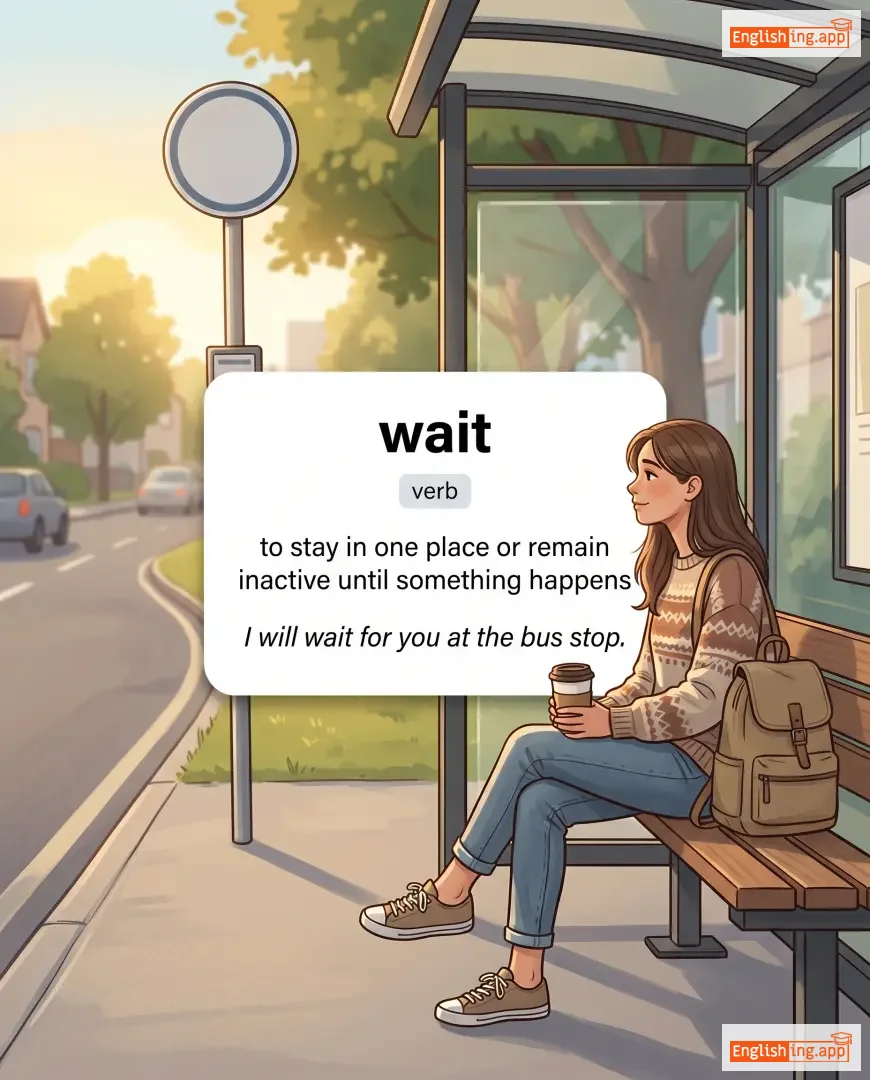
wait definition card — visual illustration of the meaning
verb
/weɪt/
esperar (esperar)

to stay in one place or remain inactive until something happens

"I will wait for you at the bus stop."

"Te esperaré en la parada del autobús." (Te esperaré en la parada del autobús.)
noun
/ˈweɪtər/
camarero (camarero)

a person whose job is to serve food and drinks to customers in a restaurant or café

"The waiter brought the menu and took our order politely."

"El camarero trajo el menú y tomó nuestro pedido." (el camarero trajo el menu y tomo nuestro pedido)
noun
/ˈweɪtrəs/
camarera (camarera)

a woman who serves food and drinks to customers in a restaurant or café

"The waitress took our order with a friendly smile."

"La camarera tomó nuestro pedido con una sonrisa." (La camarera tomo nuestro pedido con una sonrisa)
verb
/weɪv/
felicidad (felicidad)

to refrain from insisting on or enforcing something, especially a right or claim

"She decided to waive her right to a lawyer."

"No pudo ocultar su felicidad cuando recibió el premio." (No pudo ocultar su felicidad cuando recibió el premio.)
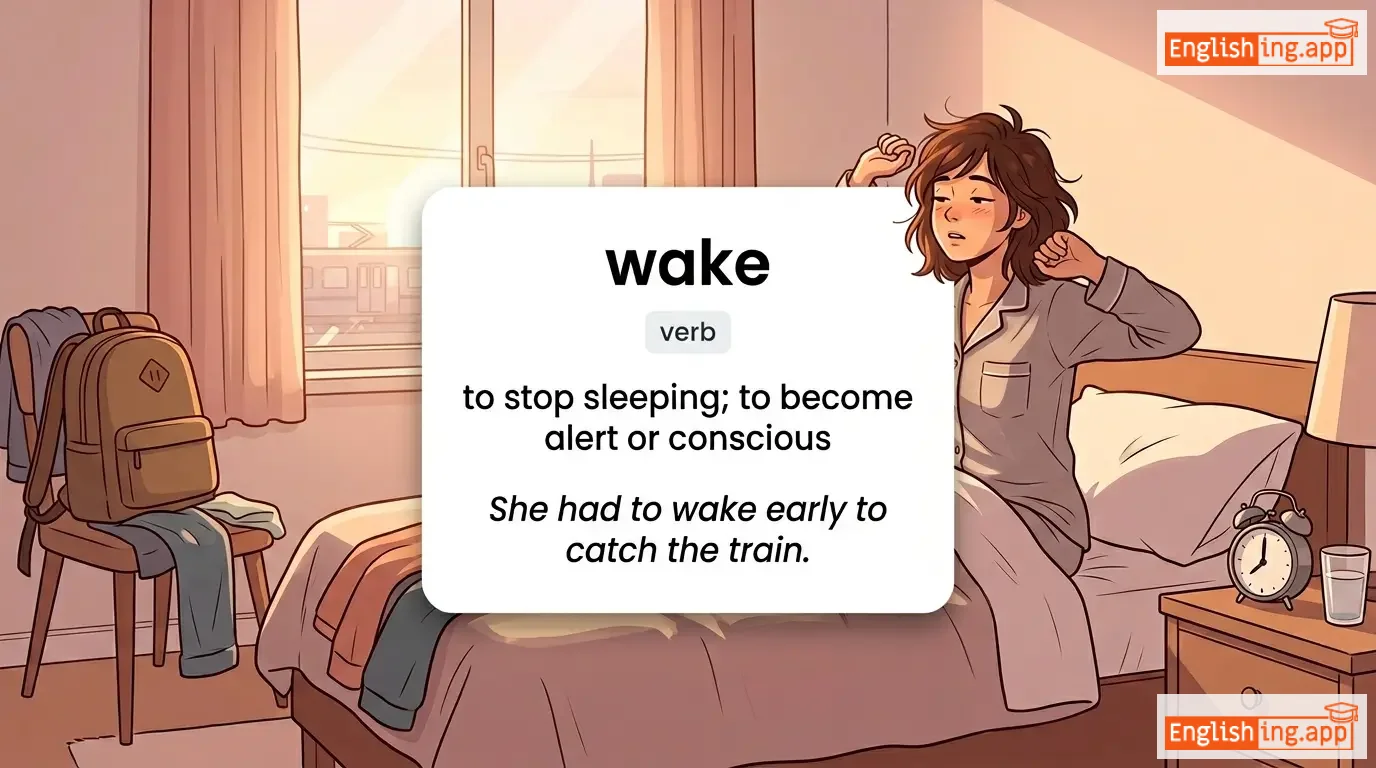
wake definition card — visual illustration of the meaning
verb
/weɪk/
felicidad (felicidad)

to stop sleeping; to become alert or conscious

"She had to wake early to catch the train."

"Ella no pudo esconder su felicidad cuando recibió el premio." (Ella no pudo esconder su felicidad cuando recibio el premio.)
adjective
/ˈweɪ.kɪŋ/
despierto; consciente (despierto; consciente)

awake and conscious; relating to the time when one is awake

"She spent her waking hours studying for the exam."

"Ella pasó sus horas despiertas estudiando para el examen." (Ella paso sus horas despiertas estudiando para el examen.)
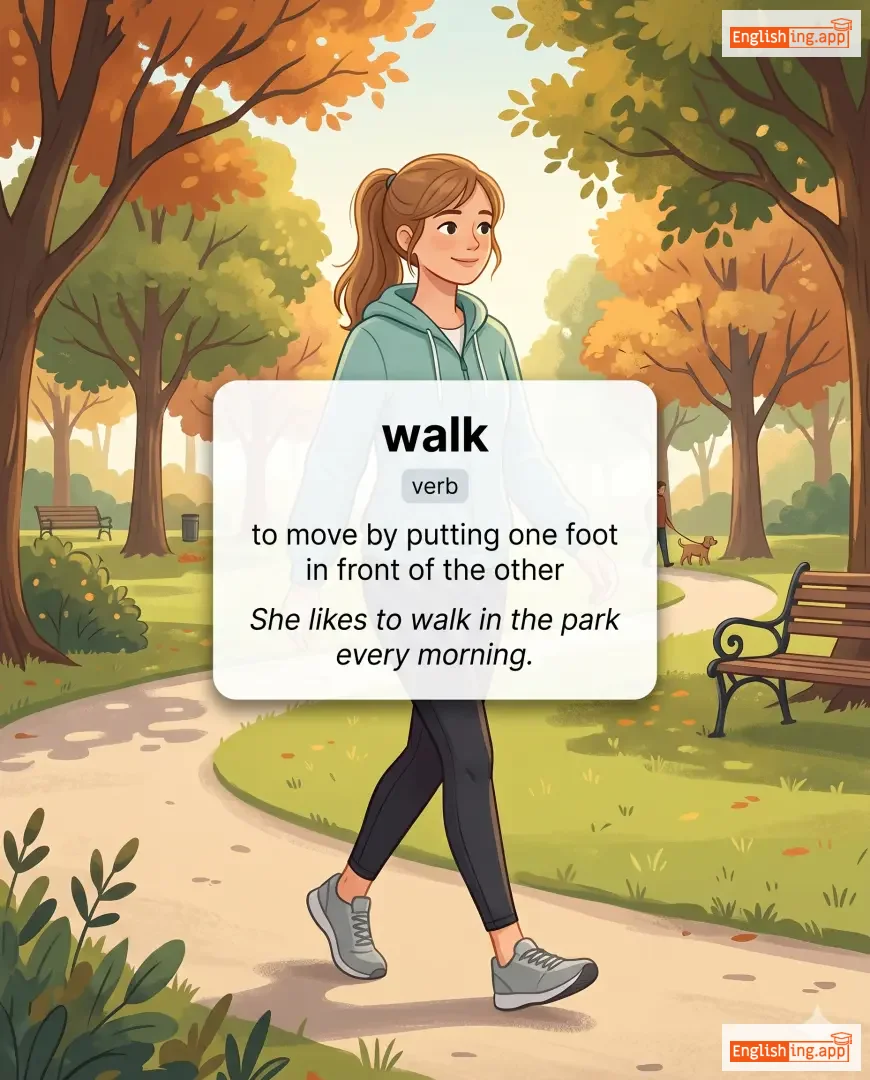
walk definition card — visual illustration of the meaning
verb
/wɔːk/
caminar (caminar)

to move by putting one foot in front of the other

"She likes to walk in the park every morning."

"A ella le gusta caminar en el parque todas las mañanas." (A ella le gusta caminar en el parque todas las mañanas.)
🚶‍♂️

walking (wóking)

noun
/ˈwɔːkɪŋ/
caminar (caminar)

the activity of moving on foot at a moderate pace

"Walking every morning is good for your health."

"Caminar todas las mañanas es bueno para tu salud." (Caminar todas las mañanas es bueno para tu salud.)
noun
/ˈwɔːkɪŋ fɪʃ/
pez caminante (pez caminante)

a fish that can move on land using its fins and breathe air for extended periods

"The walking-fish can travel across dry land to find new water sources."

"El pez caminante puede caminar por tierra seca para encontrar nuevas fuentes de agua." (El pez caminante puede caminar por tierra seca para encontrar nuevas fuentes de agua.)
noun
/wɔːl/
pared (pared)

a vertical structure that encloses or divides an area

"The wall in our living room is painted blue."

"La pared en nuestra sala de estar está pintada de azul." (La pared en nuestra sala de estar está pintada de azul.)
noun
/ˈwɒlɪt/
billetera (billetera)

a small folding case for carrying money, credit cards, and identification

"He pulled out his wallet to pay for the coffee."

"Sacó su billetera para pagar el café." (Saco su billetera para pagar el cafe.)
verb
/ˈwɒloʊ/
revolcarse, sumergirse (revolcarse, sumergirse)

to roll about or indulge oneself in something excessively

"The buffalo likes to wallow in the mud on hot days."

"Al búfalo le gusta revolcarse en el barro durante los días calurosos." (Al búfalo le gusta revolcarse en el barro durante los días calurosos.)
noun
/ˈwɔːl.nʌt/
nuez (nuez)

an edible nut with a hard shell and a wrinkled appearance

"I love to eat walnuts with honey for breakfast."

"Me encanta comer nueces con miel en el desayuno." (Me encanta comer nueces con miel en el desayuno.)
noun
/ˈwɑːmpəm/
collares de concha (collares de concha)

beads made by Native Americans from shells, used as money or decoration

"The tribe traded furs for wampum."

"La tribu intercambió pieles por collares de concha." (La tribu intercambió pieles por collares de concha.)
adjective
/wɒn/
pálido (palido)

looking pale or sickly; lacking color or vitality

"After the long illness, his face looked wan and tired."

"Después de la larga enfermedad, su rostro se veía pálido y cansado." (Despues de la larga enfermedad, su rostro se veia palido y cansado.)
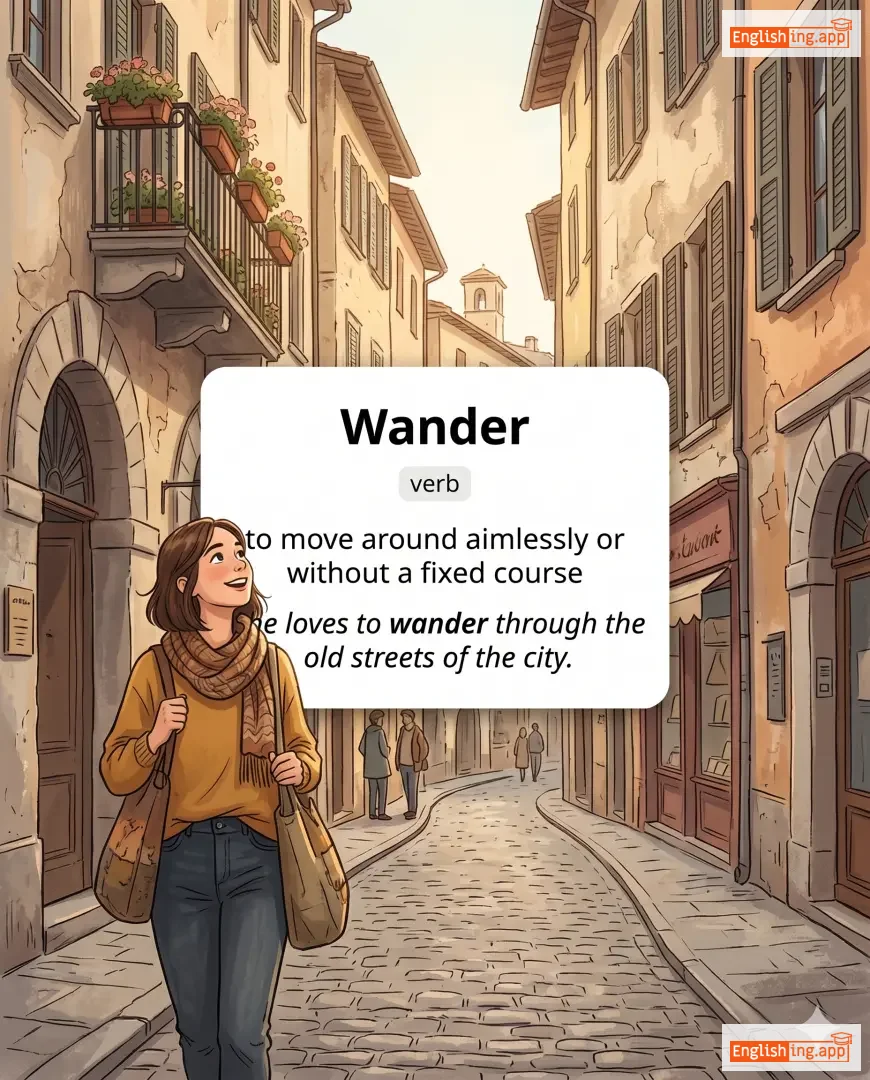
Wander definition card — visual illustration of the meaning
verb
/ˈwɒndər/
deambular (deambular)

to move around aimlessly or without a fixed course

"She loves to wander through the old streets of the city."

"A ella le encanta caminar por las viejas calles de la ciudad." (A ella le encanta caminar por las viejas calles de la ciudad.)
noun
/ˈwɒndərər/
vagabundo; persona que viaja sin un destino fijo (wanderer)

a person who travels aimlessly; someone who roams from place to place

"The wanderer explored different countries without a fixed destination."

"El vagabundo exploró diferentes países sin un destino fijo." (El vagabundo exploró diferentes países sin un destino fijo.)
noun
/ˈwɒndərlʌst/
pasión por viajar (pasion por viajar)

A strong desire to travel and explore the world.

"Her wanderlust took her to every corner of the globe."

"Su pasión por viajar la llevó a cada rincón del mundo." (Su pasion por viajar la llevo a cada rincon del mundo.)
verb
/weɪn/
decrecer (decrecer)

To decrease gradually in power, intensity, or size.

"The moon wanes after the full moon night."

"La luna decrece después de la noche de luna llena." (La luna decrece después de la noche de luna llena.)
verb
/ˈwaŋɡl/
obtener algo con astucia (obtener algo con astucia)

To achieve something by clever or sometimes dishonest persuasion or trickery.

"He wangled a free ticket to the concert."

"Consiguió una entrada gratuita para el concierto con astucia." (consiguió una entrada gratuita para el concierto con astucia.)
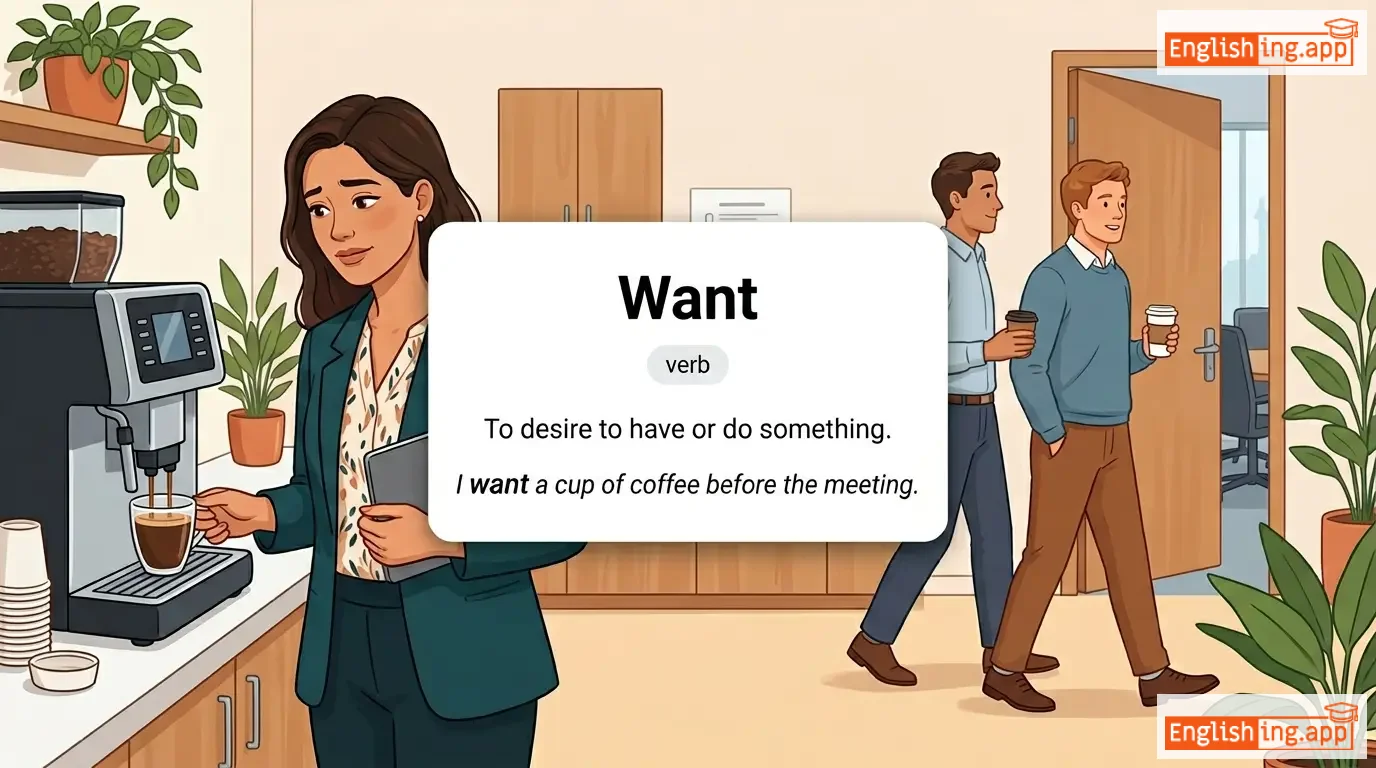
Want definition card — visual illustration of the meaning
verb
/wɒnt/
querer (querer)

To desire to have or do something.

"I want a cup of coffee before the meeting."

"Quiero una taza de café antes de la reunión." (quiero una taza de café antes de la reunión.)
adjective
/ˈwɒntɪŋ/
insuficiente (insuficiente)

Lacking or deficient in quality or quantity.

"His explanation was wanting in clarity."

"Su explicación carecía de claridad." (su explicacion carecia de claridad.)
adjective
/ˈwɒntən/
crueldad innecesaria (crueldad innecesaria)

Deliberate and unprovoked; reckless or cruel.

"The soldiers were accused of wanton destruction."

"A los soldados se les acusó de destrucción innecesaria." (A los soldados se les acusó de destrucción innecesaria.)
noun
/ˈwɒntənnəs/
crueldad gratuita (crueldad gratuita)

The quality of being reckless, cruel, or deliberately malicious.

"His wantonness shocked everyone at the gathering."

"Su crueldad gratuita sorprendió a todos en la reunión." (Su crueldad gratuita sorprendió a todos en la reunión.)
noun
/wɔːr/
guerra (guerra)

a state of conflict between different countries or groups

"The war caused great suffering to the people."

"La guerra causó un gran sufrimiento a las personas." (La guerra causó un gran sufrimiento a las personas.)
verb
/ˈwɔːbəl/
cantar o silbar con voz temblorosa o trinos (cantar o silbar con voz temblorosa o trinos)

To sing or whistle with a quavering voice or with trills.

"The bird warbled a sweet tune in the morning."

"El pájaro cantó una dulce melodía por la mañana." (El pajaro canto una dulce melodia por la manana.)
noun
/wɔːrd/
sala (sala)

A separate room in a hospital for patients; also a division of a city or a person under guardianship.

"She was admitted to the children's ward."

"Ella fue admitida en la sala de niños." (Ella fue admitida en la sala de niños.)
noun
/ˈwɔːdrəʊb/
armario (armario)

A large cupboard where clothes are stored; also the collection of clothes someone owns.

"Her wardrobe is full of colorful dresses."

"Su armario está lleno de vestidos coloridos." (Su armario está lleno de vestidos coloridos.)
noun
/ˈweə(r)haʊs/
almacén (almacen)

a large building where goods are stored before being sold or distributed

"The company stores all its products in a big warehouse."

"La empresa almacena todos sus productos en un gran almacén." (La empresa almacena todos sus productos en un gran almacén.)
noun
/ˈwɔːfeə/
guerra (guerra)

engagement in or the activities involved in war

"The country prepared for the possibility of total warfare."

"El país se preparó para la posibilidad de guerra total." (El pais se preparo para la posibilidad de guerra total.)
adjective
/ˈwɔːrˌlaɪk/
bélico (beliko)

Having an aggressive or militant nature; inclined to fight or engage in war.

"The tribe was known for its warlike traditions."

"La tribu era conocida por sus tradiciones bélicas." (La tribu era conocida por sus tradiciones belikas.)
adjective
/wɔːrm/
cálido (kalido)

having a moderate degree of heat

"The warm sunlight made the room feel cozy."

"La luz cálida hizo que la habitación se sintiera acogedora." (La luz cálido hizo que la habitación se sintiera acogedora.)
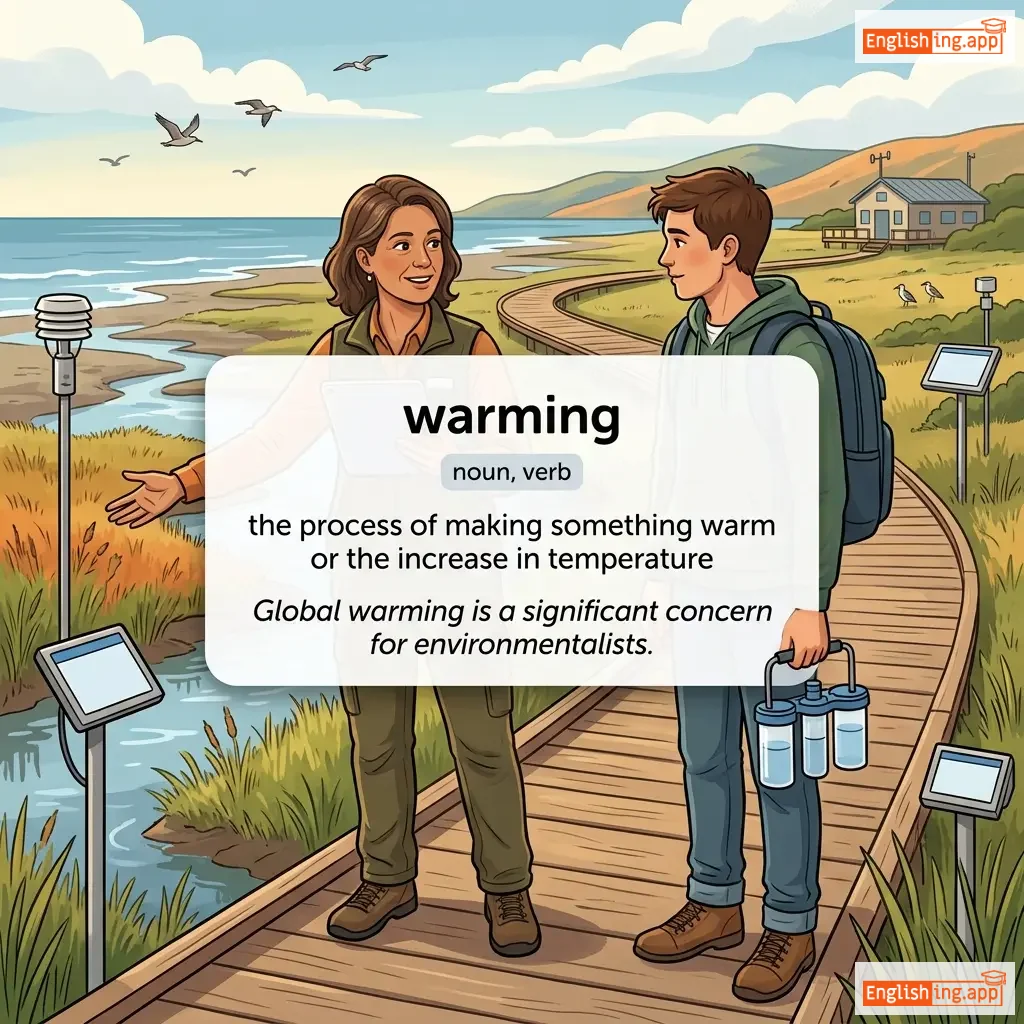
warming definition card — visual illustration of the meaning
noun, verb
/ˈwɔːmɪŋ/
aumento de temperatura (aumento de temperatura)

the process of making something warm or the increase in temperature

"Global warming is a significant concern for environmentalists."

"El calentamiento global es una preocupación significativa para los ambientalistas." (El calentamiento global es una preocupación significativa para los ambientalistas.)
adverb
/ˈwɔːm.li/
calurosamente; afectuosamente (calurosamente; afectuosamente)

in a warm manner; with warmth; cordially; affectionately

"She welcomed the guests warmly at the door."

"Ella recibió a los invitados calurosamente en la puerta." (Ella recibio a los invitados calurosamente en la puerta.)
noun
/ˈwɔːrˌmʌŋɡər/
guerrerista (guerrerista)

A person who advocates or promotes war or conflict.

"The leader was criticized as a warmonger by his opponents."

"El líder fue criticado como un guerrerista por sus oponentes." (El líder fue criticado como un guerrerista por sus oponentes.)
noun
/wɔːmθ/
calor (calor)

the quality or state of being warm in temperature or feeling

"She felt the warmth of the sun on her face."

"Ella sintió el calor del sol en su rostro." (Ella sintió el calor del sol en su rostro.)
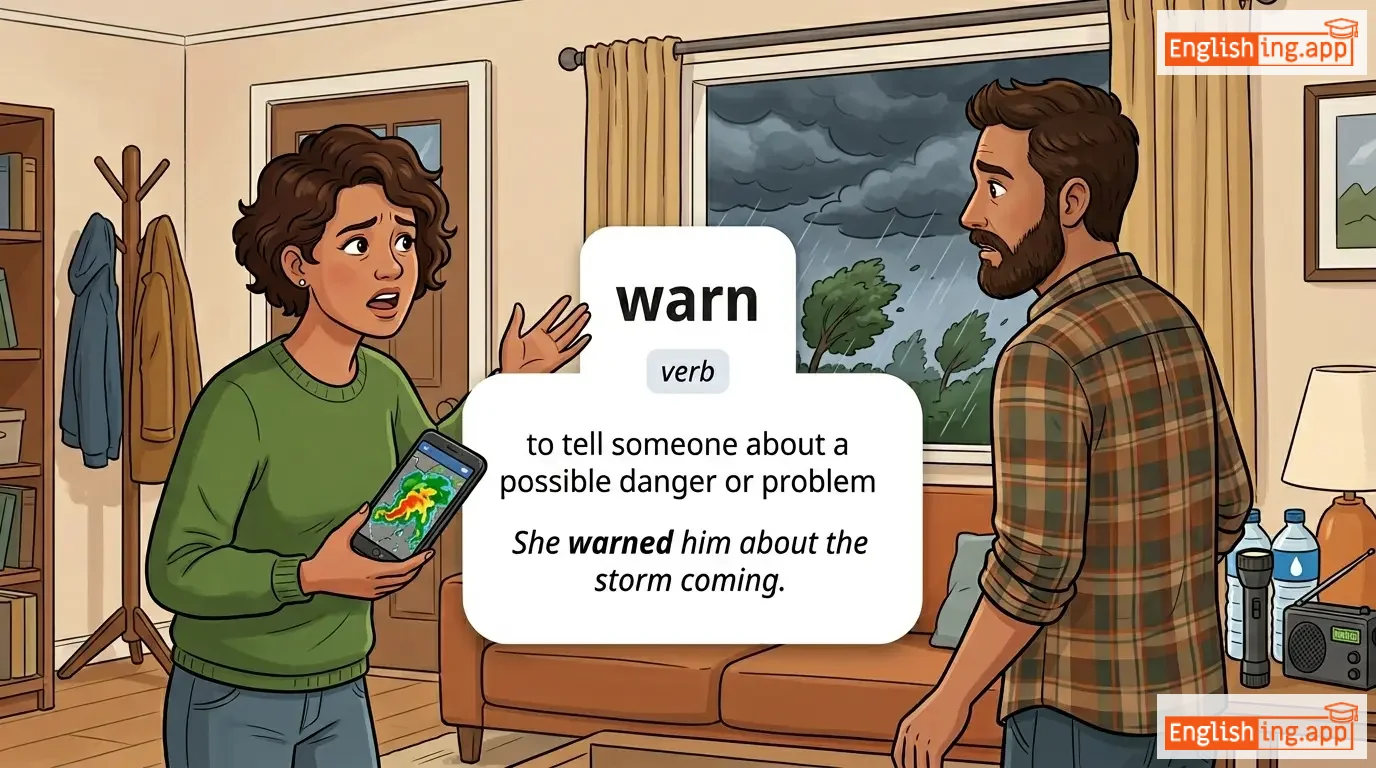
warn definition card — visual illustration of the meaning
verb
/wɔːrn/
advertir (advertir)

to tell someone about a possible danger or problem

"She warned him about the storm coming."

"Ella le advirtió sobre la tormenta que venía." (Ella le advirtió sobre la tormenta que venía.)