Vocabulaires

Découvrez, apprenez et maîtrisez le vocabulaire anglais

🙅‍♀️

Unable (ʌˈneɪbl)

adjective
/ʌˈneɪbl/
incapable (incapable)

not able to do something

"She was unable to attend the meeting."

"Elle n'a pas pu assister à la réunion." (Elle n'a pas pu assister à la réunion.)
noun
/ʌnəˈbɪləti/
incapacité (incapacite)

the state of being unable to do something; incapacity

"His unability to solve the problem caused delays in the project."

"Son incapacité à résoudre le problème a causé des retards dans le projet." (Son incapacite a resoudre le probleme a cause des retards dans le projet)
noun
/ʌmˈbrɛlə/
parapluie (parapluie)

A device used for protection against rain or sun, typically consisting of a collapsible canopy mounted on a central rod.

"She opened her umbrella as it started to rain."

"Elle a ouvert son parapluie quand il a commencé à pleuvoir." (Elle a ouvert son parapluie quand il a commence a pleuvoir.)
noun
/ˈʌmbrɪdʒ/
mécontentement, offense (mécontentement, offense)

A feeling of resentment or offense.

"She took umbrage at his rude remark."

"Elle s'est vexée par sa remarque grossière." (Elle s'est vexée par sa remarque grossière.)
noun
/ˈʌm.brə/
ombre totale, région sombre d'une tache solaire (ombre totale, region sombre d'une tache solaire)

the fully shaded inner region of a shadow cast by an opaque object; the dark center of a sunspot

"During the eclipse, we stood in the moon's umbra."

"Pendant l'éclipse, nous nous sommes tenus dans l'ombre de la lune." (Pendant l'éclipse, nous nous sommes tenus dans l'ombre de la lune.)
adjective
/ˌʌltrəˈmʌndeɪn/
ultramondain (ultramondain)

Relating to things beyond the physical world; supernatural or transcendental.

"Philosophers often discuss ultramundane realities beyond human perception."

"Les philosophes discutent souvent des réalités ultramondaines au-delà de la perception humaine." (Les philosophes discutent souvent des realites ultramondaines au-dela de la perception humaine.)
adjective
/ˌʌltrəˈmɒnteɪn/
partisan du Pape (partisan du Pape)

beyond the mountains, especially referring to support for the Pope over local church authority

"The debate highlighted the ultramontane position in church politics."

"Le débat a mis en lumière la position ultramontaine dans la politique ecclésiastique." (Le debat a mis en lumiere la position ultramontaine dans la politique ecclesiastique.)
noun
/ˌʌltɪˈmeɪtəm/
ultimatum (ultimatum)

a final demand or statement of terms

"The workers gave the company an ultimatum to raise their wages."

"Les travailleurs ont donné à l'entreprise un ultimatum pour augmenter leurs salaires." (Les travailleurs ont donne a l'entreprise un ultimatum pour augmenter leurs salaires.)
adverb
/ˈʌltəmətli/
finalement (finalement)

in the end, after everything else

"Ultimately, we decided to go ahead with the project."

"Finalement, nous avons décidé de poursuivre le projet." (Finalement, nous avons decide de poursuivre le projet.)
adjective
/ˈʌltɪmət/
ultime (ultim)

being the best, final, or most extreme

"Success is the ultimate goal of hard work."

"Le succès est le but ultime du travail acharné." (Le succes est le but ultime du travail acharne.)
adjective
/ʌlˈtɪəriər/
motif caché (motif cache)

hidden or secret, often with a selfish motive

"He invited her with an ulterior motive."

"Il l'a invitée avec un motif caché." (Il l'a invitee avec un motif cache.)
noun
/ˈʌlsər/
ulcère (ulcere)

a sore on the skin or a mucous membrane that does not heal easily

"The doctor prescribed medicine to treat the stomach ulcer."

"Le médecin a prescrit des médicaments pour traiter l'ulcère de l'estomac." (Le medecin a prescrit des medicaments pour traiter l ulcere de lestomac)
interjection
/ʌ/
euh (euh)

a sound people make when they hesitate or are unsure what to say next.

"Uh, I’m not sure if that’s the right answer."

"Euh, je ne suis pas sûr si c'est la bonne réponse." (Euh, je ne suis pas sûr si c'est la bonne réponse.)
adjective
/ˈʌɡli/
laid (laid)

unpleasant or repulsive in appearance

"The house had an ugly view of the street."

"La maison avait une vue moche de la rue." (La maison avait une vue moche de la rue.)
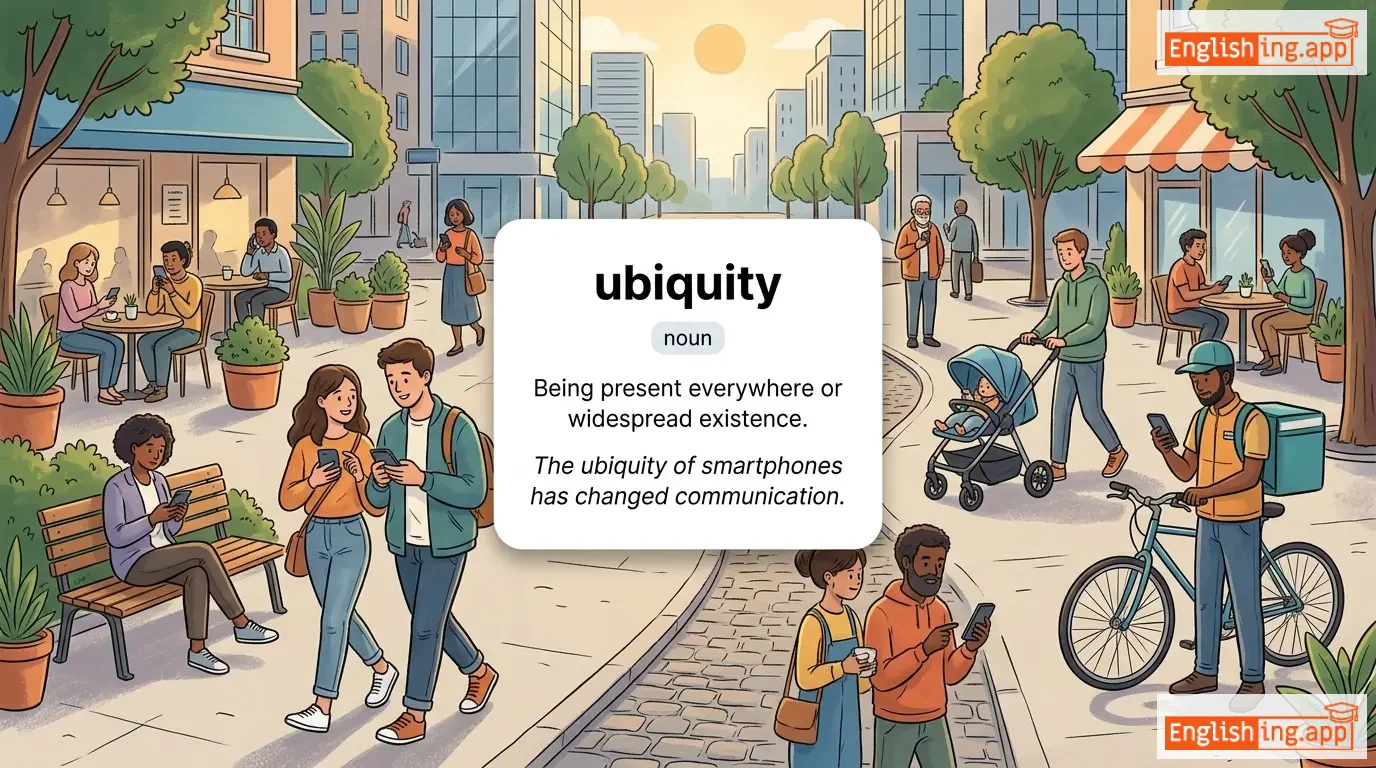
ubiquity definition card — visual illustration of the meaning
noun
/juːˈbɪk.wɪ.ti/
ubiquité (ubiquité)

Being present everywhere or widespread existence.

"The ubiquity of smartphones has changed communication."

"L'ubiquité des smartphones a changé la communication." (L'ubiquité des smartphones a changé la communication.)
adjective
/juːˈbɪkwɪtəs/
omniprésent (omnipresent)

Existing or being everywhere at the same time.

"Social media has become ubiquitous among young people."

"Les médias sociaux sont devenus omniprésents parmi les jeunes." (Les médias sociaux sont devenus omniprésents parmi les jeunes.)
adjective
/juːˈbɪkwɪtəs/
omniprésent (omnipresent)

Present, appearing, or found everywhere.

"Smartphones have become ubiquitous in modern society."

"Les smartphones sont devenus omniprésents dans la société moderne." (Les smartphones sont devenus omniprésents dans la société moderne.)
noun
/ˈtaɪroʊ/
débutant (debutant)

A beginner or novice in a field or activity.

"As a tyro in programming, she needed constant guidance."

"En tant que débutant en programmation, elle avait besoin d'une orientation constante." (En tant que débutant en programmation, elle avait besoin d'une orientation constante.)
noun
/ˈtaɪ.rənt/
tyran (tyran)

a cruel and oppressive ruler; a person who exercises power in a harsh manner

"The people rebelled against the cruel tyrant."

"Le peuple s'est rebellé contre le tyran cruel." (Le peuple s'est rebellé contre le tyran cruel)
noun
/ˈtɪrəni/
tyrannie (tyrannie)

Cruel and oppressive government or rule by a tyrant.

"The people revolted against the tyranny of their ruler."

"Les gens se sont rebellés contre la tyrannie de leur dirigeant." (Les gens se sont rebellés contre la tyrannie de leur dirigeant.)
adjective
/tɪˈrænɪkəl/
tyrannique (tyrannique)

exercising power in a cruel or arbitrary way

"The tyrannical ruler silenced all opposition."

"Le dirigeant tyrannique a réduit au silence toute opposition." (Le dirigeant tyrannique a réduit au silence toute opposition.)
noun
/taɪˈpɒɡrəfi/
typographie (typographie)

the art and technique of arranging type to make written language legible and visually appealing

"Good typography improves the readability of a website."

"Une bonne typographie améliore la lisibilité d'un site web." (Une bonne typographie améliore la lisibilité d'un site web.)
adjective
/ˌtaɪpəˈɡræfɪkəl/
typographique (typographique)

relating to the style, arrangement, or appearance of printed text

"There was a typographical error in the book."

"Il y avait une erreur typographique dans le livre." (Il y avait une erreur typographique dans le livre.)
noun
/ˈtaɪpoʊ/
faute de frappe (faute de frappe)

a mistake made in typing

"The report was full of typos."

"Le rapport était plein de fautes de frappe." (Le rapport était plein de fautes de frappe.)
verb
/ˈtɪpɪfaɪ/
représenter (representer)

to represent or be a typical example of something

"His leadership style typifies the new corporate culture."

"Son style de leadership incarne la nouvelle culture d'entreprise." (Son style de leadership incarne la nouvelle culture d'entreprise.)
adverb
/ˈtɪpɪkli/
généralement (generalement)

in a way that is typical of a particular person, thing, or group

"She typically arrives at work at 9 AM."

"Elle arrive généralement au travail à 9 heures." (Elle arrive generalement au travail a 9 heures.)
adjective
/ˈtɪpɪkəl/
ayant les qualités habituelles d'un type particulier de personne ou de chose (ayant les qualites habituelles d'un type particulier de personne ou de chose)

having the usual qualities of a particular type of person or thing

"It was a typical summer day, hot and humid."

"C'était un jour d'été typique, chaud et humide." (C'etait un jour d'ete typique, chaud et humide.)
noun
/taɪˈfuːn/
typhon (tyfon)

a tropical storm in the region of the Indian or western Pacific oceans

"The typhoon caused severe flooding in the coastal areas."

"Le typhon a causé des inondations graves dans les zones côtières." (Le typhon a causé des inondations graves dans les zones côtières.)
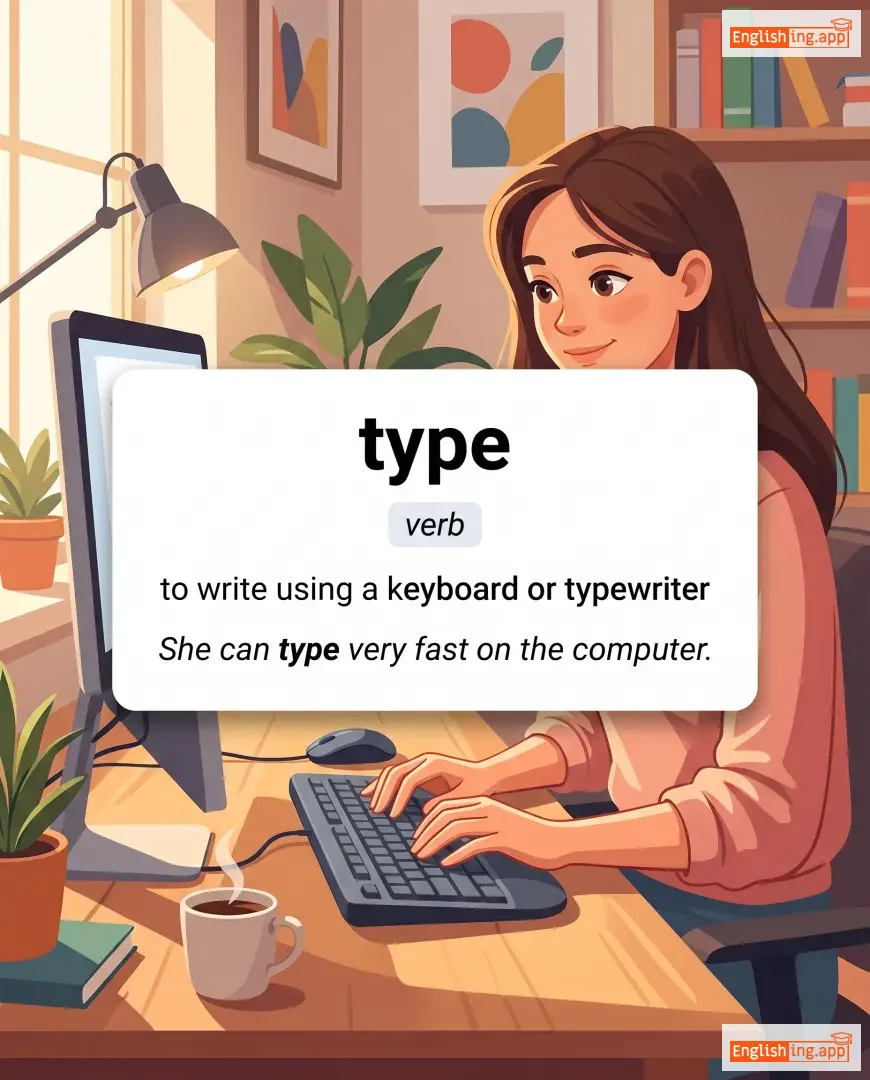
type definition card — visual illustration of the meaning
noun
/taɪp/
type (type)

a category of people or things having common characteristics

"What type of music do you like?"

"Quel type de musique aimez-vous ?" (Quel type de musique aimez-vous ?)
noun
/taɪˈkuːn/
magnat (magnat)

a wealthy, powerful businessperson

"The real estate tycoon invested in several skyscrapers."

"Le magnat de l'immobilier a investi dans plusieurs gratte-ciel." (Le magnat de l'immobilier a investi dans plusieurs gratte-ciel.)
noun
/ˈtuːsəm/
couple (couple)

A pair of people considered together, often in a romantic or competitive context.

"They entered the dance competition as a twosome."

"Ils sont entrés dans la compétition de danse en tant que couple." (Ils sont entrés dans la compétition de danse en tant que couple.)
noun
/tuː θɜːrdz/
deux tiers (deux tiers)

a fraction equal to two parts of three; 2/3.

"Two-thirds of the students passed the exam."

"Deux tiers des étudiants ont réussi l'examen." (Deux tiers des étudiants ont réussi l'examen.)
2️⃣

two (tou)

noun
/tuː/
deux (deux)

the number following one

"She has two children."

"Elle a deux enfants." (Elle a deux enfants.)
noun
/juːˈkeɪs/
décret (decret)

An authoritative decree or order, especially one issued by a sovereign or government.

"The czar issued a ukase restricting the freedom of the press."

"Le tsar a émis un décret restreignant la liberté de la presse." (Le tsar a émis un décret restreignant la liberté de la presse.)
noun
/ˈtɛrərɪzəm/
terrorisme (terrorisme)

the use of violence or threats to intimidate or coerce, especially for political purposes

"Terrorism is a serious threat to global peace and security."

"Le terrorisme est une menace sérieuse pour la paix et la sécurité mondiales." (Le terrorisme est une menace sérieuse pour la paix et la sécurité mondiales.)
noun
/ˈtɛrərɪst/
terroriste (terroriste)

a person who uses violence or threats to intimidate or coerce, especially for political purposes

"The terrorist was arrested by the police after the attack."

"Le terroriste a été arrêté par la police après l'attaque." (Le terroriste a été arrêté par la police après l'attaque.)
adjective
/tɜːrs/
bref (bref)

brief and to the point; sparing in the use of words

"His reply was terse and ended the conversation quickly."

"Sa réponse était brève et a rapidement mis fin à la conversation." (sa reponse etait breve et a rapidement mis fin a la conversation.)
adjective
/ˈtɜːrʃieri/
tertiaire (tertiaire)

third in order, rank, or level

"He is pursuing his tertiary education at the university."

"Il poursuit ses études tertiaires à l'université." (Il poursuit ses etudes tertiaires a l universite)
adjective
/ˈtɛsəleɪtɪd/
carrelé (carrele)

arranged in a pattern of repeated shapes fitting together without gaps

"The tessellated floor was made of colorful tiles arranged in perfect symmetry."

"Le sol carrelé était composé de carreaux colorés disposés en parfaite symétrie." (Le sol carrele etait compose de carreaux colores disposes en parfaite symetrie.)
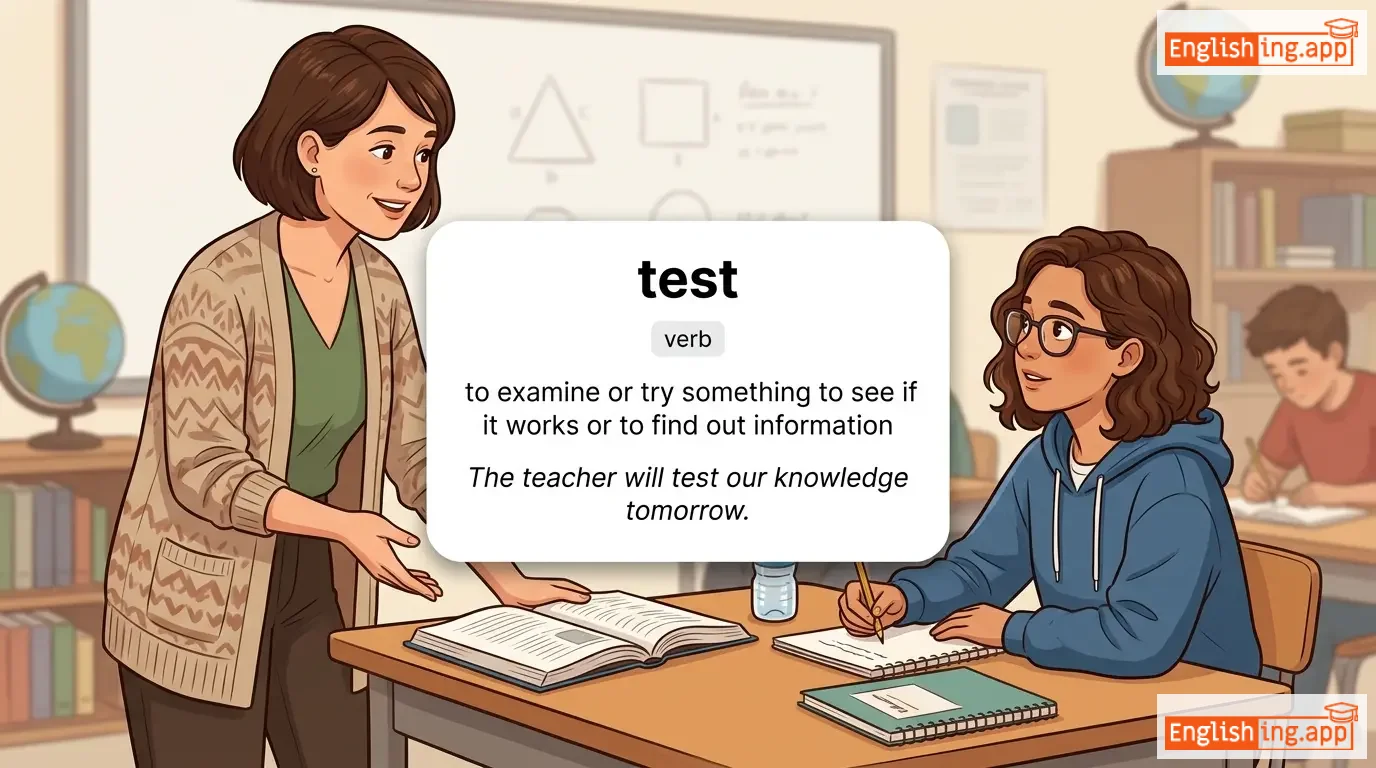
test definition card — visual illustration of the meaning
noun
/tɛst/
test (test)

a procedure intended to establish the quality, performance, or reliability of something

"The test results will determine whether the treatment is effective."

"Les résultats du test détermineront si le traitement est efficace." (Les résultats du test détermineront si le traitement est efficace.)
noun
/ˈtɛstəmənt/
testament / preuve (testament / preuve)

a person's will; or strong evidence of something

"His success is a testament to his hard work and dedication."

"Son succès est un testament de son travail acharné et de son dévouement." (Son succès est un testament de son travail acharné et de son dévouement.)
noun
/ˈtɛsteɪtər/
testateur (testateur)

a person who has made a will

"The lawyer read the will of the deceased testator."

"L'avocat a lu le testament du testateur décédé." (L'avocat a lu le testament du testateur décédé.)
verb
/ˈtɛstəfaɪ/
témoigner (temoigner)

to make a statement or declaration under oath or to give evidence

"She was called to testify in court about the accident."

"Elle a été appelée à témoigner au tribunal sur l'accident." (Elle a été appelée à témoigner au tribunal sur l'accident.)
noun
/ˌtɛstɪˈmoʊniəl/
témoignage (temoignage)

A formal statement testifying to someone's character, qualifications, or the quality of a product or service.

"The company shared a glowing testimonial from a satisfied customer."

"L'entreprise a partagé un témoignage élogieux d'un client satisfait." (L'entreprise a partage un temoignage elogieux d'un client satisfait.)
testimonials definition card — visual illustration of the meaning
noun
/ˌtɛstɪˈməʊnɪəlz/
témoignages, lettres de recommandation (temoignages, lettres de recommandation)

Written or spoken statements of praise or recommendation from clients or customers.

"Positive testimonials can enhance a company's reputation."

"Des témoignages positifs peuvent améliorer la réputation d'une entreprise." (Des temoignages positifs peuvent ameliorer la reputation d'une entreprise.)
noun
/ˈtɛstəˌmoʊni/
témoignage (temoignage)

A formal statement given in a court of law or evidence supporting a fact.

"Her testimony in court helped convict the criminal."

"Son témoignage devant le tribunal a aidé à condamner le criminel." (Son temoignage devant le tribunal a aide a condamner le criminel.)
noun
/ˈtɛstɪŋ/
test (test)

the process of assessing or evaluating something, often by trying it out

"The testing of the new software is still ongoing."

"Le test du nouveau logiciel est toujours en cours." (Le test du nouveau logiciel est toujours en cours.)
adjective
/ˈtɛsti/
irritable (irritable)

Easily irritated or annoyed.

"He became testy when asked the same question repeatedly."

"Il est devenu irritable lorsqu'on lui a posé la même question à plusieurs reprises." (Il est devenu irritable lorsqu'on lui a posé la même question à plusieurs reprises.)
noun
/θæŋks/
merci (merci)

an expression of gratitude

"Thanks for helping me with the project."

"Merci de m'avoir aidé avec le projet." (Merci de m'avoir aidé avec le projet.)
noun
/ˈθæŋksˌɡɪvɪŋ/
Action de Grâce (Action de Grace)

an annual holiday in the US for giving thanks, celebrated with a meal

"We spent Thanksgiving dinner with our family."

"Nous avons passé le dîner de Thanksgiving avec notre famille." (Nous avons passe le diner de Thanksgiving avec notre famille.)