Vocabulaires

Découvrez, apprenez et maîtrisez le vocabulaire anglais

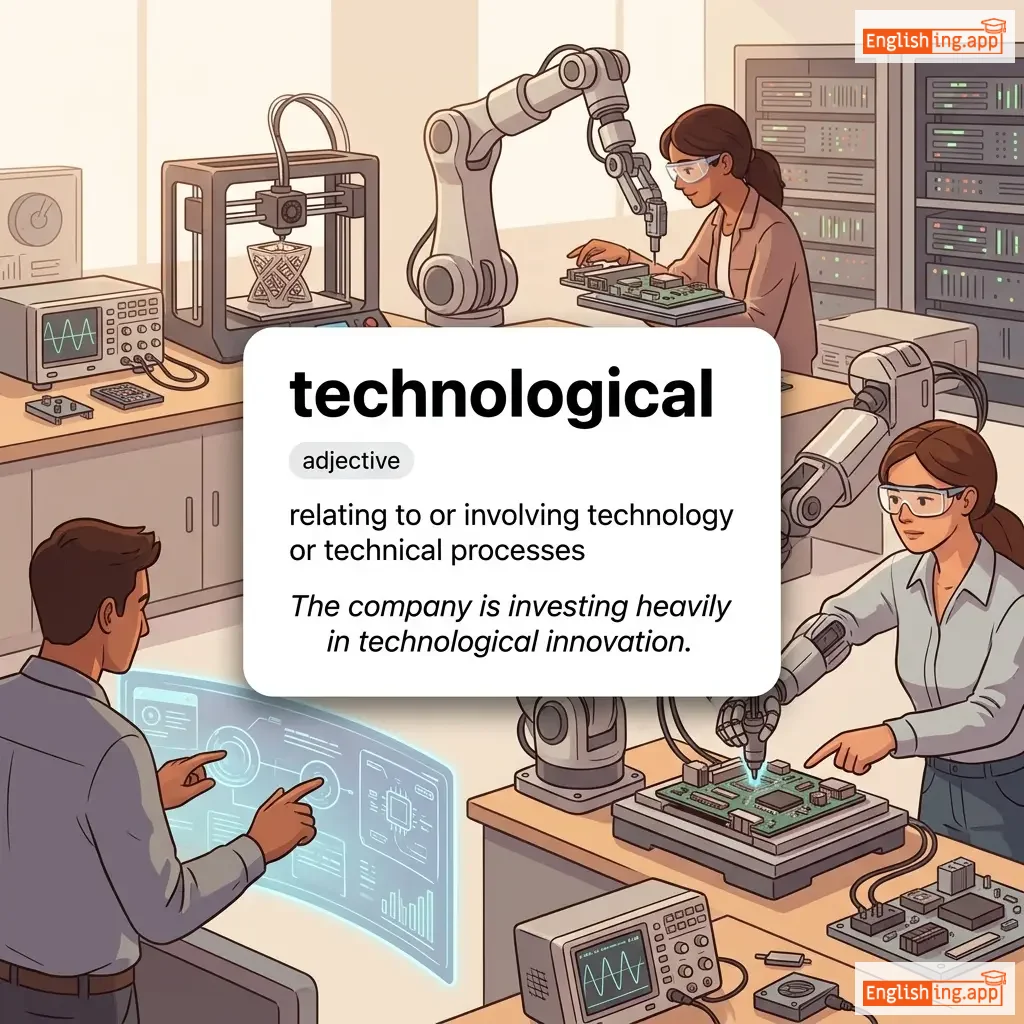
technological definition card — visual illustration of the meaning
adjective
/ˌteknəˈlɒdʒɪkəl/
technologique (teknolozhik)

relating to or involving technology or technical processes

"The company is investing heavily in technological innovation."

"L'entreprise investit massivement dans l'innovation technologique." (lentreprise investit massivement dans linnovation technologique)
noun
/tɛkˈnɒɡrəfi/
technographie (technographie)

the descriptive study or writing about the practical arts, technologies, or technical methods of a society

"The anthropologist specialized in technography to understand indigenous tool-making traditions."

"L'anthropologue s'est spécialisé en technographie pour comprendre les traditions autochtones de fabrication d'outils." (L'anthropologue s'est specialise en technographie pour comprendre les traditions autochtones de fabrication d'outils.)
noun
/tɛkˈniːk/
technique (technique)

A particular way of carrying out a task, especially with skill.

"She learned a new breathing technique in yoga class."

"Elle a appris une nouvelle technique de respiration dans le cours de yoga." (Elle a appris une nouvelle technique de respiration dans le cours de yoga.)
noun
/tɛkˈnɪʃən/
technicien (technicien)

a person skilled in the practical aspects of a particular science, art, or job

"The technician repaired the computer within an hour."

"Le technicien a réparé l'ordinateur en une heure." (Le technicien a réparé l'ordinateur en une heure.)
noun
/ˌtɛknɪˈkæləti/
technicalité (technicalite)

A small detail of law, rule, or procedure; a minor point that affects an outcome.

"The case was dismissed on a technicality."

"L'affaire a été rejetée pour une question de technicité." (L'affaire a ete rejete pour une question de technicalite.)
adjective
/ˈtɛknɪkəl/
technique (technique)

relating to a specific subject, art, or craft, or its techniques.

"He has a technical background in engineering."

"Il a un passé technique en génie." (Il a un passé technique en génie.)
noun
/ˈtɛknɪk/
technique (technique)

A method, skill, or art in a particular field, especially in the arts or sciences.

"The artist’s technic in watercolor impressed the judges."

"La technique de l'artiste en aquarelle a impressionné les juges." (La technique de l'artiste en aquarelle a impressionne les juges.)
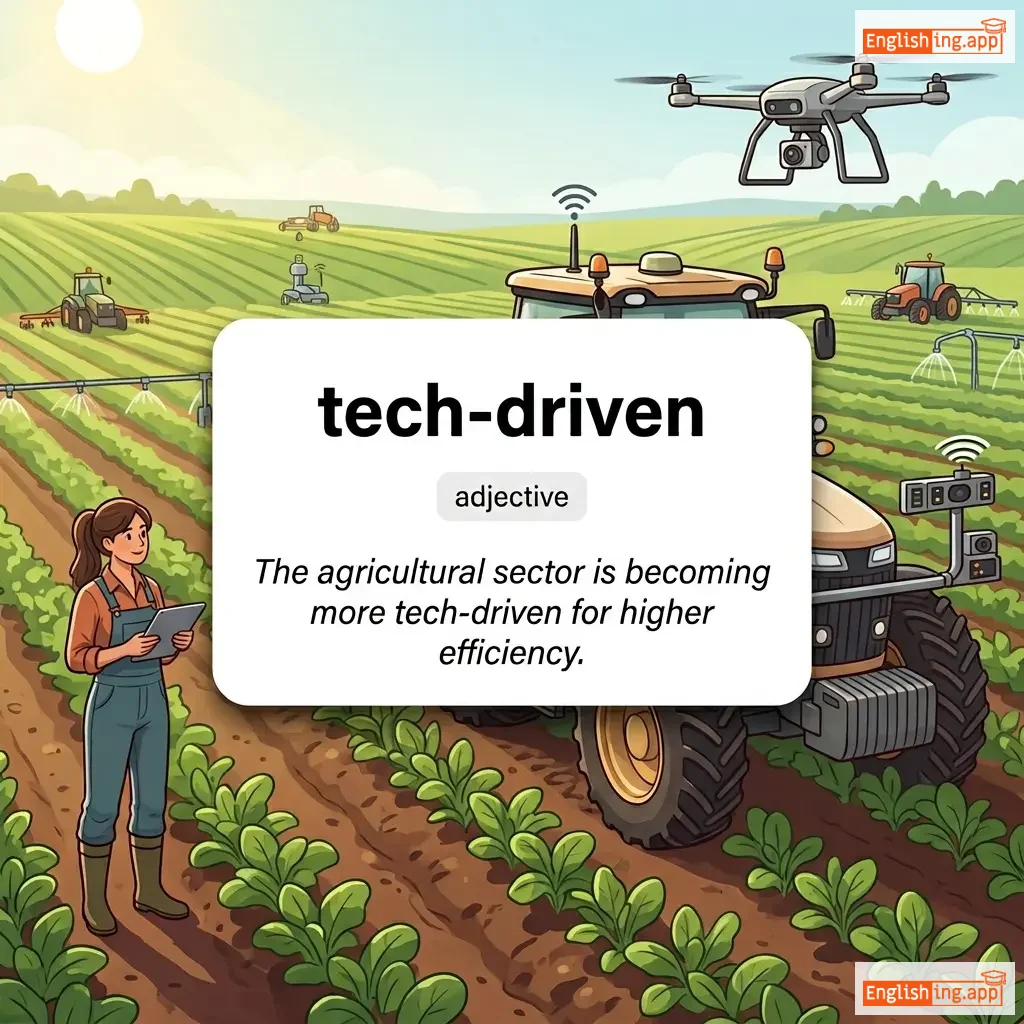
tech-driven definition card — visual illustration of the meaning
adjective
/tɛk ˈdrɪv.ən/
alimenté par la technologie (alimente par la technologie)

Powered or guided by technology; dependent on technological advancement for operation.

"The agricultural sector is becoming more tech-driven for higher efficiency."

"Le secteur agricole devient de plus en plus axé sur la technologie pour une efficacité accrue." (Le secteur agricole devient de plus en plus axe sur la technologie pour une efficacite accrue.)
noun
/ˈtiːspuːn/
bonheur (bonheur)

a small spoon used for stirring drinks or eating soft foods, or for measuring small amounts of ingredients.

"Add a teaspoon of sugar to the tea."

"Elle ne pouvait pas cacher son bonheur quand elle a reçu le prix." (Elle ne pouvait pas cacher son bonheur quand elle a reçu le prix.)
verb
/tiːz/
taquiner (taquiner)

to make fun of someone in a playful or unkind way

"Children often tease their younger siblings playfully."

"Les enfants se moquent souvent de leurs frères et sœurs plus jeunes de manière ludique." (Les enfants se moquent souvent de leurs frères et sœurs plus jeunes de manière ludique.)
adjective
/ˈtɪərfəl/
en larmes; incliné à pleurer (en larmes; incline a pleurer)

expressing or showing sadness and sorrow; inclined to weep

"She gave a tearful goodbye to her friends at the airport."

"Elle a fait ses adieux en pleurant à ses amis à l'aéroport." (Elle a fait ses adieux en pleurant à ses amis à l'aéroport.)
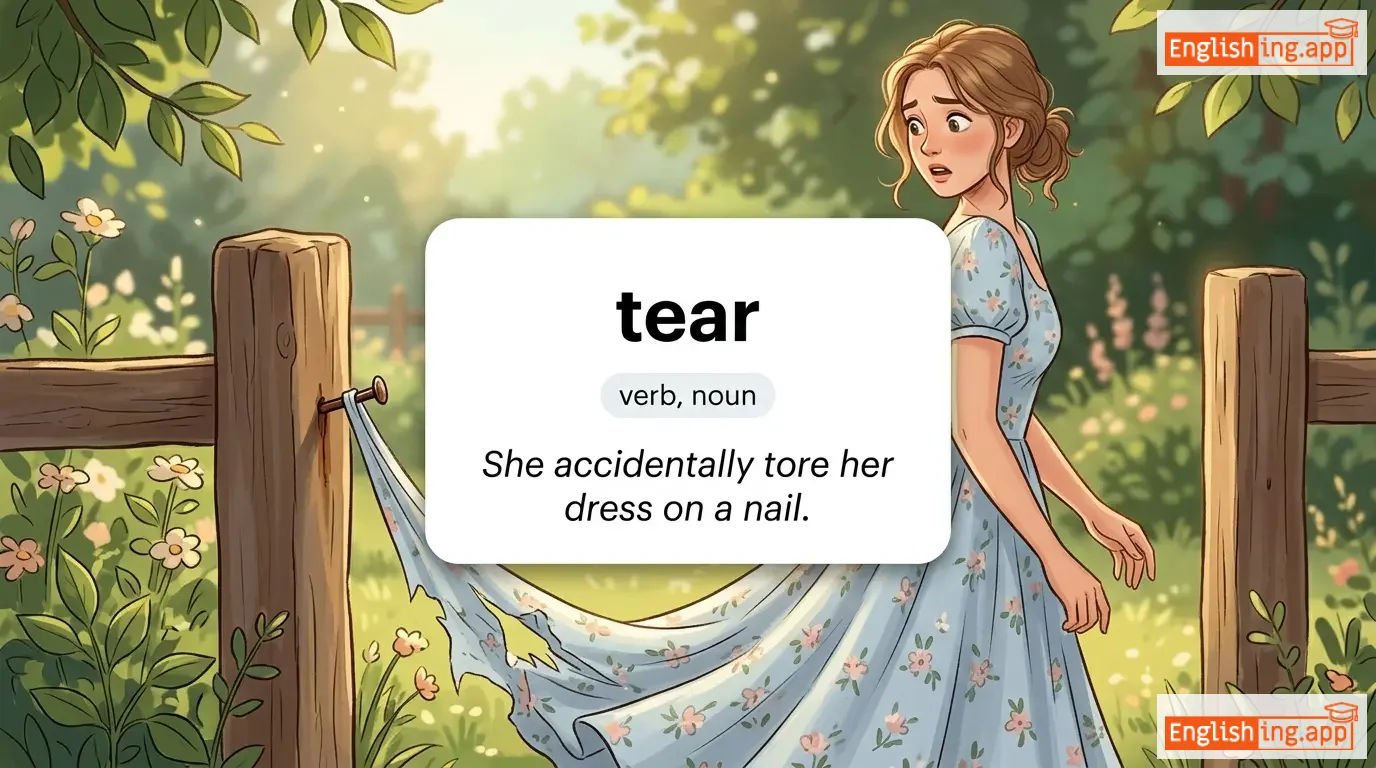
tear definition card — visual illustration of the meaning
verb, noun
/tɪər/ (noun: liquid) /tɛər/ (verb: rip)
larme / déchirer (larme / dechirer)

As a verb: to pull apart or rip something. As a noun: a drop of clear salty liquid produced by glands in your eyes.

"She accidentally tore her dress on a nail."

"Elle a accidentellement déchiré sa robe avec un clou." (Elle a accidentellement déchiré sa robe avec un clou.)
noun
/ˈtiːmmeɪt/
coéquipier (coequipier)

a member of the same team

"He congratulated his teammate after scoring the goal."

"Il a félicité son coéquipier après avoir marqué le but." (Il a felicité son coequipier apres avoir marqué le but.)
noun
/tiːm/
équipe (équipe)

a group of people working together towards a common goal

"Our team won the match after a great effort."

"Notre équipe a gagné le match après un grand effort." (Notre équipe a gagné le match après un grand effort.)
noun
/ˈtiːtʃɪŋ/
enseignement (enseignement)

the profession or practice of teaching

"Teaching is a noble profession."

"L'enseignement est une profession noble." (L'enseignement est une profession noble.)
👩‍🏫

Teacher (ticher)

noun
/ˈtiːtʃər/
enseignant (enseignant)

a person who teaches, especially in a school

"Mr. Smith is the teacher of the math class."

"M. Smith est l'enseignant de la classe de mathématiques." (M. Smith est l'enseignant de la classe de mathématiques.)
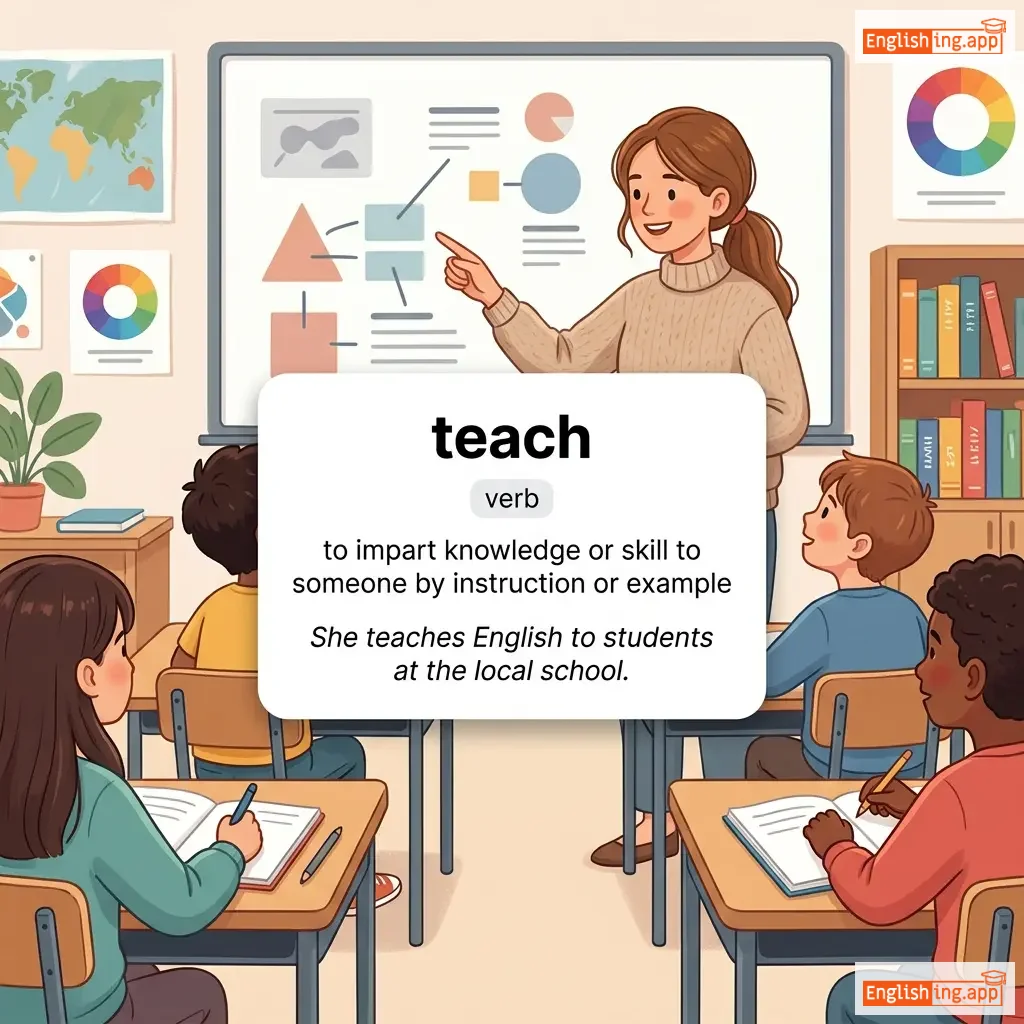
teach definition card — visual illustration of the meaning
verb
/tiːʧ/
enseigner (enseigner)

to impart knowledge or skill to someone by instruction or example

"She teaches English to students at the local school."

"Elle enseigne l'anglais aux étudiants de l'école locale." (Elle enseigne l'anglais aux étudiants de l'école locale.)
noun
/tiː ˈstreɪnər/
passoire à thé (passoire a the)

a small perforated device used to strain tea leaves from brewed tea

"I always use a tea-strainer when pouring tea into cups."

"J'utilise toujours une passoire à thé lorsque je verse le thé dans des tasses." (J'utilise toujours une passoire à thé lorsque je verse le thé dans des tasses.)
noun
/ˈtiː.pɒt/
théière (théière)

a container with a lid, handle, and spout for brewing and serving tea

"She poured hot water into the tea-pot to make tea."

"Elle a versé de l'eau chaude dans la théière pour préparer du thé." (Elle a versé de l'eau chaude dans la théière pour préparer du thé.)
noun
/tiː/
thé (the)

a hot drink made by infusing the dried, crushed leaves of the tea plant in boiling water

"I drink tea every morning to start my day."

"Je bois du thé chaque matin pour commencer ma journée." (Je bois du thé chaque matin pour commencer ma journée.)
noun
/ˈtæksˌpeɪər/
contribuable (contribuable)

a person who pays tax to the government

"The taxpayers' money is used to fund public services."

"L'argent des contribuables est utilisé pour financer les services publics." (L'argent des contribuables est utilisé pour financer les services publics.)
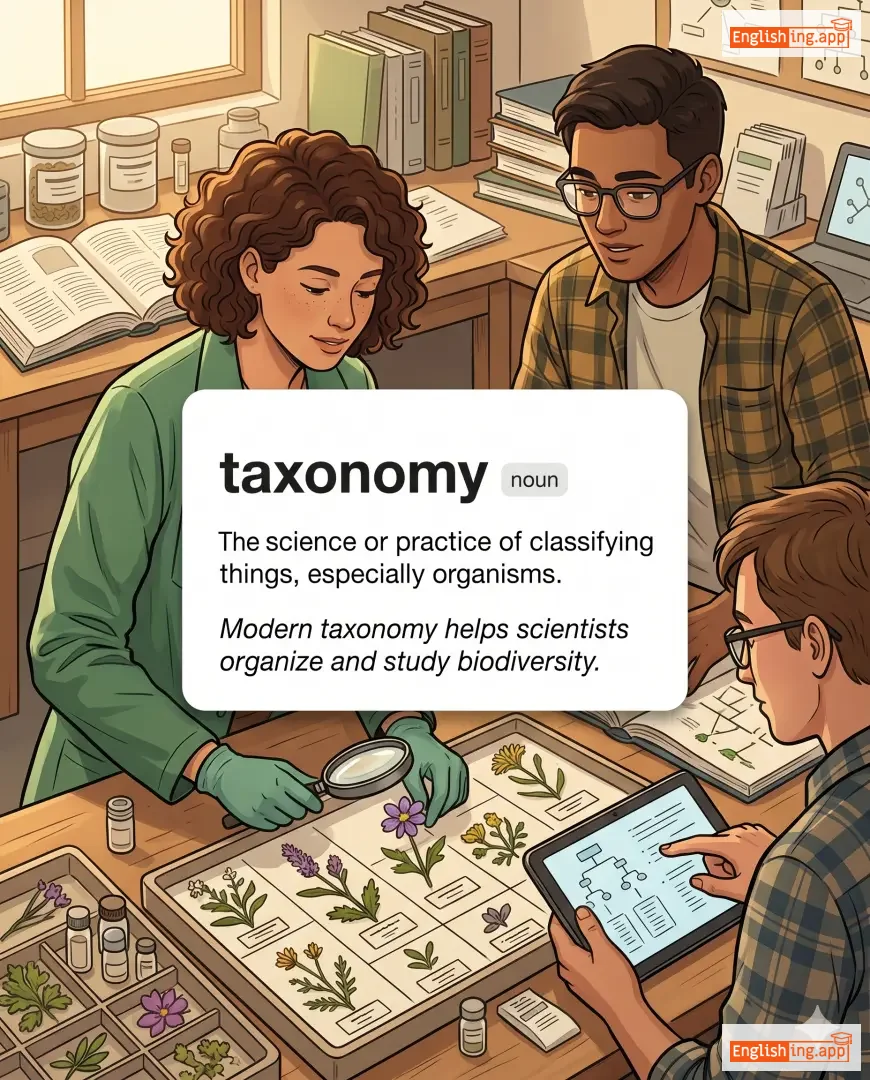
taxonomy definition card — visual illustration of the meaning
noun
/tækˈsɒnəmi/
science de la classification (science de la classification)

The science or practice of classifying things, especially organisms.

"Modern taxonomy helps scientists organize and study biodiversity."

"La taxonomie moderne aide les scientifiques à organiser et à étudier la biodiversité." (La taxonomie moderne aide les scientifiques à organiser et à étudier la biodiversité.)
noun
/tækˈsɒnəmɪst/
taxonome (taxonome)

A scientist who classifies organisms into groups based on their characteristics.

"The taxonomist discovered a new species of insect."

"Le taxonome a découvert une nouvelle espèce d'insecte." (Le taxonome a decouvert une nouvelle espece d'insecte.)
adjective
/ˈtæksɪŋ/
épuisant (epuisant)

Requiring a lot of effort; physically or mentally demanding.

"Preparing for the exam was a taxing experience."

"Préparer l'examen a été une expérience épuisante." (Préparer l'examen a été une expérience épuisante.)
noun
/ˈtæksɪˌdɜːrmi/
taxidermie (taxidermie)

The art of preparing, stuffing, and mounting the skins of animals for display.

"The museum had a large collection of taxidermy animals."

"Le musée avait une grande collection d'animaux empaillés." (Le musée avait une grande collection d'animaux empaillés.)
noun
/ˈtæk.si kæb/
taxi (taksi)

A car that carries passengers for a fare, usually in cities

"We took a taxi cab to the restaurant."

"Nous avons pris un taxi pour le restaurant." (nous avons pris un taxi pour le restaurant.)
noun
/ˈtæksi/
taxi (taxi)

A car licensed to transport passengers in exchange for payment of a fare.

"We hailed a taxi to get to the airport."

"Nous avons pris un taxi pour aller à l'aéroport." (Nous avons pris un taxi pour aller a l'aeroport.)
noun
/tækˈseɪʃən/
taxation (taxation)

The system of imposing and collecting taxes.

"Taxation is necessary for funding public services."

"La taxation est nécessaire pour financer les services publics." (La taxation est nécessaire pour financer les services publics.)
noun
/tɑːsk/
tâche (tache)

a piece of work or duty to be done

"He completed the task before the deadline."

"Il a terminé la tâche avant la date limite." (Il a termine la tache avant la date limite.)
noun
/ˈtæntrəm/
colère (colère)

An uncontrolled outburst of anger and frustration, typically in a young child.

"The child threw a tantrum when he didn’t get the toy."

"L'enfant a eu une colère quand il n'a pas eu le jouet." (L'enfant a eu une colère quand il n'a pas eu le jouet.)
verb
/tæp/
taper (taper)

to strike something lightly, usually with a quick, sharp sound

"He tapped on the door to get her attention."

"Il a tapé à la porte pour attirer son attention." (Il a tape a la porte pour attirer son attention.)
noun
/teɪp/
ruban adhésif (ruban adhesif)

a long, narrow strip of material, often sticky on one side, used for fastening or sticking things together

"I need some tape to seal this box."

"J'ai besoin de ruban adhésif pour sceller cette boîte." (J'ai besoin de ruban adhésif pour sceller cette boîte.)
verb
/ˈteɪpər/
rétrécir (retrecir)

To gradually decrease in width, thickness, or intensity.

"The road tapers off as it reaches the mountains."

"La route se rétrécit à mesure qu'elle atteint les montagnes." (La route se rétrécit à mesure qu'elle atteint les montagnes.)
noun
/ˈtæpəstri/
tapisserie (tapisserie)

A piece of thick textile fabric with pictures or designs woven into it, often hung on walls.

"The museum displayed an ancient tapestry from the 15th century."

"Le musée a exposé une tapisserie ancienne du XVe siècle." (Le musée a exposé une tapisserie ancienne du XVe siècle.)
noun
/təˈræntjʊlə/
tarantule (tarantula)

A large hairy spider found in warm regions.

"The tarantula crawled across the desert floor."

"La tarentule rampait sur le sol du désert." (La tarentule rampait sur le sol du désert.)
adjective
/ˈtɑːrdi/
en retard (en retard)

Delayed; arriving or happening late.

"The student received a warning for being tardy to class."

"L'élève a reçu un avertissement pour être en retard en classe." (L'élève a reçu un avertissement pour être en retard en classe.)
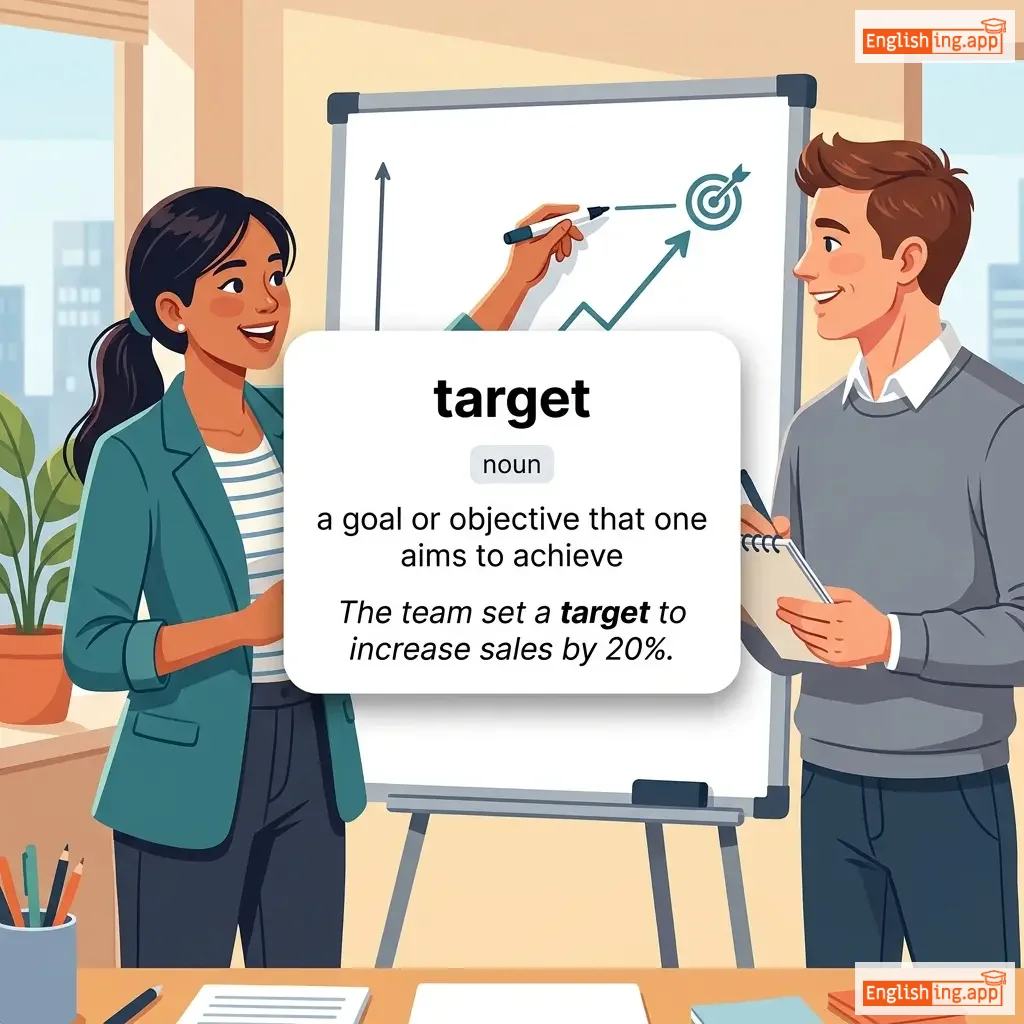
target definition card — visual illustration of the meaning
noun
/ˈtɑːɡɪt/
cible (cible)

a goal or objective that one aims to achieve

"The team set a target to increase sales by 20%."

"L'équipe a fixé un objectif d'augmenter les ventes de 20%." (L'equipe a fixe un objectif d'augmenter les ventes de 20%.)
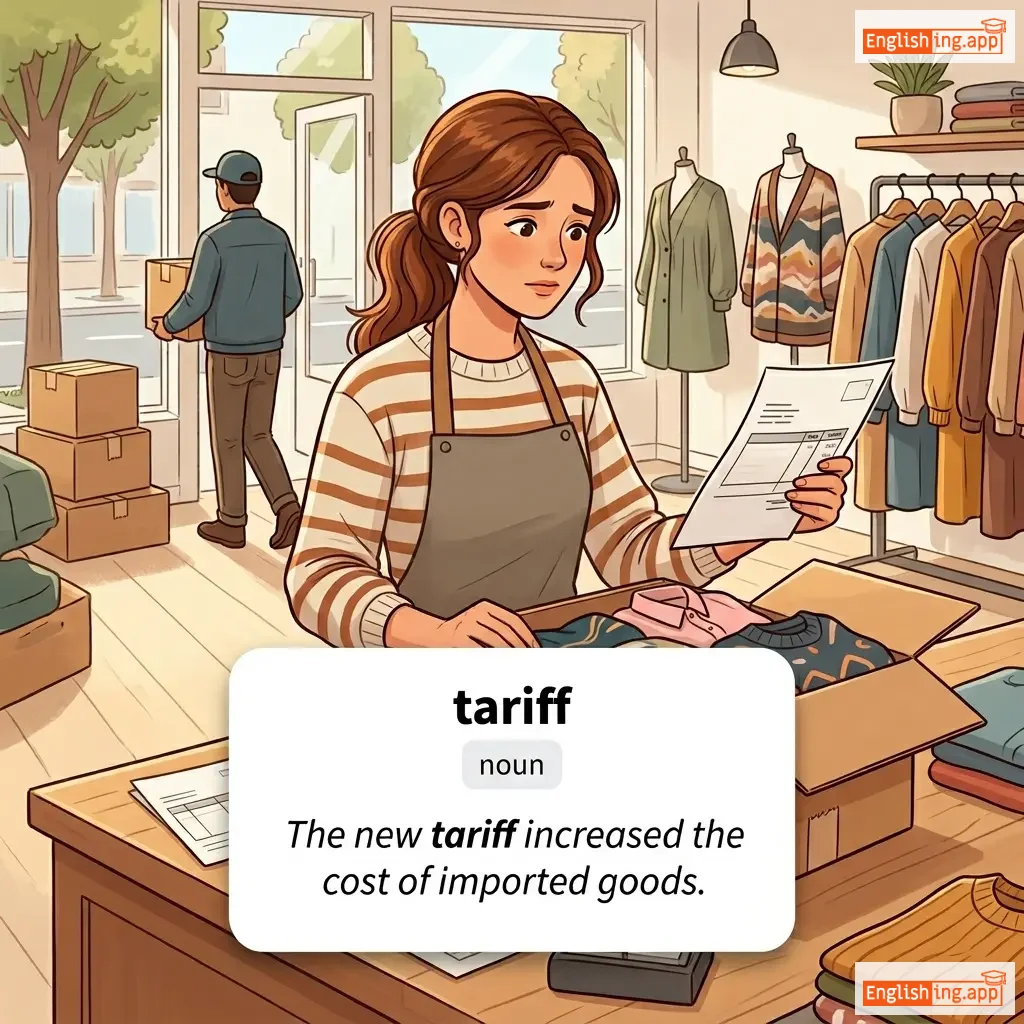
tariff definition card — visual illustration of the meaning
noun
/ˈtær.ɪf/
tarif (tarif)

A tax imposed by the government on imported or exported goods, also known as duty, customs tax, or levy.

"The new tariff increased the cost of imported goods."

"Le nouveau tarif a augmenté le coût des marchandises importées." (Le nouveau tarif a augmenté le coût des marchandises importées.)
noun
/tɑːrn/
lac de montagne (lac de montagne)

A small mountain lake or pool.

"We camped near a tranquil tarn in the highlands."

"Nous avons campé près d'un lac de montagne tranquille dans les Highlands." (Nous avons campé près d'un lac de montagne tranquille dans les Highlands.)
verb
/ˈtɑːrnɪʃ/
ternir (ternir)

To lose luster, especially as a result of exposure to air or moisture; to damage reputation.

"The silver jewelry tarnished quickly when left in the open air."

"Les bijoux en argent se sont ternis rapidement lorsqu'ils ont été laissés à l'air libre." (Les bijoux en argent se sont ternis rapidement lorsqu'ils ont ete laisses a l'air libre.)
noun
/tɑːrˈpɔːlɪn/
bâche (tarpaulin)

A large sheet of strong, flexible, water-resistant material used for covering or protecting things.

"The workers used a tarpaulin to cover the construction materials from rain."

"Les ouvriers ont utilisé une bâche pour protéger les matériaux de construction de la pluie." (Les ouvriers ont utilise une bache pour proteger les materiaux de construction de la pluie)
verb
/ˈtæri/
tarder (tarder)

To delay or linger; to stay longer than intended.

"Do not tarry, or you will miss the train."

"Ne tardez pas, sinon vous manquerez le train." (Ne tardez pas, sinon vous manquerez le train.)
noun, adjective
/tɑːrt/
tartelette (tartelette)

A small pie with a sweet or savory filling; or having a sharp, sour taste.

"She served a delicious apple tart for dessert."

"Elle a servi une tartelette aux pommes délicieuse pour le dessert." (Elle a servi une tartelette aux pommes delicieuse pour le dessert)
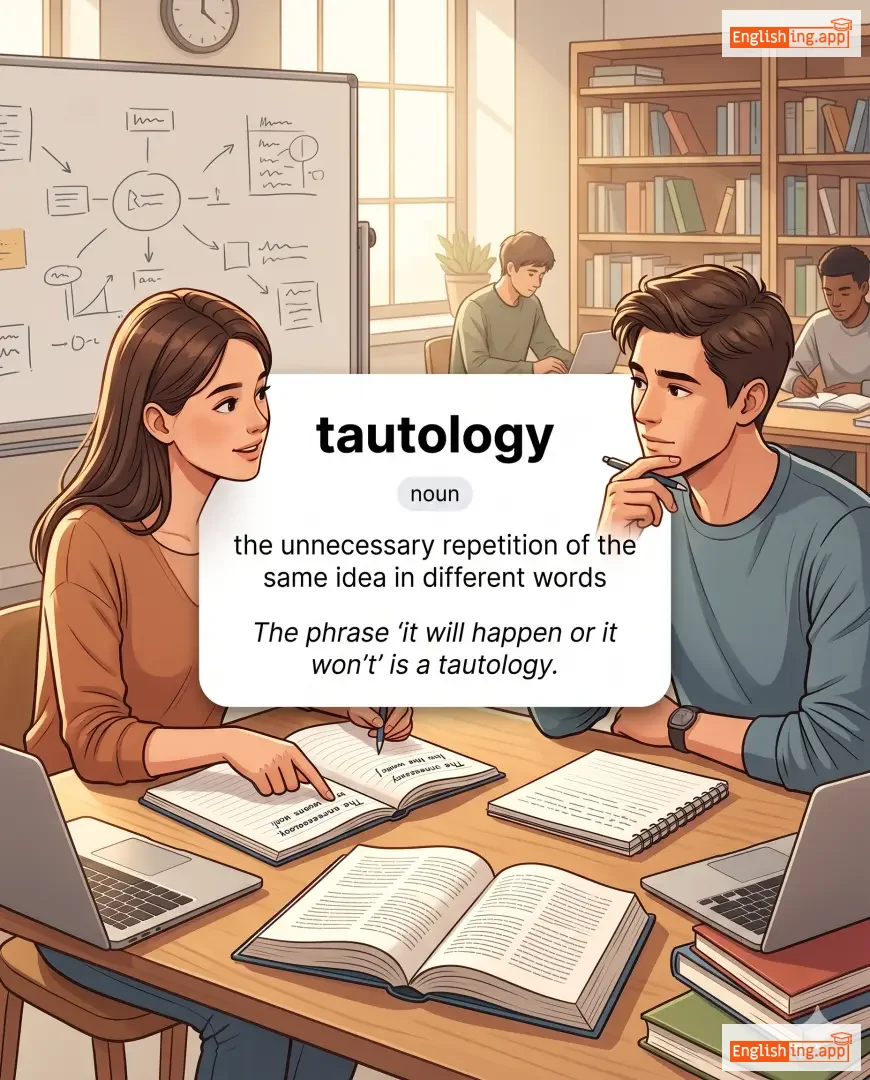
tautology definition card — visual illustration of the meaning
noun
/tɔːˈtɒlədʒi/
répétition inutile (repetition inutile)

the unnecessary repetition of the same idea in different words

"The phrase 'it will happen or it won’t' is a tautology."

"L'expression 'ça va arriver ou ça n'arrivera pas' est une tautologie." (L'expression 'ca va arriver ou ca n'arrivera pas' est une tautologie.)
verb
/tɔːnt/
moquer (moquer)

to provoke or challenge someone with insulting remarks

"The bully tried to taunt him with cruel words."

"Le bully a essayé de le provoquer avec des mots cruels." (Le bully a essayé de le provoquer avec des mots cruels.)
adjective
/tɔːt/
tendu (tendu)

stretched or pulled tight; tense

"The rope was pulled taut between the two poles."

"La corde était tendue entre les deux poteaux." (La corde était tendue entre les deux poteaux.)
adjective
/ˌtɔːtəˈlɒdʒɪkəl/
tautologique (tautologique)

expressing something by repeating the same idea in different words; redundant

"Saying 'free gift' is considered tautological."

"Dire 'cadeau gratuit' est considéré comme tautologique." (Dire 'cadeau gratuit' est considéré comme tautologique.)
adjective
/ˈtæti/
usé (use)

Worn out, shabby, or in poor condition.

"The sofa looked old and tatty after years of use."

"Le canapé semblait vieux et usé après des années d'utilisation." (Le canapé semblait vieux et usé après des années d'utilisation.)
adjective
/ˈtɔːdri/
bon marché et voyante mais de mauvaise qualité (bon marche et voyante mais de mauvaise qualite)

cheap and showy but of poor quality

"She wore a tawdry necklace that broke easily."

"Elle portait un collier bon marché et voyante qui s'est cassé facilement." (Elle portait un collier bon marché et voyante qui s'est cassé facilement.)
adjective
/ˈtɔːni/
couleur brun jaunâtre (couleur brun jaunatre)

A warm, sandy or golden-brown color.

"The owl's tawny feathers blended with the tree bark."

"Les plumes brunes jaunâtres de la chouette se mêlaient à l'écorce de l'arbre." (Les plumes brunes jaunatres de la chouette se melangeaient a l'ecorce de l'arbre.)