Vocabulaires

Découvrez, apprenez et maîtrisez le vocabulaire anglais

conjunction
/ðæn/
que (que)

used to introduce the second element in a comparison

"She is taller than her brother."

"Elle est plus grande que son frère." (Elle est plus grande que son frère.)
noun
/ˈtɛkstʃər/
texture (texture)

the way something feels when you touch it; the quality of a surface or substance

"The fabric has a soft and smooth texture."

"Le tissu a une texture douce et lisse." (Le tissu a une texture douce et lisse.)
noun
/ˈtek.staɪl/
tissu (tissu)

a type of cloth or woven fabric made by knitting or weaving fibers

"Bangladesh is famous for its high-quality textile industry."

"Le Bangladesh est célèbre pour son industrie textile de haute qualité." (Le Bangladesh est célèbre pour son industrie textile de haute qualité.)
noun
/ˈtɛkstbʊk/
livre scolaire (livre scolaire)

a book used for studying a subject in school or college

"She bought a new biology textbook for her class."

"Elle a acheté un nouveau livre de biologie pour sa classe." (Elle a acheté un nouveau livre de biologie pour sa classe.)
noun
/tɛkst/
texte (texte)

a written or printed work or passage, especially a book or document

"The teacher asked us to read the text on page 50."

"L'enseignant nous a demandé de lire le texte à la page 50." (L'enseignant nous a demandé de lire le texte à la page 50.)
verb
/ˈtɛðər/
attacher (attacher)

To tie an animal with a rope or chain so it cannot move far.

"The farmer tethered the goat to a post."

"Le fermier a attaché la chèvre à un poteau." (Le fermier a attaché la chèvre à un poteau.)
adjective
/ˈtɛsti/
irritable (irritable)

Easily irritated or annoyed.

"He became testy when asked the same question repeatedly."

"Il est devenu irritable lorsqu'on lui a posé la même question à plusieurs reprises." (Il est devenu irritable lorsqu'on lui a posé la même question à plusieurs reprises.)
noun
/ˈtɛstɪŋ/
test (test)

the process of assessing or evaluating something, often by trying it out

"The testing of the new software is still ongoing."

"Le test du nouveau logiciel est toujours en cours." (Le test du nouveau logiciel est toujours en cours.)
noun
/ˈtɛstəˌmoʊni/
témoignage (temoignage)

A formal statement given in a court of law or evidence supporting a fact.

"Her testimony in court helped convict the criminal."

"Son témoignage devant le tribunal a aidé à condamner le criminel." (Son temoignage devant le tribunal a aide a condamner le criminel.)
testimonials definition card — visual illustration of the meaning
noun
/ˌtɛstɪˈməʊnɪəlz/
témoignages, lettres de recommandation (temoignages, lettres de recommandation)

Written or spoken statements of praise or recommendation from clients or customers.

"Positive testimonials can enhance a company's reputation."

"Des témoignages positifs peuvent améliorer la réputation d'une entreprise." (Des temoignages positifs peuvent ameliorer la reputation d'une entreprise.)
noun
/ˌtɛstɪˈmoʊniəl/
témoignage (temoignage)

A formal statement testifying to someone's character, qualifications, or the quality of a product or service.

"The company shared a glowing testimonial from a satisfied customer."

"L'entreprise a partagé un témoignage élogieux d'un client satisfait." (L'entreprise a partage un temoignage elogieux d'un client satisfait.)
verb
/ˈtɛstəfaɪ/
témoigner (temoigner)

to make a statement or declaration under oath or to give evidence

"She was called to testify in court about the accident."

"Elle a été appelée à témoigner au tribunal sur l'accident." (Elle a été appelée à témoigner au tribunal sur l'accident.)
noun
/ˈtɛsteɪtər/
testateur (testateur)

a person who has made a will

"The lawyer read the will of the deceased testator."

"L'avocat a lu le testament du testateur décédé." (L'avocat a lu le testament du testateur décédé.)
noun
/ˈtɛstəmənt/
testament / preuve (testament / preuve)

a person's will; or strong evidence of something

"His success is a testament to his hard work and dedication."

"Son succès est un testament de son travail acharné et de son dévouement." (Son succès est un testament de son travail acharné et de son dévouement.)
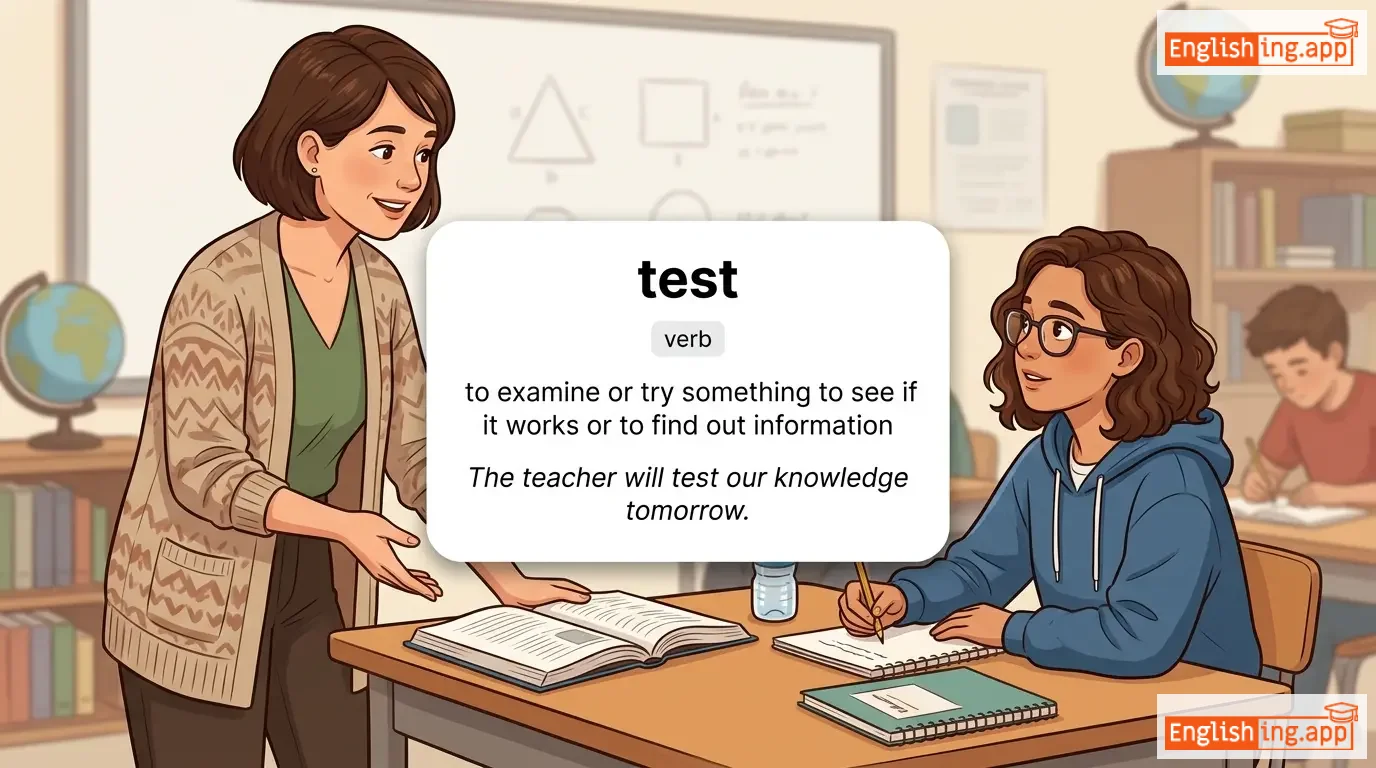
test definition card — visual illustration of the meaning
noun
/tɛst/
test (test)

a procedure intended to establish the quality, performance, or reliability of something

"The test results will determine whether the treatment is effective."

"Les résultats du test détermineront si le traitement est efficace." (Les résultats du test détermineront si le traitement est efficace.)
adjective
/ˈtɛsəleɪtɪd/
carrelé (carrele)

arranged in a pattern of repeated shapes fitting together without gaps

"The tessellated floor was made of colorful tiles arranged in perfect symmetry."

"Le sol carrelé était composé de carreaux colorés disposés en parfaite symétrie." (Le sol carrele etait compose de carreaux colores disposes en parfaite symetrie.)
adjective
/ˈtɜːrʃieri/
tertiaire (tertiaire)

third in order, rank, or level

"He is pursuing his tertiary education at the university."

"Il poursuit ses études tertiaires à l'université." (Il poursuit ses etudes tertiaires a l universite)
adjective
/tɜːrs/
bref (bref)

brief and to the point; sparing in the use of words

"His reply was terse and ended the conversation quickly."

"Sa réponse était brève et a rapidement mis fin à la conversation." (sa reponse etait breve et a rapidement mis fin a la conversation.)
noun
/ˈtɛrərɪst/
terroriste (terroriste)

a person who uses violence or threats to intimidate or coerce, especially for political purposes

"The terrorist was arrested by the police after the attack."

"Le terroriste a été arrêté par la police après l'attaque." (Le terroriste a été arrêté par la police après l'attaque.)
noun
/ˈtɛrərɪzəm/
terrorisme (terrorisme)

the use of violence or threats to intimidate or coerce, especially for political purposes

"Terrorism is a serious threat to global peace and security."

"Le terrorisme est une menace sérieuse pour la paix et la sécurité mondiales." (Le terrorisme est une menace sérieuse pour la paix et la sécurité mondiales.)
noun
/ˈtɛrər/
terreur (terreur)

Extreme fear or dread.

"The villagers fled in terror during the attack."

"Les villageois ont fui dans la terreur lors de l'attaque." (Les villageois ont fui dans la terreur lors de l'attaque.)
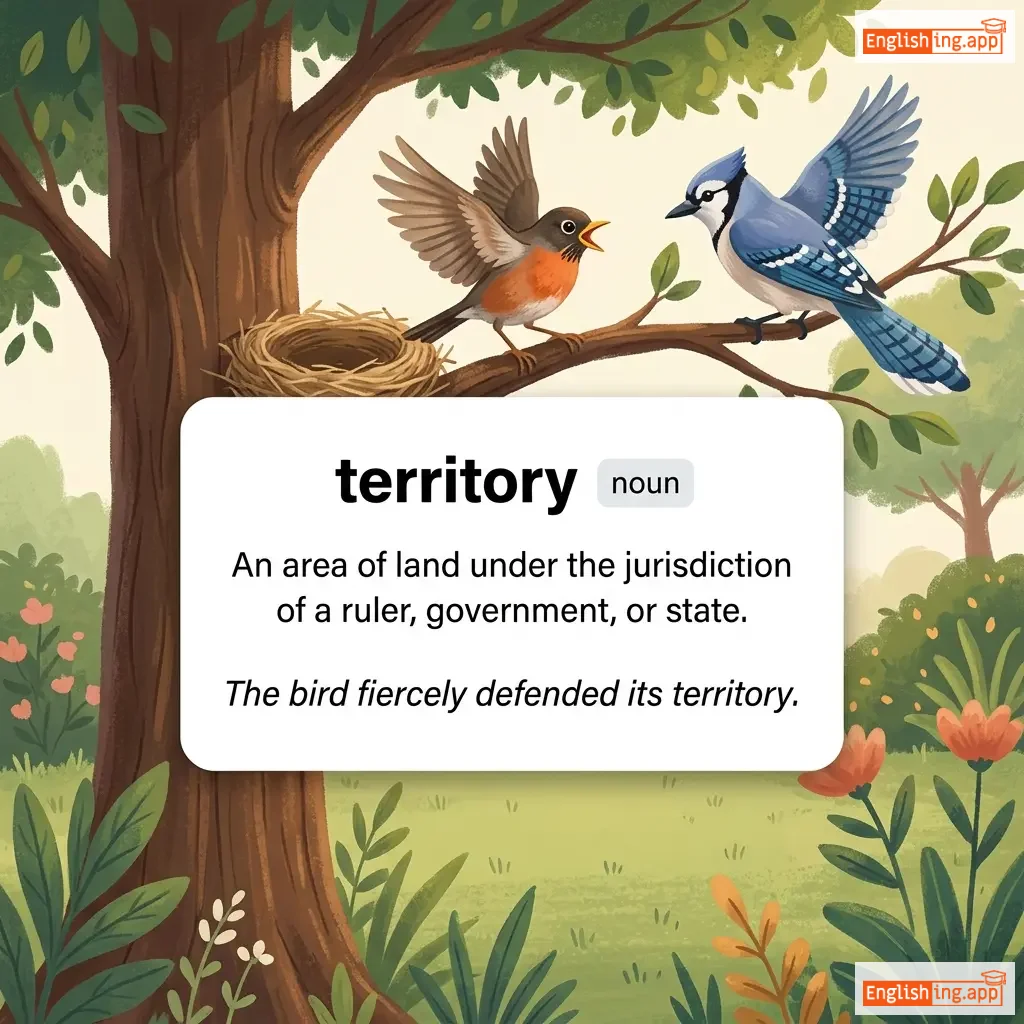
territory definition card — visual illustration of the meaning
noun
/ˈtɛrɪˌtɔːri/
territoire (territoire)

An area of land under the jurisdiction of a ruler, government, or state.

"The bird fiercely defended its territory."

"L'oiseau a défendu son territoire avec férocité." (L'oiseau a defendu son territoire avec ferocite.)
adjective
/ˌtɛrɪˈtɔːriəl/
territorial (territorial)

Relating to the ownership or control of land or territory.

"The two countries had a territorial dispute over the island."

"Les deux pays avaient un différend territorial concernant l'île." (Les deux pays avaient un different territorial concernant l'ile.)
verb
/ˈtɛrəˌfaɪ/
terrifier (terifier)

To cause someone to feel extreme fear.

"The loud thunder terrified the children."

"Le fort tonnerre a terrifié les enfants." (Le fort tonnerre a terrifie les enfants.)
adjective
/təˈrɪfɪk/
fantastique (fantastik)

extremely good or excellent; very great or intense

"The concert last night was absolutely terrific."

"Le concert d'hier soir était absolument fantastique." (Le concert d'hier soir etait absolument fantastique.)
adverb
/ˈtɛrəbli/
terriblement (terriblement)

to a very great or extreme degree; very badly or unpleasantly

"He felt terribly sad after hearing the news."

"Il se sentait terriblement triste après avoir entendu la nouvelle." (Il se sentait terriblement triste après avoir entendu la nouvelle.)
adjective
/ˈtɛrɪbəl/
terrible (terble)

extremely bad or unpleasant

"The food at that restaurant was terrible."

"La nourriture de ce restaurant était terrible." (La nourriture de ce restaurant etait terrible.)
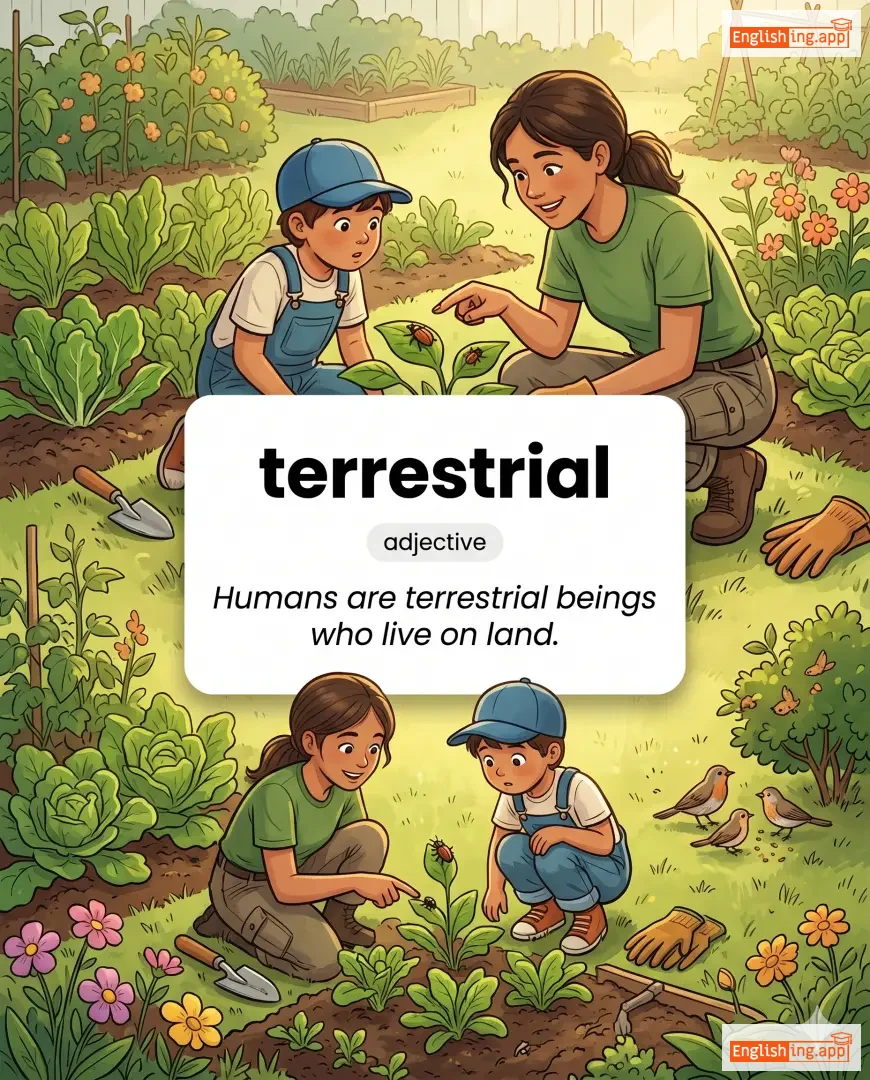
terrestrial definition card — visual illustration of the meaning
adjective
/təˈrɛstriəl/
terrestre (terrestre)

Relating to the Earth or land as opposed to the sea or air; living or growing on land.

"Humans are terrestrial beings who live on land."

"Les humains sont des êtres terrestres qui vivent sur la terre." (Les humains sont des êtres terrestres qui vivent sur la terre.)
noun
/ˈterəpɪn/
une petite tortue d'eau douce (une petite tortue d'eau douce)

a small freshwater turtle, especially one found in North America

"The terrapin slowly crawled into the pond."

"Le terrapin se glissa lentement dans l'étang." (Le terrapin se glissa lentement dans l'étang.)
noun
/təˈreɪn/
terrain (terrain)

a stretch of land, especially with regard to its physical features

"The soldiers had to cross rough terrain during the mission."

"Les soldats ont dû traverser un terrain difficile pendant la mission." (Les soldats ont du traverser un terrain difficile pendant la mission.)
noun
/tɜːmz/
termes (termes)

plural of term; conditions or rules in a contract or agreement

"The terms of the agreement are clearly outlined in the contract."

"Les termes de l'accord sont clairement définis dans le contrat." (Les termes de l'accord sont clairement definis dans le contrat.)
noun
/ˈtɜːrmɪnəs/
point final (pwan fianal)

the final point or end of something, especially the final station on a railway line

"The train finally arrived at the terminus after a long journey."

"Le train est finalement arrivé au terminus après un long voyage." (Le tran é finaleman arrivé o terminus après un long voyaj.)
noun
/ˌtɜːrməˈnɑːlədʒi/
terminologie (terminologie)

the set of technical or special words used in a particular subject

"Medical terminology can be difficult for new students to understand."

"La terminologie médicale peut être difficile à comprendre pour les nouveaux étudiants." (La terminologie medicale peut etre difficile a comprendre pour les nouveaux etudiants.)
noun
/ˌtɜːrmɪˈneɪʃən/
résiliation (resiliation)

the act of ending something or the state of being ended

"The termination of the contract caused financial loss."

"La résiliation du contrat a causé une perte financière." (La resiliation du contrat a cause une perte financiere.)
verb
/ˈtɜːrmɪˌneɪt/
terminer (terminer)

to bring something to an end or to stop something from continuing

"The company decided to terminate his contract."

"L'entreprise a décidé de mettre fin à son contrat." (L'entreprise a décidé de mettre fin à son contrat.)
noun/adjective
/ˈtɜːrmɪnəl/
terminal, final, maladie terminale (terminal, final, maladie terminale)

As a noun: A place where transport routes begin or end. As an adjective: Relating to the end or final stage of something, often an illness.

"He waited for the bus at the central terminal."

"Il attendait le bus à la terminale centrale." (Il attendait le bus à la terminale centrale.)
noun
/ˈtɜːrməɡənt/
femme autoritaire et irritable (femme autoritaire et irritable)

A harsh-tempered or overbearing woman.

"The character was portrayed as a loud and domineering termagant."

"Le personnage a été dépeint comme une femme bruyante et dominatrice." (Le personnage a été dépeint comme une femme bruyante et dominatrice.)
noun
/tɜːm/
terme (terme)

a word or phrase used to describe a thing or to express a concept

"The term 'machine learning' is commonly used in technology."

"Le terme 'apprentissage automatique' est couramment utilisé dans la technologie." (Le terme 'apprentissage automatique' est couramment utilise dans la technologie.)
noun
/ˌtɜːdʒɪvərˈseɪʃən/
évasion, retournement (evazion, retournement)

Evasion of straightforward action or speech; changing sides or being inconsistent.

"The politician’s tergiversation frustrated his supporters."

"La tergiversation du politicien a frustré ses partisans." (La tergiversation du politicien a frustre ses partisans.)
noun
/ˌtɜːsənˈtɛnəri/
tercentenaire (tercentenaire)

The 300th anniversary of an event.

"The city celebrated its tercentenary with a grand festival."

"La ville a célébré son tercentenaire avec un grand festival." (La ville a célébré son tercentenaire avec un grand festival.)
adjective
/ˈtɛpɪd/
tiède, indifférent (tiede, indifferente)

Lukewarm; showing little enthusiasm or force.

"His speech received only a tepid response from the audience."

"Son discours n'a reçu qu'une réponse tiède de la part du public." (Son discours n'a reçu qu'une réponse tiède de la part du public.)
noun
/ˈtɛnjər/
mandat (mandat)

The period of time during which someone holds a position, office, or land.

"His tenure as president lasted for five years."

"Son mandat en tant que président a duré cinq ans." (Son mandat en tant que president a dure cinq ans.)
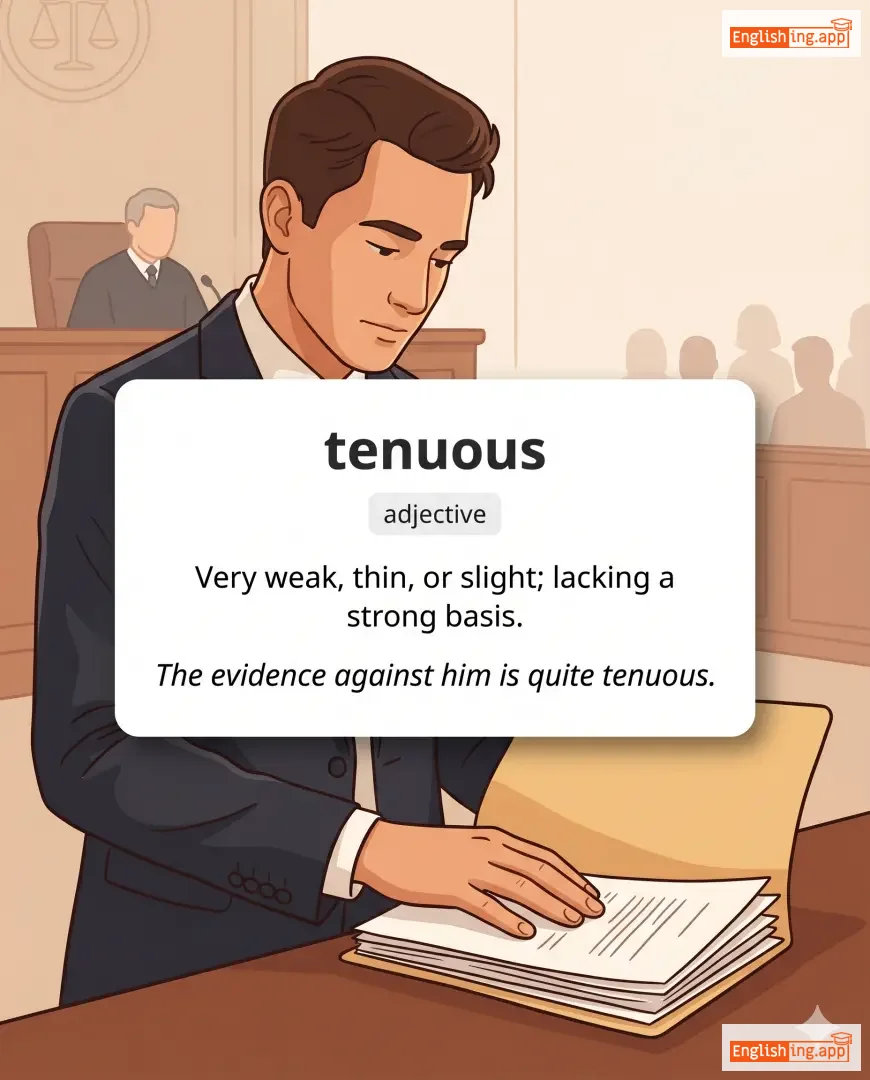
tenuous definition card — visual illustration of the meaning
adjective
/ˈtɛn.ju.əs/
faible / mince (faible / mince)

Very weak, thin, or slight; lacking a strong basis.

"The evidence against him is quite tenuous."

"La preuve contre lui est assez faible." (La preuve contre lui est assez faible.)
adjective
/ˈtɛn.tə.tɪv/
tentatif (tentatif)

Not certain or fixed; done without confidence.

"She gave a tentative smile before agreeing."

"Elle a donné un sourire tentatif avant d'accepter." (Elle a donné un sourire tentatif avant d'accepter.)
noun
/tɛnt/
tente (tente)

a portable shelter made of fabric, supported by poles and ropes

"We set up a tent for the camping trip."

"Nous avons monté une tente pour le voyage de camping." (Nous avons monté une tente pour le voyage de camping.)
noun
/ˈtɛn.ʃən/
tension (tension)

A state of being stretched tight; mental or emotional strain.

"There was a lot of tension in the room before the exam results were announced."

"Il y avait beaucoup de tension dans la salle avant l'annonce des résultats de l'examen." (Il y avait beaucoup de tension dans la salle avant l'annonce des résultats de l'examen.)
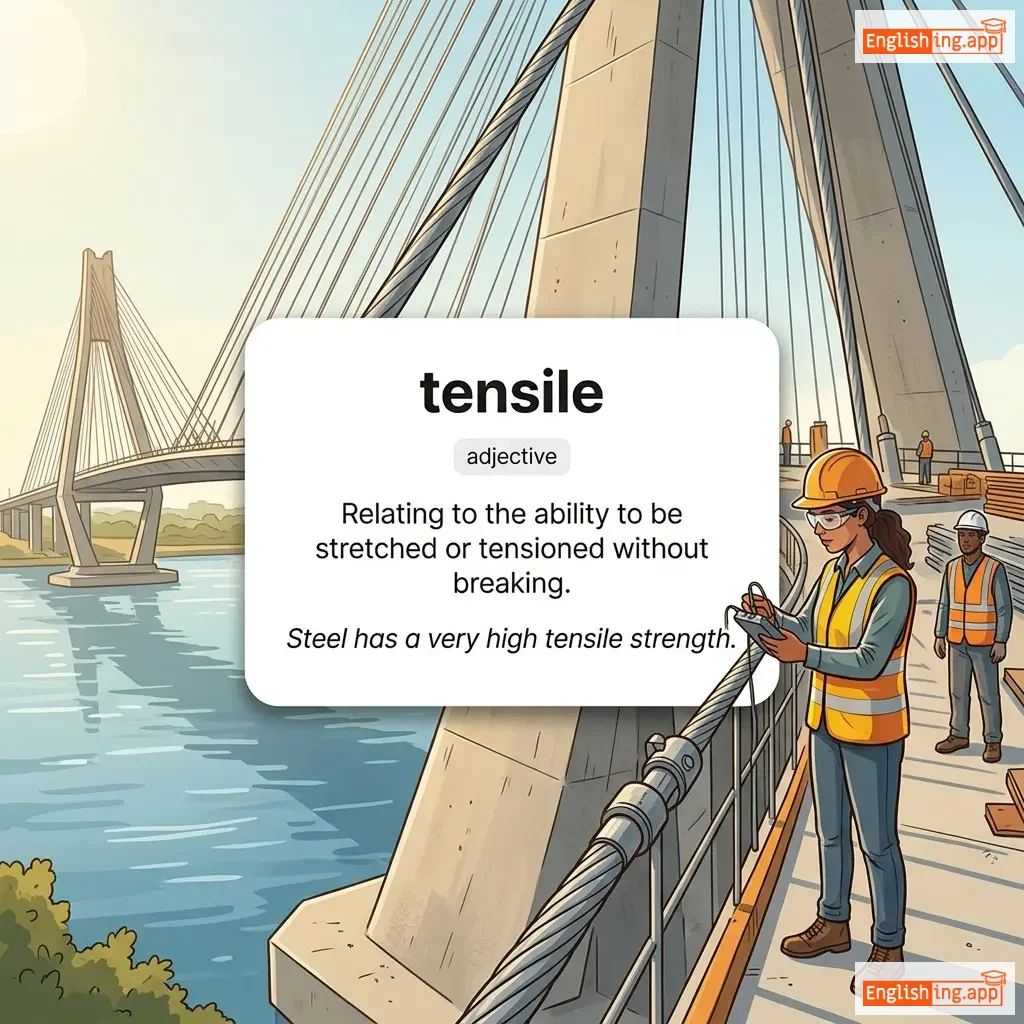
tensile definition card — visual illustration of the meaning
adjective
/ˈtɛn.saɪl/
extensible (extensible)

Relating to the ability to be stretched or tensioned without breaking.

"Steel has a very high tensile strength."

"L'acier a une résistance extensible très élevée." (L'acier a une résistance extensible très élevée.)
noun, adjective, verb
/tɛns/
tendu / temps grammatical (tendu / temps grammatical)

a grammatical category showing time reference; stretched tight or anxious

"She felt tense before the interview."

"Elle se sentait tendue avant l'entretien." (Elle se sentait tendue avant l'entretien.)
noun
/ˈtɛnər/
ténor / ton général (tenor / ton general)

the general meaning, drift, or character of something; a male singing voice between baritone and alto

"The overall tenor of his speech was hopeful and reassuring."

"Le ton général de son discours était plein d'espoir et rassurant." (Le ton général de son discours était plein d'espoir et rassurant.)
noun
/tiː/
thé (the)

a hot drink made by infusing the dried, crushed leaves of the tea plant in boiling water

"I drink tea every morning to start my day."

"Je bois du thé chaque matin pour commencer ma journée." (Je bois du thé chaque matin pour commencer ma journée.)