वोकैबुलरीज

इंग्लिश वोकैबुलरी डिस्कवर, लर्न और मास्टर करें

conjunction
/ðæn/
से ज्यादा (se zyada)

used to introduce the second element in a comparison

"She is taller than her brother."

"वह अपने भाई से लंबी है।" (Wah apne bhai se lambi hai.)
noun
/ˈtɛkstʃər/
बनावट (banavat)

the way something feels when you touch it; the quality of a surface or substance

"The fabric has a soft and smooth texture."

"कपड़े की बनावट नरम और चिकनी है।" (Kapde ki banavat narm aur chikni hai.)
noun
/ˈtek.staɪl/
कपड़ा (kapda)

a type of cloth or woven fabric made by knitting or weaving fibers

"Bangladesh is famous for its high-quality textile industry."

"बांगलादेश अपनी उच्च गुणवत्ता वाले वस्त्र उद्योग के लिए प्रसिद्ध है।" (Bangladesh apni uchch gunwatta wale vastra udyog ke liye prasiddh hai.)
noun
/ˈtɛkstbʊk/
पाठ्यपुस्तक (pathyapustak)

a book used for studying a subject in school or college

"She bought a new biology textbook for her class."

"उसने अपनी कक्षा के लिए एक नया जीवविज्ञान पाठ्यपुस्तक खरीदी।" (Usne apni kaksha ke liye ek naya jeevvigyan pathyapustak kharidi.)
noun
/tɛkst/
पाठ (paath)

a written or printed work or passage, especially a book or document

"The teacher asked us to read the text on page 50."

"शिक्षक ने हमें पृष्ठ 50 पर पाठ पढ़ने को कहा।" (Shikshak ne humein pusta 50 par paath padhne ko kaha.)
verb
/ˈtɛðər/
बाँधना (bandhna)

To tie an animal with a rope or chain so it cannot move far.

"The farmer tethered the goat to a post."

"किसान ने बकरी को एक खंभे से बाँध दिया।" (Kisan ne bakri ko ek khambhe se bandh diya.)
adjective
/ˈtɛsti/
चिड़चिड़ा (chichida)

Easily irritated or annoyed.

"He became testy when asked the same question repeatedly."

"वह बार-बार एक ही सवाल पूछे जाने पर चिढ़ गए।" (Vah baar-baar ek hi sawaal poochhe jaane par chid gaye.)
noun
/ˈtɛstɪŋ/
परीक्षण (parikshan)

the process of assessing or evaluating something, often by trying it out

"The testing of the new software is still ongoing."

"नई सॉफ़्टवेयर का परीक्षण अभी भी चल रहा है।" (Nayi software ka parikshan abhi bhi chal raha hai.)
noun
/ˈtɛstəˌmoʊni/
गवाही (gavaahi)

A formal statement given in a court of law or evidence supporting a fact.

"Her testimony in court helped convict the criminal."

"उसकी गवाही ने अदालत में अपराधी को दोषी ठहराने में मदद की।" (Uski gavaahi ne adalat mein apradhi ko doshi thahrane mein madad ki.)
testimonials definition card — visual illustration of the meaning
noun
/ˌtɛstɪˈməʊnɪəlz/
साक्षात्कार, प्रशंसा पत्र (saakshaatkaar, prashansa patra)

Written or spoken statements of praise or recommendation from clients or customers.

"Positive testimonials can enhance a company's reputation."

"सकारात्मक साक्षात्कार एक कंपनी की प्रतिष्ठा बढ़ा सकते हैं।" (Sakaraatmak saakshaatkaar ek company ki pratishtha badha sakte hain.)
noun
/ˌtɛstɪˈmoʊniəl/
प्रशंसापत्र (prashansapatra)

A formal statement testifying to someone's character, qualifications, or the quality of a product or service.

"The company shared a glowing testimonial from a satisfied customer."

"कंपनी ने एक संतुष्ट ग्राहक से एक प्रशंसापत्र साझा किया।" (Company ne ek santusht grahak se ek prashansapatra saanjha kiya.)
verb
/ˈtɛstəfaɪ/
गवाही देना (gawahi dena)

to make a statement or declaration under oath or to give evidence

"She was called to testify in court about the accident."

"उसे अदालत में दुर्घटना के बारे में गवाही देने के लिए बुलाया गया था।" (Use adalat mein durghatna ke baare mein gawahi dene ke liye bulaya gaya tha.)
noun
/ˈtɛsteɪtər/
वसीयतकर्ता (vaseeyatkartaa)

a person who has made a will

"The lawyer read the will of the deceased testator."

"वकील ने मृत वसीयतकर्ता की वसीयत पढ़ी।" (vakil ne mrt vaseeyatkartaa ki vaseeyat padhi.)
noun
/ˈtɛstəmənt/
वसीयत / प्रमाण (vasiayat / praman)

a person's will; or strong evidence of something

"His success is a testament to his hard work and dedication."

"उसकी सफलता उसकी कठिन मेहनत और समर्पण का प्रमाण है।" (uski safalta uski kathin mehnat aur samarpan ka praman hai.)
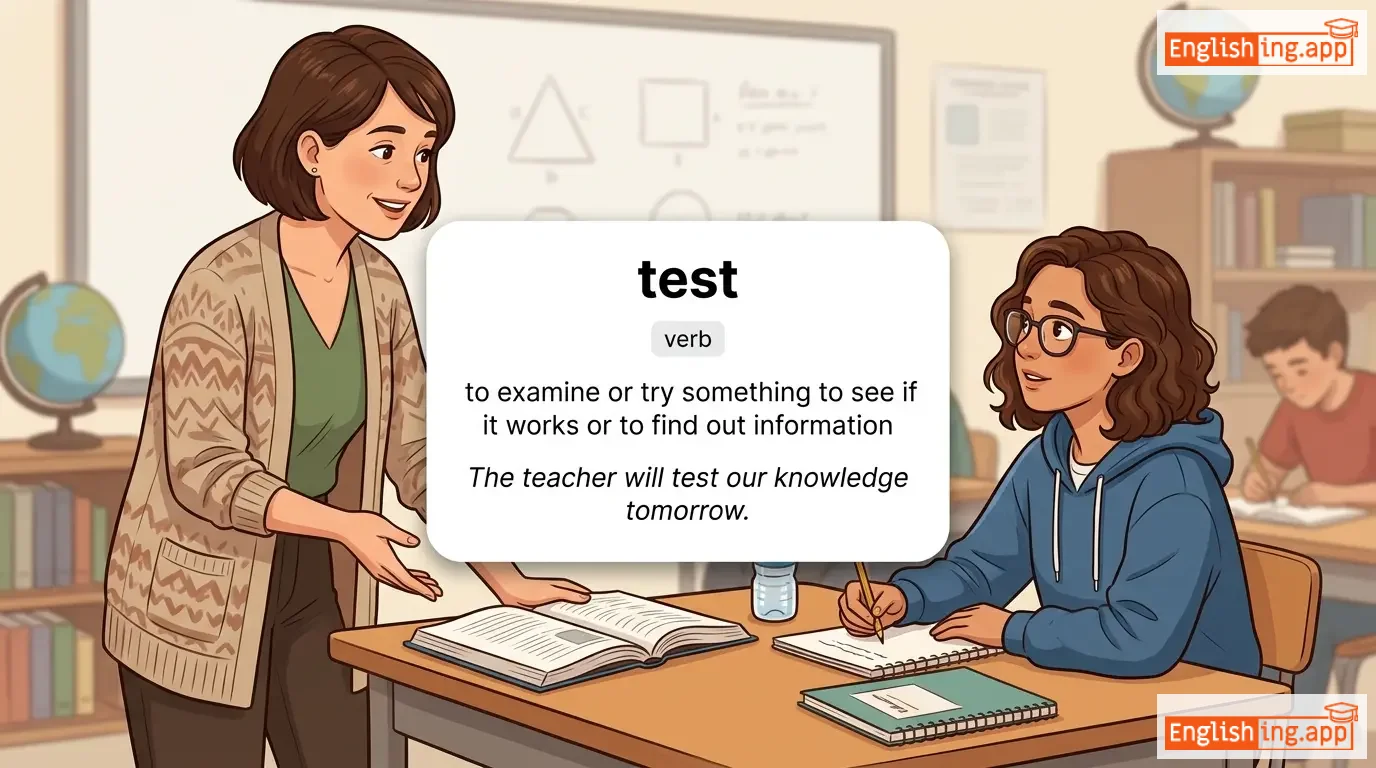
test definition card — visual illustration of the meaning
noun
/tɛst/
परीक्षा (pariksha)

a procedure intended to establish the quality, performance, or reliability of something

"The test results will determine whether the treatment is effective."

"परीक्षा के परिणाम यह निर्धारित करेंगे कि उपचार प्रभावी है या नहीं।" (Pariksha ke parinaam yah nirdharit karenge ki upchaar prabhavi hai ya nahi.)
adjective
/ˈtɛsəleɪtɪd/
आकृति युक्त (aakriti yukt)

arranged in a pattern of repeated shapes fitting together without gaps

"The tessellated floor was made of colorful tiles arranged in perfect symmetry."

"टेसलेटीड फर्श रंगीन टाइल्स से सुसज्जित था, जो परिपूर्ण सममिति में व्यवस्थित थे।" (tessellated farsh rangeen tiles se susajjit tha, jo paripurn sammiti mein vyavasthit the.)
3️⃣

tertiary

adjective
/ˈtɜːrʃieri/

third in order, rank, or level

"He is pursuing his tertiary education at the university."

adjective
/tɜːrs/
संक्षिप्त (sankshipt)

brief and to the point; sparing in the use of words

"His reply was terse and ended the conversation quickly."

"उसकी प्रतिक्रिया संक्षिप्त थी और उसने जल्दी से बातचीत समाप्त कर दी।" (uski pratikriya sankshipt thi aur usne jaldi se baatcheet samaapt kar di.)
noun
/ˈtɛrərɪst/
आतंकी (aantki)

a person who uses violence or threats to intimidate or coerce, especially for political purposes

"The terrorist was arrested by the police after the attack."

"आतंकी को हमले के बाद पुलिस ने गिरफ्तार किया।" (Aantki ko hamle ke baad pulis ne giraftaar kiya.)
noun
/ˈtɛrərɪzəm/
आतंकवाद (aantankvaad)

the use of violence or threats to intimidate or coerce, especially for political purposes

"Terrorism is a serious threat to global peace and security."

"आतंकवाद वैश्विक शांति और सुरक्षा के लिए एक गंभीर खतरा है।" (Aantankvaad vaishwik shanti aur suraksha ke liye ek gambheer khatra hai.)
noun
/ˈtɛrər/
आतंकी भय (aankki bhay)

Extreme fear or dread.

"The villagers fled in terror during the attack."

"गांववाले हमले के दौरान आतंक में भाग गए।" (Gaamwale hamle ke dauran atank mein bhag gaye.)
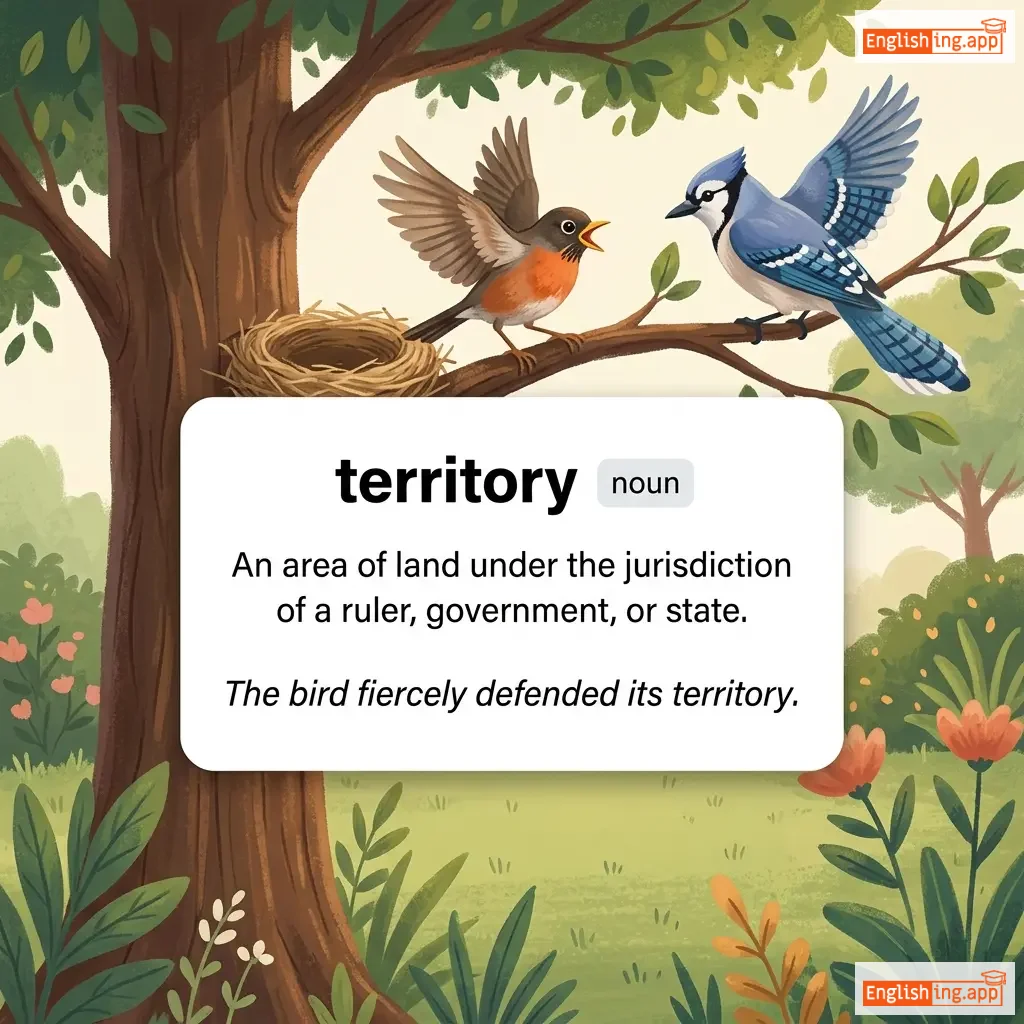
territory definition card — visual illustration of the meaning
noun
/ˈtɛrɪˌtɔːri/
क्षेत्र (kshetra)

An area of land under the jurisdiction of a ruler, government, or state.

"The bird fiercely defended its territory."

"पक्षी ने अपनी क्षेत्र की जोरदार रक्षा की।" (Pakshi ne apni kshetra ki jordaar raksha ki.)
adjective
/ˌtɛrɪˈtɔːriəl/
क्षेत्रीय (kshetriya)

Relating to the ownership or control of land or territory.

"The two countries had a territorial dispute over the island."

"दो देशों के बीच द्वीप को लेकर क्षेत्रीय विवाद था।" (Do deshon ke beech dweep ko lekar kshetriya vivaad tha.)
verb
/ˈtɛrəˌfaɪ/
डराना (darna)

To cause someone to feel extreme fear.

"The loud thunder terrified the children."

"तेज तूफान ने बच्चों को डराया।" (Tez toofan ne bachon ko daraya.)
adjective
/təˈrɪfɪk/
शानदार (shandaar)

extremely good or excellent; very great or intense

"The concert last night was absolutely terrific."

"कल रात का कंसर्ट बिल्कुल शानदार था।" (Kal raat ka concert bilkul shandaar tha.)
adverb
/ˈtɛrəbli/
भयानक तरीके से (bhayanak tareeke se)

to a very great or extreme degree; very badly or unpleasantly

"He felt terribly sad after hearing the news."

"उसने समाचार सुनने के बाद भयानक तरीके से दुखी महसूस किया।" (Usne samachar sunne ke baad bhayanak tareeke se dukhi mehsoos kiya.)
adjective
/ˈtɛrɪbəl/
खराब (terebal)

extremely bad or unpleasant

"The food at that restaurant was terrible."

"उस रेस्टोरेंट का खाना बहुत खराब था." (us restorent ka khana bahut kharab tha)
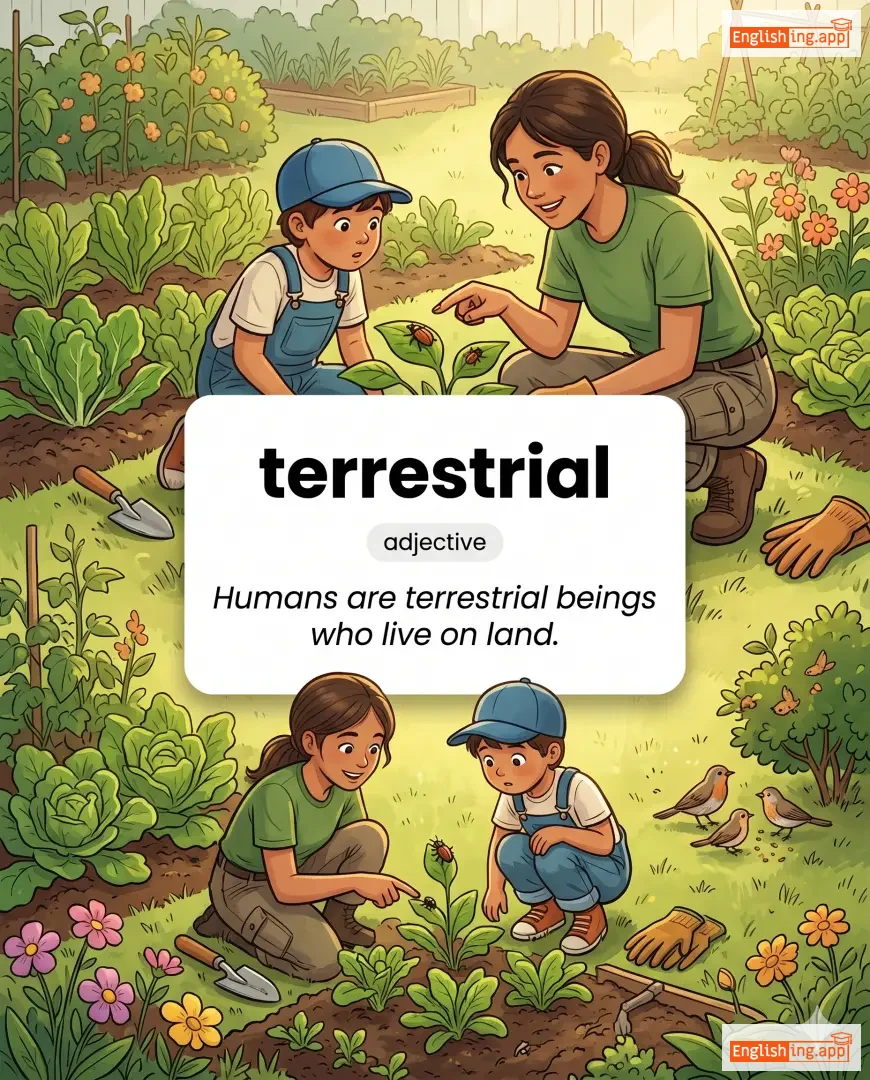
terrestrial definition card — visual illustration of the meaning
adjective
/təˈrɛstriəl/
स्थलीय (sthaliya)

Relating to the Earth or land as opposed to the sea or air; living or growing on land.

"Humans are terrestrial beings who live on land."

"मानव स्थलीय प्राणी हैं जो भूमि पर रहते हैं।" (Manav sthaliya prani hain jo bhumi par rehte hain.)
noun
/ˈterəpɪn/
एक प्रकार की छोटी ताजे पानी की कछुआ (ek prakar ki chhoti taje pani ki kachhua)

a small freshwater turtle, especially one found in North America

"The terrapin slowly crawled into the pond."

"टेरेपिन धीरे-धीरे तालाब में घुसा।" (Terrapin dheere-dheere talab mein ghusa.)
noun
/təˈreɪn/
भूमि (bhumi)

a stretch of land, especially with regard to its physical features

"The soldiers had to cross rough terrain during the mission."

"सैनिकों को मिशन के दौरान कठिन भूमि को पार करना पड़ा।" (Sainikon ko mission ke dauran kathin bhumi ko paar karna pada.)
noun
/tɜːmz/
शर्तें (sharten)

plural of term; conditions or rules in a contract or agreement

"The terms of the agreement are clearly outlined in the contract."

"समझौते की शर्तें अनुबंध में स्पष्ट रूप से उल्लिखित हैं।" (Samjhaute ki sharten anubandh mein spasht roop se ullikhit hain.)
noun
/ˈtɜːrmɪnəs/
अंतिम स्थान (antim sthan)

the final point or end of something, especially the final station on a railway line

"The train finally arrived at the terminus after a long journey."

"लंबी यात्रा के बाद ट्रेन अंततः टर्मिनस पर पहुंची।" (Lambi yatra ke baad train antatah terminus par pahiunchi.)
noun
/ˌtɜːrməˈnɑːlədʒi/
विशेष शब्दावली (vishesh shabdavali)

the set of technical or special words used in a particular subject

"Medical terminology can be difficult for new students to understand."

"मेडिकल टर्मिनोलॉजी नए छात्रों के लिए समझना मुश्किल हो सकता है।" (Medical terminology naye chatron ke liye samajhna mushkil ho sakta hai.)
noun
/ˌtɜːrmɪˈneɪʃən/
समाप्ति (samaapti)

the act of ending something or the state of being ended

"The termination of the contract caused financial loss."

"अनुबंध की समाप्ति से वित्तीय नुकसान हुआ।" (Anubandh ki samaapti se vittiya nuksan hua.)
verb
/ˈtɜːrmɪˌneɪt/
समाप्त करना (samaapt karna)

to bring something to an end or to stop something from continuing

"The company decided to terminate his contract."

"कंपनी ने उसका अनुबंध समाप्त करने का निर्णय लिया।" (Kampani ne uska anubandh samaapt karne ka nirnay liya.)
noun/adjective
/ˈtɜːrmɪnəl/
टर्मिनल, अंतिम, बीमारी के अंतिम चरण (terminal, antim, bimari ke antim charan)

As a noun: A place where transport routes begin or end. As an adjective: Relating to the end or final stage of something, often an illness.

"He waited for the bus at the central terminal."

"वह केंद्रीय टर्मिनल पर बस का इंतजार कर रहा था।" (vah kendriya terminal par bas ka intezar kar raha tha.)
noun
/ˈtɜːrməɡənt/
चिड़चिड़ी और हुक्म चलाने वाली महिला (chidhchidhī aur hukm chalāne vālī mahilā)

A harsh-tempered or overbearing woman.

"The character was portrayed as a loud and domineering termagant."

"चरित्र को एक ऊँची आवाज़ और हुक्म चलाने वाली टर्मागेंट के रूप में चित्रित किया गया था।" (charitr ko ek ūnchī āwāz aur hukm chalāne vālī termāgaint ke rūp mein citrit kiyā gayā thā.)
noun
/tɜːm/
शब्द (shabd)

a word or phrase used to describe a thing or to express a concept

"The term 'machine learning' is commonly used in technology."

"‘मशीन लर्निंग’ शब्द तकनीकी में सामान्यत: उपयोग किया जाता है।" (‘Machine learning’ shabd takneeki mein saamaanyata: upyog kiya jaata hai.)
noun
/ˌtɜːdʒɪvərˈseɪʃən/
विरोधाभास, टालमटोल (virodhabhas, taalmatol)

Evasion of straightforward action or speech; changing sides or being inconsistent.

"The politician’s tergiversation frustrated his supporters."

"राजनीतिज्ञ का विरोधाभास उसके समर्थकों को हताश कर रहा था।" (raajnaitik ka virodhabhaas uske samarthako ko hataash kar raha tha.)
noun
/ˌtɜːsənˈtɛnəri/
तिहत्तरवीं वर्षगाँठ (tihattarvin varshganth)

The 300th anniversary of an event.

"The city celebrated its tercentenary with a grand festival."

"शहर ने अपनी तिहत्तरवीं वर्षगाँठ एक भव्य उत्सव के साथ मनाई।" (shahar ne apni tihattarvin varshganth ek bhavya utsav ke saath manai.)
adjective
/ˈtɛpɪd/
नर्म गुनगुना, उदासीन (narm gunguna, udasin)

Lukewarm; showing little enthusiasm or force.

"His speech received only a tepid response from the audience."

"उसके भाषण को श्रोताओं से केवल एक नर्म गुनगुना प्रतिक्रिया मिली।" (uske bhashan ko shroton se keval ek narm gunguna pratikriya mili.)
noun
/ˈtɛnjər/
कार्यकाल (karyakal)

The period of time during which someone holds a position, office, or land.

"His tenure as president lasted for five years."

"उनका कार्यकाल राष्ट्रपति के रूप में पाँच वर्षों तक चला।" (Unka karyakal rashtrapati ke roop mein paanch varshon tak chala.)
tenuous definition card — visual illustration of the meaning
adjective
/ˈtɛn.ju.əs/
कमज़ोर / पतला (kamzor / patla)

Very weak, thin, or slight; lacking a strong basis.

"The evidence against him is quite tenuous."

"उसके खिलाफ सबूत काफी कमज़ोर है।" (Uske khilaf saboot kaafi kamzor hai.)
adjective
/ˈtɛn.tə.tɪv/
अनिश्चित (anishchit)

Not certain or fixed; done without confidence.

"She gave a tentative smile before agreeing."

"उसने सहमति देने से पहले एक अनिश्चित मुस्कान दी।" (Usne sahmati dene se pehle ek anishchit muskaan di.)
noun
/tɛnt/
टेंट (tent)

a portable shelter made of fabric, supported by poles and ropes

"We set up a tent for the camping trip."

"हमने कैम्पिंग यात्रा के लिए एक टेंट लगाया।" (Hamē kāiṁping yātrā kē li'ē ēka ṭenṭ lagāyā.)
noun
/ˈtɛn.ʃən/
तनाव (tanav)

A state of being stretched tight; mental or emotional strain.

"There was a lot of tension in the room before the exam results were announced."

"वहां परीक्षा के परिणाम घोषित होने से पहले कमरे में बहुत टेंशन थी।" (Vahan pareeksha ke parinaam ghoshit hone se pehle kamre mein bahut tension thi.)
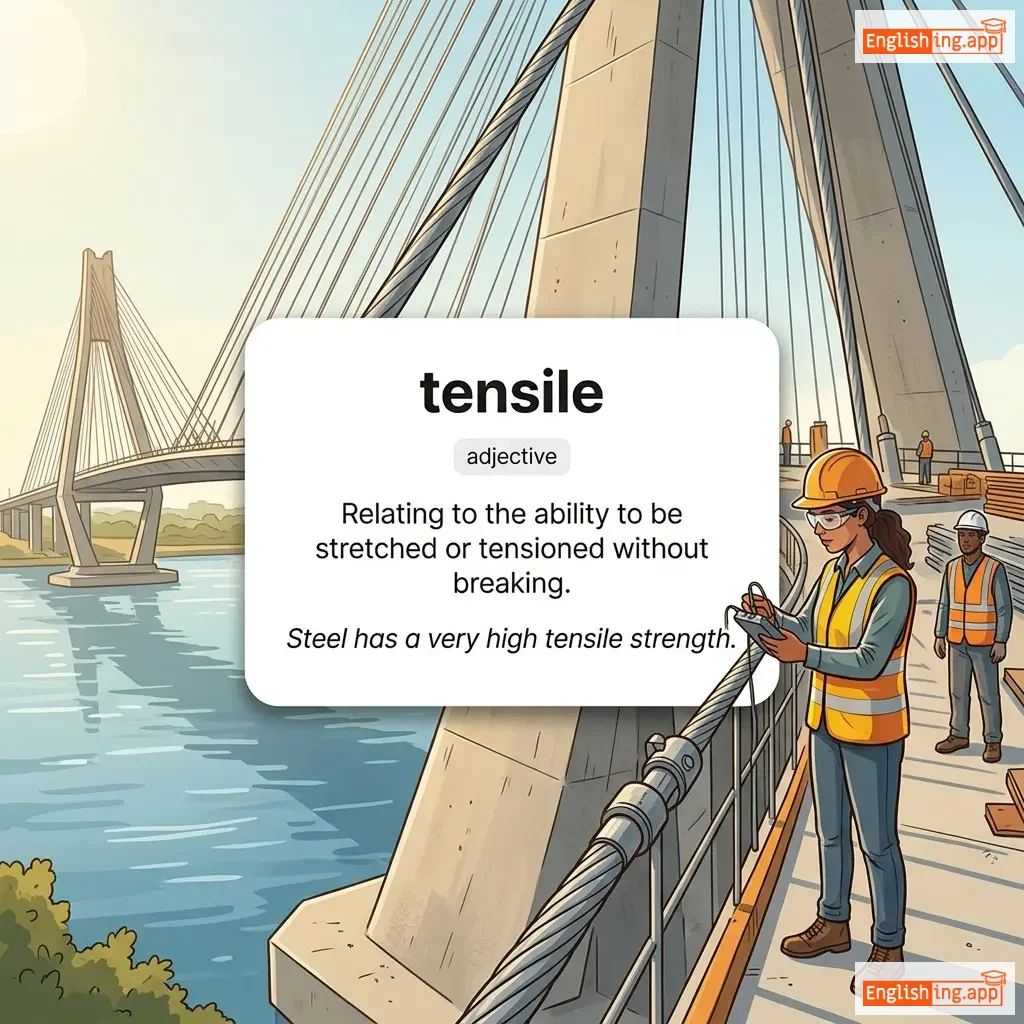
tensile definition card — visual illustration of the meaning
adjective
/ˈtɛn.saɪl/
तन्यीय (tanyiy)

Relating to the ability to be stretched or tensioned without breaking.

"Steel has a very high tensile strength."

"इस्पात में बहुत उच्च तन्यीय ताकत होती है।" (Ispaat mein bahut uchch tanyiy taakat hoti hai.)
noun, adjective, verb
/tɛns/
तनाव / काल (tanav / kaal)

a grammatical category showing time reference; stretched tight or anxious

"She felt tense before the interview."

"वह साक्षात्कार से पहले तनाव महसूस कर रही थी।" (Wah sakshatkaar se pehle tanav mehsoos kar rahi thi.)
noun
/ˈtɛnər/
स्वर / मूल भावना (swar / mool bhavna)

the general meaning, drift, or character of something; a male singing voice between baritone and alto

"The overall tenor of his speech was hopeful and reassuring."

"उसकी स्पीच का समग्र टोन आशावादी और विश्वासजनक था।" (Uski speech ka samagra ton ashaavadi aur vishwasjanak tha.)
noun
/tiː/
चाय (chai)

a hot drink made by infusing the dried, crushed leaves of the tea plant in boiling water

"I drink tea every morning to start my day."

"मैं हर सुबह अपनी सुबह की शुरुआत करने के लिए चाय पीता हूँ।" (Main har subah apnī subah kī śurūāt karne ke liye chāy pītā hūn.)