Vocabularios

Descubra, aprenda y domine el vocabulario en inglés

🙅‍♀️

Unable (ʌˈneɪbl)

adjective
/ʌˈneɪbl/
incapaz (incapaz)

not able to do something

"She was unable to attend the meeting."

"Ella no pudo asistir a la reunión." (Ella no pudo asistir a la reunión.)
noun
/ʌnəˈbɪləti/
incapacidad (incapacidad)

the state of being unable to do something; incapacity

"His unability to solve the problem caused delays in the project."

"Su incapacidad para resolver el problema causó retrasos en el proyecto." (Su incapacidad para resolver el problema causo retrasos en el proyecto)
noun
/ʌmˈbrɛlə/
paraguas (paraguas)

A device used for protection against rain or sun, typically consisting of a collapsible canopy mounted on a central rod.

"She opened her umbrella as it started to rain."

"Ella abrió su paraguas cuando empezó a llover." (Ella abrio su paraguas cuando empezo a llover.)
noun
/ˈʌmbrɪdʒ/
resentimiento, ofensa (resentimiento, ofensa)

A feeling of resentment or offense.

"She took umbrage at his rude remark."

"Ella se ofendió con su comentario grosero." (Ella se ofendió con su comentario grosero.)
noun
/ˈʌm.brə/
sombra completa, la región oscura del centro de una mancha solar (sombra completa, la region oscura del centro de una mancha solar)

the fully shaded inner region of a shadow cast by an opaque object; the dark center of a sunspot

"During the eclipse, we stood in the moon's umbra."

"Durante el eclipse, nos paramos en la umbra de la luna." (Durante el eclipse, nos paramos en la umbra de la luna.)
adjective
/ˌʌltrəˈmʌndeɪn/
ultramundano (ultramundano)

Relating to things beyond the physical world; supernatural or transcendental.

"Philosophers often discuss ultramundane realities beyond human perception."

"Los filósofos a menudo discuten las realidades ultramundanas más allá de la percepción humana." (Los filosofos a menudo discuten las realidades ultramundanas mas alla de la percepcion humana.)
adjective
/ˌʌltrəˈmɒnteɪn/
partidario del Papa (partidario del Papa)

beyond the mountains, especially referring to support for the Pope over local church authority

"The debate highlighted the ultramontane position in church politics."

"El debate destacó la posición ultramontana en la política eclesiástica." (El debate destaco la posicion ultramontana en la politica eclesiastica.)
noun
/ˌʌltɪˈmeɪtəm/
ultimátum (ultimatum)

a final demand or statement of terms

"The workers gave the company an ultimatum to raise their wages."

"Los trabajadores dieron a la empresa un ultimátum para aumentar sus salarios." (Los trabajadores dieron a la empresa un ultimatum para aumentar sus salarios.)
adverb
/ˈʌltəmətli/
finalmente (finalmente)

in the end, after everything else

"Ultimately, we decided to go ahead with the project."

"Finalmente, decidimos continuar con el proyecto." (Finalmente, decidimos continuar con el proyecto.)
adjective
/ˈʌltɪmət/
último (ultimo)

being the best, final, or most extreme

"Success is the ultimate goal of hard work."

"El éxito es el objetivo final del trabajo duro." (El exito es el objetivo final del trabajo duro.)
adjective
/ʌlˈtɪəriər/
motivo oculto (motivo oculto)

hidden or secret, often with a selfish motive

"He invited her with an ulterior motive."

"La invitó con un motivo oculto." (La invitó con un motivo oculto.)
noun
/ˈʌlsər/
úlcera (ulcera)

a sore on the skin or a mucous membrane that does not heal easily

"The doctor prescribed medicine to treat the stomach ulcer."

"El médico recetó un medicamento para tratar la úlcera de estómago." (El medico receto un medicamento para tratar la ulcera de estomago.)
interjection
/ʌ/
eh (eh)

a sound people make when they hesitate or are unsure what to say next.

"Uh, I’m not sure if that’s the right answer."

"Eh, no estoy seguro de si esa es la respuesta correcta." (Eh, no estoy seguro de si esa es la respuesta correcta.)
adjective
/ˈʌɡli/
feo (feo)

unpleasant or repulsive in appearance

"The house had an ugly view of the street."

"La casa tenía una vista fea de la calle." (La casa tenía una vista fea de la calle.)
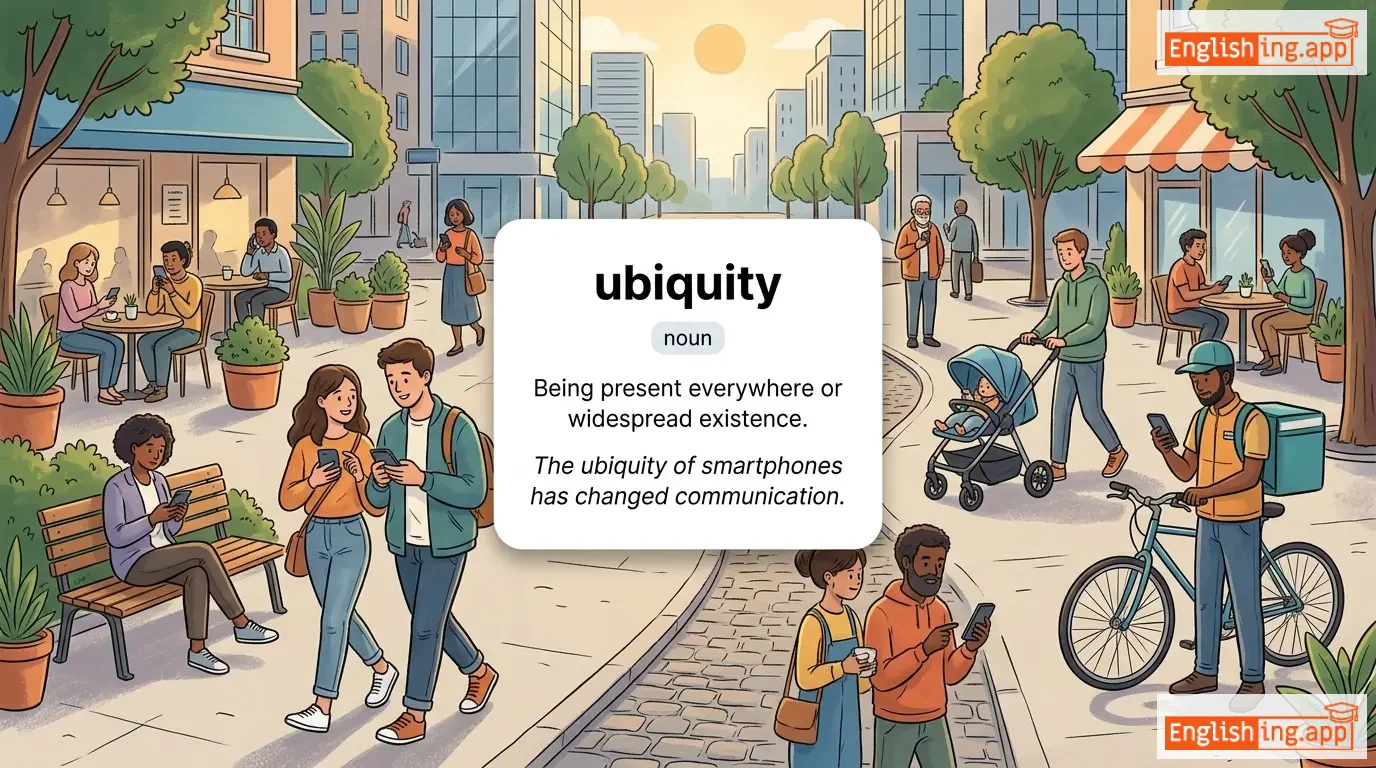
ubiquity definition card — visual illustration of the meaning
noun
/juːˈbɪk.wɪ.ti/
ubicuidad (ubiquidad)

Being present everywhere or widespread existence.

"The ubiquity of smartphones has changed communication."

"La ubiquidad de los teléfonos inteligentes ha cambiado la comunicación." (La ubiquidad de los teléfonos inteligentes ha cambiado la comunicación.)
adjective
/juːˈbɪkwɪtəs/
ubiquito (ubiquito)

Existing or being everywhere at the same time.

"Social media has become ubiquitous among young people."

"Las redes sociales se han vuelto ubicuas entre los jóvenes." (Las redes sociales se han vuelto ubicuas entre los jóvenes.)
adjective
/juːˈbɪkwɪtəs/
ubicuo (ubikuo)

Present, appearing, or found everywhere.

"Smartphones have become ubiquitous in modern society."

"Los teléfonos inteligentes se han vuelto ubicuos en la sociedad moderna." (Los telefonos inteligentes se han vuelto ubicuos en la sociedad moderna.)
noun
/ˈtaɪroʊ/
principiante (principiante)

A beginner or novice in a field or activity.

"As a tyro in programming, she needed constant guidance."

"Como principiante en programación, necesitaba orientación constante." (Como principiante en programación, necesitaba orientación constante.)
noun
/ˈtaɪ.rənt/
tirano (tirano)

a cruel and oppressive ruler; a person who exercises power in a harsh manner

"The people rebelled against the cruel tyrant."

"La gente se rebeló contra el cruel tirano." (La gente se rebeló contra el cruel tirano)
noun
/ˈtɪrəni/
tiranía (tiranía)

Cruel and oppressive government or rule by a tyrant.

"The people revolted against the tyranny of their ruler."

"La gente se rebeló contra la tiranía de su gobernante." (La gente se rebeló contra la tiranía de su gobernante.)
adjective
/tɪˈrænɪkəl/
tiránico (tiraniko)

exercising power in a cruel or arbitrary way

"The tyrannical ruler silenced all opposition."

"El gobernante tiránico silenció toda oposición." (El gobernante tiránico silenció toda oposición.)
noun
/taɪˈpɒɡrəfi/
tipografía (tipografia)

the art and technique of arranging type to make written language legible and visually appealing

"Good typography improves the readability of a website."

"Una buena tipografía mejora la legibilidad de un sitio web." (Una buena tipografia mejora la legibilidad de un sitio web.)
adjective
/ˌtaɪpəˈɡræfɪkəl/
tipográfico (tipografiko)

relating to the style, arrangement, or appearance of printed text

"There was a typographical error in the book."

"Había un error tipográfico en el libro." (Habia un error tipografiko en el libro.)
noun
/ˈtaɪpoʊ/
error tipográfico (error tipografico)

a mistake made in typing

"The report was full of typos."

"El informe estaba lleno de errores tipográficos." (El informe estaba lleno de errores tipograficos.)
verb
/ˈtɪpɪfaɪ/
representar (representar)

to represent or be a typical example of something

"His leadership style typifies the new corporate culture."

"Su estilo de liderazgo representa la nueva cultura corporativa." (Su estilo de liderazgo representa la nueva cultura corporativa.)
adverb
/ˈtɪpɪkli/
normalmente (normalmente)

in a way that is typical of a particular person, thing, or group

"She typically arrives at work at 9 AM."

"Ella normalmente llega al trabajo a las 9 AM." (Ella normalmente llega al trabajo a las 9 AM.)
adjective
/ˈtɪpɪkəl/
relacionado con las características comunes de un tipo particular de persona o cosa (relacionado con las caracteristicas comunes de un tipo particular de persona o cosa)

having the usual qualities of a particular type of person or thing

"It was a typical summer day, hot and humid."

"Era un día típico de verano, caluroso y húmedo." (Era un dia tipico de verano, caluroso y humedo.)
noun
/taɪˈfuːn/
tifón (tifon)

a tropical storm in the region of the Indian or western Pacific oceans

"The typhoon caused severe flooding in the coastal areas."

"El tifón causó graves inundaciones en las áreas costeras." (El tifón causó graves inundaciones en las áreas costeras.)
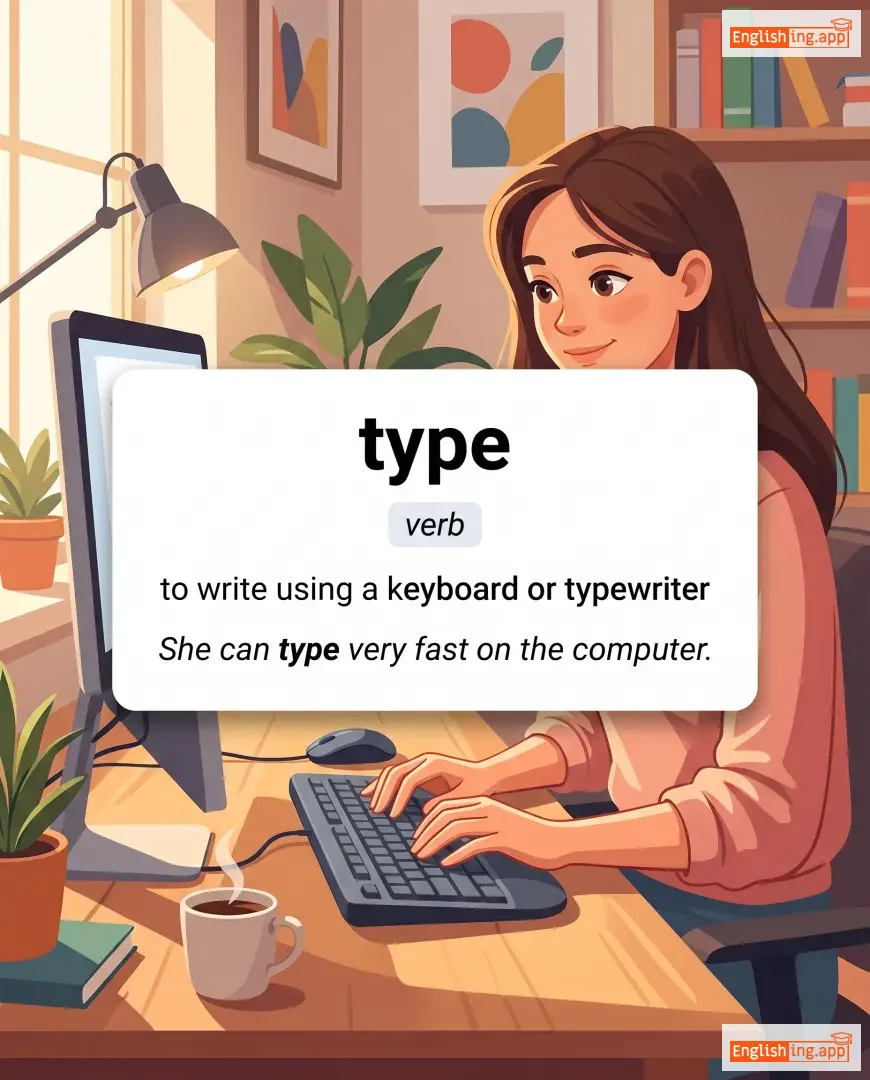
type definition card — visual illustration of the meaning
noun
/taɪp/
tipo (tipo)

a category of people or things having common characteristics

"What type of music do you like?"

"¿Qué tipo de música te gusta?" (¿Qué tipo de música te gusta?)
noun
/taɪˈkuːn/
magnate (magnate)

a wealthy, powerful businessperson

"The real estate tycoon invested in several skyscrapers."

"El magnate inmobiliario invirtió en varios rascacielos." (El magnate inmobiliario invirtió en varios rascacielos.)
noun
/ˈtuːsəm/
pareja (pareja)

A pair of people considered together, often in a romantic or competitive context.

"They entered the dance competition as a twosome."

"Entraron a la competencia de baile como una pareja." (Entraron a la competencia de baile como una pareja.)
noun
/tuː θɜːrdz/
dos tercios (dos tercios)

a fraction equal to two parts of three; 2/3.

"Two-thirds of the students passed the exam."

"Dos tercios de los estudiantes aprobaron el examen." (Dos tercios de los estudiantes aprobaron el examen.)
2️⃣

two (tú)

noun
/tuː/
dos (dos)

the number following one

"She has two children."

"Ella tiene dos hijos." (Ella tiene dos hijos.)
noun
/juːˈkeɪs/
decreto (decreto)

An authoritative decree or order, especially one issued by a sovereign or government.

"The czar issued a ukase restricting the freedom of the press."

"El zar emitió un decreto que restringía la libertad de prensa." (El zar emitió un decreto que restringía la libertad de prensa.)
noun
/ˈtɛrərɪzəm/
terrorismo (terrorismo)

the use of violence or threats to intimidate or coerce, especially for political purposes

"Terrorism is a serious threat to global peace and security."

"El terrorismo es una amenaza seria para la paz y seguridad global." (El terrorismo es una amenaza seria para la paz y seguridad global.)
noun
/ˈtɛrərɪst/
terrorista (terrorista)

a person who uses violence or threats to intimidate or coerce, especially for political purposes

"The terrorist was arrested by the police after the attack."

"El terrorista fue arrestado por la policía después del ataque." (El terrorista fue arrestado por la policía después del ataque.)
adjective
/tɜːrs/
conciso (conciso)

brief and to the point; sparing in the use of words

"His reply was terse and ended the conversation quickly."

"Su respuesta fue concisa y terminó rápidamente la conversación." (su respuesta fue concisa y termino rapidamente la conversacion.)
adjective
/ˈtɜːrʃieri/
terciario (tertiary)

third in order, rank, or level

"He is pursuing his tertiary education at the university."

"El esta cursando su educacion terciaria en la universidad." (El esta cursando su educacion terciaria en la universidad.)
adjective
/ˈtɛsəleɪtɪd/
enlazado (enlazado)

arranged in a pattern of repeated shapes fitting together without gaps

"The tessellated floor was made of colorful tiles arranged in perfect symmetry."

"El piso enlazado estaba hecho de baldosas coloridas dispuestas en simetría perfecta." (El piso enlazado estaba hecho de baldosas coloridas dispuestas en simetría perfecta.)
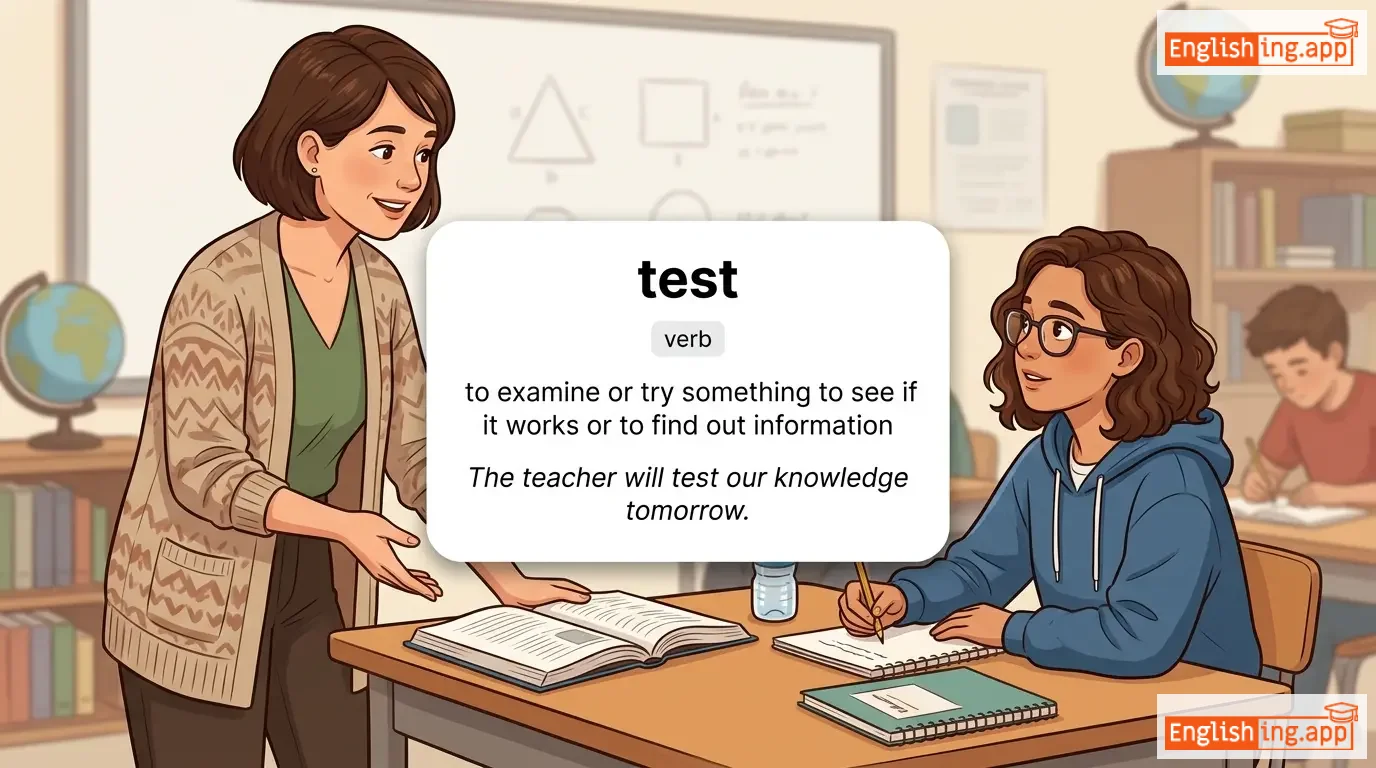
test definition card — visual illustration of the meaning
noun
/tɛst/
prueba (prueba)

a procedure intended to establish the quality, performance, or reliability of something

"The test results will determine whether the treatment is effective."

"Los resultados de la prueba determinarán si el tratamiento es efectivo." (Los resultados de la prueba determinarán si el tratamiento es efectivo.)
noun
/ˈtɛstəmənt/
testamento / prueba (testamento / prueba)

a person's will; or strong evidence of something

"His success is a testament to his hard work and dedication."

"Su éxito es un testamento de su trabajo arduo y dedicación." (Su éxito es un testamento de su trabajo arduo y dedicación.)
noun
/ˈtɛsteɪtər/
testador (testador)

a person who has made a will

"The lawyer read the will of the deceased testator."

"El abogado leyó el testamento del testador fallecido." (El abogado leyó el testamento del testador fallecido.)
verb
/ˈtɛstəfaɪ/
testificar (testificar)

to make a statement or declaration under oath or to give evidence

"She was called to testify in court about the accident."

"Fue llamada a testificar en el tribunal sobre el accidente." (Fue llamada a testificar en el tribunal sobre el accidente.)
noun
/ˌtɛstɪˈmoʊniəl/
testimonio (testimonio)

A formal statement testifying to someone's character, qualifications, or the quality of a product or service.

"The company shared a glowing testimonial from a satisfied customer."

"La compañía compartió un testimonio brillante de un cliente satisfecho." (La compania compartio un testimonio brillante de un cliente satisfecho.)
testimonials definition card — visual illustration of the meaning
noun
/ˌtɛstɪˈməʊnɪəlz/
testimonios, cartas de recomendación (testimonios, cartas de recomendacion)

Written or spoken statements of praise or recommendation from clients or customers.

"Positive testimonials can enhance a company's reputation."

"Los testimonios positivos pueden mejorar la reputación de una empresa." (Los testimonios positivos pueden mejorar la reputación de una empresa.)
noun
/ˈtɛstəˌmoʊni/
testimonio (testimonio)

A formal statement given in a court of law or evidence supporting a fact.

"Her testimony in court helped convict the criminal."

"Su testimonio en el juicio ayudó a condenar al criminal." (Su testimonio en el juicio ayudo a condenar al criminal.)
noun
/ˈtɛstɪŋ/
prueba (prueba)

the process of assessing or evaluating something, often by trying it out

"The testing of the new software is still ongoing."

"La prueba del nuevo software aún está en curso." (La prueba del nuevo software aún está en curso.)
adjective
/ˈtɛsti/
irritable (irritable)

Easily irritated or annoyed.

"He became testy when asked the same question repeatedly."

"Se puso irritable cuando le hicieron la misma pregunta repetidamente." (Se puso irritable cuando le hicieron la misma pregunta repetidamente.)
noun
/θæŋks/
gracias (gracias)

an expression of gratitude

"Thanks for helping me with the project."

"Gracias por ayudarme con el proyecto." (Gracias por ayudarme con el proyecto.)
noun
/ˈθæŋksˌɡɪvɪŋ/
Día de Acción de Gracias (Dia de Accion de Gracias)

an annual holiday in the US for giving thanks, celebrated with a meal

"We spent Thanksgiving dinner with our family."

"Pasamos la cena de Acción de Gracias con nuestra familia." (Pasamos la cena de Accion de Gracias con nuestra familia.)