Vocabularios

Descubra, aprenda y domine el vocabulario en inglés

adjective
/ʌnˈkɒmən/
poco común (poco comun)

rare, unusual, or remarkable

"It is uncommon to see snow in this region."

"Es raro ver nieve en esta región." (Es raro ver nieve en esta región.)
adjective
/ʌnˈkʌmfətəbl/
incómodo (incomodo)

causing or feeling physical or emotional discomfort

"He felt uncomfortable during the long meeting."

"Se sintió incómodo durante la larga reunión." (Se sintió incomodo durante la larga reunión.)
noun
/ʌnˈkloʊðɪŋ/
desvestirse (desvestirse)

the act or process of removing clothing

"The child quickly ran inside for unclothing after playing in the mud."

"El niño corrió rápidamente adentro para desvestirse después de jugar en el barro." (El nino corrio rapidamente adentro para desvestirse despues de jugar en el barro)
verb
/ʌnˈkloʊð/
desvestir; quitar la ropa (desvestir; quitar la ropa)

to remove clothing from someone or something

"The nurse helped unclothe the patient for the examination."

"La enfermera ayudó a desvestir al paciente para el examen." (La enfermera ayudo a desvestir al paciente para el examen)
adjective
/ʌnˈklɪər/
poco claro (poco claro)

not easy to understand; vague or ambiguous

"The instructions were unclear, so I asked for clarification."

"Las instrucciones eran poco claras, así que pedí aclaraciones." (Las instrucciones eran poco claras, asi que pedi aclaraciones)
👨‍🦳

uncle (ánkel)

noun
/ˈʌŋkəl/
tío (tio)

the brother of one's father or mother

"My uncle is visiting us next week."

"Mi tío nos visitará la próxima semana." (Mi tio nos visitara la proxima semana.)
adjective
/ʌnˈkleɪmd/
no reclamado; no solicitado; abandonado o sin dueño (no reclamado; no solicitado; abandonado o sin dueño)

not claimed by anyone; not demanded or requested; abandoned or ownerless

"The unclaimed luggage was stored in the airport's lost property department."

"El equipaje no reclamado fue almacenado en el departamento de objetos perdidos del aeropuerto." (El equipaje no reclamado fue almacenado en el departamento de objetos perdidos del aeropuerto.)
adjective
/ʌnˈsɪvəlaɪzd/
incivilizado; salvaje; (incivilizado; salvaje;)

not developed in terms of civilization; lacking social organization and culture; barbarous

"The explorers encountered an uncivilized tribe deep in the Amazon rainforest."

"Los exploradores encontraron una tribu incivilizada en lo profundo de la selva amazónica." (Los exploradores encontraron una tribu incivilizada en lo profundo de la selva amazonica.)
adjective
/ʌnˈsɪvəl/
grosero; descortés; (grosero; descortes)

not polite or courteous; rude and discourteous in behavior

"His uncivil remarks during the meeting offended everyone present."

"Sus comentarios incivilizados durante la reunión ofendieron a todos los presentes." (Sus comentarios incivilizados durante la reunión ofendieron a todos los presentes.)
adjective
/ʌnˈtʃeɪst/
inmoral; impuro; (inmoral; impuro;)

not celibate; having engaged in sexual relations; lacking moral purity

"The conservative society considered her behavior unchaste and improper."

"La sociedad conservadora consideró su comportamiento inmoral e inapropiado." (La sociedad conservadora consideró su comportamiento inmoral e inapropiado.)
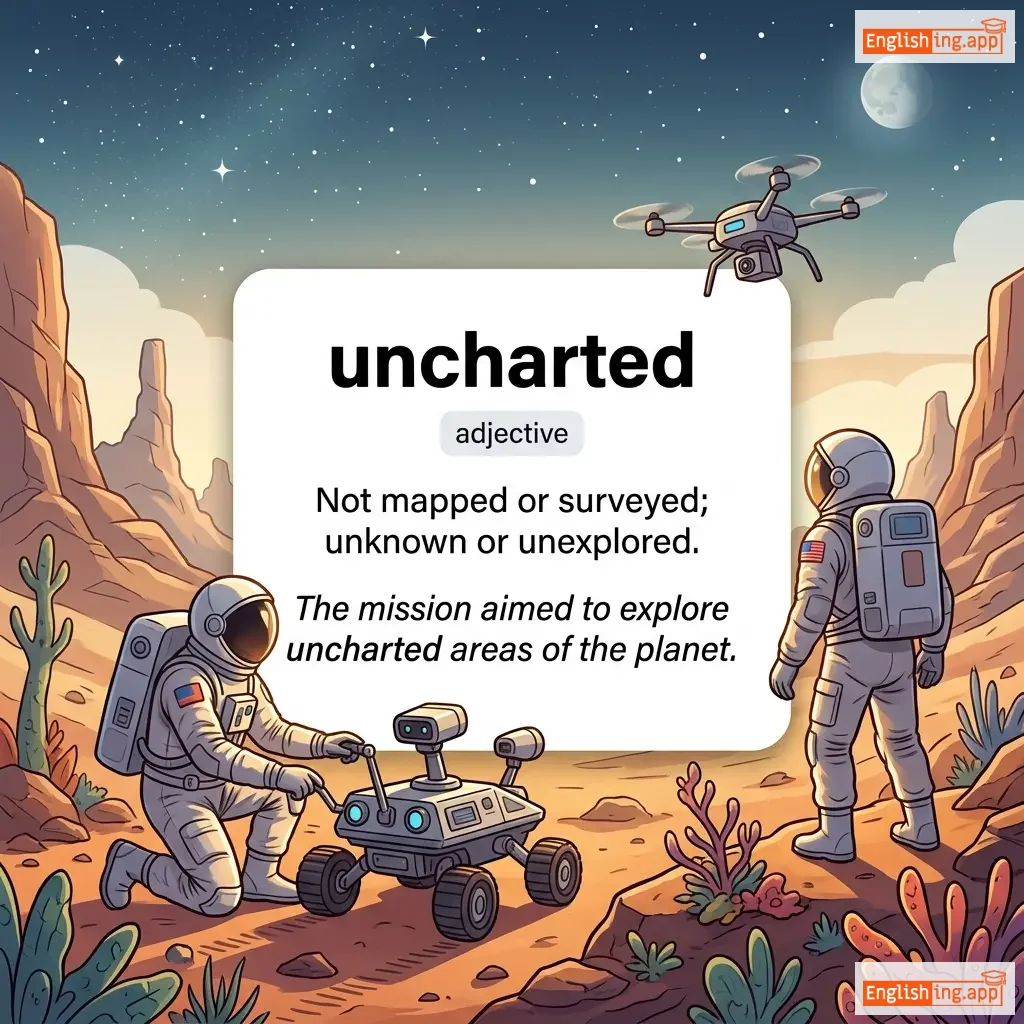
uncharted definition card — visual illustration of the meaning
adjective
ʌnˈtʃɑːtɪd
inexplorado (inexplorado)

Not mapped or surveyed; unknown or unexplored.

"The mission aimed to explore uncharted areas of the planet."

"La misión tenía como objetivo explorar áreas inexploradas del planeta." (La mision tenia como objetivo explorar areas inexploradas del planeta.)
adjective
/ʌnˈtʃeɪndʒɪŋ/
inmutable (inmutable)

remaining the same over time; not changing

"Her love for her family was unchanging throughout the years."

"Su amor por su familia fue inmutable a lo largo de los años." (Su amor por su familia fue inmutable a lo largo de los años.)
adjective
/ʌnˈtʃeɪndʒəbəl/
inmutable; fijo; (inmutable; fijo;)

not able to be changed or altered; fixed and permanent

"The laws of physics are unchangeable principles that govern the universe."

"Las leyes de la física son principios inmutables que rigen el universo." (Las leyes de la fisica son principios inmutables que rigen el universo.)
adjective
/ʌnˈtʃælɪndʒd/
incontestable; aceptado sin oposición; sin rival (incontestable; aceptado sin oposicion; sin rival)

not disputed or questioned; accepted without opposition; having no rival

"He remained the unchallenged champion for five years."

"Él permaneció como el campeón indiscutido durante cinco años." (El permanecio como el campeon indiscutido durante cinco anos.)
noun
/ʌnˈsɜːtənti/
incertidumbre (incertidumbre)

the state of being unsure or not knowing what will happen

"Economic uncertainty affects business investments."

"La incertidumbre económica afecta las inversiones empresariales." (La incertidumbre económica afecta las inversiones empresariales.)
adverb
/ʌnˈsɜːrtənli/
con incertidumbre (con incertidumbre)

in a way that shows doubt or lack of certainty

"She glanced uncertainly at the complicated instructions."

"Ella miró las instrucciones complicadas con incertidumbre." (Ella miro las instrucciones complicadas con incertidumbre.)
adjective
/ʌnˈsɜːtən/
incierto (incierto)

not sure or confident about something; not clearly known or decided

"She felt uncertain about her future after graduation."

"Se sintió incierta sobre su futuro después de la graduación." (Se sintió incierta sobre su futuro después de la graduación.)
adjective
/ˌʌnsɛrəˈmoʊniəs/
sin ceremonias/rudo (sin ceremonias/rudo)

Done without formality or courtesy; abrupt or rude.

"He made an unceremonious exit from the party."

"Él hizo una salida sin ceremonias de la fiesta." (El hizo una salida sin ceremonias de la fiesta.)
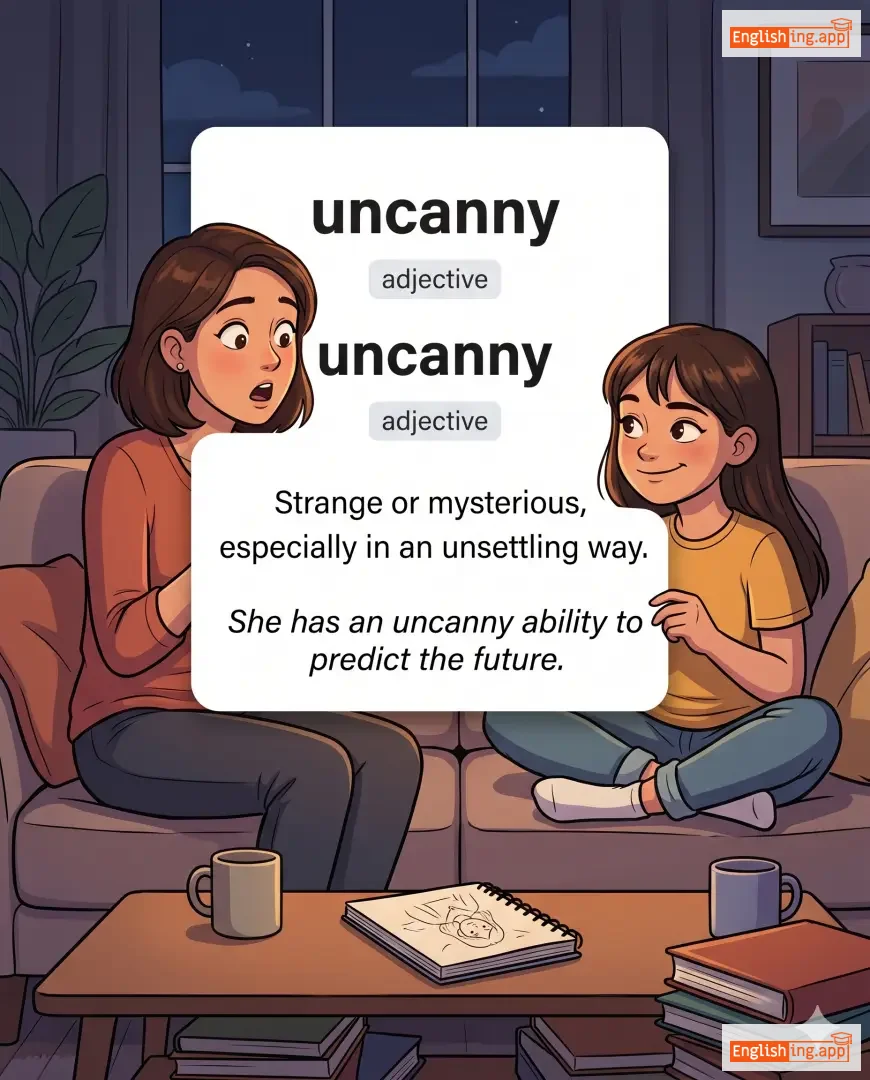
uncanny definition card — visual illustration of the meaning
adjective
/ʌnˈkæni/
extraño (extrano)

Strange or mysterious, especially in an unsettling way.

"She has an uncanny ability to predict the future."

"Ella tiene una extraña habilidad para predecir el futuro." (Ella tiene una extrana habilidad para predecir el futuro.)
adjective
/ʌnˈbraɪdld/
desenfrenado (desenfrenado)

Uncontrolled and unrestrained.

"The protesters showed unbridled enthusiasm for change."

"Los manifestantes mostraron entusiasmo desenfrenado por el cambio." (Los manifestantes mostraron entusiasmo desenfrenado por el cambio.)
adjective
/ʌnˈbreɪkəbəl/
no se puede romper o dañar; muy fuerte y duradero (no se puede romper o dañar; muy fuerte y duradero)

not able to be broken or damaged; very strong and durable

"Their friendship formed an unbreakable bond."

"Su amistad formó un vínculo inquebrantable." (su amistad formó un vínculo inquebrantable.)
adjective
/ʌnˈblʌʃɪŋ/
descarado; sinvergüenza (descarado; sinverguenza)

showing no shame or embarrassment; boldly shameless

"He told the unblushing lie without any hesitation."

"Él dijo la mentira descarada sin dudar." (El dijo la mentira descarada sin dudar.)
adjective
/ʌnˈbaɪəst/
imparcial (imparcial)

Not showing prejudice; impartial and fair.

"The report gave an unbiased view of the situation."

"El informe dio una vista imparcial de la situación." (El informe dio una vista imparcial de la situación.)
adjective
/ˌʌnbɪˈliːvɪŋ/
incrédulo (incredulo)

Not willing or able to believe; skeptical or doubtful

"She gave him an unbelieving look when he claimed to have met a celebrity."

"Ella le dio una mirada incrédula cuando afirmó haber conocido a una celebridad." (Ella le dio una mirada incredula cuando afirmo haber conocido a una celebridad.)
adjective
/ˌʌnbɪˈliːvəbəl/
increíble (increible)

impossible to believe; extremely surprising or remarkable

"The magician's performance was absolutely unbelievable."

"La actuación del mago fue absolutamente increíble." (La actuacion del mago fue absolutamente increible.)
noun
/ˌʌnbɪˈliːf/
incredulidad (incredulidad)

A lack of belief, especially in religious faith.

"His heart was full of doubt and unbelief."

"Su corazón estaba lleno de duda e incredulidad." (Su corazon estaba lleno de duda e incredulidad.)
adjective
/ˌʌnbɪˈkʌmɪŋ/
inadecuado (inadecuado)

Not proper or appropriate for a person; unsuitable.

"His rude behavior was unbecoming of a leader."

"Su comportamiento grosero era inadecuado para un líder." (Su comportamiento grosero era inadecuado para un líder.)
adjective
/ʌnˈbiːtən/
invicto; no derrotado (invicto; no derrotado)

not defeated; having never lost; undefeated

"The team remains unbeaten this season."

"El equipo sigue invicto esta temporada." (El equipo sigue invicto esta temporada.)
adjective
/ʌnˈbeərəbl/
intolerable (intolerable)

Too difficult or unpleasant to endure.

"The heat was unbearable in the afternoon."

"El calor era intolerable por la tarde." (El calor era intolerable por la tarde.)
adjective
/ʌnˈbæləns/
desbalanceado; inestable (desbalanceado; inestable)

not balanced; lacking stability or equilibrium; mentally unstable

"The unbalanced table kept wobbling."

"La mesa desbalanceada seguía tambaleando." (La mesa desbalanceada seguía tambaleando.)
🤷‍♂️

Unaware (anawer)

adjective
/ˌʌnəˈweər/
inconsciente; ajeno; sin saber (inconsciente; ajeno; sin saber)

not knowing or realizing; having no knowledge of something

"She was completely unaware of the danger."

"Ella estaba completamente inconsciente del peligro." (Ella estaba completamente inconsciente del peligro.)
adjective
/ˌʌnəˈvɔɪdəbl/
inevitable (inevitable)

Impossible to avoid or prevent.

"Delays were unavoidable due to heavy rain."

"Los retrasos fueron inevitables debido a la lluvia intensa." (Los retrasos fueron inevitables debido a la lluvia intensa.)
adjective
/ˌʌnəˈveɪləbəl/
no disponible (no disponible)

Not able to be obtained, reached, or used; not present or accessible.

"The manager was unavailable to take calls during the meeting."

"El gerente no estaba disponible para atender llamadas durante la reunión." (El gerente no estaba disponible para atender llamadas durante la reunion.)
noun
/ˌʌnəˌveɪləˈbɪləti/
indisponibilidad (indisponibilidad)

The state of being not available or not accessible.

"The unavailability of the manager caused a delay in the project."

"La indisponibilidad del gerente causó un retraso en el proyecto." (La indisponibilidad del gerente causó un retraso en el proyecto)
adjective
/ˌʌnəˈteɪnəbl/
inalcanzable (inalcanzable)

impossible to achieve, reach, or accomplish

"For many, becoming a professional athlete remains an unattainable dream."

"Para muchos, convertirse en un atleta profesional sigue siendo un sueño inalcanzable." (Para muchos, convertirse en un atleta profesional sigue siendo un sueño inalcanzable.)
adjective
/ˌʌnəˈʃʊəd/
inseguro (inseguro)

Lacking confidence or certainty.

"She gave an unassured answer during the interview."

"Ella dio una respuesta insegura durante la entrevista." (Ella dio una respuesta insegura durante la entrevista.)
adjective
/ˌʌnəˈsjuːmɪŋ/
modesto (modesto)

Not pretentious or arrogant; modest.

"Despite his success, he remained unassuming and humble."

"A pesar de su éxito, siguió siendo modesto y humilde." (A pesar de su éxito, siguió siendo modesto y humilde.)
adjective
/ˌʌnəˈsweɪdʒd/
inquieto (inquieto)

Not made less intense or relieved; unrelieved.

"His grief remained unassuaged despite the passage of time."

"Su dolor permaneció inquieto a pesar del paso del tiempo." (Su dolor permaneció inquieto a pesar del paso del tiempo.)
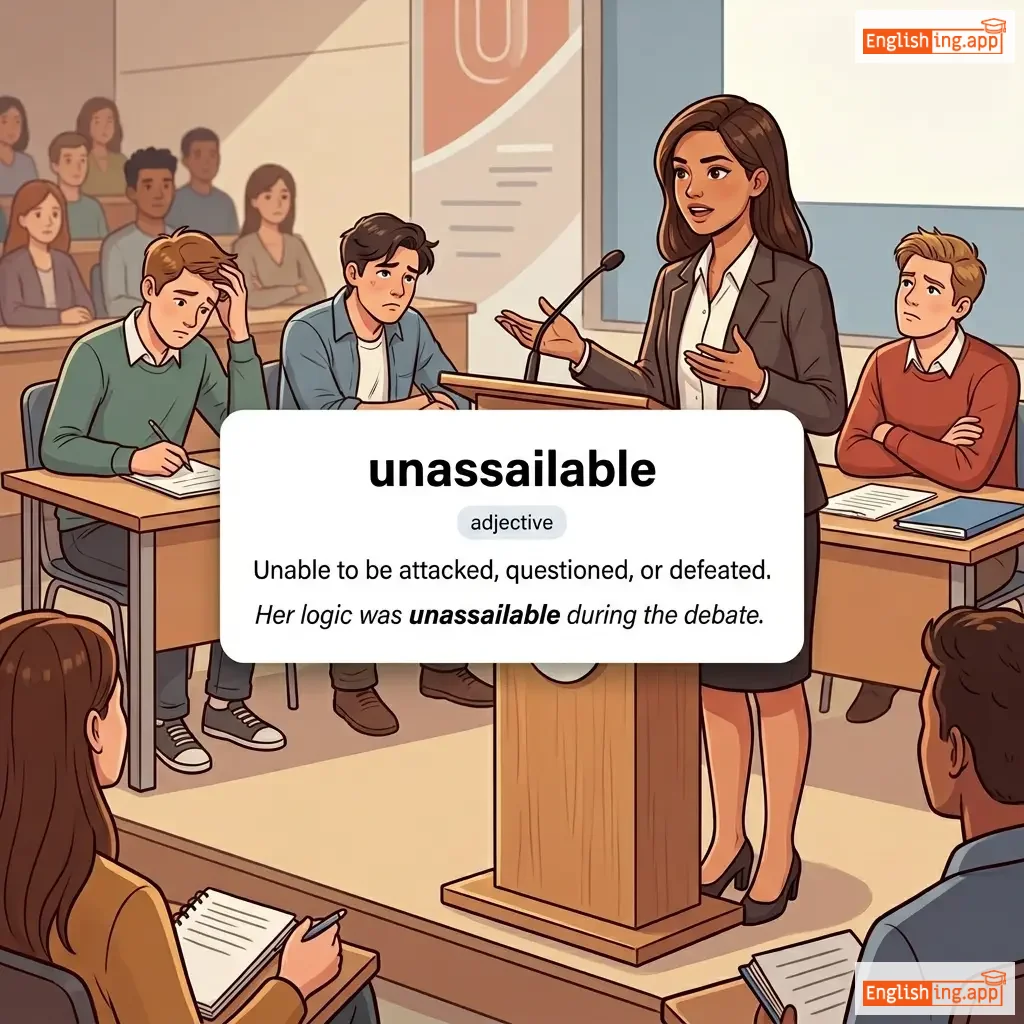
unassailable definition card — visual illustration of the meaning
adjective
/ˌʌnəˈseɪləbl/
inatacable (inatacable)

Unable to be attacked, questioned, or defeated.

"Her logic was unassailable during the debate."

"Su lógica era inatacable durante el debate." (Su logica era inatacable durante el debate.)
adjective
/ʌnˈɑːrmd/
desarmado (desarmado)

Not equipped with or carrying weapons

"The police found the suspect unarmed during the search."

"La policía encontró al sospechoso desarmado durante la búsqueda." (La policia encontro al sospechoso desarmado durante la busqueda.)
verb
/ʌnˈɑːrm/
desarmar (desarmar)

to remove weapons from someone or to deprive of means of attack or defense

"The soldiers were ordered to unarm the prisoners."

"Se ordenó a los soldados desarmar a los prisioneros." (Se ordeno a los soldados desarmar a los prisioneros)
noun
/ˈtʌrɪt/
torre pequeña en la cima de una torre o edificio más grande (torre pequena en la cima de una torre o edificio mas grande)

A small tower on top of a larger tower or building, often used in castles or fortifications.

"The castle was guarded by soldiers stationed in the turret."

"El castillo estaba custodiado por soldados apostados en la torre." (El castillo estaba custodiado por soldados apostados en la torre.)
noun
/ˈtjuːtərʃɪp/
tutela (tutela)

The office or position of a tutor; guidance or instruction given by a tutor.

"He thrived under the tutorship of his mentor."

"Él prosperó bajo la tutela de su mentor." (El prospero bajo la tutela de su mentor.)
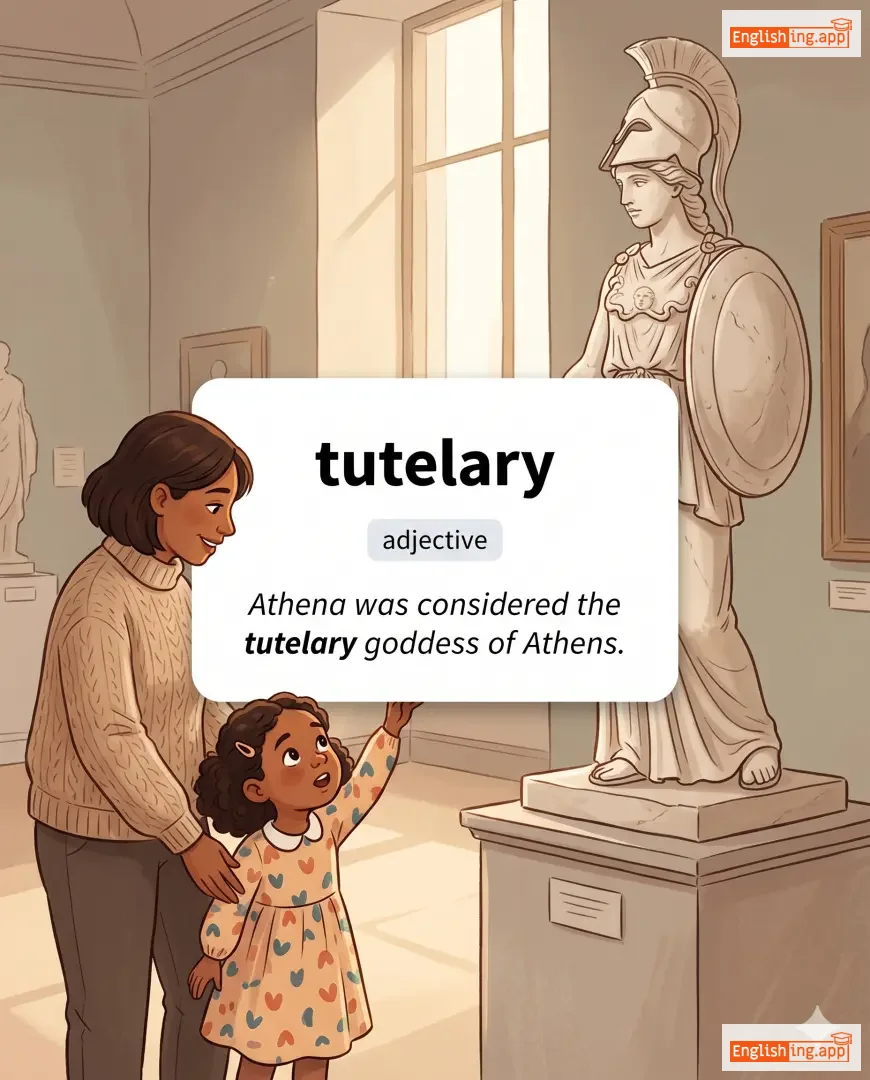
tutelary definition card — visual illustration of the meaning
adjective
/ˈtjuːtɪləri/
tutelario (tutelario)

Relating to or serving as a guardian or protector, often used for deities or spirits.

"Athena was considered the tutelary goddess of Athens."

"Se consideraba a Atenea la diosa tutelar de Atenas." (Se consideraba a Atenea la diosa tutelar de Atenas.)
adjective
/ˈtjuːtɪlɑːr/
tutelario (tutelario)

Serving as a guardian or protector.

"The tutelar spirit of the forest was believed to protect travelers."

"Se creía que el espíritu tutelar del bosque protegía a los viajeros." (Se creia que el espiritu tutelar del bosque protegía a los viajeros.)
noun
/ˈtjuːtɪlɪdʒ/
tutelaje (tutelaje)

The act of guarding, protecting, or guiding; instruction or teaching.

"She studied painting under the tutelage of a famous artist."

"Ella estudió pintura bajo la tutela de un famoso artista." (Ella estudió pintura bajo la tutela de un famoso artista.)
noun
/ˈtɜːrtl/
tortuga (tortuga)

A slow-moving reptile with a hard shell that lives in water or on land

"The turtle slowly crossed the sandy beach."

"La tortuga cruzó lentamente la playa de arena." (La tortuga cruzo lentamente la playa de arena)
noun
/ˈtɜːnˌəʊvə/
rotación (rotacion)

the amount of business conducted during a particular period, or the rate at which employees leave a company

"The company reported a high turnover in its sales department."

"La empresa reportó una alta rotación en su departamento de ventas." (La empresa reporto una alta rotacion en su departamento de ventas.)
adjective
/ˈtɜːrnkiː/
listo para usar (listo para usar)

ready for immediate use; a complete product or solution

"The company provides turnkey solutions for small businesses."

"La empresa ofrece soluciones llave en mano para pequeñas empresas." (La empresa ofrece soluciones llave en mano para pequeñas empresas.)
noun
/ˈtɜːr.naʊt/
asistencia (asistencia)

the number of people who attend or participate in an event or activity

"The turnout at the rally was impressive, with thousands showing up."

"La asistencia en la manifestación fue impresionante, con miles de personas presentes." (La asistencia en la manifestacion fue impresionante, con miles de personas presentes.)