वोकैबुलरीज

इंग्लिश वोकैबुलरी डिस्कवर, लर्न और मास्टर करें

adjective
/ʌnˈkɒmən/
असामान्य (asamaanya)

rare, unusual, or remarkable

"It is uncommon to see snow in this region."

"इस क्षेत्र में बर्फबारी असामान्य है।" (Is kshetra mein barfbaari asamaanya hai.)
adjective
/ʌnˈkʌmfətəbl/
असहज (asahaj)

causing or feeling physical or emotional discomfort

"He felt uncomfortable during the long meeting."

"लंबी बैठक के दौरान उसे असहज महसूस हुआ।" (Lambi baithak ke dauran use asahaj mehsoos hua.)
noun
/ʌnˈkloʊðɪŋ/
कपड़े उतारना (kapde utarna)

the act or process of removing clothing

"The child quickly ran inside for unclothing after playing in the mud."

"बच्चा कीचड़ में खेलने के बाद जल्दी अंदर जाकर कपड़े उतारने लगा।" (bacha kichad me khelne ke baad jaldi andar jaakar kapde utarne laga)
verb
/ʌnˈkloʊð/
कपड़े उतारना; वस्र मुक्त करना (kapde utarna; vasra mukt karna)

to remove clothing from someone or something

"The nurse helped unclothe the patient for the examination."

"नर्स ने मरीज की जांच के लिए कपड़े उतारने में मदद की।" (nars ne mariz ki jaanch ke liye kapde utarne mein madad ki)
adjective
/ʌnˈklɪər/
अस्पष्ट (aspasht)

not easy to understand; vague or ambiguous

"The instructions were unclear, so I asked for clarification."

"निर्देश अस्पष्ट थे, इसलिए मैंने स्पष्टीकरण माँगा।" (nirdesh aspasht the, isliye maine spashtikaran manga)
noun
/ˈʌŋkəl/
चाचा/काकू (chacha/kaku)

the brother of one's father or mother

"My uncle is visiting us next week."

"मेरा अंकल अगले सप्ताह हमसे मिलने आ रहे हैं।" (Mera uncle agle saptah humse milne aa rahe hain.)
adjective
/ʌnˈkleɪmd/
बिना दावा किया हुआ; मांग नहीं किया गया; छोड़ दिया गया या मालिक रहित (bina daawa kiya hua; maang nahi kiya gaya; chhod diya gaya ya malik rahit)

not claimed by anyone; not demanded or requested; abandoned or ownerless

"The unclaimed luggage was stored in the airport's lost property department."

"बिना दावा किया हुआ सामान हवाई अड्डे के खोए हुए संपत्ति विभाग में संग्रहीत किया गया था।" (bina daawa kiya hua saamaan havai addhe ke khoye hue sampatti vibhag mein sangrahit kiya gaya tha.)
adjective
/ʌnˈsɪvəlaɪzd/
असभ्य; जंगली; (ashabhya; jangli;)

not developed in terms of civilization; lacking social organization and culture; barbarous

"The explorers encountered an uncivilized tribe deep in the Amazon rainforest."

"अन्वेषकों ने अमेज़न वर्षावन में एक असभ्य जनजाति का सामना किया।" (anveshako ne amazon varshavan mein ek asabhya janjati ka samna kiya.)
adjective
/ʌnˈsɪvəl/
असभ्य; अभद्र; (ashabhya; abhadra)

not polite or courteous; rude and discourteous in behavior

"His uncivil remarks during the meeting offended everyone present."

"उसकी अन्सिविल टिप्पणियाँ बैठक में मौजूद सभी को आहत कर गईं।" (Uski ansivil tippaniyan baithak mein maujood sabhi ko aahat kar gayi.)
adjective
/ʌnˈtʃeɪst/
अविचारपूर्ण; अपवित्र; (avicharpurn; apavitra;)

not celibate; having engaged in sexual relations; lacking moral purity

"The conservative society considered her behavior unchaste and improper."

"संरक्षणवादी समाज ने उसके व्यवहार को अविचारपूर्ण और अनुचित माना।" (sarnrakshanvadi samaj ne uske vyavhaar ko avicharpurn aur anuchit mana.)
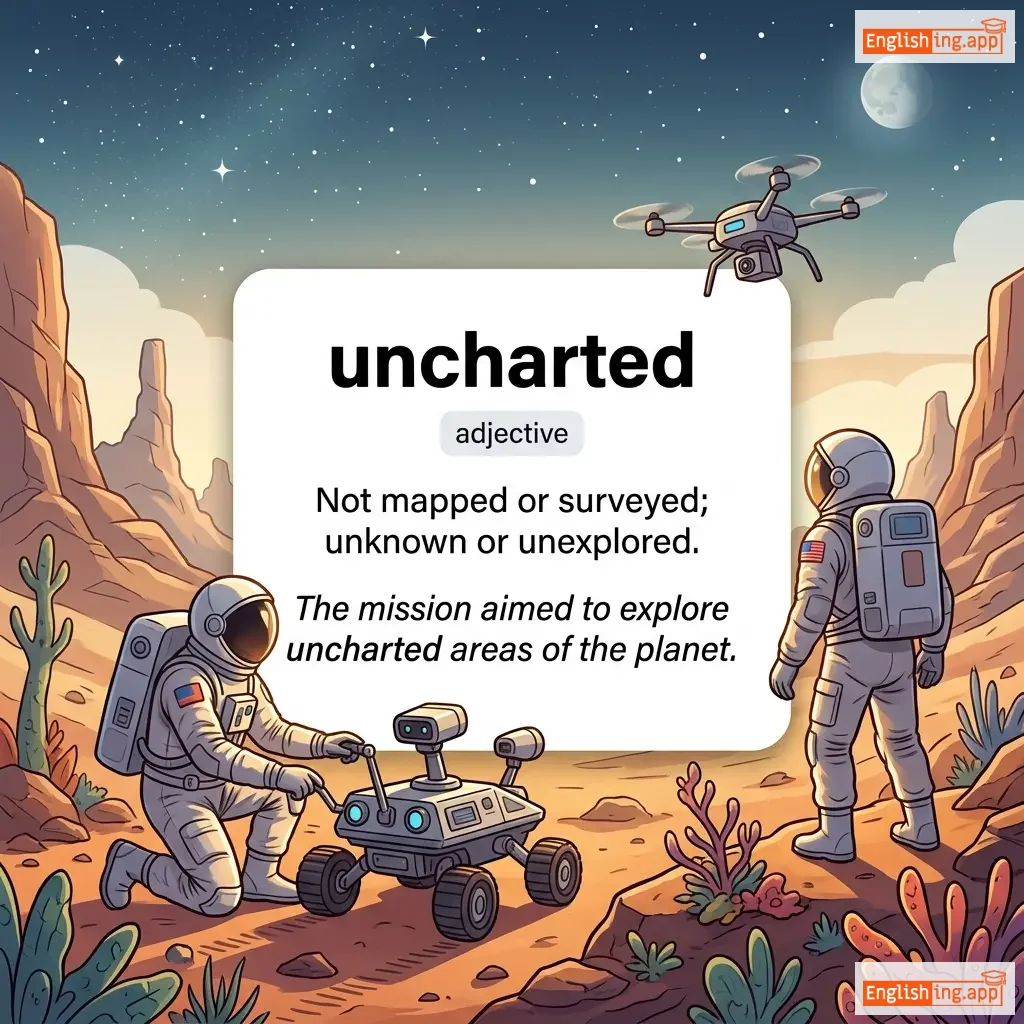
uncharted definition card — visual illustration of the meaning
adjective
ʌnˈtʃɑːtɪd
अनन्य (annya)

Not mapped or surveyed; unknown or unexplored.

"The mission aimed to explore uncharted areas of the planet."

"मिशन ने ग्रह के अनचाहे हिस्सों की खोज करने का लक्ष्य रखा था।" (D mission ne grah ke anchahe hisso ki khoj karne ka lakshya rakha tha.)
adjective
/ʌnˈtʃeɪndʒɪŋ/
अपरिवर्तनीय (aparivartaniy)

remaining the same over time; not changing

"Her love for her family was unchanging throughout the years."

"अपने परिवार के प्रति उसका प्यार वर्षों में अपरिवर्तनीय रहा।" (apne parivar ke prati uska pyar varshon mein aparivartaniy raha)
adjective
/ʌnˈtʃeɪndʒəbəl/
अपरिवर्तनीय; स्थिर; (aporibartaniy; sthir;)

not able to be changed or altered; fixed and permanent

"The laws of physics are unchangeable principles that govern the universe."

"भौतिकी के नियम अपरिवर्तनीय सिद्धांत हैं जो ब्रह्मांड को नियंत्रित करते हैं।" (bhoutiki ke niyam aparivartaniy siddhant hain jo brahmand ko niyantrit karte hain.)
adjective
/ʌnˈtʃælɪndʒd/
अप्रतिस्पर्धित; बिना विरोध के स्वीकार किया गया; बिना प्रतिद्वंद्वी के (apratispardhit; bina virodh ke sveekar kiya gaya; bina pratidvandvi ke)

not disputed or questioned; accepted without opposition; having no rival

"He remained the unchallenged champion for five years."

"वह पाँच वर्षों तक अचल चैंपियन बने रहे।" (vah paanch varshon tak achal champion bane rahe.)
noun
/ʌnˈsɜːtənti/
अनिश्चितता (anishchitata)

the state of being unsure or not knowing what will happen

"Economic uncertainty affects business investments."

"आर्थिक अनिश्चितता व्यापार निवेश को प्रभावित करती है।" (Aarthik anishchitata vyapaar nivesh ko prabhavit karti hai.)
adverb
/ʌnˈsɜːrtənli/
अनिश्चित रूप से (anishchit roop se)

in a way that shows doubt or lack of certainty

"She glanced uncertainly at the complicated instructions."

"उसने जटिल निर्देशों की ओर अनिश्चित रूप से देखा।" (Usne jatil nirdeshon ki or anishchit roop se dekha.)
adjective
/ʌnˈsɜːtən/
अनिश्चित (anishchit)

not sure or confident about something; not clearly known or decided

"She felt uncertain about her future after graduation."

"ग्रेजुएशन के बाद उसे अपने भविष्य के बारे में अनिश्चित महसूस हुआ।" (Graduation ke baad use apne bhavishya ke baare mein anishchit mehsoos hua.)
adjective
/ˌʌnsɛrəˈmoʊniəs/
अनौपचारिक/रूखा (anaupcharik/rukha)

Done without formality or courtesy; abrupt or rude.

"He made an unceremonious exit from the party."

"उसने पार्टी से अनौपचारिक तरीके से बाहर निकलने का फैसला किया।" (Usne party se anaupcharik tareeke se baahar nikalne ka faisla kiya.)
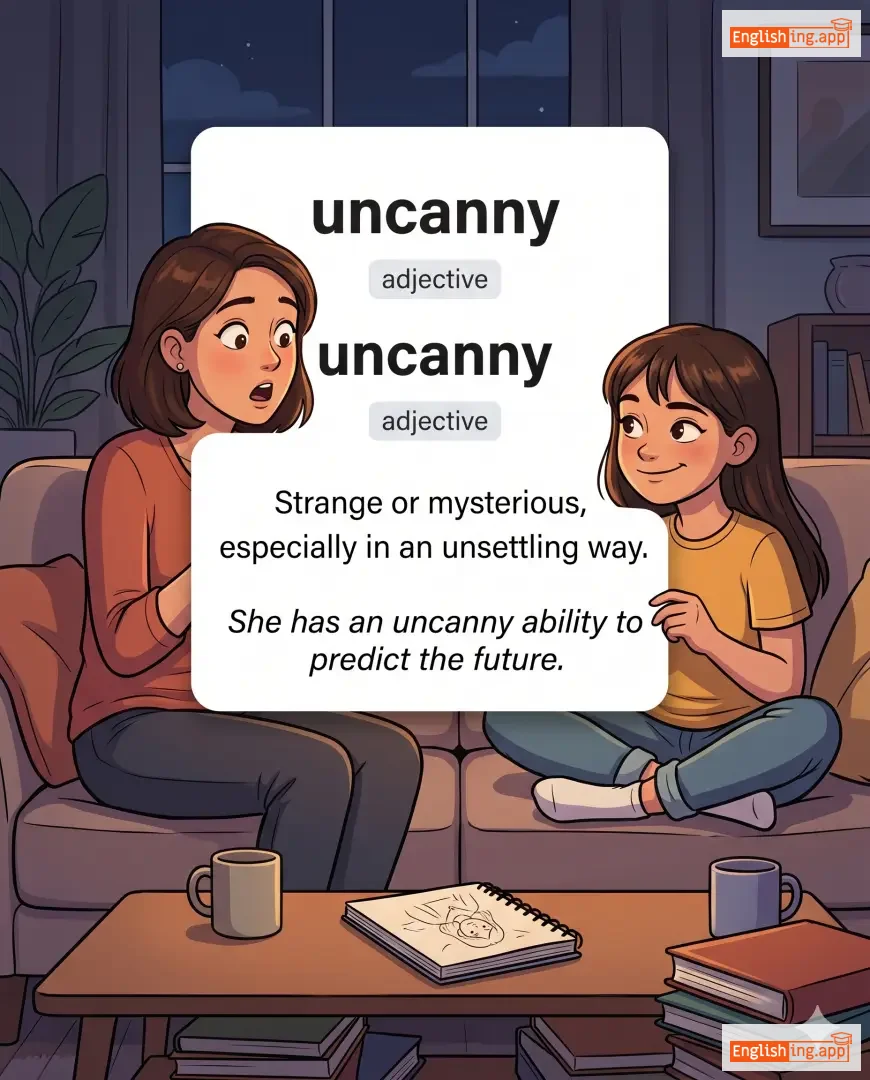
uncanny definition card — visual illustration of the meaning
adjective
/ʌnˈkæni/
अजीब (ajeeb)

Strange or mysterious, especially in an unsettling way.

"She has an uncanny ability to predict the future."

"उसके पास भविष्यवाणी करने की एक अजीब क्षमता है।" (uske paas bhavishyavani karne ki ek ajeeb kshamata hai.)
adjective
/ʌnˈbraɪdld/
बेकाबू (bekabu)

Uncontrolled and unrestrained.

"The protesters showed unbridled enthusiasm for change."

"प्रदर्शनकारियों ने बदलाव के लिए बेकाबू उत्साह दिखाया।" (Pradarshankariyon ne badlav ke liye bekabu utsah dikhaya.)
adjective
/ʌnˈbreɪkəbəl/
जो टूटा या क्षतिग्रस्त नहीं हो सकता; बहुत मजबूत और टिकाऊ (jo toota ya kṣatigrast nahin ho sakta; bahut majboot aur tikao)

not able to be broken or damaged; very strong and durable

"Their friendship formed an unbreakable bond."

"उनकी दोस्ती ने एक अडिग बंधन बनाया था।" (unki dosti ne ek adig bandhan banaya tha.)
adjective
/ʌnˈblʌʃɪŋ/
निर्लज्ज; बेशर्म (nirlajj; besharm)

showing no shame or embarrassment; boldly shameless

"He told the unblushing lie without any hesitation."

"उसने बिना किसी झिझक के निर्लज्ज झूठ बोला।" (Usne bina kisi jhijhak ke nirlojj jhooth bola.)
adjective
/ʌnˈbaɪəst/
निरपक्ष (nirapaks)

Not showing prejudice; impartial and fair.

"The report gave an unbiased view of the situation."

"रिपोर्ट ने स्थिति का एक निरपक्ष दृष्टिकोण दिया।" (report ne sthiti ka ek nirapaks drishtikon diya.)
adjective
/ˌʌnbɪˈliːvɪŋ/
अविश्वासी (avishwasi)

Not willing or able to believe; skeptical or doubtful

"She gave him an unbelieving look when he claimed to have met a celebrity."

"उसने उसे एक अविश्वासी नजर दी जब उसने दावा किया कि उसने किसी सेलिब्रिटी से मुलाकात की।" (Usne use ek avishwasi nazar di jab usne daava kiya ki usne kisi celebrity se mulaqat ki.)
adjective
/ˌʌnbɪˈliːvəbəl/
अविश्वसनीय (avishvasniya)

impossible to believe; extremely surprising or remarkable

"The magician's performance was absolutely unbelievable."

"जादूगर का प्रदर्शन बिल्कुल अविश्वसनीय था।" (jadugar ka pradarshan bilkul avishvasniya tha.)
noun
/ˌʌnbɪˈliːf/
अविश्वास (avishwas)

A lack of belief, especially in religious faith.

"His heart was full of doubt and unbelief."

"उसका दिल संदेह और अविश्वास से भरा हुआ था।" (uska dil sandeh aur avishwas se bhara hua tha.)
adjective
/ˌʌnbɪˈkʌmɪŋ/
अयोग्य (ayogya)

Not proper or appropriate for a person; unsuitable.

"His rude behavior was unbecoming of a leader."

"उसका अशिष्ट व्यवहार एक नेता के लिए अयोग्य था।" (uska ashisht vyavhaar ek neta ke liye ayogya tha.)
adjective
/ʌnˈbiːtən/
अपराजित; न हारा हुआ; (aparajit; na hara hua;)

not defeated; having never lost; undefeated

"The team remains unbeaten this season."

"टीम इस सीज़न में अपराजित बनी हुई है।" (Teem is season mein aparajit bani hui hai.)
adjective
/ʌnˈbeərəbl/
असहनीय (asahniya)

Too difficult or unpleasant to endure.

"The heat was unbearable in the afternoon."

"दोपहर में गर्मी असहनीय थी।" (dopahar mein garmi asahniya thi.)
adjective
/ʌnˈbæləns/
असंतुलित; अस्थिर; (asntulit; asthir)

not balanced; lacking stability or equilibrium; mentally unstable

"The unbalanced table kept wobbling."

"असंतुलित टेबल हिलती रही।" (asntulit tebil hilti rahi.)
adjective
/ˌʌnəˈweər/
अविचार; अनजान; न जानने वाला (avichar; anjan; na jaanne waala)

not knowing or realizing; having no knowledge of something

"She was completely unaware of the danger."

"वह खतरे से पूरी तरह अनजान थी।" (vah khatre se puri tarah anjaan thi.)
adjective
/ˌʌnəˈvɔɪdəbl/
अपरिहार्य (apariharya)

Impossible to avoid or prevent.

"Delays were unavoidable due to heavy rain."

"भारी बारिश के कारण देरी अपरिहार्य थी।" (bhari barish ke karan deri apariharya thi.)
adjective
/ˌʌnəˈveɪləbəl/
उपलब्ध नहीं (uplabdh nahin)

Not able to be obtained, reached, or used; not present or accessible.

"The manager was unavailable to take calls during the meeting."

"मैनेजर मीटिंग के दौरान कॉल्स लेने के लिए उपलब्ध नहीं थे।" (Manager meeting ke dauran calls lene ke liye uplabdh nahin the.)
noun
/ˌʌnəˌveɪləˈbɪləti/
अनुपलब्धता (anuplabdhata)

The state of being not available or not accessible.

"The unavailability of the manager caused a delay in the project."

"प्रबंधक की अनुपलब्धता के कारण परियोजना में देरी हुई।" (prabandhak ki anuplabdhata ke karan pariyojna me deri hui)
adjective
/ˌʌnəˈteɪnəbl/
अप्राप्य (aprapya)

impossible to achieve, reach, or accomplish

"For many, becoming a professional athlete remains an unattainable dream."

"कई लोगों के लिए, पेशेवर एथलीट बनना एक अप्राप्य सपना है।" (kai logon ke liye, peshevar athlete banna ek aprapya sapna hai.)
adjective
/ˌʌnəˈʃʊəd/
अविश्वासपूर्ण (avishwaspoorn)

Lacking confidence or certainty.

"She gave an unassured answer during the interview."

"उसने साक्षात्कार में एक अविश्वासपूर्ण उत्तर दिया।" (Usne sakshatkar mein ek avishwaspoorn uttar diya.)
adjective
/ˌʌnəˈsjuːmɪŋ/
नम्र (namra)

Not pretentious or arrogant; modest.

"Despite his success, he remained unassuming and humble."

"उसकी सफलता के बावजूद, वह नम्र और विनम्र रहे।" (Uski safalta ke bawjood, vah namra aur vinamra rahe.)
adjective
/ˌʌnəˈsweɪdʒd/
अशांत (ashant)

Not made less intense or relieved; unrelieved.

"His grief remained unassuaged despite the passage of time."

"समय के बावजूद उसका दुख अशांत रहा।" (Samay ke baavjood uska dukh ashant raha.)
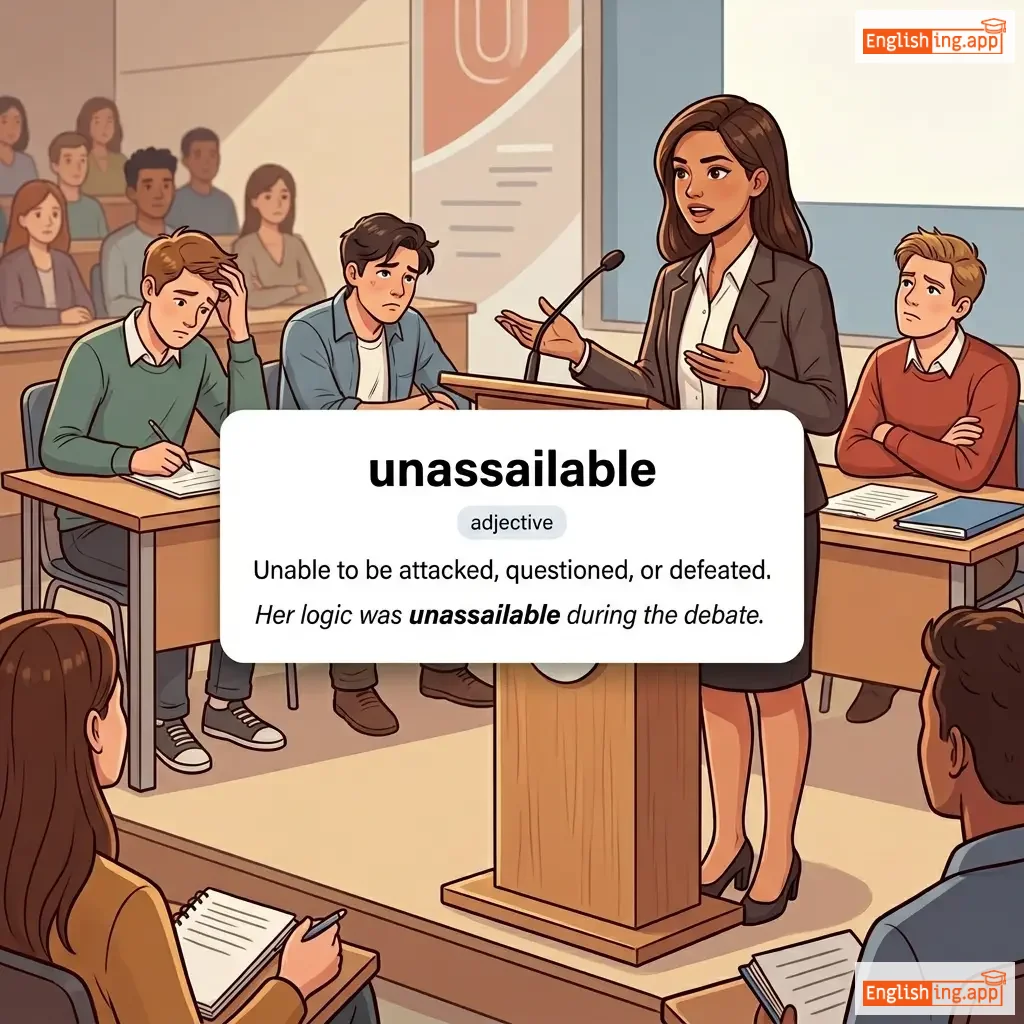
unassailable definition card — visual illustration of the meaning
adjective
/ˌʌnəˈseɪləbl/
अडिग (adig)

Unable to be attacked, questioned, or defeated.

"Her logic was unassailable during the debate."

"उसकी तर्कशक्ति बहस के दौरान अनअसेलेबल थी।" (Uski tarkshakti behas ke dauran anaselebl thi.)
adjective
/ʌnˈɑːrmd/
असशस्त्र (asashastr)

Not equipped with or carrying weapons

"The police found the suspect unarmed during the search."

"पुलिस ने तलाशी के दौरान संदिग्ध को असशस्त्र पाया।" (Police ne talashi ke dauran sandigdh ko asashastr paaya.)
verb
/ʌnˈɑːrm/
अशस्त्र करना (ashastr karna)

to remove weapons from someone or to deprive of means of attack or defense

"The soldiers were ordered to unarm the prisoners."

"सैनिकों को कैदियों को अशस्त्र करने का आदेश दिया गया।" (sainikon ko kaidiyon ko ashastr karne ka aadesh diya gaya)
noun
/ˈtʌrɪt/
किलें या किलों पर स्थित छोटा टावर (kilen ya kilon par sthit chhota towar)

A small tower on top of a larger tower or building, often used in castles or fortifications.

"The castle was guarded by soldiers stationed in the turret."

"किले की रक्षा टुरेट में तैनात सैनिकों द्वारा की जाती थी।" (Kile ki raksha turret mein tainat sainikon dvara ki jati thi.)
noun
/ˈtjuːtərʃɪp/
शिक्षकत्व (shikshaktva)

The office or position of a tutor; guidance or instruction given by a tutor.

"He thrived under the tutorship of his mentor."

"वह अपने मेंटर के शिक्षकत्व में फलफूल रहा था।" (Vah apne mentor ke shikshaktva mein phalphool raha tha.)
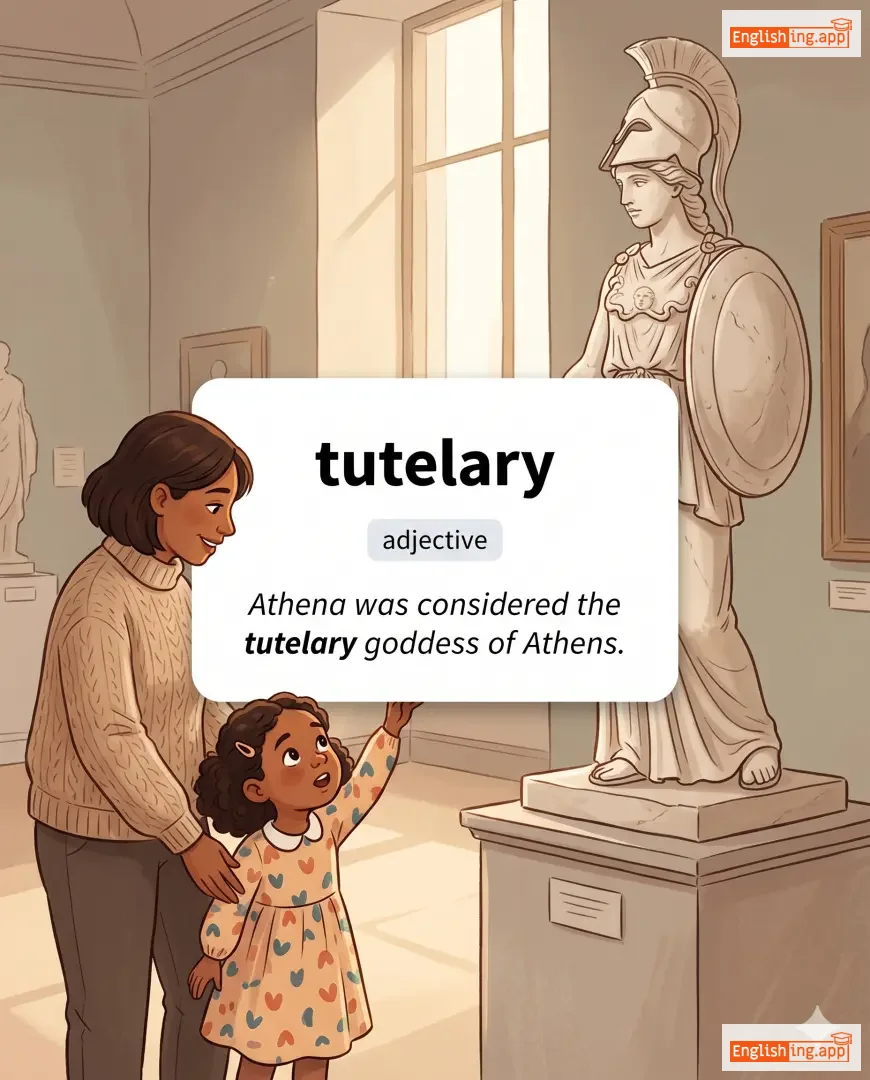
tutelary definition card — visual illustration of the meaning
adjective
/ˈtjuːtɪləri/
पालक (paalak)

Relating to or serving as a guardian or protector, often used for deities or spirits.

"Athena was considered the tutelary goddess of Athens."

"एथेना को एथेंस की पालक देवी माना जाता था।" (Athena ko Athens ki paalak devi mana jata tha.)
adjective
/ˈtjuːtɪlɑːr/
पालक (paalak)

Serving as a guardian or protector.

"The tutelar spirit of the forest was believed to protect travelers."

"वन का ट्यूटेलर आत्मा यात्रियों की रक्षा करने के लिए माना जाता था।" (Van ka tutelar atma yatrion ki raksha karne ke liye maana jaata tha.)
noun
/ˈtjuːtɪlɪdʒ/
शिक्षण (shikshan)

The act of guarding, protecting, or guiding; instruction or teaching.

"She studied painting under the tutelage of a famous artist."

"वह एक प्रसिद्ध कलाकार के मार्गदर्शन में चित्रकला का अध्ययन कर रही थी।" (Wah ek prasiddh kalakar ke margdarshan mein chitrakala ka adhyayan kar rahi thi.)
noun
/ˈtɜːrtl/
कछुआ (kachhua)

A slow-moving reptile with a hard shell that lives in water or on land

"The turtle slowly crossed the sandy beach."

"कछुआ धीरे-धीरे रेत वाले समुद्र तट को पार कर गया।" (kachhua dhire-dhire ret wale samudra tat ko paar kar gaya)
noun
/ˈtɜːnˌəʊvə/
टर्नओवर (turnover)

the amount of business conducted during a particular period, or the rate at which employees leave a company

"The company reported a high turnover in its sales department."

"कंपनी ने अपनी बिक्री विभाग में एक उच्च टर्नओवर रिपोर्ट किया।" (Kampani ne apni bikri vibhag mein ek uchch turnover report kiya.)
adjective
/ˈtɜːrnkiː/
पूर्णतया तैयार (poornataya tayar)

ready for immediate use; a complete product or solution

"The company provides turnkey solutions for small businesses."

"कंपनी छोटे व्यवसायों के लिए टर्नकी समाधान प्रदान करती है।" (Company chhote vyavsayon ke liye turnkey samadhan pradan karti hai.)
noun
/ˈtɜːr.naʊt/
हाज़िरी (hazeeri)

the number of people who attend or participate in an event or activity

"The turnout at the rally was impressive, with thousands showing up."

"रैली में हाज़िरी प्रभावशाली थी, हजारों लोग पहुंचे थे।" (Raily mein hazeeri prabhavshali thi, hazaron log pahuche the.)