词汇表

英语词汇词典 | 单词含义、定义和示例

noun
/ˈtɒpˌsɔɪl/
表土 (biaotu)

the top layer of soil, which is rich in organic matter and nutrients

"Farmers rely on healthy topsoil for good crop yields."

"农民依赖健康的表土来获得丰收。" (Nóngmín yīlài jiànkāng de biǎotǔ lái huòqǔ fēngshōu.)
adjective
/ˌtɒpsi ˈtɜːvi/
混乱的 (hùnluàn de)

in a state of confusion, disorder, or upside down

"The sudden announcement left the office in a topsy-turvy state."

"突如其来的公告让办公室陷入了完全混乱的状态。" (Tū rú qí lái de gōnggào ràng bàngōngshì xiànrùle wánquán hùnluàn de zhuàngtài.)
noun
/tɔːrtʃ/
手电筒 / 火炬 (tuoqi)

a portable electric lamp powered by batteries; a flaming stick used for light

"Use the torch to find your way in the dark."

"在黑暗中用手电筒来照路。" (zaiheianzhongyongshoudiantonglaizhaolu)
noun, verb
/ˈtɔːr.ment/
折磨 (zhémó)

severe physical or mental suffering; to cause extreme suffering

"The prisoner was in constant torment."

"囚犯正在承受着持续的痛苦。" (Qiúfàn zhèngzài chéngshòu zhe chíxù de tòngkǔ.)
noun
/tɔːrˈneɪdoʊ/
龙卷风 (long juan feng)

a rapidly rotating column of air in contact with the ground and clouds, often destructive

"The tornado destroyed several houses in the village."

"龙卷风摧毁了村子里的几座房子" (Long juan feng cui huai le cun zi li de ji zuo fang zi)
noun/verb
/tɔːrˈpiːdoʊ/
鱼雷 (yulei)

A self-propelled underwater missile; to attack or destroy something suddenly and forcefully.

"The submarine launched a torpedo at the enemy ship."

"潜艇向敌舰发射了鱼雷。" (Qian ting xiang di jian fa she le yulei.)
adjective
/ˈtɔːrpɪd/
迟缓 (torpid)

Mentally or physically inactive; sluggish or lethargic.

"After the long hike, he felt torpid and unmotivated."
"长时间徒步后,他感到迟缓且缺乏动力。" (Chang shijian tubu hou, ta gandao chi huan qie quefa dongli.)
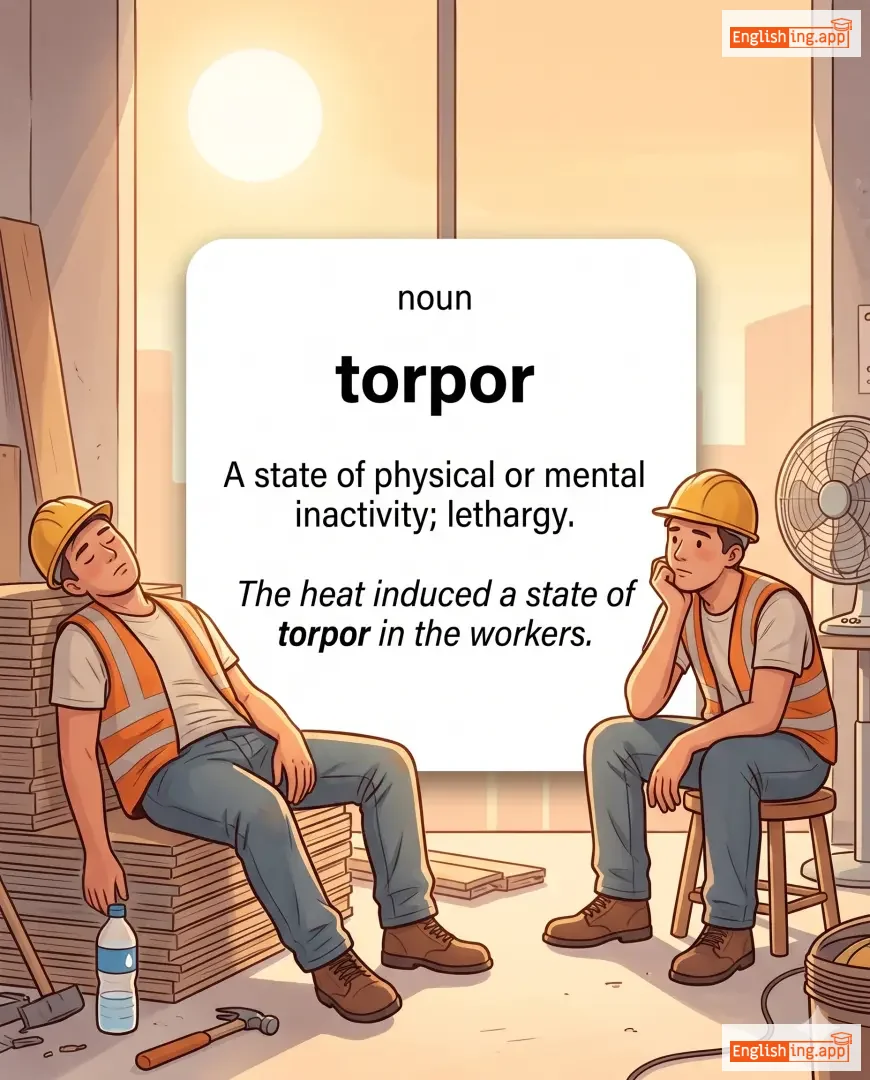
torpor definition card — visual illustration of the meaning
noun
/ˈtɔːrpər/
昏睡 (torpor)

A state of physical or mental inactivity; lethargy.

"The heat induced a state of torpor in the workers."

"高温使工人们陷入了昏睡状态。" (Gaowen shi gongrenmen xianru le hunshui zhuangtai.)
torque definition card — visual illustration of the meaning
noun
/tɔːrk/

A twisting force that causes rotation.

"The mechanic measured the torque of the engine."

noun
/ˈtɔːrənt/
洪流 (hongliu)

A strong and fast-moving stream of water; a sudden, violent outpouring of something.

"A torrent of rain flooded the streets."

"一阵暴雨的洪流淹没了街道。" (yī zhèn bàoyǔ de hóngliú yānmò le jiēdào.)
adjective
/təˈrɛnʃəl/
暴雨 (baoyu)

Relating to or resembling a torrent; very heavy and fast flowing.

"The hikers were caught in torrential rain."

"徒步旅行者被暴雨困住。" (Tubule lüxingzhe bei baoyu kunzhu.)
adjective
/ˈtɒrɪd/
非常炎热和干燥;充满强烈情感或激情 (fēicháng yánrè hé gānzào; chōngmǎn qiángliè qínggǎn huò jīqíng)

Very hot and dry; full of strong emotions or passion.

"The desert heat was torrid during the day."

"沙漠的热量白天非常炎热。" (shāmò de rèliàng báitiān fēicháng yánrè.)
noun
/ˈtɔːrsoʊ/
躯干 (qugan)

The trunk of the human body, excluding the head and limbs.

"The artist painted the torso of the model in great detail."

"艺术家详细地画了模特的躯干。" (Yishu jia xiangxi de hua le mote de qugan.)
noun
/tɔːrˈtiːə/
玉米饼 (yumi bing)

A thin round flatbread made from corn or wheat, common in Mexican cuisine.

"She wrapped the vegetables in a warm tortilla."

"她把蔬菜包裹在一个温暖的玉米饼中。" (Ta ba shucai baoguo zai yige wennuan de yumi bing zhong.)
adjective
/ˈtɔːrʃəs/
非法行为 (feifa xingwei)

Relating to or involving a wrongful act leading to legal liability.

"The company was found guilty of tortious interference with contracts."

"该公司因非法干预合同而被判有罪。" (Gai gongsi yin feifa ganyu hetong er bei pan youzui.)
noun
/ˈtɔːr.təs/
乌龟 (wugui)

A slow-moving land reptile with a hard shell.

"The tortoise slowly crossed the garden."

"乌龟慢慢地穿过花园。" (Wugui manman de chuanguo huayuan.)
adjective
/ˈtɔːrtʃuəs/
曲折,复杂 (quzhe, fuzā)

Full of twists and turns; excessively complex or complicated.

"The tortuous mountain road made driving very difficult."

"曲折的山路让驾驶变得非常困难。" (Qūzhé de shānlù ràng jiàshǐ biàn dé fēicháng kùnnán.)
noun
/ˈtɔːtʃər/
折磨 (zhémó)

the action or practice of inflicting severe pain on someone as a punishment or to force them to do something

"He was subjected to torture during the interrogation."

"他在审问中遭受了折磨。" (Tā zài shěnwèn zhōng zāoshòule zhémó.)
adjective
/ˈtɔːrtʃərəs/
痛苦的 (tòngkǔ de)

Extremely painful or causing great suffering; relating to or involving torture.

"The journey through the desert was long and torturous."

"穿越沙漠的旅程漫长且痛苦。" (Chuānyuè shāmò de lǚchéng màncháng qiě tòngkǔ.)
verb
/tɔs/
轻轻投掷 (qing qing tou zhi)

To throw something lightly or casually; to move or turn suddenly.

"He tossed the keys onto the table."

"他把钥匙扔到了桌子上。" (Ta ba yaoshi reng dao le zhuozi shang.)
adjective, noun, verb
/ˈtoʊ.təl/
总计 (zongji)

the whole amount; complete

"The total cost was too high."

"总成本太高了。" (Zong chengben tai gao le.)
adverb
/ˈtoʊtəli/
完全地 (wánquán de)

completely or in an absolute way

"She was totally shocked by the news."

"她听到消息时完全震惊了。" (Tā tīng dào xiāoxi shí wánquán zhènjīngle.)
noun
/ˈtoʊtəm/
神圣象征 (shensheng xiangzheng)

A natural object, animal, or symbol that is revered as a spiritual emblem by a group or tribe.

"The eagle is considered a sacred totem in many cultures."

"老鹰在许多文化中被视为神圣的图腾。" (Laoying zai xu duo wenhua zhong bei shi wei shensheng de tuteng.)
noun
/treɪl/
小道 (xiaodao)

a path or track left by something that has passed

"The hikers followed the trail through the forest."

"远足者沿着森林中的小道走。" (Yuanzuzhe yanzhe senlin zhong de xiaodao zou.)
trade definition card — visual illustration of the meaning
💱

trade

noun, verb
/treɪd/

The action of buying, selling, or exchanging goods and services.

"The company trades in electronic goods worldwide."

trade facilitation definition card — visual illustration of the meaning
noun
/treɪd fəˌsɪl.ɪˈteɪ.ʃən/
贸易便利化 (maoyi bianlihua)

The simplification, modernization and harmonization of export and import processes.

"Trade facilitation boosts economic growth."

"贸易便利化促进经济增长。" (Maoyi bianlilhua cujin jingji zengzhang.)
trade-off definition card — visual illustration of the meaning
noun
ˈtreɪd.ɒf
权衡 (quánhéng)

A situation where accepting one advantage means giving up another benefit.

"There is always a trade-off between price and quality."

"价格与质量之间总是有一个权衡。" (jiàgé yǔ zhìliàng zhījiān zǒng shì yǒu yīgè quánhéng.)
noun
/ˈtreɪdmɑːrk/
商标 (shāngbiāo)

a symbol, word, or words legally registered or established by use as representing a company or product

"The company’s logo is its trademark."

"公司的标志就是它的商标。" (Gōngsī de biāozhì jiùshì tā de shāngbiāo.)
noun
/ˈtreɪ.dər/
交易员 (jiaoyi yuan)

a person who buys and sells goods or financial securities for profit

"The trader made a good profit from selling imported goods."

"交易员通过销售进口商品获得了不错的利润。" (Jiaoyi yuan tongguo xiaoshou jimai shangpin huodele bushi de lirun)
noun
/ˈtreɪdɪŋ/
交易 (jiaoyi)

the act or business of buying and selling goods or services

"She made a fortune through online trading."
"她通过在线交易赚取了财富。" (Ta tongguo zaixian jiaoyi zhuanqule cai fu.)
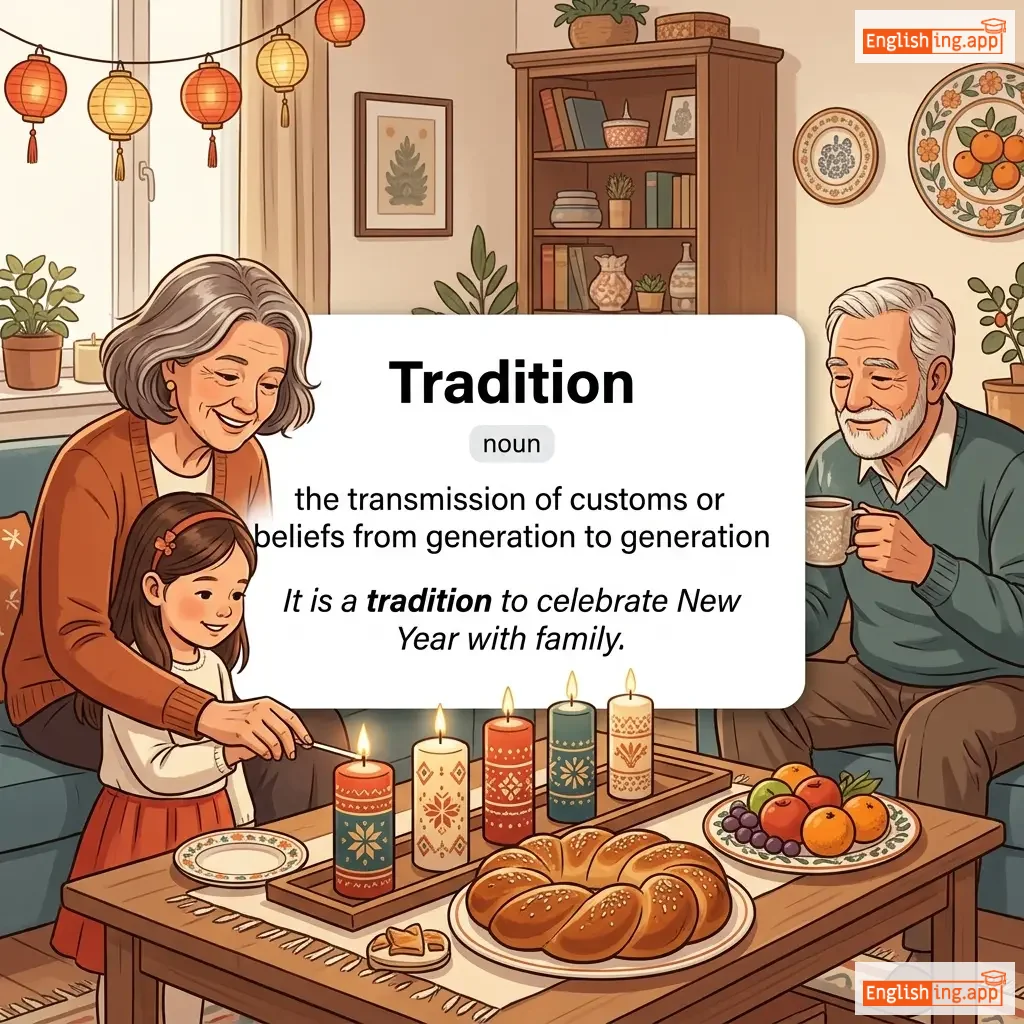
Tradition definition card — visual illustration of the meaning
noun
/trəˈdɪʃən/
传统 (chuántǒng)

the transmission of customs or beliefs from generation to generation

"It is a tradition to celebrate New Year with family."

"与家人一起庆祝新年是一种传统。" (Yǔ jiārén yīqǐ qìngzhù xīnnián shì yī zhǒng chuántǒng.)
adjective
/trəˈdɪʃənəl/
传统 (chuántǒng)

existing in or as part of a tradition

"The traditional dance of this village is performed every year."
"这个村庄的传统舞蹈每年都会表演。" (Zhège cūnzhuāng de chuántǒng wǔdǎo měinián dūhuì biǎoyǎn.)
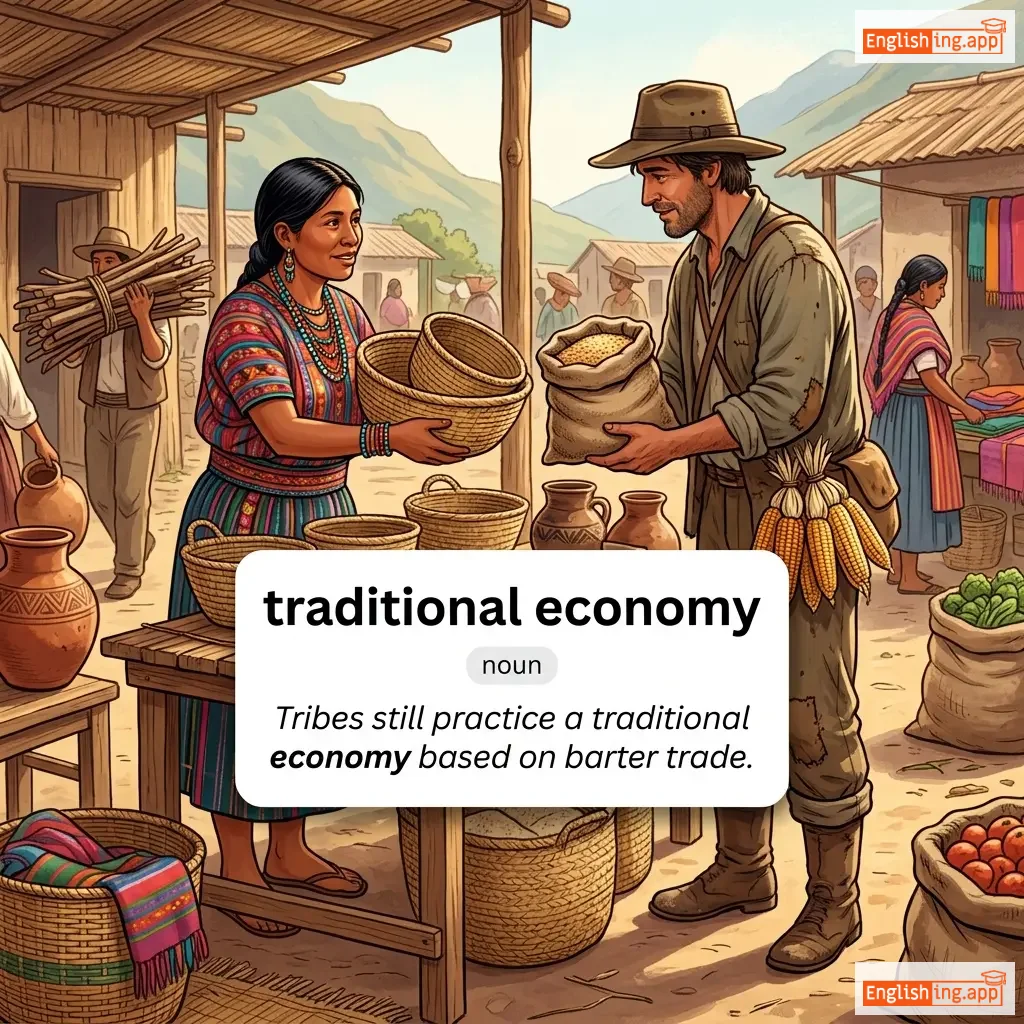
traditional economy definition card — visual illustration of the meaning
noun
/trəˈdɪʃ.ən.əl ɪˈkɒn.ə.mi/
传统经济 (chuántǒng jīngjì)

An economic system based on customs and traditions, often involving barter trade.

"Tribes still practice a traditional economy based on barter trade."

"部落仍然实践着基于物物交换的传统经济。" (Bùluò réngrán shíjiànzhe jīyú wù wù jiāohuàn de chuántǒng jīngjì.)
adverb
/trəˈdɪʃənəli/
传统上 (chuántǒng shàng)

according to custom or long-established practice

"Bangladesh is traditionally known for its hospitality."

"孟加拉国传统上以其热情好客而闻名。" (Mèngjiālāguó chuántǒng shàng yǐ qí rèqíng hǎokè ér wénmíng.)
verb
/trəˈdjuːs/
诽谤 (fěibàng)

To speak badly of someone or tell lies to damage their reputation.

"He was furious when he found out that his rivals had traduced him."
"他发现他的对手诽谤他时非常生气。" (Tā fāxiàn tā de duìshǒu fěibàng tā shí fēicháng shēngqì.)
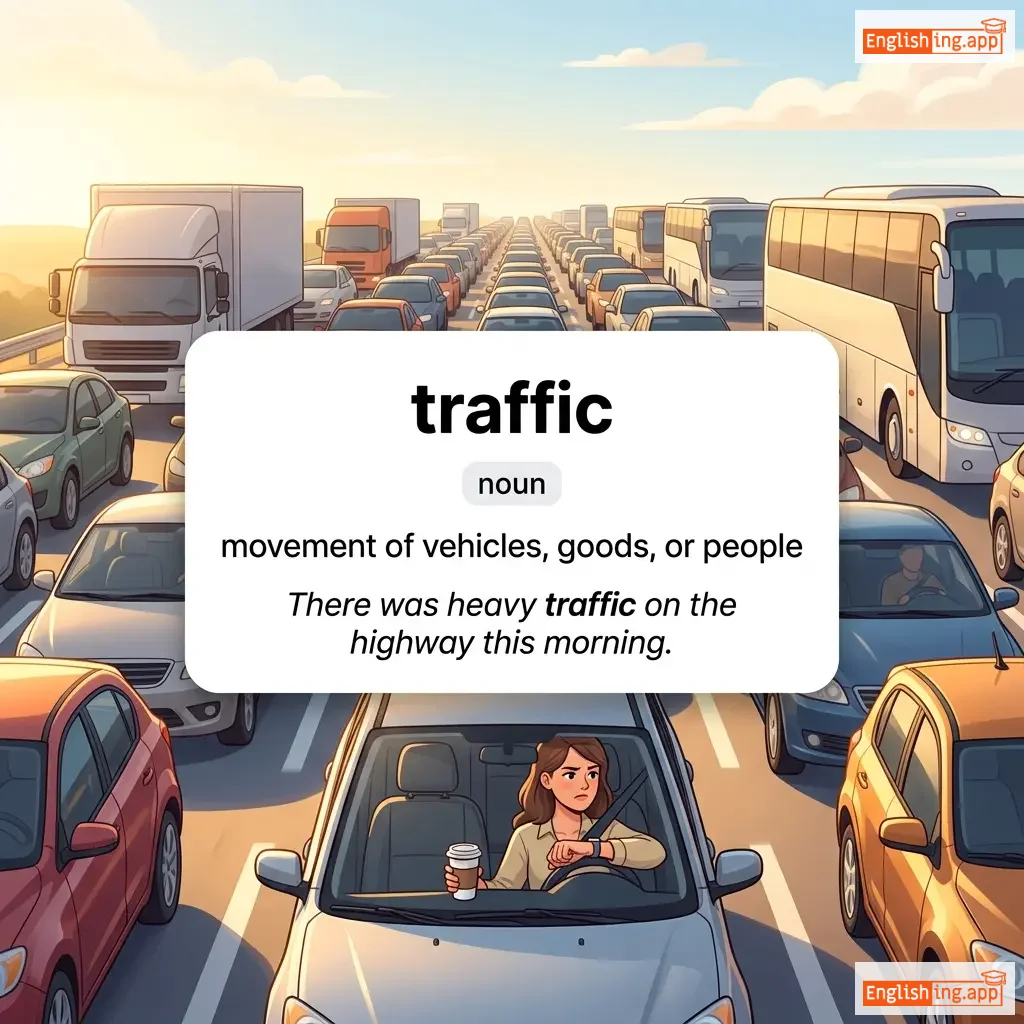
traffic definition card — visual illustration of the meaning
noun
/ˈtræfɪk/
交通 (jiaotong)

movement of vehicles, goods, or people

"There was heavy traffic on the highway this morning."

"今天早上高速公路上交通繁忙。" (Jīntiān zǎoshang gāosù gōnglù shàng jiāotōng fánmáng.)
noun
/ˈtrædʒədi/
悲剧 (bēijù)

an event causing great suffering or distress

"The earthquake was a tragedy for the entire country."

"地震对整个国家来说是一场悲剧。" (Dìzhèn duì zhěnggè guójiā lái shuō shì yī chǎng bēijù.)
adjective
/ˈtrædʒɪk/
悲剧的 (beijude)

causing great sadness or suffering; very unfortunate

"The news of the accident was truly tragic."

"事故的消息真是悲剧的。" (Shigu de xiaoxi zhenshi beijude de.)
noun
/ˈtreɪtər/
叛徒 (pàntú)

A person who betrays their country, friends, or a cause by acting against them.

"The soldier was labeled a traitor for giving secrets to the enemy."

"这名士兵因为向敌人提供机密信息而被贴上了叛徒的标签。" (Zhè míng shìbīng yīnwèi xiàng dírén tígōng jīmì xìnxī ér bèi tiē shàngle pàntú de biāoqiān.)
noun
/træns/
恍惚 (huǎnghū)

a half-conscious state like dreaming, often with loss of awareness of surroundings

"She stared out of the window as if in a trance."

"她盯着窗外,好像处于恍惚状态。" (Tā dīngzhe chuāng wài, hǎoxiàng chǔyú huǎnghū zhuàngtài.)
verb
/ˈtræmpəl/

to tread heavily on something and cause damage or injury

"The crowd trampled the flowers in the park."

verb, noun
/træmp/
流浪者 / 沉重地走 (liulangzhe / chenzhong de zou)

to walk heavily or noisily; a person who travels from place to place on foot, often homeless

"They tramped through the forest in heavy boots."

"他们穿着厚重的靴子在森林中走。" (Tamen chuanzhuo houzhong de xuezi zai senlin zhong zou.)
noun, verb
/ˈtræməl/
限制 (xianzhi)

A restriction or impediment to freedom of action; to restrict.

"The strict rules trammel the creativity of the students."

"严格的规则限制了学生的创造力。" (Yángé de guīzé xiànzhìle xuéshēng de chuàngzàolì.)
noun
/træm kɑːr/
有轨电车 (you gui dian che)

An electric vehicle that runs on rails along the street

"The tram car stopped at every station in the city center."

"有轨电车在市中心的每个车站停靠。" (You gui dian che zai shi zhongxin de mei ge chezhan tingkao.)
trajectory definition card — visual illustration of the meaning
noun
/trəˈdʒɛktəri/
轨迹 (guiji)

The path followed by a moving object under the influence of forces like gravity.

"The scientist calculated the rocket's trajectory."

"科学家计算了火箭的轨迹。" (Kēxuéjiā jìsuànle huǒjiàn de guiji.)
noun
/ˈtreɪnər/
教练 (jiao lian)

a person who teaches skills or gives training

"The fitness trainer helped me improve my posture."

"健身教练帮助我改善了姿势。" (Jianshen jiaolian bangzhu wo gaishan le zishi.)
noun
/ˈtreɪlər/
预告片 / 拖车 (yùgàopiàn / tuōchē)

a preview of a movie or a vehicle used for transporting goods

"The movie trailer was released last week."
"电影预告片上周发布了。" (Diànyǐng yùgàopiàn shàng zhōu fābùle.)
Train definition card — visual illustration of the meaning
noun
/treɪn/
火车 (huǒchē)

a series of connected vehicles that run on tracks and are used for transporting people or goods

"The train departed from the station on time."

"火车准时从车站出发。" (Huǒchē zhǔnshí cóng chēzhàn chūfā.)
noun
/treɪˈniː/
实习生; 学徒 (trainee)

a person undergoing training for a particular job or profession; a novice learner

"The medical trainee worked long hours to gain practical experience."

"医学实习生工作了很长时间,以获得实践经验。" (yīxué shíxíshēng gōngzuò le hěn cháng shíjiān, yǐ huòdé shíjiàn jīngyàn.)
tractable definition card — visual illustration of the meaning
adjective
/ˈtræktəbəl/
容易控制或影响 (rongyi kongzhi huo yingxiang)

easy to control or influence

"The child was surprisingly tractable during the long journey."

"那个孩子在漫长的旅程中出奇的容易控制。" (Nàgè háizi zài màncháng de lǚchéng zhōng chūqí de róngyì kòngzhì.)