वोकैबुलरीज

इंग्लिश वोकैबुलरी डिस्कवर, लर्न और मास्टर करें

noun
/ˈtɒpˌsɔɪl/
ऊपरी मिट्टी (upari mitti)

the top layer of soil, which is rich in organic matter and nutrients

"Farmers rely on healthy topsoil for good crop yields."

"किसान अच्छे फसल उगाने के लिए स्वस्थ ऊपरी मिट्टी पर निर्भर करते हैं।" (Kisan achhe fasal ugane ke liye swasth upari mitti par nirbhar karte hain.)
adjective
/ˌtɒpsi ˈtɜːvi/
अव्यवस्थित (avyavasthit)

in a state of confusion, disorder, or upside down

"The sudden announcement left the office in a topsy-turvy state."

"अचानक घोषणा ने कार्यालय को पूरी तरह से अव्यवस्थित स्थिति में डाल दिया।" (Achanak ghoshna ne karyalaya ko poori tarah se avyavasthit sthiti mein daal diya.)
noun
/tɔːrtʃ/
टॉर्च (torch)

a portable electric lamp powered by batteries; a flaming stick used for light

"Use the torch to find your way in the dark."

"अंधेरे में अपना रास्ता खोजने के लिए टॉर्च का इस्तेमाल करें." (Andhere mein apna raasta khojne ke liye torch ka istemal karein)
noun, verb
/ˈtɔːr.ment/
यातना (yatna)

severe physical or mental suffering; to cause extreme suffering

"The prisoner was in constant torment."

"कैदी निरंतर यातना में था।" (Kaidi nirantar yatna mein tha.)
noun
/tɔːrˈneɪdoʊ/
बवंडर (bavandar)

a rapidly rotating column of air in contact with the ground and clouds, often destructive

"The tornado destroyed several houses in the village."

"बवंडर ने गांव में कई घरों को नष्ट कर दिया" (Bavandar ne gaon mein kai gharon ko nasht kar diya)
noun/verb
/tɔːrˈpiːdoʊ/
टॉरपीडो (torpedo)

A self-propelled underwater missile; to attack or destroy something suddenly and forcefully.

"The submarine launched a torpedo at the enemy ship."

"द सबमरीन ने शत्रु जहाज पर एक टॉरपीडो दागा।" (Da submarin ne shatrul jahaz par ek torpedo daaga.)
adjective
/ˈtɔːrpɪd/
सुस्त (torpid)

Mentally or physically inactive; sluggish or lethargic.

"After the long hike, he felt torpid and unmotivated."

"लंबी सैर के बाद, वह सुस्त और प्रेरणाहीन महसूस कर रहा था।" (Lambi sair ke baad, wah sust aur preranahin mehsoos kar raha tha.)
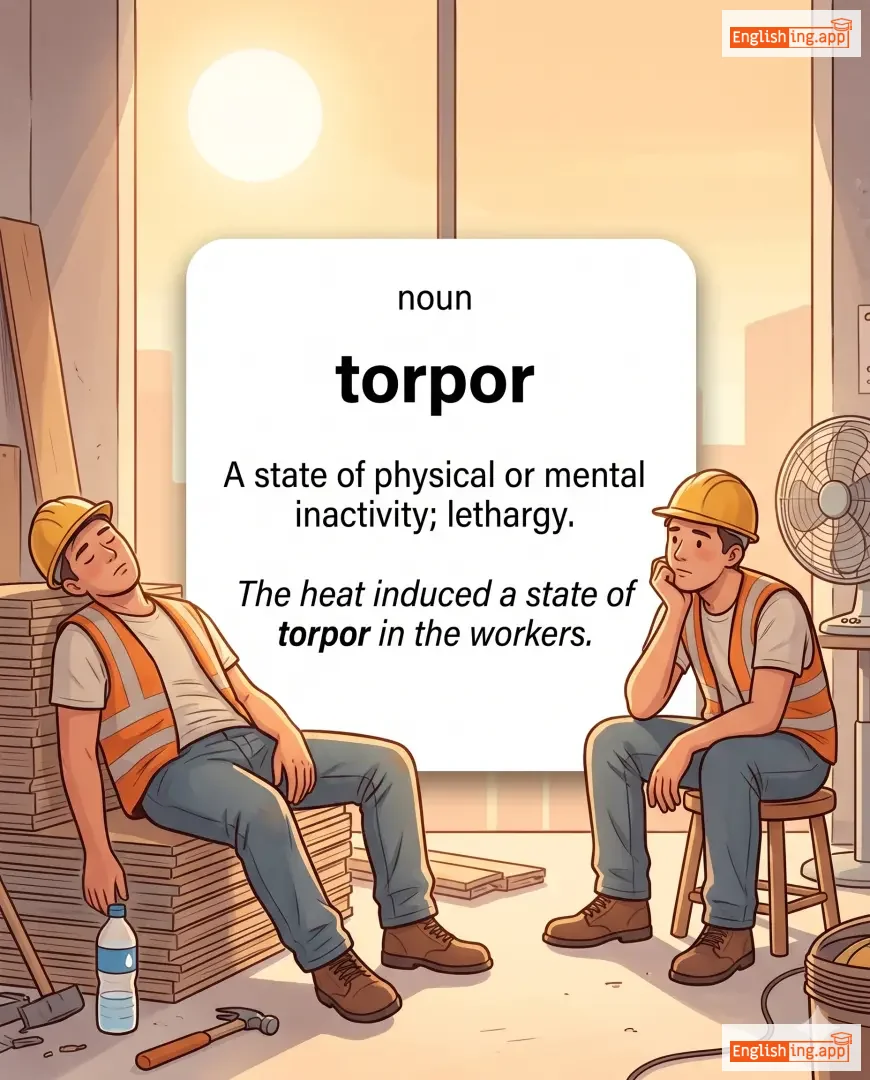
torpor definition card — visual illustration of the meaning
noun
/ˈtɔːrpər/
निःसक्रियता (torpor)

A state of physical or mental inactivity; lethargy.

"The heat induced a state of torpor in the workers."

"गर्मी ने श्रमिकों में निःसक्रियता की स्थिति उत्पन्न कर दी थी।" (Garmi ne shramikon mein nishkriyata ki stithi utpann kar di thi.)
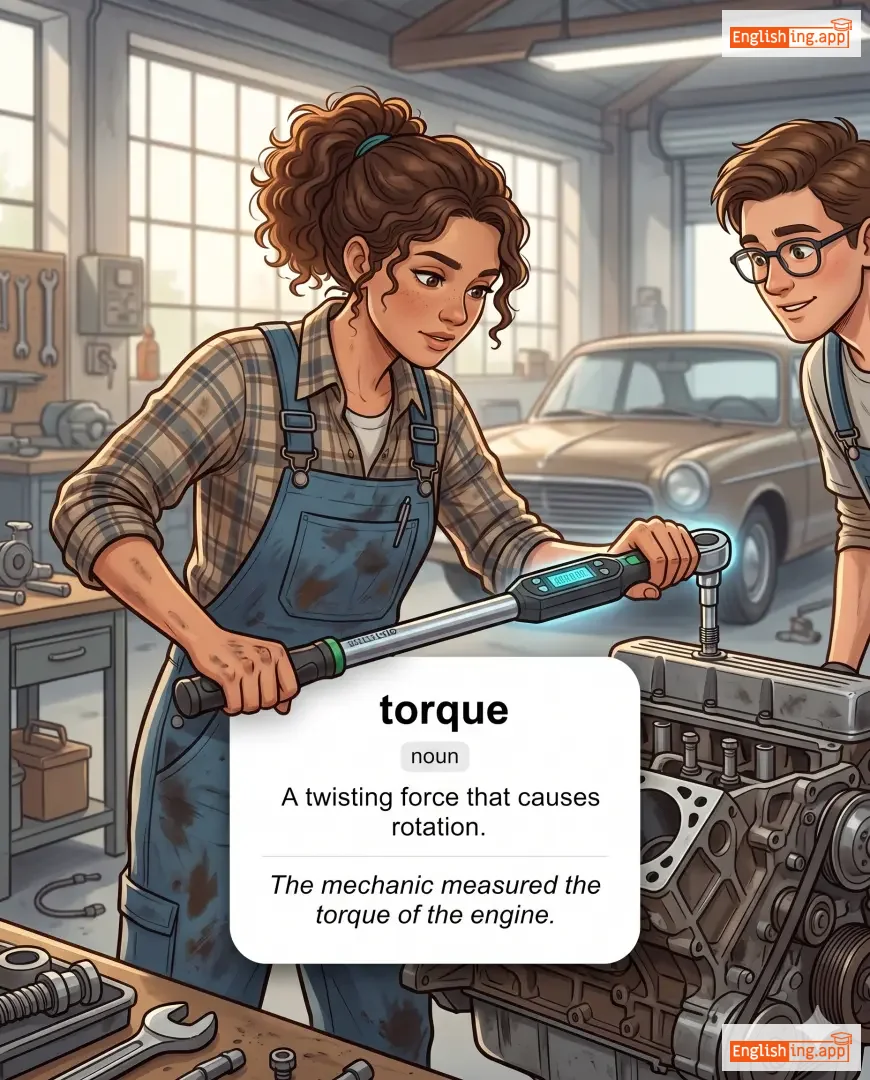
torque definition card — visual illustration of the meaning
noun
/tɔːrk/
घूर्ण बल (tork)

A twisting force that causes rotation.

"The mechanic measured the torque of the engine."

"मैकेनिक ने इंजन के टॉर्क को मापा।" (mekaanikneinjanketorqkomaapa)
noun
/ˈtɔːrənt/
सैलाब (sailab)

A strong and fast-moving stream of water; a sudden, violent outpouring of something.

"A torrent of rain flooded the streets."

"बारिश की एक सैलाब ने सड़कों को बहा दिया।" (baarish ki ek sailab ne sadkon ko baha diya.)
adjective
/təˈrɛnʃəl/
मूसलधार (musaldhaar)

Relating to or resembling a torrent; very heavy and fast flowing.

"The hikers were caught in torrential rain."

"हाइकर मूसलधार बारिश में फंस गए थे।" (Haikar musaldhaar baarish mein fans gaye the.)
adjective
/ˈtɒrɪd/
काफी गर्म और शुष्क; तीव्र भावनाओं या पैशन से भरा हुआ (kaafi garm aur shushk; teevr bhavanao ya passion se bhara hua)

Very hot and dry; full of strong emotions or passion.

"The desert heat was torrid during the day."

"रेगिस्तान की गर्मी दिन के दौरान काफी तंग थी।" (registan ki garmi din ke dauran kaafi tang thi.)
noun
/ˈtɔːrsoʊ/
धड़ (dhar)

The trunk of the human body, excluding the head and limbs.

"The artist painted the torso of the model in great detail."

"कलाकार ने मॉडल के धड़ को बड़ी बारीकी से चित्रित किया।" (Kalakar ne model ke dhad ko badi bareeki se chitrait kiya.)
noun
/tɔːrˈtiːə/
टॉरटिला (tortilla)

A thin round flatbread made from corn or wheat, common in Mexican cuisine.

"She wrapped the vegetables in a warm tortilla."

"उसने सब्ज़ियों को एक गर्म टॉरटिला में लपेटा।" (Usne sabziyon ko ek garm tortilla mein lapeta.)
adjective
/ˈtɔːrʃəs/
गलत कृत्य (galat kritya)

Relating to or involving a wrongful act leading to legal liability.

"The company was found guilty of tortious interference with contracts."

"कंपनी को अनुबंधों में गलत हस्तक्षेप करने के लिए दोषी पाया गया था।" (Company ko anubandhon mein galat hastakshep karne ke liye doshi paya gaya tha.)
noun
/ˈtɔːr.təs/
कछुआ (kachhua)

A slow-moving land reptile with a hard shell.

"The tortoise slowly crossed the garden."

"कछुआ धीरे से बगीचे में चला।" (Kachhua dheere se bageeche mein chala.)
adjective
/ˈtɔːrtʃuəs/
जटिल, घुमावदार (jatil, ghumavdar)

Full of twists and turns; excessively complex or complicated.

"The tortuous mountain road made driving very difficult."

"जटिल पहाड़ी सड़क ने गाड़ी चलाना बहुत मुश्किल बना दिया।" (Jatil pahaadi sadak ne gaadi chalana bahut mushkil bana diya.)
noun
/ˈtɔːtʃər/
यातना (yaatna)

the action or practice of inflicting severe pain on someone as a punishment or to force them to do something

"He was subjected to torture during the interrogation."

"उसे पूछताछ के दौरान दर्दनाक यातना दी गई।" (Use poochtaach ke dauraan dardnaak yaatna dee gayi.)
adjective
/ˈtɔːrtʃərəs/
यातनादायक (yatanadayak)

Extremely painful or causing great suffering; relating to or involving torture.

"The journey through the desert was long and torturous."

"रेगिस्तान के बीच यात्रा लंबी और यातनादायक थी।" (Registan ke beech yatra lambi aur yatanadayak thi.)
verb
/tɔs/
हलके से फेंकना (halke se phenkna)

To throw something lightly or casually; to move or turn suddenly.

"He tossed the keys onto the table."

"उसने चाबियाँ मेज पर फेंक दीं।" (Usne chabiyan mej par phenk di.)
adjective, noun, verb
/ˈtoʊ.təl/
कुल (kul)

the whole amount; complete

"The total cost was too high."

"कुल खर्च बहुत अधिक था।" (Kul kharch bahut adhik tha.)
adverb
/ˈtoʊtəli/
पूरी तरह से (puri tarah se)

completely or in an absolute way

"She was totally shocked by the news."

"वह खबर सुनकर पूरी तरह से चौंक गई थी।" (Vah khabar sunkar puri tarah se chaunk gayi thi.)
noun
/ˈtoʊtəm/
पूज्य प्रतीक (poojya prateek)

A natural object, animal, or symbol that is revered as a spiritual emblem by a group or tribe.

"The eagle is considered a sacred totem in many cultures."

"ईगल को कई संस्कृतियों में एक पूज्य प्रतीक माना जाता है।" (Eagle ko kai sanskritiyon mein ek poojya prateek maana jaata hai.)
noun
/treɪl/
पथ (path)

a path or track left by something that has passed

"The hikers followed the trail through the forest."

"हाइकर्स ने जंगल में ट्रेल का पालन किया।" (Haikers ne jangal mein trail ka paalan kiya.)
trade definition card — visual illustration of the meaning
noun, verb
/treɪd/
व्यापार (vyapar)

The action of buying, selling, or exchanging goods and services.

"The company trades in electronic goods worldwide."

"कंपनी विश्वभर में इलेक्ट्रॉनिक सामान का व्यापार करती है।" (Kampani vishwabhar mein electronic samaan ka vyapar karti hai.)
trade facilitation definition card — visual illustration of the meaning
noun
/treɪd fəˌsɪl.ɪˈteɪ.ʃən/
व्यापार सुलभता (vyapar sulbhata)

The simplification, modernization and harmonization of export and import processes.

"Trade facilitation boosts economic growth."

"व्यापार सुलभता आर्थिक विकास को बढ़ावा देती है।" (Vyapar sulbhata aarthik vikas ko badhava deti hai.)
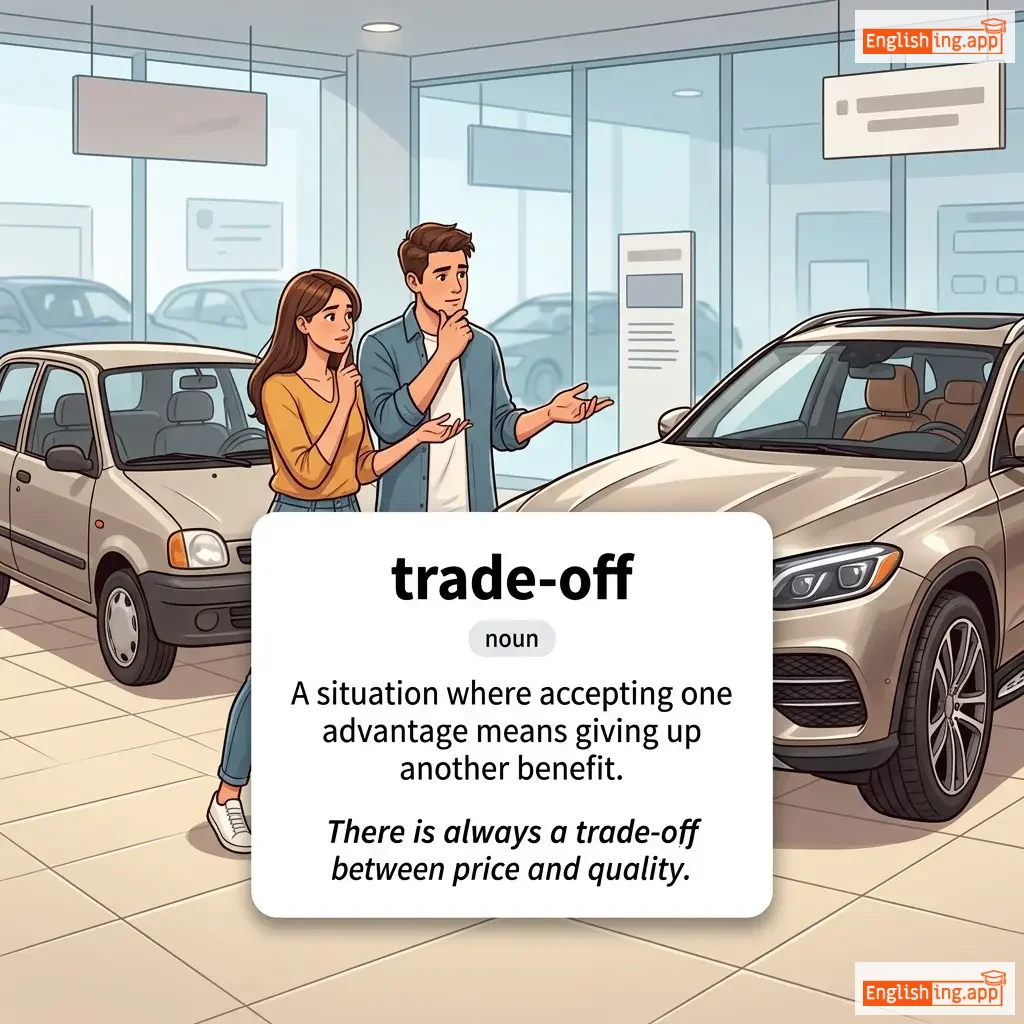
trade-off definition card — visual illustration of the meaning
noun
ˈtreɪd.ɒf
विकल्प-चयन (vikalp-chayan)

A situation where accepting one advantage means giving up another benefit.

"There is always a trade-off between price and quality."

"कीमत और गुणवत्ता के बीच हमेशा एक विकल्प-चयन होता है।" (keemat aur gunwatta ke beech hamesha ek vikalp-chayan hota hai.)
noun
/ˈtreɪdmɑːrk/
ट्रेडमार्क (trademark)

a symbol, word, or words legally registered or established by use as representing a company or product

"The company’s logo is its trademark."

"कंपनी का लोगो उसका ट्रेडमार्क है।" (Company ka logo uska trademark hai.)
noun
/ˈtreɪ.dər/
व्यापारी (vyapari)

a person who buys and sells goods or financial securities for profit

"The trader made a good profit from selling imported goods."

"व्यापारी ने आयातित सामान बेचकर अच्छा मुनाफा कमाया।" (vyapari ne aayatit samaan bechkar accha munafa kamaya)
noun
/ˈtreɪdɪŋ/
व्यापार (vyapar)

the act or business of buying and selling goods or services

"She made a fortune through online trading."

"उसने ऑनलाइन ट्रेडिंग के माध्यम से एक बड़ी संपत्ति बनाई।" (Usne online trading ke madhyam se ek badi sampatti banayi.)
Tradition definition card — visual illustration of the meaning
noun
/trəˈdɪʃən/
परंपरा (parampara)

the transmission of customs or beliefs from generation to generation

"It is a tradition to celebrate New Year with family."

"नया साल परिवार के साथ मनाना एक परंपरा है।" (Naya saal parivaar ke saath manana ek parampara hai.)
adjective
/trəˈdɪʃənəl/
परंपरागत (paramparagat)

existing in or as part of a tradition

"The traditional dance of this village is performed every year."

"इस गाँव का पारंपरिक नृत्य हर साल प्रदर्शन किया जाता है।" (Is gaon ka paramparagat nritya har saal pradarshan kiya jata hai.)
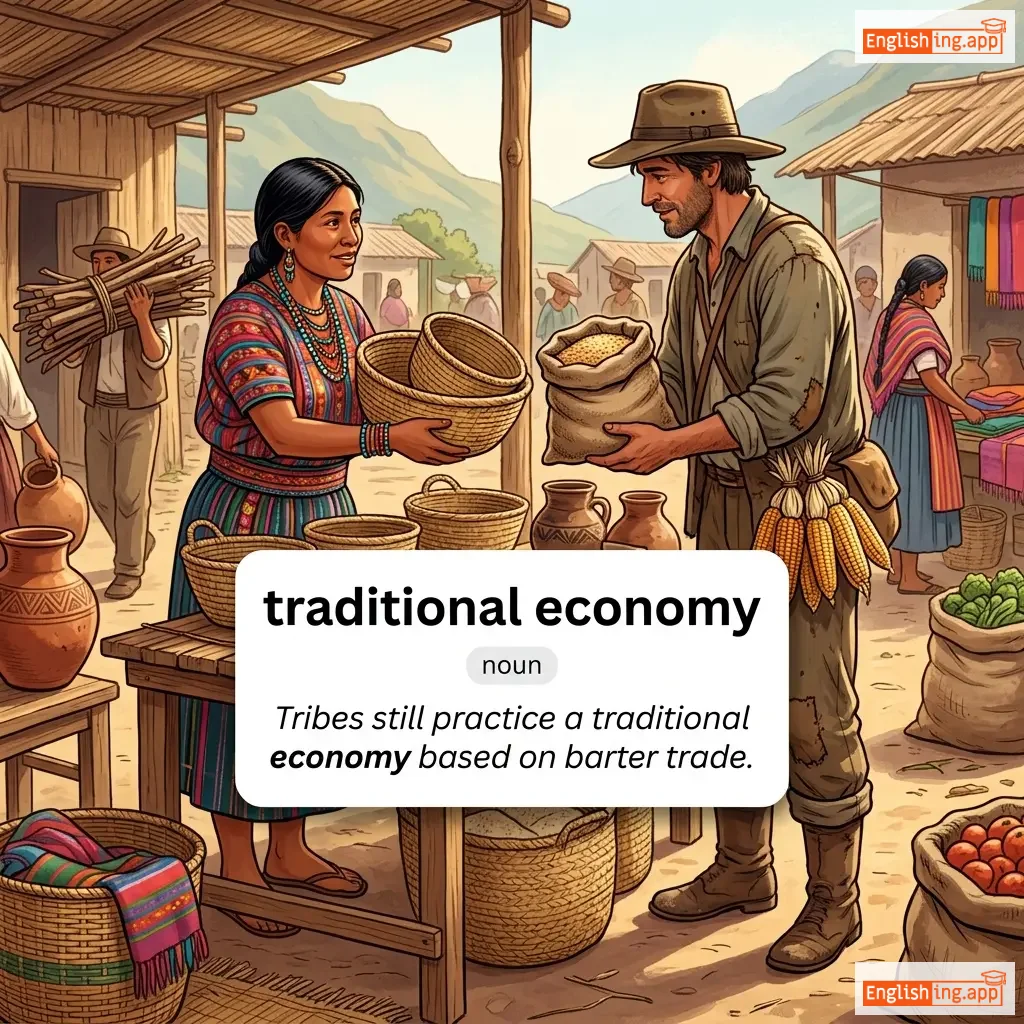
traditional economy definition card — visual illustration of the meaning
noun
/trəˈdɪʃ.ən.əl ɪˈkɒn.ə.mi/
पारंपरिक अर्थव्यवस्था (paaraṃparik arthavyavasthaa)

An economic system based on customs and traditions, often involving barter trade.

"Tribes still practice a traditional economy based on barter trade."

"कबीलों ने अभी भी वस्तु विनिमय व्यापार पर आधारित एक पारंपरिक अर्थव्यवस्था का पालन किया।" (Kabeelon ne abhi bhi vastu vinimay vyaapar par aadharit ek paaraṃparik arthavyavasthaa ka paalan kiya.)
adverb
/trəˈdɪʃənəli/
पारंपरिक रूप से (paramparik roop se)

according to custom or long-established practice

"Bangladesh is traditionally known for its hospitality."

"बांगलादेश पारंपरिक रूप से अपनी मेहमाननवाजी के लिए जाना जाता है।" (Bangladesh paramparik roop se apni mehmanawaji ke liye jana jata hai.)
verb
/trəˈdjuːs/
बदनाम करना (badnaam karna)

To speak badly of someone or tell lies to damage their reputation.

"He was furious when he found out that his rivals had traduced him."

"वह गुस्से में था जब उसने पाया कि उसके प्रतिद्वंद्वियों ने उसे बदनाम किया था।" (Wah gusse mein tha jab usne paaya ki uske pratidwandviyon ne use badnaam kiya tha.)
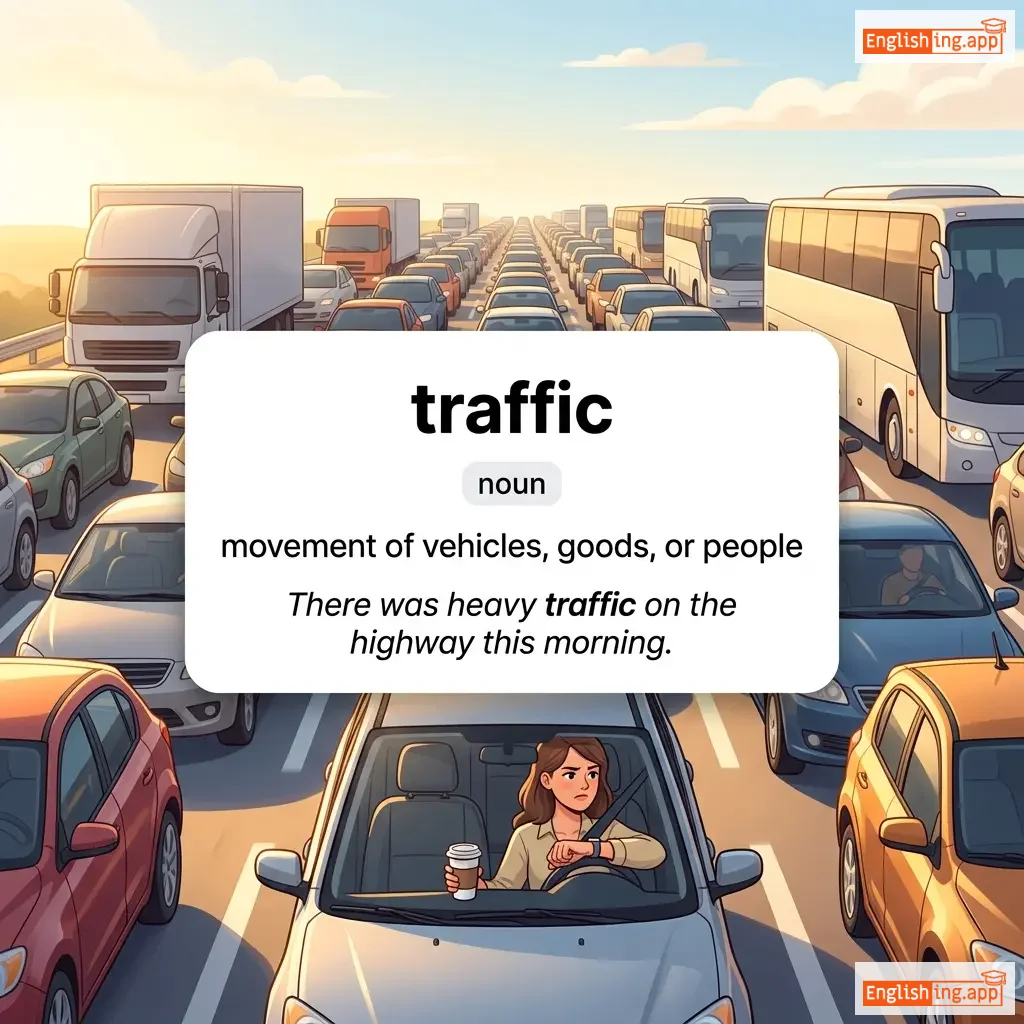
traffic definition card — visual illustration of the meaning
noun
/ˈtræfɪk/
यातायात (yatayat)

movement of vehicles, goods, or people

"There was heavy traffic on the highway this morning."

"आज सुबह हाईवे पर भारी यातायात था।" (Aaj subah highway par bhari yatayat tha.)
noun
/ˈtrædʒədi/
विपत्ति (vipatti)

an event causing great suffering or distress

"The earthquake was a tragedy for the entire country."

"भूकंप देश के लिए एक त्रासदी था।" (Bhookamp desh ke liye ek trasadi tha.)
adjective
/ˈtrædʒɪk/
दुःखद (dukhad)

causing great sadness or suffering; very unfortunate

"The news of the accident was truly tragic."

"दुर्घटना की खबर सच में दुःखद थी।" (Durghatna ki khabar sach mein dukhad thi.)
noun
/ˈtreɪtər/
दगा करने वाला (daga karne wala)

A person who betrays their country, friends, or a cause by acting against them.

"The soldier was labeled a traitor for giving secrets to the enemy."

"सैनिक को दुश्मन को गुप्त जानकारी देने के लिए दगा करने वाला करार दिया गया था।" (Sainik ko dushman ko gupt jankari dene ke liye daga karne wala karar diya gaya tha.)
noun
/træns/
मोहित अवस्था (mohit avastha)

a half-conscious state like dreaming, often with loss of awareness of surroundings

"She stared out of the window as if in a trance."

"वह खिड़की से बाहर घूर रही थी जैसे वह एक मोहित अवस्था में हो।" (vah khidki se baahar ghoor rahi thi jaise vah ek mohit avastha mein ho.)
verb
/ˈtræmpəl/
पैरों तले कुचलना (pairo tale kuchalna)

to tread heavily on something and cause damage or injury

"The crowd trampled the flowers in the park."

"भीड़ ने पार्क में फूलों को पैरों तले कुचल दिया।" (bheer ne park mein phoolon ko pairo tale kuchal diya.)
verb, noun
/træmp/
घूमंतू / भारी कदमों से चलना (ghumantu / bhari kadmon se chalna)

to walk heavily or noisily; a person who travels from place to place on foot, often homeless

"They tramped through the forest in heavy boots."

"वे भारी बूट पहने जंगल में चल रहे थे।" (ve bhari boot pahne jangl mein chal rahe the.)
noun, verb
/ˈtræməl/
बाधा (baadha)

A restriction or impediment to freedom of action; to restrict.

"The strict rules trammel the creativity of the students."

"कठोर नियम छात्रों की रचनात्मकता को बाधित करते हैं।" (Kathor niyam chhatron ki rachnatmakta ko baadhit karte hain.)
noun
/træm kɑːr/
ट्राम कार (tram car)

An electric vehicle that runs on rails along the street

"The tram car stopped at every station in the city center."

"ट्राम कार हर स्टेशन पर शहर के केंद्र में रुकी।" (tram car har station par shahar ke kendra mein ruki.)
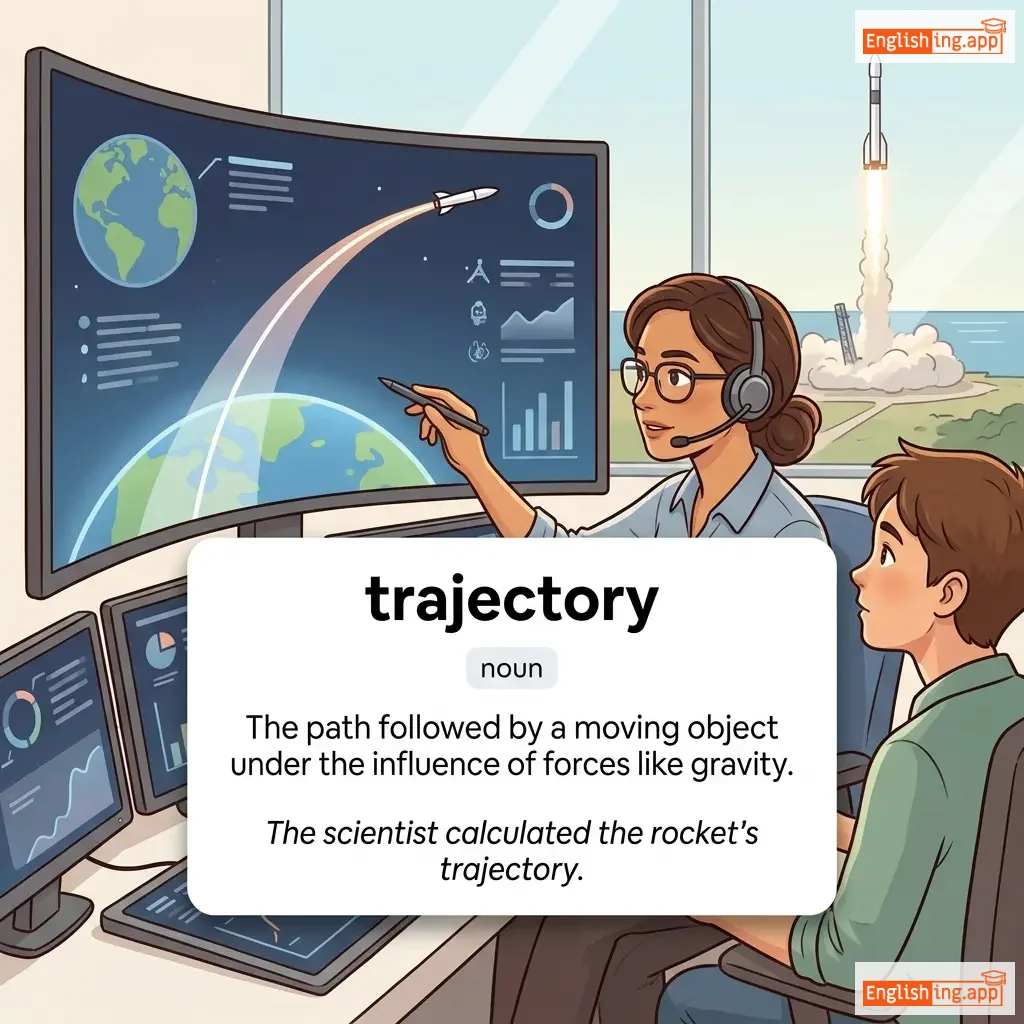
trajectory definition card — visual illustration of the meaning
noun
/trəˈdʒɛktəri/
पथरेखा (pathrekha)

The path followed by a moving object under the influence of forces like gravity.

"The scientist calculated the rocket's trajectory."

"वैज्ञानिक ने रॉकेट के पथरेखा की गणना की।" (Vaigyanik ne rocket ke pathrekha ki ganana ki.)
noun
/ˈtreɪnər/
प्रशिक्षक (prashikshak)

a person who teaches skills or gives training

"The fitness trainer helped me improve my posture."

"फिटनेस प्रशिक्षक ने मेरी मुद्रा सुधारने में मदद की।" (Fitness prashikshak ne meri mudra sudhaarne mein madad ki.)
noun
/ˈtreɪlər/
ट्रेलर / प्रिव्यू (trailer / preview)

a preview of a movie or a vehicle used for transporting goods

"The movie trailer was released last week."

"फिल्म का ट्रेलर पिछले हफ्ते जारी किया गया था।" (Film ka trailer pichhle hafte jaari kiya gaya tha.)
Train definition card — visual illustration of the meaning
noun
/treɪn/
ट्रेन (train)

a series of connected vehicles that run on tracks and are used for transporting people or goods

"The train departed from the station on time."

"ट्रेन समय पर स्टेशन से रवाना हुई।" (Train samay par station se ravaana hui.)
noun
/treɪˈniː/
प्रशिक्षु; नौसिखिया (trainee)

a person undergoing training for a particular job or profession; a novice learner

"The medical trainee worked long hours to gain practical experience."

"चिकित्सा प्रशिक्षु ने व्यावहारिक अनुभव प्राप्त करने के लिए लंबी घंटों तक काम किया।" (chikitsa prashikshu ne vyavaharik anubhav prapt karne ke liye lambi ghanton tak kaam kiya.)
tractable definition card — visual illustration of the meaning
adjective
/ˈtræktəbəl/
आसान से नियंत्रित या प्रभावित करने योग्य (asaan se niyantrit ya prabhavit karne yogya)

easy to control or influence

"The child was surprisingly tractable during the long journey."

"बच्चा लंबी यात्रा के दौरान आश्चर्यजनक रूप से नियंत्रित था।" (Baccha lambi yatra ke dauran aascharyajanak roop se niyantrit tha.)