词汇表

英语词汇词典 | 单词含义、定义和示例

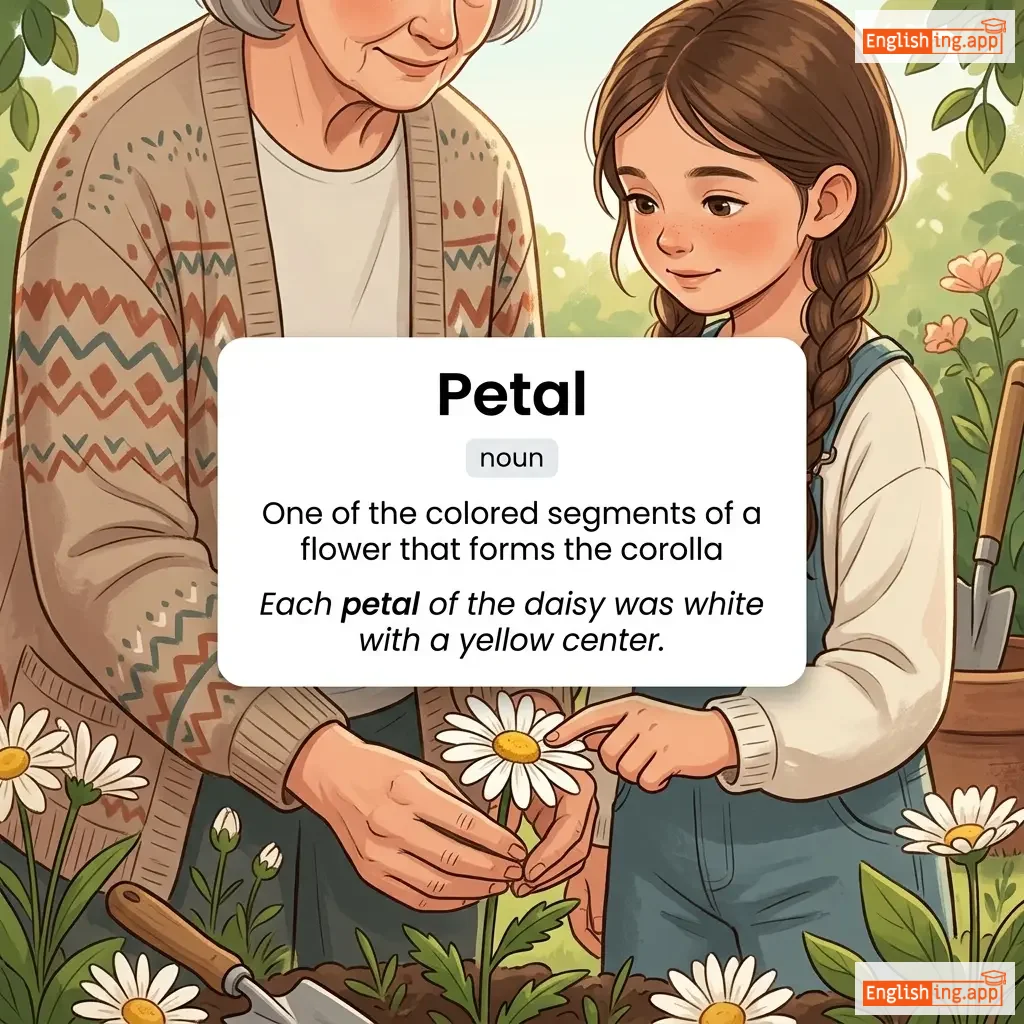
Petal definition card — visual illustration of the meaning
noun
/ˈpetəl/
花瓣 (huaban)

One of the colored segments of a flower that forms the corolla

"Each petal of the daisy was white with a yellow center."

"雏菊的每一片花瓣都是白色的,中央是黄色的。" (chujus de mei yi pian huaban doushi baise de, zhongyang shi huangse de)
verb
/ˈpiːtər/
逐渐减弱 (zhújiàn jiǎnruò)

to diminish gradually and come to an end; to fade or dwindle away

"The excitement of the event began to peter out after a few hours."

"事件的兴奋感在几个小时后开始逐渐消退。" (Shìjiàn de xīngfèn gǎn zài jǐ gè xiǎoshí hòu kāishǐ zhújiàn xiāotuì.)
noun
/pəˈtɪʃən/
请愿书 (qǐngyuàn shū)

a formal written request, typically signed by many people, appealing to authority about a cause

"They signed a petition to improve road safety in the area."

"他们签署了一份请愿书,要求改善该地区的道路安全。" (Tāmen qiānshǔle yī fèn qǐngyuàn shū, yāoqiú gǎishàn gāi dìqū de dàolù ānquán.)
verb
/ˈpɛtrɪfaɪ/
石化 (shí huà)

to make someone so frightened that they are unable to move or think; to turn into stone

"The loud noise petrified the little child."

"大声的噪音让孩子石化了。" (Dà shēng de zàoyīn ràng háizi shí huà le.)
noun
/ˈpɛtrəˌɡræf/
岩石描述 (yan shi miao shu)

a description or representation of rocks, especially in detailed scientific writing

"The scientist studied the petrograph to understand the rock composition."
"科学家研究了岩石图,以了解岩石的组成。" (Ke xue jia yan jiu le yan shi tu, yi liao jie yan shi de zu cheng.)
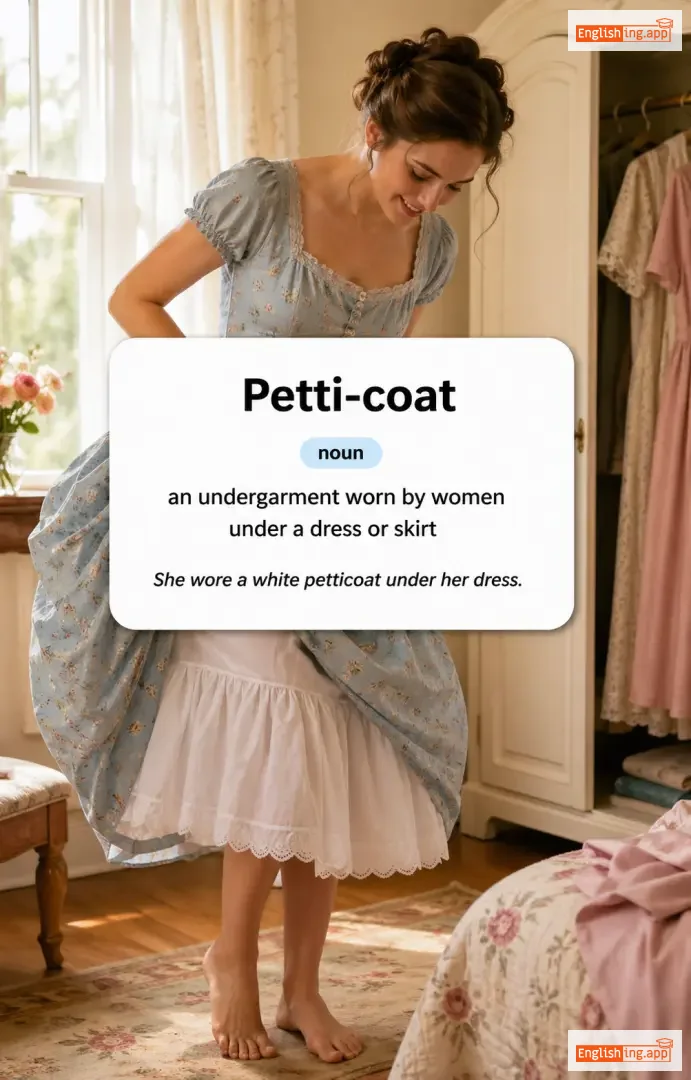
Petti-coat definition card — visual illustration of the meaning
noun
/ˈpetɪkoʊt/
裙子内衬 (qunzi neichen)

an undergarment worn by women under a dress or skirt

"She wore a white petticoat under her dress."

"她穿着一条白色的衬裙在她的裙子下面。" (Tā chuānzhuó yītiáo báisè de chènqún zài tā de qúnzi xiàmiàn.)
verb
/ˈpɛtɪˌfɒɡ/
争论琐碎的事情 (zhēnglùn suǒsuì de shìqíng)

to argue or quibble over trivial matters; to engage in petty, dishonest practices

"The lawyer was accused of trying to pettifog instead of addressing the real issue."

"律师被指控试图争论琐碎的事情,而不是解决真正的问题。" (Lǚshī bèi zhǐkòng shìtú zhēnglùn suǒsuì de shìqíng, ér bùshì jiějué zhēnzhèng de wèntí.)
adjective
/ˈpɛti/
琐碎 (suǒsuì)

Of little importance or trivial; also describes a person overly concerned with small or unimportant matters.

"She often gets upset over the most petty things."

"她经常为最琐碎的事情感到不安。" (Tā jīngcháng wèi zuì suǒsuì de shìqíng gǎndào bù'ān.)
noun
/ˈpɛtjʊləns/
暴躁 (bàozào)

The quality of being childishly sulky or bad-tempered.

"His petulance during the meeting annoyed everyone."

"他在会议中的佩图兰斯让所有人都烦恼。" (Tā zài huìyì zhōng de pèi tú lán sī ràng suǒyǒu rén dōu fánnǎo.)
adjective
/ˈpɛtjʊlənt/
脾气坏 (píqì huài)

Childishly sulky or bad-tempered.

"The child became petulant when denied more candy."

"孩子因为没得到更多糖果而变得脾气坏。" (Háizi yīnwèi méi dédào gèng duō tángguǒ ér biàn dé píqì huài.)
noun
/ˈfeɪlæŋks/
方阵 (fāngzhèn)

A group of people or things arranged in a compact, close formation; also an ancient Greek military formation.

"A phalanx of reporters waited outside the courthouse."

"一群记者在法院外等候。" (Yī qún jìzhě zài fǎyuàn wài děnghòu.)
noun
/ˈfænˌtæzəm/
幽灵 (youling)

an illusion, ghost, or figment of the imagination

"The child claimed to see a phantasm in the old house."

"孩子声称在旧房子里看见了幽灵。" (Haizi shengcheng zai jiu fangzi li kanjianle youling.)
adjective
/ˌfæntæzməˈɡɒrɪkəl/
幻想的 (huànxiǎng de)

Having a fantastic, dreamlike, or surreal appearance, often shifting or illusory.

"The movie created a phantasmagorical vision of another world."

"这部电影创造了另一个世界的幻想。" (Zhè bù diànyǐng chuàngzàole lìng yīgè shìjiè de huànxiǎng.)
adjective
/ˌfærɪˈseɪɪkəl/
伪善的 (wěishàn de)

Excessively concerned with formal rules or outward show of morality, often in a hypocritical way.

"His pharisaical behavior made people doubt his sincerity."

"他的伪善行为让人怀疑他的真诚。" (Tā de wěishàn xíngwéi ràng rén huáiyí tā de zhēnchéng.)
noun
/ˈfærɪsiː/
伪君子 (wěi jūn zǐ)

A member of an ancient Jewish sect; by extension, a self-righteous or hypocritical person.

"He acted like a pharisee, judging others while ignoring his own faults."

"他像个法利赛人一样行事,批评别人却忽视自己的错误。" (Tā xiàng gè fǎ lì sài rén yīyàng xíngshì, pīpíng biérén què hūshì zìjǐ de cuòwù.)
noun
/ˌfɑːrməkəˈpiːə/
药典 (yaodian)

An official book listing medicinal drugs, their effects, and directions for use.

"The doctor referred to the pharmacopoeia to check the drug's proper dosage."

"医生查阅了药典,以核对药物的正确剂量。" (Yisheng chayuele yaodian, yi hedui yaowu de zhengque jiliao.)
noun
/ˈfɑːrməsi/
药店 (yaodian)

A place where medicinal drugs are prepared and sold.

"I went to the pharmacy to buy antibiotics."

"我去药店买抗生素。" (Wo qu yaodian mai kangshengsu.)
Phase definition card — visual illustration of the meaning
noun
/feɪz/
阶段 (jieduan)

a distinct period or stage in a process of development

"We are in the final phase of the project."

"我们处于项目的最后阶段。" (Wo men chuyu xiangmu de zuihou jieduan.)
phase-out definition card — visual illustration of the meaning
noun
ˈfeɪz.aʊt
逐步淘汰 (zhú bù táo tài)

A gradual reduction and eventual elimination of something.

"A phase-out of fossil fuels was agreed upon."
"达成了逐步淘汰化石燃料的协议。" (Dá chéng le zhú bù táo tài huà shí rán liào de xié yì.)
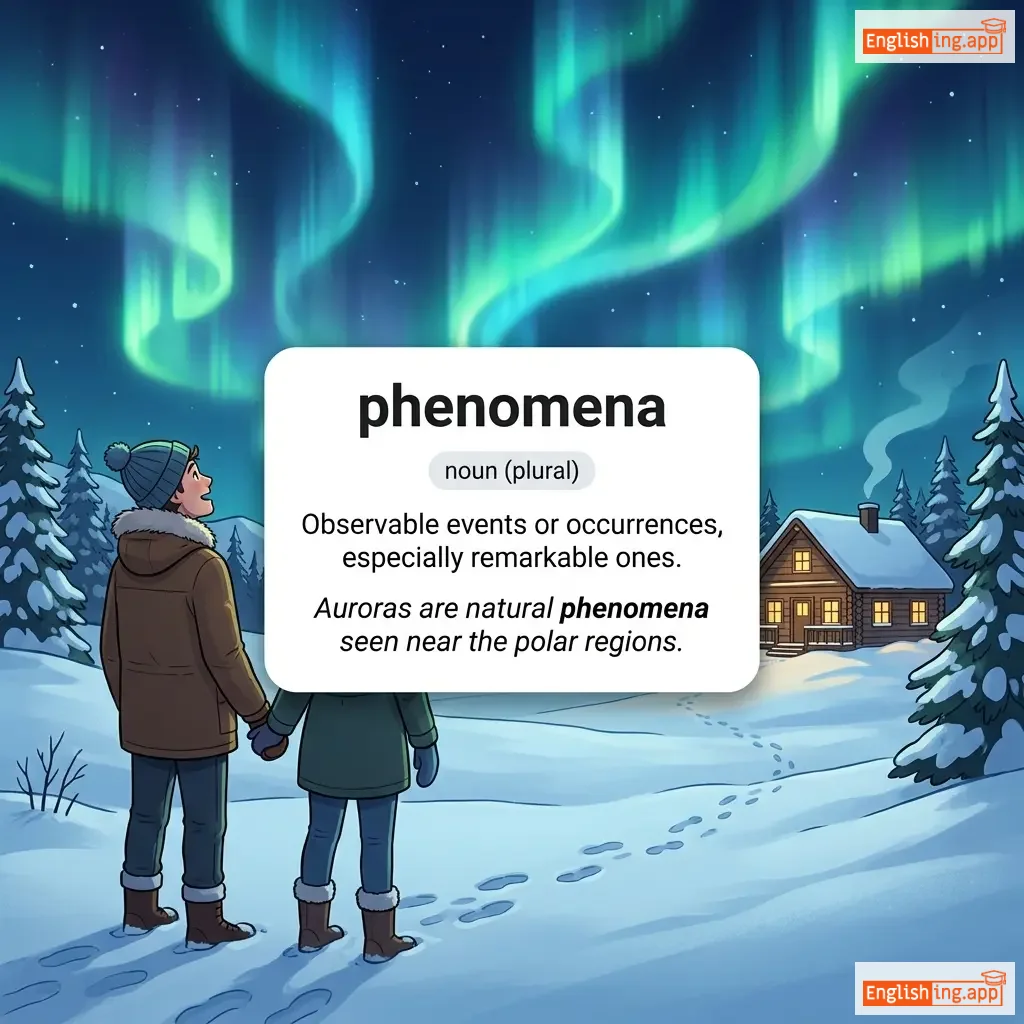
phenomena definition card — visual illustration of the meaning
noun (plural)
/fəˈnɒmɪnə/
现象 (xianxiang)

Observable events or occurrences, especially remarkable ones.

"Auroras are natural phenomena seen near the polar regions."

"极光是自然现象,常见于极地地区。" (Jiguang shi ziran xianxiang, changjian yu jidi diqu.)
adjective
/fəˈnɒmɪnəl/
非凡 (feifan)

extraordinary, remarkable, or exceptional in a way that is very impressive

"The team achieved phenomenal success in the tournament."

"团队在比赛中取得了非凡的成功。" (Tuánduì zài bǐsài zhōng qǔdéle fēifán de chénggōng.)
noun
/fəˈnɒmɪnən/
现象 (xianxiang)

an observable event, fact, or occurrence, often unusual or remarkable

"The Northern Lights are a natural phenomenon."

"北极光是自然现象。" (Beiji guang shi ziran xianxiang.)
noun
/ˈfaɪəl/
小玻璃瓶 (xiao boli ping)

a small glass container for liquids, especially medicines

"The doctor gave her a phial of medicine."

"医生给了她一瓶药。" (Yisheng gei le ta yi ping yao.)
verb
/fɪˈlændər/
调情 (tiáoqíng)

to engage in casual or frivolous romantic or sexual relationships

"He was known to philander with many women in town."

"他以与城里许多女性交往而闻名。" (Tā yǐ yǔ chéng lǐ xǔduō nǚxìng jiāowǎng ér wénmíng.)
noun
/fɪˈlændərər/
花花公子 (huāhuā gōngzǐ)

a man who habitually engages in casual romantic or sexual affairs

"The politician was exposed as a notorious philanderer."

"这位政治家被揭露为一个臭名昭著的花花公子。" (Zhè wèi zhèngzhìjiā bèi jiēlù wéi yí ge chòumíng zhāozhù de huāhuā gōngzǐ.)
adjective
/ˌfɪl.ænˈθrɒp.ɪk/
慈善的 (císhàn de)

showing concern for the welfare of others; generous and charitable

"She is known for her philanthropic activities in the city."

"她因在城市中的慈善活动而闻名。" (Tā yīn zài chéngshì zhōng de císhàn huódòng ér wénmíng.)
noun
/fɪˈlæn.θrə.pɪst/
慈善家 (císhànjiā)

a person who seeks to promote the welfare of others, especially by donating money to good causes

"The philanthropist donated millions to build schools in rural areas."

"慈善家捐赠了数百万美元用于建设农村地区的学校。" (Císhànjiā juānzèngle shù bǎi wàn měiyuán yòng yú jiànshè nóngcūn dìqū de xuéxiào.)
noun
/fɪˈlæn.θrə.pi/
慈善事业 (císhàn shìyè)

the desire to promote the welfare of others, often expressed by the generous donation of money to good causes

"Philanthropy has helped improve healthcare in many developing countries."

"慈善事业帮助改善了许多发展中国家的医疗保健。" (Císhàn shìyè bāngzhù gǎishànle xǔduō fāzhǎn zhōngguó de yīliáo bǎojiàn.)
noun
/fɪˈlæt.əl.ɪst/
集邮家 (jí yóu jiā)

a person who collects or studies postage stamps

"The philatelist spent years building a rare stamp collection."

"这位集邮家花了多年时间建立了一个稀有的邮票收藏。" (Zhè wèi jí yóu jiā huāle duōnián shíjiān jiànlìle yīgè xīyǒu de yóupiào shōucáng.)
noun
/fɪˈlæt.əl.i/
邮票收藏学 (yóupiào shōucáng xué)

the collection and study of postage stamps

"Philately is a hobby enjoyed by people of all ages."

"邮票收藏学是一项各年龄段人群都喜爱的爱好。" (Yóupiào shōucáng xué shì yī xiàng gè niánlíng duàn rénqún dōu xǐ'ài de àihào.)
adjective
/ˌfɪl.hɑːrˈmɒn.ɪk/
与交响乐团有关 (yǔ jiāoxiǎng yuètuán yǒuguān)

relating to a symphony orchestra or its music

"The philharmonic orchestra performed a stunning rendition of Beethoven's Ninth Symphony."

"爱乐乐团演绎了贝多芬第九交响曲的精彩版本。" (Ài yuè yuètuán yǎnyìle bèiduōfēn dì jiǔ jiāoxiǎngqǔ de jīngcǎi bǎnběn.)
noun
/ˈfɪl.ɪ.staɪn/
对文化和艺术漠不关心或敌对的人 (fēi lì shì rén)

a person who is indifferent or hostile to culture and the arts

"He was criticized as a philistine for dismissing modern art."

"他因拒绝现代艺术而被批评为非利士人。" (tā yīn jù jué xiàn dài yì shù ér bèi pī píng wéi fēi lì shì rén)
noun
/ˈfɪl.ə.dʒɪ.nɪst/
一个热爱或钦佩女性的人 (yí gè rè'ài huò qīnpèi nǚxìng de rén)

a person who loves or admires women

"As a known philogynist, he advocated for women's education."

"作为一位著名的菲洛吉尼斯特,他倡导女性的教育。" (Zuòwéi yī wèi zhùmíng de fēiluòjīnìsītè, tā chàngdǎo nǚxìng de jiàoyù.)
noun
/fɪˈlɒl.ə.dʒɪst/
语言学家 (yǔyánxué jiā)

a person who studies languages and their history

"The philologist analyzed ancient texts to understand language evolution."

"语言学家分析了古代文献,以理解语言的演变。" (Yǔyánxué jiā fēn xīle gǔdài wénxiàn, yǐ lǐjiě yǔyán de yǎnbiàn.)
noun
/fɪˈlɒl.ə.dʒi/
研究语言在书面历史资料中的应用; 语言学 (yanjiu yuyan zai shumianshi liushi ziliao zhong de yingyong; yuyanxue)

the study of language in written historical sources; linguistics

"She devoted her career to philology, researching ancient manuscripts."

"她将自己的职业生涯献给了语言学,研究古代手稿。" (Ta jiang ziji de zhiye shengya xian geile yuyanxue, yanjiu gudai shougou.)
noun
/fɪˈlɒsəfə/
哲学家 (zhexuejia)

a person engaged in the study of philosophy or in serious thinking about fundamental questions

"Socrates was a famous philosopher of ancient Greece."

"苏格拉底是古希腊著名的哲学家。" (Sūgélādǐ shì gǔxīlà zhùmíng de zhéxuéjiā.)
adjective
/ˌfɪl.əˈsɒf.ɪ.kəl/
哲学的 (zhexue de)

relating to the study of the fundamental nature of knowledge, reality, and existence

"She maintained a calm and philosophical attitude during the crisis."

"她在危机期间保持了冷静和哲学的态度。" (Ta zai weiji qijian baochi le lengjing he zhexue de taidu.)
verb
/fɪˈlɒs.ə.faɪz/
哲学 (zhexue)

to think or talk about the fundamental nature of knowledge, reality, and existence

"He likes to philosophize about life and its meaning."

"他喜欢谈论生活及其意义。" (Ta xihuan tanlun shenghuo jiqi yiyi.)
noun
/fɪˈlɒs.ə.fi/
哲学 (zhexue)

the study of the fundamental nature of knowledge, reality, and existence

"Her philosophy emphasizes kindness and empathy."

"她的哲学强调善良和同理心。" (Ta de zhexue qiangdiao shanliang he tongli xin.)
phishing definition card — visual illustration of the meaning
noun
/ˈfɪʃ.ɪŋ/
欺诈性信息盗窃 (qī zhà xìng xìn xī dào qiè)

Deceptive technique for stealing personal information unauthorized

"Phishing emails trick users into revealing passwords."

"网络钓鱼电子邮件欺骗用户透露密码。" (wǎng luò diào yú diàn zǐ yóu jiàn qī piàn yòng hù tóu lù mìmǎ.)
phlegmatic definition card — visual illustration of the meaning
adjective
/flɛgˈmæt.ɪk/
冷静的 (lěngjìng de)

having an unemotional and stolidly calm disposition

"Despite the chaos, he remained phlegmatic and composed."

"尽管混乱,他依然保持冷静和平静。" (Jǐnguǎn hùnluàn, tā yīrán bǎochí lěngjìng hé píngjìng.)
noun
/ˈfəʊ.bi.ə/
恐惧症 (kǒngjù zhèng)

an extreme or irrational fear of something

"She has a phobia of heights and avoids tall buildings."

"她有高度恐惧症,避免高楼。" (Tā yǒu gāodù kǒngjù zhèng, bìmiǎn gāolóu.)
phrasal verb
/pɪk ʌp/
捡起; 接载; 学会 (jian qi; jie zai; xue hui)

to lift something; to collect or receive someone or something; to learn or acquire gradually; to improve or increase

"She picked up the book from the floor."

"她从地板上捡起了那本书。" (Ta cong diban shang jianqi le na ben shu)
noun
/ˈpɪkəloʊ/
小长笛 (xiao changdi)

a small flute, higher in pitch than the regular flute

"She played a lively tune on the piccolo during the concert."
"她在音乐会期间吹奏了生动的皮科洛旋律。" (Ta zai yinyuehui qijian chuizou le shengdong de pikkolo xuanlü.)
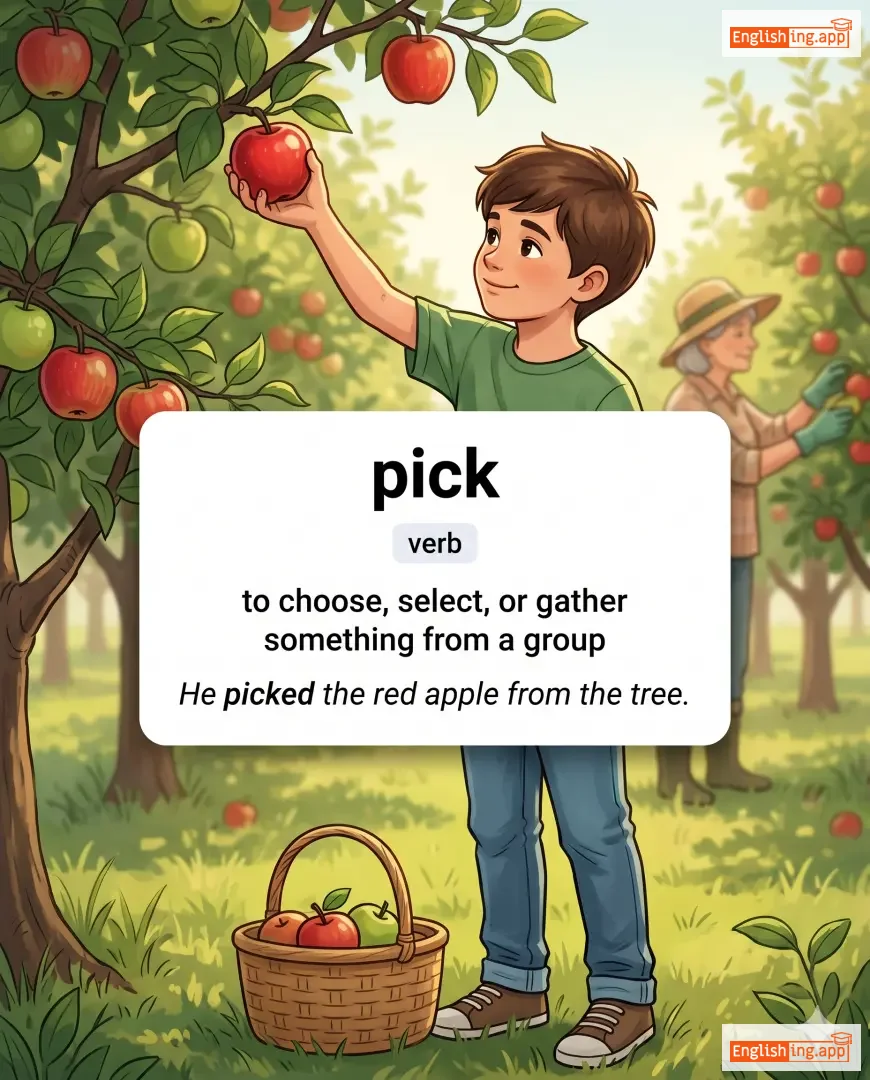
pick definition card — visual illustration of the meaning
verb
/pɪk/
选择 (xuanze)

to choose, select, or gather something from a group

"He picked the red apple from the tree."

"他从树上摘下了红色的苹果。" (Ta cong shu shang zhai xia le hongse de pingguo.)
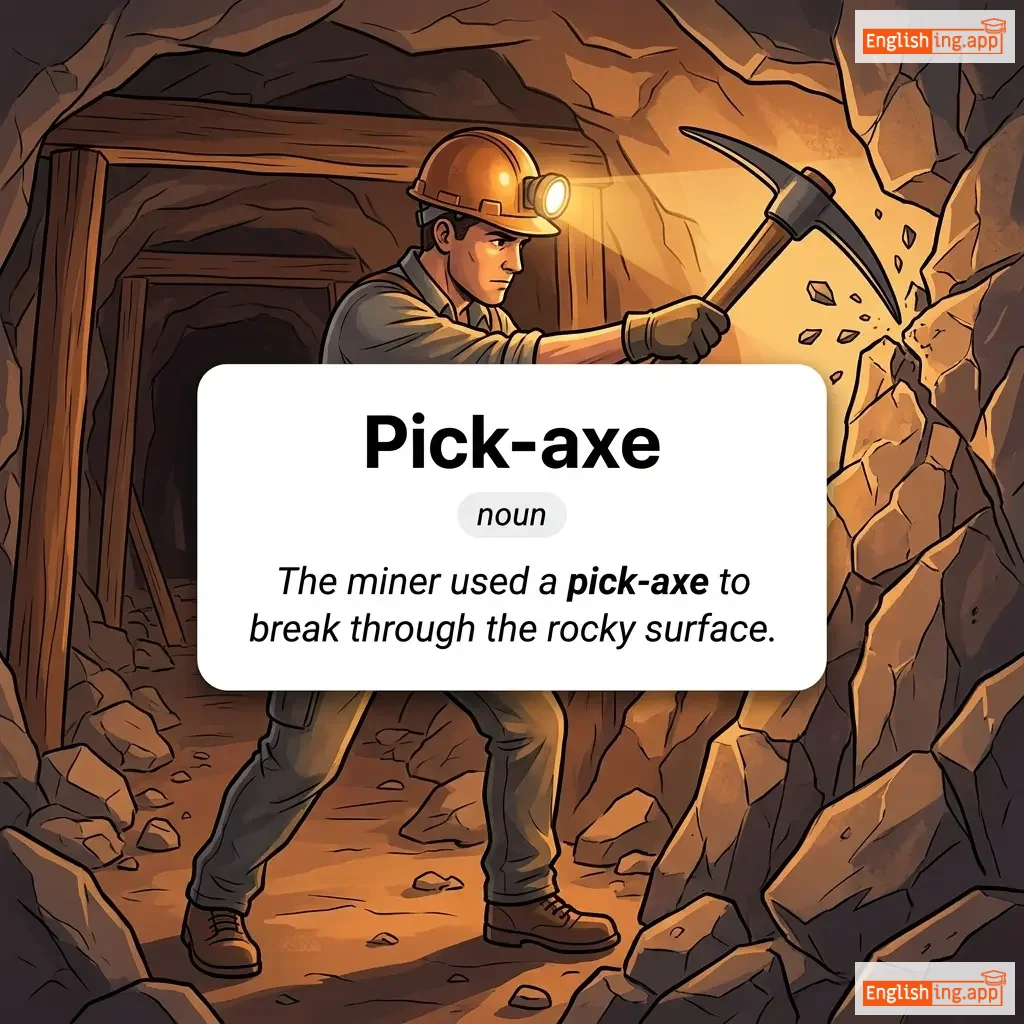
Pick-axe definition card — visual illustration of the meaning
noun
/ˈpɪk.æks/
鹤嘴锄 (he zui chu)

a tool with a heavy metal head and long handle used for breaking up hard ground or rock

"The miner used a pick-axe to break through the rocky surface."
"矿工用鹤嘴锄打破了岩石表面。" (Kuànggōng yòng hèzuǐchú dǎpòle yánshí biǎomiàn.)
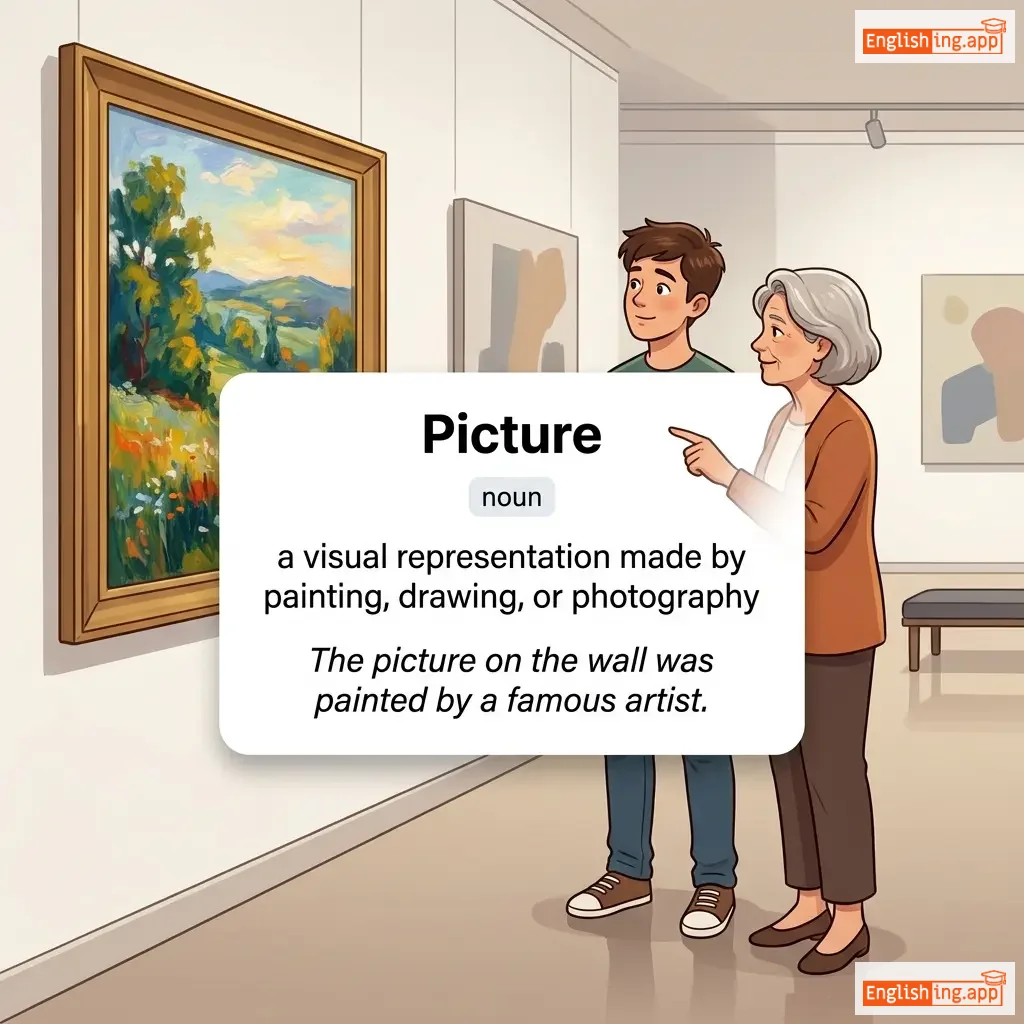
Picture definition card — visual illustration of the meaning
noun
/ˈpɪktʃər/
画面 (huàmiàn)

a visual representation made by painting, drawing, or photography

"The picture on the wall was painted by a famous artist."

"墙上的画面是由一位著名艺术家绘制的。" (Qiáng shàng de huàmiàn shì yóu yī wèi zhùmíng yìshùjiā huìzhì de.)
adjective
/ˈpɪdlɪŋ/
微不足道, 琐碎 (wēi bù zú dào, suǒ suì)

trivial or insignificant; very small

"He made a piddling amount of money from that deal."

"他从那笔交易中赚了一笔微不足道的金额。" (Tā cóng nà bǐ jiāoyì zhōng zhuànle yī bǐ wēi bù zú dào de jīn'é.)
adjective
/ˌpɪkəˈjuːn/
微不足道的, 琐碎的 (wēi bù zú dào de, suǒ suì de)

of little value or importance; trivial

"He complained about the picayune details of the contract."

"他抱怨合同中的琐碎细节。" (Tā bàoyuàn hé tong zhōng de suǒ suì xìjié.)
noun
/ˈpɪkʌp/
有开放式车厢的小卡车; 收集或改进某物的行为 (yǒu kāifàng shì chēxiāng de xiǎo kǎchē; shōují huò gǎijìn mǒu wù de xíngwéi)

a small truck with an open back; the act of collecting or improving something

"The company scheduled a pickup for the returned goods."

"公司为退还的货物安排了取货。" (Gōngsī wèi tuìhuán de huòwù ānpái le qǔhuò.)