Vocabulaires

Découvrez, apprenez et maîtrisez le vocabulaire anglais

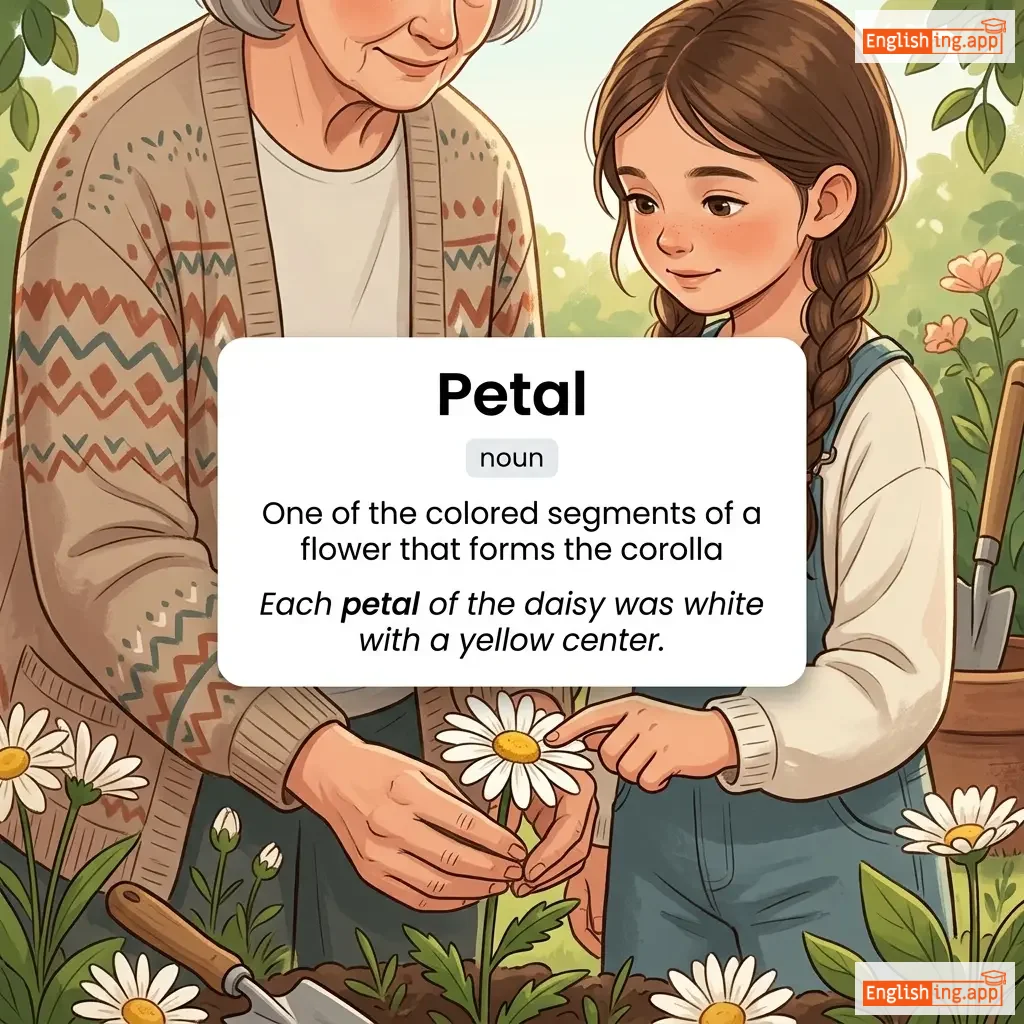
Petal definition card — visual illustration of the meaning
noun
/ˈpetəl/
pétale (petale)

One of the colored segments of a flower that forms the corolla

"Each petal of the daisy was white with a yellow center."

"Chaque pétale de la marguerite était blanc avec un centre jaune." (chaque petale de la marguerite etait blanc avec un centre jaune)
verb
/ˈpiːtər/
diminuer progressivement (diminuer progressivement)

to diminish gradually and come to an end; to fade or dwindle away

"The excitement of the event began to peter out after a few hours."

"L'excitation de l'événement a commencé à diminuer après quelques heures." (L'excitation de l'événement a commencé à diminuer après quelques heures.)
noun
/pəˈtɪʃən/
pétition (petition)

a formal written request, typically signed by many people, appealing to authority about a cause

"They signed a petition to improve road safety in the area."

"Ils ont signé une pétition pour améliorer la sécurité routière dans la région." (Ils ont signé une petition pour améliorer la sécurité routière dans la région.)
verb
/ˈpɛtrɪfaɪ/
pétrifier (petrifier)

to make someone so frightened that they are unable to move or think; to turn into stone

"The loud noise petrified the little child."

"Le bruit fort pétrifia l'enfant." (Le bruit fort pétrifia l'enfant.)
noun
/ˈpɛtrəˌɡræf/
description des roches (description des roches)

a description or representation of rocks, especially in detailed scientific writing

"The scientist studied the petrograph to understand the rock composition."

"Le scientifique a étudié le pétrographe pour comprendre la composition de la roche." (Le scientifique a etudie le petrographe pour comprendre la composition de la roche.)
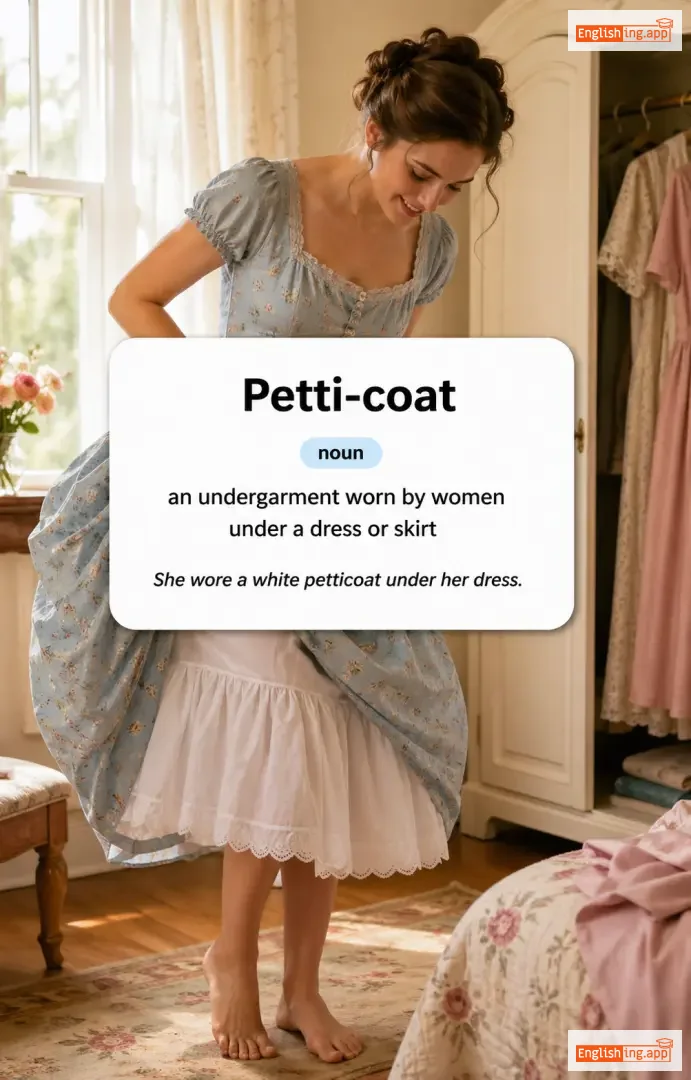
Petti-coat definition card — visual illustration of the meaning
noun
/ˈpetɪkoʊt/
jupon (jupon)

an undergarment worn by women under a dress or skirt

"She wore a white petticoat under her dress."

"Elle portait un jupon blanc sous sa robe." (Elle portait un jupon blanc sous sa robe.)
verb
/ˈpɛtɪˌfɒɡ/
discuter de futilités (discuter de futilités)

to argue or quibble over trivial matters; to engage in petty, dishonest practices

"The lawyer was accused of trying to pettifog instead of addressing the real issue."

"L'avocat a été accusé d'essayer de discuter de questions futiles au lieu de traiter le vrai problème." (L'avocat a été accusé d'essayer de discuter de questions futiles au lieu de traiter le vrai problème.)
adjective
/ˈpɛti/
insignifiant (insignifiant)

Of little importance or trivial; also describes a person overly concerned with small or unimportant matters.

"She often gets upset over the most petty things."

"Elle se fâche souvent pour les choses les plus insignifiantes." (Elle se fâche souvent pour les choses les plus insignifiantes.)
noun
/ˈpɛtjʊləns/
pétulance (pétulance)

The quality of being childishly sulky or bad-tempered.

"His petulance during the meeting annoyed everyone."

"Sa pétulance pendant la réunion a agacé tout le monde." (Sa pétulance pendant la réunion a agacé tout le monde.)
adjective
/ˈpɛtjʊlənt/
irritable (irritable)

Childishly sulky or bad-tempered.

"The child became petulant when denied more candy."

"L'enfant est devenu irritable lorsqu'on lui a refusé plus de bonbons." (L'enfant est devenu irritable lorsqu'on lui a refusé plus de bonbons.)
noun
/ˈfeɪlæŋks/
phalanx (phalanx)

A group of people or things arranged in a compact, close formation; also an ancient Greek military formation.

"A phalanx of reporters waited outside the courthouse."

"Un groupe de journalistes attendait devant le tribunal." (Un groupe de journalistes attendait devant le tribunal.)
noun
/ˈfænˌtæzəm/
fantôme (fantome)

an illusion, ghost, or figment of the imagination

"The child claimed to see a phantasm in the old house."

"L'enfant prétendait avoir vu un fantôme dans la vieille maison." (L'enfant pretendait avoir vu un fantome dans la vieille maison.)
adjective
/ˌfæntæzməˈɡɒrɪkəl/
fantasmagorique (fantasmagorique)

Having a fantastic, dreamlike, or surreal appearance, often shifting or illusory.

"The movie created a phantasmagorical vision of another world."

"Le film a créé une vision fantasmagorique d'un autre monde." (Le film a cree une vision fantasmagorique d'un autre monde.)
adjective
/ˌfærɪˈseɪɪkəl/
pharisaïque (pharisaïque)

Excessively concerned with formal rules or outward show of morality, often in a hypocritical way.

"His pharisaical behavior made people doubt his sincerity."

"Son comportement pharisaïque a fait douter les gens de sa sincérité." (Son comportement pharisaïque a fait douter les gens de sa sincérité.)
noun
/ˈfærɪsiː/
personne hypocrite (personne hypocrite)

A member of an ancient Jewish sect; by extension, a self-righteous or hypocritical person.

"He acted like a pharisee, judging others while ignoring his own faults."

"Il agissait comme un pharisien, jugeant les autres tout en ignorant ses propres défauts." (Il agissait comme un pharisien, jugeant les autres tout en ignorant ses propres défauts.)
noun
/ˌfɑːrməkəˈpiːə/
pharmacopée (pharmacopée)

An official book listing medicinal drugs, their effects, and directions for use.

"The doctor referred to the pharmacopoeia to check the drug's proper dosage."

"Le médecin a consulté la pharmacopée pour vérifier la dose correcte du médicament." (Le médecin a consulté la pharmacopée pour vérifier la dose correcte du médicament.)
noun
/ˈfɑːrməsi/
pharmacie (pharmacie)

A place where medicinal drugs are prepared and sold.

"I went to the pharmacy to buy antibiotics."

"Je suis allé à la pharmacie acheter des antibiotiques." (Je suis allé à la pharmacie acheter des antibiotiques.)
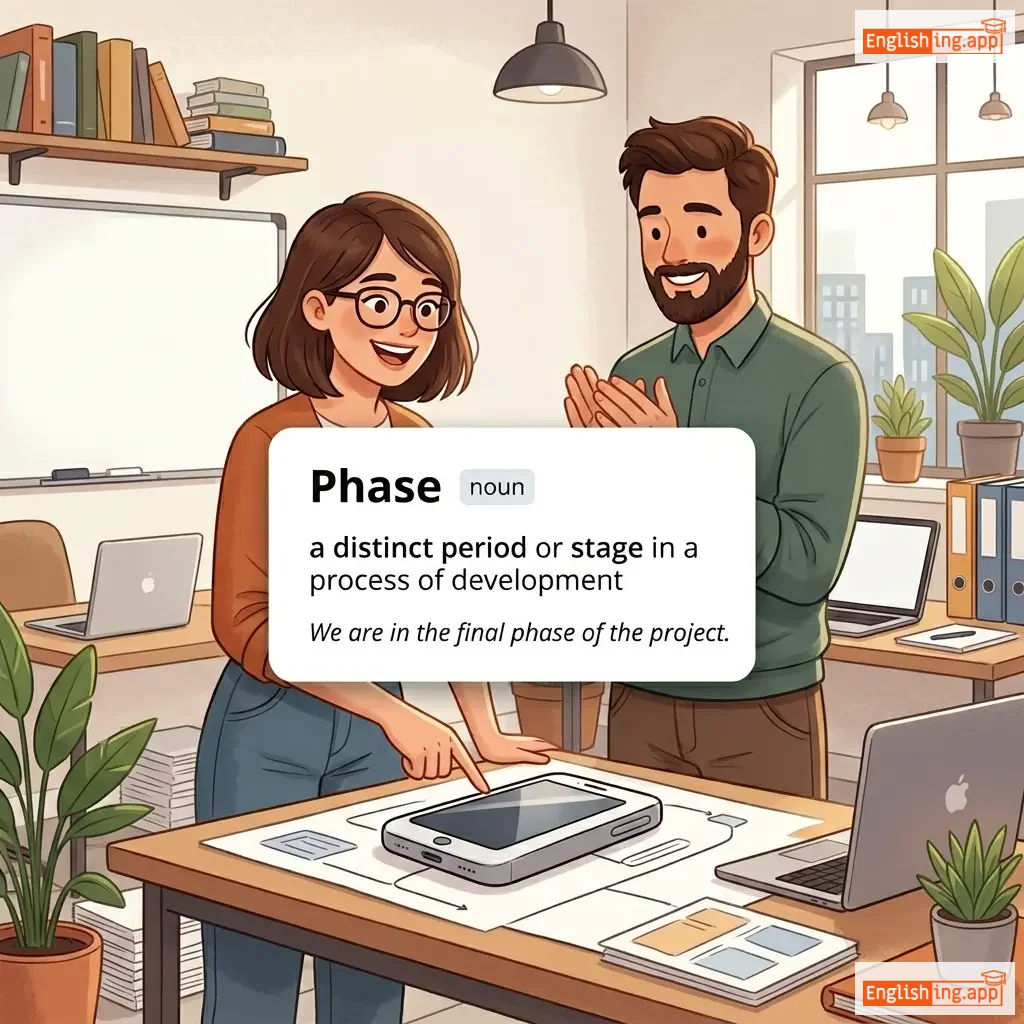
Phase definition card — visual illustration of the meaning
noun
/feɪz/
phase (phase)

a distinct period or stage in a process of development

"We are in the final phase of the project."

"Nous sommes dans la phase finale du projet." (Nous sommes dans la phase finale du projet.)
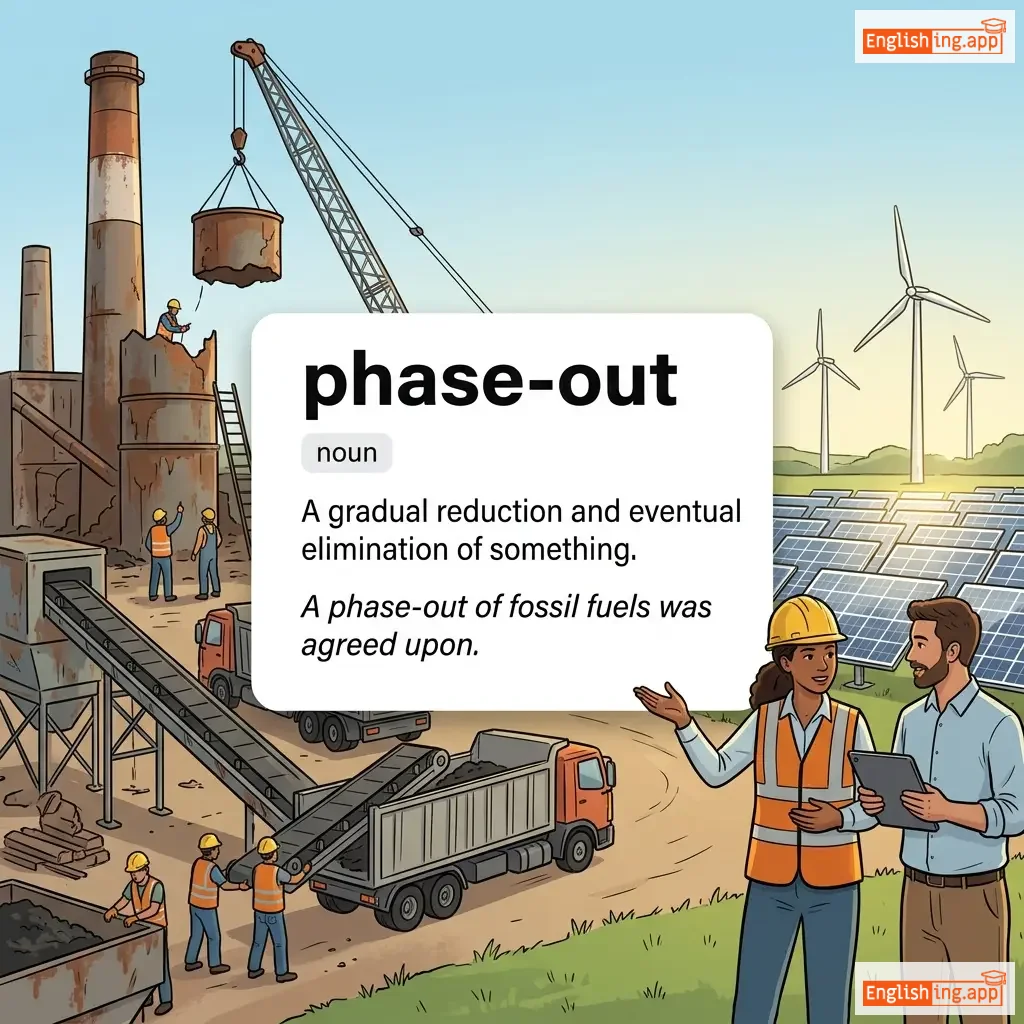
phase-out definition card — visual illustration of the meaning
noun
ˈfeɪz.aʊt
suppression progressive (suppression progressive)

A gradual reduction and eventual elimination of something.

"A phase-out of fossil fuels was agreed upon."

"Il a été convenu de la suppression progressive des combustibles fossiles." (Il a ete convenu de la suppression progressive des combustibles fossiles.)
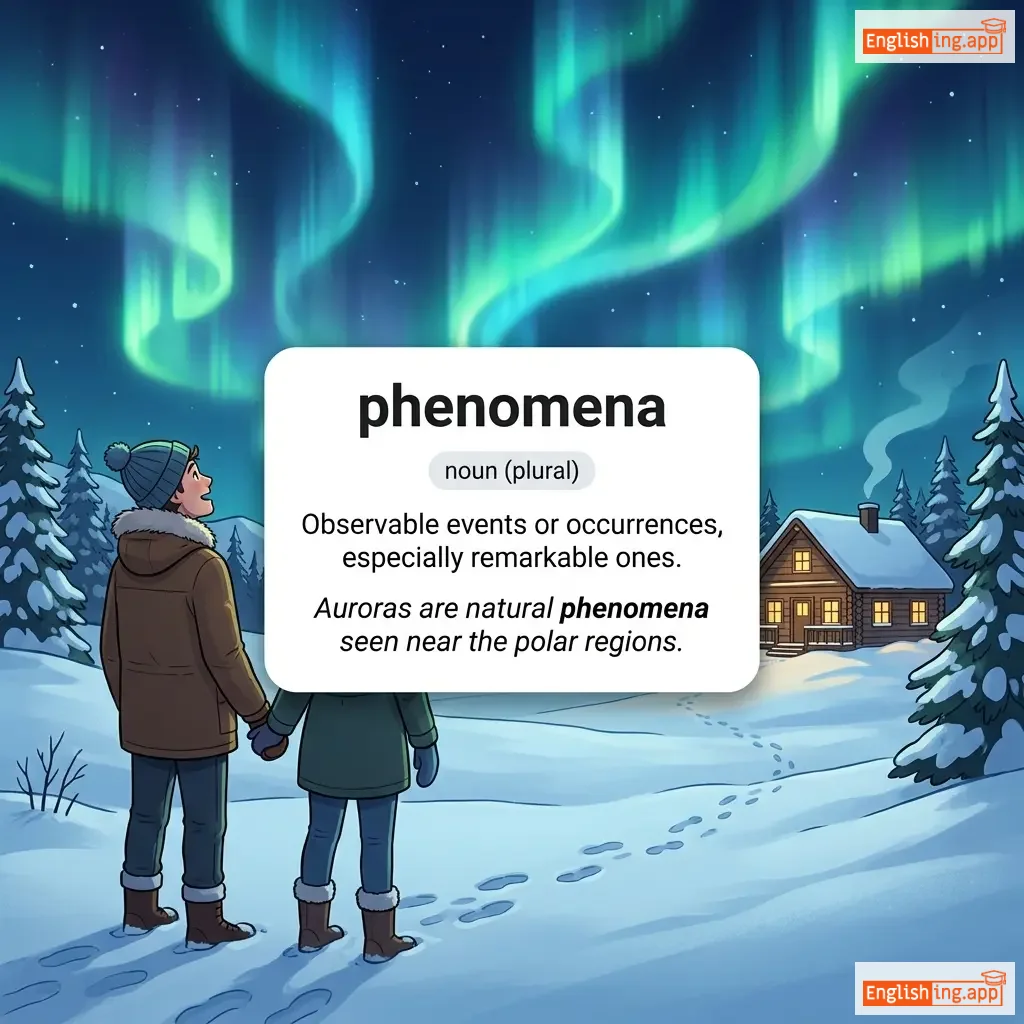
phenomena definition card — visual illustration of the meaning
noun (plural)
/fəˈnɒmɪnə/
phénomènes (phenomenes)

Observable events or occurrences, especially remarkable ones.

"Auroras are natural phenomena seen near the polar regions."

"Les aurores sont des phénomènes naturels observés près des régions polaires." (Les aurores sont des phenomenes naturels observes pres des regions polaires.)
adjective
/fəˈnɒmɪnəl/
phénoménal (phenomenal)

extraordinary, remarkable, or exceptional in a way that is very impressive

"The team achieved phenomenal success in the tournament."

"L'équipe a obtenu un succès phénoménal dans le tournoi." (L'équipe a obtenu un succès phénoménal dans le tournoi.)
noun
/fəˈnɒmɪnən/
phénomène (phenomene)

an observable event, fact, or occurrence, often unusual or remarkable

"The Northern Lights are a natural phenomenon."

"Les Aurores boréales sont un phénomène naturel." (Les aurores boreales sont un phenomene naturel.)
noun
/ˈfaɪəl/
petite fiole (petite fiole)

a small glass container for liquids, especially medicines

"The doctor gave her a phial of medicine."

"Le médecin lui a donné un flacon de médicament." (Le médecin lui a donné un flacon de médicament.)
verb
/fɪˈlændər/
flirter (flirter)

to engage in casual or frivolous romantic or sexual relationships

"He was known to philander with many women in town."

"Il était connu pour flirter avec de nombreuses femmes en ville." (Il était connu pour flirter avec de nombreuses femmes en ville.)
noun
/fɪˈlændərər/
volage (volage)

a man who habitually engages in casual romantic or sexual affairs

"The politician was exposed as a notorious philanderer."

"Le politicien a été exposé comme un célèbre volage." (Le politicien a été exposé comme un célèbre volage.)
adjective
/ˌfɪl.ænˈθrɒp.ɪk/
philanthropique (philanthropique)

showing concern for the welfare of others; generous and charitable

"She is known for her philanthropic activities in the city."

"Elle est connue pour ses activités philanthropiques dans la ville." (Elle est connue pour ses activites philanthropiques dans la ville.)
noun
/fɪˈlæn.θrə.pɪst/
philanthrope (philanthrope)

a person who seeks to promote the welfare of others, especially by donating money to good causes

"The philanthropist donated millions to build schools in rural areas."

"Le philanthrope a fait don de millions pour construire des écoles dans les zones rurales." (Le philanthrope a fait don de millions pour construire des écoles dans les zones rurales.)
noun
/fɪˈlæn.θrə.pi/
philanthropie (philanthropie)

the desire to promote the welfare of others, often expressed by the generous donation of money to good causes

"Philanthropy has helped improve healthcare in many developing countries."

"La philanthropie a contribué à améliorer les soins de santé dans de nombreux pays en développement." (La philanthropie a contribué à améliorer les soins de santé dans de nombreux pays en développement.)
noun
/fɪˈlæt.əl.ɪst/
collectionneur de timbres (collectionneur de timbres)

a person who collects or studies postage stamps

"The philatelist spent years building a rare stamp collection."

"Le philatéliste a passé des années à constituer une collection rare de timbres." (Le philatéliste a passé des années à constituer une collection rare de timbres.)
noun
/fɪˈlæt.əl.i/
philatélie (philatelie)

the collection and study of postage stamps

"Philately is a hobby enjoyed by people of all ages."

"La philatélie est un passe-temps apprécié des personnes de tous âges." (La philatelie est un passe-temps apprecie des personnes de tous ages.)
adjective
/ˌfɪl.hɑːrˈmɒn.ɪk/
relatif à un orchestre symphonique (relatif à un orchestre symphonique)

relating to a symphony orchestra or its music

"The philharmonic orchestra performed a stunning rendition of Beethoven's Ninth Symphony."

"L'orchestre philharmonique a réalisé une interprétation impressionnante de la Neuvième Symphonie de Beethoven." (L'orchestre philharmonique a réalisé une interprétation impressionnante de la Neuvième Symphonie de Beethoven.)
noun
/ˈfɪl.ɪ.staɪn/
personne indifférente ou hostile à la culture et aux arts (personne indifferente ou hostile a la culture et aux arts)

a person who is indifferent or hostile to culture and the arts

"He was criticized as a philistine for dismissing modern art."

"Il a été critiqué comme un philistin pour avoir rejeté l'art moderne." (Il a ete critique comme un philistin pour avoir rejete l'art moderne.)
noun
/ˈfɪl.ə.dʒɪ.nɪst/
personne qui aime ou admire les femmes (personne qui aime ou admire les femmes)

a person who loves or admires women

"As a known philogynist, he advocated for women's education."

"En tant que philogyniste connu, il a plaidé en faveur de l'éducation des femmes." (En tant que philogyniste connu, il a plaidé en faveur de l'éducation des femmes.)
noun
/fɪˈlɒl.ə.dʒɪst/
philologue (philologue)

a person who studies languages and their history

"The philologist analyzed ancient texts to understand language evolution."

"Le philologue a analysé des textes anciens pour comprendre l'évolution du langage." (Le philologue a analyse des textes anciens pour comprendre l'evolution du langage.)
noun
/fɪˈlɒl.ə.dʒi/
l'étude de la langue dans les sources historiques écrites ; linguistique (l'etude de la langue dans les sources historiques ecrites; linguistique)

the study of language in written historical sources; linguistics

"She devoted her career to philology, researching ancient manuscripts."

"Elle a consacré sa carrière à la philologie, en recherchant des manuscrits anciens." (Elle a consacre sa carriere a la philologie, en recherchant des manuscrits anciens.)
noun
/fɪˈlɒsəfə/
philosophe (philosophe)

a person engaged in the study of philosophy or in serious thinking about fundamental questions

"Socrates was a famous philosopher of ancient Greece."

"Socrate était un philosophe célèbre de la Grèce antique." (Socrate etait un philosophe celebre de la Grece antique.)
adjective
/ˌfɪl.əˈsɒf.ɪ.kəl/
philosophique (philosophik)

relating to the study of the fundamental nature of knowledge, reality, and existence

"She maintained a calm and philosophical attitude during the crisis."

"Elle a gardé une attitude calme et philosophique pendant la crise." (Elle a gardé une attitude calme et philosophique pendant la crise.)
verb
/fɪˈlɒs.ə.faɪz/
philosopher (philosopher)

to think or talk about the fundamental nature of knowledge, reality, and existence

"He likes to philosophize about life and its meaning."

"Il aime philosopher sur la vie et son sens." (Il aime philosopher sur la vie et son sens.)
noun
/fɪˈlɒs.ə.fi/
philosophie (philosophie)

the study of the fundamental nature of knowledge, reality, and existence

"Her philosophy emphasizes kindness and empathy."

"Sa philosophie met l'accent sur la gentillesse et l'empathie." (Sa philosophie met l'accent sur la gentillesse et l'empathie.)
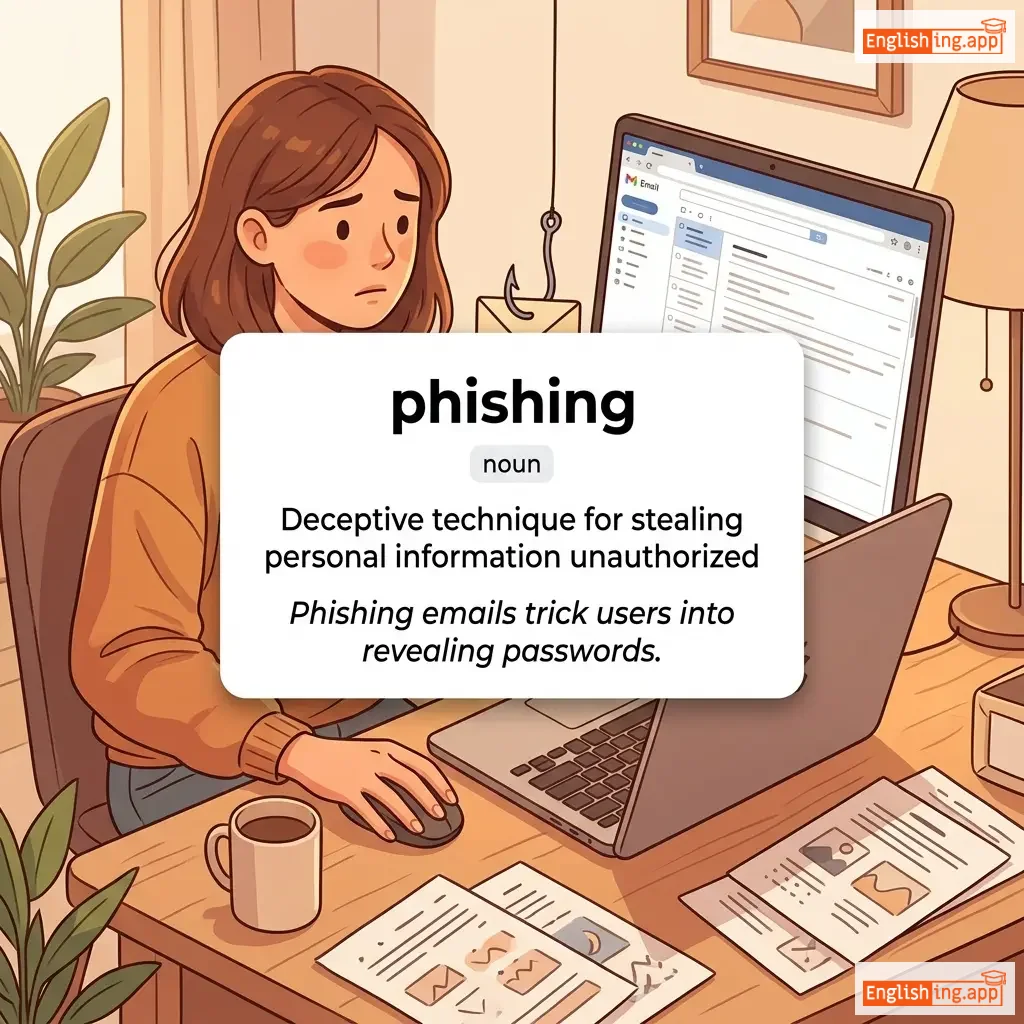
phishing definition card — visual illustration of the meaning
noun
/ˈfɪʃ.ɪŋ/
vol d'informations frauduleuses (vol d'informations frauduleuses)

Deceptive technique for stealing personal information unauthorized

"Phishing emails trick users into revealing passwords."

"Les e-mails de phishing trompent les utilisateurs pour qu'ils révèlent des mots de passe." (Les e-mails de phishing trompent les utilisateurs pour qu'ils révèlent des mots de passe.)
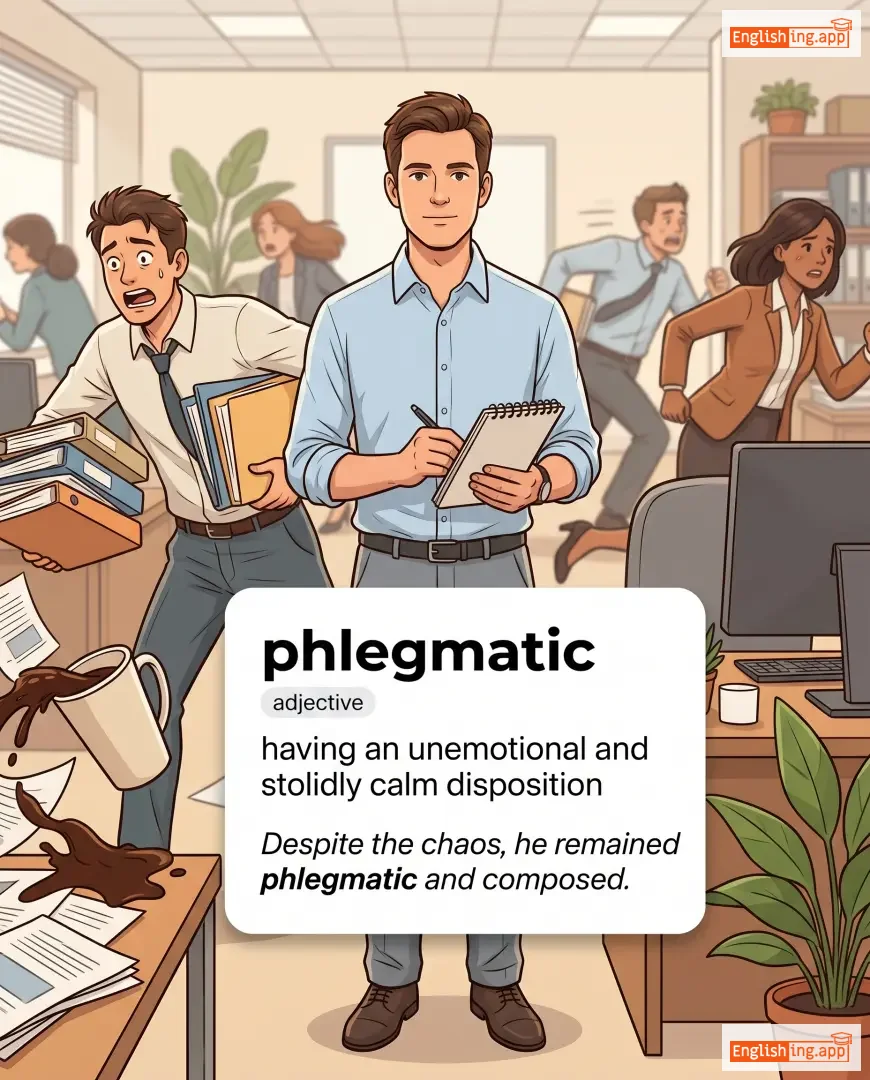
phlegmatic definition card — visual illustration of the meaning
adjective
/flɛgˈmæt.ɪk/
phlegmatique (phlegmatique)

having an unemotional and stolidly calm disposition

"Despite the chaos, he remained phlegmatic and composed."

"Malgré le chaos, il est resté flégmatique et composé." (Malgre le chaos, il est reste phlegmatique et compose.)
noun
/ˈfəʊ.bi.ə/
phobie (phobie)

an extreme or irrational fear of something

"She has a phobia of heights and avoids tall buildings."

"Elle a une phobie des hauteurs et évite les grands bâtiments." (Elle a une phobie des hauteurs et évite les grands bâtiments.)
phrasal verb
/pɪk ʌp/
ramasser; prendre; apprendre (ramasser; prendre; apprendre)

to lift something; to collect or receive someone or something; to learn or acquire gradually; to improve or increase

"She picked up the book from the floor."

"Elle a ramassé le livre par terre." (Elle a ramasse le livre par terre)
noun
/ˈpɪkəloʊ/
petite flûte (petite flute)

a small flute, higher in pitch than the regular flute

"She played a lively tune on the piccolo during the concert."

"Elle a joué une mélodie vive sur le piccolo pendant le concert." (Elle a joué une mélodie vive sur le piccolo pendant le concert.)
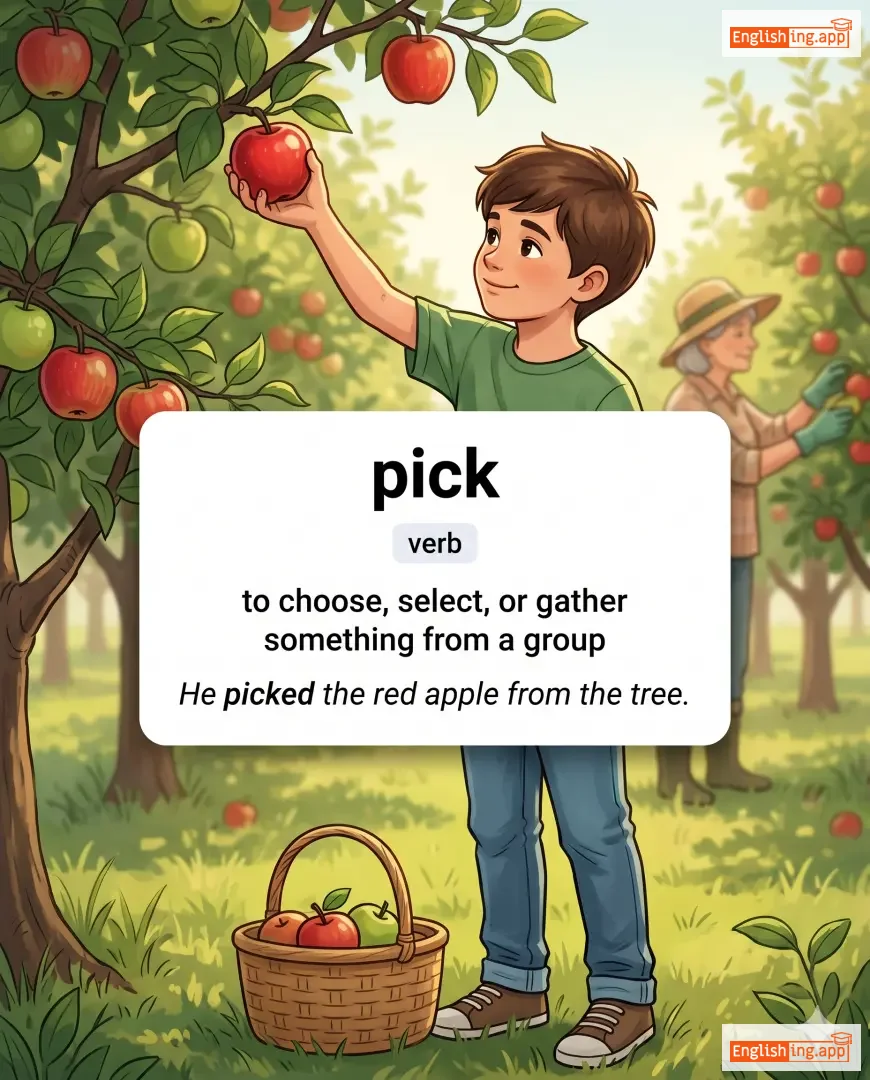
pick definition card — visual illustration of the meaning
verb
/pɪk/
choisir (choisir)

to choose, select, or gather something from a group

"He picked the red apple from the tree."

"Il a choisi la pomme rouge de l'arbre." (Il a choisi la pomme rouge de l'arbre.)
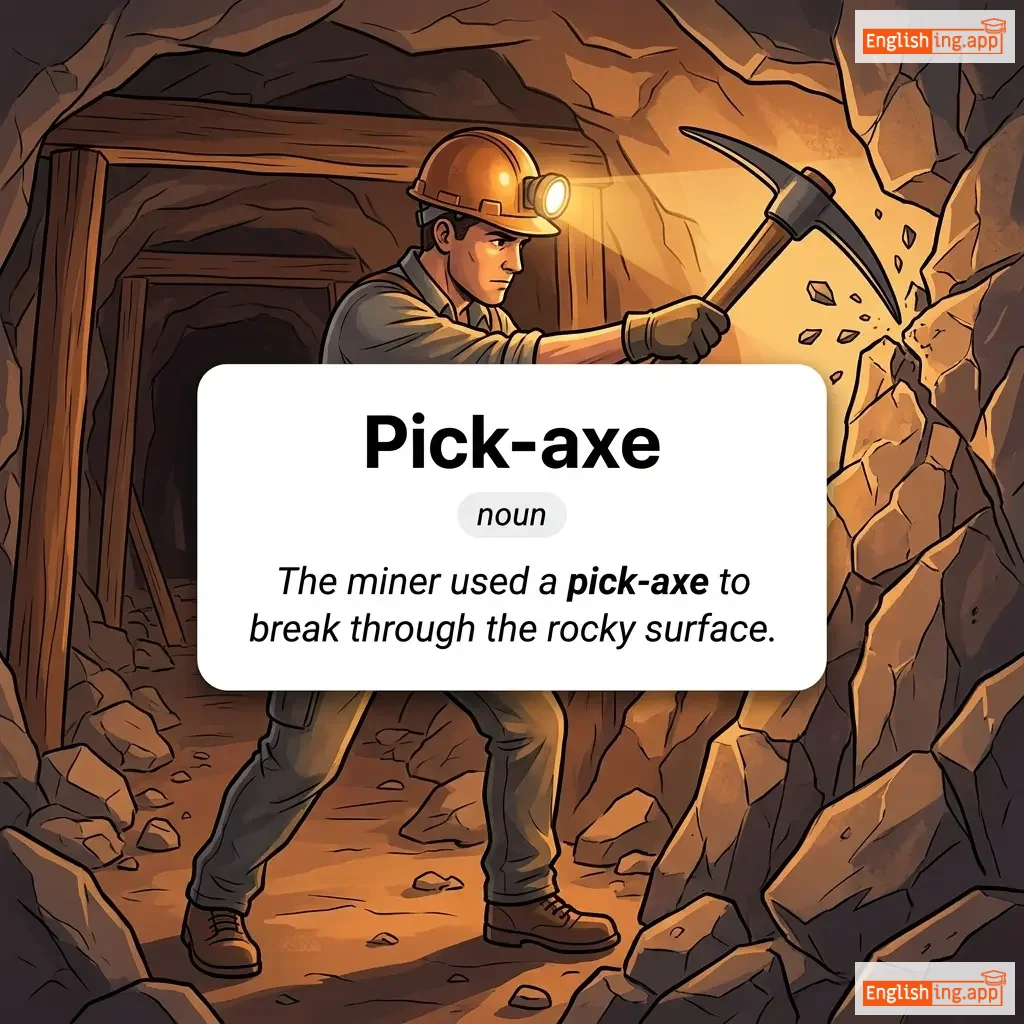
Pick-axe definition card — visual illustration of the meaning
noun
/ˈpɪk.æks/
pioche (piosh)

a tool with a heavy metal head and long handle used for breaking up hard ground or rock

"The miner used a pick-axe to break through the rocky surface."

"Le mineur a utilisé une pioche pour briser la surface rocheuse." (Le mineur a utilisé une pioche pour briser la surface rocheuse.)
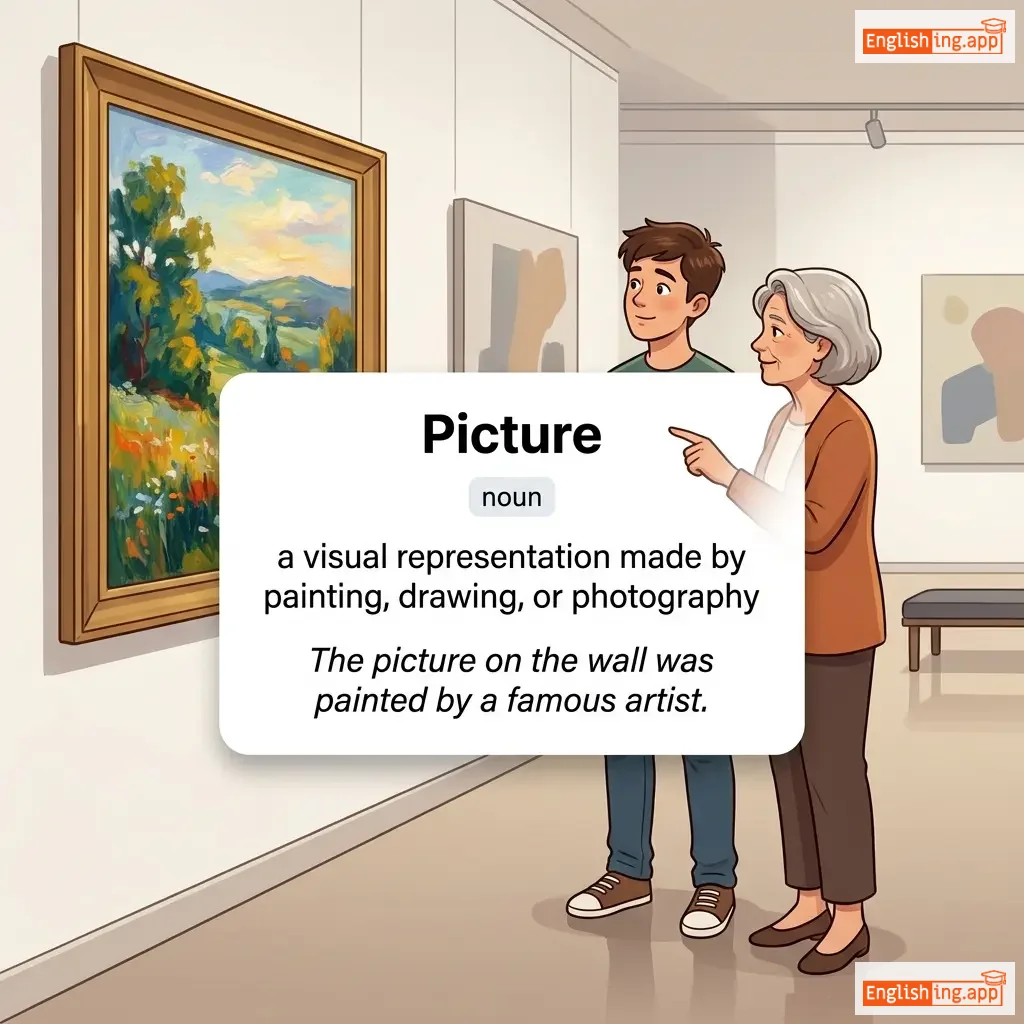
Picture definition card — visual illustration of the meaning
noun
/ˈpɪktʃər/
image (image)

a visual representation made by painting, drawing, or photography

"The picture on the wall was painted by a famous artist."

"L'image sur le mur a été peinte par un artiste célèbre." (L'image sur le mur a ete peinte par un artiste celebre.)
adjective
/ˈpɪdlɪŋ/
insignifiant, trivial (insignifiant, trivial)

trivial or insignificant; very small

"He made a piddling amount of money from that deal."

"Il a gagné une somme insignifiante d'argent avec cette affaire." (Il a gagné une somme insignifiante d'argent avec cette affaire.)
adjective
/ˌpɪkəˈjuːn/
insignifiant, trivial (insignifiant, trivial)

of little value or importance; trivial

"He complained about the picayune details of the contract."

"Il se plaignait des détails triviaux du contrat." (Il se plaignait des détails triviaux du contrat.)
noun
/ˈpɪkʌp/
camionnettes à cabine ouverte ; l'acte de collecter ou d'améliorer quelque chose (camionnettes a cabine ouverte ; l'acte de collecter ou d'amliorer quelque chose)

a small truck with an open back; the act of collecting or improving something

"The company scheduled a pickup for the returned goods."

"L'entreprise a planifié un ramassage pour les produits retournés." (L'entreprise a planifié un ramassage pour les produits retournés.)