词汇表

英语词汇词典 | 单词含义、定义和示例

🍛

Curry

noun/verb
/ˈkʌri/

A dish of meat, vegetables, etc., cooked in a sauce with spices; or to prepare food in such a style.

"She cooked a delicious chicken curry for dinner."

noun
/ˈkɜːr.i liːvz/
咖喱叶 (gālí yè)

aromatic leaves from the curry tree used in South Asian cooking

"Fresh curry leaves add authentic flavor to Indian dishes."

"新鲜的咖喱叶为印度菜肴增添了正宗的风味。" (Xīnxiān de gālí yè wèi yìndù cài yáo zēngtiānle zhèngzōng de fēngwèi.)
noun, verb
/kɜːrs/
诅咒 (zuzhou)

a solemn wish that harm or misfortune should befall someone; a rude or offensive word or phrase; to utter offensive words or wish harm upon someone

"He cursed loudly when he realized he had lost his wallet."

"当他意识到自己丢了钱包时,他大声咒骂。" (Dang ta yishi dao ziji diu le qianbao shi ta dasheng zhouma)
adjective/noun
/ˈkɜːrsɪv/
斜体字 (xieti zi)

Written with characters joined together in a flowing manner.

"The teacher asked students to write the essay in cursive handwriting."

"老师让学生用斜体字写作文。" (Laoshi rang xuesheng yong xieti zi xie zuowen.)
adjective
/ˈkɜːrsəri/
草率 (cǎo shuài)

Hasty and therefore not thorough or detailed.

"He gave the report only a cursory glance before the meeting."

"他在会议前匆忙地扫了一眼报告。" (Tā zài huìyì qián cōngmáng de sǎo le yī yǎn bàogào.)
adjective
/kɜːrt/
简短 (jiǎn duǎn)

Rudely brief in speech or manner.

"His curt reply made everyone uncomfortable."

"他的简短回答让每个人都感到不舒服。" (Tā de jiǎn duǎn huídá ràng měi gè rén dōu gǎndào bù shūfu.)
verb
/kɜːrˈteɪl/
减少 (jiǎnshǎo)

to reduce or limit something, especially something considered undesirable

"The company had to curtail its spending due to budget cuts."

"由于预算削减,公司不得不缩减开支。" (Yóuyú yùsuàn xuējiǎn, gōngsī bùdébù suōjiǎn kāizhī.)
Curtain definition card — visual illustration of the meaning
noun
/ˈkɜː.tən/
窗帘 (chuānglián)

a piece of cloth that hangs down to cover a window or divide a room

"She pulled back the curtain to let the sunlight in."

"她拉开窗帘,让阳光进来。" (Tā lā kāi chuānglián, ràng yángguāng jìnlái.)
🙇‍♀️

curtsy (kɜːrtsi)

noun/verb
/ˈkɜːrtsi/
屈膝礼 (qūxī lǐ)

a respectful bow made by women by bending the knees with one foot in front of the other

"She gave a quick curtsy before leaving the stage."

"她在离开舞台前做了一个快速的屈膝礼。" (Tā zài líkāi wǔtái qián zuòle yīgè kuàisù de qūxī lǐ.)
noun
/kɜːv/
曲线 (quxian)

a smooth, continuous line that bends without angles

"The road curved sharply to the left."

"道路急转弯向左。" (daolu ji zhuanwan xiang zuo.)
adjective
/ˈkʌsɪd/
倔强 (juejiang)

Annoyingly stubborn or difficult.

"He was too cussed to admit his mistake."

"他太倔强,无法承认自己的错误。" (Ta tai juejiang, wu fa chengren ziji de cuowu.)
noun
/ˈkʌstərd ˈæpəl/
奶油苹果 (nǎiyóu píngguǒ)

a tropical fruit with sweet creamy white flesh and black seeds

"The custard apple has a sweet and creamy texture."

"奶油苹果具有甜美和奶油般的口感。" (Nǎiyóu píngguǒ jùyǒu tiánměi hé nǎiyóu bān de kǒugǎn.)
noun
/kʌˈstoʊ.di.ən/
看门人; 守护者; 管理员 (kan-men-ren; shou-hu-zhe; guan-li-yuan)

a person who has responsibility for or looks after something; a caretaker or guardian

"The school custodian ensures that all buildings are clean and secure."

"学校管理员确保所有建筑物干净和安全。" (Xue-xiao guan-li-yuan que-bao suo-you jian-zhu-wu gan-jing he an-quan.)
noun
/ˈkʌs.tə.di/
监护 (jiānhù)

the legal right or responsibility of taking care of someone or something

"The mother was granted custody of her children after the divorce."

"离婚后,母亲获得了对孩子的监护权。" (líhūn hòu, mǔqīn huòdéle duì háizi de jiānhùquán.)
Custom definition card — visual illustration of the meaning
noun
/ˈkʌstəm/
习惯 (xíguàn)

a traditional practice or usual way of behaving in a particular society or place

"Shaking hands is a common custom in many countries."

"握手是许多国家的常见习惯。" (Wòshǒu shì xǔduō guójiā de chángjiàn xíguàn.)
customer definition card — visual illustration of the meaning
noun
/ˈkʌstəmər/
客户 (kèhù)

a person or organization that buys goods or services from a store or business

"The shopkeeper greeted the customer with a smile."

"店主用微笑迎接了客户。" (Diànzhǔ yòng wēixiào yíngjiē le kèhù.)
Customer Retention definition card — visual illustration of the meaning
noun
/ˈkʌs.tə.mər rɪˈten.ʃən/
客户保持 (kèhù bǎochí)

The ability of a company or product to retain its customers over some specified period.

"High customer retention increases business sustainability."

"高客户保持率增加了商业可持续性。" (Gāo kèhù bǎochí lǜ zēngjiāle shāngyè kěchíxù xìng.)
cut definition card — visual illustration of the meaning
verb
/kʌt/
(qie)

To divide into parts with a sharp tool.

"He used a knife to cut the bread."

"他用刀切面包。" (Tā yòng dāo qiē miànbāo.)
adjective
/kjuːt/
可爱 (ke ai)

attractive in a pretty or endearing way

"That puppy is so cute!"

"那只小狗真可爱!" (Na zhi xiao gou zhen ke ai!)
noun
/ˈkʌt.lət/
炸肉饼 (zha ròu bǐng)

a small piece of meat, especially veal or lamb, for frying or grilling

"She served delicious chicken cutlets for dinner."

"她为晚餐提供了美味的炸鸡肉饼。" (Tā wèi wǎncān tígōngle měiwèi de zhá jīròu bǐng.)
adjective
/ˈkʌtɪŋ/
尖锐 (jianrui)

sharp or severe, often used to describe remarks or actions

"Her cutting remarks made everyone feel uncomfortable."

"她的尖锐评论让每个人都感到不舒服。" (Ta de jianrui pinglun rang meige ren dou gandao bu shufu.)
cutting-edge definition card — visual illustration of the meaning
adjective
ˈkʌtɪŋ ˌɛdʒ
前沿, 创新, 尖端技术 (qián yán, chuàng xīn, jiān duān jì shù)

The most advanced or innovative; at the forefront of development.

"This company develops cutting-edge technology."

"这家公司开发尖端技术。" (Zhè jiā gōngsī kāifā jiānduān jìshù.)
cybernetics definition card — visual illustration of the meaning
noun
ˌsaɪ.bəˈnet.ɪks
控制论 (kongzhilun)

The science of communications and automatic control systems in both machines and living things.

"Cybernetics plays a crucial role in artificial intelligence."

"控制论在人工智能中起着至关重要的作用。" (Kongzhilun zai rengong zhinen zhong qizhe zhiguan zhongyao de zuoyong.)
cybersecurity definition card — visual illustration of the meaning
noun
ˌsaɪ.bə.sɪˈkjʊə.rɪ.ti
网络安全 (saibo xi ku li di)

The practice of protecting systems, networks, and programs from digital attacks

"Cybersecurity ensures safe digital operations."

"网络安全确保数字化运营的安全。" (wangluo anquan quebao shuzi hua yunying de anquan)
noun/verb
/ˈsaɪkl/
自行车 / 循环 (zìxíngchē / xúnhuán)

a series of events that repeat in the same order; or to ride a bicycle

"She cycles to school every day."

"她每天骑自行车去学校。" (Tā měitiān qí zìxíngchē qù xuéxiào.)
noun/adjective
/ˈsaɪklɔɪd/
摆线 (bǎi xiàn)

a curve traced by a point on the rim of a circle as it rolls along a straight line

"The cycloid is often studied in mathematics and physics."

"摆线常在数学和物理学中研究。" (Bǎixiàn cháng zài shùxué hé wùlǐxué zhōng yánjiū.)
noun
/ˈsaɪkloʊn/
气旋 (qixuan)

a large-scale air mass that rotates around a strong center of low atmospheric pressure; a violent tropical storm

"The cyclone caused severe flooding along the coast."

"气旋在沿海地区造成了严重的洪水。" (qixuan zai yanhai diqu zaocheng le yanzhong de hongshui)
noun
/ˈsɪɡnət/
天鹅幼崽 (tiāné yòuzǎi)

a young swan

"The cygnet swam closely behind its mother."

"小天鹅在母亲后面游泳。" (Xiǎo tiān'é zài mǔqīn hòumiàn yóuyǒng.)
noun
/ˈsɪnɪk/
愤世嫉俗者 (fènshì jì sú zhě)

a person who believes that people are motivated purely by self-interest rather than acting for honorable reasons

"He was too much of a cynic to believe in true love."

"他太愤世嫉俗了,无法相信真正的爱。" (Tā tài fènshì jì sú le, wúfǎ xiāngxìn zhēnzhèng de ài.)
adjective
/ˈsɪn.ɪ.kəl/
愤世嫉俗 (fènshì jìsú)

Believing that people are motivated by self-interest; distrustful of human sincerity or integrity.

"She was cynical about the politician's promises."

"她对政治家的承诺持愤世嫉俗的态度。" (Tā duì zhèngzhìjiā de chéngnuò chí fènshì jìsú de tàidù.)
noun
/ˈsɪn.ɪˌsɪz.əm/
愤世嫉俗 (fèn shì jí sú)

An inclination to believe that people are motivated purely by self-interest; skepticism.

"His cynicism made it hard for him to trust anyone."

"他的愤世嫉俗让他很难相信任何人。" (Tā de fèn shì jí sú ràng tā hěn nán xiāngxìn rènhé rén.)
noun
/ˈsaɪ.nəˌʃʊr/
众人焦点 (zhòng rén jiāo diǎn)

A person or thing that is the center of attention or admiration.

"She was the cynosure of all eyes at the party."

"她是派对上所有人焦点。" (Tā shì pàiduì shàng suǒyǒu rén jiāodiǎn.)
verb
/ˈdæb.əl/
浅尝辄止 (qiǎnchángzhézhǐ)

To take part in an activity in a casual or superficial way.

"He dabbled in painting during his college days."

"他在大学时涉足绘画。" (Tā zài dàxué shí shèzú huìhuà.)
noun
/dəˈkɔɪt/
强盗 (qiángdào)

a member of an armed gang of robbers; a bandit, especially in India and Myanmar

"The village was terrorized by a gang of dacoits who robbed travelers."

"这个村庄被一群强盗所恐吓,他们抢劫了旅行者。" (Zhège cūnzhuāng bèi yī qún qiángdào suǒ kǒnghè, tāmen qiǎngjié le lǚxíng zhě.)
dad definition card — visual illustration of the meaning
noun
/dæd/
爸爸 (bàba)

an informal term for father

"My dad taught me how to ride a bike."

"我爸爸教我骑自行车。" (Wǒ bàba jiāo wǒ qí zìxíngchē.)
noun
/ˈdæf.ə.dɪl/
水仙花 (shuǐ xiān huā)

A bright yellow spring flower with a trumpet-shaped center, symbolizing rebirth and new beginnings

"The daffodils bloomed early this spring in the meadow."

"这些水仙花在这个春天早早在草地上盛开。" (Zhèxiē shuǐxiān huā zài zhège chūntiān zǎo zǎo zài cǎodì shàng shèngkāi.)
adjective
/dæft/
愚蠢 (yuchun)

Silly or foolish.

"It was a daft idea to go hiking without water."

"没有水去远足是一个愚蠢的想法。" (Meiyou shui qu yuanzu shi yige yuchun de xiangfa.)
noun
/ˈdæɡər/
匕首 (bǐshǒu)

a short knife with a pointed and edged blade, used as a weapon

"The assassin concealed a dagger beneath his cloak."

"刺客将匕首藏在他的披风下。" (cìkè jiāng bǐshǒu cáng zài tā de pīfēng xià)
noun
/dəˈɡerəˌtaɪp/
古老的照片 (gǔlǎo de zhàopiàn)

An early type of photograph produced on a silver or silver-covered copper plate.

"The museum displayed a rare daguerreotype of Abraham Lincoln."

"博物馆展出了一张亚伯拉罕·林肯的稀有达盖尔类型照片。" (Bówùguǎn zhǎnchūle yī zhāng yàbólāhǎn línkěn de xīyǒu dágàilè lèixíng zhàopiàn.)
noun
/ˈdeɪ.li.ə/
大丽花 (dà lì huā)

a garden plant with brightly colored flowers that bloom in summer and autumn

"She planted colorful dahlias in her garden last summer."
"她在去年夏天在花园里种了五颜六色的大丽花。" (Tā zài qùnián xiàtiān zài huāyuán lǐ zhòngle wǔyán liùsè de dà lì huā.)
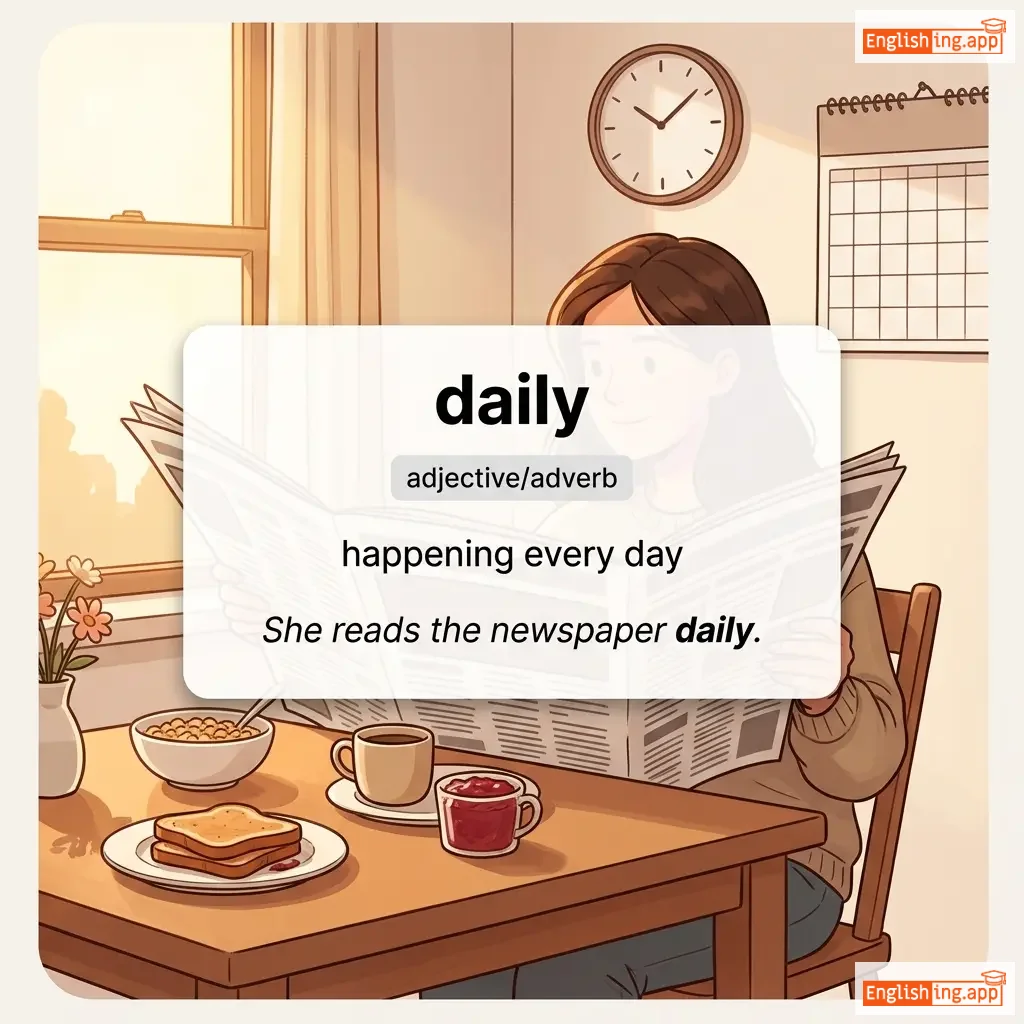
daily definition card — visual illustration of the meaning
adjective/adverb
/ˈdeɪli/
每日的 (meiri de)

happening every day

"She reads the newspaper daily."

"她每天读报纸。" (Ta meitian du baozhi.)
adjective
/ˈdeɪnti/
精致而美丽 (jingzhi er meili)

Delicately small, pretty, and often considered elegant.

"She wore a dainty necklace made of pearls."

"她戴着一条由珍珠做的精致项链。" (Tā dàizhe yītiáo yóu zhēnzhū zuò de jīngzhì xiàngliàn.)
noun
/ˈdɛəri/
奶制品厂 (nǎi zhì pǐn chǎng)

a place where milk and milk products are produced or sold

"They visited the local dairy for fresh milk."

"他们去了当地的奶制品厂买新鲜牛奶。" (Tāmen qùle dāngdì de nǎi zhì pǐn chǎng mǎi xīnxiān niúnǎi.)
noun
/ˈdeɪ.ɪs/ or /ˈdeɪ.əs/
讲台 (jiangtai)

A raised platform in a hall or room, usually where speakers or honored guests sit.

"The speaker stood on the dais to address the audience."

"演讲者站在讲台上向观众发表演讲。" (Yanjiangzhe zhan zai jiangtai shang xiang guanzhong fabiao yanjiang.)
noun
/ˈdæliəns/
短暂的浪漫关系 (duǎnzhàn de làngmàn guānxì)

A casual romantic or sexual relationship; also frivolous or playful behavior.

"Their dalliance during the summer was brief but intense."

"他们夏季的短暂关系虽然简短,但很强烈。" (Tāmen xiàjì de duǎnzhàn guānxì suīrán jiǎnduǎn, dàn hěn qiángliè.)
verb
/ˈdæli/
浪费时间 (làngfèi shíjiān)

To act or move slowly; to waste time; also to engage in a casual romantic relationship.

"He dallied in the garden instead of starting his work."
"他在花园里浪费时间,而不是开始工作。" (Tā zài huāyuán lǐ làngfèi shíjiān, ér bùshì kāishǐ gōngzuò.)
🏞️

Dam (dæm)

noun
/dæm/
水坝 (shuǐbà)

a barrier built to hold back water and raise its level

"The dam provides electricity to nearby towns."

"水坝为附近的城市提供电力。" (Shuǐbà wèi fùjìn de chéngshì tígōng diànlì.)
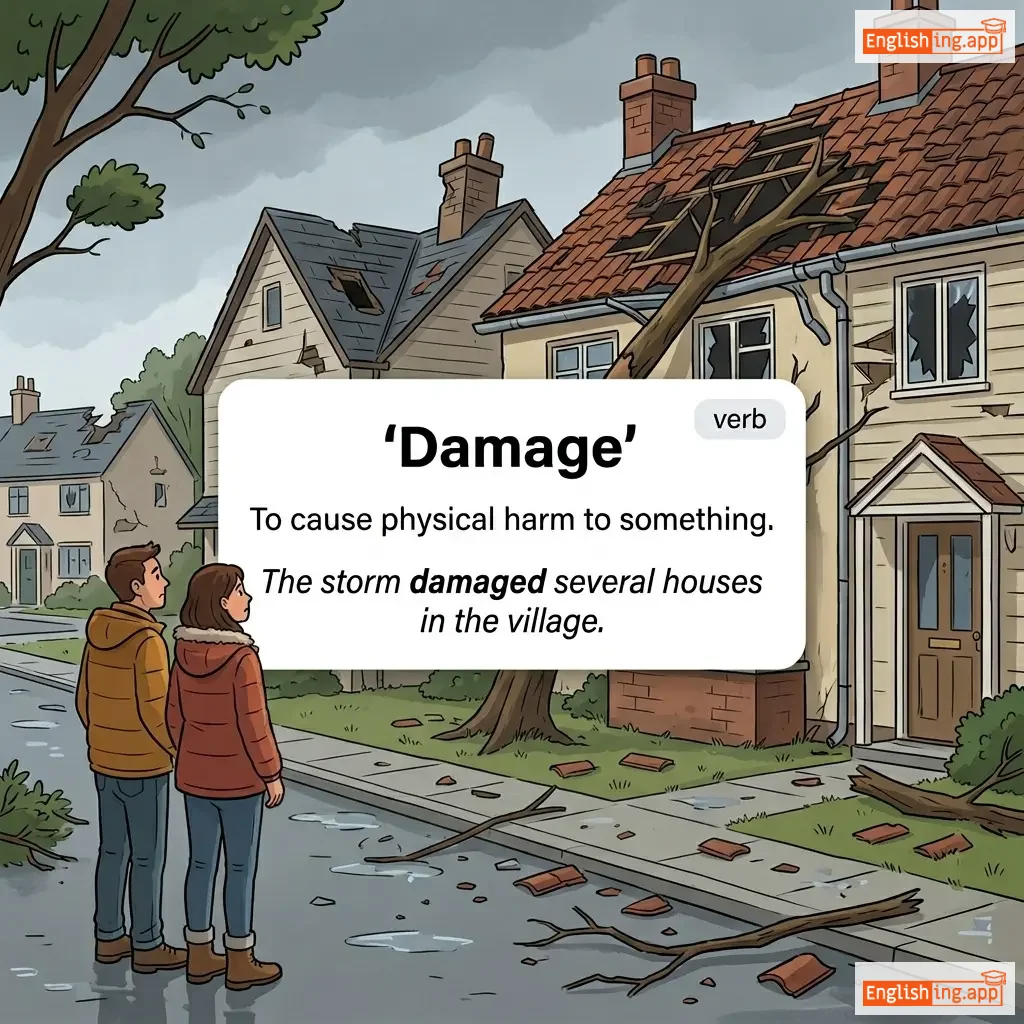
Damage definition card — visual illustration of the meaning
verb
/ˈdæmɪdʒ/
损坏 (sǔnhuài)

To cause physical harm to something.

"The storm damaged several houses in the village."

"风暴破坏了村里的几所房子。" (Fēngbào pòhuài le cūn lǐ de jǐ suǒ fángzi.)
adjective
/ˈdæmɪdʒɪŋ/

causing harm or injury

"The storm caused damaging effects to the crops."

😡

damn

verb
/dæm/

to condemn or criticize strongly; used as an expletive to express anger or emphasis

"He damned the unfair system in his speech."