Vocabulaires

Découvrez, apprenez et maîtrisez le vocabulaire anglais

noun/verb
/ˈkʌri/
curry (curry)

A dish of meat, vegetables, etc., cooked in a sauce with spices; or to prepare food in such a style.

"She cooked a delicious chicken curry for dinner."

"Elle a préparé un délicieux curry de poulet pour le dîner." (Elle a préparé un délicieux curry de poulet pour le dîner.)
noun
/ˈkɜːr.i liːvz/
feuilles de curry (feuilles de curry)

aromatic leaves from the curry tree used in South Asian cooking

"Fresh curry leaves add authentic flavor to Indian dishes."

"Les feuilles de curry fraîches ajoutent une saveur authentique aux plats indiens." (Les feuilles de curry fraiches ajoutent une saveur authentique aux plats indiens.)
noun, verb
/kɜːrs/
malédiction (malediction)

a solemn wish that harm or misfortune should befall someone; a rude or offensive word or phrase; to utter offensive words or wish harm upon someone

"He cursed loudly when he realized he had lost his wallet."

"Il a juré bruyamment quand il s’est rendu compte qu’il avait perdu son portefeuille." (Il a jure bruyamment quand il s est rendu compte qu il avait perdu son portefeuille)
adjective/noun
/ˈkɜːrsɪv/
écriture cursive (ecriture cursive)

Written with characters joined together in a flowing manner.

"The teacher asked students to write the essay in cursive handwriting."

"Le professeur a demandé aux élèves d'écrire l'essai en écriture cursive." (Le professeur a demande aux eleves d'ecrire l'essai en ecriture cursive.)
adjective
/ˈkɜːrsəri/
superficiel (superficiel)

Hasty and therefore not thorough or detailed.

"He gave the report only a cursory glance before the meeting."

"Il a jeté un coup d'œil superficiel au rapport avant la réunion." (Il a jeté un coup d'œil superficiel au rapport avant la réunion.)
adjective
/kɜːrt/
bref (bref)

Rudely brief in speech or manner.

"His curt reply made everyone uncomfortable."

"Sa réponse brève rendit tout le monde mal à l'aise." (Sa reponse breve rendit tout le monde mal a l'aise.)
verb
/kɜːrˈteɪl/
réduire (reduire)

to reduce or limit something, especially something considered undesirable

"The company had to curtail its spending due to budget cuts."

"L'entreprise a dû réduire ses dépenses en raison des réductions budgétaires." (L'entreprise a dû réduire ses dépenses en raison des réductions budgétaires.)
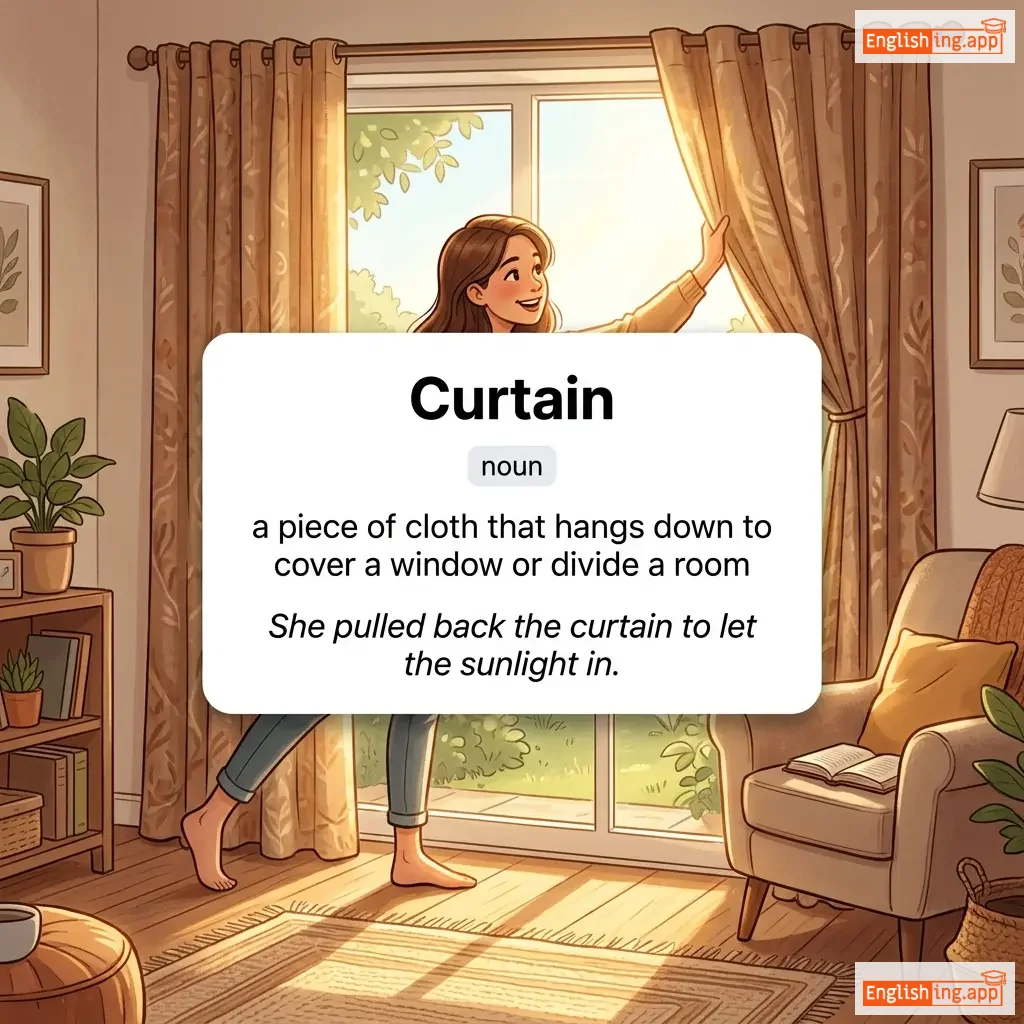
Curtain definition card — visual illustration of the meaning
noun
/ˈkɜː.tən/
rideau (rideau)

a piece of cloth that hangs down to cover a window or divide a room

"She pulled back the curtain to let the sunlight in."

"Elle a tiré le rideau pour laisser entrer la lumière du soleil." (Elle a tiré le rideau pour laisser entrer la lumière du soleil.)
🙇‍♀️

curtsy (kɜːrtsi)

noun/verb
/ˈkɜːrtsi/
révérence (reverans)

a respectful bow made by women by bending the knees with one foot in front of the other

"She gave a quick curtsy before leaving the stage."

"Elle fit une rapide révérence avant de quitter la scène." (Elle fit une rapide reverance avant de quitter la scene.)
noun
/kɜːv/
courbe (courbe)

a smooth, continuous line that bends without angles

"The road curved sharply to the left."

"La route a tourné brusquement à gauche." (La route a tourne brusquement a gauche.)
adjective
/ˈkʌsɪd/
têtu (tetu)

Annoyingly stubborn or difficult.

"He was too cussed to admit his mistake."

"Il était trop têtu pour admettre son erreur." (Il etait trop tetu pour admettre son erreur.)
noun
/ˈkʌstərd ˈæpəl/
pomme à la crème (pomme a la creme)

a tropical fruit with sweet creamy white flesh and black seeds

"The custard apple has a sweet and creamy texture."

"La pomme à la crème a une texture douce et crémeuse." (La pomme à la crème a une texture douce et crémeuse.)
noun
/kʌˈstoʊ.di.ən/
concierge; gardien; gestionnaire (kon-syerj; gar-dyen; jes-tyo-nar)

a person who has responsibility for or looks after something; a caretaker or guardian

"The school custodian ensures that all buildings are clean and secure."

"Le concierge de l'école veille à ce que tous les bâtiments soient propres et sécurisés." (Le kon-syerj de l'ekol ve-yil a ke tu le ba-ti-ment swat pro-pre e se-ku-ri-ze.)
👮‍♂️

Custody (kos-to-di)

noun
/ˈkʌs.tə.di/
garde (garde)

the legal right or responsibility of taking care of someone or something

"The mother was granted custody of her children after the divorce."

"La mère a obtenu la garde de ses enfants après le divorce." (La mère a obtenu la garde de ses enfants après le divorce.)
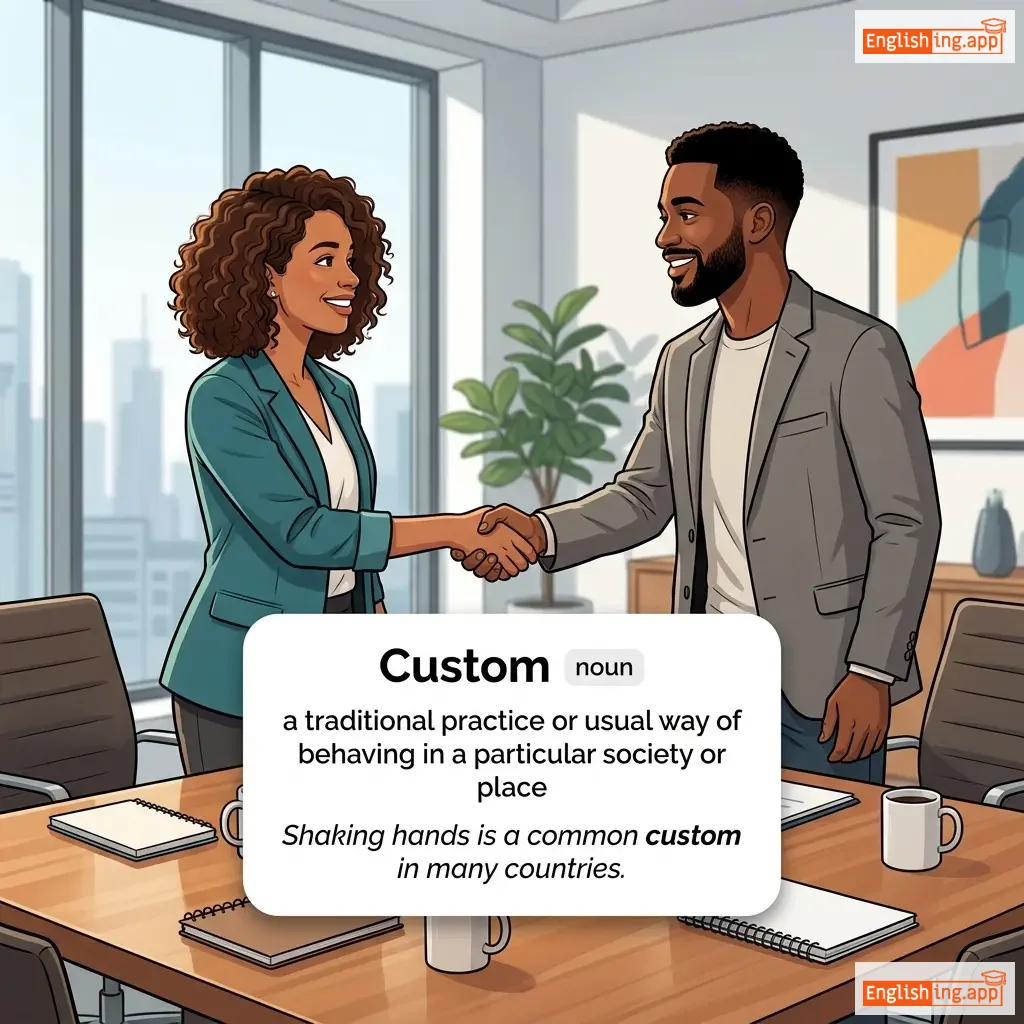
Custom definition card — visual illustration of the meaning
noun
/ˈkʌstəm/
coutume (coutume)

a traditional practice or usual way of behaving in a particular society or place

"Shaking hands is a common custom in many countries."

"Se serrer la main est une coutume courante dans de nombreux pays." (Se serrer la main est une coutume courante dans de nombreux pays.)
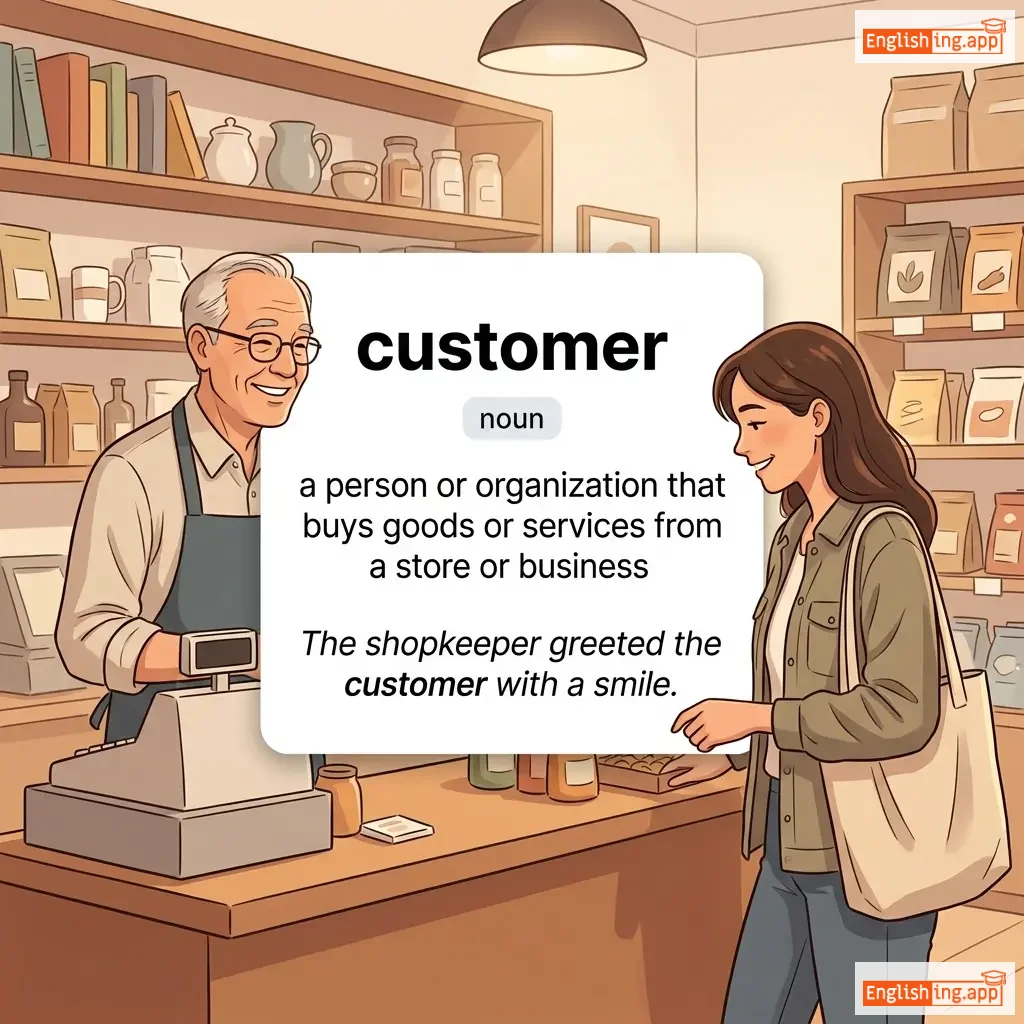
customer definition card — visual illustration of the meaning
noun
/ˈkʌstəmər/
client (klian)

a person or organization that buys goods or services from a store or business

"The shopkeeper greeted the customer with a smile."

"Le commerçant a salué le client avec un sourire." (Le commerçant a salué le client avec un sourire.)
Customer Retention definition card — visual illustration of the meaning
noun
/ˈkʌs.tə.mər rɪˈten.ʃən/
fidélisation des clients (fidelisation des clients)

The ability of a company or product to retain its customers over some specified period.

"High customer retention increases business sustainability."

"Une forte fidélisation des clients augmente la durabilité des entreprises." (Une forte fidélisation des clients augmente la durabilité des entreprises.)
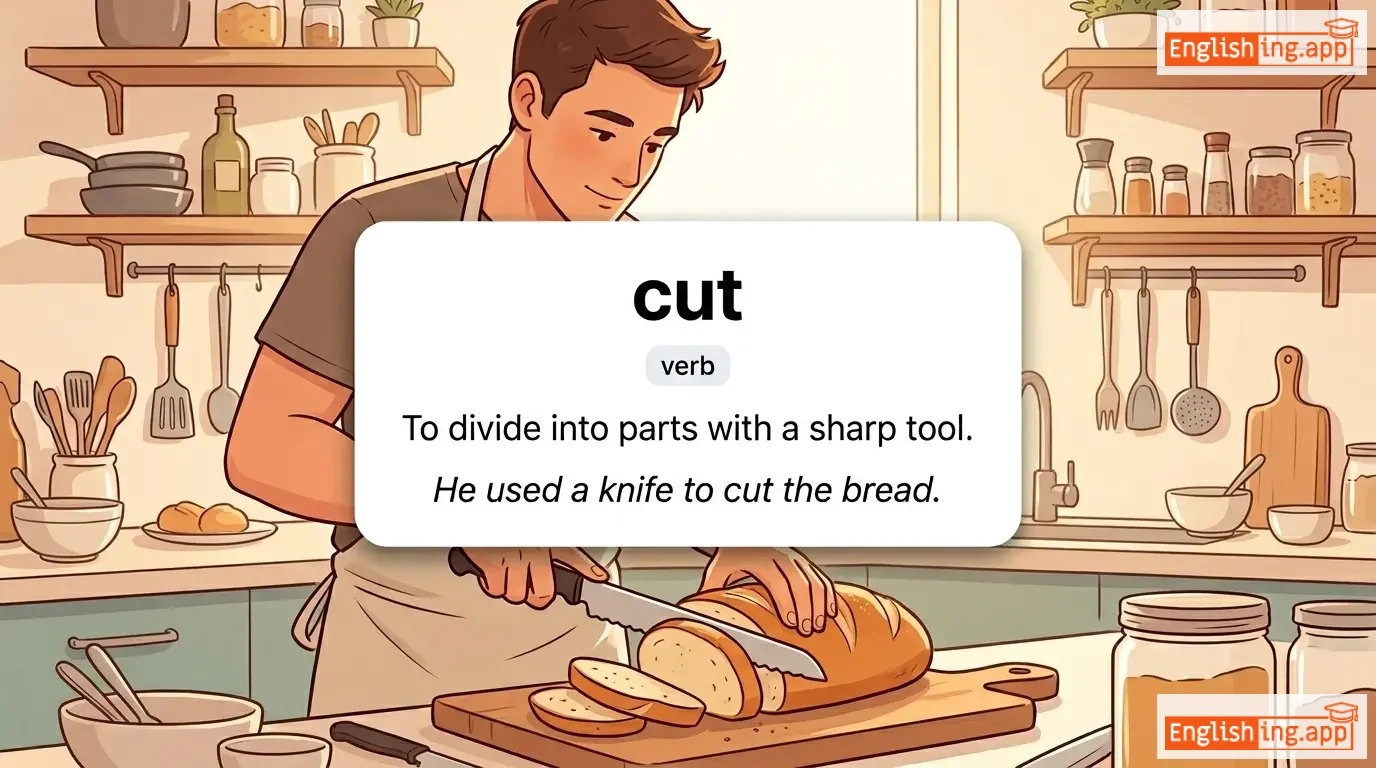
cut definition card — visual illustration of the meaning
verb
/kʌt/
couper (couper)

To divide into parts with a sharp tool.

"He used a knife to cut the bread."

"Il a utilisé un couteau pour couper le pain." (Il a utilisé un couteau pour couper le pain.)
adjective
/kjuːt/
mignon (mignon)

attractive in a pretty or endearing way

"That puppy is so cute!"

"Ce chiot est tellement mignon !" (Ce chiot est tellement mignon !)
noun
/ˈkʌt.lət/
côtelette (cotelette)

a small piece of meat, especially veal or lamb, for frying or grilling

"She served delicious chicken cutlets for dinner."

"Elle a servi de délicieuses côtelettes de poulet pour le dîner." (elle a servi de delicieuses cotelettes de poulet pour le diner)
adjective
/ˈkʌtɪŋ/
tranchant (tranchant)

sharp or severe, often used to describe remarks or actions

"Her cutting remarks made everyone feel uncomfortable."

"Ses remarques acerbes ont mis tout le monde mal à l'aise." (Ses remarques acerbes ont mis tout le monde mal à l'aise.)
cutting-edge definition card — visual illustration of the meaning
adjective
ˈkʌtɪŋ ˌɛdʒ
à la pointe, innovant, technologie de pointe (a la pointe, innovant, technologie de pointe)

The most advanced or innovative; at the forefront of development.

"This company develops cutting-edge technology."

"Cette entreprise développe des technologies de pointe." (Cette entreprise developpe des technologies de pointe.)
cybernetics definition card — visual illustration of the meaning
noun
ˌsaɪ.bəˈnet.ɪks
cybernétique (cybernetique)

The science of communications and automatic control systems in both machines and living things.

"Cybernetics plays a crucial role in artificial intelligence."

"La cybernétique joue un rôle crucial dans l'intelligence artificielle." (La cybernetique joue un role crucial dans l'intelligence artificielle.)
cybersecurity definition card — visual illustration of the meaning
noun
ˌsaɪ.bə.sɪˈkjʊə.rɪ.ti
cybersécurité (cybersecurite)

The practice of protecting systems, networks, and programs from digital attacks

"Cybersecurity ensures safe digital operations."

"La cybersécurité assure des opérations numériques sûres." (La cybersecurite assure des operations numeriques sures.)
noun/verb
/ˈsaɪkl/
vélo / cycle (vélo / cycle)

a series of events that repeat in the same order; or to ride a bicycle

"She cycles to school every day."

"Elle va à l'école à vélo tous les jours." (Elle va à l'école à vélo tous les jours.)
noun/adjective
/ˈsaɪklɔɪd/
courbe cycloïdienne (courbe cycloidienne)

a curve traced by a point on the rim of a circle as it rolls along a straight line

"The cycloid is often studied in mathematics and physics."

"La cycloïde est souvent étudiée en mathématiques et en physique." (La cycloïde est souvent étudiée en mathématiques et en physique.)
noun
/ˈsaɪkloʊn/
cyclone (cyclone)

a large-scale air mass that rotates around a strong center of low atmospheric pressure; a violent tropical storm

"The cyclone caused severe flooding along the coast."

"Le cyclone a provoqué de graves inondations sur la côte." (le cyclone a provoque de graves inondations sur la cote)
noun
/ˈsɪɡnət/
cygneon (cygneon)

a young swan

"The cygnet swam closely behind its mother."

"Le cygneon nageait juste derrière sa mère." (Le cygneon nageait juste derrière sa mère.)
noun
/ˈsɪnɪk/
cynique (sinik)

a person who believes that people are motivated purely by self-interest rather than acting for honorable reasons

"He was too much of a cynic to believe in true love."

"Il était trop cynique pour croire en l'amour véritable." (Il etait trop sinik pour croire en l'amour veritable.)
adjective
/ˈsɪn.ɪ.kəl/
cynique (siniik)

Believing that people are motivated by self-interest; distrustful of human sincerity or integrity.

"She was cynical about the politician's promises."

"Elle était cynique à propos des promesses du politicien." (Elle etait sinik a propos des promesses du politicien.)
noun
/ˈsɪn.ɪˌsɪz.əm/
cynisme (sinisme)

An inclination to believe that people are motivated purely by self-interest; skepticism.

"His cynicism made it hard for him to trust anyone."

"Son cynisme lui rendait difficile de faire confiance à quiconque." (Son cynisme lui rendait difficile de faire confiance a quiconque.)
noun
/ˈsaɪ.nəˌʃʊr/
le centre de toutes les attentions (le centre de toutes les attentions)

A person or thing that is the center of attention or admiration.

"She was the cynosure of all eyes at the party."

"Elle était le centre de toutes les attentions à la fête." (Elle était le centre de toutes les attentions à la fête.)
verb
/ˈdæb.əl/
tâtonner (tatonner)

To take part in an activity in a casual or superficial way.

"He dabbled in painting during his college days."

"Il a dabblé dans la peinture pendant ses années universitaires." (Il a dabblé dans la peinture pendant ses années universitaires.)
noun
/dəˈkɔɪt/
bandit (bandit)

a member of an armed gang of robbers; a bandit, especially in India and Myanmar

"The village was terrorized by a gang of dacoits who robbed travelers."

"Le village a été terrorisé par un gang de bandits qui ont volé les voyageurs." (Le village a été terrorisé par un gang de bandits qui ont volé les voyageurs.)
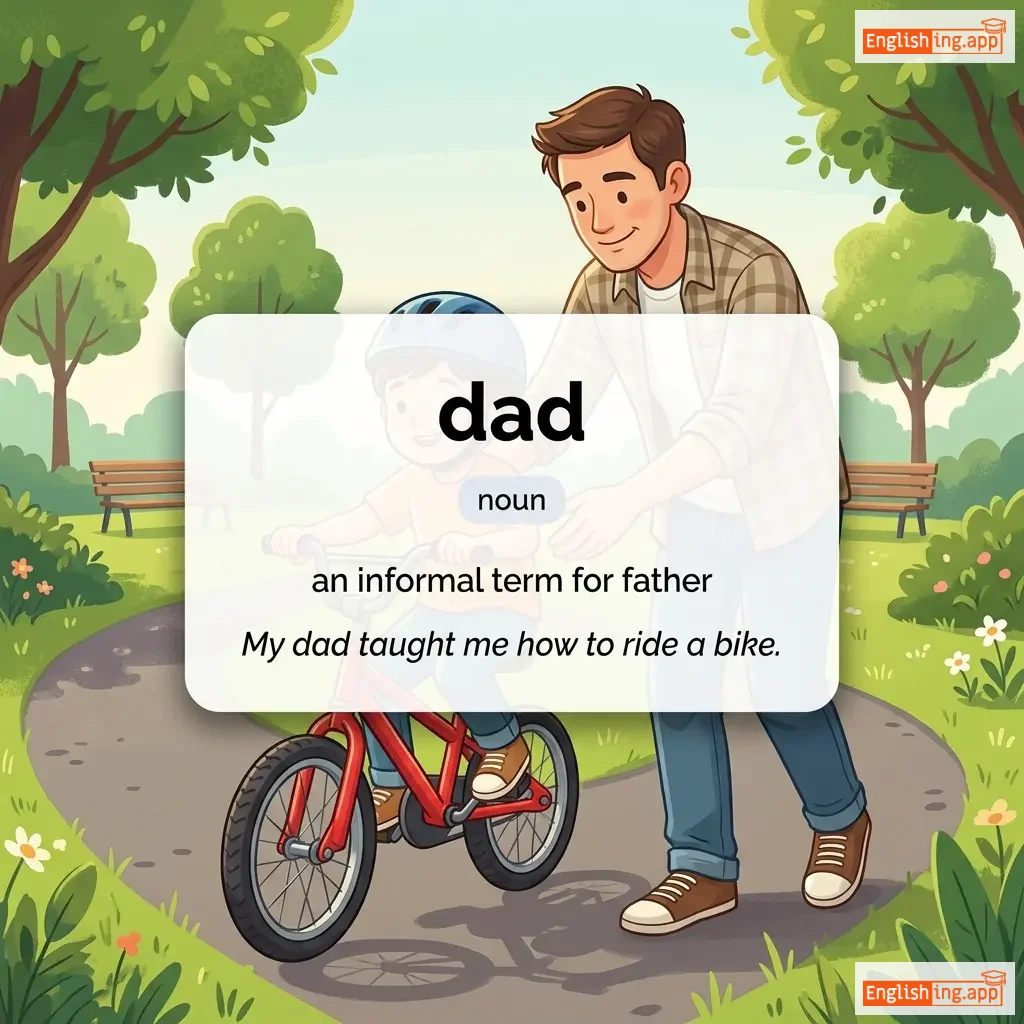
dad definition card — visual illustration of the meaning
noun
/dæd/
papa (papa)

an informal term for father

"My dad taught me how to ride a bike."

"Mon papa m'a appris à faire du vélo." (Mon papa m'a appris à faire du vélo.)
noun
/ˈdæf.ə.dɪl/
jonquille (jonquille)

A bright yellow spring flower with a trumpet-shaped center, symbolizing rebirth and new beginnings

"The daffodils bloomed early this spring in the meadow."

"Les jonquilles ont fleuri tôt ce printemps dans la prairie." (Les jonquilles ont fleuri tôt ce printemps dans la prairie.)
adjective
/dæft/
fou (fou)

Silly or foolish.

"It was a daft idea to go hiking without water."

"C'était une idée folle de partir en randonnée sans eau." (C'était une idée folle de partir en randonnée sans eau.)
noun
/ˈdæɡər/
dague (dague)

a short knife with a pointed and edged blade, used as a weapon

"The assassin concealed a dagger beneath his cloak."

"L'assassin cacha une dague sous sa cape." (L'assassin cacha une dague sous sa cape.)
noun
/dəˈɡerəˌtaɪp/
photographie ancienne (photographie ancienne)

An early type of photograph produced on a silver or silver-covered copper plate.

"The museum displayed a rare daguerreotype of Abraham Lincoln."

"Le musée a exposé un daguérotype rare d'Abraham Lincoln." (Le musée a exposé un daguérotype rare d'Abraham Lincoln.)
noun
/ˈdeɪ.li.ə/
dahlia (dahlia)

a garden plant with brightly colored flowers that bloom in summer and autumn

"She planted colorful dahlias in her garden last summer."

"Elle a planté des dahlias colorés dans son jardin l'été dernier." (Elle a plante des dahlias colores dans son jardin l'ete dernier.)
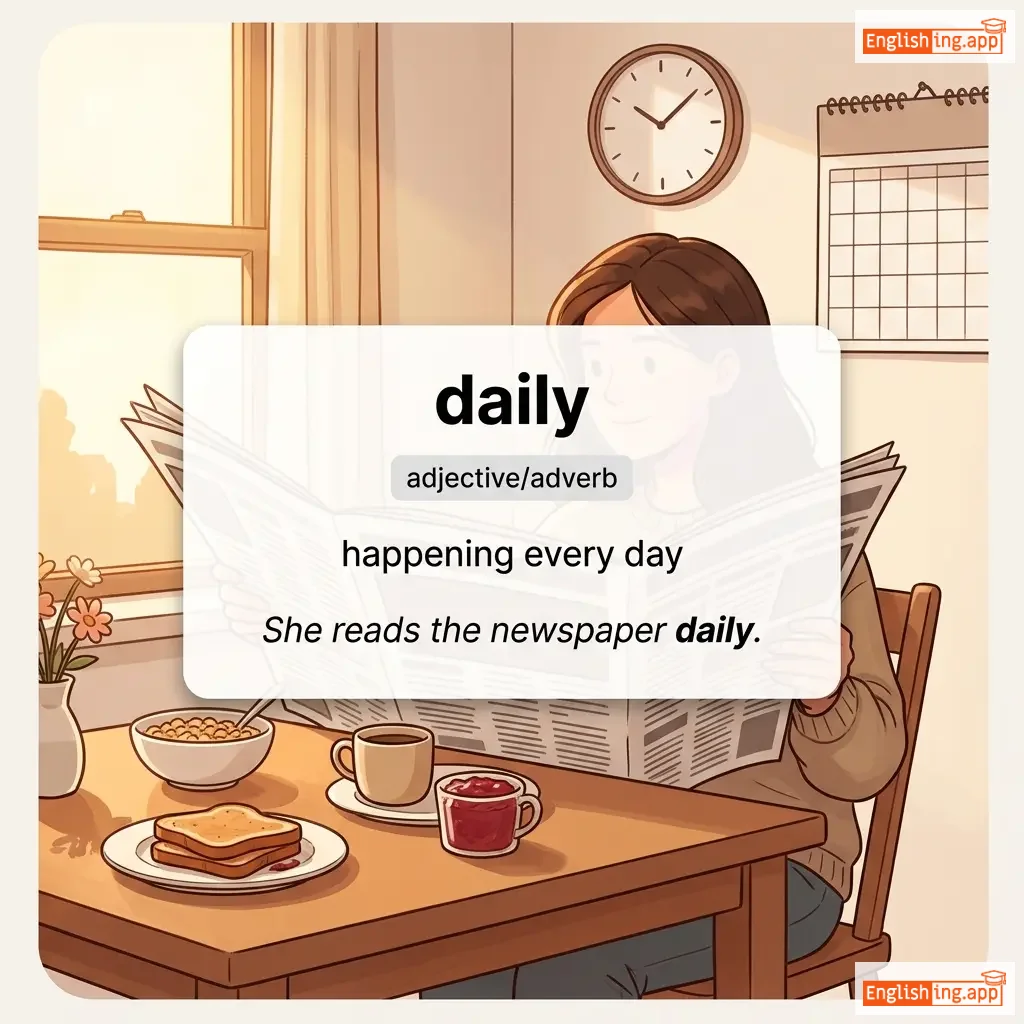
daily definition card — visual illustration of the meaning
adjective/adverb
/ˈdeɪli/
quotidien (quotidien)

happening every day

"She reads the newspaper daily."

"Elle lit le journal quotidiennement." (Elle lit le journal quotidiennement.)
adjective
/ˈdeɪnti/
délicat et joli (delikat et joli)

Delicately small, pretty, and often considered elegant.

"She wore a dainty necklace made of pearls."

"Elle portait un collier délicat fait de perles." (Elle portait un collier delicat fait de perles.)
noun
/ˈdɛəri/
laiterie (laiterie)

a place where milk and milk products are produced or sold

"They visited the local dairy for fresh milk."

"Ils ont visité la laiterie locale pour du lait frais." (Ils ont visité la laiterie locale pour du lait frais.)
noun
/ˈdeɪ.ɪs/ or /ˈdeɪ.əs/
estrade (estrade)

A raised platform in a hall or room, usually where speakers or honored guests sit.

"The speaker stood on the dais to address the audience."

"L'orateur s'est tenu sur l'estrade pour s'adresser au public." (L'orateur s'est tenu sur l'estrade pour s'adresser au public.)
noun
/ˈdæliəns/
relation fugace (relation fugace)

A casual romantic or sexual relationship; also frivolous or playful behavior.

"Their dalliance during the summer was brief but intense."

"Leur relation fugace pendant l'été a été brève mais intense." (Leur relation fugace pendant l'ete a ete breve mais intense.)
verb
/ˈdæli/
traîner (trainer)

To act or move slowly; to waste time; also to engage in a casual romantic relationship.

"He dallied in the garden instead of starting his work."

"Il a traîné dans le jardin au lieu de commencer son travail." (Il a traîné dans le jardin au lieu de commencer son travail.)
🏞️

Dam (dæm)

noun
/dæm/
barrage (barrage)

a barrier built to hold back water and raise its level

"The dam provides electricity to nearby towns."

"Le barrage fournit de l'électricité aux villes voisines." (Le barrage fournit de l'électricité aux villes voisines.)
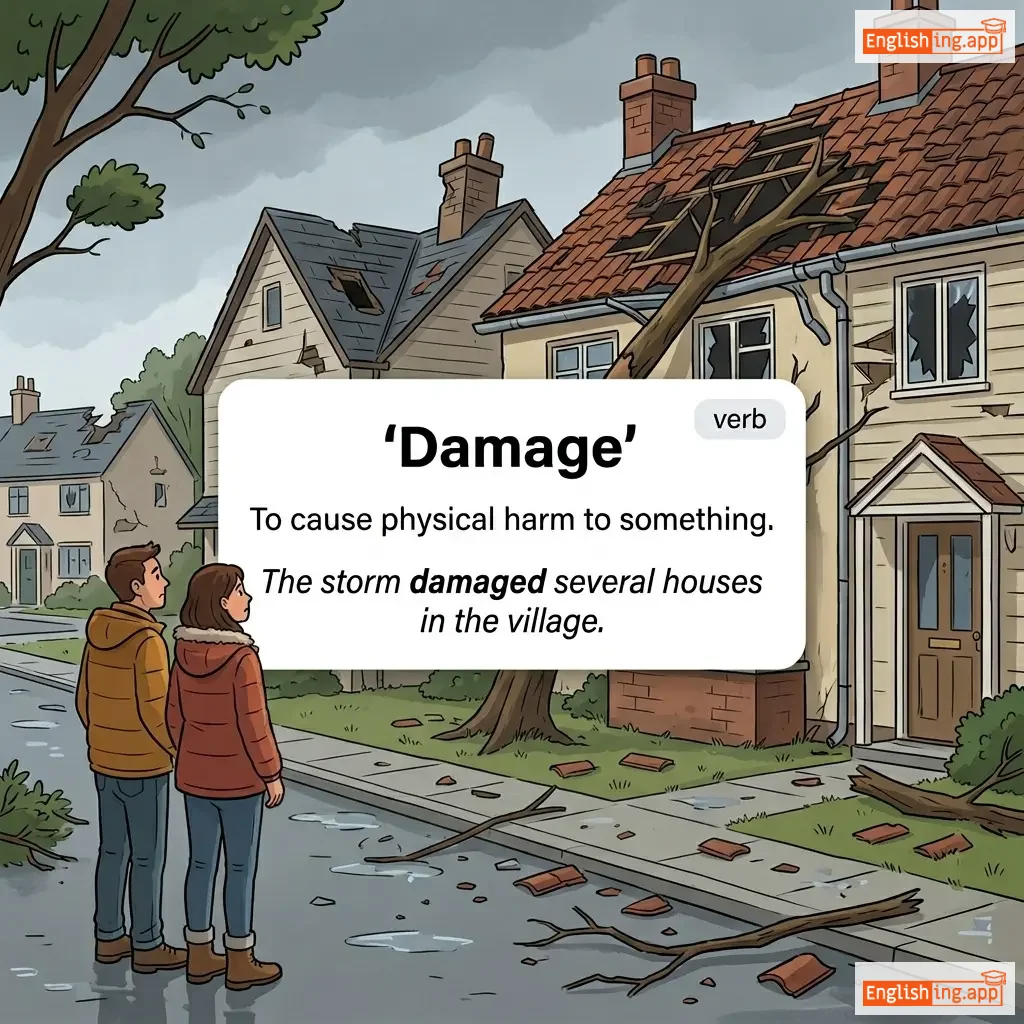
Damage definition card — visual illustration of the meaning
verb
/ˈdæmɪdʒ/
dommages (domaj)

To cause physical harm to something.

"The storm damaged several houses in the village."

"La tempête a endommagé plusieurs maisons dans le village." (La tempête a endommagé plusieurs maisons dans le village.)
adjective
/ˈdæmɪdʒɪŋ/
prejudiciable (prejudiciable)

causing harm or injury

"The storm caused damaging effects to the crops."

"La tempête a provoqué des effets dommageables sur les cultures." (La tempete a provoque des effets dommageables sur les cultures.)
verb
/dæm/
maudire / juron (maudire / juron)

to condemn or criticize strongly; used as an expletive to express anger or emphasis

"He damned the unfair system in his speech."

"Il a maudit le système injuste dans son discours." (Il a maudit le système injuste dans son discours.)