वोकैबुलरीज

इंग्लिश वोकैबुलरी डिस्कवर, लर्न और मास्टर करें

noun/verb
/ˈkʌri/
करी (kari)

A dish of meat, vegetables, etc., cooked in a sauce with spices; or to prepare food in such a style.

"She cooked a delicious chicken curry for dinner."

"उसने रात के खाने के लिए स्वादिष्ट चिकन करी पकाई।" (Usne raat ke khane ke liye swadisht chicken kari pakai.)
noun
/ˈkɜːr.i liːvz/
करी पत्ते (kari patte)

aromatic leaves from the curry tree used in South Asian cooking

"Fresh curry leaves add authentic flavor to Indian dishes."

"ताजे करी पत्ते भारतीय व्यंजनों में असली स्वाद जोड़ते हैं।" (taje kari patte bhartiya vyanjanon mein asli swad jodte hain.)
noun, verb
/kɜːrs/
शाप (shaap)

a solemn wish that harm or misfortune should befall someone; a rude or offensive word or phrase; to utter offensive words or wish harm upon someone

"He cursed loudly when he realized he had lost his wallet."

"उसने अपना बटुआ खो जाने पर ज़ोर से शाप दिया।" (usne apna batuwa kho jaane par zor se shaap diya)
adjective/noun
/ˈkɜːrsɪv/
कर्सिव लेखन (karsiv lekhan)

Written with characters joined together in a flowing manner.

"The teacher asked students to write the essay in cursive handwriting."

"शिक्षक ने विद्यार्थियों से कर्सिव हैंडराइटिंग में निबंध लिखने को कहा।" (Shikshak ne vidyarthiyon se karsiv handwriting mein nibandh likhne ko kaha.)
adjective
/ˈkɜːrsəri/
जल्दी (jaldi)

Hasty and therefore not thorough or detailed.

"He gave the report only a cursory glance before the meeting."

"उसने मीटिंग से पहले रिपोर्ट पर केवल एक त्वरित नजर डाली।" (Usne meeting se pehle report par keval ek tvarit nazar daali.)
adjective
/kɜːrt/
कठोर (kathor)

Rudely brief in speech or manner.

"His curt reply made everyone uncomfortable."

"उसका कठोर जवाब सबको असहज बना दिया।" (Uska kathor jawab sabko asahaj bana diya.)
verb
/kɜːrˈteɪl/
सीमित करना (seemit karna)

to reduce or limit something, especially something considered undesirable

"The company had to curtail its spending due to budget cuts."

"कंपनी को बजट कटौती के कारण अपनी खर्च सीमा तय करनी पड़ी।" (Kampani ko bajat katouti ke karan apni kharch seema tay karni padi.)
Curtain definition card — visual illustration of the meaning
noun
/ˈkɜː.tən/
पर्दा (parda)

a piece of cloth that hangs down to cover a window or divide a room

"She pulled back the curtain to let the sunlight in."

"उसने धूप को अंदर आने देने के लिए पर्दा खींचा।" (Usne dhoop ko andar aane dene ke liye parda kheencha.)
noun/verb
/ˈkɜːrtsi/
सम्मान प्रदर्शन (sammaan pradarshan)

a respectful bow made by women by bending the knees with one foot in front of the other

"She gave a quick curtsy before leaving the stage."

"उसने मंच छोड़ने से पहले एक तेज कर्टसी दी।" (Usne manch chhodne se pehle ek tez kurtsee dee.)
noun
/kɜːv/
वक्र (vakra)

a smooth, continuous line that bends without angles

"The road curved sharply to the left."

"सड़क बाएं तेज़ी से मुड़ी।" (Sadak baen tezī se muṛī.)
adjective
/ˈkʌsɪd/
अड़ियल (adiyal)

Annoyingly stubborn or difficult.

"He was too cussed to admit his mistake."

"वह अपनी गलती स्वीकार करने के लिए बहुत अड़ियल था।" (Wah apni galti sweekar karne ke liye bahut adiyal tha.)
noun
/ˈkʌstərd ˈæpəl/
कटहल (kathal)

a tropical fruit with sweet creamy white flesh and black seeds

"The custard apple has a sweet and creamy texture."

"कटहल में एक मीठा और मलाईदार बनावट होती है।" (Kathal mein ek meetha aur malaidaar banawat hoti hai。)
noun
/kʌˈstoʊ.di.ən/
देखभाल करनेवाला; संरक्षक; प्रबंधक/रक्षक; (dekbhaal karnewala; sanrakshak; prabandhak/rakshak)

a person who has responsibility for or looks after something; a caretaker or guardian

"The school custodian ensures that all buildings are clean and secure."

"स्कूल का कस्टोडियन यह सुनिश्चित करता है कि सभी भवन साफ और सुरक्षित हैं।" (skool ka kstodian yah sunishchit karta hai ki sabhi bhavan saaf aur surakshit hain.)
noun
/ˈkʌs.tə.di/
कस्टडी (kastadi)

the legal right or responsibility of taking care of someone or something

"The mother was granted custody of her children after the divorce."

"तलाक के बाद माँ को अपने बच्चों की कस्टडी मिल गई।" (Talaak ke baad maa ko apne bachon ki kastadi mil gayi.)
Custom definition card — visual illustration of the meaning
noun
/ˈkʌstəm/
रीति, परंपरा (riti, parampara)

a traditional practice or usual way of behaving in a particular society or place

"Shaking hands is a common custom in many countries."

"हाथ मिलाना कई देशों में एक सामान्य परंपरा है।" (Haath milaana kai deshon mein ek saamaanya parampara hai.)
customer definition card — visual illustration of the meaning
noun
/ˈkʌstəmər/
ग्राहक (graahak)

a person or organization that buys goods or services from a store or business

"The shopkeeper greeted the customer with a smile."

"दुकानदार ने ग्राहक को मुस्कान के साथ अभिवादन किया।" (Dukaandaar ne graahak ko muskaan ke saath abhiwaadan kiya.)
Customer Retention definition card — visual illustration of the meaning
noun
/ˈkʌs.tə.mər rɪˈten.ʃən/
ग्राहक बनाए रखना (graahak banaye rakhna)

The ability of a company or product to retain its customers over some specified period.

"High customer retention increases business sustainability."

"उच्च ग्राहक बनाए रखने से व्यापार की स्थिरता बढ़ती है।" (Ucch graahak banaye rakhne se vyavhaar ki sthirata badhti hai.)
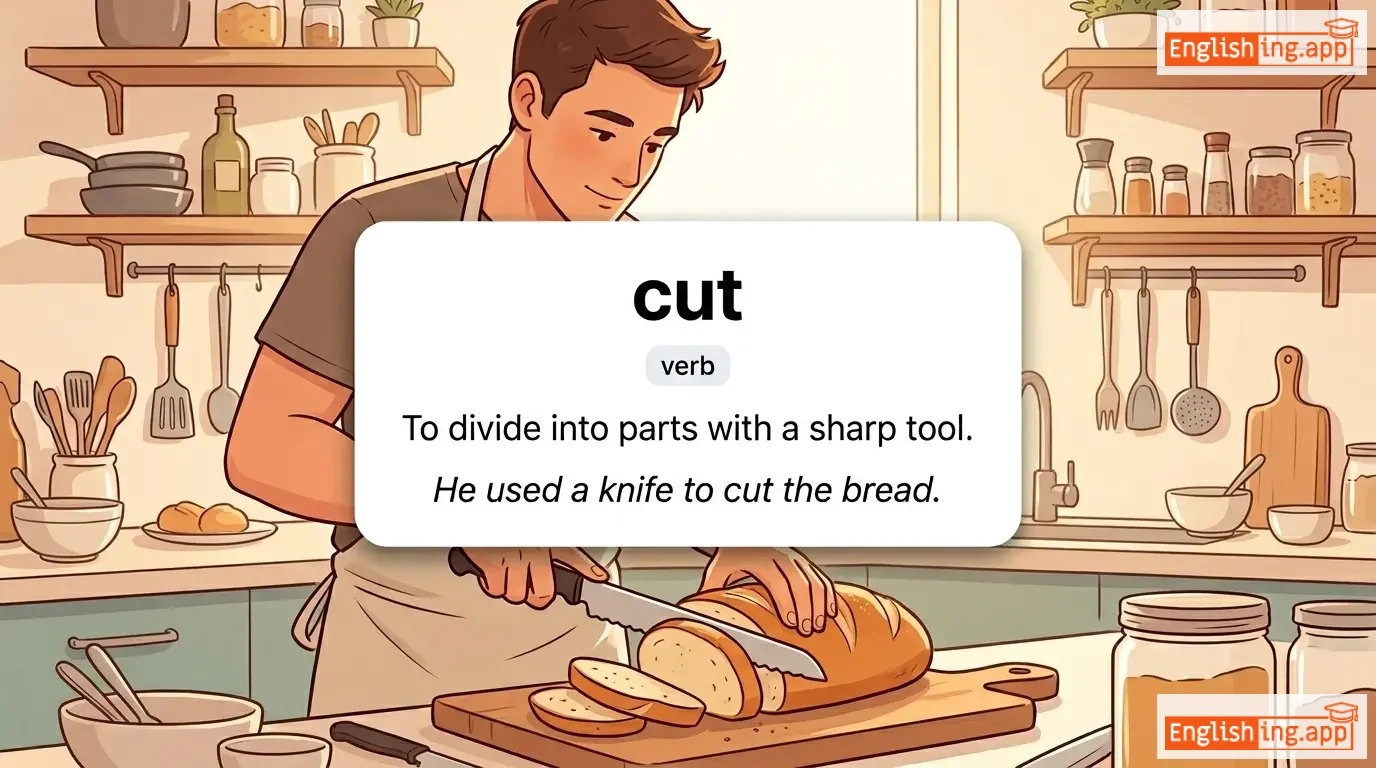
cut definition card — visual illustration of the meaning
verb
/kʌt/
काटना (katna)

To divide into parts with a sharp tool.

"He used a knife to cut the bread."

"उसने रोटी काटने के लिए चाकू का इस्तेमाल किया।" (Usne roti katne ke liye chaaku ka istemaal kiya.)
adjective
/kjuːt/
प्यारा (pyara)

attractive in a pretty or endearing way

"That puppy is so cute!"

"वह पपी कितना प्यारा है!" (vah pappi kitna pyara hai!)
noun
/ˈkʌt.lət/
कटलेट (katlet)

a small piece of meat, especially veal or lamb, for frying or grilling

"She served delicious chicken cutlets for dinner."

"उसने डिनर के लिए स्वादिष्ट चिकन कटलेट सर्व किए।" (usne dinner ke liye swadisht chicken katlet serve kiye.)
adjective
/ˈkʌtɪŋ/
तीव्र (teevr)

sharp or severe, often used to describe remarks or actions

"Her cutting remarks made everyone feel uncomfortable."

"उसकी कटिंग टिप्पणियों ने सभी को असहज कर दिया।" (Uski cutting tippaniyon ne sabhi ko asahaj kar diya.)
cutting-edge definition card — visual illustration of the meaning
adjective
ˈkʌtɪŋ ˌɛdʒ
सर्वोत्तम, नवीनतम, अत्याधुनिक प्रौद्योगिकी (sarvottam, naveenatam, atyadhunik praudyogiki)

The most advanced or innovative; at the forefront of development.

"This company develops cutting-edge technology."

"यह कंपनी कटिंग-एज तकनीक विकसित करती है।" (Yah company cutting-edge takneek vikasit karti hai.)
cybernetics definition card — visual illustration of the meaning
noun
ˌsaɪ.bəˈnet.ɪks
साइबरनेटिक्स (cybernetics)

The science of communications and automatic control systems in both machines and living things.

"Cybernetics plays a crucial role in artificial intelligence."

"साइबरनेटिक्स कृत्रिम बुद्धिमत्ता में एक महत्वपूर्ण भूमिका निभाता है।" (Cybernetics krtrim buddhimatta mein ek mahatvapurn bhumika nibhata hai.)
cybersecurity definition card — visual illustration of the meaning
noun
ˌsaɪ.bə.sɪˈkjʊə.rɪ.ti
साइबर सुरक्षा (saiber sikyuriti)

The practice of protecting systems, networks, and programs from digital attacks

"Cybersecurity ensures safe digital operations."

"साइबर सुरक्षा सुरक्षित डिजिटल संचालन सुनिश्चित करती है।" (saiber suraksha surakshit digital sanchalan sunishchit karti hai)
noun/verb
/ˈsaɪkl/
सायकल (saikal)

a series of events that repeat in the same order; or to ride a bicycle

"She cycles to school every day."

"वह हर दिन स्कूल सायकल से जाती है।" (Vah har din school saikal se jati hai.)
noun/adjective
/ˈsaɪklɔɪd/
वृत्ताकार रेखा (vrttakar rekha)

a curve traced by a point on the rim of a circle as it rolls along a straight line

"The cycloid is often studied in mathematics and physics."

"सायक्लॉइड को गणित और भौतिकी में अक्सर अध्ययन किया जाता है।" (Saikloid ko ganit aur bhautikī mein aksar adhyayan kiya jaata hai.)
noun
/ˈsaɪkloʊn/
चक्रवात (chakravaat)

a large-scale air mass that rotates around a strong center of low atmospheric pressure; a violent tropical storm

"The cyclone caused severe flooding along the coast."

"चक्रवात ने तटीय क्षेत्रों में भारी बाढ़ ला दी।" (chakravaat ne tatiya kshetron mein bhaari baadh la di)
noun
/ˈsɪɡnət/
हंस के बच्चे (hans ke bachche)

a young swan

"The cygnet swam closely behind its mother."

"हंस के बच्चे ने अपनी मां के पीछे सटीक रूप से तैराकी की।" (Hans ke bachche ne apni maan ke peeche sathik roop se tairaki ki.)
noun
/ˈsɪnɪk/
निराशावादी (niraashavaadi)

a person who believes that people are motivated purely by self-interest rather than acting for honorable reasons

"He was too much of a cynic to believe in true love."

"वह सच्चे प्यार में विश्वास करने के लिए बहुत अधिक निराशावादी था।" (vah sachche pyaar mein vishwas karne ke liye bahut adhik niraashavaadi tha.)
adjective
/ˈsɪn.ɪ.kəl/
संशयी (sanshayi)

Believing that people are motivated by self-interest; distrustful of human sincerity or integrity.

"She was cynical about the politician's promises."

"वह राजनेता के वादों पर संशयी थी।" (Wah rajneta ke vadon par sanshayi thi.)
noun
/ˈsɪn.ɪˌsɪz.əm/
निराशावाद (niraashavaad)

An inclination to believe that people are motivated purely by self-interest; skepticism.

"His cynicism made it hard for him to trust anyone."

"उसका निराशावाद उसे किसी पर विश्वास करने में कठिनाई देता था।" (Uska niraashavaad use kisi par vishwas karne mein kathinai deta tha.)
noun
/ˈsaɪ.nəˌʃʊr/
सभी की नजरों का केंद्र (sabhi ki nazron ka kendra)

A person or thing that is the center of attention or admiration.

"She was the cynosure of all eyes at the party."

"वह पार्टी में सभी की नजरों का केंद्र थी।" (vah party mein sabhi ki nazron ka kendra thi.)
verb
/ˈdæb.əl/
संगति से काम करना (sangati se kaam karna)

To take part in an activity in a casual or superficial way.

"He dabbled in painting during his college days."

"उसने कॉलेज के दिनों में पेंटिंग में शौकिया काम किया।" (Usne college ke dino mein painting mein shaukia kaam kiya.)
noun
/dəˈkɔɪt/
डाकू (daaku)

a member of an armed gang of robbers; a bandit, especially in India and Myanmar

"The village was terrorized by a gang of dacoits who robbed travelers."

"गाँव को डाकुओं के एक गिरोह ने आतंकित कर दिया था जिन्होंने यात्रियों को लूटा।" (Gaav ko daakoon ke ek giroh ne aatankit kar diya tha jinhone yatrion ko lootaa.)
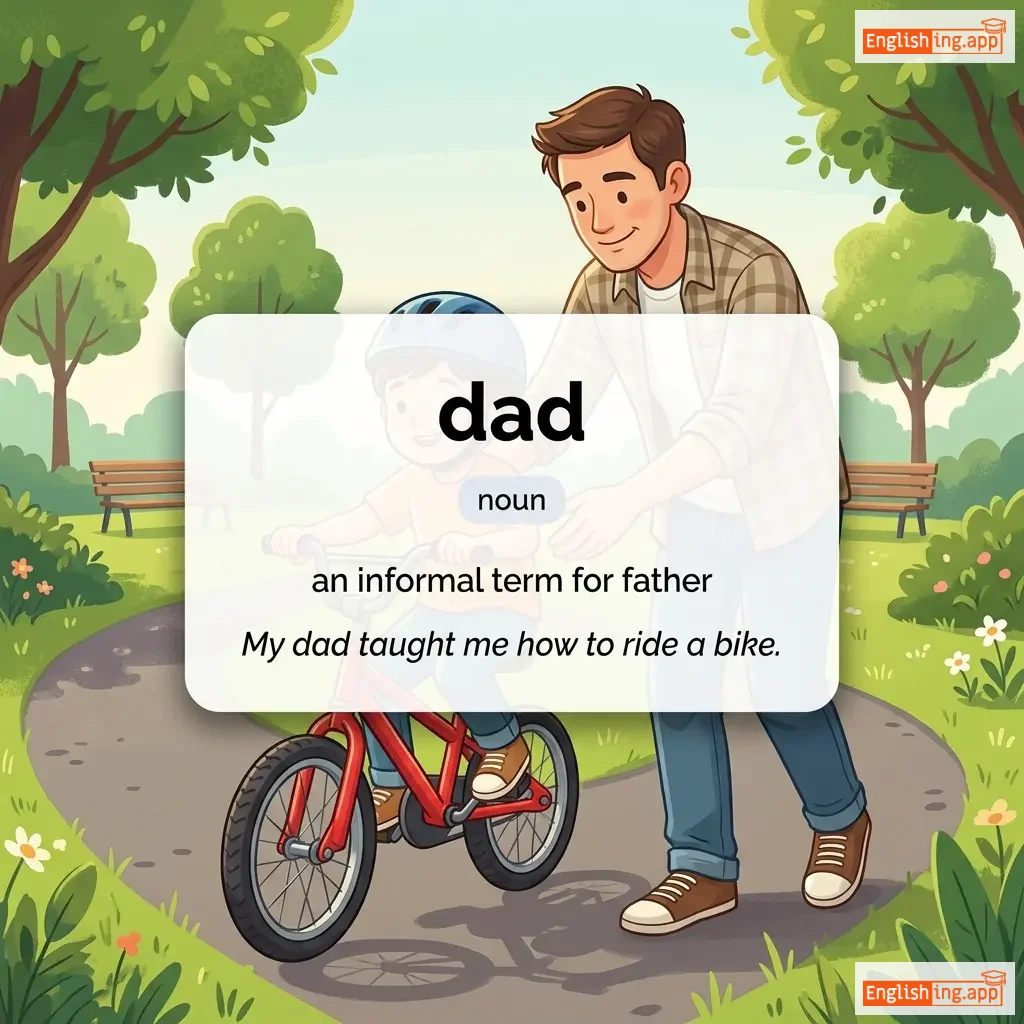
dad definition card — visual illustration of the meaning
noun
/dæd/
पापा (papa)

an informal term for father

"My dad taught me how to ride a bike."

"मेरे पापा ने मुझे साइकिल चलाना सिखाया।" (Mere papa ne mujhe saikil chalana sikhaya.)
noun
/ˈdæf.ə.dɪl/
नरगिस फूल (nargis phool)

A bright yellow spring flower with a trumpet-shaped center, symbolizing rebirth and new beginnings

"The daffodils bloomed early this spring in the meadow."

"इस वसंत में मैदान में नरगिस फूल जल्दी खिले थे।" (is vasant mein maidan mein nargis phool jaldi khile the)
adjective
/dæft/
मूर्ख (moorkh)

Silly or foolish.

"It was a daft idea to go hiking without water."

"पानी के बिना हाइकिंग पर जाना एक मूर्खतापूर्ण विचार था।" (Pani ke bina hiking par jana ek moorkhatapurn vichar tha.)
noun
/ˈdæɡər/
कुंआ (kunaa)

a short knife with a pointed and edged blade, used as a weapon

"The assassin concealed a dagger beneath his cloak."

"हत्यारा अपनी चादर के नीचे एक कुंआ छिपा कर रखा था।" (hatyaara apni chadar ke neeche ek kunaa chhupa kar rakha tha)
noun
/dəˈɡerəˌtaɪp/
प्राचीन फोटोग्राफ (prachin photograph)

An early type of photograph produced on a silver or silver-covered copper plate.

"The museum displayed a rare daguerreotype of Abraham Lincoln."

"संग्रहालय में अब्राहम लिंकन की एक दुर्लभ डेगेरोटाइप प्रदर्शित की गई थी।" (Sangrahalay mein Abraham Lincoln ki ek durlabh daguerreotype pradarshit ki gayi thi.)
noun
/ˈdeɪ.li.ə/
डाहलिया (dahlia)

a garden plant with brightly colored flowers that bloom in summer and autumn

"She planted colorful dahlias in her garden last summer."

"उसने पिछले ग्रीष्मकाल में अपने बग़ीचे में रंगीन डाहलियास लगाए।" (usne pichhle grishmakal mein apne bagiche mein rangin dahlia lagaaye)
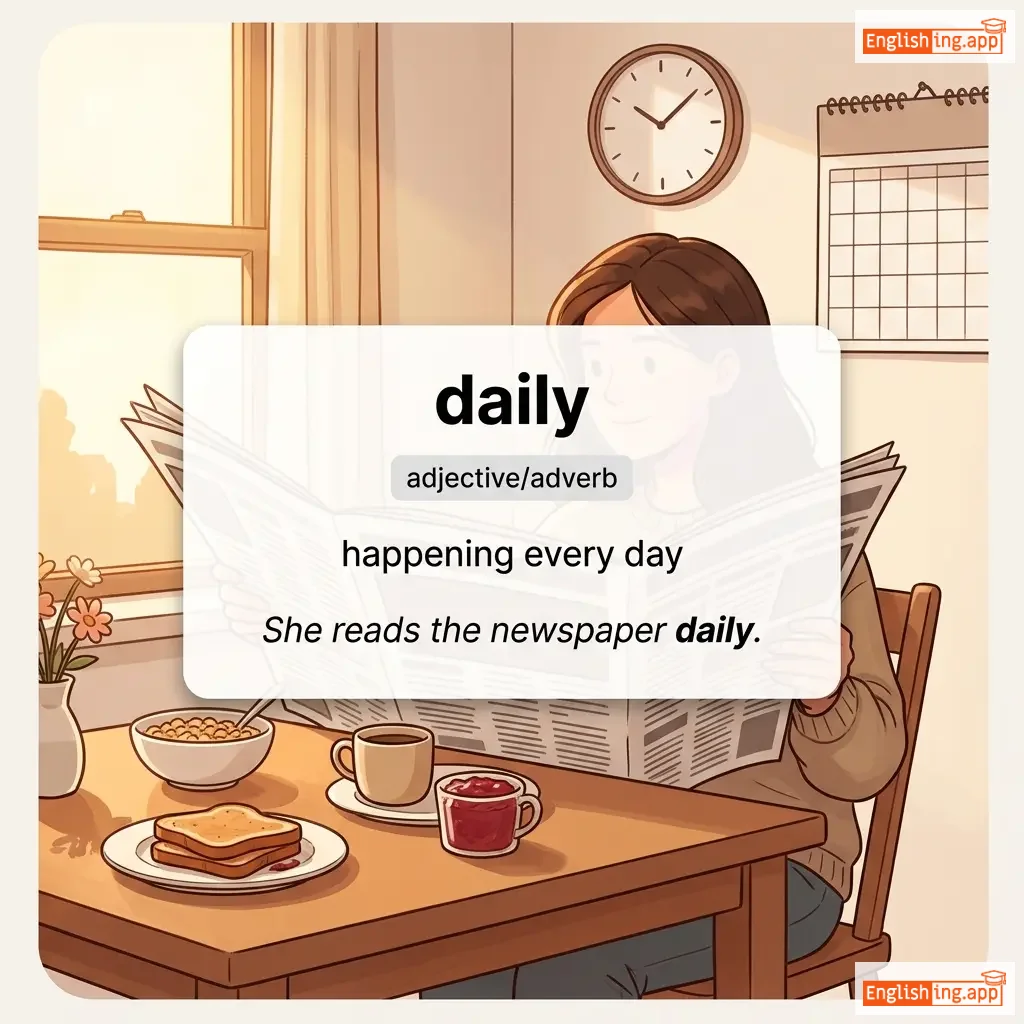
daily definition card — visual illustration of the meaning
adjective/adverb
/ˈdeɪli/
दैनिक (dainik)

happening every day

"She reads the newspaper daily."

"वह हर दिन समाचार पत्र पढ़ती है।" (Wah har din samachar patra padhti hai.)
adjective
/ˈdeɪnti/
नाज़ुक और सुंदर (naazuk aur sundar)

Delicately small, pretty, and often considered elegant.

"She wore a dainty necklace made of pearls."

"उसने मोती से बनी एक सुंदर हार पहना था।" (Usne moti se bani ek sundar haar pehna tha.)
noun
/ˈdɛəri/
डेयरी (dairy)

a place where milk and milk products are produced or sold

"They visited the local dairy for fresh milk."

"वे ताजे दूध के लिए स्थानीय डेयरी में गए थे।" (ve taje doodh ke liye sthaanee dairy mein gaye the.)
noun
/ˈdeɪ.ɪs/ or /ˈdeɪ.əs/
मंच (manch)

A raised platform in a hall or room, usually where speakers or honored guests sit.

"The speaker stood on the dais to address the audience."

"वक्ता ने श्रोताओं को संबोधित करने के लिए मंच पर खड़े होकर भाषण दिया।" (Vakta ne shrotahon ko sambodhit karne ke liye manch par khade hokar bhashan diya.)
noun
/ˈdæliəns/
संक्षिप्त रोमांटिक संबंध (sankshipt romantic sambandh)

A casual romantic or sexual relationship; also frivolous or playful behavior.

"Their dalliance during the summer was brief but intense."

"गर्मी के मौसम में उनका संबंध संक्षिप्त था लेकिन तीव्र था।" (Garmi ke mausam mein unka sambandh sankshipt tha lekin teevra tha.)
verb
/ˈdæli/
आलस्य करना (aalsi karna)

To act or move slowly; to waste time; also to engage in a casual romantic relationship.

"He dallied in the garden instead of starting his work."

"वह अपने काम की शुरुआत करने की बजाय बग़ीचे में समय बर्बाद कर रहा था।" (Wah apne kaam ki shuruat karne ki bajay bageeche mein samay barbaad kar raha tha.)
noun
/dæm/
बांध (bandh)

a barrier built to hold back water and raise its level

"The dam provides electricity to nearby towns."

"डेम नजदीकी शहरों को बिजली प्रदान करता है।" (Dem najdiki shahron ko bijli pradan karta hai.)
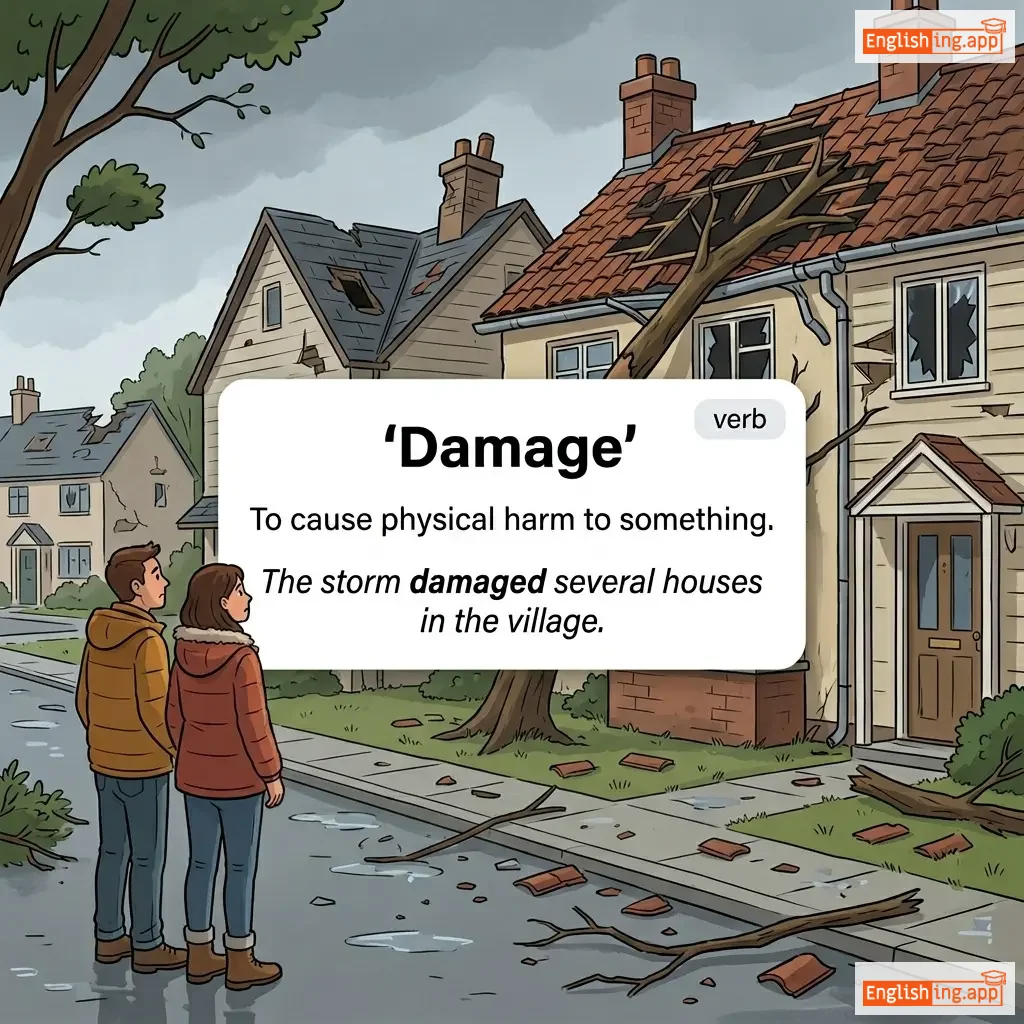
Damage definition card — visual illustration of the meaning
verb
/ˈdæmɪdʒ/
नुकसान (nuksan)

To cause physical harm to something.

"The storm damaged several houses in the village."

"तूफान ने गाँव में कई घरों को नुकसान पहुँचाया।" (Toofan ne gaanv mein kai gharon ko nuksan pahunchaya.)
adjective
/ˈdæmɪdʒɪŋ/
हानिकारक (haanikarak)

causing harm or injury

"The storm caused damaging effects to the crops."

"तूफान ने फसलों पर नुकसान पहुँचाने वाले प्रभाव डाले।" (Toofan ne faslon par nuksan pahunchane wale prabhav dale.)
verb
/dæm/
शाप देना / गाली (shaap dena / gaali)

to condemn or criticize strongly; used as an expletive to express anger or emphasis

"He damned the unfair system in his speech."

"उसने अपने भाषण में अन्यायपूर्ण प्रणाली को शाप दिया।" (Usne apne bhashan mein anyayapoorn pranali ko shaap diya.)