Vocabularios

Descubra, aprenda y domine el vocabulario en inglés

noun/verb
/ˈkʌri/
curry (curry)

A dish of meat, vegetables, etc., cooked in a sauce with spices; or to prepare food in such a style.

"She cooked a delicious chicken curry for dinner."

"Ella cocinó un delicioso curry de pollo para la cena." (Ella cocinó un delicioso curry de pollo para la cena.)
noun
/ˈkɜːr.i liːvz/
hojas de curry (hojas de curry)

aromatic leaves from the curry tree used in South Asian cooking

"Fresh curry leaves add authentic flavor to Indian dishes."

"Las hojas de curry frescas añaden un sabor auténtico a los platos indios." (Las hojas de curry frescas anaden un sabor autentico a los platos indios.)
noun, verb
/kɜːrs/
maldición (maldicion)

a solemn wish that harm or misfortune should befall someone; a rude or offensive word or phrase; to utter offensive words or wish harm upon someone

"He cursed loudly when he realized he had lost his wallet."

"Maldijo en voz alta cuando se dio cuenta de que había perdido su billetera." (Maldijo en voz alta cuando se dio cuenta de que habia perdido su billetera)
adjective/noun
/ˈkɜːrsɪv/
letra cursiva (letra cursiva)

Written with characters joined together in a flowing manner.

"The teacher asked students to write the essay in cursive handwriting."

"El maestro pidió a los estudiantes que escribieran el ensayo con letra cursiva." (El maestro pidió a los estudiantes que escribieran el ensayo con letra cursiva.)
adjective
/ˈkɜːrsəri/
superficial (superficial)

Hasty and therefore not thorough or detailed.

"He gave the report only a cursory glance before the meeting."

"Él echó un vistazo superficial al informe antes de la reunión." (Él echó un vistazo superficial al informe antes de la reunión.)
adjective
/kɜːrt/
ríspido (rispido)

Rudely brief in speech or manner.

"His curt reply made everyone uncomfortable."

"Su respuesta ríspida hizo que todos se sintieran incómodos." (Su respuesta rispida hizo que todos se sintieran incomodos.)
verb
/kɜːrˈteɪl/
reducir (reducir)

to reduce or limit something, especially something considered undesirable

"The company had to curtail its spending due to budget cuts."

"La compañía tuvo que reducir su gasto debido a los recortes presupuestarios." (La compañia tuvo que reducir su gasto debido a los recortes presupuestarios.)
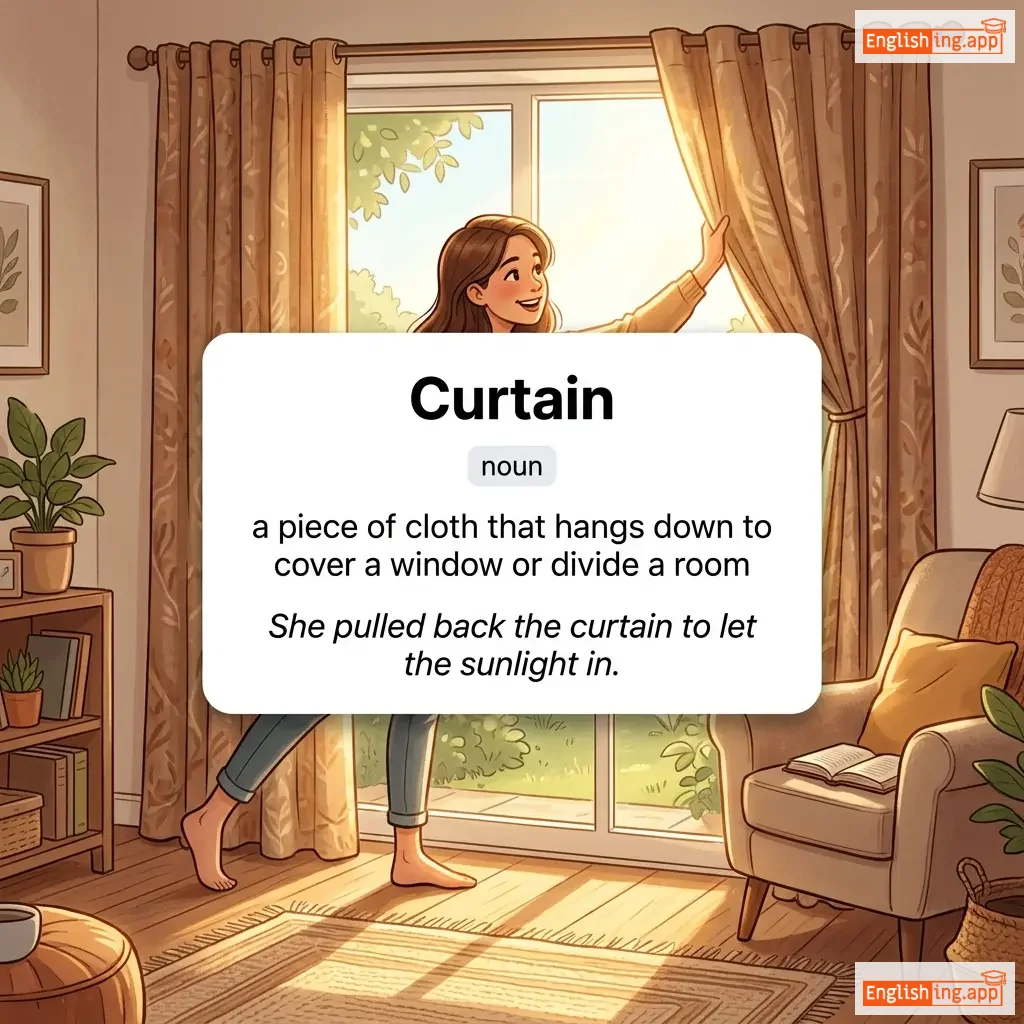
Curtain definition card — visual illustration of the meaning
noun
/ˈkɜː.tən/
cortina (cortina)

a piece of cloth that hangs down to cover a window or divide a room

"She pulled back the curtain to let the sunlight in."

"Ella abrió la cortina para dejar entrar la luz del sol." (Ella abrió la cortina para dejar entrar la luz del sol.)
🙇‍♀️

curtsy (kɜːrtsi)

noun/verb
/ˈkɜːrtsi/
reverencia (reverencia)

a respectful bow made by women by bending the knees with one foot in front of the other

"She gave a quick curtsy before leaving the stage."

"Ella dio una rápida reverencia antes de salir del escenario." (Ella dio una rapida reverencia antes de salir del escenario.)
noun
/kɜːv/
curva (curva)

a smooth, continuous line that bends without angles

"The road curved sharply to the left."

"La carretera giró bruscamente a la izquierda." (La carretera giro bruscamente a la izquierda.)
adjective
/ˈkʌsɪd/
terco (terco)

Annoyingly stubborn or difficult.

"He was too cussed to admit his mistake."

"Era demasiado terco para admitir su error." (Era demasiado terco para admitir su error.)
noun
/ˈkʌstərd ˈæpəl/
manzana de crema (manzana de crema)

a tropical fruit with sweet creamy white flesh and black seeds

"The custard apple has a sweet and creamy texture."

"La manzana de crema tiene una textura dulce y cremosa." (La manzana de crema tiene una textura dulce y cremosa.)
noun
/kʌˈstoʊ.di.ən/
conserje; guardián; encargado (kon-ser-je; guar-dian; en-kar-ga-do)

a person who has responsibility for or looks after something; a caretaker or guardian

"The school custodian ensures that all buildings are clean and secure."

"El conserje de la escuela se asegura de que todos los edificios estén limpios y seguros." (El kon-ser-he de la es-kue-la se a-se-gu-ra de ke to-dos los e-di-fi-cios es-ten lim-pios i se-gu-ros.)
noun
/ˈkʌs.tə.di/
custodia (custodia)

the legal right or responsibility of taking care of someone or something

"The mother was granted custody of her children after the divorce."

"A la madre se le concedió la custodia de sus hijos después del divorcio." (A la madre se le concedió la custodia de sus hijos después del divorcio.)
Custom definition card — visual illustration of the meaning
noun
/ˈkʌstəm/
costumbre (costumbre)

a traditional practice or usual way of behaving in a particular society or place

"Shaking hands is a common custom in many countries."

"Darse la mano es una costumbre común en muchos países." (Darse la mano es una costumbre comun en muchos paises.)
customer definition card — visual illustration of the meaning
noun
/ˈkʌstəmər/
cliente (kliente)

a person or organization that buys goods or services from a store or business

"The shopkeeper greeted the customer with a smile."

"El tendero saludó al cliente con una sonrisa." (El tendero saludo al cliente con una sonrisa.)
Customer Retention definition card — visual illustration of the meaning
noun
/ˈkʌs.tə.mər rɪˈten.ʃən/
retención de clientes (retencion de clientes)

The ability of a company or product to retain its customers over some specified period.

"High customer retention increases business sustainability."

"Una alta retención de clientes aumenta la sostenibilidad del negocio." (Una alta retención de clientes aumenta la sostenibilidad del negocio.)
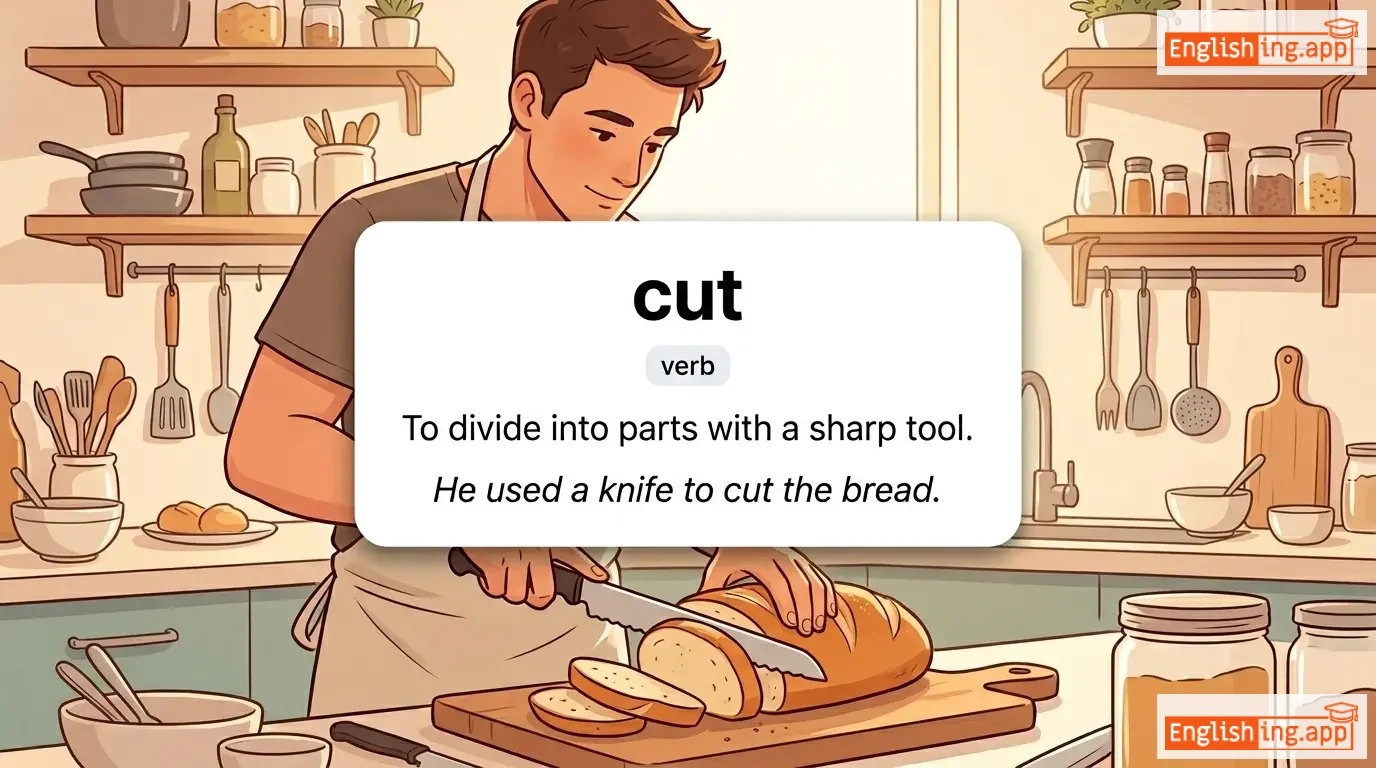
cut definition card — visual illustration of the meaning
verb
/kʌt/
cortar (cortar)

To divide into parts with a sharp tool.

"He used a knife to cut the bread."

"Él usó un cuchillo para cortar el pan." (Él usó un cuchillo para cortar el pan.)
adjective
/kjuːt/
lindo (lindo)

attractive in a pretty or endearing way

"That puppy is so cute!"

"¡Ese cachorro es tan lindo!" (¡Ese cachorro es tan lindo!)
noun
/ˈkʌt.lət/
croqueta (croqueta)

a small piece of meat, especially veal or lamb, for frying or grilling

"She served delicious chicken cutlets for dinner."

"Ella sirvió deliciosas croquetas de pollo para la cena." (ella sirvio deliciosas croquetas de pollo para la cena)
adjective
/ˈkʌtɪŋ/
agudo (agudo)

sharp or severe, often used to describe remarks or actions

"Her cutting remarks made everyone feel uncomfortable."

"Sus comentarios cortantes hicieron que todos se sintieran incómodos." (Sus comentarios cortantes hicieron que todos se sintieran incómodos.)
cutting-edge definition card — visual illustration of the meaning
adjective
ˈkʌtɪŋ ˌɛdʒ
de vanguardia, innovador, tecnología de última generación (de vanguardia, innovador, tecnologia de ultima generacion)

The most advanced or innovative; at the forefront of development.

"This company develops cutting-edge technology."

"Esta empresa desarrolla tecnología de vanguardia." (Esta empresa desarrolla tecnologia de vanguardia.)
cybernetics definition card — visual illustration of the meaning
noun
ˌsaɪ.bəˈnet.ɪks
cibernética (cibernetica)

The science of communications and automatic control systems in both machines and living things.

"Cybernetics plays a crucial role in artificial intelligence."

"La cibernética juega un papel crucial en la inteligencia artificial." (La cibernetica juega un papel crucial en la inteligencia artificial.)
cybersecurity definition card — visual illustration of the meaning
noun
ˌsaɪ.bə.sɪˈkjʊə.rɪ.ti
ciberseguridad (saibersekyuriti)

The practice of protecting systems, networks, and programs from digital attacks

"Cybersecurity ensures safe digital operations."

"La ciberseguridad garantiza operaciones digitales seguras." (la ciberseguridad garantiza operaciones digitales seguras)
noun/verb
/ˈsaɪkl/
ciclo / bicicleta (ciclo / bicicleta)

a series of events that repeat in the same order; or to ride a bicycle

"She cycles to school every day."

"Ella va a la escuela en bicicleta todos los días." (Ella va a la escuela en bicicleta todos los días.)
noun/adjective
/ˈsaɪklɔɪd/
curva ciclóidea (curva cicloidea)

a curve traced by a point on the rim of a circle as it rolls along a straight line

"The cycloid is often studied in mathematics and physics."

"La ciclóidea se estudia a menudo en matemáticas y física." (La cicloidea se estudia a menudo en matemáticas y física.)
noun
/ˈsaɪkloʊn/
ciclón (ciclon)

a large-scale air mass that rotates around a strong center of low atmospheric pressure; a violent tropical storm

"The cyclone caused severe flooding along the coast."

"El ciclón causó graves inundaciones en la costa." (el ciclon causo graves inundaciones en la costa)
noun
/ˈsɪɡnət/
cisne joven (cisne joven)

a young swan

"The cygnet swam closely behind its mother."

"El cigüeño nadó cerca de su madre." (El cigüeyo nadó cerca de su madre.)
noun
/ˈsɪnɪk/
cínico (siniko)

a person who believes that people are motivated purely by self-interest rather than acting for honorable reasons

"He was too much of a cynic to believe in true love."

"Él era demasiado cínico para creer en el amor verdadero." (El era demasiado siniko para creer en el amor verdadero.)
adjective
/ˈsɪn.ɪ.kəl/
cínico (siniko)

Believing that people are motivated by self-interest; distrustful of human sincerity or integrity.

"She was cynical about the politician's promises."

"Ella era cínica acerca de las promesas del político." (Ella era sinika acerca de las promesas del politico.)
noun
/ˈsɪn.ɪˌsɪz.əm/
cinismo (sinismo)

An inclination to believe that people are motivated purely by self-interest; skepticism.

"His cynicism made it hard for him to trust anyone."

"Su cinismo le dificultaba confiar en alguien." (Su cinismo le dificultaba confiar en alguien.)
noun
/ˈsaɪ.nəˌʃʊr/
el centro de todas las miradas (el centro de todas las miradas)

A person or thing that is the center of attention or admiration.

"She was the cynosure of all eyes at the party."

"Ella era el centro de todas las miradas en la fiesta." (Ella era el centro de todas las miradas en la fiesta.)
verb
/ˈdæb.əl/
incursionar (incursionar)

To take part in an activity in a casual or superficial way.

"He dabbled in painting during his college days."

"Él dabbleó en la pintura durante sus días en la universidad." (El dabbleó en la pintura durante sus días en la universidad.)
noun
/dəˈkɔɪt/
bandido (bandido)

a member of an armed gang of robbers; a bandit, especially in India and Myanmar

"The village was terrorized by a gang of dacoits who robbed travelers."

"La aldea fue aterrorizada por una banda de bandidos que robaban a los viajeros." (La aldea fue aterrorizada por una banda de bandidos que robaban a los viajeros.)
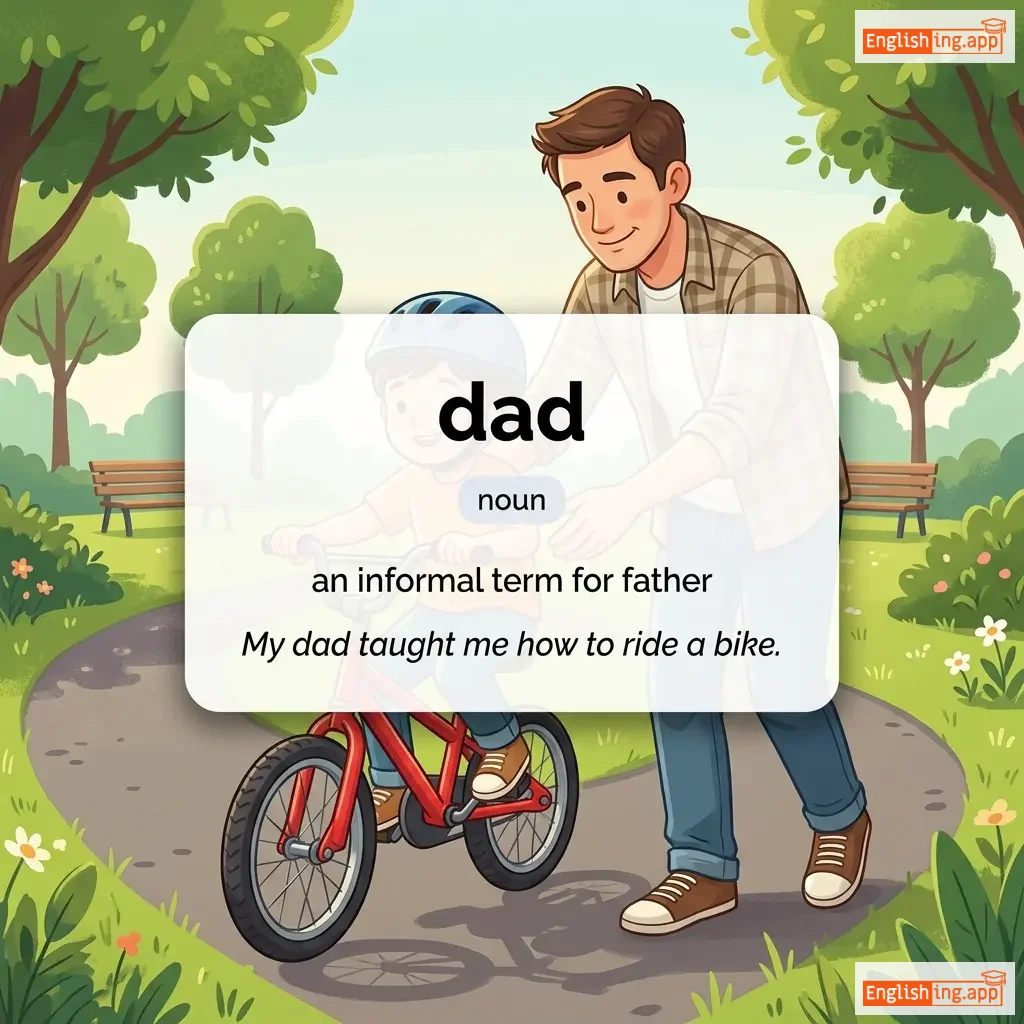
dad definition card — visual illustration of the meaning
noun
/dæd/
papá (papa)

an informal term for father

"My dad taught me how to ride a bike."

"Mi papá me enseñó a montar en bicicleta." (Mi papa me enseno a montar en bicicleta.)
noun
/ˈdæf.ə.dɪl/
narciso (narciso)

A bright yellow spring flower with a trumpet-shaped center, symbolizing rebirth and new beginnings

"The daffodils bloomed early this spring in the meadow."

"Los narcisos florecieron temprano esta primavera en el prado." (Los narcisos florecieron temprano esta primavera en el prado.)
adjective
/dæft/
tonto (tonto)

Silly or foolish.

"It was a daft idea to go hiking without water."

"Fue una idea tonta ir a hacer senderismo sin agua." (Fue una idea tonta ir a hacer senderismo sin agua.)
noun
/ˈdæɡər/
daga (daga)

a short knife with a pointed and edged blade, used as a weapon

"The assassin concealed a dagger beneath his cloak."

"El asesino escondió una daga debajo de su capa." (El asesino escondió una daga debajo de su capa.)
noun
/dəˈɡerəˌtaɪp/
fotografía antigua (fotografia antigua)

An early type of photograph produced on a silver or silver-covered copper plate.

"The museum displayed a rare daguerreotype of Abraham Lincoln."

"El museo exhibió un raro daguerrotipo de Abraham Lincoln." (El museo exhibió un raro daguerrotipo de Abraham Lincoln.)
noun
/ˈdeɪ.li.ə/
dalia (dahlia)

a garden plant with brightly colored flowers that bloom in summer and autumn

"She planted colorful dahlias in her garden last summer."

"Ella plantó dalias coloridas en su jardín el verano pasado." (Ella planto dalias coloridas en su jardin el verano pasado.)
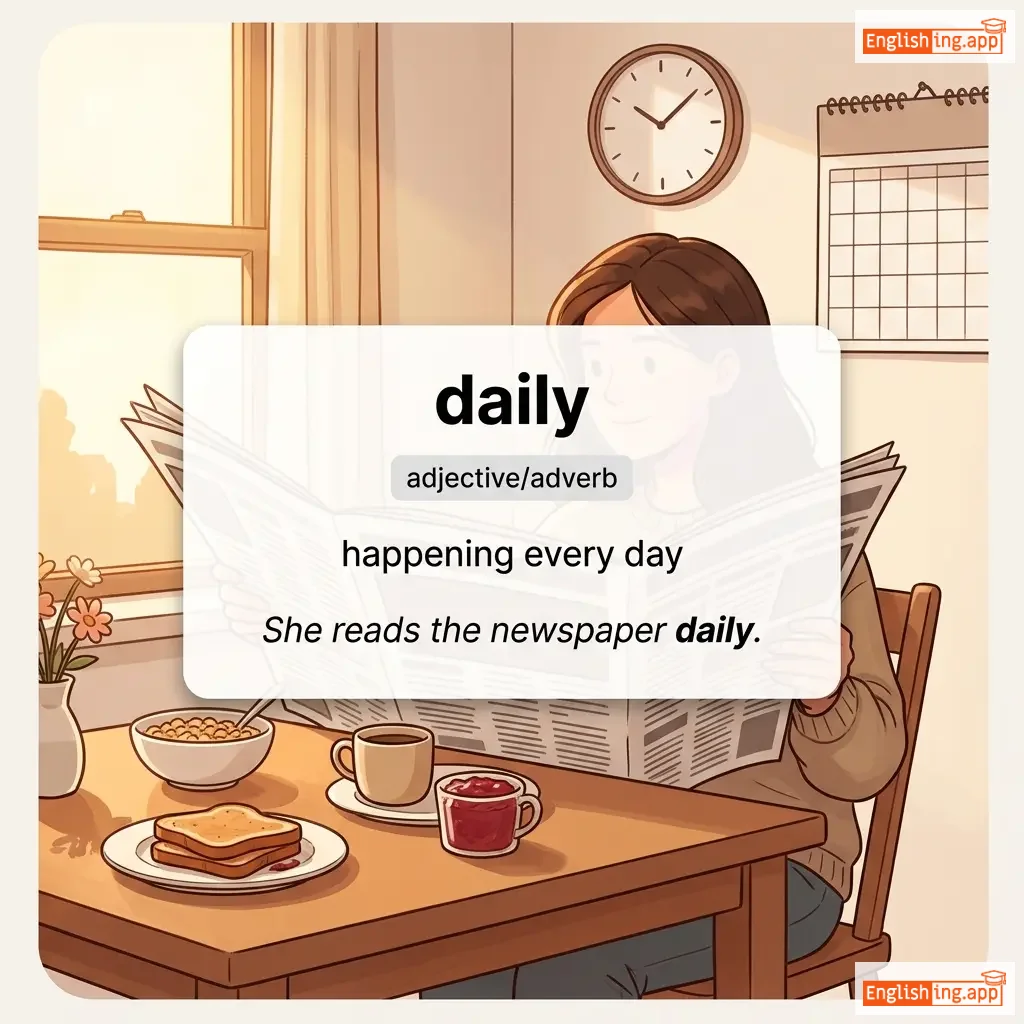
daily definition card — visual illustration of the meaning
adjective/adverb
/ˈdeɪli/
diario (diario)

happening every day

"She reads the newspaper daily."

"Ella lee el periódico diariamente." (Ella lee el periodico diariamente.)
adjective
/ˈdeɪnti/
delicado y bonito (delicado y bonito)

Delicately small, pretty, and often considered elegant.

"She wore a dainty necklace made of pearls."

"Ella llevaba un collar delicado hecho de perlas." (Ella llevaba un collar delicado hecho de perlas.)
noun
/ˈdɛəri/
lechería (lecheria)

a place where milk and milk products are produced or sold

"They visited the local dairy for fresh milk."

"Visitaron la lechería local para obtener leche fresca." (Visitaron la lecheria local para obtener leche fresca.)
noun
/ˈdeɪ.ɪs/ or /ˈdeɪ.əs/
estrado (estrado)

A raised platform in a hall or room, usually where speakers or honored guests sit.

"The speaker stood on the dais to address the audience."

"El orador se subió al estrado para dirigirse a la audiencia." (El orador se subió al estrado para dirigirse a la audiencia.)
noun
/ˈdæliəns/
relación fugaz (relacion fugaz)

A casual romantic or sexual relationship; also frivolous or playful behavior.

"Their dalliance during the summer was brief but intense."

"Su relación fugaz durante el verano fue breve pero intensa." (Su relacion fugaz durante el verano fue breve pero intensa.)
verb
/ˈdæli/
demorarse (demorarse)

To act or move slowly; to waste time; also to engage in a casual romantic relationship.

"He dallied in the garden instead of starting his work."

"Él se demoró en el jardín en lugar de comenzar su trabajo." (Él se demoró en el jardín en lugar de comenzar su trabajo.)
🏞️

Dam (dæm)

noun
/dæm/
presa (presa)

a barrier built to hold back water and raise its level

"The dam provides electricity to nearby towns."

"La presa proporciona electricidad a las ciudades cercanas." (La presa proporciona electricidad a las ciudades cercanas.)
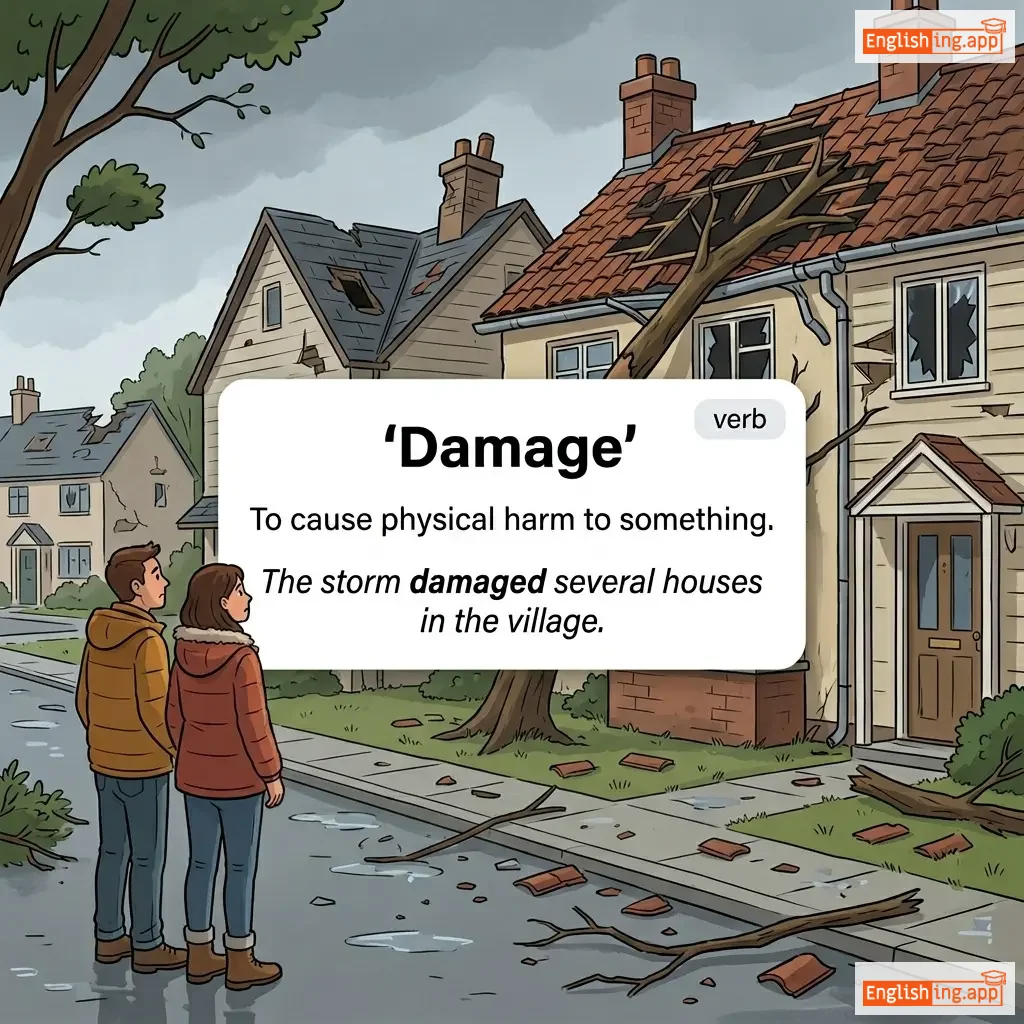
Damage definition card — visual illustration of the meaning
verb
/ˈdæmɪdʒ/
daño (danyo)

To cause physical harm to something.

"The storm damaged several houses in the village."

"La tormenta dañó varias casas en el pueblo." (La tormenta dano varias casas en el pueblo.)
adjective
/ˈdæmɪdʒɪŋ/
dañino (danino)

causing harm or injury

"The storm caused damaging effects to the crops."

"La tormenta causó efectos dañinos en los cultivos." (La tormenta causo efectos daninos en los cultivos.)
verb
/dæm/
maldecir / maldición (maldecir / maldición)

to condemn or criticize strongly; used as an expletive to express anger or emphasis

"He damned the unfair system in his speech."

"Él maldijo el sistema injusto en su discurso." (Él maldijo el sistema injusto en su discurso.)