वोकैबुलरीज

इंग्लिश वोकैबुलरी डिस्कवर, लर्न और मास्टर करें

adjective
/ˈkjuːbən/
क्यूबन (kyuban)

relating to Cuba, its people, or its culture

"We enjoyed delicious Cuban coffee at the café."

"हमने कैफे में स्वादिष्ट क्यूबन कॉफ़ी का आनंद लिया।" (Hamne cafe mein swadisht kyuban coffee ka anand liya.)
noun, verb
/kjuːb/
घन (ghan)

As a noun: a solid object with six equal square faces. As a verb: to cut food into small square pieces.

"She put a sugar cube in her tea."

"वह अपनी चाय में चीनी का एक क्यूब डाल रही थी।" (Vah apni chai mein cheeni ka ek cube daal rahi thi.)
noun
/ˈkjuːbeb ˈpepər/
क्यूब पेपर (kyub pepar)

aromatic spice with a slightly bitter taste and cooling aftertaste

"Cubeb pepper is used in traditional Indonesian cuisine."

"क्यूब पेपर पारंपरिक इंडोनेशियाई व्यंजन में इस्तेमाल होता है।" (kyub pepar paramparik indoneshiyai vyanjan mein istemal hota hai)
noun
/ˈkjuː.bɪ.kəl/
छोटा कक्ष (chhota kaksh)

A small partitioned-off area of a room, typically in an office.

"She works in a cubicle with three other colleagues."

"वह तीन अन्य सहकर्मियों के साथ एक क्यूबिकल में काम करती है।" (Wah teen anya sahakarmiyon ke saath ek cubicle mein kaam karti hai.)
noun
/ˈkʊk.uː/
कोयल (koyal)

a bird known for its distinctive call and for laying eggs in other birds' nests

"We heard the cuckoo calling from the forest early in the morning."

"हमने सुबह-सुबह जंगल से कुकू का आवाज सुनी।" (hamne subah-subah jangal se kkoo ka awaaz suni.)
noun
/ˈkjuː.kʌm.bər/
खीरा (kheera)

a long green vegetable with watery flesh, eaten raw in salads or cooked

"I added fresh cucumber slices to my salad."

"मैंने अपनी सलाद में ताजे क्यूकंबर के टुकड़े डाले।" (maine apni salad mein taje kyoombar ke tukde daale.)
noun/verb
/ˈkʌdʒ.əl/
लाठी (lathi)

A short, thick stick used as a weapon; to beat with a cudgel.

"The guard used a cudgel to chase away the thief."

"गार्ड ने चोर को भगाने के लिए लाठी का इस्तेमाल किया।" (Garde ne chor ko bhagane ke liye lathi ka istemal kiya.)
noun/verb
/kjuː/
संकेत (sanket)

A signal or prompt for action; to give a signal.

"The actor waited for his cue before entering the stage."

"अभिनेता मंच पर प्रवेश करने से पहले अपने संकेत का इंतजार कर रहा था।" (Abhinetā manch par pravesh karne se pehle apne sanket ka intezār kar rahā thā.)
cues definition card — visual illustration of the meaning
noun
kjuːz
संकेत (sanket)

Signals or hints from conversation or environment that help understanding

"Facial expressions provide cues about a person's emotions."

"चेहरे के हाव-भाव एक व्यक्ति के इमोशन्स के बारे में संकेत देते हैं।" (Chehre ke haav-bhaav ek vyakti ke emotions ke baare mein sanket dete hain.)
noun
/kwɪˈziːn/
व्यंजन (vyanjan)

A style or method of cooking, especially characteristic of a particular country or region.

"Italian cuisine is famous all over the world."

"इतालवी व्यंजन दुनिया भर में प्रसिद्ध है।" (Itali vyanjan duniya bhar mein prasiddh hai.)
noun
/ˌkʌl də ˈsæk/
अंतिम सड़क (antim sadak)

A street or passage closed at one end; a dead end.

"They bought a house at the end of a quiet cul de sac."

"उन्होंने एक शांत अंतिम सड़क के अंत में एक घर खरीदा।" (Unhone ek shant antim sadak ke ant mein ek ghar kharida.)
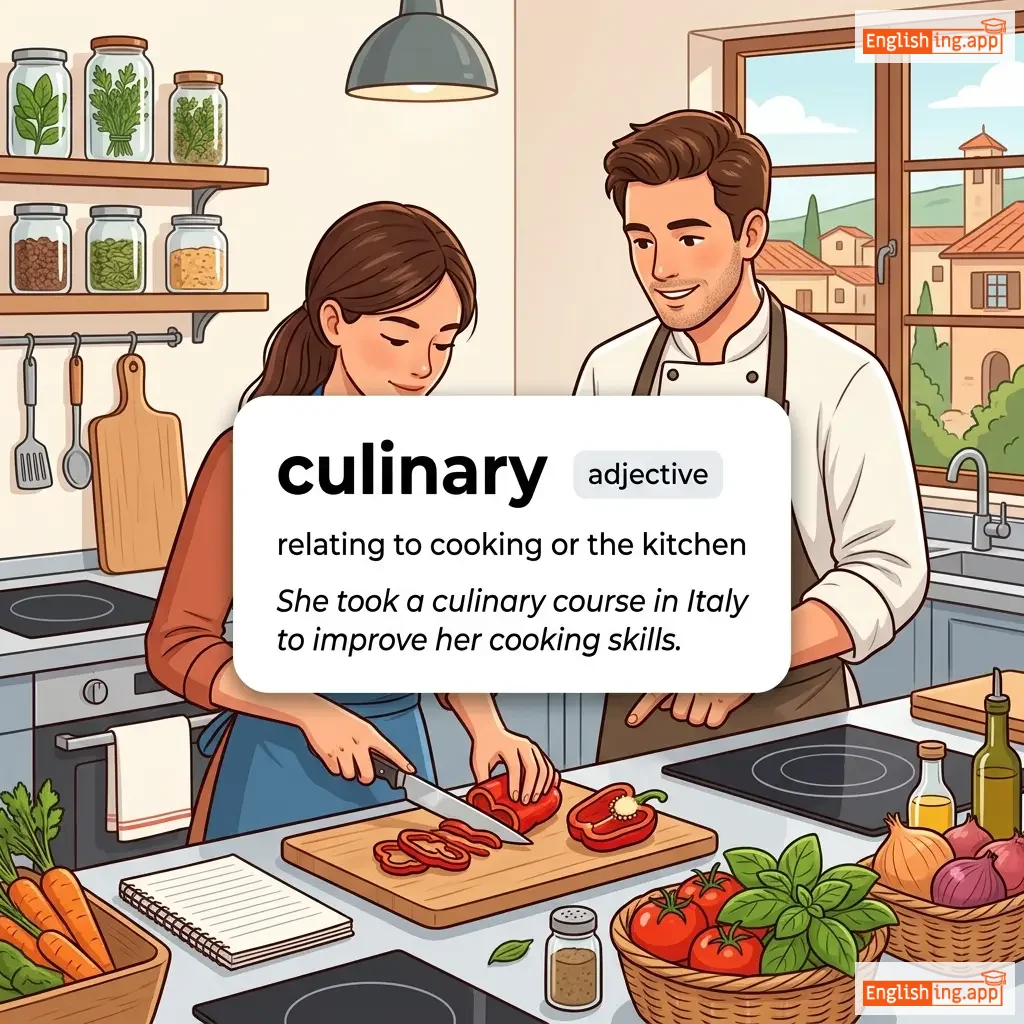
culinary definition card — visual illustration of the meaning
adjective
/ˈkʌl.ɪ.nɛr.i/
कुलिनरी (kulinary)

relating to cooking or the kitchen

"She took a culinary course in Italy to improve her cooking skills."

"वह अपनी कुकिंग कौशल को सुधारने के लिए इटली में एक कुलिनरी कोर्स कर रही थी।" (Wah apni cooking kaushal ko sudharne ke liye Italy mein ek culinary course kar rahi thi.)
verb
/kʌl/
चुनना / बाहर करना (chunna / baahar karna)

to select or remove from a larger group, often to reduce numbers

"The farmers decided to cull the sick animals from the herd."

"किसान ने बीमार जानवरों को झुंड से बाहर करने का निर्णय लिया।" (Kisaan ne beemar jaanwaron ko jhund se baahar karne ka nirnay liya.)
culminate definition card — visual illustration of the meaning
verb
/ˈkʌl.mɪ.neɪt/
उच्चतम बिंदु पर पहुँचना (uchchtam bindu par pahuchna)

to reach the highest point or final stage

"The negotiations culminated in a successful agreement."

"मोलभाव एक सफल समझौते में उच्चतम बिंदु पर पहुँचा।" (Molbhav ek safal samjhote mein uchchtam bindu par pahucha.)
culmination definition card — visual illustration of the meaning
noun
/ˌkʌl.mɪˈneɪ.ʃən/
परिणति (parinati)

the highest point or final result of something

"Graduation day is the culmination of years of hard work."

"ग्रेजुएशन दिवस वर्षों की कठिन मेहनत का परिणति है।" (Graduation divas varshon ki kathin mehnat ka parinati hai.)
noun
/ˌkʌl.pəˈbɪl.ɪ.ti/
दोषिता (doshita)

responsibility for a fault or wrong; blameworthiness

"The jury considered his level of culpability in the crime."

"जूरी ने अपराध में उसकी दोषिता के स्तर पर विचार किया।" (Juri ne aparadh mein uski doshita ke star par vichar kiya.)
adjective
/ˈkʌlpəbl̩/
दोषी (doshi)

deserving blame or responsibility for a wrongdoing

"The judge found him culpable for the accident."

"न्यायाधीश ने उसे दुर्घटना के लिए दोषी पाया।" (Nyayadhish ne use durghatna ke liye doshi paaya.)
noun
/ˈkʌlprɪt/
अपराधी (apraadi)

a person who is responsible for a crime or misdeed

"The police caught the culprit behind the robbery."

"पुलिस ने लूटपाट के पीछे के अपराधी को पकड़ लिया।" (Police ne lootpaat ke peeche ke apradhi ko pakad liya.)
noun
/kʌlt/
संप्रदाय (sampraday)

a system of religious veneration and devotion directed toward a particular figure or object

"The cult followed their leader with great devotion."

"संप्रदाय ने अपने नेता का पालन बड़ी श्रद्धा से किया।" (Sampraday ne apne neta ka paalan badi shraddha se kiya.)
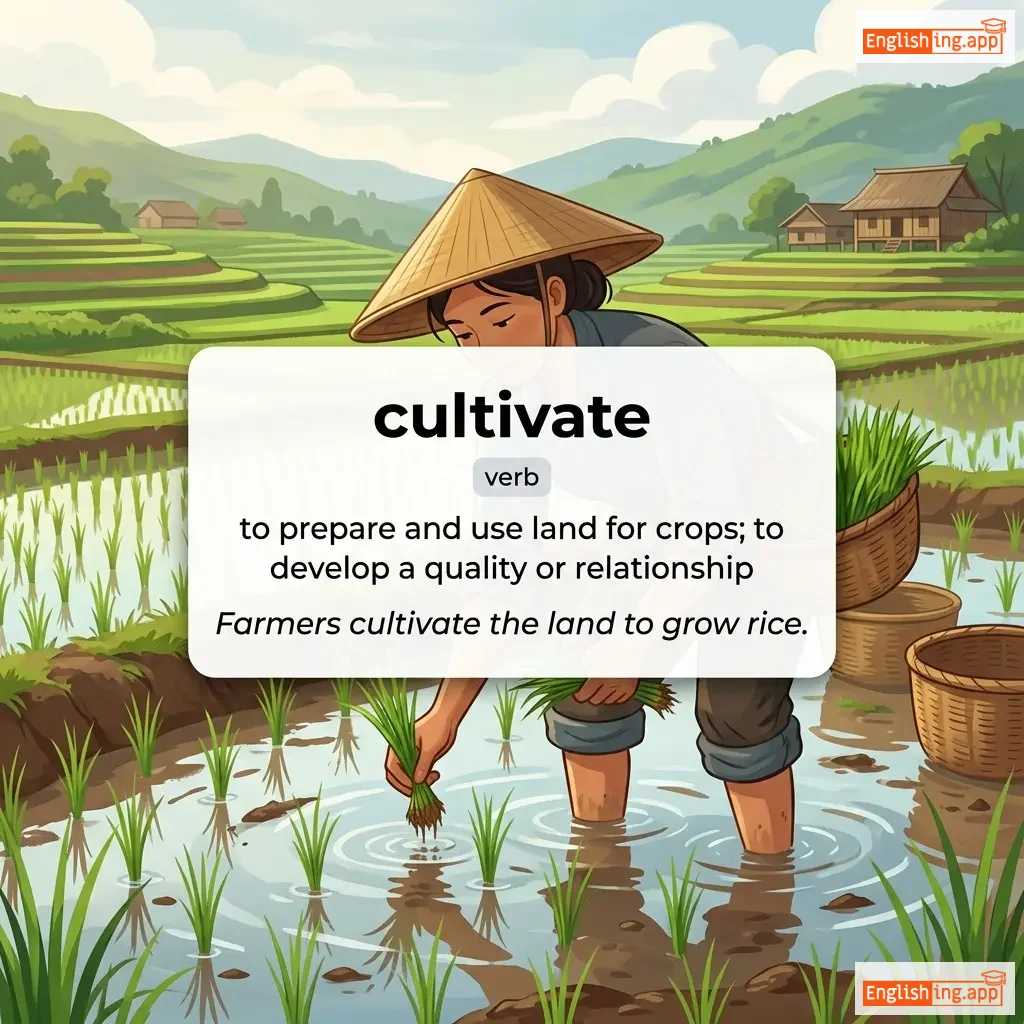
cultivate definition card — visual illustration of the meaning
verb
/ˈkʌltɪveɪt/
खुशी (khushi)

to prepare and use land for crops; to develop a quality or relationship

"Farmers cultivate the land to grow rice."

"वह जब पुरस्कार प्राप्त करती है तो अपनी खुशी छिपा नहीं पाती।" (Wah jab puraskar prapt karti hai to apni khushi chhupa nahi paati.)
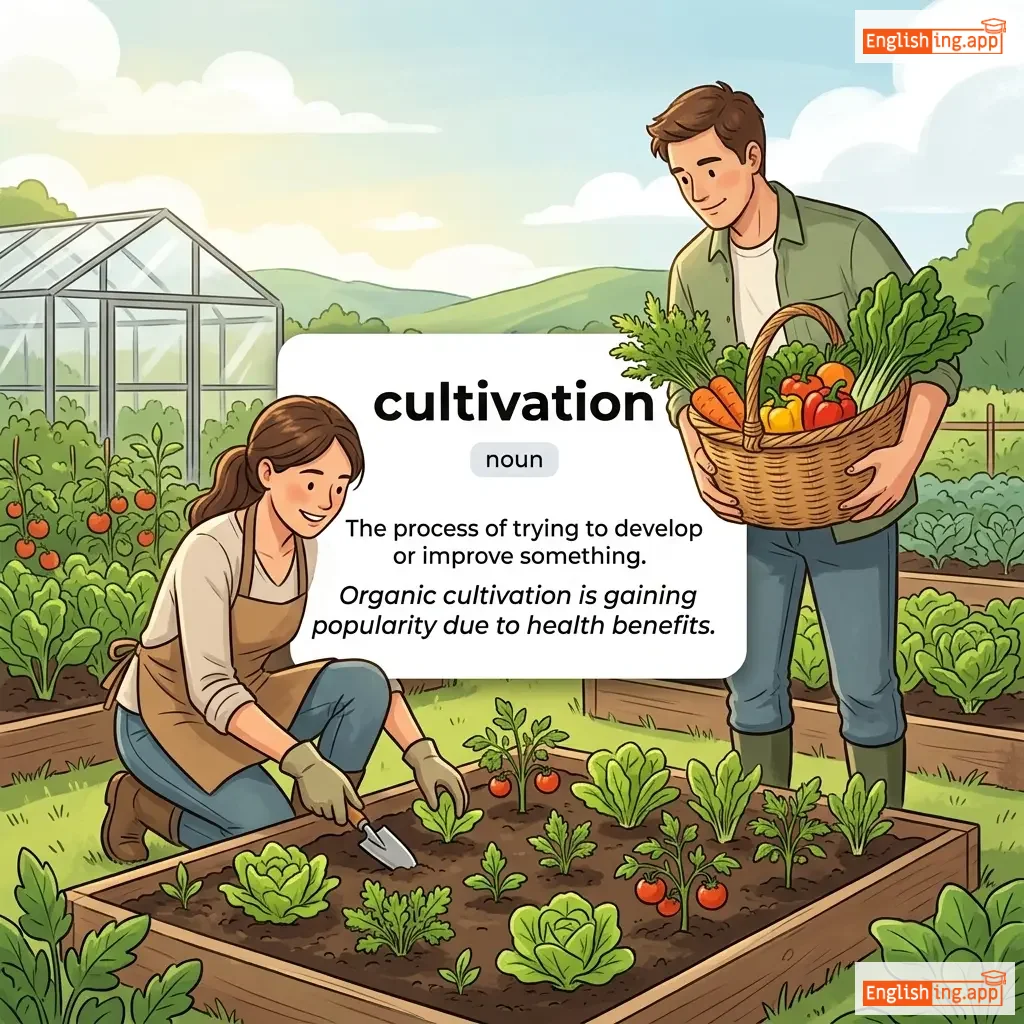
cultivation definition card — visual illustration of the meaning
noun
/ˌkʌl.tɪˈveɪ.ʃən/
कृषि (krishi)

The process of trying to develop or improve something.

"Organic cultivation is gaining popularity due to health benefits."

"ऑर्गेनिक कृषि स्वास्थ्य लाभ के कारण लोकप्रियता प्राप्त कर रही है।" (Organic krishi swasthya labh ke karan lokpriyata prapt kar rahi hai.)
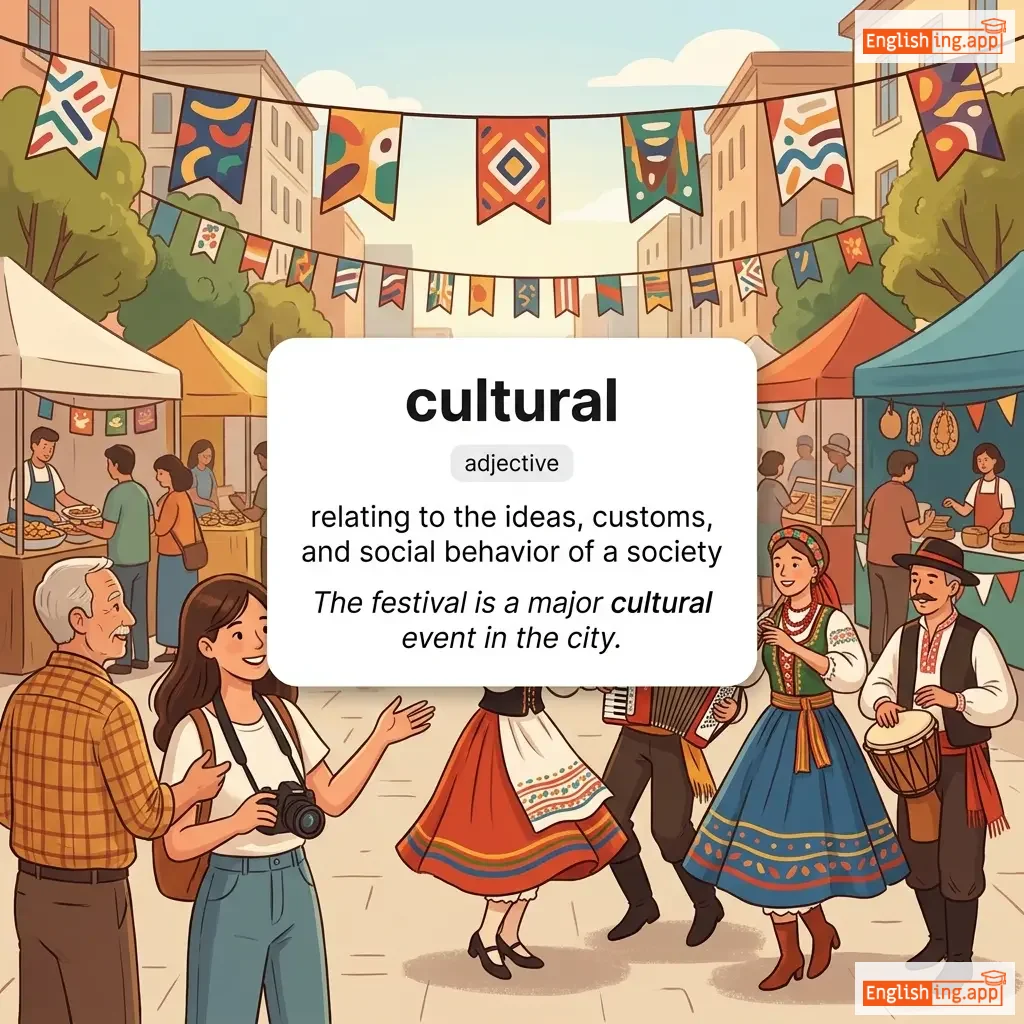
cultural definition card — visual illustration of the meaning
adjective
/ˈkʌltʃərəl/
सांस्कृतिक (sanskritik)

relating to the ideas, customs, and social behavior of a society

"The festival is a major cultural event in the city."

"त्योहार शहर में एक प्रमुख सांस्कृतिक घटना है।" (Tyohar sheher mein ek pramukh sanskritik ghatna hai.)
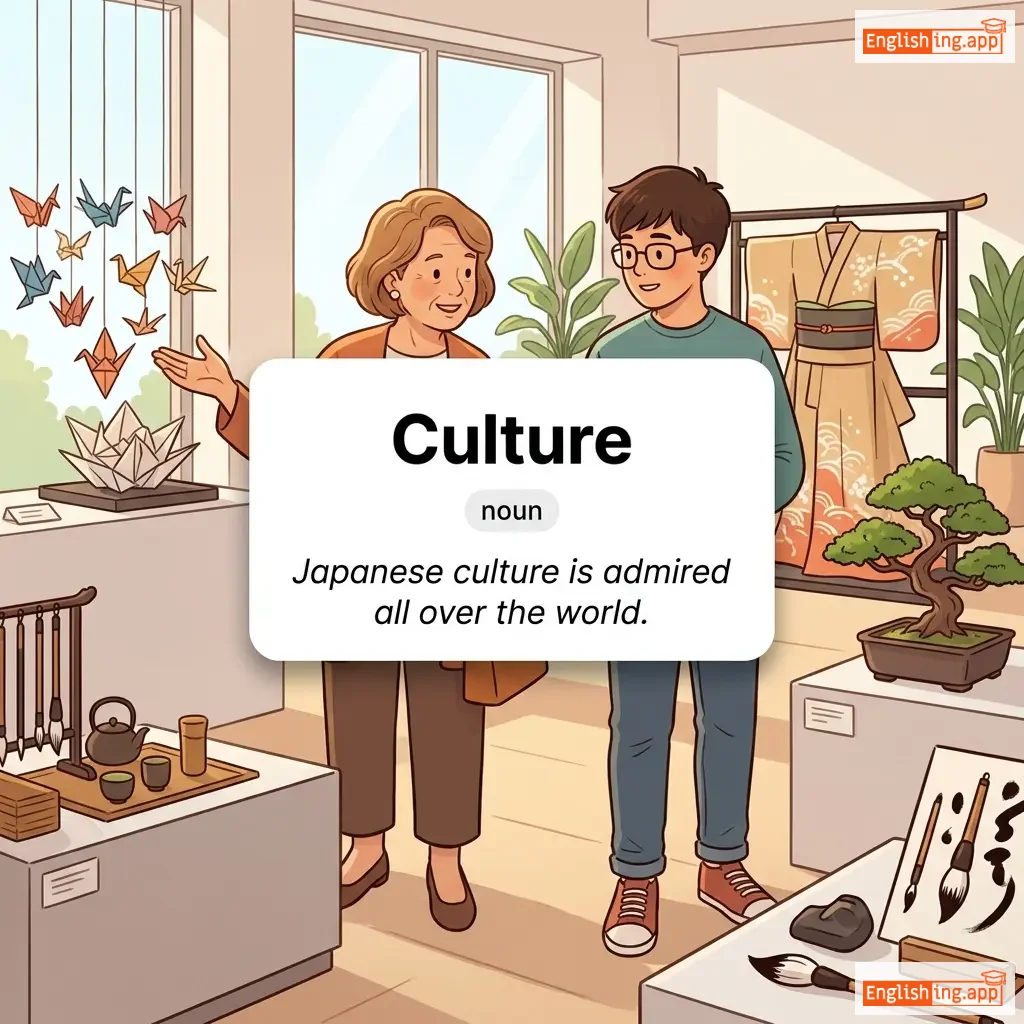
Culture definition card — visual illustration of the meaning
noun
/ˈkʌltʃər/
संस्कृति (sanskruti)

the customs, arts, social institutions, and achievements of a particular people or society

"Japanese culture is admired all over the world."

"जापानी संस्कृति पूरी दुनिया में सराही जाती है।" (Japani sanskruti poori duniya mein sarahee jaati hai.)
adjective
/ˈkʌltʃəd/
संस्कृत (sanskruti)

characterized by refined taste, manners, and education

"She is a cultured woman who loves art and literature."

"वह एक संस्कृत महिला है जो कला और साहित्य को पसंद करती है।" (Wah ek sanskrit mahila hai jo kala aur sahitya ko pasand karti hai.)
noun
/ˈkʌlvərt/
कलवर्ट (kalvart)

a tunnel or drain that carries water under a road or railway

"The heavy rainwater flowed through the culvert under the bridge."

"भारी वर्षा का पानी पुल के नीचे कलवर्ट से बहकर गया।" (Bhaari varsha ka paani pul ke neeche kalvart se behkar gaya.)
cumbersome definition card — visual illustration of the meaning
adjective
/ˈkʌmbərsəm/
झंझटपूर्ण (jhanjhatpoorn)

Large, heavy, or difficult to handle; complicated and inefficient.

"The cumbersome package was too heavy to carry alone."

"झंझटपूर्ण पैकेज अकेले उठाने के लिए बहुत भारी था।" (jhanjhatpoorn paikej akela uthane ke liye bahut bhaari tha.)
noun
/ˈkjuːmɪn/
जीरा (jeera)

A spice made from the dried seeds of a plant in the parsley family, with a warm earthy flavor

"Cumin is an essential spice in Indian and Middle Eastern cooking."

"जीरा भारतीय और मध्य पूर्वी खाना पकाने में एक आवश्यक मसाला है।" (jeera bhartiya aur madhya purvi khana pakane mein ek aavashyak masala hai.)
adjective
/ˈkjuːmjələtɪv/
संवृद्धि (sanvruddhi)

Increasing gradually by addition; growing in quantity, force, or effect.

"The cumulative effect of stress can harm your health."

"तनाव का संचित प्रभाव आपके स्वास्थ्य को नुकसान पहुँचा सकता है।" (tanaav ka sanchit prabhav aapke swasthya ko nuksan pahunchaa sakta hai.)
adjective
/ˈkʌnɪŋ/
चतुर (chatur)

Having or showing skill in achieving one's ends by deceit or evasion; cleverness in a tricky way.

"The cunning fox tricked the farmer."

"चतुर लोमड़ी ने किसान को धोखा दिया।" (chatur lomdi ne kisan ko dhokha diya.)
noun
/kʌp/
कप (kap)

a small bowl-shaped container for drinking from, typically with a handle

"She drank a cup of tea in the morning."

"उसने सुबह में एक कप चाय पी।" (Usne subah mein ek kap chai pi.)
noun
/ˈkʌp.bɔːrd/
कपबोर्ड (kapbord)

a piece of furniture with doors and shelves for storing dishes, food, or clothes

"She stored all the plates and bowls in the kitchen cupboard."

"उसने सभी प्लेट और कटोरे रसोई के कपबोर्ड में रखे।" (usne sabhi plet aur katore rasoi ke kapbord mein rakhe.)
noun
/kjuːˈpɪdəti/
लालच (laalach)

Excessive desire for wealth or possessions; greed.

"The king's downfall was caused by his cupidity."

"राजा की बर्बादी उसके लालच के कारण हुई।" (raja ki barbadi uske laalach ke kaaran hui.)
adjective
/ˈkjʊərəbl/
ठीक किया जा सकने वाला (theek kiya ja sakne wala)

Able to be cured or healed.

"The doctor assured her that the disease was curable."

"डॉक्टर ने उसे यकीन दिलाया कि बीमारी ठीक किया जा सकने वाली थी।" (daktar ne use yakeen dilaya ki bimari theek kiya ja sakne wali thi.)
adjective
/ˈkjʊərətɪv/
उपचारात्मक (upcharatmak)

Able to cure disease or restore health.

"The doctor prescribed a curative treatment for the illness."

"द डॉक्टर ने बीमारी के लिए एक उपचारात्मक इलाज सुझाया।" (Da doctor ne bimari ke liye ek upcharatmak ilaaj sujhaaya.)
noun
/kjʊˈreɪtər/
क्यूरेटर (kyu'retar)

a person who is responsible for the care and management of a museum, gallery, or collection

"The curator organized a new exhibition of ancient artifacts."

"क्यूरेटर ने प्राचीन कलाकृतियों की एक नई प्रदर्शनी का आयोजन किया।" (Kyurēṭar ne prācīn kalākr̥tiyoṅ kī ek naī pradarśanī kā āyojan kiyā.)
verb
/kɜːrb/
नियंत्रित करना / रोकना (niyantrit karna / rokna)

to restrain, control, or limit something

"The government took steps to curb inflation."

"सरकार ने महंगाई को नियंत्रित करने के लिए कदम उठाए।" (Sarkar ne mehngai ko niyantrit karne ke liye kadam uthaye.)
noun
/kɜːrd/
दही (dahi)

a white dairy product made by coagulating milk; yogurt

"She added fresh curd to the salad for a tangy flavor."

"उसने सलाद में तीखा स्वाद देने के लिए ताजे दही डाले।" (usne salad mein tikha swaad dene ke liye tazee dahi daale.)
cure definition card — visual illustration of the meaning
verb
/kjʊər/
उपचार करना (upchar karna)

to make someone healthy again after an illness

"The new medicine cured her of the infection."

"नई दवा ने उसे संक्रमण से ठीक किया।" (Nayi dawa ne use sankraman se theek kiya.)
noun
/ˈkɜːrfjuː/
कर्फ्यू (karfyu)

a rule requiring people to stay indoors after a certain time, usually at night

"The city imposed a curfew during the unrest."

"शहर ने अशांति के दौरान कर्फ्यू लगा दिया था।" (Shahar ne ashanti ke dauran karfyu laga diya tha.)
noun
/ˈkjʊriˌoʊ/
अजीब वस्तु (ajeeb vastu)

a small unusual or interesting object, often collected for its rarity

"She bought a curio from the antique shop."

"उसने प्राचीन दुकान से एक क्यूरियो खरीदी।" (Usne pracheen dukaan se ek curio khareedi.)
noun
/ˌkjʊəriˈɒsɪti/
जिज्ञासा (jijñāsā)

a strong desire to know or learn something

"Children have a natural curiosity about the world around them."

"बच्चों में अपने आस-पास की दुनिया के बारे में प्राकृतिक जिज्ञासा होती है।" (Baccho mein apne aas-paas ki duniya ke baare mein prakritik jijñāsā hoti hai.)
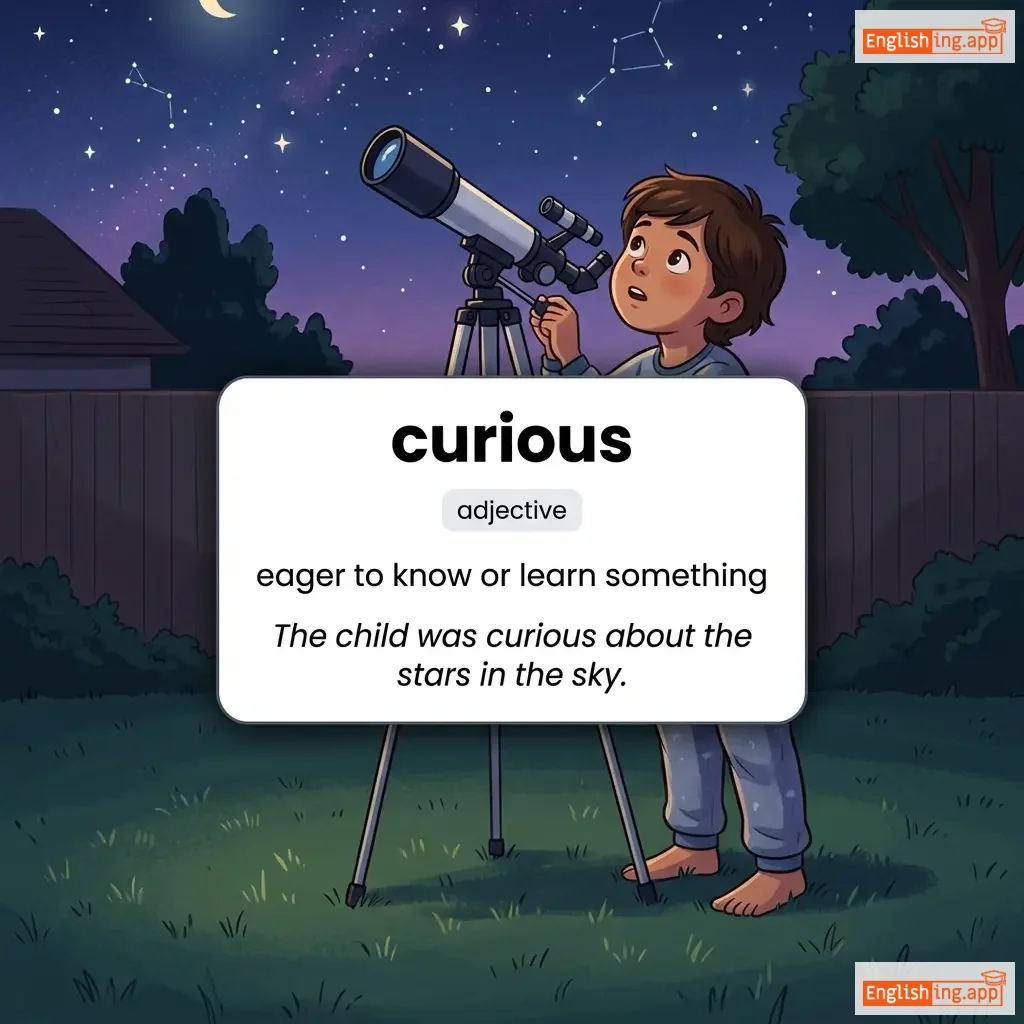
curious definition card — visual illustration of the meaning
adjective
/ˈkjʊəriəs/
जिज्ञासु (jijñāsu)

eager to know or learn something

"The child was curious about the stars in the sky."

"बच्चा आकाश में तारों के बारे में जिज्ञासु था।" (Baccha aakash mein taaron ke baare mein jijñāsu tha.)
noun
/kɜːrl/
घुंघराले बाल; लहरदार आकार (ghunghraale baal; lahrdaar aakaar)

a piece of hair that curves or coils; something with a spiral or curved shape

"She had beautiful natural curls that framed her face perfectly."

"उसके सुंदर प्राकृतिक घुंघराले बाल थे जो उसके चेहरे को परफेक्टली फ्रेम करते थे।" (uske sundar prakritik ghunghraale baal the jo uske chehre ko parfektli frame karte the)
noun
/ˈkɜːrlər/
कर्लर (karlr)

A small roller used for curling hair.

"She used a curler to style her hair for the party."

"उसने पार्टी के लिए अपने बालों को स्टाइल करने के लिए कर्लर का इस्तेमाल किया।" (Usne party ke liye apne baalon ko style karne ke liye karlar ka istemaal kiya.)
adjective
/ˈkɜːrli/
घुँघराले (ghungharaale)

having curls or waves; shaped with bends or coils

"She has naturally curly hair."

"उसके बाल स्वाभाविक रूप से घुँघराले हैं।" (uske baal swabhavik roop se ghungharaale hain)
noun
/kərˈmʌdʒən/
चिड़चिड़ा आदमी (chidhchidhā ādmī)

a bad-tempered, cranky, or irritable person, usually old

"The old curmudgeon complained about everything in the neighborhood."

"वृद्ध चिड़चिड़े आदमी ने मोहल्ले में सब कुछ पर शिकायत की।" (Vr̥ddh chidhchidhā ādmī ne mohalle meṁ sab kuch par śikāyat kī.)
currency definition card — visual illustration of the meaning
noun
/ˈkʌrənsi/
मुद्रा (mudra)

the system of money used in a particular country

"The U.S. dollar is the official currency of the United States."

"यूएस डॉलर संयुक्त राज्य की आधिकारिक मुद्रा है।" (US dollar sanyukt rajya ki aadhikarik mudra hai.)
adjective, noun
/ˈkʌrənt/
वर्तमान, धारा (vartaman, dhara)

belonging to the present time; a flow of water or electricity

"She is reading the current issue of the magazine."

"वह पत्रिका का वर्तमान अंक पढ़ रही है।" (Vah patrika ka vartaman ank padh rahi hai.)
adverb
/ˈkʌrəntli/
वर्तमान में (vartaman mein)

at the present time; now

"He is currently working on a new project."

"वह वर्तमान में एक नए प्रोजेक्ट पर काम कर रहा है।" (Vah vartaman mein ek naye project par kaam kar raha hai.)
curriculum definition card — visual illustration of the meaning
noun
/kəˈrɪkjələm/
पाठ्यक्रम (pathyakram)

The subjects comprising a course of study in a school, college, or university.

"The school updated its curriculum to include more digital literacy courses."

"स्कूल ने अपने पाठ्यक्रम को अधिक डिजिटल साक्षरता पाठ्यक्रमों को शामिल करने के लिए अपडेट किया।" (School ne apne pathyakram ko adhik digital saksharta pathyakramon ko shamil karne ke liye update kiya.)