वोकैबुलरीज

इंग्लिश वोकैबुलरी डिस्कवर, लर्न और मास्टर करें

noun
/dɪˈspɔɪlər/
लूटने वाला (lootne wala)

A person who robs, plunders, or violently takes things from others.

"The despoilers left the city in ruins."

"लूटने वालों ने शहर को बर्बाद कर दिया।" (Lootne walon ne shahar ko barbaad kar diya.)
verb
/dɪˈspɒnd/
निराश होना (nirash hona)

to lose confidence or hope; to become dejected

"After repeated failures, he began to despond."

"बार-बार असफलताओं के बाद, वह निराश होने लगा।" (Bar-bar asafaltaon ke baad, vah nirash hone laga.)
adjective
/dɪˈspɒndənt/
हताश (despondent)

feeling or showing deep hopelessness or discouragement

"She felt despondent after losing her job."

"उसने अपनी नौकरी खोने के बाद निराश महसूस किया।" (Usne apni naukri khone ke baad nirash mahasoos kiya.)
noun
/ˈdɛspɒt/
तानाशाह (tanashah)

a ruler with absolute power, often ruling in a cruel or oppressive way

"The despot ruled the nation with fear and violence."

"तानाशाह ने डर और हिंसा के साथ देश पर शासन किया।" (Tanashah ne dar aur hinsa ke saath desh par shasan kiya.)
adjective
/dɛˈspɒtɪk/
तानाशाही (tanashahi)

exercising power in a cruel, oppressive, or authoritarian way

"The king’s despotic rule left the people in misery."

"राजा का तानाशाही शासन लोगों को दुःख में डाल गया।" (Raja ka tanashahi shasan logon ko dukh mein daal gaya.)
noun
/ˈdɛspətɪzəm/
तानाशाही (tanashaahi)

absolute power exercised in a cruel and oppressive way

"The people revolted against the era of despotism."

"लोगों ने तानाशाही के युग के खिलाफ विद्रोह किया।" (Logon ne tanashaahi ke yug ke khilaaf vidroh kiya.)
noun
/dɪˈzɜːrt/
मिठाई (mithai)

the sweet course eaten at the end of a meal

"We had ice cream for dessert after dinner."

"हमने रात के खाने के बाद मिठाई के रूप में आइसक्रीम खाई।" (Hamne raat ke khane ke baad mithai ke roop mein ice cream khai.)
Destination definition card — visual illustration of the meaning
noun
/ˌdɛstɪˈneɪʃən/
गंतव्य (gantavya)

the place to which someone or something is going or being sent

"Paris is a popular tourist destination."

"पेरिस एक लोकप्रिय पर्यटक गंतव्य है।" (Paris ek lokpriya paryatak gantavya hai.)
noun
/ˈdɛstəni/
किस्मत (kismat)

The events that will necessarily happen to a particular person or thing in the future; fate.

"She believed it was her destiny to become a doctor."

"उसे विश्वास था कि डॉक्टर बनना उसकी किस्मत थी।" (Use vishwas tha ki doctor banna uski kismat thi.)
adjective
/ˈdɛstɪˌtuːt/
बेहद गरीब (behad gareeb)

extremely poor and lacking the means to provide for oneself

"The earthquake left many families destitute."

"भूकंप ने कई परिवारों को बेहद गरीब बना दिया।" (Bhookamp ne kai parivaron ko behad gareeb bana diya.)
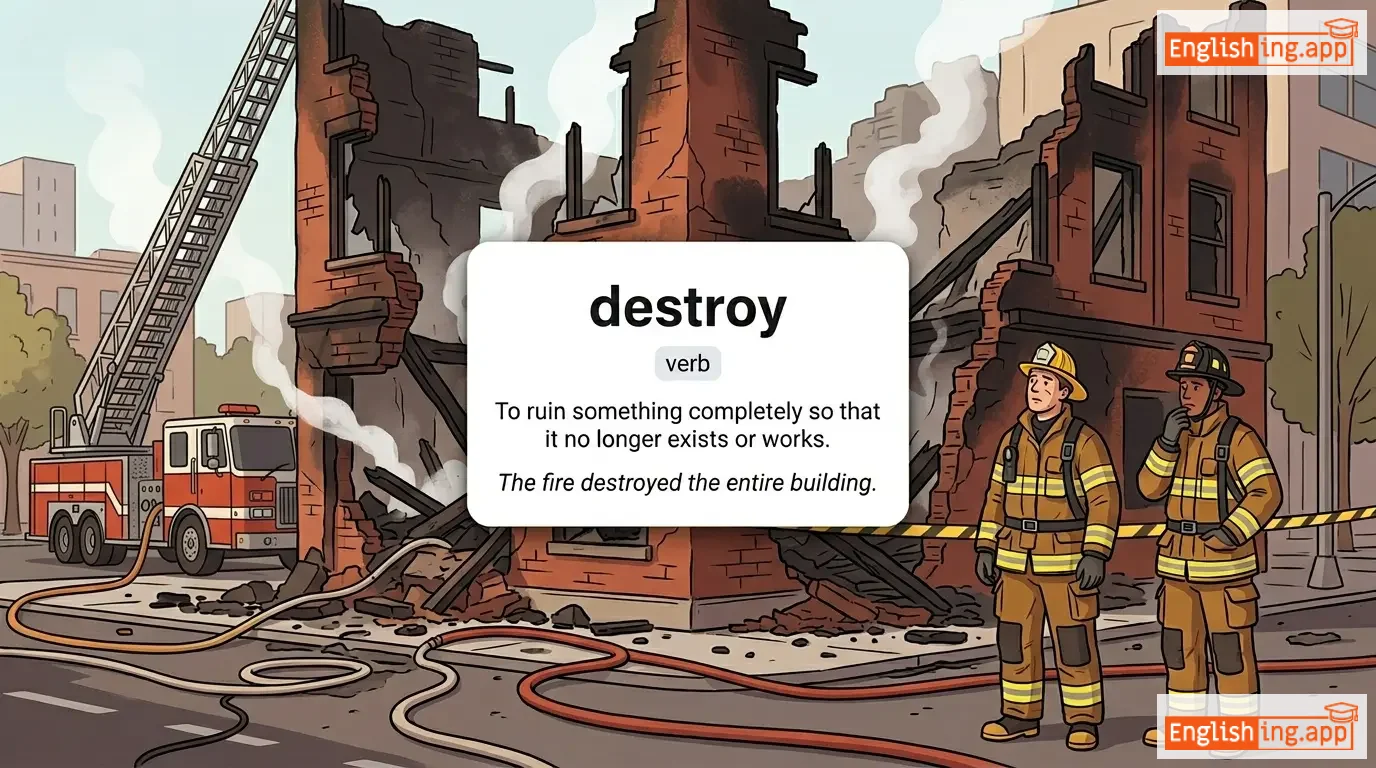
destroy definition card — visual illustration of the meaning
verb
/dɪˈstrɔɪ/
विनाश करना (vinash karna)

To ruin something completely so that it no longer exists or works.

"The fire destroyed the entire building."

"आग ने पूरी बिल्डिंग को नष्ट कर दिया।" (Aag ne puri building ko nasht kar diya.)
noun
/dɪˈstrʌkʃən/
विनाश (vinash)

the act of causing so much damage to something that it no longer exists or cannot be repaired

"The fire caused the destruction of the building."

"आग ने इमारत के विनाश का कारण बना।" (Aag ne imarat ke vinash ka kaaran bana.)
adjective
/dɪˈstrʌktɪv/
विनाशकारी (vinashkari)

Causing great and irreparable harm or damage.

"Hurricanes are often destructive to coastal cities."

"हरिकेन्स अक्सर तटीय शहरों के लिए विनाशकारी होते हैं।" (Harikens aksar tatiya shahron ke liye vinashkari hote hain.)
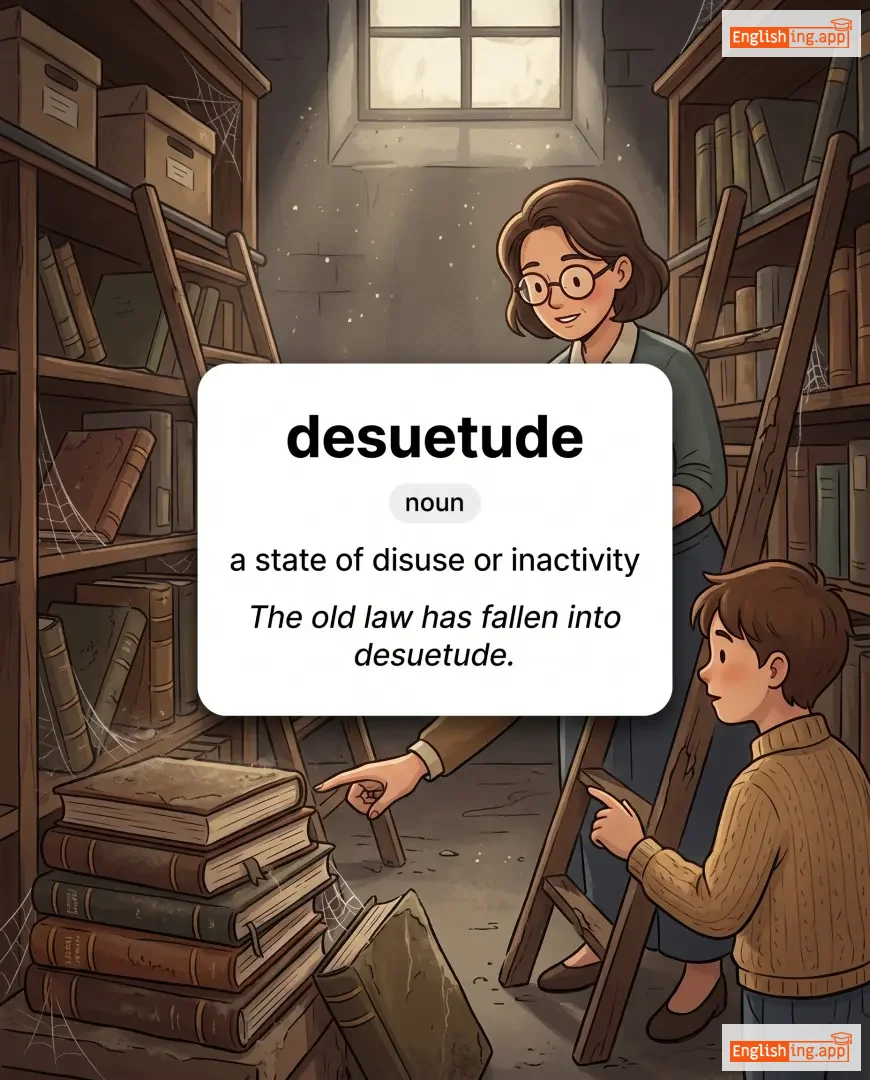
desuetude definition card — visual illustration of the meaning
noun
/ˈdɛswɪˌtuːd/
परित्याग (parityag)

a state of disuse or inactivity

"The old law has fallen into desuetude."

"पुराना कानून अब परित्याग में गिर गया है।" (Purana kanoon ab parityag mein gir gaya hai.)
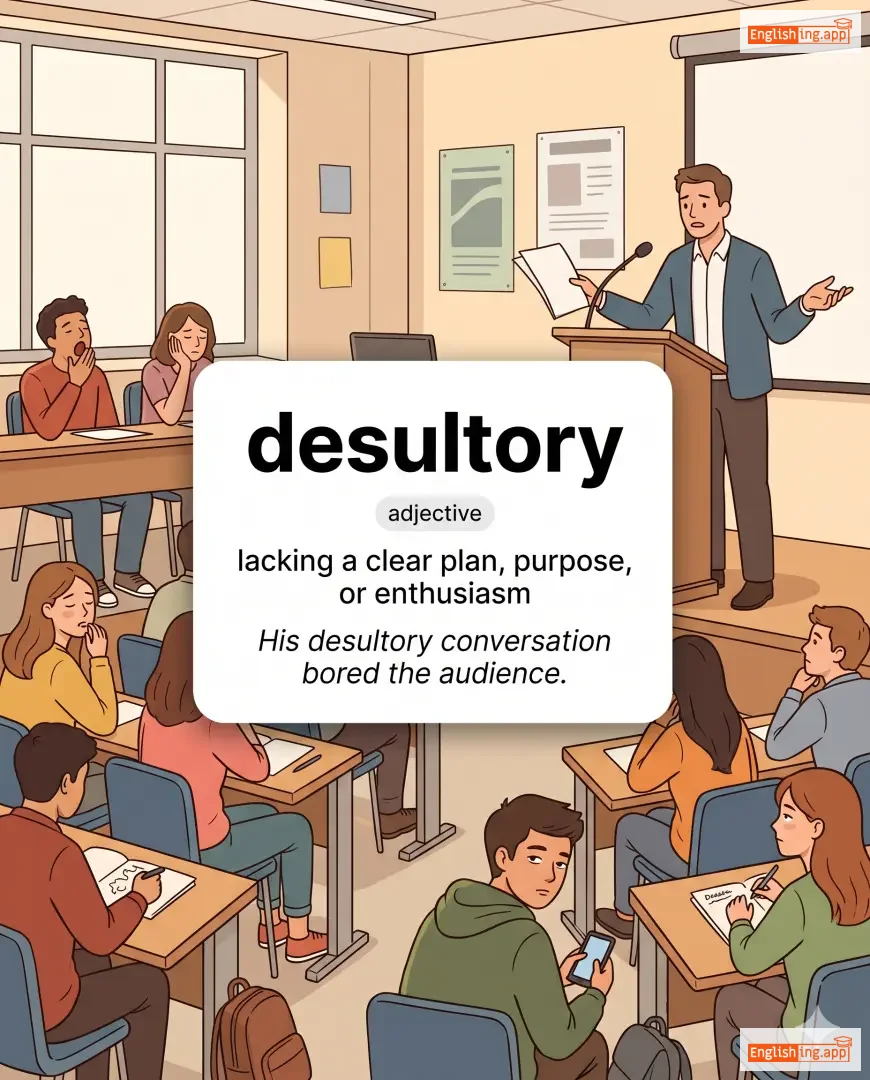
desultory definition card — visual illustration of the meaning
adjective
/ˈdɛsəlˌtɔːri/
असंगत (asangat)

lacking a clear plan, purpose, or enthusiasm

"His desultory conversation bored the audience."

"उसकी असंगत बातचीत ने दर्शकों को ऊब दिया।" (Uski asangat baatchit ne darshako ko oob diya.)
verb
/dɪˈtætʃ/
अलग करना (alag karna)

to separate or remove something from something else

"She detached the page from the notebook."

"उसने नोटबुक से पन्ना अलग किया।" (Usne notebook se panna alag kiya.)
adjective
/dɪˈtætʃt/
विच्छिन्न, निर्लिप्त (vichchhinna, nirlipta)

separate or disconnected; showing a lack of emotional involvement

"He lived in a detached house away from the city."

"वह शहर से दूर एक विच्छिन्न घर में रहता था।" (Vah shahar se door ek vichchhinna ghar mein rehta tha.)
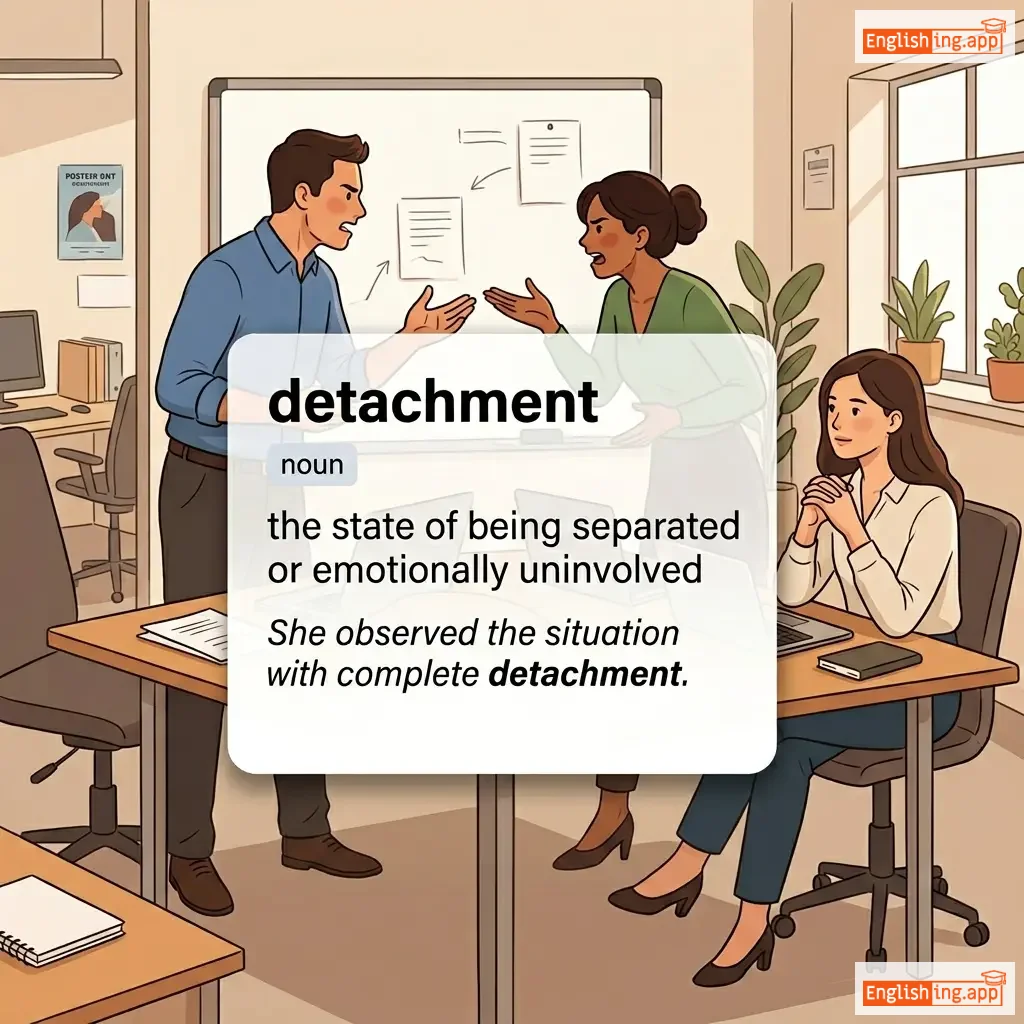
detachment definition card — visual illustration of the meaning
noun
/dɪˈtætʃmənt/
विच्छिन्नता, निस्पृहता (vichchhinnta, nisprihata)

the state of being separated or emotionally uninvolved

"She observed the situation with complete detachment."

"वह स्थिति को पूर्ण विच्छिन्नता के साथ देख रही थी।" (Vah sthiti ko poorn vichchhinnta ke saath dekh rahi thi.)
noun
/ˈdiː.teɪl/
विवरण (vivaran)

An individual feature, fact, or item of information.

"She explained the plan in great detail."

"उसने योजना को बहुत विस्तार से समझाया।" (Usne yojana ko bahut vistaar se samjhaya.)
adjective
/ˈdiː.teɪld/
विस्तृत (vistrit)

Having many details; very thorough.

"The report provided a detailed analysis of the situation."

"रिपोर्ट ने स्थिति का विस्तृत विश्लेषण प्रस्तुत किया।" (Report ne sthiti ka vistarit vishleshan prastut kiya.)
verb
/dɪˈteɪn/
बंदी बनाना (bandi banana)

to keep someone from proceeding; to hold back, especially by official authority

"The police detained the suspect for questioning."

"पुलिस ने संदिग्ध को पूछताछ के लिए डिटेन किया।" (Polis ne sandigdh ko poochtaach ke liye detain kiya.)
verb
/dɪˈtɛkt/
पहचानना (pehchanna)

To discover or identify the presence of something.

"The device can detect smoke in the room."

"उपकरण कमरे में धुआं पहचान सकता है।" (Upkaran kamre mein dhuan pehchaan sakta hai.)
noun
/dɪˈtɛkʃən/
पहचान (pahchan)

the action or process of identifying the presence of something

"The detection of fraud in the system was swift."

"सिस्टम में धोखाधड़ी का पता लगाना तेज़ था।" (System mein dhokhaadari ka pata lagana tez tha.)
noun
/dɪˈtɛktɪv/
जासूस (jaasoós)

a person whose job is to investigate and solve crimes

"The detective solved the mystery in just two days."

"जासूस ने केवल दो दिनों में रहस्य हल कर दिया।" (Jasoos ne keval do dinon mein rahasya hal kar diya.)
noun
/deɪˈtɒnt/
संबंधों में सुधार, तनाव में कमी (sambandhon mein sudhaar, tanaav mein kami)

the easing of strained relations, especially between countries

"The treaty helped bring about a détente between the two nations."

"संविदा ने दो राष्ट्रों के बीच तनाव में कमी लाने में मदद की।" (Samvida ne do rashtron ke beech tanaav mein kami laane mein madad ki.)
noun
/dɪˈtɛnʃən/
हिरासत (hirasat)

the action of keeping someone in custody or confinement

"The student faced detention for his misbehavior."

"छात्र को उसके खराब व्यवहार के लिए हिरासत का सामना करना पड़ा।" (Chhatra ko uske kharab vyavhaar ke liye hirasat ka samna karna pada.)
verb
/dɪˈtɜːr/
रोकना, निरुत्साहित करना (rokna, nirutsahit karna)

to discourage someone from doing something by instilling doubt or fear

"High fines are meant to deter people from breaking the law."

"उच्च जुर्माना लोगों को कानून तोड़ने से रोकने के लिए होता है।" (Ucch jurmana logon ko kanoon todne se rokne ke liye hota hai.)
noun
/dɪˈtɜːrdʒənt/
डिटर्जेंट (deterjent)

a substance used for cleaning, especially for washing clothes and dishes

"She bought a new brand of detergent for laundry."

"उसने कपड़े धोने के लिए एक नया डिटर्जेंट खरीदा।" (Usne kapde dhone ke liye ek naya detergent kharida.)
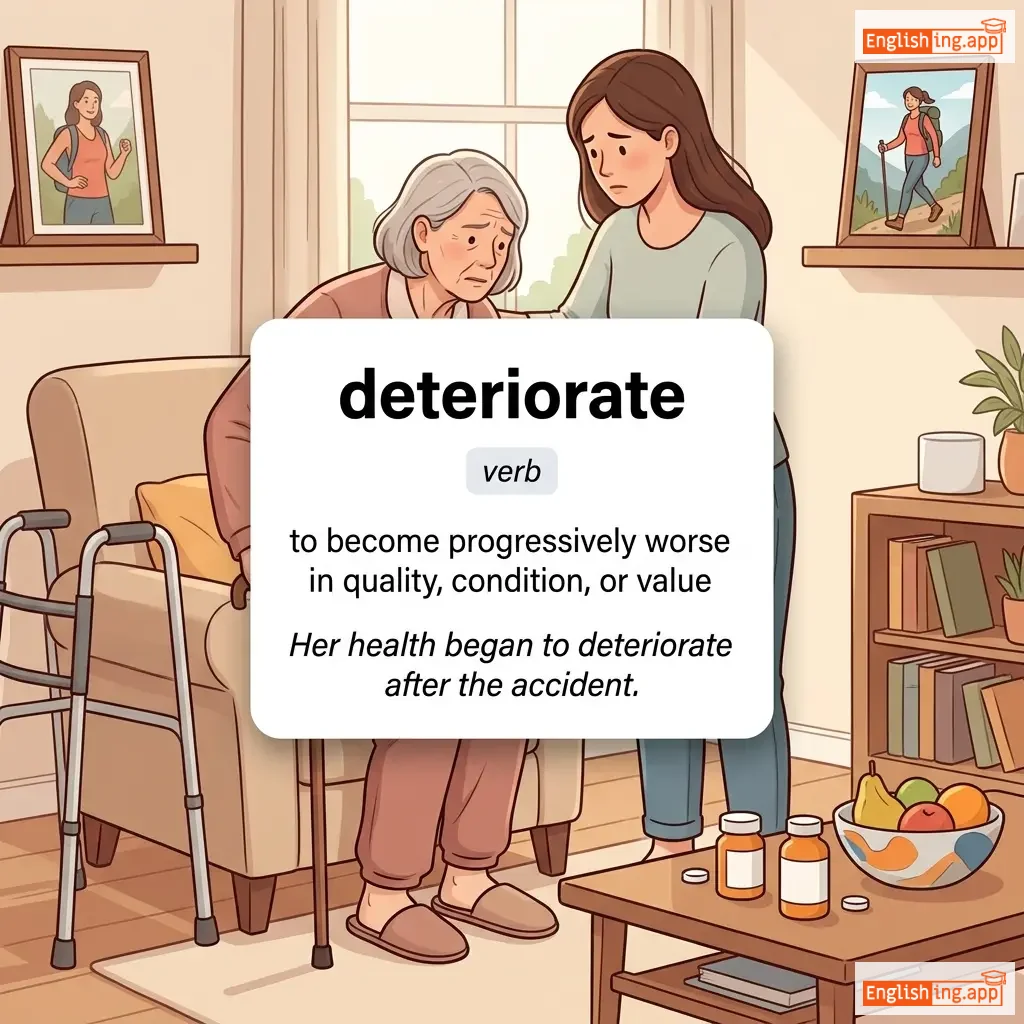
deteriorate definition card — visual illustration of the meaning
verb
/dɪˈtɪriəreɪt/
अवक्षिप्त होना (avakshipt hona)

to become progressively worse in quality, condition, or value

"Her health began to deteriorate after the accident."

"उसकी सेहत दुर्घटना के बाद deteriorate होने लगी।" (Uski sehat durghatna ke baad deteriorate hone lagi.)
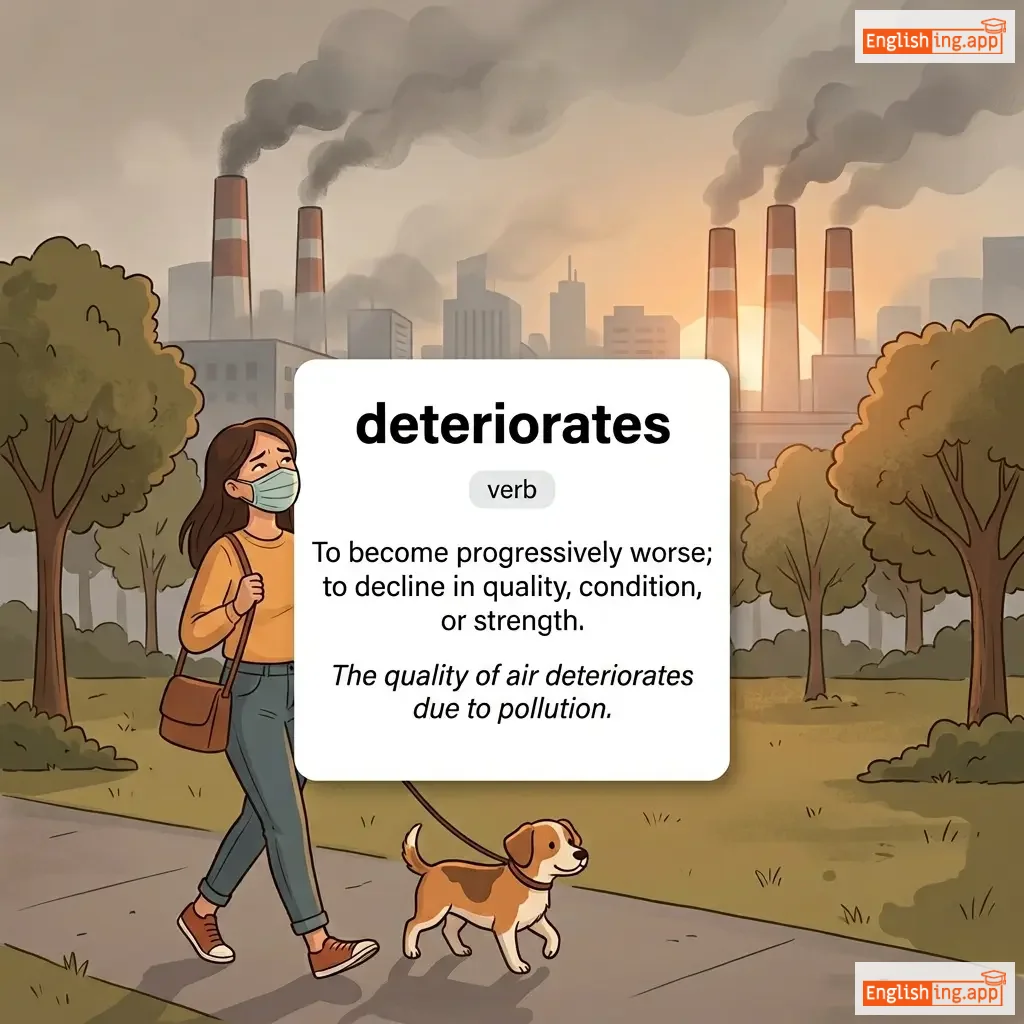
deteriorates definition card — visual illustration of the meaning
verb
dɪˈtɪrɪəˌreɪts
बिगड़ना (diteriorates)

To become progressively worse; to decline in quality, condition, or strength.

"The quality of air deteriorates due to pollution."

"वायु की गुणवत्ता प्रदूषण के कारण बिगड़ती है।" (vayu ki gunvatta pradushan ke karan bigadti hai)
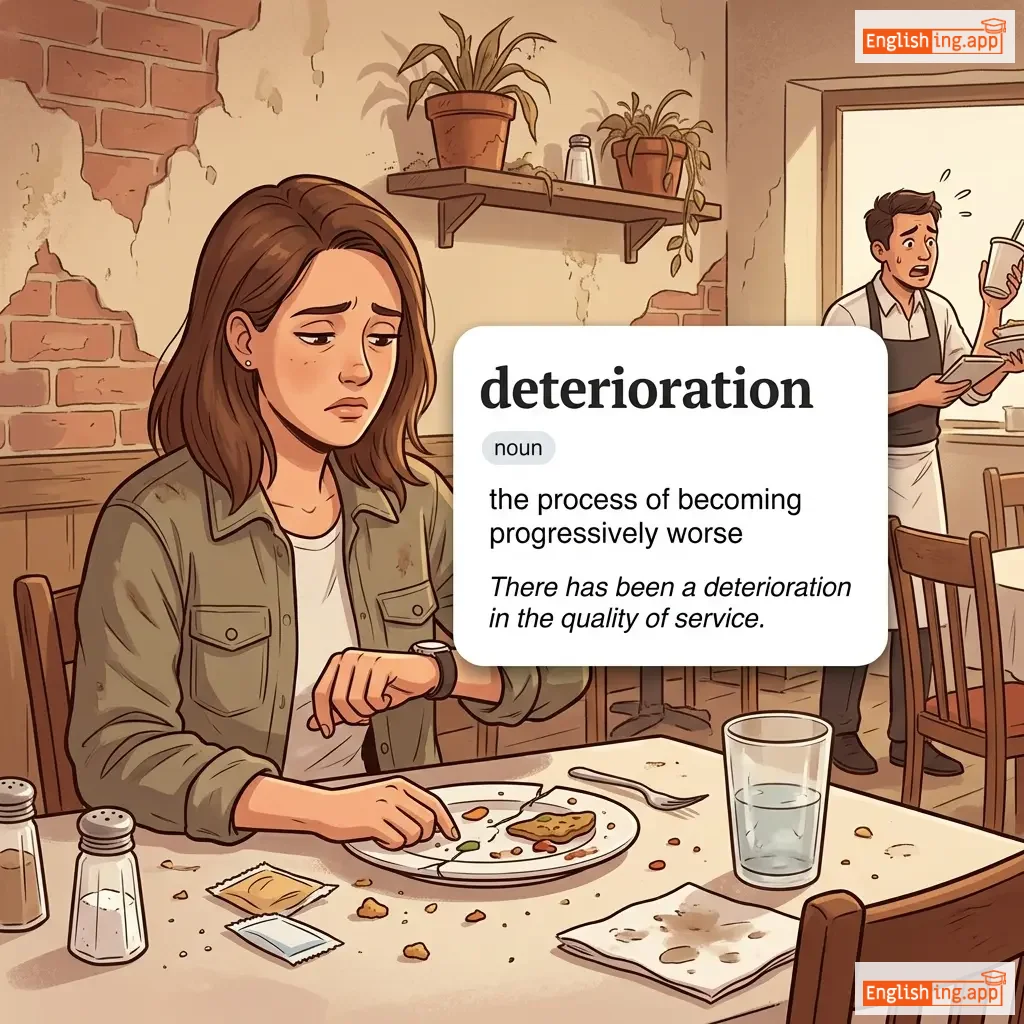
deterioration definition card — visual illustration of the meaning
noun
/dɪˌtɪriəˈreɪʃən/
नकामी (nakaami)

the process of becoming progressively worse

"There has been a deterioration in the quality of service."

"सेवा की गुणवत्ता में गिरावट आई है।" (Seva ki gunwatta mein girawat aayi hai.)
determinant definition card — visual illustration of the meaning
noun
/dɪˈtɜːrmɪnənt/
निर्धारक (nirdharak)

a factor that decisively affects the nature or outcome of something

"Education is a key determinant of economic growth."

"शिक्षा आर्थिक वृद्धि का एक प्रमुख निर्धारक है।" (Shiksha aarthik vruddhi ka ek pramukh nirdharak hai.)
adjective
/dɪˈtɜːrmɪnət/
निर्धारित (nirdharit)

having exact and definite limits or form

"The contract is for a determinate period of two years."

"संधि दो साल की एक निर्धारित अवधि के लिए है।" (Sandhi do saal ki ek nirdharit avadhi ke liye hai.)
determination definition card — visual illustration of the meaning
noun
/dɪˌtɜːrmɪˈneɪʃən/
दृढ़ संकल्प (drid sankalp)

The firmness of purpose; the act of deciding something firmly.

"Her determination helped her overcome all the obstacles."

"उसकी दृढ़ संकल्प ने उसे सभी बाधाओं को पार करने में मदद की।" (uski drid sankalp ne use sabhi baadhayon ko paar karne mein madad ki.)
verb
/dɪˈtɜː.mɪn/
निर्धारण करना (nirdharan karna)

To decide or establish something after consideration.

"The jury will determine the outcome of the case."

"जूरी मामले का परिणाम निर्धारित करेगी।" (Juri mamle ka parinaam nirdharit karegi.)
adjective
/dɪˈtɜːrmɪnd/
दृढ़निश्चयी (dridhnishchayi)

Having firmly decided to do something and not letting anything stop you.

"She was determined to finish her studies despite many obstacles."

"वह अपनी पढ़ाई खत्म करने के लिए दृढ़निश्चयी थी, भले ही कई रुकावटें थीं।" (vah apni padhai khatam karne ke liye dridhnishchayi thi, bhale hi kai rukavaten thin.)
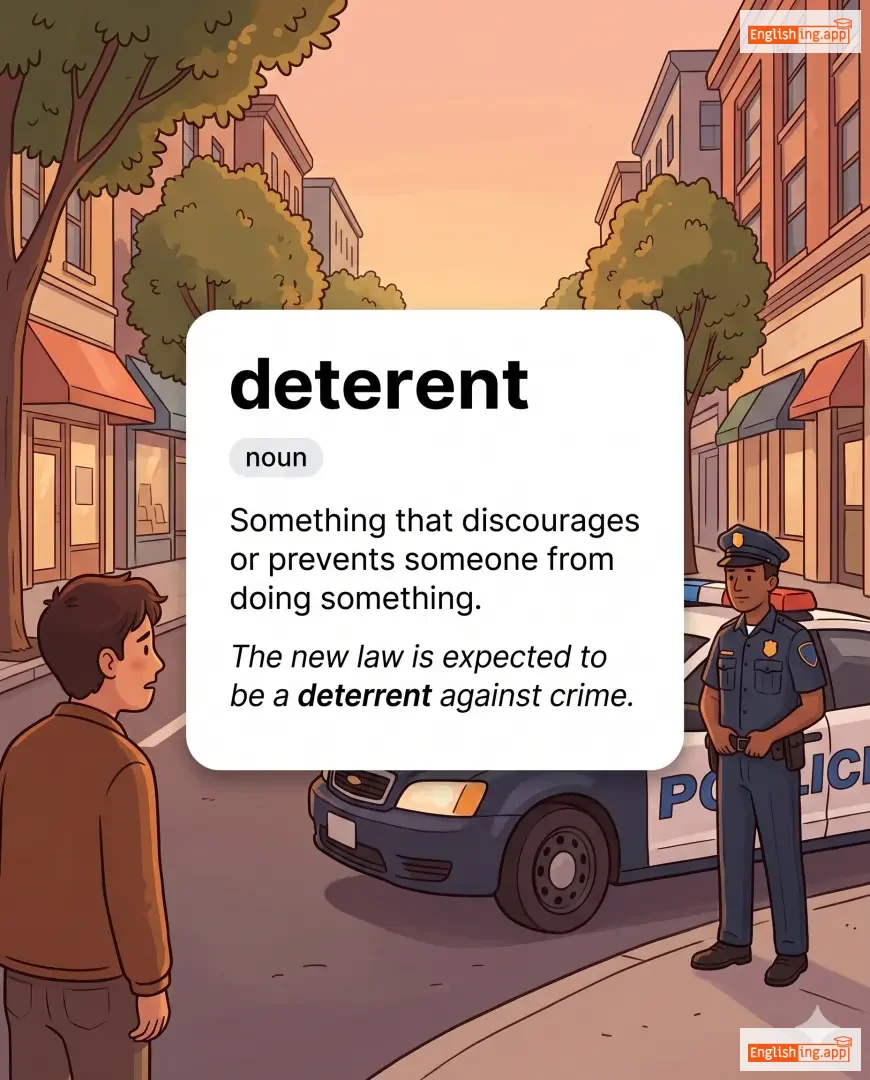
deterrent definition card — visual illustration of the meaning
noun
/dɪˈtɜːrənt/
रोकथाम (roktham)

Something that discourages or prevents someone from doing something.

"The new law is expected to be a deterrent against crime."

"नया कानून अपराध के खिलाफ रोकथाम के रूप में काम करने की उम्मीद है।" (naya kanoon aparadh ke khilaf roktham ke roop mein kaam karne ki ummid hai.)
verb
/dɪˈtɛst/
नफरत करना (nafrat karna)

To dislike intensely or hate.

"I detest waking up early on weekends."

"मैं सप्ताहांत पर जल्दी उठने से नफरत करता हूँ।" (main saptahant par jaldi uthne se nafrat karta hoon.)
noun
/ˌdɛtəˈneɪʃən/
विस्फोट (visphot)

The act of exploding or causing something to explode.

"The sudden detonation shook the entire building."

"अचानक विस्फोट ने पूरे भवन को हिलाकर रख दिया।" (achanak visphot ne pure bhavan ko hilakar rakh diya.)
noun
/ˈdiːtʊr/
विकल्प मार्ग (vikalp marg)

A longer or less direct route taken to avoid something or reach a destination.

"We had to take a detour because the main road was closed."

"हमें एक डिटूर लेना पड़ा क्योंकि मुख्य सड़क बंद थी।" (humein ek detour lena pada kyunki mukhya sadak band thi.)
detoxification definition card — visual illustration of the meaning
noun
/dɪˌtɒksɪfɪˈkeɪʃən/
विषमुक्ति (vishmukti)

The process of removing toxic substances or effects from the body.

"Detoxification is often the first step in treating drug addiction."

"विषमुक्ति अक्सर नशीली दवाओं की लत का इलाज करने में पहला कदम होता है।" (vishmukti aksar nashili dawaon ki lat ka ilaaj karne mein pehla kadam hota hai.)
verb
/dɪˈtrækt/
कम करना (kam karna)

To reduce or take away the worth or value of something.

"His rude behavior will detract from his good reputation."

"उसका असभ्य व्यवहार उसकी अच्छी प्रतिष्ठा को घटा देगा।" (uska asabhya vyavhaar uski achhi pratishtha ko ghata dega.)
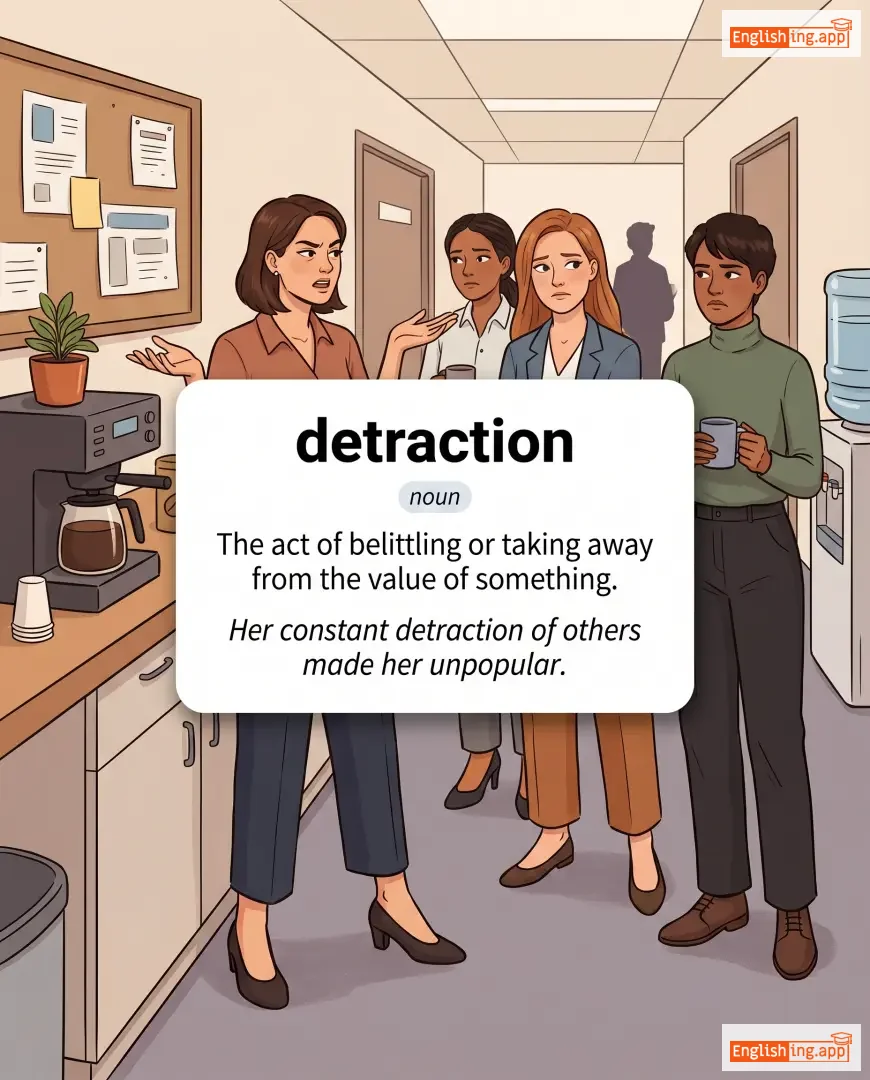
detraction definition card — visual illustration of the meaning
noun
/dɪˈtrækʃən/
निंदा (ninda)

The act of belittling or taking away from the value of something.

"Her constant detraction of others made her unpopular."

"उनकी लगातार निंदा ने उन्हें अप्रिय बना दिया।" (unki lagataar ninda ne unhein apriya bana diya.)
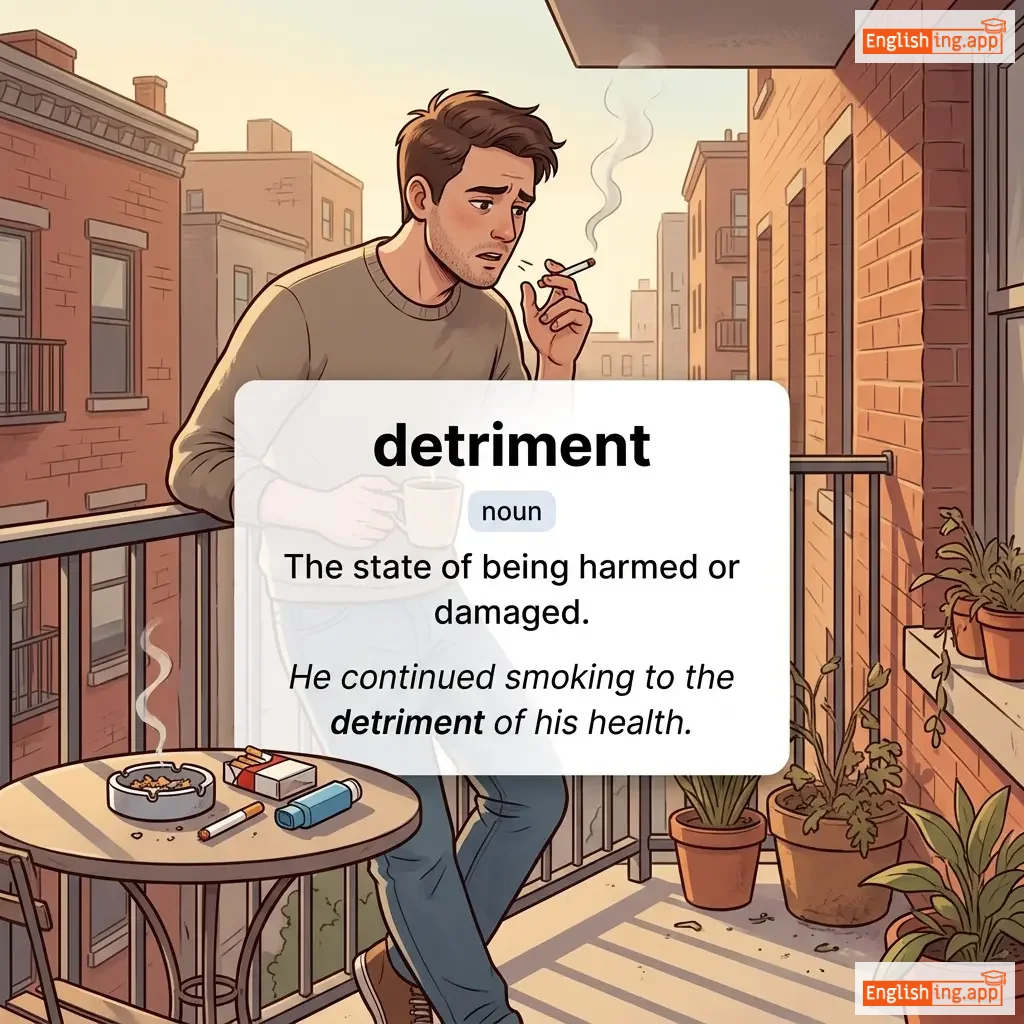
detriment definition card — visual illustration of the meaning
noun
/ˈdɛtrɪmənt/
हानि (haani)

The state of being harmed or damaged.

"He continued smoking to the detriment of his health."

"उसने अपने स्वास्थ्य की हानि के बावजूद धूम्रपान जारी रखा।" (Usne apne swasthya ki haani ke bawajood dhumrapan jaari rakha.)
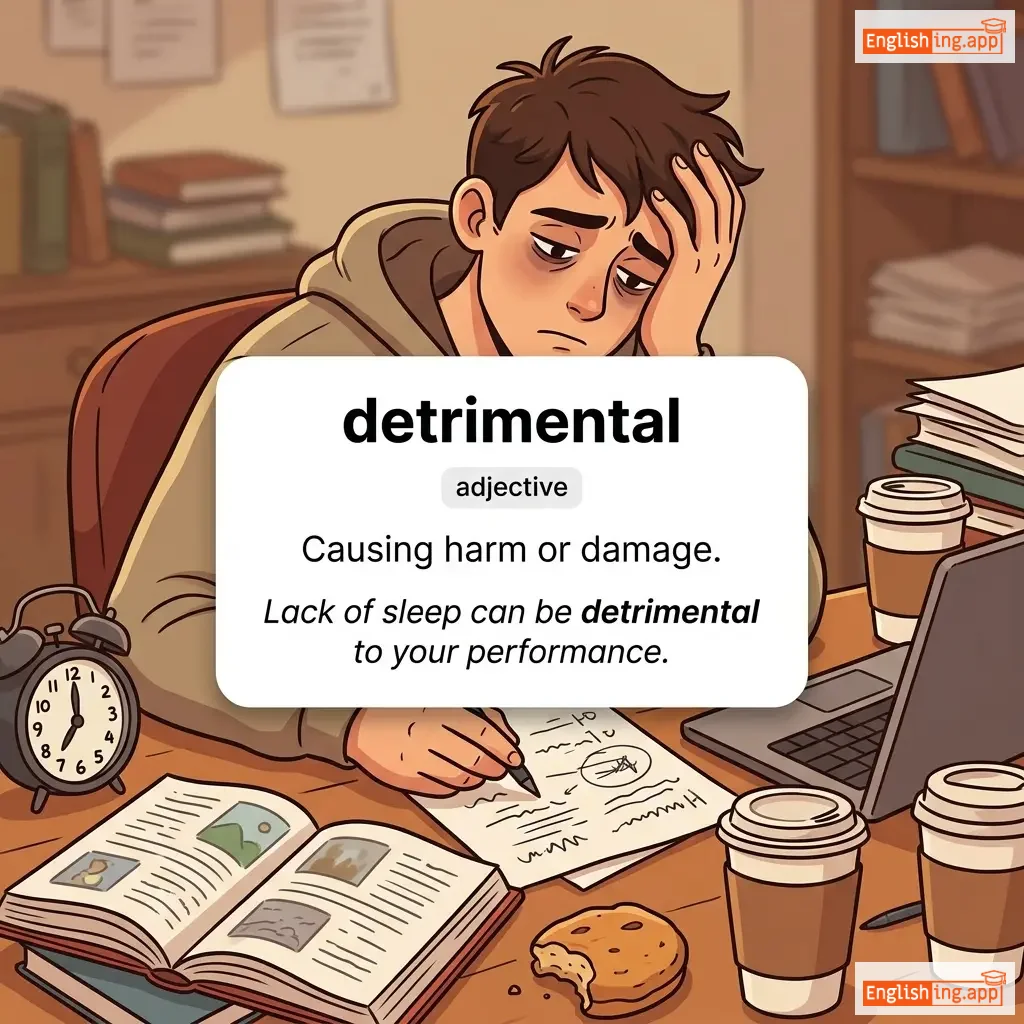
detrimental definition card — visual illustration of the meaning
adjective
/ˌdɛtrɪˈmɛntəl/
हानिकारक (detrimental)

Causing harm or damage.

"Lack of sleep can be detrimental to your performance."

"नींद की कमी आपके प्रदर्शन के लिए हानिकारक हो सकती है।" (neend ki kami aapke pradarshan ke liye hanikarak ho sakti hai.)
noun
/dɪˈtraɪtəs/
कचरा (kachra)

Waste or debris of any kind; fragments left from destruction or decay.

"The riverbank was covered with detritus after the flood."

"बाढ़ के बाद नदी के किनारे कचरे से ढक गए थे।" (Baadh ke baad nadi ke kinare kachre se dhak gaye the.)
verb
/dɪˈtruːd/
धक्का देकर बाहर या नीचे की ओर फेंकना (dhakka dekar baahar ya neeche ki or phenkna)

To thrust or force something downward or outward.

"The violent waves detruded rocks from the cliff."

"हिंसक लहरों ने चट्टानों को खाई से बाहर फेंक दिया।" (Hinsak lahro ne chhatano ko khai se baahar phenk diya.)
verb
/ˈdɛvəˌsteɪt/
विनाश करना (vinaash karna)

to cause severe and overwhelming destruction or damage

"The hurricane devastated the coastal town."

"हैरिकेन ने तटीय शहर को बर्बाद कर दिया।" (Hariken ne tatiy shahar ko barbaad kar diya.)
adjective
/ˈdevəsteɪtɪŋ/
विनाशकारी (vinashkari)

causing severe shock, distress, or destruction; extremely damaging or upsetting

"The earthquake had a devastating effect on the city."

"भूकंप का शहर पर विनाशकारी प्रभाव पड़ा।" (Bhookamp ka shahar par vinashkari prabhav pada.)
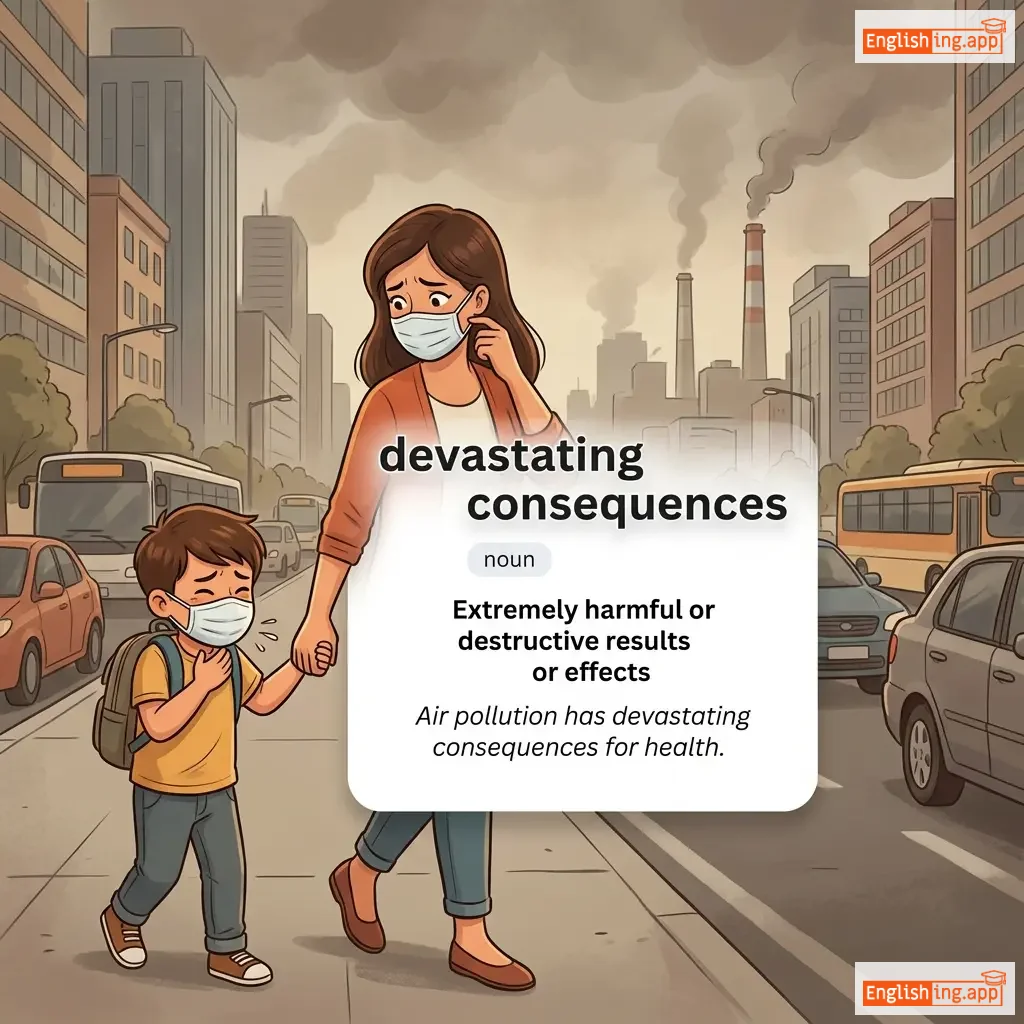
devastating consequences definition card — visual illustration of the meaning
noun
ˈdevəsteɪtɪŋ ˈkɒnsɪkwənsɪz
विनाशकारी परिणाम (vinashkari parinaam)

Extremely harmful or destructive results or effects

"Air pollution has devastating consequences for health."

"वायु प्रदूषण के स्वास्थ्य पर विनाशकारी परिणाम होते हैं।" (Vaayu pradushan ke swasthya par vinashkari parinaam hote hain.)