词汇表

英语词汇词典 | 单词含义、定义和示例

noun
/dɪˈsiːt/
欺骗 (qipian)

The act of deceiving someone by concealing or misrepresenting the truth.

"His career was ruined by lies and deceit."

"他的职业生涯被谎言和欺骗毁了。" (Tade zhiye shengya bei huangyan he qipian hui le.)
adjective
/dɪˈsiːtfəl/
欺骗的 (qīpiàn de)

Deliberately misleading or dishonest.

"She gave a deceitful answer to hide the truth."

"她给了一个欺骗性的回答,以掩盖真相。" (Tā gěile yīgè qīpiàn xìng de huídá, yǐ yǎngài zhēnxiàng.)
verb
/dɪˈsiːv/
欺骗 (qīpiàn)

To cause someone to believe something that is not true.

"He tried to deceive his friends with a fake story."

"他试图用一个假的故事欺骗他的朋友。" (Tā shìtú yòng yīgè jiǎ de gùshì qīpiàn tā de péngyǒu.)
verb
/dɪˈsɛləˌreɪt/
减速 (jiansu)

to reduce speed; to slow down

"The car began to decelerate as it approached the traffic light."

"汽车接近红绿灯时开始减速。" (qiche jiejin honglv deng shi kaishi jiansu.)
noun
/dɪˈsɛmbər/
十二月 (shi er yue)

the twelfth and last month of the year in the Gregorian calendar

"December is usually cold in many countries."

"十二月在许多国家通常很冷。" (shi er yue zai xu duo guo jia tong chang hen leng)
noun
/ˈdiːsənsi/
体面 (tǐmiàn)

behavior that conforms to accepted standards of morality or respectability

"She showed great decency by helping the stranger in need."

"她通过帮助有需要的陌生人展示了极大的体面。" (Tā tōngguò bāngzhù yǒu xūyào de mòshēngrén zhǎnshìle jí dà de tǐmiàn.)
adjective
/ˈdiːsənt/
体面 (tǐmiàn)

conforming to standards of propriety, good taste, or morality

"He found a decent job after months of searching."

"他在几个月的寻找后找到了一份体面的工作。" (Tā zài jǐ gè yuè de xúnzhǎo hòu zhǎodàole yī fèn tǐmiàn de gōngzuò.)
decentralization definition card — visual illustration of the meaning
noun
/diːˌsen.trə.laɪˈzeɪ.ʃən/
去中心化; 权力分配 (qù zhōngxīn huà; quánlì fēnpèi)

the transfer of authority from central to local government; distribution of power

"The decentralization of government services improved efficiency at the local level."
"政府服务的去中心化提高了地方层面的效率。" (zhèngfǔ fúwù de qù zhōngxīn huà tígāo le dìfāng céngmiàn de xiàolǜ.)
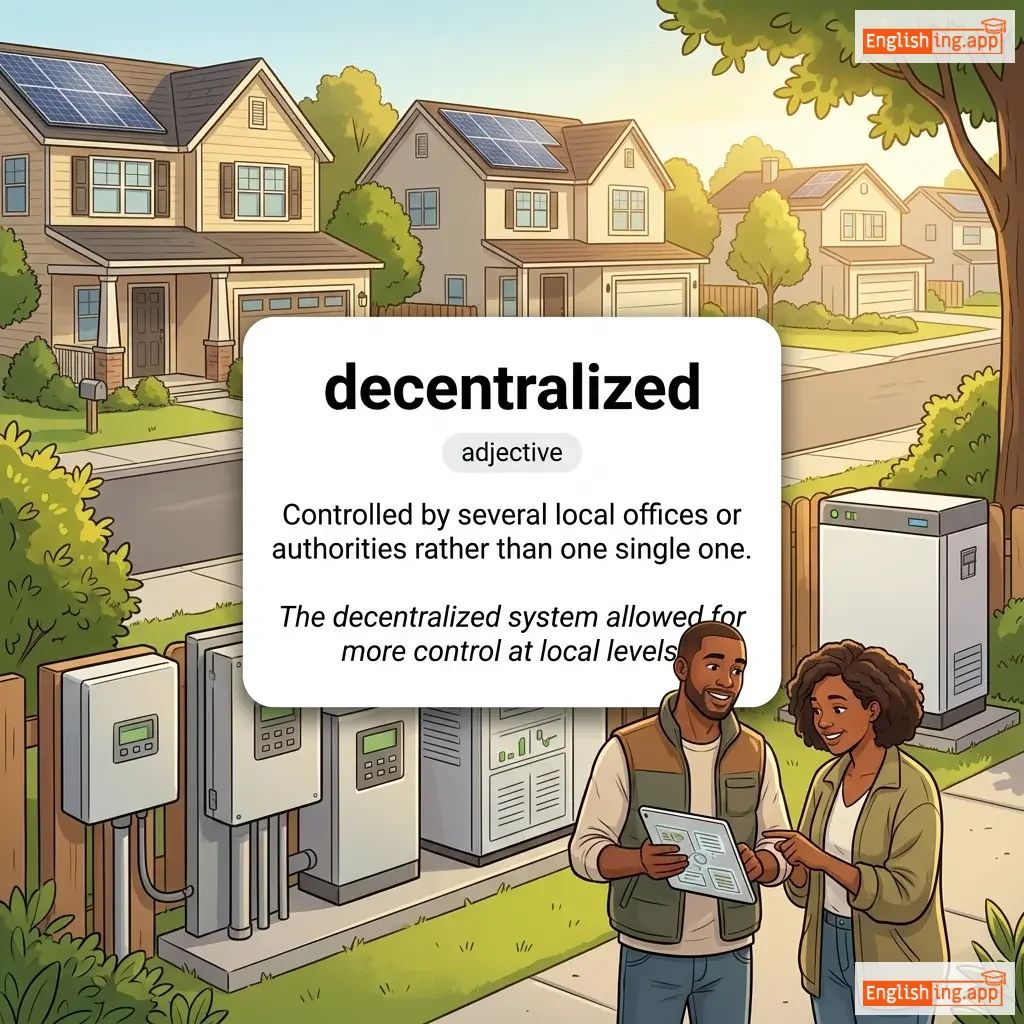
decentralized definition card — visual illustration of the meaning
adjective
/diːˈsɛntrəlaɪzd/
去中心化 (qu zhong xinhua)

Controlled by several local offices or authorities rather than one single one.

"The decentralized system allowed for more control at local levels."

"去中心化的系统允许在地方层级进行更多的控制。" (Qu zhong xinhua de xi tong yun xu zai di fang ceng ji jin xing geng duo de kong zhi.)
noun
/dɪˈsep.ʃən/
欺骗 (qīpiàn)

the action of deceiving someone; the state of being deceived

"The magician's deception amazed the audience with seemingly impossible tricks."

"魔术师的欺骗让观众对看似不可能的魔法惊讶不已。" (Móshù shī de qīpiàn ràng guānzhòng duì kànshì bù kěnéng de mófǎ jīngyà bùyǐ.)
adjective
/dɪˈsɛptɪv/
具有欺骗性的 (jù yǒu qī piàn xìng de)

Giving an appearance or impression different from the truth; misleading.

"Appearances can be deceptive."

"外表可能具有欺骗性。" (Wàibiǎo kěnéng jù yǒu qī piàn xìng.)
noun
/ˈdɛsɪˌbɛl/
分贝 (fenbei)

a unit used to measure the intensity of sound

"The noise level in the factory exceeded 90 decibels."
"工厂里的噪音水平超过了90分贝。" (Gōngchǎng lǐ de zàoyīn shuǐpíng chāoguòle 90 fēnbèi.)
decide definition card — visual illustration of the meaning
verb
/dɪˈsaɪd/

To make a choice or judgment about something.

"She decided to study abroad after graduation."

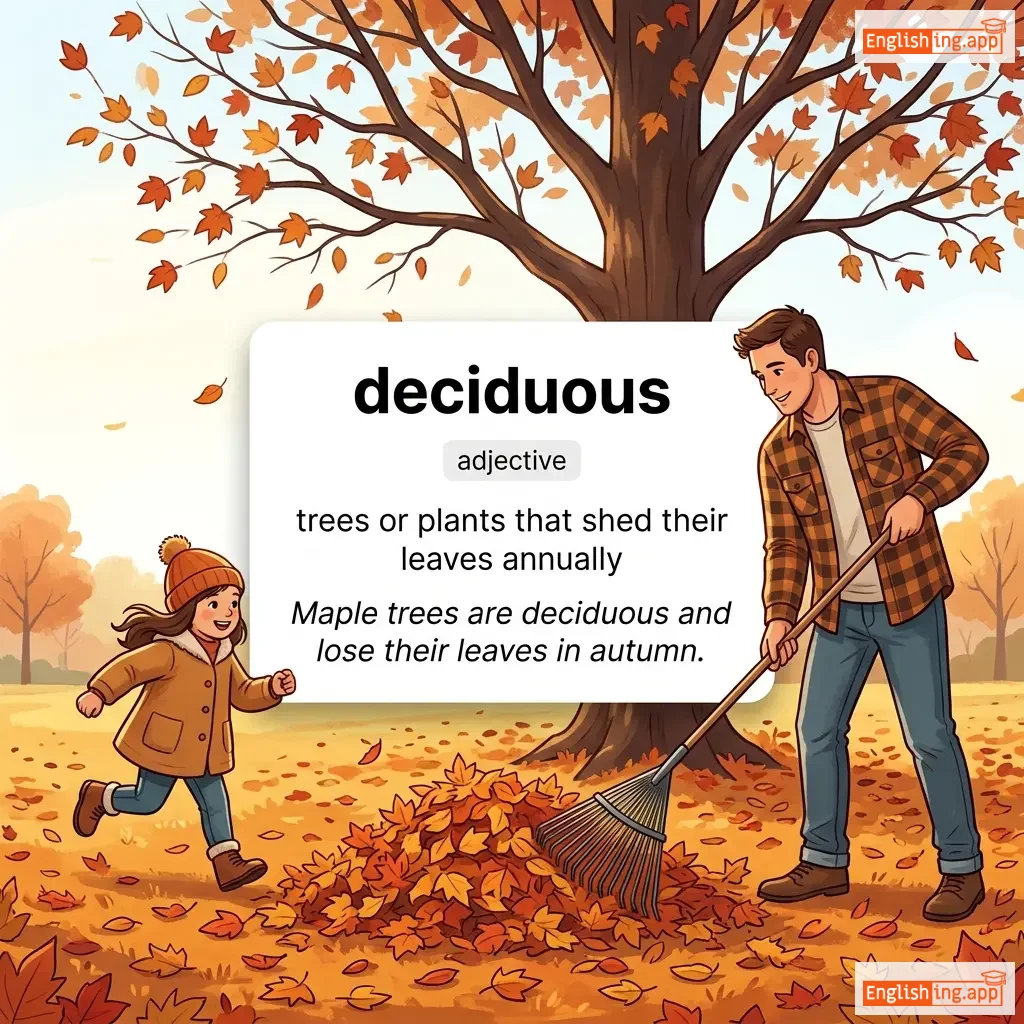
deciduous definition card — visual illustration of the meaning
adjective
/dɪˈsɪdʒuəs/
落叶的 (luòyè de)

trees or plants that shed their leaves annually

"Maple trees are deciduous and lose their leaves in autumn."

"枫树是落叶树,在秋天会掉落它们的叶子。" (Fēng shù shì luòyè shù, zài qiūtiān huì diàoluò tāmen de yèzi.)
noun
/ˈdɛsɪməl/
十进制 (shí jìn zhì)

A number system based on 10; a number expressed in the base-10 system.

"The number 0.75 is a decimal."

"数字0.75是一个十进制数。" (Shùzì 0.75 shì yī gè shí jìn zhì shù.)
verb
/ˈdɛsɪmeɪt/
摧毁 (cuīhuǐ)

To destroy or kill a large proportion of something.

"The wildfire decimated the forest."

"火灾摧毁了森林。" (Huǒzāi cuīhuǐle sēnlín.)
noun
/ˌdɛsɪˈmeɪʃən/
大规模摧毁 (da guimo cuīhuǐ)

The act of destroying or killing a large proportion of something.

"The decimation of the city left thousands homeless."

"城市的毁灭使成千上万的人无家可归。" (Chéngshì de huǐmiè shǐ chéng qiān shàng wàn de rén wújiā kě guī.)
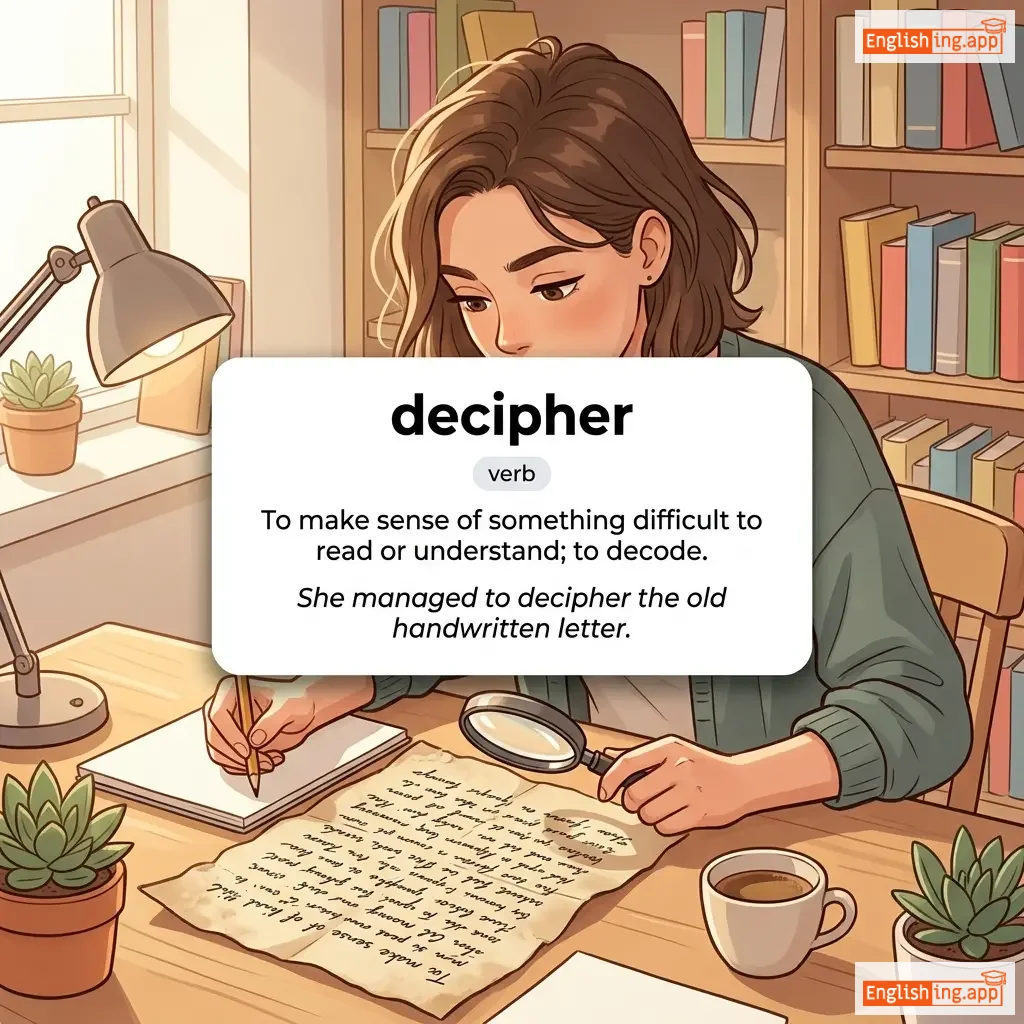
decipher definition card — visual illustration of the meaning
verb
/dɪˈsaɪfər/

To make sense of something difficult to read or understand; to decode.

"She managed to decipher the old handwritten letter."

noun
/dɪˈsɪʒən/
决定 (jueding)

A conclusion or choice made after consideration.

"She made a quick decision to accept the job offer."

"她快速决定接受这份工作邀请。" (Tā kuàisù juédìng jiēshòu zhè fèn gōngzuò yāoqǐng.)
noun
/dɪˈsɪʒənˌmeɪkɪŋ/
决策制定 (juécè zhìdìng)

the process of making decisions, especially important or business-related decisions

"The CEO's decision-making was crucial for the success of the company."

"CEO的决策制定对公司成功至关重要。" (CEO de juécè zhìdìng duì gōngsī chénggōng zhìguān zhòngyào.)
decisions definition card — visual illustration of the meaning
noun
/dɪˈsɪʒənz/
决定 (jueding)

A conclusion or resolution reached after consideration; the action or process of deciding something.

"Making the right decisions in time was key to the project's success."

"及时做出正确的决定是项目成功的关键。" (Jíshí zuò chū zhèngquè de juédìng shì xiàngmù chénggōng de guānjiàn.)
adjective
/dɪˈsaɪsɪv/
决定性 (juédìngxìng)

Having the ability to make decisions quickly and effectively; determining the outcome.

"Her decisive action saved the company from collapse."

"她的决定性行动挽救了公司免于崩溃。" (Tā de juédìngxìng xíngdòng wǎnjiùle gōngsī miǎn yú bēngkuì.)
decisiveness definition card — visual illustration of the meaning
noun
dɪˈsʌɪsɪvnɪs
决策能力 (juécè nénglì)

The ability to make decisions quickly and effectively.

"His decisiveness during the crisis saved the company."

"他在危机中的果断决策拯救了公司。" (Tā zài wēijī zhōng de guǒduàn juécè zhěngjiùle gōngsī.)
noun
/dɛk/
甲板 / 平台 (jiǎbǎn / píngtái)

A flat surface or platform, often on a ship or building.

"We enjoyed the sunset from the upper deck of the ferry."

"我们从渡船的上层甲板上欣赏日落。" (Wǒmen cóng dùchuán de shàngcéng jiǎbǎn shàng xīnshǎng rìluò.)
verb
/dɪˈkleɪm/

to speak aloud in a formal, passionate, or theatrical way

"The actor declaimed his lines with great intensity."

noun
/ˌdɛkləˈmeɪʃən/
朗诵 (lǎng sòng)

a formal speech delivered with rhetorical or dramatic effect

"Her declamation captivated the audience at the competition."

"她的朗诵在比赛中吸引了观众。" (Tā de lǎngsòng zài bǐsài zhōng xīyǐn le guānzhòng.)
adjective
/dɪˈklæməˌtɔri/
激昂的演讲风格 (jī'áng de yǎnjiǎng fēnggé)

speaking in a loud, rhetorical, or dramatic way

"The politician’s declamatory style impressed some but irritated others."

"这位政治家的激昂演讲风格让一些人印象深刻,但让另一些人感到恼火。" (Zhè wèi zhèngzhìjiā de jī'áng yǎnjiǎng fēnggé ràng yīxiē rén yìnxiàng shēnkè, dàn ràng lìng yīxiē rén gǎndào nǎohuǒ.)
noun
/ˌdɛkləˈreɪʃən/
声明 (shengming)

a formal or explicit statement or announcement

"The president made a declaration of independence."

"总统做出了独立声明。" (Zǒngtǒng zuòchūle dúlì shēngmíng.)
adjective
/dɪˈklærətɪv/
陈述的 (chénshù de)

relating to a statement that declares something; in grammar, a sentence that makes a statement

"A declarative sentence simply states a fact or opinion."

"陈述句只是陈述一个事实或意见。" (Chénshù jù zhǐshì chénshù yīgè shìshí huò yìjiàn)
verb
/dɪˈklɛər/
宣布 (xuanbu)

To announce something formally or officially.

"The government declared a state of emergency."

"政府宣布了紧急状态。" (Zhengfu xuanbu le jinji zhuangtai.)
decline definition card — visual illustration of the meaning
verb
/dɪˈklaɪn/

To refuse politely or to decrease in strength, quality, or number.

"She declined the invitation to the party."

noun
/dɪˈklɪvɪti/
坡度 (pōdù)

a downward slope of ground

"They carefully climbed down the declivity of the hill."

"他们小心地爬下了山坡。" (Tāmen xiǎxīn de pá xiàle shānpō.)
verb
/diːˈkoʊd/

to convert a coded message into a readable form; to interpret meaning

"The software can decode the hidden message within seconds."

adjective
/ˌdeɪ.kɒlˈteɪ/
低胸的服装 (dīxiōng de fúzhuāng)

of a woman's dress or top, cut low so as to reveal the neck and upper chest

"She wore a decollete gown to the party."

"她穿着低胸裙子参加了派对。" (Tā chuānzhuó dīxiōng qúnzi cānjiāle pàiduì.)
noun
/ˌdiː.kɒmpəˈzɪʃən/
分解 (fenjie)

the process of decaying or breaking down into simpler parts

"The decomposition of leaves enriches the soil."
"叶子的分解使土壤更加肥沃。" (Yezi de fenjie shi turang gengjia feiwo.)
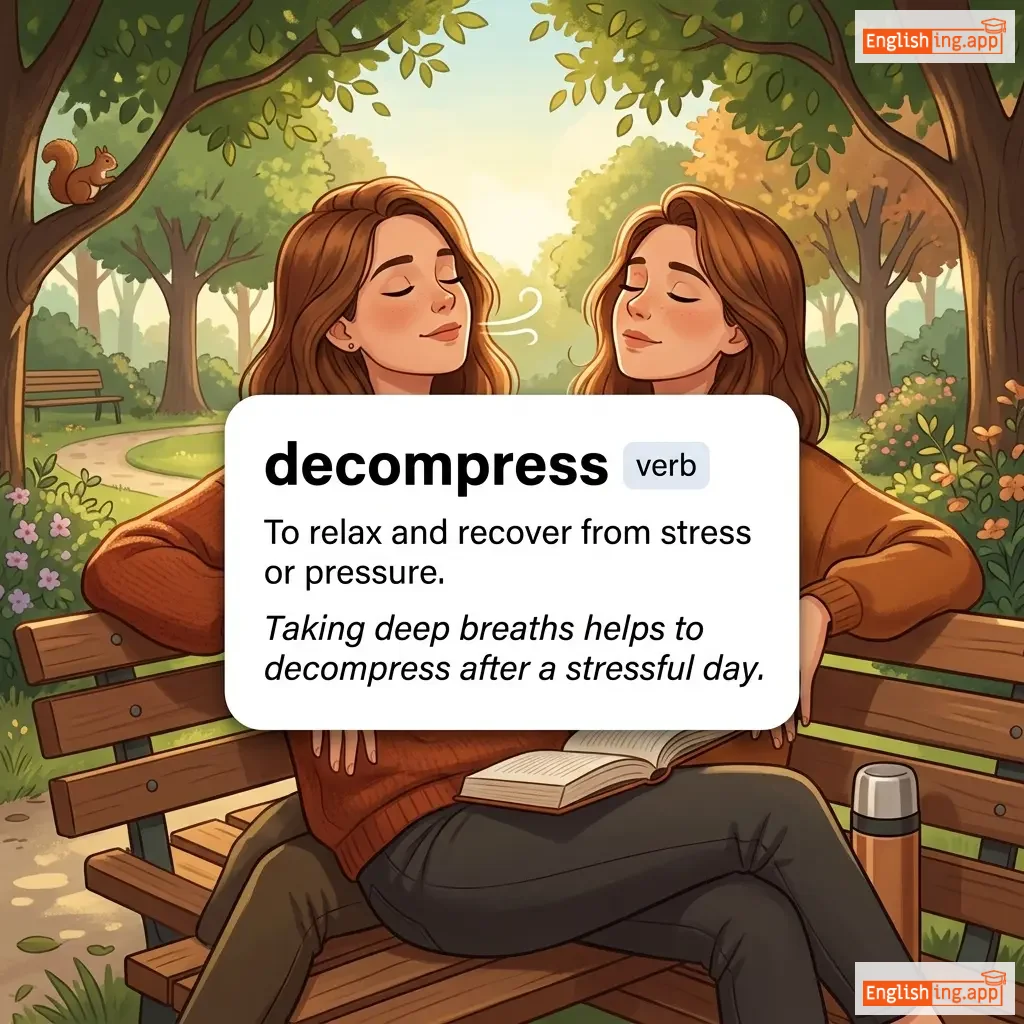
decompress definition card — visual illustration of the meaning
verb
/ˌdiː.kəmˈprɛs/
放松 (fang song)

To relax and recover from stress or pressure.

"Taking deep breaths helps to decompress after a stressful day."

"深呼吸帮助在压力过大的日子后放松。" (Shen huxi bangzhu zai yali guoda de rizi hou fangsong.)
decorate definition card — visual illustration of the meaning
verb
/ˈdɛkəreɪt/

to make something look more attractive by adding ornaments or color

"They decorated the hall with balloons and lights for the party."

noun
/ˌdek.əˈreɪ.ʃən/
装饰; 装饰品; 奖项; (zhuangshi, zhuangshipin, jiangxiang)

the process or art of decorating something; ornamental items used to beautify

"The Christmas decoration transformed the ordinary room into a festive wonderland."

"圣诞装饰把普通房间变成了一个节日奇境。" (Shèngdàn zhuāngshì bǎ pǔtōng fángjiān biànchéngle yīgè jiérì qíjìng.)
adjective
/ˈdekərəs/
得体 (détǐ)

showing proper and polite behavior; marked by good taste

"The audience gave a decorous applause after the performance."

"观众在演出后给予了得体的掌声。" (Guānzhòng zài yǎnchū hòu jǐyǔle détǐ de zhǎngshēng.)
Decorum definition card — visual illustration of the meaning
noun
/dɪˈkɔːrəm/
礼仪 (lǐyí)

behavior in keeping with good taste and propriety

"The students maintained decorum during the ceremony."

"学生们在仪式期间保持了礼仪。" (Xuéshēngmen zài yíshì qījiān bǎochí le lǐyí.)
adjective
/dɪˈkɔːrəs/
得体 (détǐ)

characterized by propriety, good taste, and proper manners

"She maintained a decourous silence during the ceremony."

"她在仪式上保持了得体的沉默。" (Tā zài yíshì shàng bǎochí le détǐ de chénmò.)
noun/verb
/ˈdiːkɔɪ/
诱饵 (yòu'ěr)

something or someone used to lure or mislead

"The hunters used a wooden duck as a decoy."

"猎人们用一只木鸭作为诱饵。" (Lièrénmen yòng yī zhī mù yā zuòwéi yòu'ěr.)
⬇️

decrease

verb/noun
/ˈdiːkriːs/ (noun), /dɪˈkriːs/ (verb)

To become or make something smaller or fewer in number, amount, or degree.

"The population of the town has decreased over the years."

noun/verb
/dɪˈkriː/
法令 (fǎlìng)

an official order or command, often by authority

"The king issued a decree banning hunting in the forest."

"国王发布了一个禁止在森林中狩猎的法令。" (Guówáng fābùle yīgè jìnzhǐ zài sēnlín zhōng shòuliè de fǎlìng.)
adjective
/dɪˈkrɛpɪt/
破旧 (pojiu)

worn out or weakened by age or neglect

"The decrepit old house was on the verge of collapse."

"那座破旧的老房子几乎要坍塌了。" (Na zuo pojiu de lao fangzi jihu yao tantali.)
noun
/dɪˈkrɛpɪˌtjuːd/
衰败 (shuāibài)

the state of being old, weak, and worn out

"The once-great empire fell into decrepitude."

"曾经伟大的帝国陷入了衰败。" (Céngjīng wěidà de dìguó xiànrùle shuāibài.)
verb
/dɪˈkraɪ/
谴责 (qiǎnzé)

to publicly criticize or express strong disapproval of something

"Many activists decry the destruction of the rainforest."

"许多活动家谴责毁灭雨林。" (Xǔduō huódòngjiā qiǎnzé huǐmiè yǔlín.)
decryption definition card — visual illustration of the meaning
noun
/dɪˈkrɪp.ʃən/
解密 (jiěmì)

The process of converting encrypted information back to its original form

"Decryption of sensitive files requires a secure key."

"解密敏感文件需要一个安全的密钥。" (Jiěmì mǐngǎn wénjiàn xūyào yīgè ānquán de mìyào.)
verb
/ˈdɛdɪkeɪt/
奉献 (fengxian)

to devote time, effort, or oneself to a particular purpose or person

"She dedicated her life to helping the poor."

"她献出了自己的生命来帮助穷人。" (Ta xianchu le ziji de shengming lai bangzhu qiongren.)
adjective
/ˈdɛdɪˌkeɪtɪd/
专心致志 (zhuān xīn zhì zhì)

devoted to a cause, task, or purpose

"She is a dedicated teacher who goes above and beyond for her students."

"她是一位献身的教师,为她的学生竭尽全力。" (Ta shi yi wei xian shen de jiao shi, wei ta de xue sheng jie jin quan li.)