词汇表

英语词汇词典 | 单词含义、定义和示例

adjective
/kəʊˈɒpərətɪv/
合作的 (hezuo de)

willing to work or act together with others for a common purpose

"She was very cooperative during the interview process."

"她在面试过程中非常合作。" (Ta zai mianshi guocheng zhong feichang hezuo.)
verb
/koʊˈɔːrdɪˌneɪt/
协调 (xie tiao)

to organize people or things so that they work together effectively

"We need to coordinate our efforts to finish the project on time."

"我们需要协调我们的努力,以便按时完成项目。" (Women xuyao xietiao women de nuli, yi bian anshi wancheng xiangmu.)
noun
/kəʊˌɔːdɪˈneɪʃən/
协调 (xie tiao)

the process of organizing different elements to work together effectively

"The coordination between the teams was flawless."

"团队之间的协调无可挑剔。" (Tuan dui zhi jian de xie tiao wu ke tiao ti.)
noun
/koʊˈɔːrdɪˌneɪtər/
协调员 (xie tiao yuan)

a person who organizes people or activities so that they work well together

"The event coordinator managed everything perfectly."
"活动协调员完美地管理了一切。" (Huo dong xie tiao yuan wan mei di guan li le yi qie.)
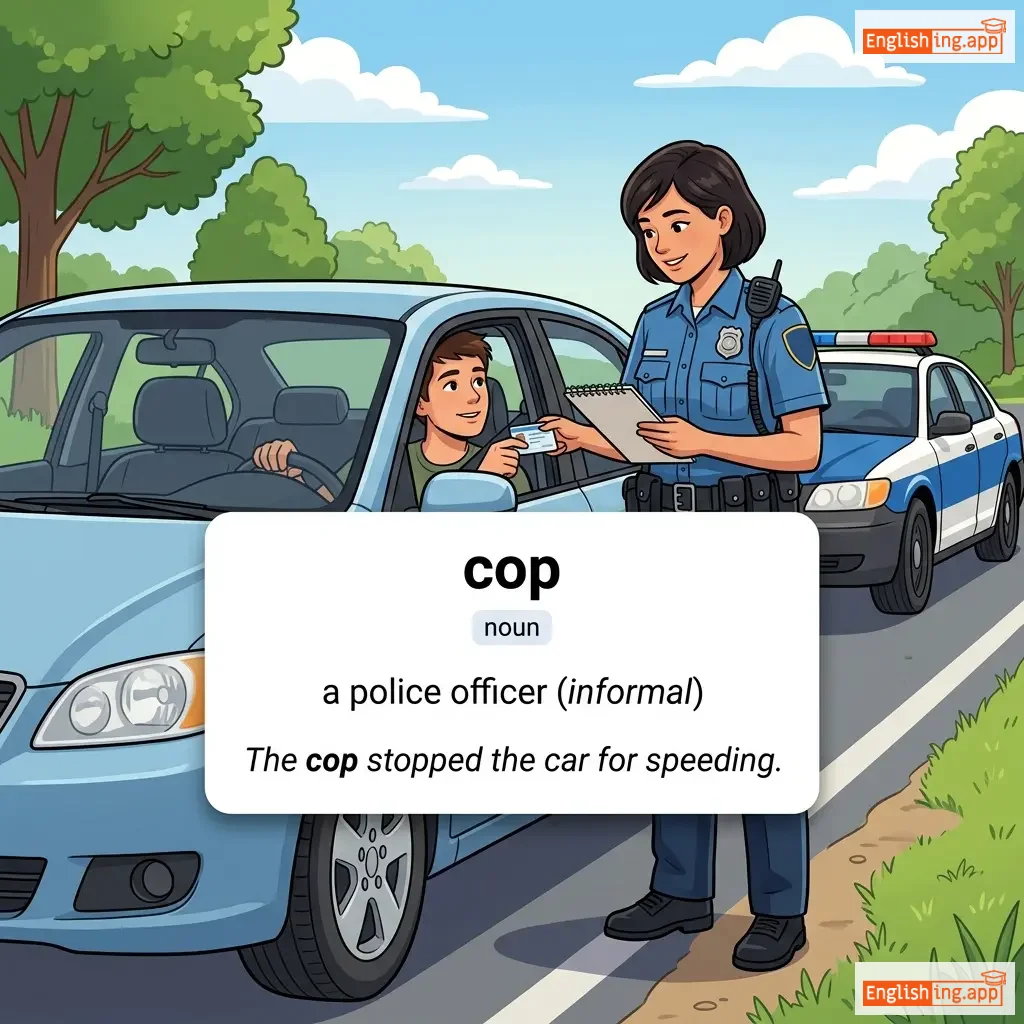
cop definition card — visual illustration of the meaning
noun
/kɒp/
警察 (jingcha)

a police officer (informal)

"The cop stopped the car for speeding."

"警察因超速而拦下了那辆车。" (Jingcha yin chaosu er lansha le na liang che.)
verb
/koʊp/
应对 (yìng duì)

to deal effectively with something difficult

"She had to cope with a lot of pressure at work."

"她不得不应对工作中的巨大压力。" (Tā bùdé bù yìng duì gōngzuò zhōng de jù dà yālì.)
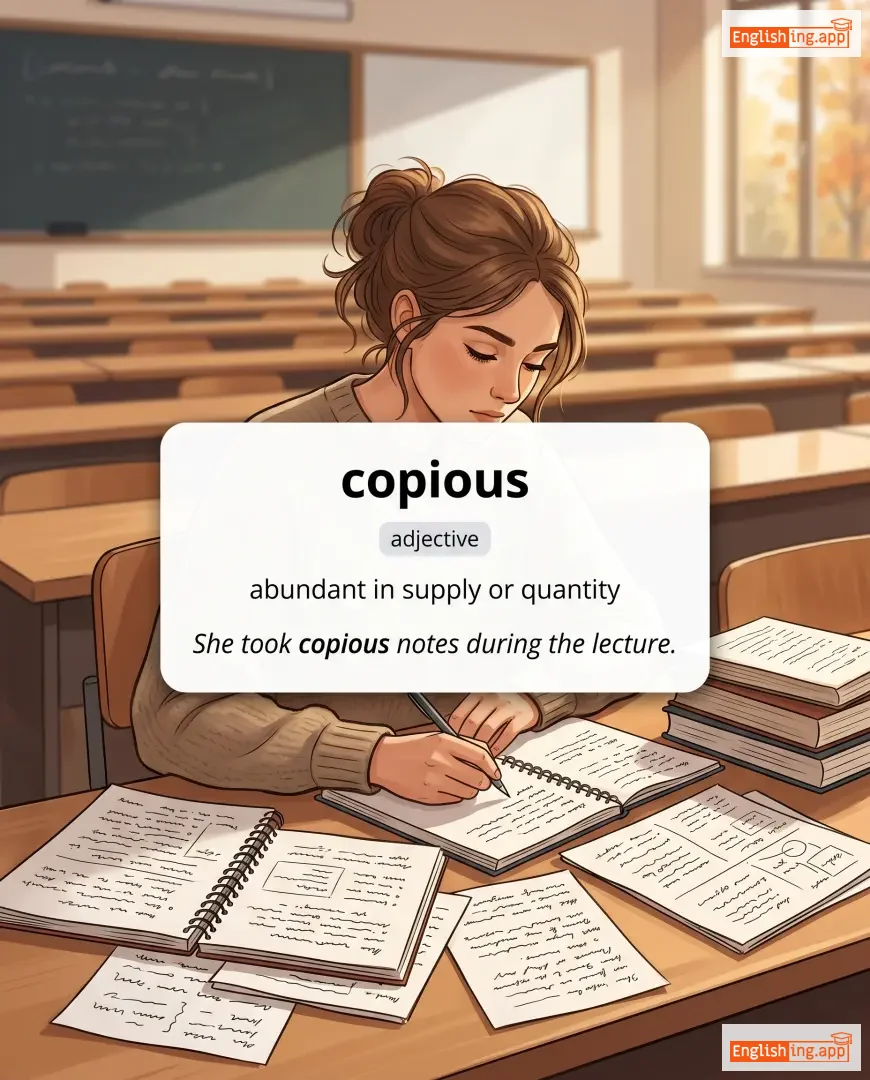
copious definition card — visual illustration of the meaning
adjective
/ˈkoʊpiəs/
大量 (dà liàng)

abundant in supply or quantity

"She took copious notes during the lecture."

"她在讲座期间做了大量笔记。" (Tā zài jiǎngzuò qījiān zuòle dà liàng bǐjì.)
noun
/ˈkɒpə/
(tong)

a reddish-brown metal used for electrical wiring, coins, and more

"Copper is a good conductor of electricity."
"铜是良好的电力导体。" (Tong shi lianghao de dianli daoti.)
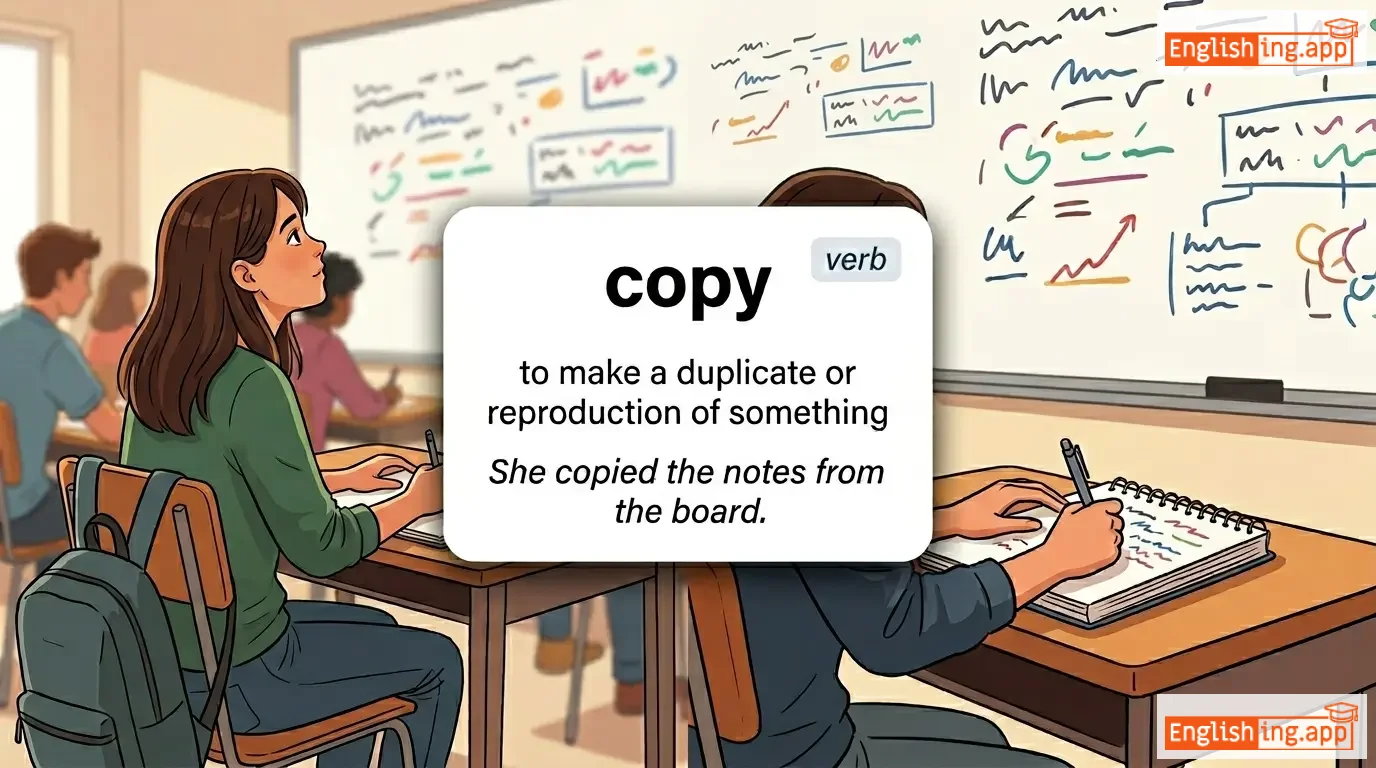
copy definition card — visual illustration of the meaning
verb
/ˈkɒpi/
复制 (fùzhì)

to make a duplicate or reproduction of something

"She copied the notes from the board."

"她从黑板上复制了笔记。" (Tā cóng hēibǎn shàng fùzhìle bǐjì.)
noun
/ˈkɒpɪraɪt/
版权 (bǎnquán)

the legal right of the creator of a work to control its use and distribution

"She holds the copyright for the book."

"她拥有这本书的版权。" (Tā yǒngyǒu zhè běn shū de bǎnquán.)
coquette definition card — visual illustration of the meaning
noun
/koʊˈkɛt/
卖弄风情的女人 (mài nòng fēng qíng de nǚ rén)

a woman who flirts lightheartedly

"She was a coquette, always charming everyone at the party."

"她是个卖弄风情的女人,总是在聚会上迷倒所有人。" (Tā shì gè mài nòng fēng qíng de nǚ rén, zǒng shì zài jù huì shàng mí dǎo suǒ yǒu rén.)
noun, adjective
/ˈkɒrəl/
珊瑚 (shanhu)

a hard, rock-like marine organism formed by tiny sea animals; a pinkish-orange color resembling coral

"The coral in the reef provides shelter for many sea creatures."

"珊瑚礁中的珊瑚为许多海洋生物提供庇护。" (shanhujiao zhong de shanhu wei xuduo haiyang shengwu tigong bihu)
Coral Reefs definition card — visual illustration of the meaning
noun
ˈkɔːrəl ˈriːfs
珊瑚礁 (shanhua jiao)

Underwater structures made from calcium carbonate secreted by corals, forming diverse marine ecosystems.

"Saint Martin's Island is known for its coral reefs."

"圣马丁岛以其珊瑚礁而闻名。" (Sheng Ma Ding dao yi qi shanhua jiao er wenming.)
noun
/kɔːrd/
绳子 (shengzi)

a long, thin, flexible string or rope

"He tied the package with a strong cord."

"他用一根强绳子绑住了包裹。" (Ta yong yi gen qiang shengzi bangzhu le baoguo.)
adjective
/ˈkɔːrdʒəl/
热情和友好 (rèqíng hé yǒuhǎo)

warm and friendly; heartfelt

"They exchanged cordial greetings after the meeting."

"Tāmen zài huìyì hòu jiāohuànle rèqíng de wènhòu." (Tāmen zài huìyì hòu jiāohuànle rèqíng de wènhòu.)
noun
/ˌkɔr.diˈæl.ɪ.ti/
热情; 友善 (rèqíng; yǒushàn)

sincere affection and kindness; warm and friendly behavior

"The host's cordiality made all the guests feel welcome and comfortable."

"主人的热情使所有客人都感到受欢迎和舒适。" (Zhǔrén de rèqíng shǐ suǒyǒu kèrén dōu gǎndào shòu huānyíng hé shūshì.)
adverb
/ˈkɔːrdiəli/
热情地 (rèqíng de)

in a warm and friendly manner; sincerely

"You are cordially invited to our wedding ceremony."

"你被热情邀请参加我们的婚礼仪式。" (Nǐ bèi rèqíng yāoqǐng cānjiā wǒmen de hūnlǐ yíshì.)
noun
/ˈkɔːrdən/
警戒线 (jingjiexian)

a line or circle of police, soldiers, or guards preventing access

"The police set up a cordon around the crime scene."

"警方在犯罪现场周围设立了封锁线。" (Jingfang zai fanzui xianshi zhouwei sheli le fengsuoxian.)
noun
/kɔːr/
核心 (hexin)

the central or most important part of something

"Honesty is at the core of their values."

"诚实是他们价值观的核心。" (Chengshi shi tamen jiazhi guan de hexin.)
noun
/ˌkɔːriˈændər/
香菜 (xiang cai)

aromatic herb with feathery leaves used for flavoring food; also refers to the seeds used as spice

"Fresh coriander leaves are sprinkled on top of the curry."

"新鲜的香菜叶撒在咖喱上。" (Xinxian de xiang cai ye sa zai gāli shang.)
noun
/kɔˈrɪkə soˈbɔrnə/
卡奇基鱼 (ka qi ji yu)

a small silvery fish species found in South Asian rivers, commonly used in local cuisine

"Corica soborna is a popular ingredient in traditional Bengali fish curry."

"科里卡索博尔纳是传统孟加拉鱼咖喱中的一种受欢迎的配料。" (Ke li ka suo bo er na shi chuan tong Meng jia la yu ga li zhong de yi zhong shou huan ying de pei liao.)
noun
/ˈkɔːrmərənt/
一种大黑色海鸟,通过潜水捕捉鱼类 (yī zhǒng dà hēisè hǎi niǎo, tōngguò qiánshuǐ bǔzhuō yú lèi)

a large black sea bird that catches fish by diving

"The cormorant perched on the rock, drying its wings after a dive."

"鸬鹚停在岩石上,潜水后晾干翅膀。" (Lúcí tíng zài yánshí shàng, qiánshuǐ hòu liànggān chìbǎng.)
noun
/kɔːrn/
玉米 (yumi)

a type of grain, often yellow, eaten as food

"They harvested corn in the summer."

"他们在夏天收割了玉米。" (Tāmen zài xiàtiān shōugē le yùmǐ.)
corner definition card — visual illustration of the meaning
noun
/ˈkɔːrnər/
角落 (jiǎoluò)

the place where two edges or sides meet

"The store is just around the corner."

"商店就在拐角处。" (Shāngdiàn jiù zài guǎijiǎo chù.)
noun
/ˈkɔːrnɪs/
檐口 (yánkǒu)

an ornamental molding around the wall of a room just below the ceiling

"The elegant cornice added a classical touch to the living room."
"优雅的檐口为客厅增添了一份古典的气息。" (Yōuyǎ de yánkǒu wèi kètīng zēngtiānle yī fèn gǔdiǎn de qìxī.)
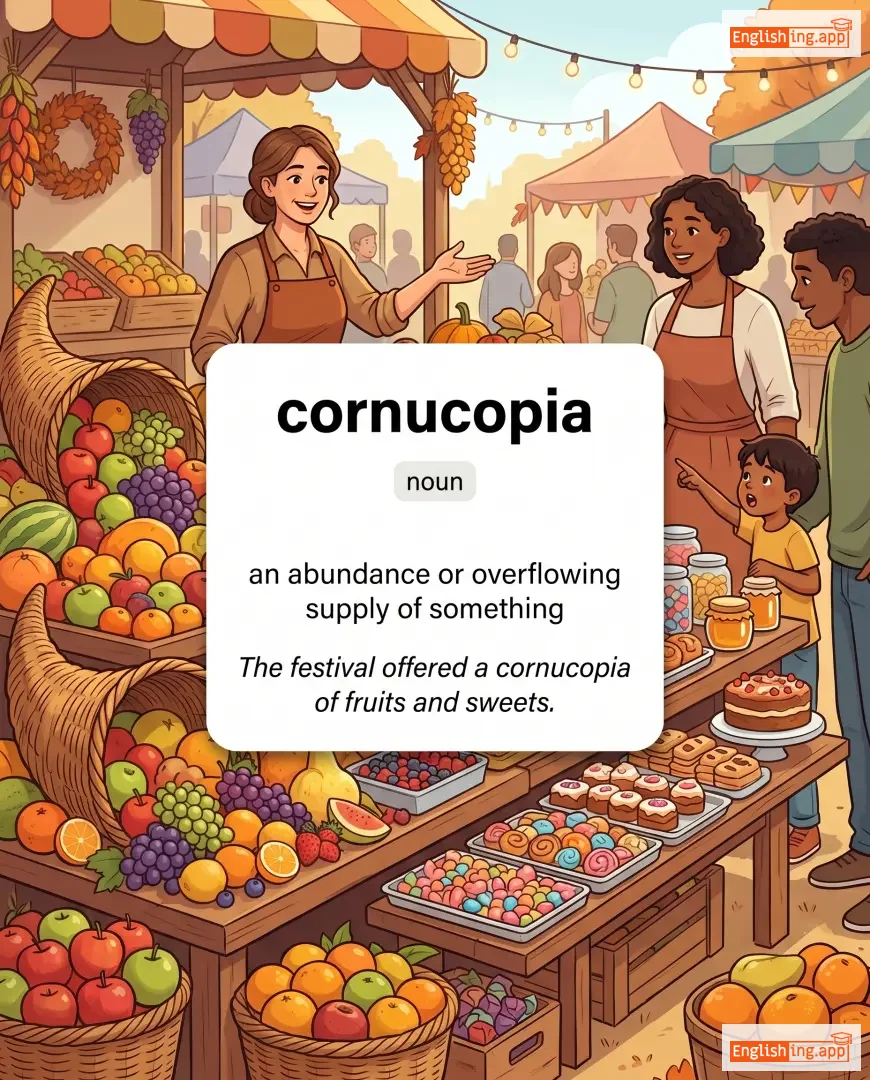
cornucopia definition card — visual illustration of the meaning
noun
/ˌkɔːrnjuˈkoʊpiə/
某物的丰盈或溢出的供应 (mou wu de feng ying huo yi chu de gong ying)

an abundance or overflowing supply of something

"The festival offered a cornucopia of fruits and sweets."

"节日提供了丰盛的水果和糖果。" (Jieri tigong le fengsheng de shuiguo he tangguo.)
noun
/kəˈrɑːləri/
直接或自然的结果 (zhíjiē huò zìrán de jiéguǒ)

a direct or natural consequence or result

"One corollary of the new policy was increased public awareness."

"新政策的一个结果是公众意识的提高。" (Xīn zhèngcè de yīgè jiéguǒ shì gōngzhòng yìshí de tígāo.)
noun
/kəˈroʊnə/
一种类似于冠状的结构;也指太阳的外层大气 (yī zhǒng lèisì yú guān zhuàng de jié gòu; yě zhǐ tàiyáng de wài céng dàqì)

a crown or crown-like structure; also refers to the outer atmosphere of the sun

"The sun's corona was visible during the total solar eclipse."

"太阳的日冕在一次全日蚀时可见。" (Tàiyáng de rìmiǎn zài yīcì quán rìshí shí kějiàn.)
noun
/ˌkɒrəˈneɪʃən/
加冕礼 (jiā miǎn lǐ)

the act or ceremony of crowning a sovereign or monarch

"The coronation of the new king was attended by thousands of people."

"新国王的加冕礼有成千上万的人参加。" (Xīn guówáng de jiā miǎn lǐ yǒu chéng qiān shàng wàn de rén cān jiā.)
noun
/ˈkɒrənər/
法医 (fǎ yī)

an official who investigates sudden, violent, or suspicious deaths

"The coroner determined the cause of death was natural."

"法医确定死亡原因是自然的。" (Fǎ yī quèdìng sǐwáng yuányīn shì zìrán de.)
noun
/ˈkɒrənɛt/
小王冠 (xiao wangguan)

a small crown, especially one worn by a prince, princess, or noble

"She wore a delicate coronet on her head for the ceremony."

"她为仪式戴上了一顶精致的小王冠。" (Ta wei yishi daishang le yi ding jingzhi de xiao wangguan.)
adjective, noun
/ˈkɔːrpərəl/
军士 (junshi)

relating to the body; a low-ranking officer in the military

"He suffered a corporal punishment for his mistake."

"他因为犯错误而遭受了体罚。" (Tā yīnwèi fàn cuòwù ér zāoshòu le tǐfá.)
corporate definition card — visual illustration of the meaning
adjective, noun
/ˈkɔːrpərət/
与公司/企业相关 (yu gongsi/qiye xiangguan)

relating to a corporation or large company; united as a single body

"Corporate social responsibility is important for modern businesses."

"公司企业社会责任对现代企业非常重要。" (Gōngsī qǐyè shèhuì zérèn duì xiàndài qǐyè fēicháng zhòngyào.)
noun
/ˌkɔːrpəˈreɪʃən/
公司 (gongsi)

A large company or group of companies that is legally recognized as a single entity.

"The corporation invested heavily in renewable energy projects."

"该公司在可再生能源项目上进行了大量投资。" (Gai gongsi zai kezai sheng nengyuan xiangmu shang jinxingle dali touzi.)
adjective
/kɔːrˈpɔːriəl/
有形的, 物质的 (you xing de, wu zhi de)

relating to the physical body; material or tangible

"Ghosts are often described as having no corporeal form."

"鬼魂通常被描述为没有有形的形态。" (Guihun tongchang bei miaoshu wei meiyou youxing de xingtai.)
noun
/kɔːr/
军队分支,团队 (jūnduì fēnzhī, tuánduì)

a branch of the military or a group organized for a specific purpose

"He joined the army corps after graduation."

"他在毕业后加入了军队分支。" (Tā zài bìyè hòu jiārùle jūnduì fēnzhī.)
noun
/kɔːrps/
尸体 (shīti)

a dead body, especially of a human

"The police discovered a corpse in the abandoned house."

"警察在废弃的房子里发现了一具尸体。" (Jǐngchá zài fèiqì de fángzi lǐ fāxiànle yī jù shīti.)
adjective
/ˈkɔːpjʊlənt/
肥胖的, 胖 (féipàng de, pàng)

fat or obese; having a large bulky body

"The corpulent man struggled to fit into the small chair."
"那个肥胖的男人努力地坐进了小椅子。" (Nàgè féipàng de nánrén nǔlì de zuò jìnle xiǎo yǐzi.)
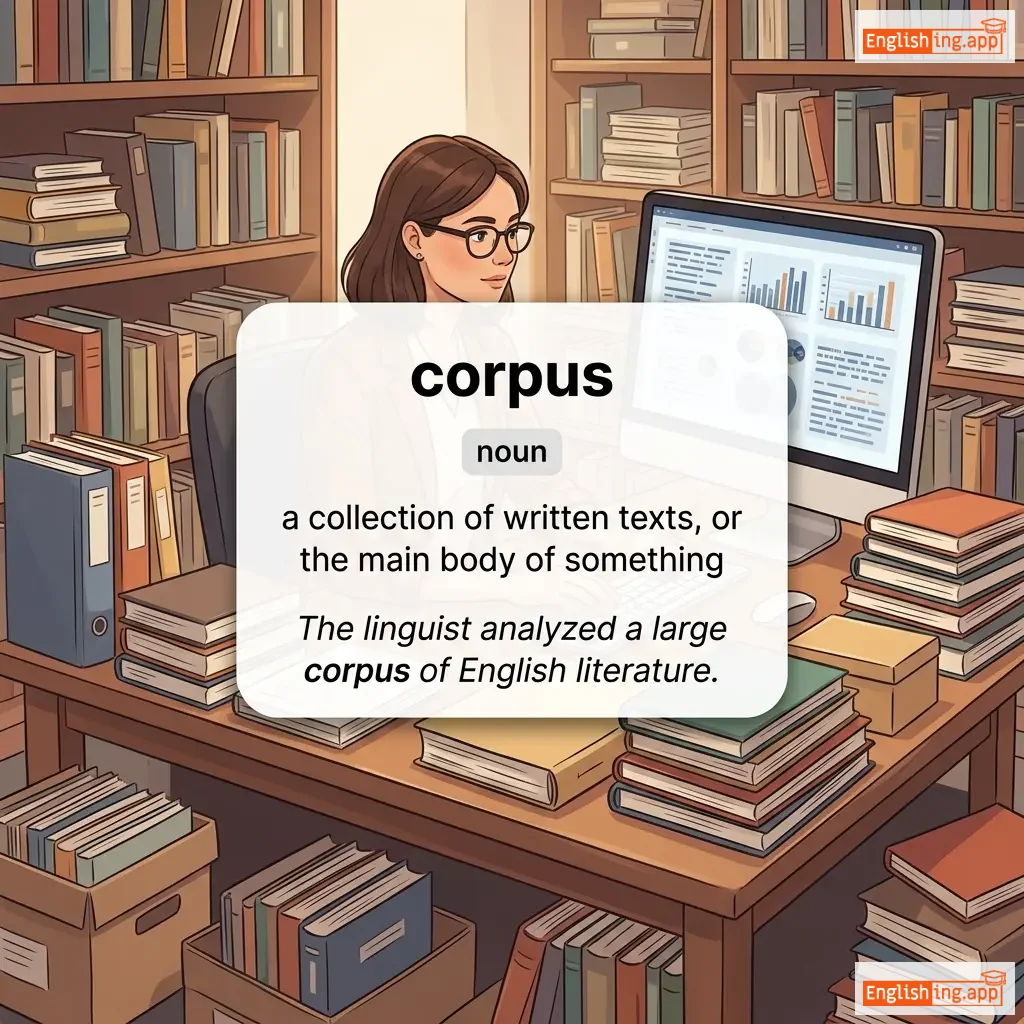
corpus definition card — visual illustration of the meaning
noun
/ˈkɔːrpəs/
集合,主体 (jihe, zhuti)

a collection of written texts, or the main body of something

"The linguist analyzed a large corpus of English literature."

"语言学家分析了大量的英语文学文献。" (Yuyanxuejia fenxile daliao de yingyu wenxue wenxian.)
noun
/ˈkɔːrpəskəl/
小颗粒或细胞,尤其是血细胞 (xiao ke li huo xi bao, you qi shi xue xi bao)

a small particle or cell, especially a blood cell

"Red corpuscles carry oxygen throughout the body."

"红血球在体内运输氧气。" (Hong xue qiu zai ti nei yun shu yang qi.)
adjective
/kəˈrɛkt/
正确 (zhèngquè)

free from error; accurate

"The answer she gave was correct."

"她给出的答案是正确的。" (Tā gěi chū de dá'àn shì zhèngquè de.)
noun
/kəˈrɛkʃən/
修正 (xiūzhèng)

the action or process of correcting something

"The teacher made a correction to the student's essay."

"老师对学生的文章进行了修正。" (Lǎoshī duì xuéshēng de wénzhāng jìnxíngle xiūzhèng.)
adverb
/kəˈrɛktli/
正确地 (zhèngquè de)

in a way that is true, accurate, or without mistakes

"She answered all the questions correctly."

"她正确地回答了所有问题。" (Tā zhèngquè de huídá le suǒyǒu wèntí.)
correlate definition card — visual illustration of the meaning
verb
/ˈkɒrəleɪt/
相关 (xiāngguān)

to have a mutual relationship or connection between two or more things

"High stress levels often correlate with poor health."

"高压水平通常与健康不佳相关。" (Gāo yā shuǐpíng tōngcháng yǔ jiànkāng bù jiā xiāngguān.)
noun
/ˌkɒrəˈleɪʃən/
相关 (xiāngguān)

a mutual relationship or connection between two or more things

"Researchers found a strong correlation between diet and heart disease."

"研究人员发现饮食与心脏病之间有着强烈的相关性。" (Yánjiū rényuán fāxiàn yǐnshí yǔ xīnzàng bìng zhī jiān yǒuzhe qiángliè de xiāngguān xìng.)
adjective
/kəˈrɛlətɪv/
相关的 (xiāngguān de)

having a mutual relationship; corresponding

"The increase in temperature is correlative with the melting of glaciers."

"温度的升高与冰川的融化有关。" (Wēndù de shēnggāo yǔ bīngchuān de rónghuà yǒu guānxi.)
verb
/kəˈrɛspɒnd/
通信 (tongxin)

to communicate by exchanging letters or messages

"I correspond regularly with my old friends."

"我与我的老朋友定期通信。" (Wo yu wo de lao pengyou dingqi tongxin.)
noun
/kəˈrɛspɒndəns/
通信 (tongxin)

the exchange of letters or communication

"His correspondence with clients was always timely."

"他与客户的通信总是及时的。" (Ta yu kehu de tongxin zongshi shíji de.)
noun
/ˌkɒrəˈspɒndənt/
记者 (jìzhě)

A journalist who reports news from a particular place or on a particular subject.

"The foreign correspondent reported live from Paris."

"外国记者从巴黎进行现场直播报道。" (Wàiguó jìzhě cóng bālí jìnxíng xiànchǎng zhíbò bàodào.)
adjective
/kəˈrɛspɒndɪŋ/
相关的 (xiāngguān de)

matching or related to something

"The corresponding page in the book explains the process in detail."

"书中的相关页面详细解释了该过程。" (Shū zhōng de xiāngguān yèmiàn xiángxì jiěshìle gāi guòchéng.)