Словари

Словарь английского языка | Значения слов, определения и примеры

noun
/dɪˈsiːt/
обман (obman)

The act of deceiving someone by concealing or misrepresenting the truth.

"His career was ruined by lies and deceit."

"Его карьера была разрушена ложью и обманом." (Yego kariyera byla razrushena lozh'yu i obmanom.)
adjective
/dɪˈsiːtfəl/
обманчивый (obmanchivyy)

Deliberately misleading or dishonest.

"She gave a deceitful answer to hide the truth."

"Она дала лживый ответ, чтобы скрыть правду." (Ona dala lzhivyy otvet, chtoby skryt pravdu.)
verb
/dɪˈsiːv/
обманывать (obmanyvat')

To cause someone to believe something that is not true.

"He tried to deceive his friends with a fake story."

"Он пытался обмануть своих друзей ложной историей." (On pytalsya obmanut' svoikh druzey lozhnoi istoriei.)
verb
/dɪˈsɛləˌreɪt/
замедлить (zamedlit)

to reduce speed; to slow down

"The car began to decelerate as it approached the traffic light."

"Машина начала замедляться, когда она подошла к светофору." (Mashina nachala zamedlyatsya, kogda ona podoshla k svetoforu.)
noun
/dɪˈsɛmbər/
декабрь (dekabr)

the twelfth and last month of the year in the Gregorian calendar

"December is usually cold in many countries."

"Декабрь обычно холодный во многих странах." (dekabr obychno kholodnyi vo mnogikh stranakh)
noun
/ˈdiːsənsi/
порядочность (poryadochnost)

behavior that conforms to accepted standards of morality or respectability

"She showed great decency by helping the stranger in need."

"Она продемонстрировала большую порядочность, помогая незнакомцу в беде." (Ona prodemonstrirovala bol'shuyu poryadochnost', pomogaya neznakomtsu v bede.)
adjective
/ˈdiːsənt/
приличный (prilichny)

conforming to standards of propriety, good taste, or morality

"He found a decent job after months of searching."

"Он нашел приличную работу после месяцев поисков." (On nashel prilichnuyu rabotu posle mesyatsev poisov.)
decentralization definition card — visual illustration of the meaning
noun
/diːˌsen.trə.laɪˈzeɪ.ʃən/
децентрализация; распределение власти (detsentralizatsiya; raspredelenie vlasti)

the transfer of authority from central to local government; distribution of power

"The decentralization of government services improved efficiency at the local level."

"Децентрализация государственных услуг повысила эффективность на местном уровне." (Detsentralizatsiya gosudarstvennykh uslug povysila effektivity na mestnom urovne.)
decentralized definition card — visual illustration of the meaning
adjective
/diːˈsɛntrəlaɪzd/
децентрализованный (detsentralizovannyi)

Controlled by several local offices or authorities rather than one single one.

"The decentralized system allowed for more control at local levels."

"Децентрализованная система позволила больший контроль на местном уровне." (Detsentralizovannaya sistema pozvolila bol'shiy kontrol' na mestnom urovne.)
noun
/dɪˈsep.ʃən/
обман (obman)

the action of deceiving someone; the state of being deceived

"The magician's deception amazed the audience with seemingly impossible tricks."

"Обман фокусника удивил зрителей казавшимися невозможными трюками." (Obman fokusnika udivil zriteley kazavshimisya nevozmozhnymi tryukami.)
adjective
/dɪˈsɛptɪv/
обманчивый (obmanchivyy)

Giving an appearance or impression different from the truth; misleading.

"Appearances can be deceptive."

"Внешность может быть обманчивой." (Vneshnost' mozhet byt' obmanchivoy.)
noun
/ˈdɛsɪˌbɛl/
децибел (detsibel)

a unit used to measure the intensity of sound

"The noise level in the factory exceeded 90 decibels."

"Уровень шума на заводе превысил 90 децибелов." (Uroven' shuma na zavode prevysil 90 detsibelov.)
decide definition card — visual illustration of the meaning
verb
/dɪˈsaɪd/
решать (reshat)

To make a choice or judgment about something.

"She decided to study abroad after graduation."
"Она решила учиться за границей после окончания университета." (Ona reshila uchit'sya za granitsey posle okonchaniya universiteta.)
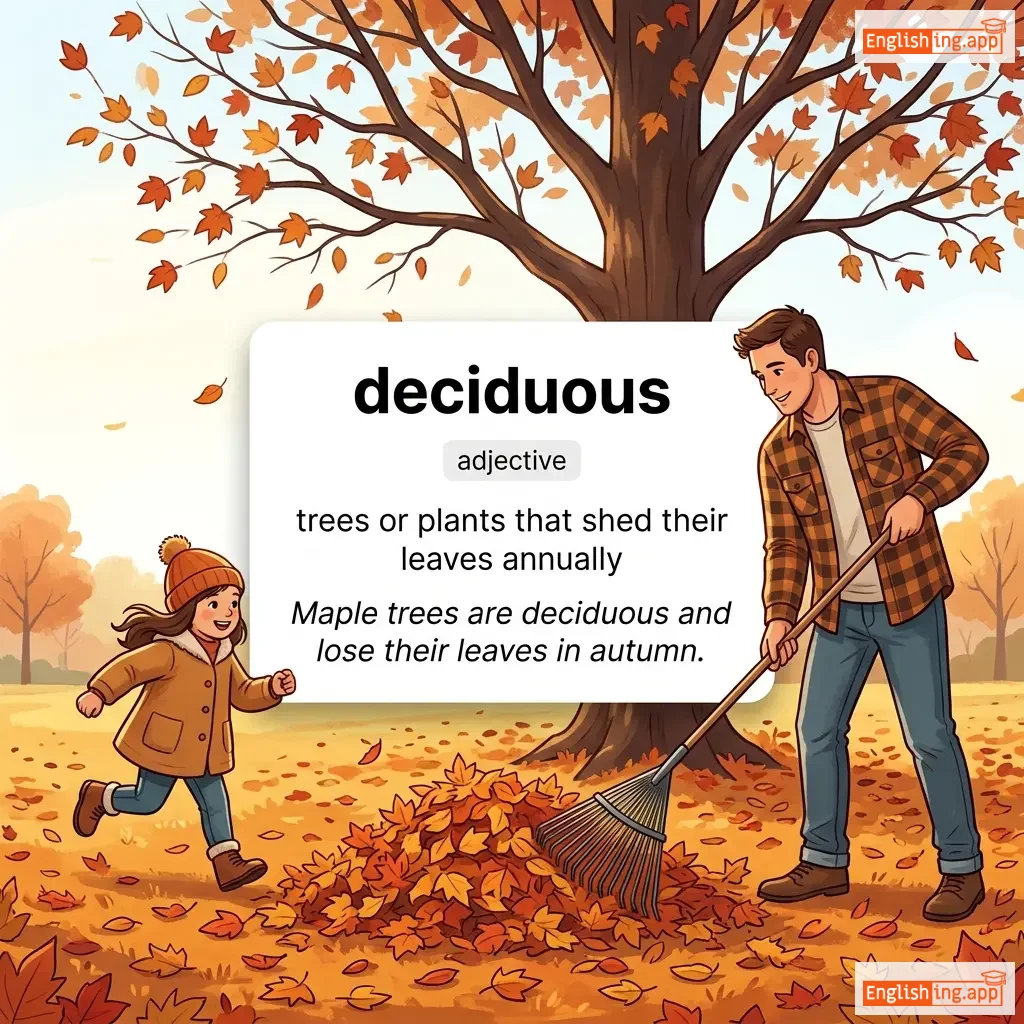
deciduous definition card — visual illustration of the meaning
adjective
/dɪˈsɪdʒuəs/
лиственный (listvennyj)

trees or plants that shed their leaves annually

"Maple trees are deciduous and lose their leaves in autumn."

"Кленовые деревья являются лиственными и теряют свои листья осенью." (Klenovye derev'ya yavlyayutsya listvennymi i teryayut svoi list'ya osenyu.)
noun
/ˈdɛsɪməl/
десятичный (desyatchnyy)

A number system based on 10; a number expressed in the base-10 system.

"The number 0.75 is a decimal."

"Число 0,75 — это десятичное число." (Chislo 0,75 — eto desyatochnoe chislo.)
verb
/ˈdɛsɪmeɪt/
уничтожить (unichtozhit)

To destroy or kill a large proportion of something.

"The wildfire decimated the forest."

"Лесной пожар уничтожил лес." (Lesnoy pozhar unichtozhil les.)
noun
/ˌdɛsɪˈmeɪʃən/
истребление (istreblenie)

The act of destroying or killing a large proportion of something.

"The decimation of the city left thousands homeless."
"Истребление города оставило тысячи бездомных." (Istreblenie goroda ostavilo tysyachi bezdomnykh.)
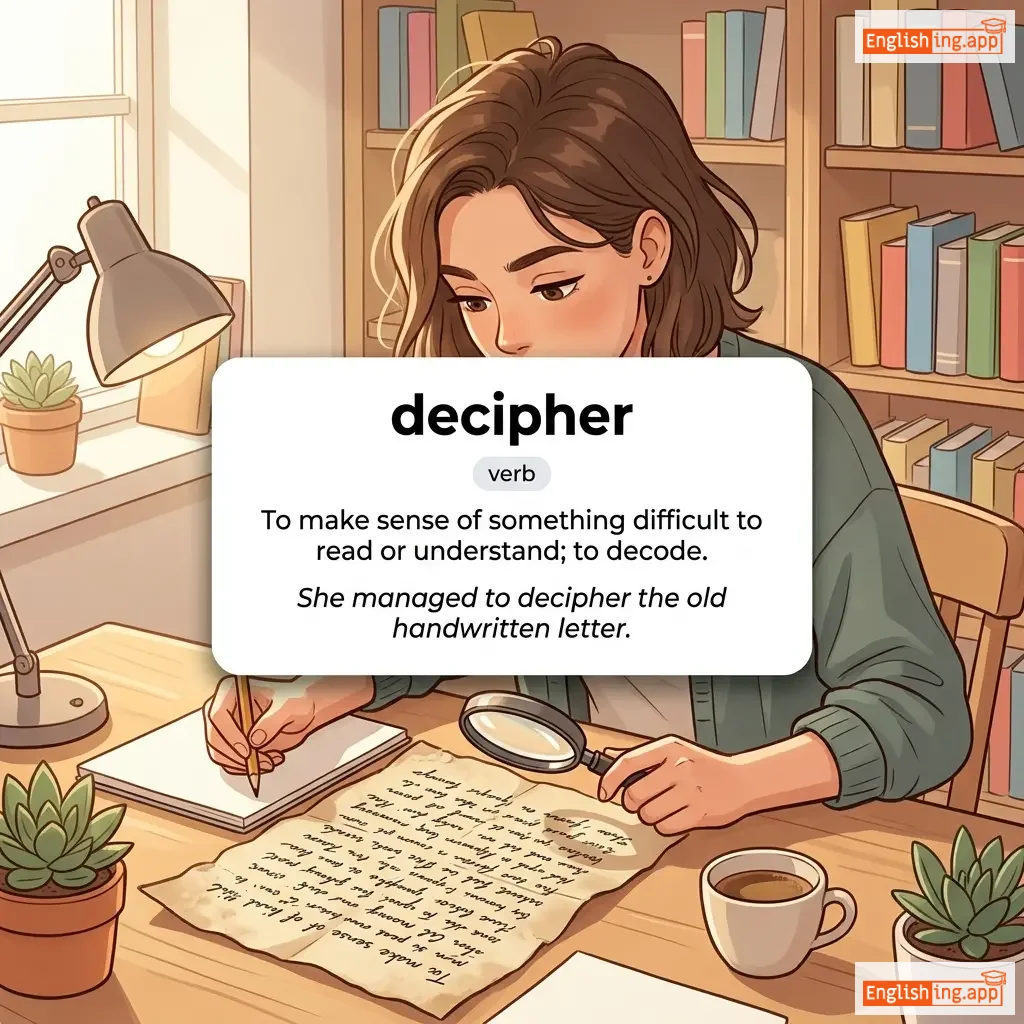
decipher definition card — visual illustration of the meaning
verb
/dɪˈsaɪfər/

To make sense of something difficult to read or understand; to decode.

"She managed to decipher the old handwritten letter."

noun
/dɪˈsɪʒən/
решение (reshenie)

A conclusion or choice made after consideration.

"She made a quick decision to accept the job offer."

"Она приняла быстрое решение принять предложение о работе." (Ona prinjala bystroye resheniye prinyat' predlozheniye o rabote.)
noun
/dɪˈsɪʒənˌmeɪkɪŋ/
принятие решений (prinyatie resheniy)

the process of making decisions, especially important or business-related decisions

"The CEO's decision-making was crucial for the success of the company."

"Принятие решений CEO было критически важным для успеха компании." (Prinyatiye resheniy CEO bylo kriticheski vazhnym dlya uspekha kompanii.)
decisions definition card — visual illustration of the meaning
noun
/dɪˈsɪʒənz/
решения (resheniya)

A conclusion or resolution reached after consideration; the action or process of deciding something.

"Making the right decisions in time was key to the project's success."

"Принятие правильных решений вовремя было ключом к успеху проекта." (Prinyatiye pravylnykh resheniy vovremya bylo klyuchom k uspekhu proyektu.)
adjective
/dɪˈsaɪsɪv/
решающий (reshayushchiy)

Having the ability to make decisions quickly and effectively; determining the outcome.

"Her decisive action saved the company from collapse."
"Ее решающее действие спасло компанию от краха." (Eyo reshayushchee deystviye spaslo kompaniyu ot krakha.)
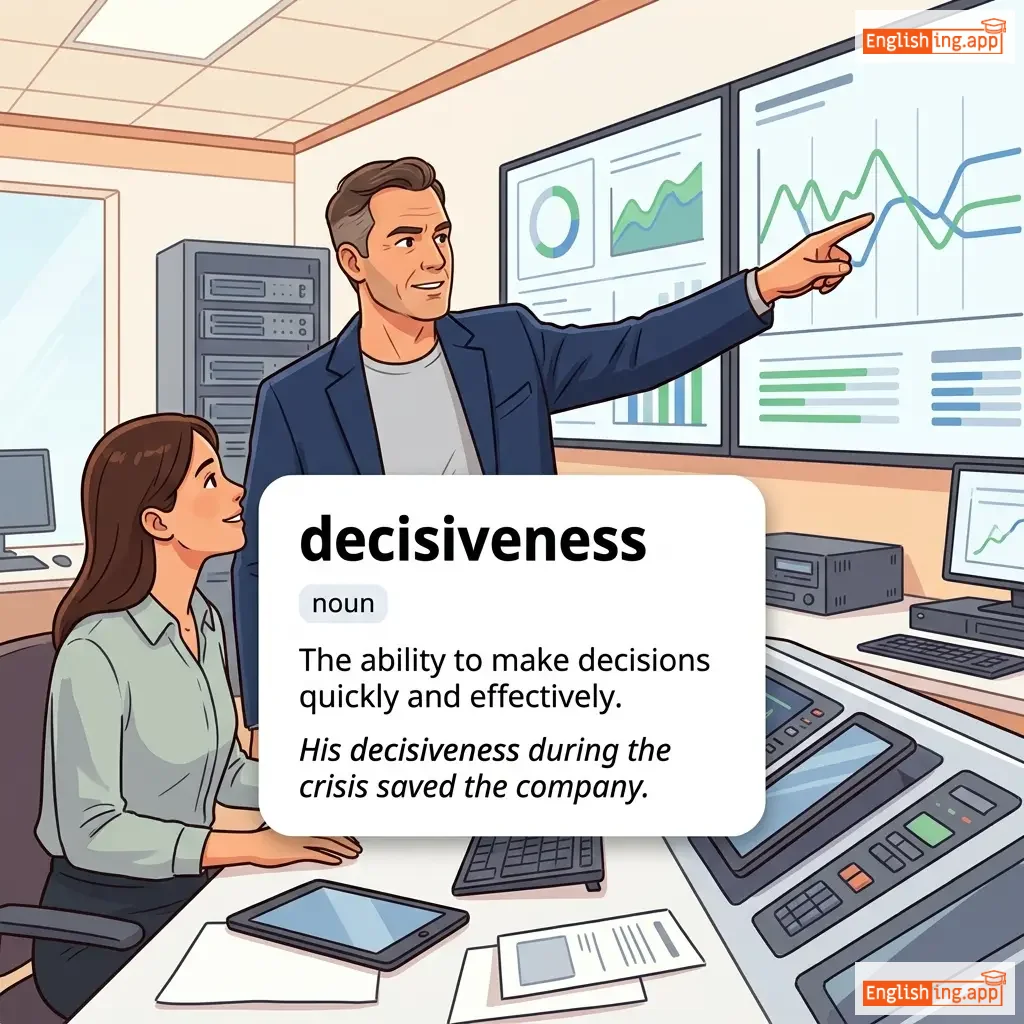
decisiveness definition card — visual illustration of the meaning
noun
dɪˈsʌɪsɪvnɪs
способность принимать решения (sposobnost' prinimat' resheniya)

The ability to make decisions quickly and effectively.

"His decisiveness during the crisis saved the company."

"Его решительность в кризисной ситуации спасла компанию." (Ego reshitel'nost' v krizisnoy situatsii spasla kompaniyu.)
🛳️

deck (dek)

noun
/dɛk/
палуба / платформа (paluba / platforma)

A flat surface or platform, often on a ship or building.

"We enjoyed the sunset from the upper deck of the ferry."

"Мы наслаждались закатом с верхней палубы парома." (My naslazhdalis' zakatom s verkhney paluby paroma.)
verb
/dɪˈkleɪm/
декламировать (deklamirovat)

to speak aloud in a formal, passionate, or theatrical way

"The actor declaimed his lines with great intensity."

"Актёр декламировал свои реплики с большой интенсивностью." (Aktor deklamiroval svoi repliki s bolshoi intensivnostyu)
noun
/ˌdɛkləˈmeɪʃən/
декламация (deklamatsiya)

a formal speech delivered with rhetorical or dramatic effect

"Her declamation captivated the audience at the competition."

"Её декламация очаровала зрителей на конкурсе." (Yeyo deklamatsiya ocharovala zriteley na konkurse.)
adjective
/dɪˈklæməˌtɔri/
декламационный стиль (deklyamatsionnyy stil)

speaking in a loud, rhetorical, or dramatic way

"The politician’s declamatory style impressed some but irritated others."

"Декламационный стиль политика впечатлил одних, но раздражал других." (Deklyamatsionnyy stil politika vpechatlil odnikh, no razdrazhal drugikh.)
noun
/ˌdɛkləˈreɪʃən/
декларация (deklaraatsiya)

a formal or explicit statement or announcement

"The president made a declaration of independence."

"Президент сделал декларацию независимости." (Prezident sdelal deklaratsiyu nezavisimosti.)
adjective
/dɪˈklærətɪv/
утвердительный (utverditel'nyy)

relating to a statement that declares something; in grammar, a sentence that makes a statement

"A declarative sentence simply states a fact or opinion."

"Утвердительное предложение просто излагает факт или мнение." (Utverditel'noye predlozheniye prosto izlagaet fakt ili mneniye)
verb
/dɪˈklɛər/
объявить (ob'yavit')

To announce something formally or officially.

"The government declared a state of emergency."
"Правительство объявило чрезвычайное положение." (Pravitel'stvo ob'yavilo chrezvychaynoye polozheniye.)
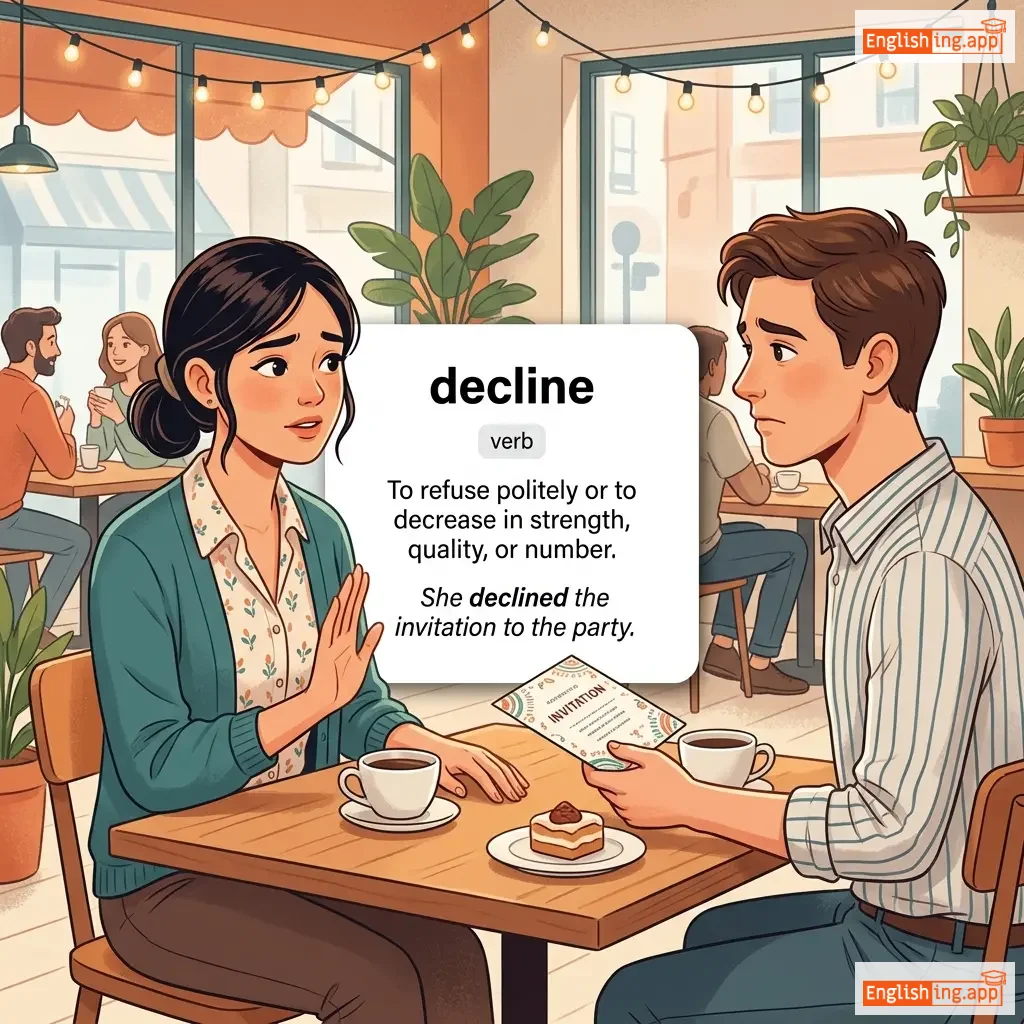
decline definition card — visual illustration of the meaning
verb
/dɪˈklaɪn/

To refuse politely or to decrease in strength, quality, or number.

"She declined the invitation to the party."

noun
/dɪˈklɪvɪti/
склон (sklon)

a downward slope of ground

"They carefully climbed down the declivity of the hill."

"Они осторожно спустились по склону холма." (Oni ostorozhno spustilis' po sklonu kholma.)
verb
/diːˈkoʊd/
расшифровать (rasshifrovat)

to convert a coded message into a readable form; to interpret meaning

"The software can decode the hidden message within seconds."

"Программное обеспечение может расшифровать скрытое сообщение за несколько секунд." (Programmnoye obespecheniye mozhet rasshifrovat skrytoye soobshcheniye za neskol'ko sekund.)
adjective
/ˌdeɪ.kɒlˈteɪ/
платье с глубоким вырезом (plat'ye s glubokim vyrezom)

of a woman's dress or top, cut low so as to reveal the neck and upper chest

"She wore a decollete gown to the party."

"Она носила платье с глубоким вырезом на вечеринке." (Ona nosila plat'ye s glubokim vyrezom na vecherinke.)
noun
/ˌdiː.kɒmpəˈzɪʃən/
разложение (razlozhenie)

the process of decaying or breaking down into simpler parts

"The decomposition of leaves enriches the soil."
"Разложение листьев обогащает почву." (Razlozhenie listev obogashchaet pochvu.)
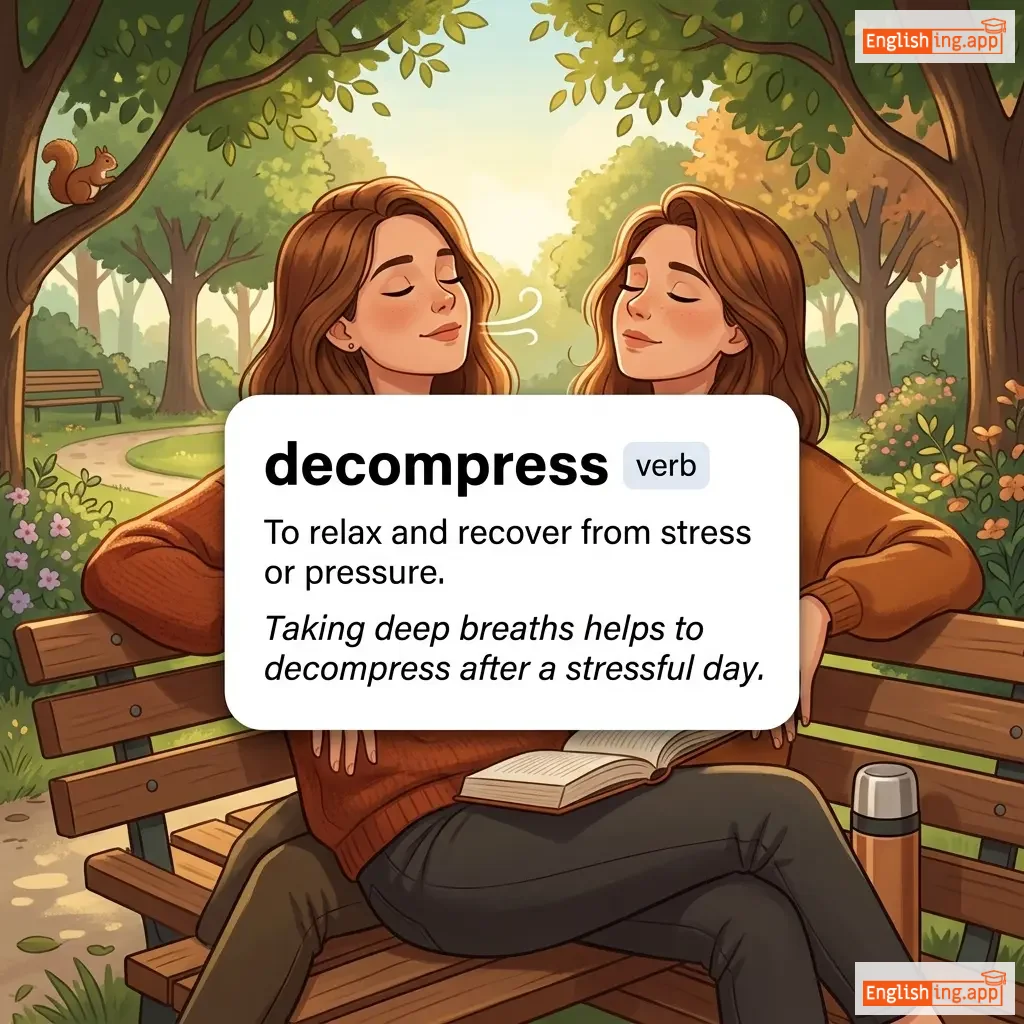
decompress definition card — visual illustration of the meaning
verb
/ˌdiː.kəmˈprɛs/
расслабляться (rasslablyatsya)

To relax and recover from stress or pressure.

"Taking deep breaths helps to decompress after a stressful day."
"Глубокое дыхание помогает расслабиться после напряжённого дня." (Glubokoe dykhaniye pomogaet rasslablyat'sya posle napryazhonnogo dnya.)
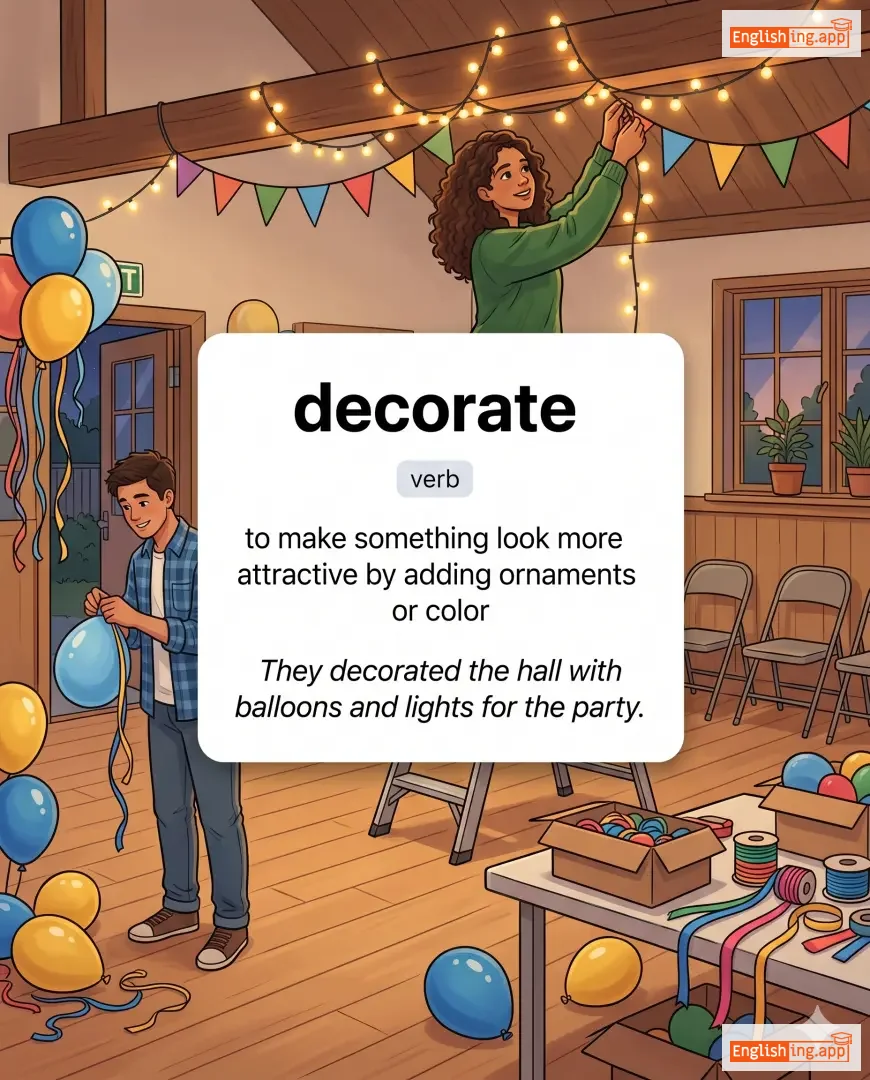
decorate definition card — visual illustration of the meaning
verb
/ˈdɛkəreɪt/

to make something look more attractive by adding ornaments or color

"They decorated the hall with balloons and lights for the party."

noun
/ˌdek.əˈreɪ.ʃən/
декорирование; украшение; приз; (dekorirovaniye, ukrasheniye, priz)

the process or art of decorating something; ornamental items used to beautify

"The Christmas decoration transformed the ordinary room into a festive wonderland."

"Рождественское украшение превратило обычную комнату в праздничную страну чудес." (Rozhdestvenskoye ukrasheniye prevratilo obychnuyu komnatu v prazdnichnuyu stranu chudes.)
adjective
/ˈdekərəs/
учтивый (uchtivyy)

showing proper and polite behavior; marked by good taste

"The audience gave a decorous applause after the performance."

"Зрители выразили учтивое одобрение после выступления." (Zriteli vyrazili uchtivoye odobreniye posle vystupleniya.)
Decorum definition card — visual illustration of the meaning
noun
/dɪˈkɔːrəm/
декорум (dekorum)

behavior in keeping with good taste and propriety

"The students maintained decorum during the ceremony."

"Студенты сохраняли декорум во время церемонии." (Studenty sokhranyali dekorum vo vremya tseremonii.)
adjective
/dɪˈkɔːrəs/
приличный (prilichny)

characterized by propriety, good taste, and proper manners

"She maintained a decourous silence during the ceremony."

"Она сохранила приличное молчание во время церемонии." (Ona sokhranyla prlichnoe molchaniye vo vremya tseremonii.)
noun/verb
/ˈdiːkɔɪ/
приманка (primanka)

something or someone used to lure or mislead

"The hunters used a wooden duck as a decoy."

"Охотники использовали деревянную утку как приманку." (Okhotniki ispol'zovali derevyannuyu utku kak primanku.)
⬇️

decrease

verb/noun
/ˈdiːkriːs/ (noun), /dɪˈkriːs/ (verb)

To become or make something smaller or fewer in number, amount, or degree.

"The population of the town has decreased over the years."

noun/verb
/dɪˈkriː/
указ (ukaz)

an official order or command, often by authority

"The king issued a decree banning hunting in the forest."

"Король издал указ, запрещающий охоту в лесу." (Korol' izdal ukaz, zapreshchayushchiy okhotu v lesu.)
adjective
/dɪˈkrɛpɪt/
обветшавший (obvetshavshiy)

worn out or weakened by age or neglect

"The decrepit old house was on the verge of collapse."

"Древний обветшавший дом был на грани обрушения." (Drevniy obvetshavshiy dom byl na grani obrusheniya.)
noun
/dɪˈkrɛpɪˌtjuːd/
упадок (upadok)

the state of being old, weak, and worn out

"The once-great empire fell into decrepitude."

"Когда-то великая империя погрузилась в упадок." (Kogda-to velikaya imperiya pogruzilas' v upadok.)
verb
/dɪˈkraɪ/
осуждать (osuzhdat)

to publicly criticize or express strong disapproval of something

"Many activists decry the destruction of the rainforest."

"Многие активисты осуждают уничтожение тропических лесов." (Mnogie aktivisty osuzhdayut unichtozhenie tropicheskikh lesov.)
decryption definition card — visual illustration of the meaning
noun
/dɪˈkrɪp.ʃən/
дешифровка (deshifrovka)

The process of converting encrypted information back to its original form

"Decryption of sensitive files requires a secure key."

"Расшифровка конфиденциальных файлов требует безопасного ключа." (Rasshifrovka konfidentsial'nykh faylov trebuyet bezopasnogo klyucha.)
verb
/ˈdɛdɪkeɪt/
посвящать (posvyashchat)

to devote time, effort, or oneself to a particular purpose or person

"She dedicated her life to helping the poor."

"Она посвятила свою жизнь помощи бедным." (Ona posvyatila svoyu zhizn pomoshchi bednym.)
adjective
/ˈdɛdɪˌkeɪtɪd/
посвящённый (posvyashchyonny)

devoted to a cause, task, or purpose

"She is a dedicated teacher who goes above and beyond for her students."

"Она преданный учитель, который идёт выше и дальше ради своих студентов." (Ona predannyy uchitel', kotoryy idyot vyshe i dal'she radi svoikh studentov.)