Словари

Словарь английского языка | Значения слов, определения и примеры

noun
/ˌdɛd ˈhiːt/
ничья (nichya)

a race or contest in which two or more competitors finish exactly equal

"The race ended in a dead-heat between the two runners."

"Гонка закончилась ничьей между двумя бегунами." (Gonka zakonchilas' nich'ey mezhdu dvumya begunami.)
noun
/ˈded.lɑk/
тупик; блокировка (tupik; blokirovka)

a situation in which no progress is possible; complete standstill

"The negotiations reached a deadlock when neither side would compromise."

"Переговоры зашли в тупик, когда ни одна из сторон не хотела идти на компромисс." (Peregovory zashli v tupik, kogda ni odna iz storon ne khotela idti na kompromiss.)
noun
/ˈdedlaɪn/
крайний срок (krajniy srok)

the latest time or date by which something must be completed

"We need to finish this project before the deadline."

"Нам нужно закончить этот проект до крайнего срока." (Nam nuzhno zakontchit' etot proyekt do krajnego sroka.)
deadlines definition card — visual illustration of the meaning
noun
/ˈdɛdˌlaɪnz/
сроки (sroki)

The latest time or date by which something should be completed.

"Setting deadlines helps finish tasks."

"Установление сроков помогает завершить задачи." (Ustanovlenie srokov pomogayet zavershit' zadachi.)
noun
/ˈdɛdlɒk/
тупик (tupik)

a situation in which progress is impossible because of disagreement

"Negotiations reached a deadlock after neither side agreed to compromise."

"Переговоры зашли в тупик, когда ни одна сторона не согласилась на компромисс." (Peregovory zashli v tupik, kogda ni odna storona ne soglasilas na kompromiss.)
adjective
/ˈdedli/
смертельный (smertel'nyy)

causing or able to cause death; extremely dangerous

"The snake's bite is deadly to humans."

"Укус змеи смертелен для людей." (Ukus zmei smertelen dlya lyudey.)
adjective
/ˈdɛdˌpæn/
бесстрастный (besstrastny)

Deliberately impassive or expressionless in manner.

"She delivered the joke in a completely deadpan voice."

"Она рассказала шутку с совершенно бесстрастным голосом." (Ona rasskazala shutku s sovershenno besstrastnym golosom.)
adjective
/def/
глухой; с нарушением слуха (glukhoy; s narusheniyem sluha)

unable to hear; having a hearing impairment

"The deaf child learned to communicate using sign language."

"Глухой ребёнок научился общаться с помощью жестового языка." (Glukhoy rebyonok nauchilsya obshchat'sya s pomoshch'yu zhestovogo yazyka.)
deal definition card — visual illustration of the meaning
🤝

deal

verb
/diːl/
счастье (schast'ye)

to distribute or give out something; to handle or manage

"He had to deal with many problems at work."

"Она не могла скрыть свое счастье, когда получила награду." (Ona ne mogla skryt' svoe schast'ye, kogda poluchila nagradu.)
noun
/ˈdiːlər/
продавец (prodavets)

a person or business that buys and sells goods; someone who distributes

"The car dealer offered a discount to attract customers."

"Продавец автомобилей предложил скидку, чтобы привлечь клиентов." (Prodavets avtomobiley predlozhil skidku, chtoby privlech' klientov.)
noun
/ˈdiː.lɪŋ/
обращение; сделки; бизнес-процессы (obrascheniye, sdelki, biznes-protsessy)

business transactions; the way of treating people or handling situations

"His fair dealing with customers earned him an excellent reputation."

"Его честное обращение с клиентами принесло ему отличную репутацию." (Yego chestnoye obrascheniye s klientami prineslo yemu otlichnuyu reputatsiyu.)
adjective
/dɪr/
дорогой (dorogoy)

loved or cherished; sometimes used as a polite form of address

"She is very dear to her grandparents."
"Она очень дорога своим бабушке и дедушке." (Ona ochen' doroga svoim babushke i dedushke.)
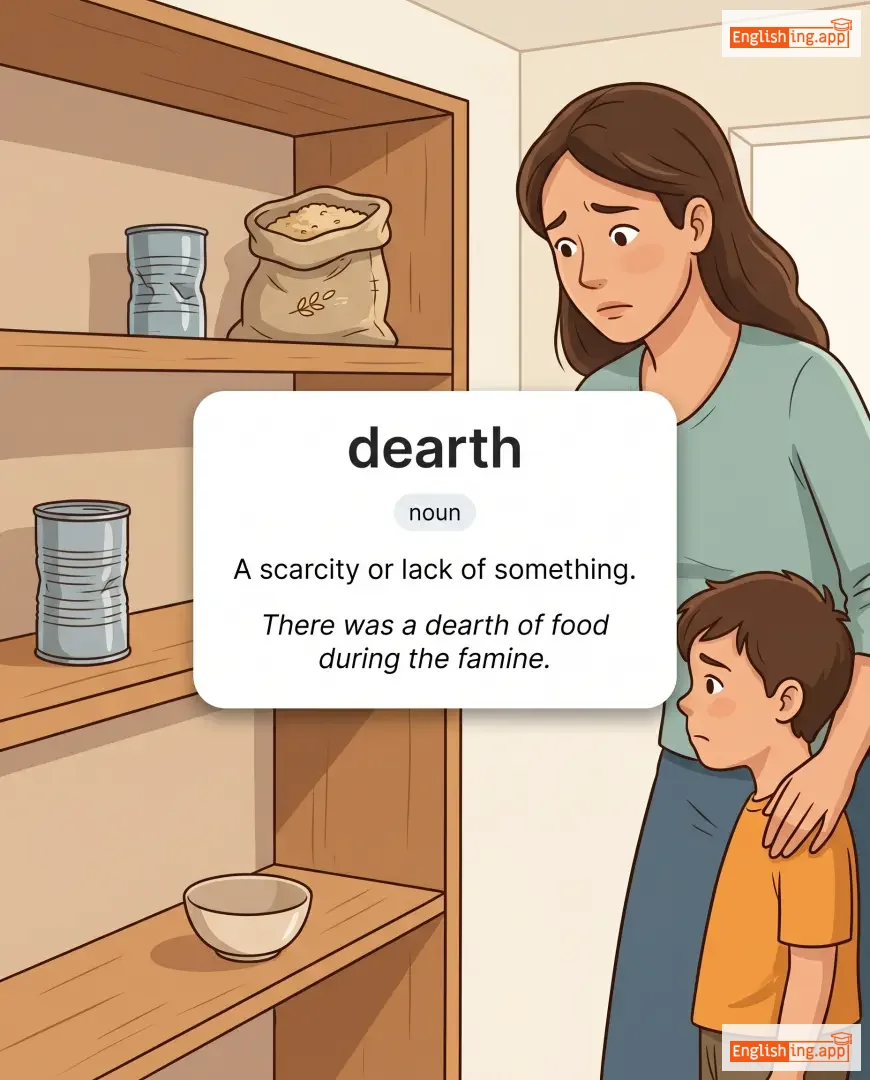
dearth definition card — visual illustration of the meaning
noun
/dɜːrθ/
дефицит (defitsit)

A scarcity or lack of something.

"There was a dearth of food during the famine."

"Был дефицит еды во время голода." (Byl defitsit edy vo vremya goloda.)
noun
/dɛθ/
смерть (smert')

The end of life; the permanent cessation of all vital functions.

"The news of his death shocked everyone in the village."

"Новости о его смерти потрясли всех в деревне." (Novosti o yego smerti potryasli vsekh v derevne.)
noun
/ˈdɛθsˌhɛd/
череп (cherep)

A representation of a human skull, often used as a symbol of death.

"The pirate flag was marked with a grim deaths-head."

"Пиратский флаг был отмечен зловещим черепом." (Piratskiy flag byl otmechen zloveshchim cherepom.)
noun
/deɪˈbɑːkəl/
крах (krakh)

A sudden and complete failure; a fiasco.

"The product launch turned into a complete debacle."

"Запуск продукта стал полным крахом." (Zapusk produkta stal polnym krakhom.)
verb
/dɪˈbɑːr/
запрещать (zapreshchat)

To officially prevent someone from doing something.

"He was debarred from entering the competition due to cheating."

"Он был лишен возможности участвовать в соревновании из-за мошенничества." (On byl lishen vozmozhnosti uchastvovat' v sorevnovanii iz-za moshennichestva.)
verb
/dɪˈbɑːrk/
сходить (skhodit')

to disembark or get off a ship, aircraft, or vehicle

"The passengers debarked as soon as the ship docked."

"Пассажиры сошли с корабля, как только оно пришвартовалось." (Passazhiry sozhli s korablya, kak tol'ko ono prishvartovalos'.)
verb
/dɪˈbeɪs/
девальвировать (devalvirovat)

to reduce the quality, value, or dignity of something

"Corruption can debase the values of a society."

"Коррупция может девальвировать ценности общества." (Korruptsiya mozhet devalvirovat' tsennosti obshchestva.)
adjective
/dɪˈbeɪst/
обесцененный (obescenenniy)

having lost quality, value, or moral character

"The debased currency lost the trust of the people."

"Обесцененная валюта потеряла доверие людей." (Obescenennaia valiuta poteryala doverie lyudey.)
adjective
/dɪˈbeɪtəbl̩/
спорный (spornyy)

open to discussion or doubt; not certain

"It is debatable whether the policy will work."

"Это спорно, будет ли политика работать." (Eto sporno, budet li politika rabotat'.)
noun, verb
/dɪˈbeɪt/
дебаты (debaty)

A formal discussion on a particular topic where opposing arguments are presented.

"The students prepared well for the school debate."

"Студенты хорошо подготовились к школьным дебатам." (Studenty khorosho podgotovilis' k shkol'nym debatam.)
debates definition card — visual illustration of the meaning
noun
dɪˈbeɪts
дебаты (debaty)

A formal discussion on a particular topic in a public meeting or legislative assembly.

"Debates foster intellectual growth."

"Дебаты способствуют интеллектуальному росту." (Debaty sposobstvuyut intellektual'nomu rostu.)
verb
/dɪˈbɔːtʃ/
развращать (razvrashchat)

to corrupt morally; to lead into excessive indulgence in sensual pleasures

"The novel shows how wealth can debauch a person's character."

"Роман показывает, как богатство может развратить характер человека." (Roman pokazyvayet, kak bogatstvo mozhet razvratit' kharakter cheloveka.)
debauchery definition card — visual illustration of the meaning
noun
/dɪˈbɔːtʃəri/
разврат (razvrat)

excessive indulgence in sensual pleasures; corruption or vice

"The novel depicts the debauchery of the aristocrats in the city."

"Роман изображает разврат аристократов в городе." (Roman izobrazhaet razvrat aristokratov v gorode.)
noun
/dɪˈbɛntʃər/
облигация (obligatsiya)

a type of debt instrument not secured by physical assets or collateral

"The company raised capital by issuing debentures to investors."

"Компания привлекла капитал, выпустив облигации для инвесторов." (Kompaniya privlekla kapital, vypustiv obligatsii dlya investorov.)
verb
/dɪˈbɪlɪteɪt/
ослаблять (oslablyat)

to weaken or make someone or something infirm

"The long illness debilitated his strength."
"Долгая болезнь ослабила его силу." (Dolgaya bolezn' oslabila ego silu.)
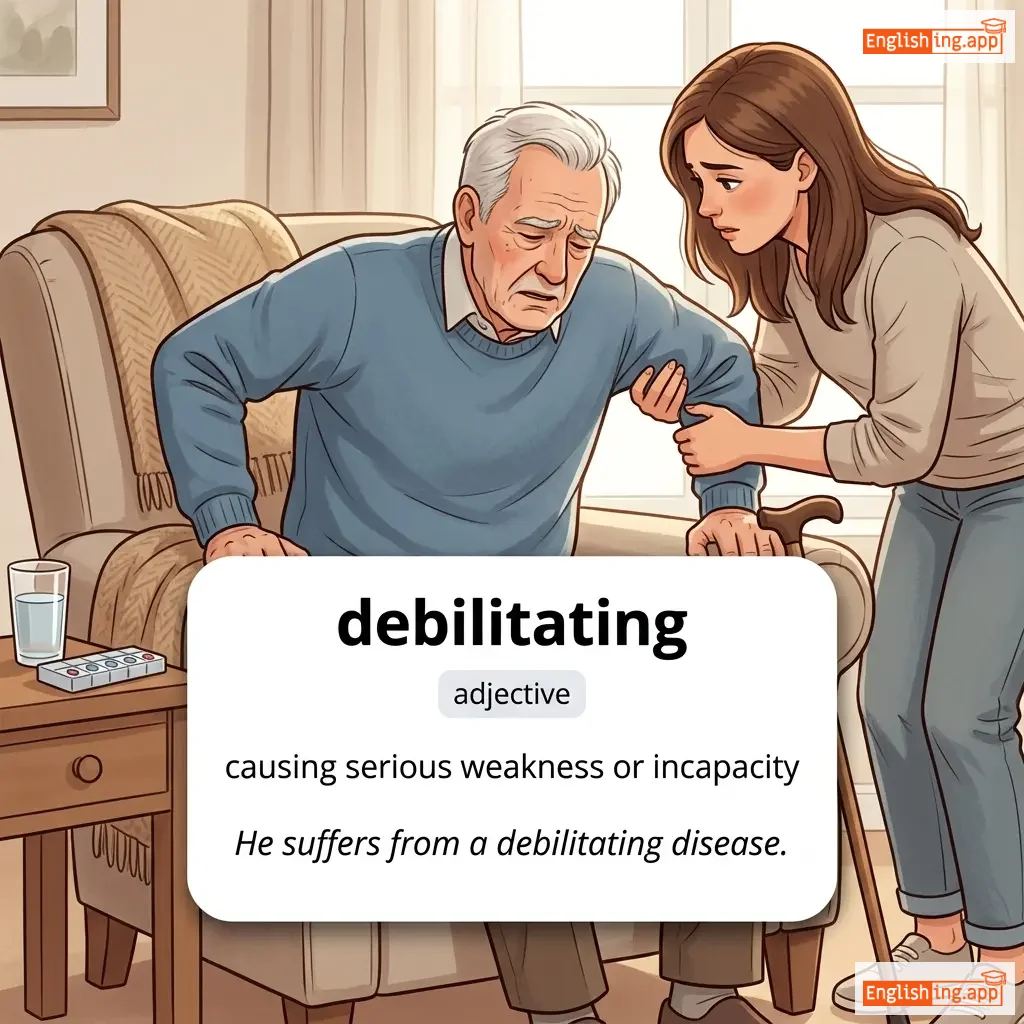
debilitating definition card — visual illustration of the meaning
adjective
/dɪˈbɪlɪteɪtɪŋ/
ослабляющий (oslablyayushchiy)

causing serious weakness or incapacity

"He suffers from a debilitating disease."

"Он страдает от ослабляющей болезни." (On stradayet ot oslablyayushchey bolezni.)
noun
/ˈdeb.ɪt/
дебет; долг; списание (debet; dolg; spisanie)

an entry recording an amount owed; money taken from a bank account

"The bank showed a debit of fifty dollars from my checking account."

"Банк показал дебет в размере пятидесяти долларов с моего расчетного счета." (Bank pokazal debit v razmere pyatidesyati dollarov s moyego raschetnogo scheta.)
adjective
/ˌdɛbəˈnɛr/
привлекательный (privlekatel'nyy)

confident, stylish, and charming, typically referring to a man

"He looked debonair in his tuxedo at the gala."
"Он выглядел привлекательным в своем смокинге на балу." (On vyglyadel privlekatel'nym v svoem smokinge na balu.)
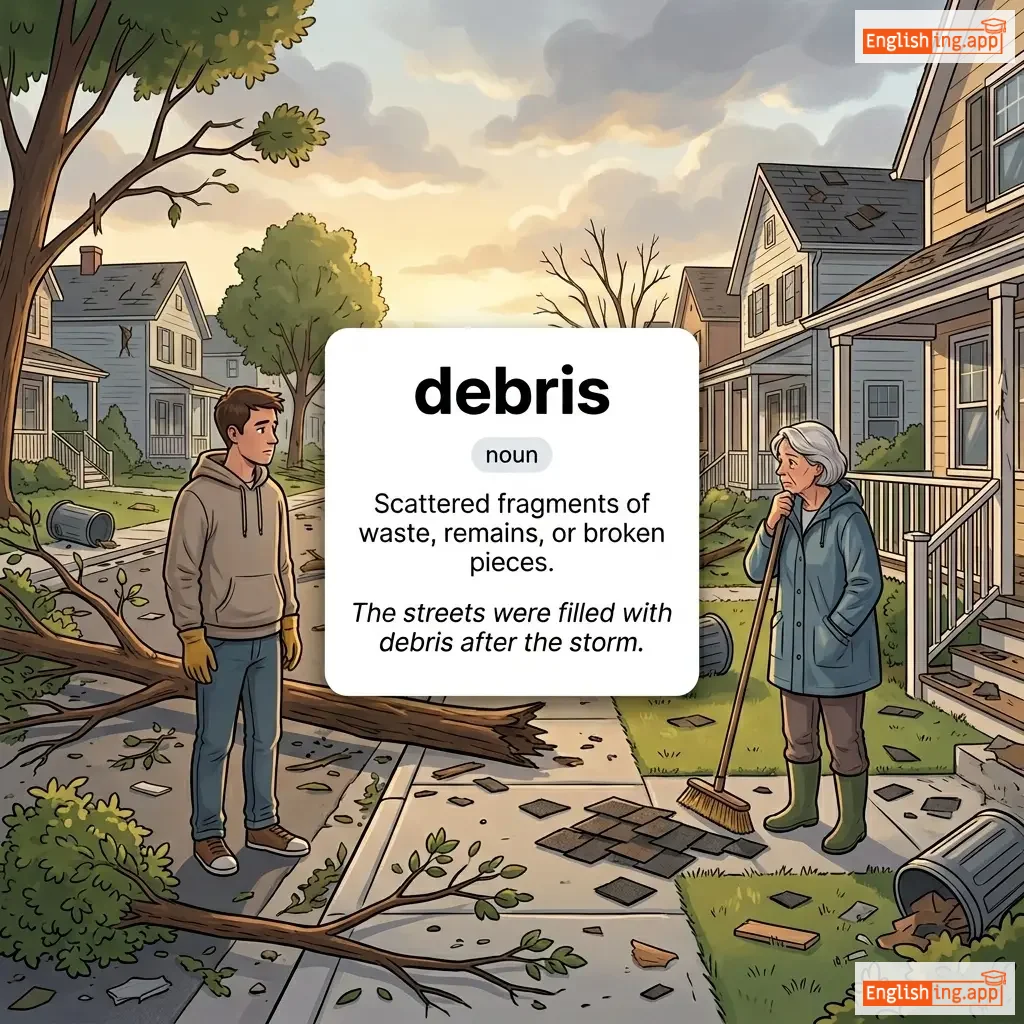
debris definition card — visual illustration of the meaning
noun
/dəˈbriː/
мусор (musor)

Scattered fragments of waste, remains, or broken pieces.

"The streets were filled with debris after the storm."

"Улицы были заполнены мусором после бури." (Uliцы byli zapolneny musorom posle buri.)
debt definition card — visual illustration of the meaning
noun
/dɛt/
долг (dolg)

Something, typically money, that is owed or due.

"He struggled for years to pay off his debt."

"Он боролся много лет, чтобы погасить свой долг." (On borolsya mnogo let, chtoby pogasit' svoy dolg.)
debunk definition card — visual illustration of the meaning
verb
/diːˈbʌŋk/

To expose the falseness or exaggeration of a claim, myth, or belief.

"The scientist worked to debunk the myths about vaccines."

noun, verb
/ˈdeɪ.bjuː/
дебют (debyut)

The first public appearance or performance of someone or something.

"The young actor made his debut on the big stage."

"Молодой актер дебютировал на большой сцене." (Molodoy akter debiutiroval na bol'shoy stsene.)
noun
/ˈdeb.juː.tɑːnt/
молодая женщина, которая делает своё первое официальное появление в обществе (molodaya zhenshchina, kotoraya delaet svoe pervoe ofitsialnoe poyavlenie v obshchestve)

A young woman making her first formal appearance in society.

"The debutante wore a white gown at the ball."

"Дебютантка носила белое платье на балу." (Debyutantka nosila beloje platje na balu.)
noun
/ˈdɛkeɪd/
десятилетие (desyatiletie)

A period of ten years.

"The country has changed a lot in the past decade."

"Страна сильно изменилась за последнее десятилетие." (Strana sil'no izmenilas' za poslednee desyatiletie.)
noun
/ˈdek.ə.dəns/
декаданс (dekadans)

Moral or cultural decline characterized by excessive indulgence in pleasure or luxury.

"The novel describes the decadence of the wealthy elite."

"Роман описывает декаданс богатой элиты." (Roman opisivayet dekadans bogatoy elity.)
adjective
/ˈdɛkədənt/
декадент, роскошный (dekadent, roskoshnyy)

Characterized by or reflecting a state of moral or cultural decline; excessively self-indulgent.

"The party was filled with decadent luxury and excess."

"Вечеринка была наполнена декадентским роскошью и излишеством." (Vecherinka byla napolnena dekadentskim roskosh'yu i izlishestvom.)
noun
/ˈdɛkəˌɡɒn/
декагон (dekaton)

A polygon with ten sides and ten angles.

"The geometry teacher drew a perfect decagon on the board."

"Учитель геометрии нарисовал идеальный декагон на доске." (Uchitel' geometrii narisoval ideal'nyi dekagon na doske.)
noun
/ˈdɛkəˌɡræm/
декаграмм (dekagramm)

A metric unit of mass equal to ten grams.

"The package weighed exactly one decagram."

"Посылка весила ровно один декаграмм." (Posylka vesila rovno odin dekagramm.)
noun
/ˈdɛkəˌliːtər/
десять литров (desyat' litrov)

A metric unit of capacity equal to ten liters.

"The container could hold up to one decaliter of water."

"Контейнер может вмещать до одного декалитра воды." (Konteyner mozhet vmeschat' do odnogo dekalitry vody.)
noun
/ˈdɛkəˌlɔːɡ/
декалог (dekalog)

The Ten Commandments in the Bible; a set of fundamental rules or principles.

"The priest gave a sermon on the importance of the Decalogue."

"Священник произнес проповедь о важности Десяти заповедей." (Svyashennik proiznes propoved o vazhnosti Desyati zapovedey.)
noun
/dɪˈkæmərən/
Декамерон (сборник рассказов Боккаччо) (dekameron)

A collection of 100 tales written by Giovanni Boccaccio in the 14th century, told by a group of people over ten days.

"The Decameron is considered a masterpiece of classical Italian literature."

"Декамерон считается шедевром классической итальянской литературы." (Dekameron schitaetsya shedevrom klassicheskoy italiyanskoy literatury.)
noun
/dɪˈkæmɪtər/
декаметр (dekametr)

A metric unit of length equal to ten meters.

"The field was measured in decameters for accuracy."

"Поле измеряли в декаметрах для точности." (Pole izmeriali v dekametrah dlya tochnosti.)
verb
/dɪˈkæmp/
убежать (dikamp)

To depart suddenly or secretly, often to avoid trouble or escape.

"The thief decamped before the police arrived."

"Вор сбежал до того, как полиция приехала." (Vor sbezhal do togo, kak politsiya priekhala.)
verb
/dɪˈkænt/
дека́нтировать (dekantirovat)

To pour liquid gently from one container into another, especially without disturbing the sediment.

"She carefully decanted the wine into a clean glass."

"Она осторожно наливала вино в чистый стакан." (Ona ostorozhno nalivala vino v chisty stakan.)
verb
/dɪˈkæpɪteɪt/
счастье (schast'ye)

To cut off the head of a person or animal.

"The ancient executioner decapitated the criminal."

"Она не могла скрыть своего счастья, когда получила награду." (Ona ne mogla skryt' svoego schast'ya, kogda poluchila nagradu.)
noun
/ˈdɛkəˌpɒd/
декапод (dekapod)

An arthropod with ten limbs, such as crabs, lobsters, and shrimps.

"The lobster is a well-known decapod."

"Омар — это известный декапод." (Omar — eto izvestnyy dekapod.)
noun
/ˌdɛkəˈsɪləbəl/
декасиллаб (dekasillab)

A line of verse with ten syllables.

"The poet often wrote in decasyllable form."

"Поэт часто писал в декосиллабической форме." (Poet chasto pisal v dekosillabicheskoy forme.)
verb, noun
/dɪˈkeɪ/
гниение (gnienie)

The process of rotting or decomposition; to decline in quality or strength.

"The abandoned house slowly began to decay."

"Покинутое здание медленно начало разлагаться." (Pokinutoe zdanie medlenno nachalo razlagatsya.)