Словари

Словарь английского языка | Значения слов, определения и примеры

e-commerce definition card — visual illustration of the meaning
noun
ˈiːˌkɒm.ɜːrs
электронная коммерция (elektronnaya kommerciya)

The process of buying and selling goods or services through the internet.

"E-commerce has revolutionized the way people shop."

"Электронная коммерция революционизировала способы покупок людей." (Elektronnaya kommerciya revoljucionizirovala sposoby pokupok lyudey.)
noun, verb
/ˈiː.meɪl/
электронная почта (elektronnaya pochta)

messages distributed by electronic means from one computer user to another

"I sent an e-mail to my professor yesterday."

"Я отправил электронное письмо своему профессору вчера." (Ya otpravil elektronnoye pis'mo svoemu professoru vchera.)
abbreviation
/iː ˈdʒiː/
например (naprimer)

For example (from Latin 'exempli gratia').

"You should eat more fruits, e.g., apples and bananas."

"Тебе следует есть больше фруктов, например, яблоки и бананы." (Tebe sleduyet est' bol'she fruktov, naprimer, yabloki i banany.)
determiner/pronoun
/iːtʃ/
каждый (kazhdy)

every one of two or more people or things considered separately

"Each student received a certificate."

"Каждый студент получил сертификат." (Kazhdyy student poluchil sertifikat.)
adjective
/ˈiːɡər/
жаждущий / стремящийся (zhazhdushchiy / stremyashchiesya)

very excited and interested; keen to do something

"The children were eager to open their gifts."

"Дети были стремящимися открыть свои подарки." (Deti byli stremyashchimisya otkryt' svoi podarki.)
adverb
/ˈiːɡərli/
с нетерпением; с большим желанием (s neterpeniem; s bolshim zhelaniem)

with keen interest or enthusiasm; with great desire

"The children eagerly waited for the holiday to begin."

"Дети с нетерпением ждали, когда начнется отпуск." (Deti s neterpeniem zh-dali, kogda nachnyotsya otpusk)
noun
/ˈiː.ɡəl/
орел (orel)

large bird of prey with powerful wings and sharp talons

"The eagle soared high above the mountains."

"Орел летел высоко над горами." (Orel letel vysoko nad gorami)
noun
/ˈiːɡlət/
орлятко (orlyatko)

A young eagle.

"The eaglet waited in the nest for its mother to return."

"Орлятко ждал в гнезде, когда его мать вернется." (Orlyatko zhdal v gnezde, kogda ego mat' vernyotsya.)
noun
/ɪə(r)/
ухо (ukho)

the organ of hearing and balance in humans and other animals

"She whispered something in his ear."

"Она шептала ему что-то на ухо." (Ona sheptala yemu chto-to na ukho.)
noun
/ˈɪər.ɪŋ/
серьга (ser'ga)

a piece of jewelry worn on the earlobe or ear

"Her diamond earrings caught everyone's attention."

"Ее алмазные серьги привлекли внимание всех." (Yeyo almaznye ser'gi privlekli vnimanie vsekh.)
adjective/adverb
/ˈɜːrli/
рано (rano)

before the usual or expected time

"She arrived early to the meeting."

"Она пришла рано на встречу." (Ona prishla rano na vstrechu.)
verb
/ˈɪə.mɑːrk/
выделять (vydelyat')

To designate funds, resources, or time for a particular purpose.

"The government has earmarked funds for education."

"Правительство выделило средства на образование." (Pravitel'stvo vydelilo sredstva na obrazovanie.)
earn definition card — visual illustration of the meaning
verb
/ɜːrn/
заработать (zarabotat)

To receive money or reward in return for work or service.

"She worked hard to earn enough money for college."

"Она усердно работала, чтобы заработать достаточно денег на колледж." (Ona usyerdno rabotala, chtoby zarabotat' dostatochno deneg na kolledzh.)
noun
/ˈɜːrnər/
зарабатывающий (zarabatyvayushchiy)

A person who earns money through work or business

"She is the primary earner in her family."

"Она главный зарабатывающий в своей семье." (Ona glavnyy zarabatyvayushchiy v svoey sem'ye.)
adjective
/ˈɜːrnɪst/
серьезный и искренний (seryoznyy i iskrenniy)

showing sincere and intense conviction

"She spoke in an earnest voice about the importance of honesty."

"Она говорила с искренним голосом о важности честности." (Ona govorila s iskrennim golosom o vazhnosti chestnosti.)
noun
/ˈɜːnɪŋz/
доход (dokhod)

money obtained in return for labor or services

"Her monthly earnings are enough to support her family."

"Её ежемесячный доход достаточно, чтобы поддержать её семью." (Eyo yezhemesyachnyy dokhod dostatochno, chtoby podderzhat' yeyo sem'yu.)
noun
/ˈɪrˌplʌɡ/
беруши (berushi)

a device inserted into the ear to block out noise or water

"He wore earplugs to sleep during the noisy night."

"Он носил беруши, чтобы спать во время шумной ночи." (On nosil berushi, chtoby spat' vo vremya shumnoj nochi.)
noun
/ˈɪrˌʃɑːt/
диапазон слуха (diapazon slukha)

the range or distance within which a sound can be heard

"The children whispered secrets out of earshot of their parents."

"Дети шептали секреты вне зоны слышимости их родителей." (Deti sheptali sekrety vne zony slyshimosti ikh roditely.)
adjective
/ˈɪrˌsplɪtɪŋ/
оглушающий (oglushayushchiy)

extremely loud or piercing sound

"The earsplitting noise of the fire alarm startled everyone."

"Оглушающий звук пожарной сигнализации напугал всех." (Oglushayushchiy zvuk pozharnoy signalizatsii napugal vsekh.)
noun
/ɜːrθ/
Земля (Zemlya)

the planet we live on; soil or ground

"The astronauts looked back at the Earth from space."

"Астронавты посмотрели на Землю из космоса." (Astronavty posmotreli na Zemlyu iz kosmosa.)
noun
/ˈɜːθ.wɜːm/
червяк (chervyak)

a segmented worm that lives in soil and helps decompose organic matter

"The gardener was happy to find many earthworms in the soil."

"Садовник был счастлив найти много червей в почве." (Sadovnik byl schastliv nayti mnogo chervyey v pochve.)
adjective
/ˈɜːr.θən/
из земли или глины; связанный с керамикой (iz zemli ili gliny; svyazannyy s keramikoy)

made of earth or clay; relating to pottery or ceramic materials

"The kitchen had beautiful earthen pots for storage."

"На кухне стояли красивые глиняные горшки для хранения." (Na kukhne stoyali krasivye glinyanye gorshki dlya khraneniya.)
noun
/ˈɜːr.θən pɒt/
горшок из глины (gorshok iz gliny)

a container made of baked clay or earth, used for cooking or storing

"The earthen pot keeps water naturally cool in summer."

"Горшок из глины сохраняет воду естественным образом холодной летом." (Gorshok iz gliny sokhranyaet vodu yestestvennym obrazom kholodnoy letom.)
noun
/ˈɜːrθənˌwɛr/
керамика (keramika)

pottery made of clay and hardened by heat

"The shop displayed beautiful earthenware pots and bowls."

"Магазин демонстрировал красивые керамические горшки и миски." (Magazin demonstriroval krasivye keramičeskie gorški i miski.)
adjective
/ˈɜːrθli/
земной (zemnoy)

relating to the physical world as opposed to the spiritual or heavenly; worldly

"He was more concerned with earthly pleasures than spiritual matters."

"Он больше заботился о земных удовольствиях, чем о духовных вопросах." (On bolshe zabotsilsya o zemnykh udovolstviyakh, chem o dukhovnykh voprosakh.)
earthquake definition card — visual illustration of the meaning
noun
/ˈɜːrθ.kweɪk/
землетрясение (zemletryasenie)

a sudden shaking of the ground caused by movements within the Earth's crust or volcanic action

"A strong earthquake hit the city last night."

"Сильное землетрясение потрясло город прошлой ночью." (Sil'noe zemletryasenie potryaslo gorod proshloy noch'yu.)
adjective
/ˈɜːrθi/
землистый / простой (zemlistyy / prostoy)

resembling or suggestive of earth or soil; simple, natural, and sometimes coarse

"The dish had a rich, earthy flavor from the mushrooms."

"Блюдо имело насыщенный, землистый вкус от грибов." (Blyudo imelo nasyshchennyy, zemlistyy vkus ot gribov.)
noun/verb
/iːz/
легкость (legkost)

absence of difficulty or effort; to make something less serious or severe

"Meditation helps ease stress."

"Медитация помогает уменьшить стресс." (Meditatsiya pomogaet umenshit' stress.)
noun
/ˈiːzl̩/
мольберт (molbert)

a frame for supporting an artist's canvas while painting or drawing

"The artist placed the canvas on the easel before starting to paint."

"Художник поставил холст на мольберт перед тем, как начать рисовать." (Khodozhnik postavil kholst na molbert pered tem, kak nachat risovat.)
adverb
/ˈiːzəli/
легко (legko)

without difficulty or effort

"He solved the problem easily."

"Он решил проблему легко." (On reshil problemu legko.)
noun
/iːst/
восток (vostok)

The direction from which the sun rises; one of the four cardinal points.

"The sun rises in the east."

"Солнце восходит на востоке." (Solntse voskhodit na vostoke.)
adjective
/ˈiːstərn/
восточный (vostochnyy)

Relating to, situated in, or characteristic of the east.

"They traveled to the eastern part of the country."

"Они путешествовали в восточную часть страны." (Oni puteshestvovali v vostochnuyu chast' strany.)
adverb
/ˈiːstwədz/
восток (vostok)

towards the east; in an eastern direction

"The river flows eastwards into the ocean."

"Река течет на восток в океан." (Reka techet na vostok v okean.)
adjective
/ˈiːzi/
легкий (legkiy)

not difficult; requiring little effort

"The exam was surprisingly easy."

"Экзамен был удивительно легким." (Ekzamen byl udivitel'no legkim.)
noun
/ˈiː.zi tʃeər/
кресло (izicher)

a comfortable chair with arms and a back that reclines

"He relaxed in his favorite easy-chair after work."

"После работы он расслабился в своем любимом кресле." (Posle raboty on rasslabilsya v svoem lyubimom kresle)
eat definition card — visual illustration of the meaning
🍽️

eat (it)

verb
/iːt/
есть (yest)

To put food into the mouth, chew, and swallow it.

"They eat breakfast together every morning."

"Они завтракают вместе каждое утро." (Oni zavtrakuyut vmeste kazhdoe utro.)
adjective
/ˈiːtəbl̩/
съедобный (s'yedobnyy)

suitable or safe for eating

"The berries are not only eatable but also quite tasty."

"Ягоды не только съедобны, но и довольно вкусные." (Yagody ne tol'ko s'yedobny, no i dovol'no vkusnye.)
verb
/ˈiːtɪŋ/
есть (yest)

the act of consuming food

"They were eating dinner when the phone rang."
"Они ужинали, когда зазвонил телефон." (Oni uzhinali, kogda zazvonil telefon.)
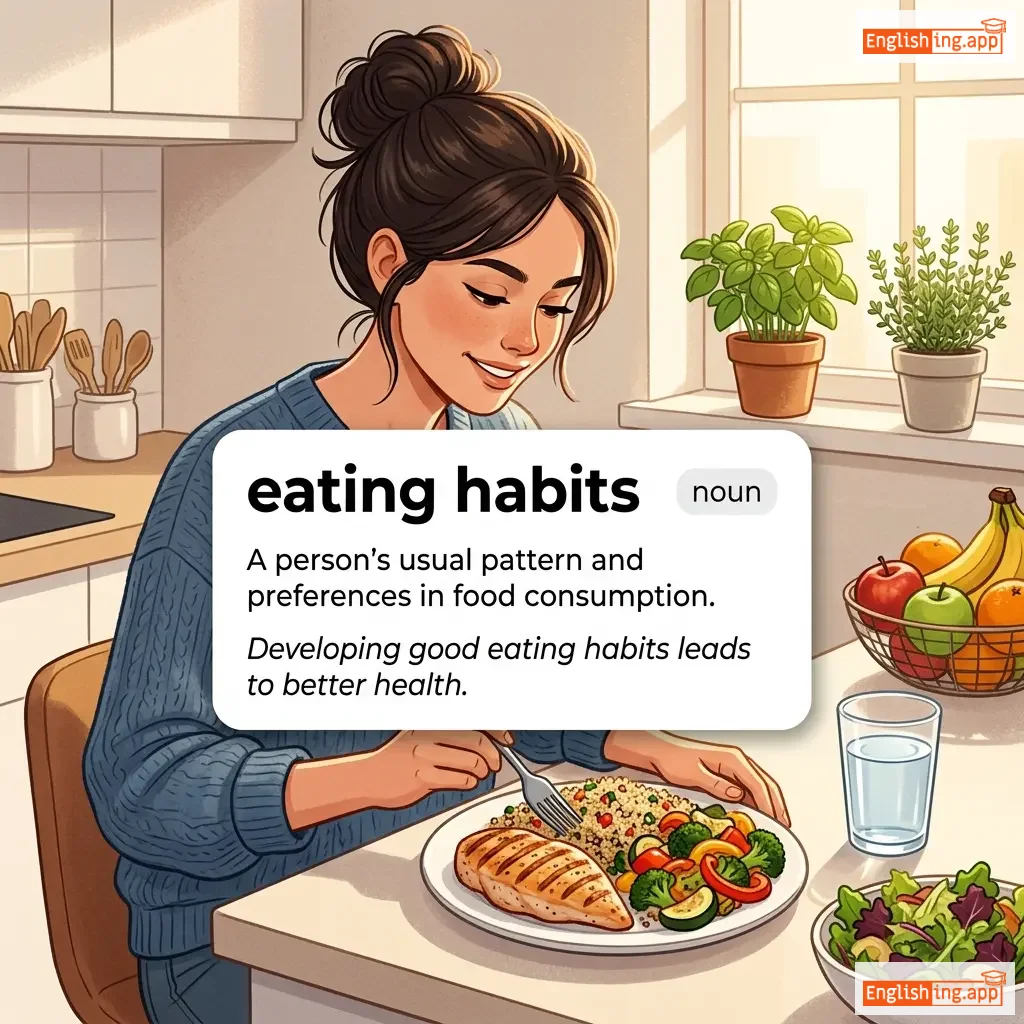
eating habits definition card — visual illustration of the meaning
noun
/ˈiː.tɪŋ ˈhæb.ɪts/
привычки питания (privyichki pitaniya)

A person's usual pattern and preferences in food consumption.

"Developing good eating habits leads to better health."

"Развитие хороших привычек питания ведет к улучшению здоровья." (Razvitiye khoroshikh privyichok pitaniya vedet k uluchsheniyu zdorov'ya.)
verb
/ˈiːvzdrɒp/
подслушивать (podslushivat)

to secretly listen to a conversation

"She stood near the door to eavesdrop on their conversation."

"Она стояла рядом с дверью, чтобы подслушать их разговор." (Ona stoyala ryadom s dveryu, chtoby podslushat' ikh razgovor.)
verb
/ɛb/
уменьшаться (umenshatsya)

to recede, decline, or lessen gradually, often referring to the tide or emotions

"Her confidence began to ebb after the repeated failures."

"Её уверенность начала снижаться после повторных неудач." (Eё uverennost' nachala snizhat'sya posle povtornykh neudach.)
noun
/ˈeb.taɪd/
отлив (otliv)

the movement of the tide out to sea; a time when the sea level is falling

"During ebb-tide, we could walk further out on the beach."

"Во время отлива мы могли пройти дальше по пляжу." (Vo vremya otliva my mogli proyti dalshe po plyazhu.)
noun
/ɪˈbʊliəns/
бодрость (bodrost)

the quality of being cheerful, enthusiastic, and full of energy

"The teacher's ebullience inspired her students."

"Энтузиазм учителя вдохновил её учеников." (Entuziazm uchitelya vdokhnovil yeyo uchenikov.)
ebullient definition card — visual illustration of the meaning
adjective
/ɪˈbʊliənt/
эксуберантный (eksuberantny)

cheerful and full of energy

"She was ebullient after receiving the good news."

"Она была эксуберантной после получения хороших новостей." (Ona byla eksuberantnoy posle polucheniya khoroshikh novostey.)
adjective
/ɪkˈsɛntrɪk/
эксцентричный (eksentrichnyy)

unconventional and slightly strange in behavior or appearance

"The artist was known for his eccentric style."

"Художник был известен своим эксцентричным стилем." (Khudozhnik byl izvesten svoim ekscentrichnym stilem.)
noun
/ˌɛksɛnˈtrɪsəti/
эксцентричность (ekstsentrichnost)

the quality of being unconventional or slightly strange

"His eccentricity made him both admired and misunderstood."

"Его эксцентричность сделала его одновременно восхищаемым и непонятым." (Yego ekstsentrichnost' sdelala ego odnovremenno voskhishchayemym i neponyatym.)
noun
/ɪˌkliːziˈæstɪk/
церковный (tserkovny)

A member of the clergy or church official.

"The council was attended by several high-ranking ecclesiastics."

"На совет были приглашены несколько высокопоставленных церковных служителей." (Na sovet byli priglasheny neskol'ko vysokopostavlennykh tserkovnykh sluzhiteley.)
echelon definition card — visual illustration of the meaning
noun
/ˈɛʃəlɒn/
уровень (uroven)

A level or rank in an organization, profession, or society.

"She quickly rose to the upper echelon of the company."

"Она быстро поднялась на высший эшелон компании." (Ona bystro podnyalas' na vysshij eshelon kompanii.)
noun, verb
/ˈɛkəʊ/
счастье (schast'ye)

a sound that is reflected off a surface and heard again; to repeat or reflect a sound or idea.

"Her laughter echoed through the empty hall."

"Она не смогла скрыть своего счастья, когда получила награду." (Ona ne smogla skryt' svoego schast'ya, kogda poluchila nagradu.)
echoed definition card — visual illustration of the meaning
verb
ˈɛkəʊd
отразилось (otrasilos)

To repeat or resound; to be reminiscent of something.

"The words of gratitude echoed in his heart."

"Слова благодарности отозвались в его сердце." (Slova blagodarnosti otozvalis' v ego serdce.)