词汇表

英语词汇词典 | 单词含义、定义和示例

noun
/dæmˈneɪ.ʃən/
永恒的惩罚; 破坏 (yǒnghéng de chéngfá; pòhuài)

condemnation to eternal punishment in hell; something that causes ruin or failure

"The preacher spoke about salvation and damnation in his sermon."

"传教士在他的讲道中谈到了救赎和诅咒。" (Chuánjiàoshì zài tā de jiǎngdào zhōng tán dào le jiùshú hé zǔzhòu.)
adjective
/dæmp/
潮湿的 (chaoshi de)

slightly wet, often in an unpleasant way

"The room felt cold and damp after the rain."

"下雨后,房间感觉又冷又潮湿。" (Xiàyǔ hòu, fángjiān gǎnjué yòu lěng yòu cháoshī.)
verb
/ˈdæmpən/
使潮湿,减弱 (shǐ cháo shī, jiǎn ruò)

to make something slightly wet; to make something less strong, active, or intense

"The rain dampened the excitement of the outdoor concert."

"雨水减弱了户外音乐会的兴奋。" (Yǔ shuǐ jiǎn ruò le hù wài yīn yuè huì de xīng fèn.)
noun
/ˈdæmpər/
某物减少或减弱力量、效果或兴奋 (mǒu wù jiǎn shǎo huò jiǎn ruò lì liàng, xiào guǒ huò xīng fèn)

something that reduces or lessens the force, effect, or excitement

"The cancellation of the trip put a damper on their enthusiasm."

"旅行的取消降低了他们的热情。" (Lǚ xíng de qǔ xiāo jiàng dī le tā men de rè qíng.)
dance definition card — visual illustration of the meaning
verb/noun
/dæns/
幸福 (xìngfú)

to move rhythmically to music, typically following a set sequence of steps

"They danced all night at the wedding."

"她收到奖项时无法隐藏自己的幸福。" (Tā shōu dào jiǎng xiàng shí wúfǎ yǐn cáng zìjǐ de xìngfú.)
noun
/ˈdænsər/
舞者 (wǔ zhě)

a person who dances or performs dancing professionally or as a hobby

"The dancer moved gracefully across the stage."

"舞者优雅地在舞台上移动。" (Wǔ zhě yōuyǎ de zài wǔtái shàng yídòng.)
noun
/ˈdænsɪŋ/

the activity of moving the body rhythmically to music

"They spent the evening dancing at the party."

noun
/ˈdæn.drʌf/
头皮屑 (dandruff)

small white or grey flakes of dead skin that form on the scalp and fall from the hair

"He used a special shampoo to treat his persistent dandruff problem."

"他使用了一种特殊的洗发水来治疗他持续的头皮屑问题。" (ta shiyongle yi zhong teshu de xifashui lai zhiliao ta chixu de toupixie wenti)
noun
/ˈdændi/
过度注重外貌和衣着的男人 (guòdù zhùzhòng wàimào hé yīzhuó de nánrén)

a man who gives too much attention to his appearance and clothes

"The young dandy spent hours grooming himself before the party."
"年轻的丹迪在聚会前花了几个小时打理自己。" (Niánqīng de dāndí zài jùhuì qián huā le jǐ gè xiǎoshí dǎlǐ zìjǐ.)
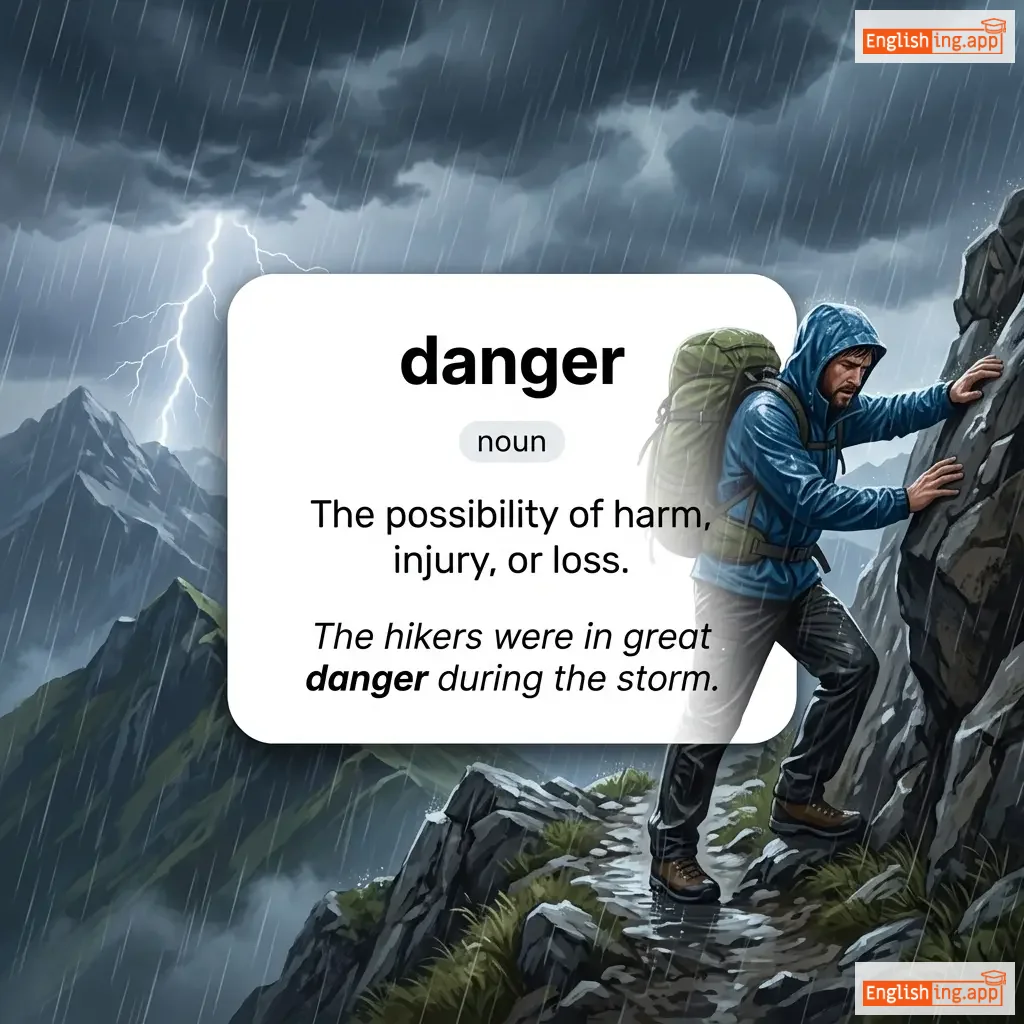
danger definition card — visual illustration of the meaning
noun
/ˈdeɪn.dʒər/
危险 (wei xian)

The possibility of harm, injury, or loss.

"The hikers were in great danger during the storm."

"徒步旅行者在暴风雨中处于极大危险中。" (Túbù lǚxíng zhě zài bàofēngyǔ zhōng chǔyú jí dà wēixiǎn zhōng.)
adjective
/ˈdeɪndʒərəs/
危险 (wéixiǎn)

likely to cause harm or injury; unsafe

"Driving fast on icy roads is dangerous."

"在冰雪路面上开车很危险。" (Zài bīngxuě lùmiàn shàng kāichē hěn wéixiǎn.)
adverb
/ˈdeɪndʒərəsli/
危险地 (wei xian de)

in a way that could cause harm or injury; riskily

"He was driving dangerously fast on the highway."

"他在高速公路上开得非常危险。" (ta zai gao su gong lu shang kai de fei chang wei xian)
verb
/ˈdæŋɡəl/
悬挂 (xuánguà)

to hang loosely or swing freely

"The keys dangled from his belt."

"钥匙从他的腰带上悬挂。" (Yuèxīn cóng tā de yāodài shàng xuánguà.)
adjective
/dæŋk/
潮湿且寒冷 (chaoshi qie hanleng)

unpleasantly damp and cold

"The basement was dark and dank, filled with a musty smell."

"地下室又黑又潮湿,弥漫着一股霉味。" (Dixiashi you hei you chaoshi, miman zhe yi gu meiwei.)
adjective
/ˈdæpər/
整洁而时尚 (zhěngjié ér shíshàng)

Neat, stylish, and well-dressed in appearance.

"He looked very dapper in his new suit."

"他穿着新西装看起来非常整洁和时尚。" (Tā chuānzhuó xīn xīzhuāng kàn qǐlái fēicháng zhěngjié hé shíshàng.)
adjective
/ˈdæpəld/
斑驳 (banbo)

Marked with spots or patches of light and shade or different colors.

"The forest floor was dappled with sunlight."

"森林的地面被阳光斑驳照亮。" (Senlin de dimian bei yangguang banbo zhaoliang.)
dare definition card — visual illustration of the meaning
verb
/der/
敢于 (gǎn yú)

To have the courage to do something risky or challenging.

"She dared to speak against the unfair rules."

"她敢于反对不公平的规则。" (Tā gǎn yú fǎnduì bù gōngpíng de guīzé.)
noun
/ˈderˌdevəl/
冒险者 (màoxiǎn zhě)

A person who enjoys doing dangerous or risky things.

"The stunt was performed by a famous daredevil."

"这个特技是由一位著名的冒险者完成的。" (Zhège tèjì shì yóu yī wèi zhùmíng de màoxiǎn zhě wánchéng de.)
adjective
/ˈderɪŋ/
大胆 (dadan)

Willing to take risks; bold and adventurous.

"Her daring plan surprised everyone."

"她大胆的计划让所有人都吃惊。" (Tā dàdǎn de jìhuà ràng suǒyǒu rén dōu chījīng.)
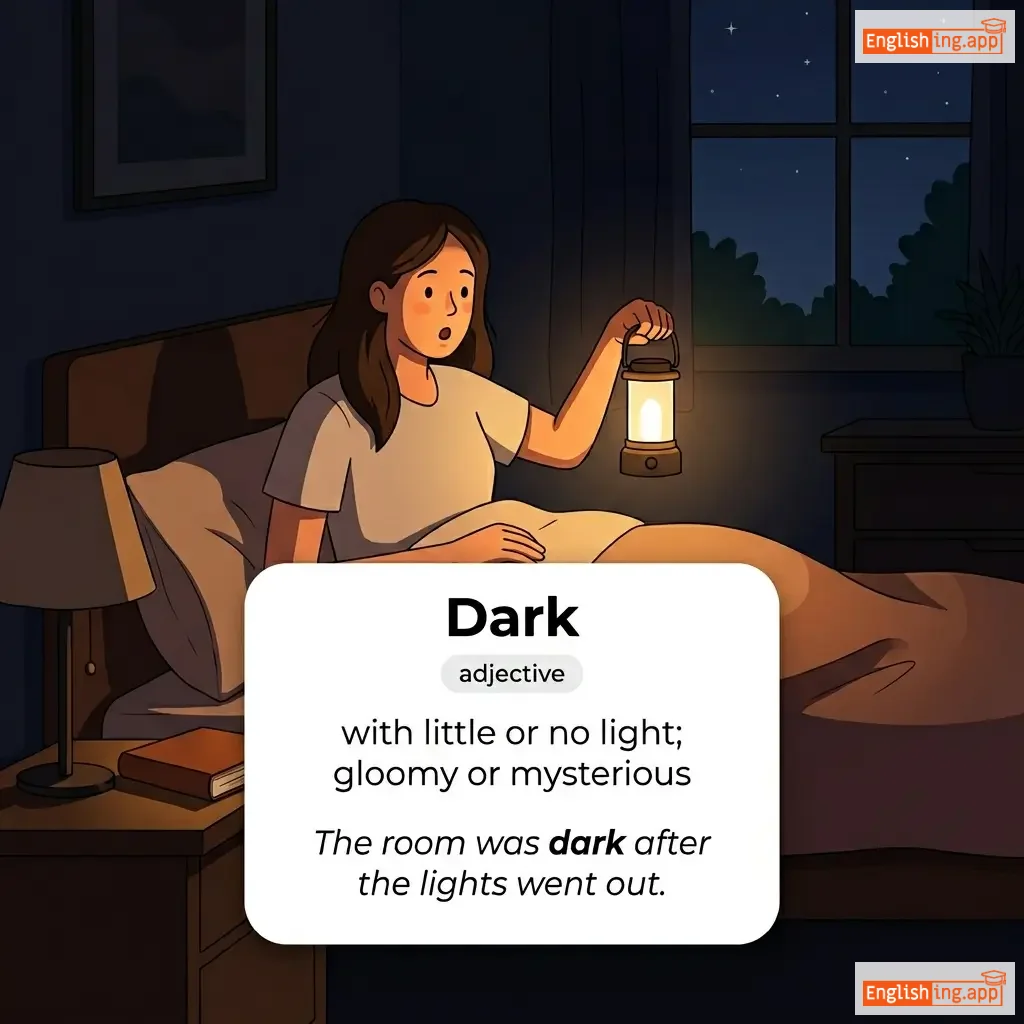
Dark definition card — visual illustration of the meaning
adjective
/dɑːrk/
黑暗的 (hei an de)

with little or no light; gloomy or mysterious

"The room was dark after the lights went out."

"灯灭后房间变得黑暗。" (deng mie hou fang jian bian de hei an.)
adjective
/dɑːrk bluː/
深蓝色 (shen lan se)

a deep shade of blue color

"She wore a dark blue dress to the party."

"她穿着一件深蓝色的裙子去参加派对。" (Tā chuānzhuó yī jiàn shēn lán sè de qúnzi qù cānjiā pàiduì.)
verb
/ˈdɑːrkən/
变暗 (bian an)

to make or become dark; to reduce brightness or light

"The clouds began to darken the sky before the storm."

"暴风雨来临前,乌云开始使天空变暗。" (Baofengyu lailin qian wuyun kaishi shi tiankong bian an)
adverb
/ˈdɑːrklɪŋ/
在黑暗中 (zai hei'an zhong)

In the dark or growing dark; dimly.

"The forest creatures moved darkling through the night."

"森林生物在夜晚穿越黑暗。" (Senlin shengwu zai yewan chuanyue hei'an.)
noun
/ˈdɑːrk.nəs/
黑暗 (hei an)

The absence of light; the state of being dark.

"The room was filled with darkness after the lights went out."

"当灯光熄灭后,房间充满了黑暗。" (Dang dengguang ximie hou, fangjian chongman le heian.)
verb, noun
/dɑːrt/
飞镖/迅速奔跑 (fēibiāo/xùn sù bēnpǎo)

to move suddenly and quickly; a small pointed missile thrown at a target

"The cat darted across the street to avoid the car."

"猫迅速穿过街道以避开汽车。" (Māo xùnsù chuānguò jiēdào yǐ bìkāi qìchē.)
noun
/ˈdɑːrwɪnɪzəm/
达尔文主义 (Dá'ěrwén zhǔyì)

the theory of biological evolution developed by Charles Darwin, emphasizing natural selection

"Darwinism revolutionized the way scientists understood the origin of species."

"达尔文主义彻底改变了科学家们对物种起源的理解。" (Dá'ěrwén zhǔyì chèdǐ gǎibiànle kēxuéjiāmen duì wùzhǒng qǐyuán de lǐjiě.)
💨

dash

verb
/dæʃ/

to move quickly and suddenly; to strike or break something violently

"She dashed across the street to catch the bus."

adjective
/ˈdæʃ.ɪŋ/
英俊; 魅力; 自信; (yingjun; meili; zixin)

stylish and confident; lively and energetic; attractive and charming

"He looked dashing in his new suit."

"他穿上新西装看起来英俊。" (Ta chuan shang xin xizhuang kan qilai yingjun.)
noun
/ˈdæstərd/
懦夫 (nuofu)

a cowardly or dishonorable person

"Only a dastard would betray his closest friend."

"只有懦夫才会背叛自己最亲密的朋友。" (Zhǐyǒu nuòfū cái huì bèipàn zìjǐ zuì qīnmì de péngyǒu.)
noun
/ˈdeɪ.tə/ or /ˈdæt.ə/
数据 (shuju)

Facts, statistics, or information collected for reference or analysis.

"The scientists analyzed the data to find patterns."

"科学家分析了数据以寻找模式。" (Kēxuéjiā fēnxīle shùjù yǐ xúnzhǎo móshì.)
data breach definition card — visual illustration of the meaning
noun
/ˈdeɪ.tə briːtʃ/
数据泄露 (shùjù xièlòu)

Unauthorized disclosure of sensitive information through security violation

"A data breach exposed millions of users' passwords."

"一次数据泄露暴露了数百万用户的密码。" (Yīcì shùjù xièlòu bàolùle shù bǎi wàn yònghù de mìmǎ.)
noun
/ˈdeɪtəbeɪs/
数据库 (shùjùkù)

a structured collection of data stored and accessed electronically

"The company's customer details are stored in a secure database."

"公司的客户信息存储在一个安全的数据库中。" (Gōngsī de kèhù xìnxī cúnchú zài yīgè ānquán de shùjùkù zhōng.)
📅

date

noun/verb
/deɪt/

A particular day of the month or year; also, a social or romantic appointment.

"They decided to meet on the date of her birthday."

noun
/deɪts/
(zǎo)

sweet brown oval fruits that grow on date palm trees

"Dates are commonly eaten during Ramadan to break the fast."

"日期通常在斋月期间食用,用来打破禁食。" (Riqi tongchang zai zhaiyue qijian shiyong, yonglai dapo jinshi)
noun
/ˈdeɪtəm/ or /ˈdætəm/
数据 (shuju)

a single piece of information; a fact used as a basis for reasoning or calculation

"Each datum in the survey was carefully analyzed."

"调查中的每一条数据都经过仔细分析。" (Diaocha zhong de mei yi tiao shuju dou jinguo zixi fenxi.)
verb
/dɔːb/
涂抹 (tūmǒ)

to spread a thick or sticky substance carelessly on a surface

"The children daubed paint all over the walls."

"孩子们把油漆涂遍了墙壁。" (háizimen bǎ yóuqī tú biànle qiángbì.)
noun
/ˈdɔːtər/
女儿 (nǚ'ér)

a female child in relation to her parents

"They are proud of their daughter for graduating college."

"他们为女儿毕业于大学而感到骄傲。" (tāmen wèi nǚ'ér bìyè yú dàxué ér gǎndào jiāo'ào.)
daunt definition card — visual illustration of the meaning
verb
/dɔːnt/
威吓 (weihe)

to make someone feel intimidated, discouraged, or less confident

"The steep climb did not daunt the experienced hikers."
"陡峭的攀登没有让经验丰富的登山者气馁。" (Dǒuqiào de pāndēng méiyǒu ràng jīngyàn fēngfù de dēngshān zhě qìněi.)
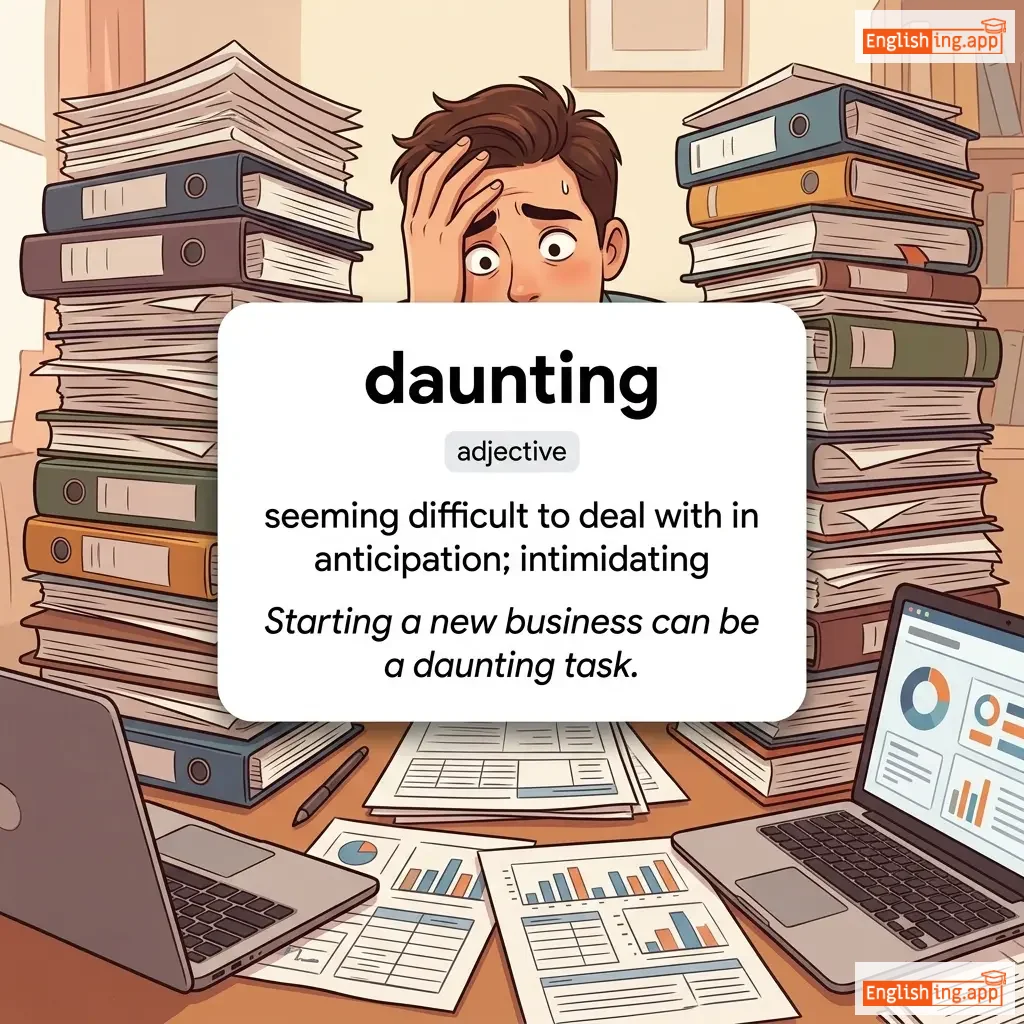
daunting definition card — visual illustration of the meaning
adjective
/ˈdɔːntɪŋ/
令人生畏 (lìng rén shēng wèi)

seeming difficult to deal with in anticipation; intimidating

"Starting a new business can be a daunting task."
"开始新业务可能是一个令人生畏的任务。" (Kāishǐ xīn yèwù kěnéng shì yīgè lìng rén shēng wèi de rènwù.)
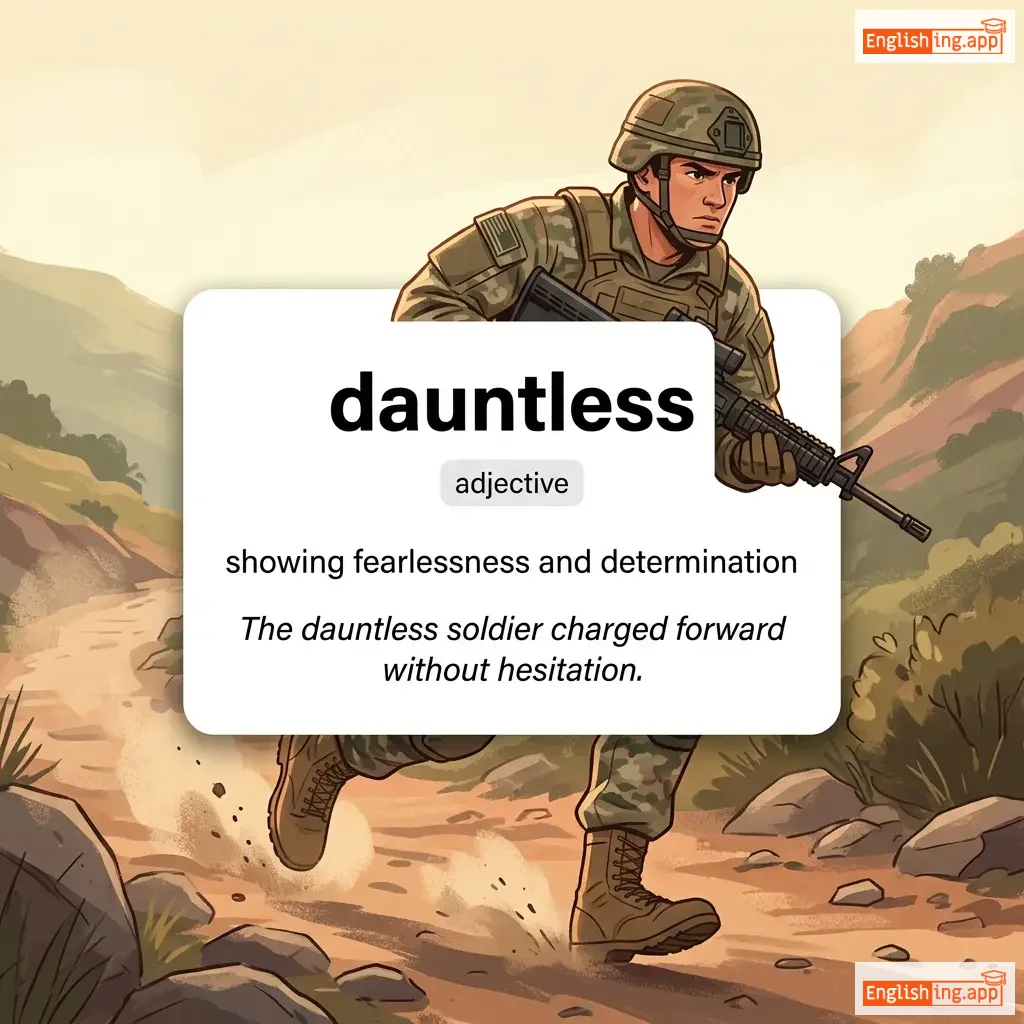
dauntless definition card — visual illustration of the meaning
adjective
/ˈdɔːntləs/
无畏 (wú wèi)

showing fearlessness and determination

"The dauntless soldier charged forward without hesitation."

"无畏的士兵毫不犹豫地向前冲。" (Wú wèi de shì bīng háo bù yóu yù de xiàng qián chōng.)
verb
/ˈdɔːd(ə)l/
拖延 (tuōyán)

to waste time by being slow or idle

"Stop dawdling and finish your homework."

"停止拖延,完成你的作业。" (Tíngzhǐ tuōyán, wánchéng nǐ de zuòyè.)
noun, verb
/dɔːn/
黎明 (liming)

The first appearance of light in the sky before sunrise; to begin or become apparent.

"Hope began to dawn in her heart after hearing the good news."

"在听到好消息后,希望在她的心中开始黎明。" (Zai tingdao hao xiaoxi hou, xiwang zai ta de xinzhi kaishi liming.)
Day definition card — visual illustration of the meaning
noun
/deɪ/
(tian)

a period of 24 hours or the time between sunrise and sunset

"She enjoyed a relaxing day at the beach."

"她在海滩上度过了一个轻松的日子。" (Ta zai haitan shang duoguo le yige qingsong de tianzi.)
noun
/ˈdeɪ.mæn/
日工 (rì gōng)

a worker employed by the day; a day laborer

"The farmer hired a day-man to help with the harvest."

"农民雇佣了一个日工来帮助收割。" (nóngmín gùyōng le yīgè rì gōng lái bāngzhù shōugē.)
noun
/ˈdeɪˌbreɪk/
黎明 (liming)

The time in the morning when daylight first appears; dawn.

"They set out on their journey at daybreak."

"他们在黎明时分开始了他们的旅程。" (Tāmen zài límíng shífēn kāishǐle tāmen de lǚchéng.)
noun
/deɪz/
天数 (tianshu)

plural of day; refers to multiple 24-hour periods of time

"The project will take at least five days to finish."

"这个项目将需要至少五天才能完成。" (Zhege xiangmu jiang xuyao zhishao wu tian cai neng wancheng.)
😵

daze

verb
/deɪz/

to stun or confuse someone temporarily with a shock or surprise

"The bright lights dazed the runners as they entered the stadium."

verb
/ˈdæzəl/
使目眩 (shǐ mùxuàn)

to impress deeply or blind with brilliance or skill

"The magician's tricks dazzled the audience."

"魔术师的把戏使观众眼花缭乱。" (Móshù shī de bǎxì shǐ guānzhòng yǎnhuā liáo luàn.)
adjective
/ˈdæz.lɪŋ/
耀眼的; 令人印象深刻的 (yàoyǎn de; lìng rén yìnxiàng shēnkè de)

extremely bright and impressive; brilliant and stunning

"The dazzling lights of the city amazed the tourists."

"城市的耀眼灯光让游客感到惊讶。" (Chéngshì de yàoyǎn dēngguāng ràng yóukè gǎndào jīngyà.)
adjective, noun
/dɛd/
死的 (si de)

No longer alive; the end of life.

"The old tree is completely dead."

"那棵老树已经完全死了。" (Na ke lao shu yijing wanquan si le.)