词汇表

英语词汇词典 | 单词含义、定义和示例

adjective
/fɪəs/
凶猛,强烈 (xiōngměng, qiángliè)

showing strong, intense, or aggressive feelings; powerful and violent

"The fierce storm damaged several houses in the village."

"猛烈的风暴摧毁了村庄中的几座房屋。" (Ménliè de fēngbào cuīhuǐle cūnzhuāng zhōng de jǐ zuò fángwū.)
adjective
/ˈfaɪə.ri/
火热的; 激情的; 暴躁的 (huǒrè de; jīqíng de; bàozào de)

burning; passionate; hot-tempered; showing strong emotion

"She has a fiery temper that flares up quickly."

"她有一个火热的脾气,容易迅速发火。" (Tā yǒu yīgè huǒrè de píqì, róngyì xùnsù fāhuǒ.)
1️⃣5️⃣

fifteen (fifteen)

number
/ˌfɪfˈtiːn/
十五 (shi wu)

the number 15

"There are fifteen students in the class."

"班里有十五个学生。" (Ban li you shi wu ge xuesheng.)
adjective
/fɪfθ/
第五 (di wu)

constituting number five in a sequence

"She lives on the fifth floor of the building."

"她住在大楼的第五层。" (Ta zhu zai dalou de di wu ceng.)
5️⃣0️⃣

fifty (fifty)

number
/ˈfɪfti/
五十 (wu shi)

the number 50

"The stadium can hold fifty thousand people."
"体育场可以容纳五万人。" (Tiyuchang keyi rongna wuwan ren.)
noun
/fɪɡ/
无花果 (wuhua guo)

a soft sweet fruit with many small seeds, eaten fresh or dried

"Fresh figs are delicious when eaten with honey."

"新鲜的无花果配蜂蜜吃非常美味。" (xinxian de wuhua guo pei fengmi chi feichang meiwei)
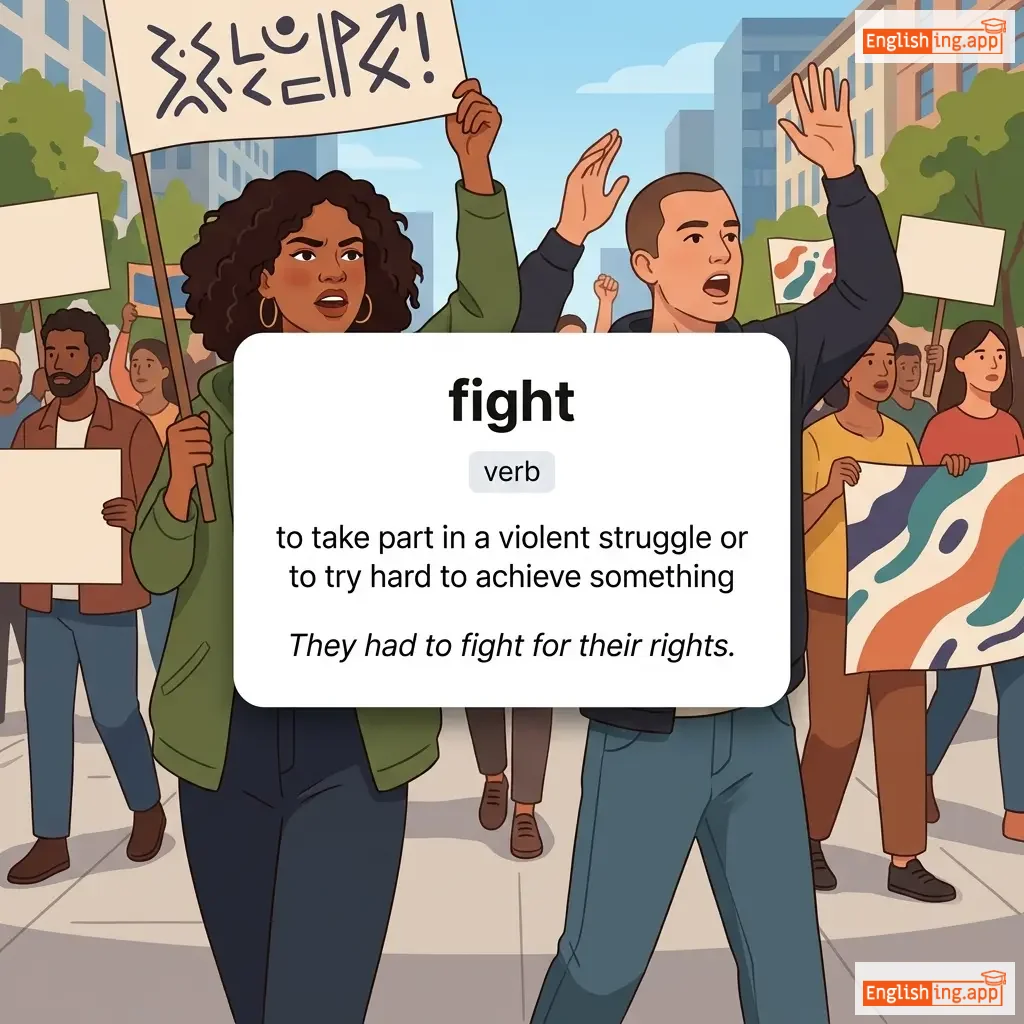
fight definition card — visual illustration of the meaning
verb
/faɪt/
打斗 (da dou)

to take part in a violent struggle or to try hard to achieve something

"They had to fight for their rights."

"他们必须为自己的权利而战。" (Tamen bixu wei ziji de quanli er zhan.)
noun
/ˈfaɪtər/
战士 (zhanshi)

a person who fights, especially in combat or sports like boxing

"The fighter won the championship after a tough battle."

"战士在激烈的战斗后赢得了冠军。" (Zhanshi zài jīliè de zhàndòu hòu yíngdéle guànjūn.)
noun/verb
/ˈfaɪtɪŋ/
战斗 (zhàn dòu)

the act of engaging in a physical or verbal conflict

"The soldiers were fighting bravely on the battlefield."

"士兵们在战场上英勇作战。" (Shìbīng men zài zhànchǎng shàng yīngyǒng zuòzhàn.)
noun
/ˈfɪɡmənt/
虚构,想象 (xugou, xiangxiang)

something invented or imaginary; a fabrication of the mind

"The story of the haunted house is just a figment of her imagination."

"鬼屋的故事只是她想象的产物。" (Guiwu de gushi zhishi ta xiangxiang de chanwu.)
adjective
/ˈfɪɡərətɪv/
比喻的 (bǐyù de)

not literal; using figures of speech or symbolic representation

"She used figurative language to describe her feelings."

"她用比喻的语言来描述她的感受。" (Tā yòng bǐyù de yǔyán lái miáoshù tā de gǎnshòu.)
noun
/ˈfɪɡjər/
数字, 形状, 重要人物 (shuzi, xingzhuang, zhongyao renwu)

a number, shape, or person of importance; also a representation in drawing or sculpture

"The report included several important figures."

"报告中包含了几个重要的人物。" (Baogao zhong baokuo le jige zhongyao de renwu.)
noun
/ˈfɪɡjərˌhɛd/
象征性领导 (xiangzhengxing lingdao)

a nominal leader with no real power; a symbolic head

"The king was merely a figurehead with no real authority."

"国王只是一个没有实权的象征性领袖。" (Guowang zhishi yi ge mei you shiji quanli de xiangzhengxing lingdao.)
noun
/ˌfɪɡjʊˈriːn/
小型装饰雕像 (xiaoxing zhuangshi diaoxiang)

a small ornamental statue or model of a human or animal

"She bought a porcelain figurine of a dancing ballerina."

"她买了一尊舞蹈芭蕾舞者的瓷雕像。" (Ta mai le yi zun wudao balewuzhe de cidiaoxiang.)
🕵️‍♂️

filch (菲尔奇)

verb
/fɪltʃ/
(tou)

to steal something in a sneaky or petty way

"He tried to filch a candy bar from the shop."

"他试图从商店偷一块糖果。" (Ta shitu cong shangdian tou yi kuai tangguo.)
File definition card — visual illustration of the meaning
📂

File

noun/verb
/faɪl/

a collection of documents stored together; or to submit an official document

"She saved the report in a new file on her computer."

👨‍👩‍👧

filial (filiǎl)

adjective
/ˈfɪliəl/
与儿子或女儿有关;表现出对父母的尊重或爱 (yǔ érzi huò nǚ'ér yǒuguān; biǎoxiàn chū duì fùmǔ de zūnzhòng huò ài)

relating to a son or daughter; showing respect or affection toward parents

"He showed filial respect by caring for his aging parents."
"他通过照顾年迈的父母展示了孝顺。" (Tā tōngguò zhàogù niánmài de fùmǔ zhǎnshìle xiàoshùn.)
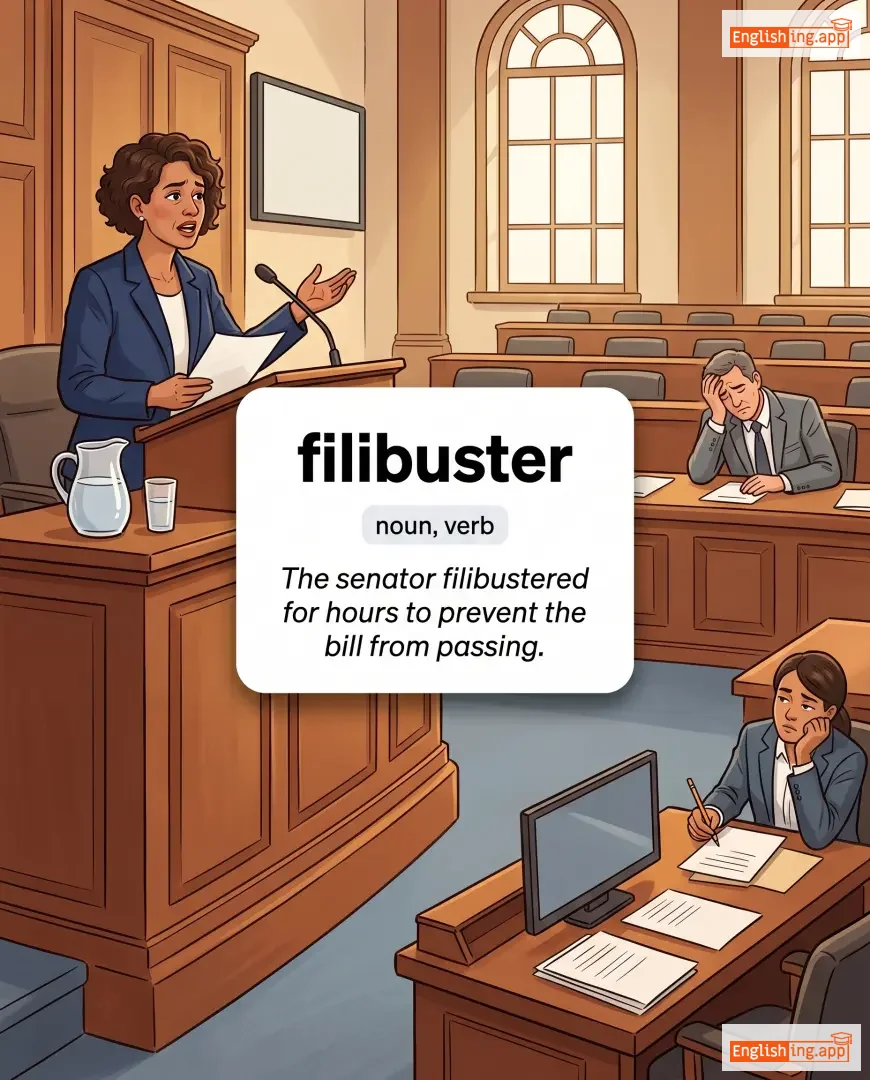
filibuster definition card — visual illustration of the meaning
noun, verb
/ˈfɪlɪˌbʌstər/
通过长时间演讲延迟立法行动的策略;使用这种策略 (tongguo changshijian yanjiang yanchi lifa xingdong de celue; shiyong zhezhong celue)

a tactic of delaying legislative action by prolonged speech; to use such a tactic

"The senator filibustered for hours to prevent the bill from passing."

"参议员费利巴斯特了几个小时,以阻止该法案通过。" (Canliyuan feilibasite le ji ge xiaoshi, yi zhuzhi gai fabiao tongguo.)
noun
/ˈfɪlɪɡri/
精致的装饰工艺,通常由金或银制成 (jingzhi de zhuāngshì gōngyì, tōngcháng yóu jīn huò yín zhìchéng)

delicate ornamental work of fine wire, usually of gold or silver

"The necklace was decorated with intricate gold filigree."

"项链上装饰着精致的金质镶嵌工艺。" (Xiàngliàn shàng zhuāngshì zhe jīngzhì de jīnzhì xiāngqiàn gōngyì.)
noun, verb
/ˈfaɪlɪŋ/
提交文件; 整理文件 (tíjiāo wénjiàn; zhěnglǐ wénjiàn)

the act of submitting documents; the process of organizing papers

"The lawyer handled the filing of all court documents."

"律师处理了所有法院文件的提交。" (Lǜshī chǔlǐle suǒyǒu fǎyuàn wénjiàn de tíjiāo.)
fill definition card — visual illustration of the meaning
verb
/fɪl/
填充 (tiánchōng)

To make something full; occupy completely.

"She filled the glass with water."

"她把杯子装满了水。" (Tā bǎ bēizi zhuāng mǎn le shuǐ.)
noun
/ˈfɪli/
小母马 (xiǎo mǔ mǎ)

a young female horse

"The filly ran swiftly across the meadow."

"这匹小母马在草地上跑得很快。" (Zhè pǐ xiǎo mǔ mǎ zài cǎo dì shàng pǎo dé hěn kuài.)
noun/verb
/fɪlm/
电影 (dianying)

a motion picture or movie; or to record on camera

"They watched a film together on the weekend."

"他们在周末一起观看了一部电影。" (Tamen zai zhoumo yiqi guankanle yi bu dianying.)
noun
/fɪlm ˈæktər/
电影演员 (dianying yanyuan)

A person who performs roles in movies or films.

"The film actor received widespread acclaim for his performance."

"这位电影演员因其出色的表演而获得广泛赞誉。" (Zhe wei dianying yanyuan yin qi chuse de biaoyan er huode guangfan zanyu)
noun
/ˈfɪlmˌmeɪkər/
电影制作人 (dianying zhizuo ren)

A person who directs or produces films

"The film-maker received an award for his latest documentary."

"电影制作人因他最新的纪录片获得了奖项。" (Dianying zhizuo ren yin ta zui xin de jilupian huode le jiangxiang.)
noun
/ˈfɪlmˌmeɪkər/
电影制作人 (dianying zhizuo ren)

a person who makes films, typically as a profession

"He is a well-known filmmaker in the industry."

"他是业内著名的电影制作人。" (Ta shi yne zhuming de dianying zhizuoren.)
verb
/ˈfɪltər/
过滤 (guòlǜ)

to pass a substance through a device to remove unwanted material or to selectively pass certain items

"She used a coffee filter to separate the grounds from the liquid."

"她用咖啡过滤器将咖啡渣和液体分开。" (Tā yòng kāfēi guòlǜqì jiāng kāfēi zhā hé yè tǐ fēnkāi.)
noun
/fɪlθ/
肮脏 (angzang)

dirty or disgusting matter; moral corruption

"The streets were full of filth after the storm."

"暴风雨后街道上满是肮脏。" (Baofengyu hou jiedao shang man shi angzang.)
verb
/fɪˈneɪɡəl/
通过聪明或欺骗得到某物 (tongguo congming huo qipian dedao mouwu)

to obtain something by cleverness or trickery

"He finagled a free ticket by pretending to be a VIP guest."
"他通过假装是VIP客人来获得了一张免费票。" (Ta tongguo jiazhuang shi VIP keren lai huode le yi zhang mianfei piao.)
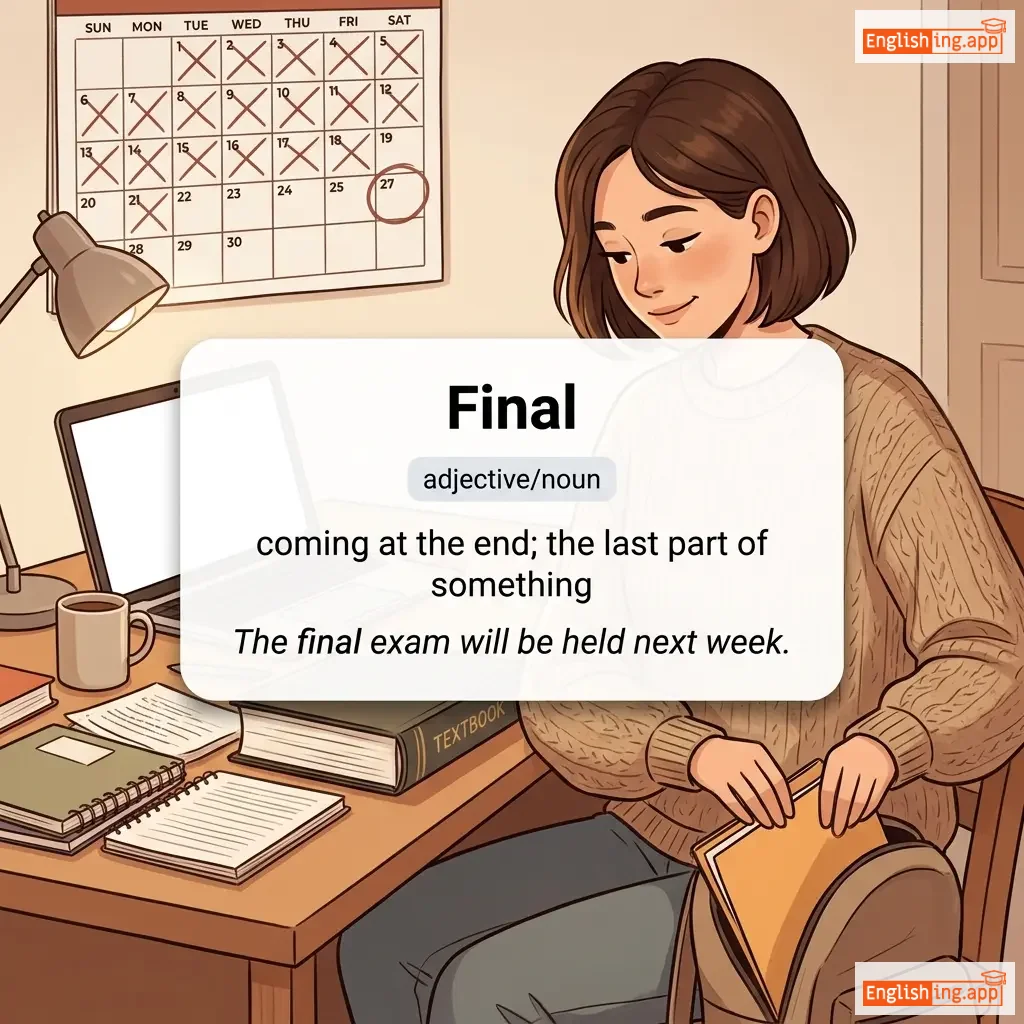
Final definition card — visual illustration of the meaning
adjective/noun
/ˈfaɪnəl/
最终 (zuihou)

coming at the end; the last part of something

"The final exam will be held next week."

"期末考试将在下周进行。" (Qimo kaoshi jiang zai xia zhou jinxing.)
noun
/fɪˈnɑːleɪ/
结尾 (jiewei)

the last part or conclusion of a performance, event, or series

"The concert ended with a spectacular finale."

"音乐会以一个壮观的菲纳尔结束。" (Yinyuehui yi yige zhuangguang de final jie shu.)
noun
/faɪˈnælɪti/
最终性 (zuìzhōng xìng)

the quality of being final or irreversible; a sense of conclusiveness

"The judge's decision gave the case a sense of finality."

"法官的决定赋予案件一种最终性的感觉。" (Fǎguān de juédìng fùyǔ ànjiàn yī zhǒng zuìzhōng xìng de gǎnjué.)
finalize definition card — visual illustration of the meaning
verb
ˈfaɪ.nəl.aɪz
最终确定 (zuìzhōng quèdìng)

To complete arrangements for something; put into final form.

"The treaty was finalized after the discussions."

"协议在讨论后最终确定。" (Xiéyì zài tǎolùn hòu zuìzhōng quèdìng.)
adverb
/ˈfaɪnəli/
终于 (zhōng yú)

after a long time; at the end; ultimately

"After years of hard work, she finally achieved her dream."

"经过多年的努力工作,她终于实现了她的梦想。" (Jīng guò duō nián de nǔ lì gōng zuò, tā zhōng yú shí xiàn le tā de mèng xiǎng.)
finance definition card — visual illustration of the meaning
noun, verb
/ˈfaɪ.næns/ or /fəˈnæns/
金融 (jinrong)

the management of money and investments, or to provide funds for something

"The company secured finance from a major bank."

"公司从一家大银行获得了融资。" (Gongsi cong yijia da yinhang huodele rongzi.)
adjective
/faɪˈnænʃəl/
金融的 (jinrong de)

relating to money, banking, or finance

"He made a sound financial decision by investing wisely."

"他通过明智的投资做出了稳健的金融决策。" (Ta tongguo mingzhi de touzi zuo chule wenjian de jinrong juece.)
financial responsibility definition card — visual illustration of the meaning
noun
/faɪˈnæn.ʃəl rɪˌspɒn.sɪˈbɪl.ə.ti/
财务责任 (caiwu ze ren)

The practice of managing money and other financial resources in a responsible and effective manner.

"Financial responsibility ensures long-term economic stability."

"财务责任确保长期的经济稳定。" (Caiwu ze ren quebao changqi de jingji wen ding.)
noun
/fɪˈnænʃɪər/
金融家 (jin rong jia)

a person who manages large amounts of money or investments

"The financier advised the company on its investments."

"金融家为公司提供了关于投资的建议。" (Jin rong jia wei gong si ti gong le guan yu tou zi de jian yi.)
noun
/fɪntʃ/
雀鸟(小型歌唱鸟) (que niao (xiaoxing gechang niao))

a small songbird with a short, stout bill

"A colorful finch perched on the branch singing sweetly."

"一只五彩斑斓的雀鸟栖息在树枝上,甜美地唱着歌。" (Yī zhī wǔ cǎi bān lán de què niǎo qīxī zài shù zhī shàng, tián měi de chàng zhe gē.)
find definition card — visual illustration of the meaning
verb
/faɪnd/
找到 (zhǎodào)

to discover something or someone after searching

"She managed to find her lost keys under the couch."

"她成功地在沙发下找到了丢失的钥匙。" (Tā chénggōng de zài shāfā xià zhǎodào le diūshī de yàoshi.)
noun
/ˈfaɪn.dɪŋ/
发现,经过调查后得出的结论或结果 (faxian, jingguo diaocha hou de chuluo huo jieguo)

a discovery, conclusion, or result reached after investigation

"The scientist published her findings in a leading journal."

"科学家在一家领先的期刊上发布了她的发现。" (Kexuejia zai yijia liding de qikan shang fabu le ta de faxian.)
adjective, noun, verb
/faɪn/
幸福 (xìng fú)

of high quality; very good, or a penalty for breaking a law

"She paid a fine for parking in the wrong place."

"她在获得奖项时无法掩饰自己的快乐。" (Tā zài huòdé jiǎngxiàng shí wúfǎ yǎnshì zìjǐ de kuàilè.)
noun
/ˈfaɪnəri/
昂贵或精致的衣服 (ángguì huò jīngzhì de yīfú)

expensive or elaborate clothes, decorations, or accessories

"She attended the party in her finest finery."
"她穿着最好的衣服参加了聚会。" (Tā chuānzhuó zuì hǎo de yīfú cānjiā le jùhuì.)
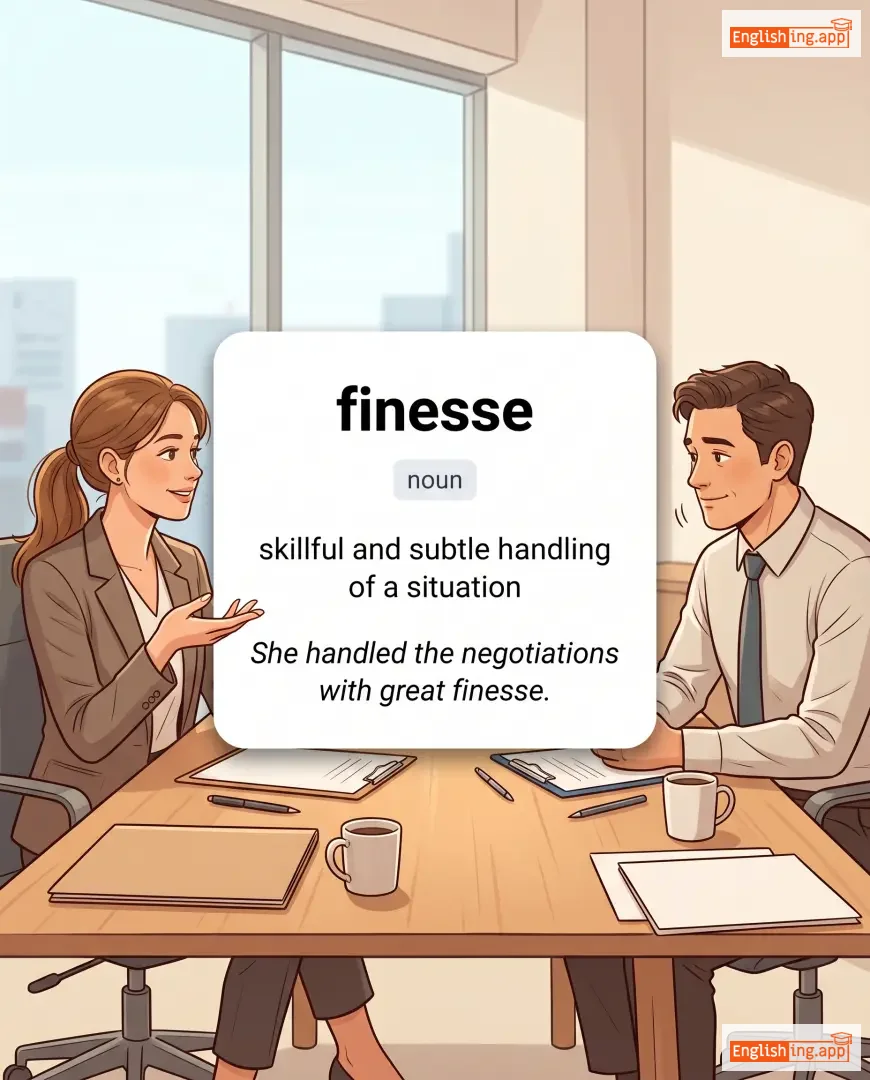
finesse definition card — visual illustration of the meaning
noun
/fɪˈnɛs/
技巧, 微妙 (jiqiao, weimiao)

skillful and subtle handling of a situation

"She handled the negotiations with great finesse."

"她以极大的技巧处理了谈判。" (Ta yi jida de jiqiao chuli le tanpan.)
noun
/ˈfɪŋ.ɡər/
手指 (shǒuzhǐ)

one of the five long parts of the hand

"He wore a gold ring on his finger."

"他戴着一枚金戒指在手指上。" (Tā dàizhe yī méi jīn jièzhǐ zài shǒuzhǐ shàng.)
noun
/ˈfɪŋ.ɡər.prɪnt/
指纹 (zhǐwén)

an impression or mark made on a surface by a person's fingertip; unique identification pattern

"The police found his fingerprints on the door handle at the crime scene."

"警方在犯罪现场的门把手上找到了他的指纹。" (Jǐngfāng zài fànzuì xiànchǎng de mén bǎshǒu shàng zhǎodàole tā de zhǐwén.)
adjective
/ˈfɪnɪki/
难以取悦; 对细节非常挑剔 (nan yi qu yue; dui xi jie fei chang tiao ti)

difficult to please; very particular about details

"He is so finicky about his food that he only eats organic vegetables."

"他对食物要求如此挑剔,甚至只吃有机蔬菜。" (Ta dui shiwu yaoqiu ruci tiao ti, shenzhi zhi chi youji shucai.)
finish definition card — visual illustration of the meaning
verb
/ˈfɪnɪʃ/
完成 (wánchéng)

to complete or bring to an end

"She will finish her homework before dinner."

"她会在晚餐前完成作业。" (Tā huì zài wǎncān qián wánchéng zuòyè.)
noun
/ˈfɪnɪʃ laɪn/
终点线 (zhongdian xian)

The line or point at the end of a race or competition where participants complete it.

"She sprinted towards the finish line and won the race."

"她冲向终点线并赢得了比赛。" (Ta chong xiang zhongdian xian bing yingde le bisai.)
adjective
/ˈfɪnɪʃt/
完成, 结束 (wánchéng, jiéshù)

completed or brought to an end

"The painting is finished and ready to display."

"这幅画已经完成,准备展示。" (Zhè fú huà yǐjīng wánchéng, zhǔnbèi zhǎnshì.)