词汇表

英语词汇词典 | 单词含义、定义和示例

noun
/ˌfɜːrmənˈteɪʃən/
发酵,酵母或细菌的化学变化 (fajiào, jiàomǔ huò xìjūn de huàxué biànhuà)

a chemical process by which substances like sugar are converted into alcohol or acids using microorganisms

"The fermentation of grapes produces wine."

"葡萄的发酵产生葡萄酒。" (Pútáo de fājiào chǎnshēng pútáojiǔ.)
noun
/ˈfɜːrnəri/
蕨类植物培育园,培养蕨类植物的地方 (jue lei zhi wu pei yu yuan, peiyang jue lei zhi wu de difang)

a place or greenhouse where ferns are cultivated

"The garden's fernery was full of exotic plants."

"花园的蕨类植物培育园里充满了异国植物。" (Huayuan de jue lei zhi wu peiyu yuan li chongman le yiguo zhiwu.)
adjective
/fəˈroʊʃəs/
凶猛, 暴力, 侵略性 (xiōngměng, bào lì, qīnlüèxìng)

savagely fierce, intense, or violent

"The tiger gave a ferocious roar."
"老虎发出了凶猛的咆哮。" (Lǎohǔ fāchūle xiōngměng de páoxiào.)
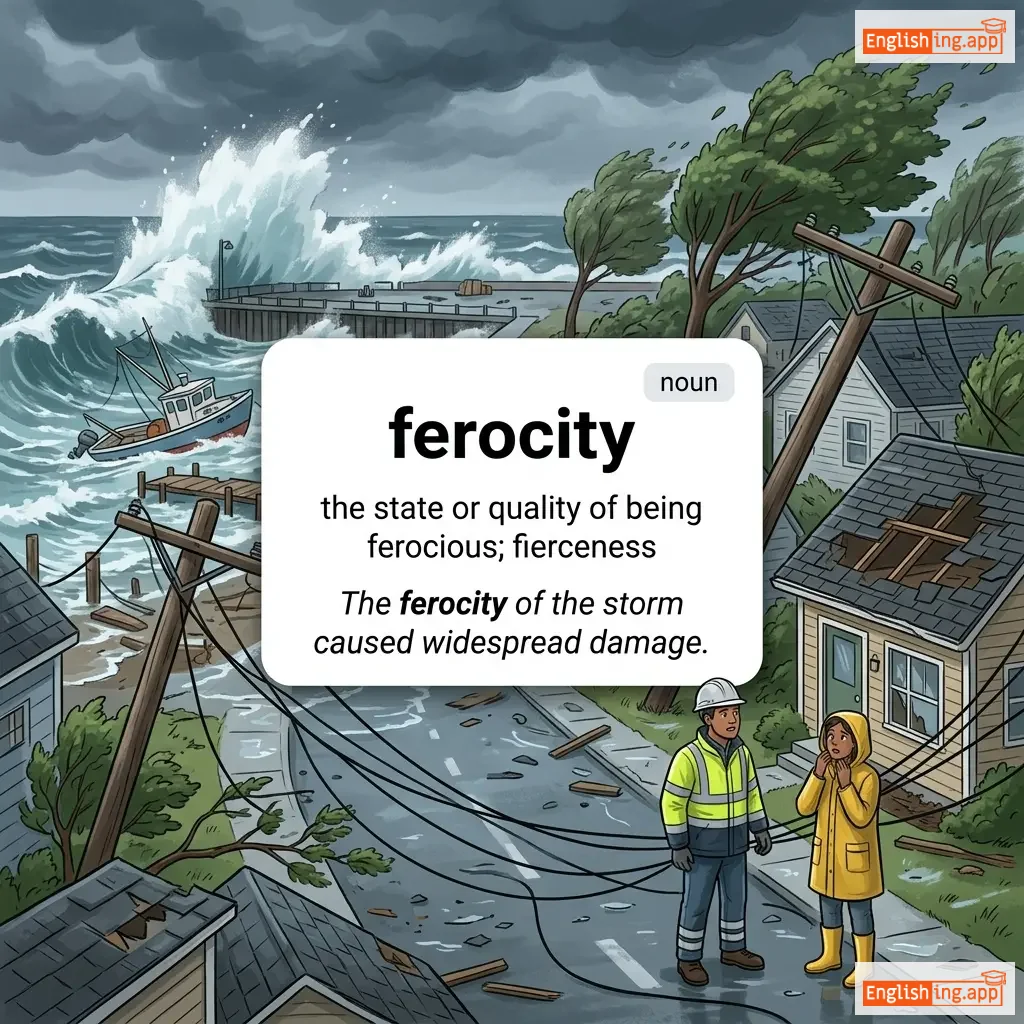
ferocity definition card — visual illustration of the meaning
noun
/fəˈrɒsəti/
残忍, 激烈, 凶猛 (cánrěn, jīliè, xiōngměng)

the state or quality of being ferocious; fierceness

"The ferocity of the storm caused widespread damage."

"暴风雨的猛烈造成了广泛的破坏。" (Bàofēngyǔ de miǎnliè zàochéngle guǎngfàn de pòhuài.)
noun, verb
/ˈfɛrɪt/
雪貂, 坚持不懈地寻找或发现某物 (xuědiāo, jiānchí bùxiè de xúnzhǎo huò fāxiàn mǒuwù)

a small domesticated animal used for hunting; to search or uncover something persistently

"He ferreted out the hidden documents."

"他发现了隐藏的文件。" (Tā fāxiànle yǐncáng de wénjiàn.)
adjective
/ˈfer.əs/
含铁的 (hán tiě de)

containing or consisting of iron

"Ferrous metals are commonly used in construction."

"铁金属常用于建筑中。" (Tiě jīnshǔ cháng yòng yú jiànzhú zhōng.)
verb
/ˈfɛri/
渡船运输 (dùchuán yùnshū)

to transport by boat; to carry back and forth

"The boat ferried passengers across the river."

"船把乘客运过了河。" (Chuán bǎ chéngkè yùn guòle hé.)
noun
/ˈfer.i boʊt/
渡船 (dùchuán)

a boat that carries passengers and vehicles across water

"We took the ferry-boat to cross the river."

"我们坐渡船过河。" (wǒmen zuò dùchuán guò hé.)
adjective
/ˈfɜːr.taɪl/
肥沃 (feiwo)

capable of producing abundant vegetation or offspring

"The fertile soil yielded a bountiful harvest."

"肥沃的土壤产生了丰收的作物。" (Feiwo de turang chanshengle fengshou de zuowu.)
fertility definition card — visual illustration of the meaning
noun
/fərˈtɪl.ə.ti/
生育能力 (shengyu nengli)

the ability to conceive children or young; the quality of being fertile

"Modern medicine has helped many couples overcome fertility problems."
"现代医学帮助许多夫妇克服了生育问题。" (Xiandai yixue bangzhu xuduo fufu kefu le shengyu wenti.)
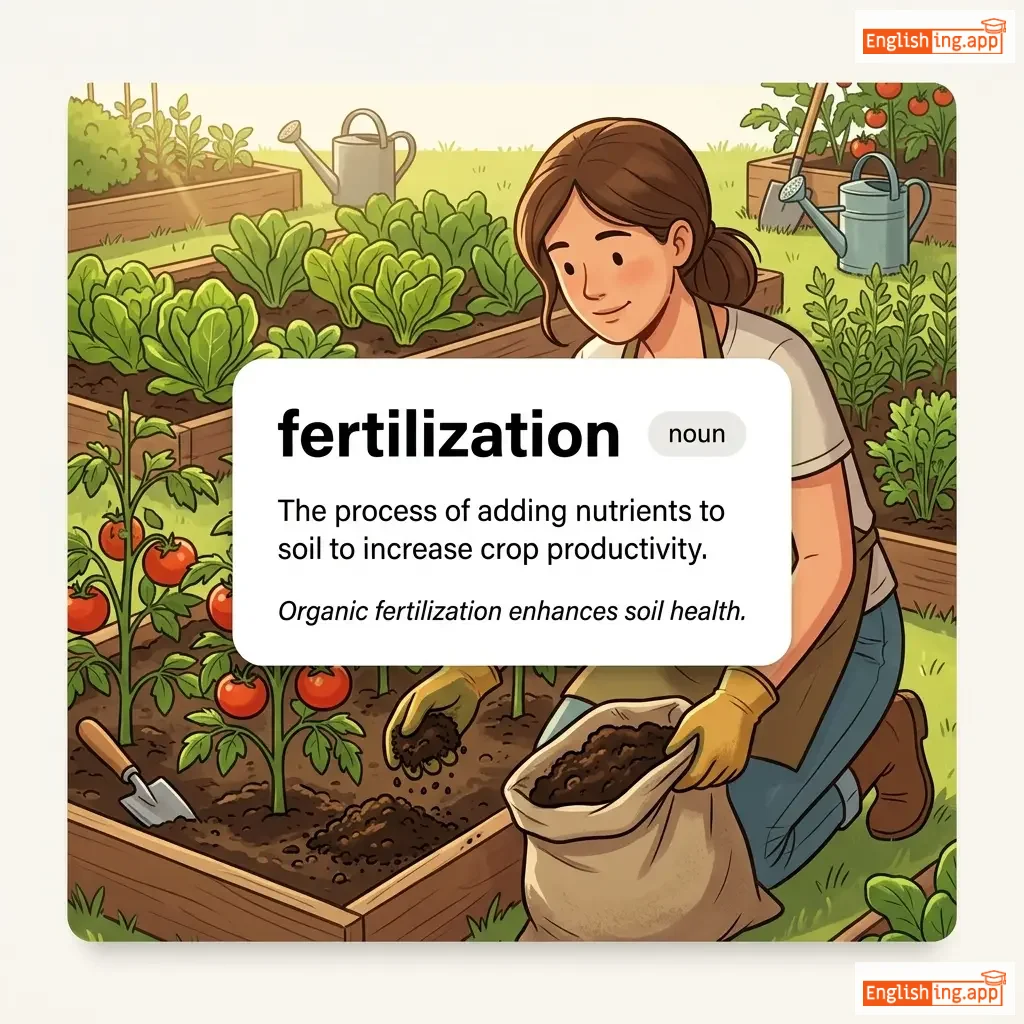
fertilization definition card — visual illustration of the meaning
noun
ˌfɜːr.tɪ.laɪˈzeɪ.ʃən
施肥 (shifei)

The process of adding nutrients to soil to increase crop productivity.

"Organic fertilization enhances soil health."

"有机施肥有助于改善土壤健康。" (Youji shifei youzhu yu gaishan turang jiankang.)
verb
/ˈfɜːr.tɪ.laɪz/
施肥 (shīféi)

to make soil or land more fertile by adding substances

"Farmers fertilize the fields to increase crop yield."
"农民施肥以增加作物产量。" (Nóngmín shīféi yǐ zēngjiā zuòwù chǎnliàng.)
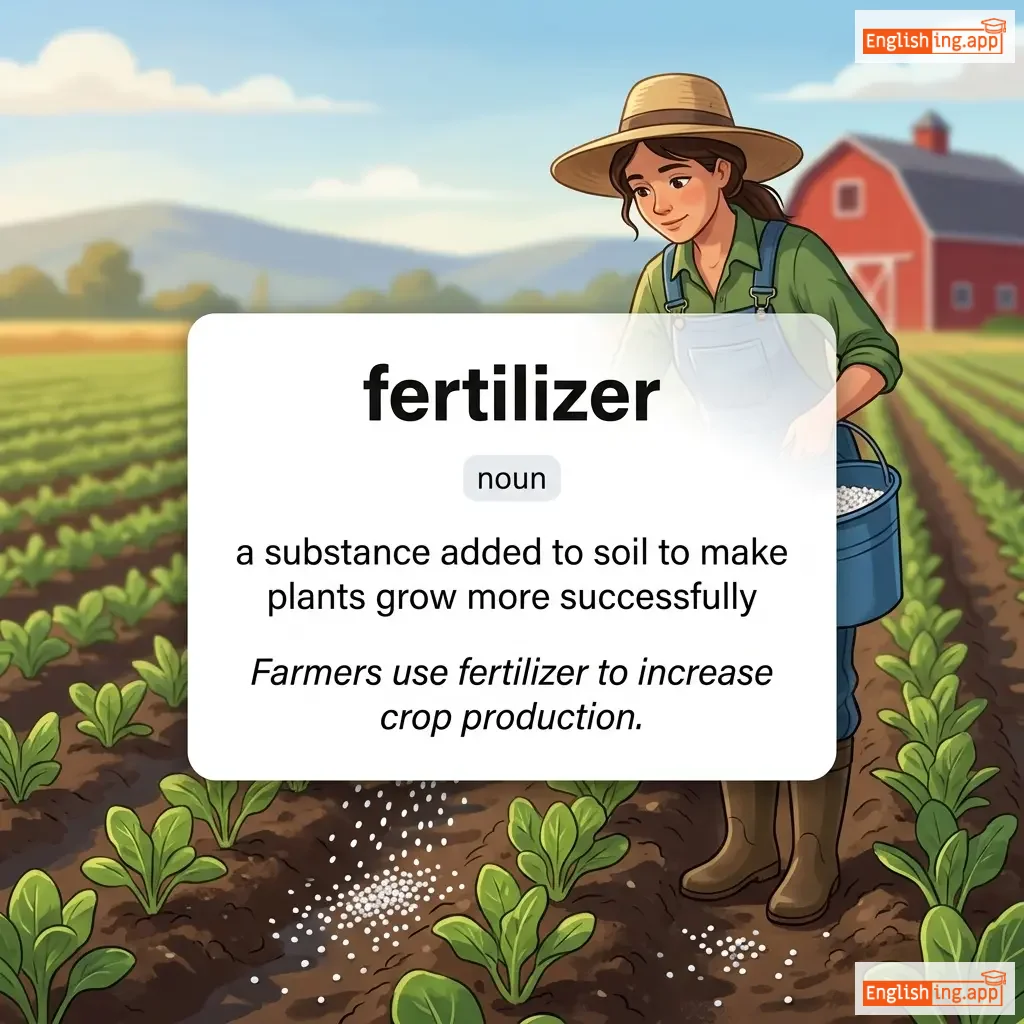
fertilizer definition card — visual illustration of the meaning
noun
/ˈfɜː.tɪ.laɪ.zər/
肥料 (feiliao)

a substance added to soil to make plants grow more successfully

"Farmers use fertilizer to increase crop production."

"农民使用肥料来提高作物产量。" (Nóngmín shǐyòng féiliào lái tígāo zuòwù chǎnliàng.)
adjective
/ˈfɜːr.vənt/
热情的,激情四射的 (rèqíng de, jīqíng sì shè de)

having or showing intense passion or enthusiasm

"She gave a fervent speech about climate change."

"她发表了关于气候变化的热情演讲。" (Tā fābiǎo le guānyú qìhòu biànhuà de rèqíng yǎnjiǎng.)
adverb
/ˈfɜː.vənt.li/
热情地; 激情地; (rèqíng de; jīqíng de;)

with passionate intensity; ardently; with great emotion or enthusiasm

"She fervently hoped that her dreams would come true."

"她热情地希望她的梦想能成真。" (Tā rèqíng de xīwàng tā de mèngxiǎng néng chéng zhēn.)
adjective
/ˈfɜːr.vɪd/
激烈的, 热情的 (jīliè de, rèqíng de)

intensely passionate or enthusiastic

"He wrote a fervid letter expressing his love."

"他写了一封热情的信,表达了他的爱。" (Tā xiěle yī fēng rèqíng de xìn, biǎodále tā de ài.)
fervor definition card — visual illustration of the meaning
noun
/ˈfɜːrvər/
热情, 激情 (reqing, jiqing)

intense and passionate feeling

"She spoke with great fervor about the importance of education."

"她以极大的热情谈论教育的重要性。" (Ta yi jida de reqing tanlun jiaoyu de zhongyao xing.)
adjective
/ˈfɛstəl/
节日的,庆祝的 (jiérì de, qìngzhù de)

relating to a festival or celebration

"The hall was decorated in a festal manner for the wedding."

"婚礼的大厅被装饰得节日气氛十足。" (Hūnlǐ de dàtīng bèi zhuāngshì dé jiérì qìfēn shízú.)
verb
/ˈfɛstər/
恶化, 加剧 (èhuà, jiājù)

to become worse or more intense, often through neglect or infection

"If grievances are ignored, they may fester into resentment."
"如果不理会抱怨,它们可能会变成怨恨。" (Rúguǒ bù lǐhuì bàoyuàn, tāmen kěnéng huì biàn chéng yuànhèn.)
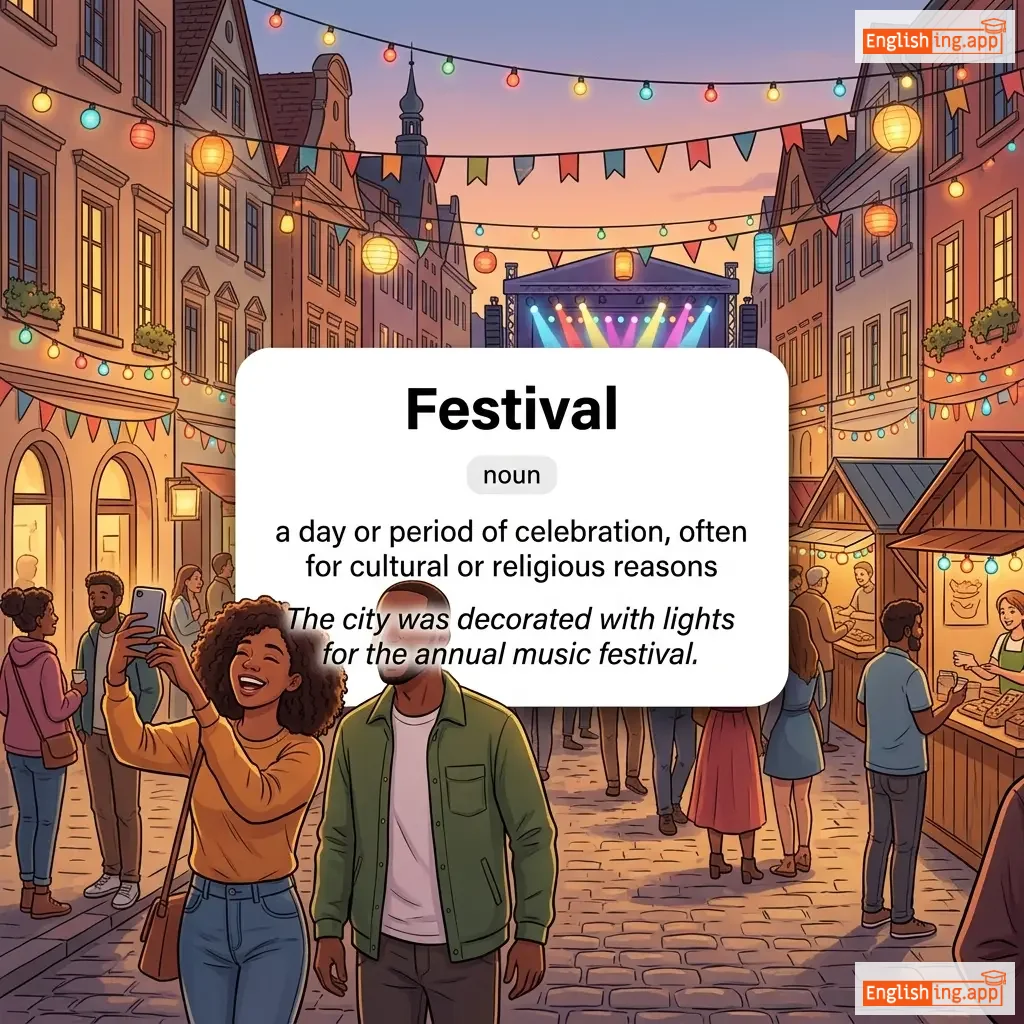
Festival definition card — visual illustration of the meaning
noun
/ˈfɛstəvəl/
节日 (jieri)

a day or period of celebration, often for cultural or religious reasons

"The city was decorated with lights for the annual music festival."

"为了年度音乐节,城市装饰了灯光。" (wèile niándù yīnyuè jié, chéngshì zhuāngshìle dēngguāng)
adjective
/ˈfɛstɪv/
节日的,欢乐的 (jieri de, huanle de)

joyful, celebratory, or suitable for a festival

"The streets were decorated with lights in a festive spirit."

"街道上装饰着灯光,充满节日的气氛。" (Jiedao shang zhuangshi zhe dengguang, chongman jieri de qifen.)
noun
/feɪt/
节日,庆典 (jie ri, qing dian)

a celebration or festival, often in honor of someone

"The village held a grand fete to celebrate the harvest."

"村庄举行了盛大的节日庆典来庆祝丰收。" (Cun zhuang ju xing le sheng da de jie ri qing dian lai qing zhu feng shou.)
noun
/ˈfetiʃ/
费蒂什 (feiti shi)

an object believed to have magical powers or to be inhabited by a spirit

"The villagers treated the statue as a powerful fetich."
"村民把雕像视为一个强大的费蒂什。" (Cūnmín bǎ diāoxiàng shì wéi yīgè qiángdà de fèi dì shí.)
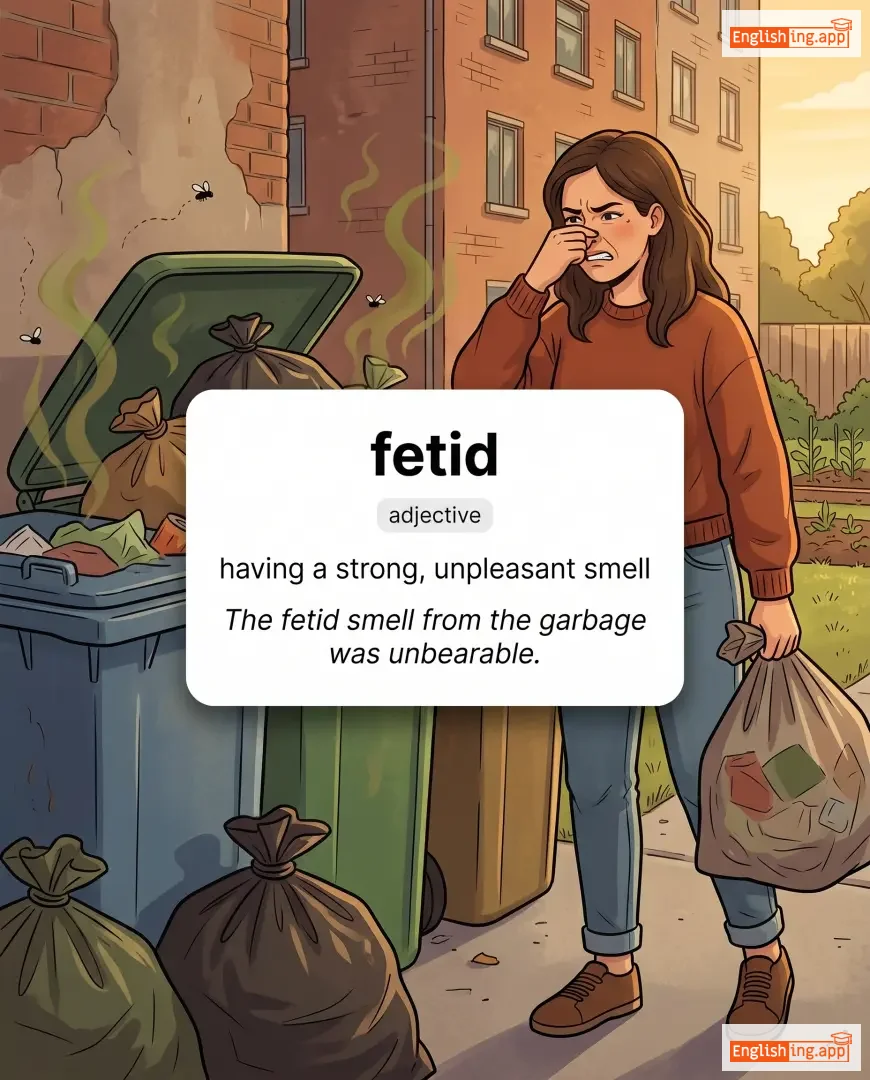
fetid definition card — visual illustration of the meaning
adjective
/ˈfɛtɪd/
有恶臭的,令人不快的 (you èchòu de, lìng rén bù kuài de)

having a strong, unpleasant smell

"The fetid smell from the garbage was unbearable."

"垃圾散发出的恶臭让人无法忍受。" (Laji sanfa chuchu de èchòu rang ren wufa renshou.)
noun
/ˈfɛtɪʃ/
过度或不理智的痴迷 (guò dù huò bù lǐ zhì de chī mí)

an excessive or irrational devotion to something

"He has a fetish for collecting rare stamps."

"他对收集稀有邮票有着一种痴迷。" (Tā duì shōu jí xī yǒu yóu piào yǒu zhe yī zhǒng chī mí.)
fetter definition card — visual illustration of the meaning
verb
/ˈfɛtər/
束缚,限制 (shùfù, xiànzhì)

to restrain or restrict someone’s freedom

"The strict rules fettered the creativity of the students."

"严格的规则限制了学生们的创造力。" (Yángé de guīzé xiànzhìle xuéshēngmen de chuàngzàolì.)
noun
/ˈfiːtəs/
胎儿 (tai'er)

an unborn or unhatched offspring in the womb or egg

"The doctor explained the development of the fetus during pregnancy."

"医生解释了胎儿在怀孕期间的发展。" (Yisheng jieshi le tai'er zai huaiyun qijian de fazhan.)
noun
/fjuːd/
争吵, 仇恨 (zhēngchǎo, chóuhèn)

a prolonged and bitter quarrel or conflict, often between families or groups

"The two families have been in a feud for generations."

"这两个家庭已经世代争斗。" (Zhè liǎng gè jiātíng yǐjīng shìdài zhēngdòu.)
adjective
/ˈfjuː.dəl/
封建的 (fengjian de)

relating to the system of feudalism, a medieval social system based on land ownership and obligations

"The castle is a remnant of the feudal era."

"城堡是封建时代的遗迹。" (Chengbao shi fengjian shidai de yiji.)
noun
/ˈfjuː.də.lɪ.zəm/
封建主义 (fengjian zhuyi)

the social system in medieval Europe in which people worked and fought for nobles who gave them protection and land in return

"Feudalism shaped the political structure of medieval Europe."

"封建主义塑造了中世纪欧洲的政治结构。" (Fēngjiàn zhǔyì sùzào le zhōng shìjì Ōuzhōu de zhèngzhì jiégòu.)
noun
/ˈfiːvər/
发烧 (fashao)

a medical condition in which the body temperature is higher than normal

"He couldn’t go to work because he had a high fever."

"他因高烧而不能上班。" (Ta yin gao shao er bu neng shang ban.)
adjective
/fjuː/
少数 (shaoshu)

A small number of; not many.

"Only a few students attended the class."

"只有少数学生参加了课堂。" (Zhǐyǒu shǎoshù xuéshēng cānjiāle kètáng.)
determiner/adjective
/ˈfjuːər/
更少 (gèng shǎo)

a smaller number of; not as many

"Fewer people attended the meeting than expected."

"参加会议的人数比预期的少。" (Cānjiā huìyì de rénshù bǐ yùqī de shǎo.)
noun
/fez/
费兹帽 (feizi mao)

a flat-topped conical red hat with a tassel, traditionally worn in some Middle Eastern countries

"He wore a traditional fez during the cultural festival."

"他在文化节期间戴着传统的费兹帽。" (Tā zài wénhuà jié qījiān dàizhe chuántǒng de fèizī mào.)
noun
/ˌfiː.ɑːnˈseɪ/
未婚夫 (weihunfu)

a man who is engaged to be married

"Sarah introduced her fiance to her parents during the family dinner."

"莎拉在家庭聚餐时向父母介绍了她的未婚夫。" (Shala zai jiating jucan shi xiang fumu jieshao le ta de weihunfu.)
noun
/ˌfiː.ɑːnˈseɪ/
未婚妻 (wei hun qi)

a woman who is engaged to be married

"John bought a beautiful engagement ring for his fiancee."

"约翰为他的未婚妻买了一枚漂亮的订婚戒指。" (Yuehan wei tā de wèihūnqī mǎile yī méi piàoliang de dìnghūn jièzhǐ.)
noun
/fiˈæs.koʊ/
彻底失败 (chèdǐ shībài)

a complete failure, especially a ludicrous or humiliating one

"The event turned into a complete fiasco due to poor planning."

"由于糟糕的规划,活动变成了彻底的失败。" (Yóuyú zāogāo de guīhuà, huódòng biànchéngle chèdǐ de shībài.)
fiat definition card — visual illustration of the meaning
noun
/ˈfiːæt/
法令,命令 (fǎlìng, mìnglìng)

an official order or decree; authoritative command

"The new policy was enacted by royal fiat."

"新政策通过皇帝的命令实施。" (Xīn zhèngcè tōngguò huángdì de mìnglìng shíshī.)
noun
/ˈfaɪbər/
纤维 (xianwei)

a thread or filament from which a textile is formed; dietary substance from plants that aids digestion

"Fruits and vegetables are high in fiber."

"水果和蔬菜富含纤维。" (Shuǐguǒ hé shūcài fùhán xiānwéi.)
noun
/ˈfaɪ.bər/
纤维 (xianwei)

A thread or filament from which a vegetable tissue, mineral substance, or textile is formed; dietary material that aids digestion.

"Eating foods rich in fibre can improve your digestion."

"食用富含纤维的食物可以改善消化。" (Shiyong fuhan xianwei de shiwu keyi gaishan xiaohua.)
adjective
/ˈfɪkəl/
多变的, 反复无常的 (duōbiàn de, fǎn fù wúcháng de)

changing frequently in loyalty, interest, or affection

"She is so fickle that she changes her mind every hour."

"她太多变了,每小时就改变一次主意。" (Tā tài duōbiàn le, měi xiǎoshí jiù gǎibiàn yīcì zhǔyì.)
noun
/ˈfɪkʃən/
虚构 (xūgòu)

Literature created from the imagination, not presented as fact.

"She enjoys reading science fiction novels."

"她喜欢阅读科幻小说。" (Tā xǐhuān yuèdú kēhuàn xiǎoshuō.)
adjective
/fɪkˈtɪʃəs/
虚构的, 假的 (xūgòu de, jiǎ de)

not real or true; imaginary or fabricated

"The story he told was entirely fictitious."

"他讲的故事完全是虚构的。" (Tā jiǎng de gùshì wánquán shì xūgòu de.)
fidelity definition card — visual illustration of the meaning
noun
/fɪˈdelɪti/
忠诚,忠实 (zhōngchéng, zhōngshí)

faithfulness to a person, cause, or belief; loyalty

"Their fidelity to the team was admired by everyone."

"他们对团队的忠诚受到了所有人的赞赏。" (Tāmen duì tuánduì de zhōngchéng shòudào le suǒyǒu rén de zànshǎng.)
verb
/ˈfɪdʒɪt/
坐立不安,焦虑不安 (zuò lì bù ān, jiāo lǜ bù ān)

to make small movements, especially because of nervousness or impatience

"The child began to fidget during the long lecture."

"孩子在漫长的讲座中开始不停地动。" (Háizi zài màncháng de jiǎngzuò zhōng kāishǐ bùtíng de dòng.)
adjective
/fɪˈdjuːʃəl/
信任的,作为参考标准的 (xìnrèn de, zuòwéi cān kǎo biāozhǔn de)

based on trust or confidence; serving as a standard of reference

"The fiducial point on the map ensures accurate measurements."

"地图上的菲杜西亚尔点确保了精确的测量。" (Dìtú shàng de fēi dù xī yà ěr diǎn quèbǎo le jīngquè de cèliáng.)
fiduciary definition card — visual illustration of the meaning
noun
/fɪˈduːʃieri/
受托人, 信托责任人 (shòu tuō rén, xìntuō zérèn rén)

a person who holds assets in trust for someone else; related to trust and responsibility

"The lawyer acted as a fiduciary for his client’s estate."

"律师担任客户财产的信托责任人。" (Lǜshī dānrèn kèhù cáichǎn de xìntuō zérèn rén.)
noun
/fiːf/
在封建制度下拥有的土地;一个控制区域或领域 (zai fengjian zhidu xia yongyou de tudi; yige kongzhi quyu huo lingyu)

an estate of land held under the feudal system; a domain or area of control

"The knight was granted a fief by the lord for his service."
"骑士因其服务而获得了领主授予的封地。" (Qishi yin qi fuwu er huodele lingzhu shouyu de fengdi.)
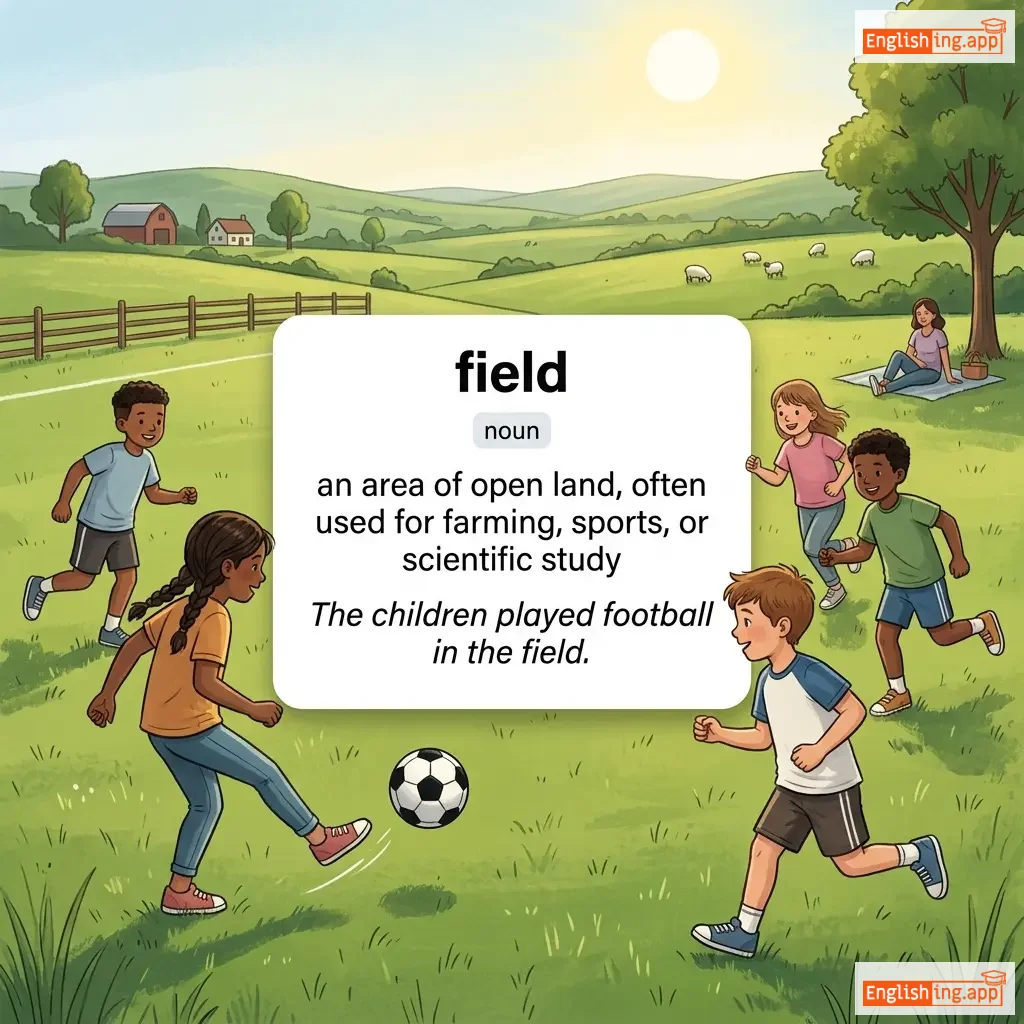
field definition card — visual illustration of the meaning
noun
/fiːld/
田野 (tian ye)

an area of open land, often used for farming, sports, or scientific study

"The children played football in the field."

"孩子们在田野上踢足球。" (Haizimen zai tianye shang ti zuqiu.)
noun
/fiːnd/
恶魔,邪恶的人 (è mó, xié è de rén)

an evil spirit or demon; a wicked or cruel person; someone obsessed with a particular thing

"He is a real fiend when it comes to solving puzzles."

"当涉及解谜时,他真的是个恶魔。" (Dāng shèjí jiě mí shí, tā zhēn de shì gè è mó.)